

Emotion Recognition from Multiband EEG Signals Using CapsNet
Open accessThe DOI matches its Crossref record; 45 of the 45 references it cites were found in a registry or an index.
Abstract
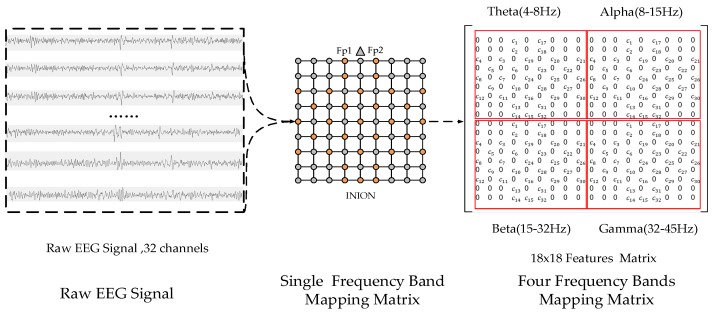
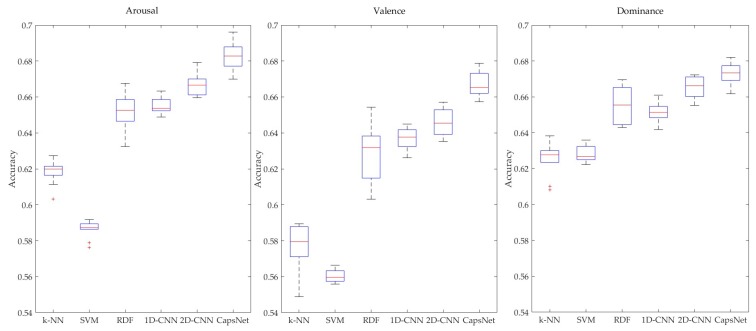
Emotion recognition based on multi-channel electroencephalograph (EEG) signals is becoming increasingly attractive. However, the conventional methods ignore the spatial characteristics of EEG signals, which also contain salient information related to emotion states. In this paper, a deep learning framework based on a multiband feature matrix (MFM) and a capsule network (CapsNet) is proposed. In the framework, the frequency domain, spatial characteristics, and frequency band characteristics of the multi-channel EEG signals are combined to construct the MFM. Then, the CapsNet model is introduced to recognize emotion states according to the input MFM. Experiments conducted on the dataset for emotion analysis using EEG, physiological, and video signals (DEAP) indicate that the proposed method outperforms most of the common models. The experimental results demonstrate that the three characteristics contained in the MFM were complementary and the capsule network was more suitable for mining and utilizing the three correlation characteristics.
Overview
The claims and statistics of this paper haven’t been checked yet.
Free: it reads the open-access text and checks the first 5 claims that cite a source we can check. Create a free account to check every claim.
Integrity signals
Registry
Cites
Statistics
Figures





Verification
Claims the paper makes
The claims and statistics of this paper haven’t been checked yet.
Free: it reads the open-access text and checks the first 5 claims that cite a source we can check. Create a free account to check every claim.
Self-check
Percentages, sums and reported differences re-computed from the paper’s own numbers.
The self-check needs the paper’s full text.
Citations
Cites
Scikit-learn: Machine Learning in Python
Pedregosa, F., Varoquaux, G., Gramfort, A., Michel, V., Thirion, B., Grisel, O., Blondel, M., Müller, A., Nothman, J., Louppe, G., et al. (2012) · arXiv · doi:10.48550/arxiv.1201.0490 · Cited by 71,016 · cited 2×
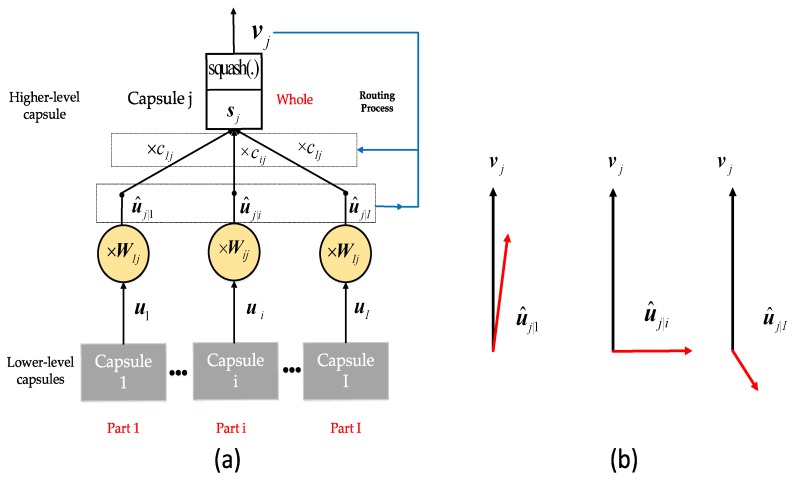
“To compensate for the shortcomings of CNN, a network structure called the capsule network has been proposed [45].”
BackgroundMethodDEAP: A Database for Emotion Analysis ;Using Physiological Signals
Koelstra, S., Muhl, C., Soleymani, M., Lee, J.-S., Yazdani, A., Ebrahimi, T., Pun, T., Nijholt, A., & Patras, I. (2012) · IEEE Transactions on Affective Computing · doi:10.1109/t-affc.2011.15 · Cited by 5,093 · cited 2×
“Methods Each trial was divided into two classes on each indicator.”
BackgroundMethodDynamic Routing Between Capsules
Sabour, S., Frosst, N., & Hinton, G. E. (2017) · arXiv · doi:10.48550/arxiv.1710.09829 · Cited by 4,167 · cited 4×
“To compensate for the shortcomings of CNN, a network structure called the capsule network has been proposed [43].”
BackgroundInfluentialAdolphs, R., Tranel, D., Damasio, H., & Damasio, A. (1994) · Nature · doi:10.1038/372669a0 · Cited by 2,360 · cited 1×
“Current emotion recognition research is implemented mainly according to non-physiological signals such as facial expressions [1], speech [2], body movement [3], and physiological signals like skin resistance (SR), electrocardiogram (ECG), functional magnetic resonance imaging (fMRI), electroencephalograph (EEG) [4], a…”
BackgroundEEG analysis based on time domain properties
Hjorth, B. (1970) · Electroencephalography and Clinical Neurophysiology · doi:10.1016/0013-4694(70)90143-4 · Cited by 1,504
Feature Extraction and Selection for Emotion Recognition from EEG
Jenke, R., Peer, A., & Buss, M. (2014) · IEEE Transactions on Affective Computing · doi:10.1109/taffc.2014.2339834 · Cited by 1,081
EEG-Based Emotion Recognition in Music Listening
Lin, Y.-P., Wang, C.-H., Jung, T.-P., Wu, T.-L., Jeng, S.-K., Duann, J.-R., & Chen, J.-H. (2010) · IEEE Transactions on Biomedical Engineering · doi:10.1109/tbme.2010.2048568 · Cited by 1,021
Emotion Recognition From EEG Using Higher Order Crossings
Petrantonakis, P. C., & Hadjileontiadis, L. J. (2010) · IEEE Transactions on Information Technology in Biomedicine · doi:10.1109/titb.2009.2034649 · Cited by 687 · cited 1×
“In addition, other studies introduced Hjorth features (Mobility, Complexity, and Activity) [17], non-stationary index (NSI) [18] and higher-order crossing features (HOCs) [19,20] for EEG emotion recognition.”
BackgroundJirayucharoensak, S., Pan-Ngum, S., & Israsena, P. (2014) · The Scientific World Journal · doi:10.1155/2014/627892 · Cited by 486
Classification of human emotion from EEG using discrete wavelet transform
Murugappan, M., Ramachandran, N., & Sazali, Y. (2010) · Journal of Biomedical Science and Engineering · doi:10.4236/jbise.2010.34054 · Cited by 436
Research works printed but not linked: 1
- Morris J.D. SAM: The Self-Assessment Manikin an Efficient Cross-Cultural Measurement of Emotional Response Advertising Research. 1995 35 63 68
Cited by
Items 301–303 of 303
TopoPSTConv: Topology-Aware Point Spatio-Temporal Convolution for EEG Decoding
Zhao, Z., Cheng, B., Zhao, M., Liu, T., & Li, M. (2026) · International Conference on Biomedicine and Bioinformatics Engineering (ICBBE) · doi:10.1145/3822183.3822225
“Because spatial neighborhoods are induced determin-istically from channel coordinates, the method avoids manually engineered adjacency rules and better preserves local neighborhood relationships than hand-crafted planar mappings [20, 21].”
Jha, S. K., Kumar, I., Kumar, M., Sharma, L. K., & Kuanar, S. K. (2026) · Discover Computing · doi:10.1007/s10791-026-10601-3
“Convolutional neural networks (CNNs) learn local spatial representations from either EEG topographic maps or temporal segments, while recurrent neural networks (RNNs), especially long short-term memory (LSTM) networks for modeling temporal dynamics learned in an EEG sequence [5].”
Liu, R., Chao, Y., Ma, X., Sha, X., Sun, L., Li, S., & Chang, S. (2024) · doi:10.3389/fnins.2024.1320645.s001
Metadata
- Authors
- Chao, H., Dong, L., Liu, Y., & Lu, B.
- Affiliations
- School of Computer Science and Technology, Henan Polytechnic University, Jiaozuo 454000, China
- Henan Polytechnic University (CN)
- Venue
- Sensors
- Publisher
- MDPI AG
- Published
- 2019-05-13
- Volume
- 19
- Issue
- 9
- Pages
- 2212
- ISSN
- 1424-8220 (ISSN-L)
- PMC
- PMC6540345
- OpenAlex
- W2944401411
- Cited by
- 287
- References
- 45
- Citations by year
- 2026: 16 · 2025: 25 · 2024: 34 · 2023: 51 · 2022: 65 · 2021: 47 · 2020: 40 · 2019: 9
- FWCI
- 47.26
- Type
- journal article
- Language
- en
- Open access
- gold
- dx.doi.org
- Licence
- Locations
- Sensors (publishedVersion, cc-by)
- PubMed Central (publishedVersion, cc-by)
- PubMed (publishedVersion)
- DOAJ (DOAJ: Directory of Open Access Journals) (submittedVersion, cc-by-sa)
- Funders
- Foundation for University Key Teacher by Henan Province (2015GGJS068)
- Fundamental Research Funds for the Universities of Henan Province (NSFRF1616)
- Key Scientific Research Projects of Universities in Henan (19A520004)
- Foundation for Scientific and Technological Project of Henan Province (172102210279)
- National Nature Science Foundation of China (61502150 and 61403128)
- Topics
- Physical Sciences › Computer Science › Artificial Intelligence › Emotion and Mood Recognition
- Life Sciences › Neuroscience › Cognitive Neuroscience › EEG and Brain-Computer Interfaces
- Physical Sciences › Computer Science › Signal Processing › Biometric Identification and Security
- Keywords
- emotion recognition, capsule networks, frequency-domain features, DEAP dataset, physiological signals
- MeSH terms
- Machine Learning, Cerebral Cortex, Electrodes, Electroencephalography, Emotions, Humans, Signal Processing, Computer-Assisted, Entropy
About these checks
Registry, retraction, Cites and statistics results are computed, not judged, with one exception: a printed reference that no index lists is read once by a model before it counts as a citation error. Claims are extracted by a model and kept only when their quote appears verbatim in the text; each cited source is then checked, with a model’s help, for whether it says what the claim relies on. Those verdicts can be wrong — read the claim’s quote and the cited source before relying on one.
Statistics and arithmetic are recomputed, not judged.
Confidence bands are shown only for fields calibrated on our annotated test set. None is calibrated yet, so no band is shown.
What counts as a claim ›How we measure confidence ›How we check this ›
Are you an author, or do you see a problem with this page? Request a review
Data sources
Bibliographic data: Semantic Scholar, OpenAlex, Crossref.
Contains information from the Semantic Scholar Academic Graph Datasets, made available under the ODC Attribution License (ODC-BY 1.0).
Semantic Scholar’s data is described in: Kinney, R., et al. (2023). The Semantic Scholar Open Data Platform. arXiv:2301.10140.
