

Real-Time Vehicle Classification and Tracking Using a Transfer Learning-Improved Deep Learning Network
Open accessThe DOI matches its Crossref record; 54 of the 56 references it cites were found in a registry or an index; 12 of the 29 sources its claims cite were checked for support.
Abstract
Accurate vehicle classification and tracking are increasingly important subjects for intelligent transport systems (ITSs) and for planning that utilizes precise location intelligence. Deep learning (DL) and computer vision are intelligent methods; however, accurate real-time classification and tracking come with problems. We tackle three prominent problems (P1, P2, and P3): the need for a large training dataset (P1), the domain-shift problem (P2), and coupling a real-time multi-vehicle tracking algorithm with DL (P3). To address P1, we created a training dataset of nearly 30,000 samples from existing cameras with seven classes of vehicles. To tackle P2, we trained and applied transfer learning-based fine-tuning on several state-of-the-art YOLO (You Only Look Once) networks. For P3, we propose a multi-vehicle tracking algorithm that obtains the per-lane count, classification, and speed of vehicles in real time. The experiments showed that accuracy doubled after fine-tuning (71% vs. up to 30%). Based on a comparison of four YOLO networks, coupling the YOLOv5-large network to our tracking algorithm provided a trade-off between overall accuracy (95% vs. up to 90%), loss (0.033 vs. up to 0.036), and model size (91.6 MB vs. up to 120.6 MB). The implications of these results are in spatial information management and sensing for intelligent transport planning.
Overview
CoChat Summary
## TL;DR
The paper presents a real-time vehicle classification and tracking system that combines fine-tuned YOLO detectors with a custom centroid-based multi-vehicle tracker for lane-level counts, classification, and speed estimation. Using a newly created dataset of nearly 30,000 samples across seven vehicle classes, the best model (YOLOv5l) reached 95% overall accuracy in the tracking/classification setup after transfer-learning fine-tuning.
## Key findings
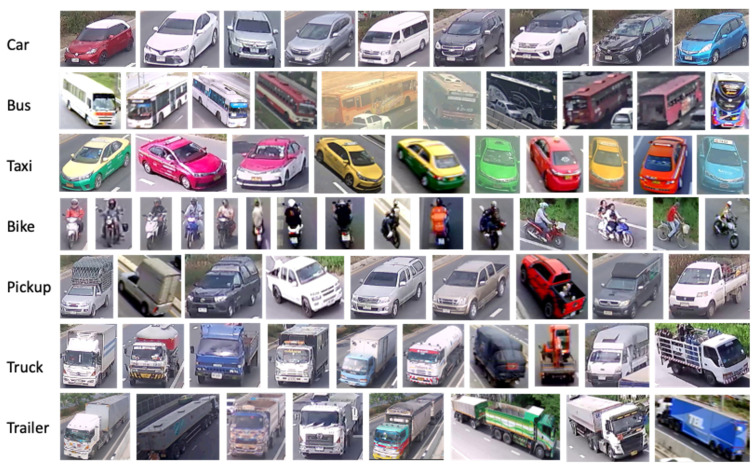
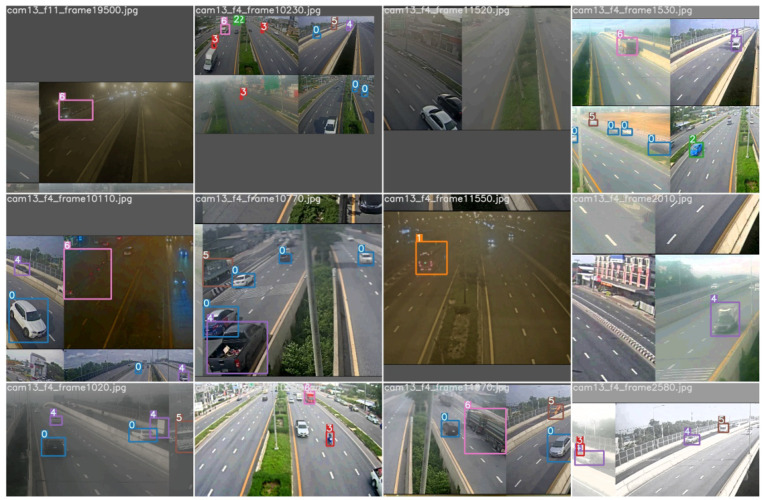
- The authors created a training dataset of nearly 30,000 samples from Thailand surveillance cameras covering 7 classes: car, bus, taxi, bike, pickup, truck, and trailer.
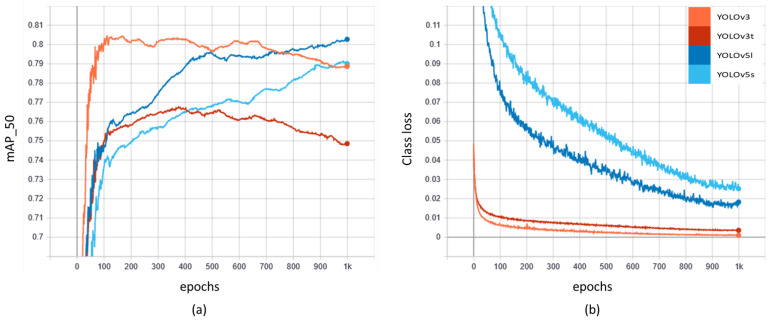
- Fine-tuning on a smaller target dataset boosted mAP_50 for all four YOLO models: YOLOv3 from 0.30 to 0.71, YOLOv3t from 0.26 to 0.67, YOLOv5l from 0.27 to 0.70, and YOLOv5s from 0.25 to 0.68.
- On the tracking/classification task, YOLOv5l performed best with precision 0.96, recall 0.95, and overall accuracy 0.95; the other models had OA values of 0.90 (YOLOv3), 0.90 (YOLOv3t), and 0.83 (YOLOv5s).
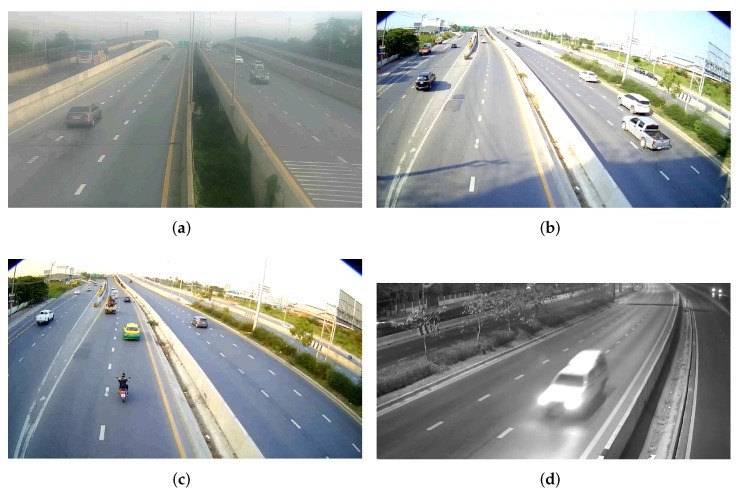
- In the stream-quality experiment, YOLOv5l counted/classified 99.6% and 94% of vehicles on clear video streams, and the average accuracy across four videos was 94%.
## Methods
- Two-stage training design: TR1 was a large source dataset built from 23 surveillance cameras over 3 days (6.3 TB of video, manually annotated), and TR2 was a smaller target dataset from the deployment cameras used for transfer-learning fine-tuning.
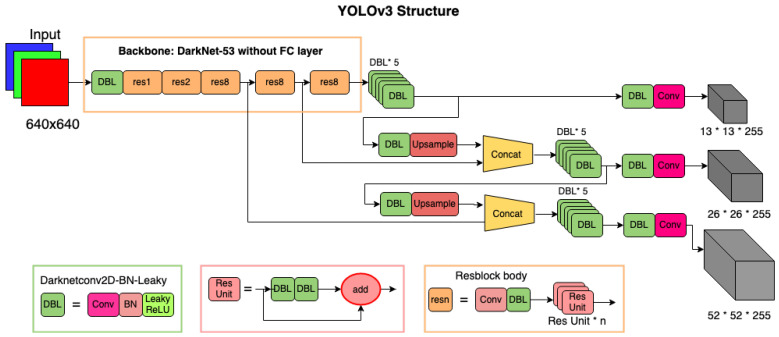
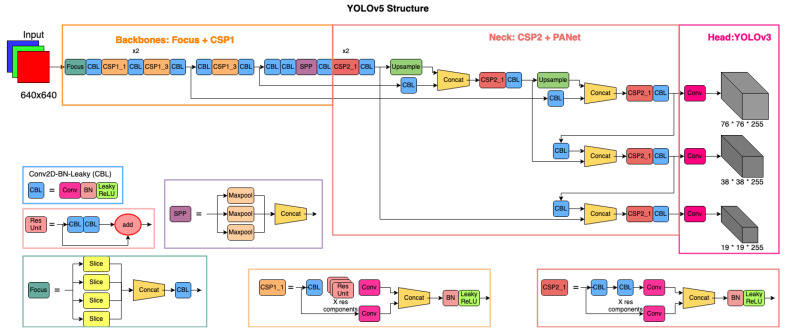
- Compared four YOLO variants: YOLOv3, YOLOv3-tiny, YOLOv5-large, and YOLOv5-small, all trained with 640 × 640 inputs and evaluated with mAP_50, precision, recall, loss, and model size.
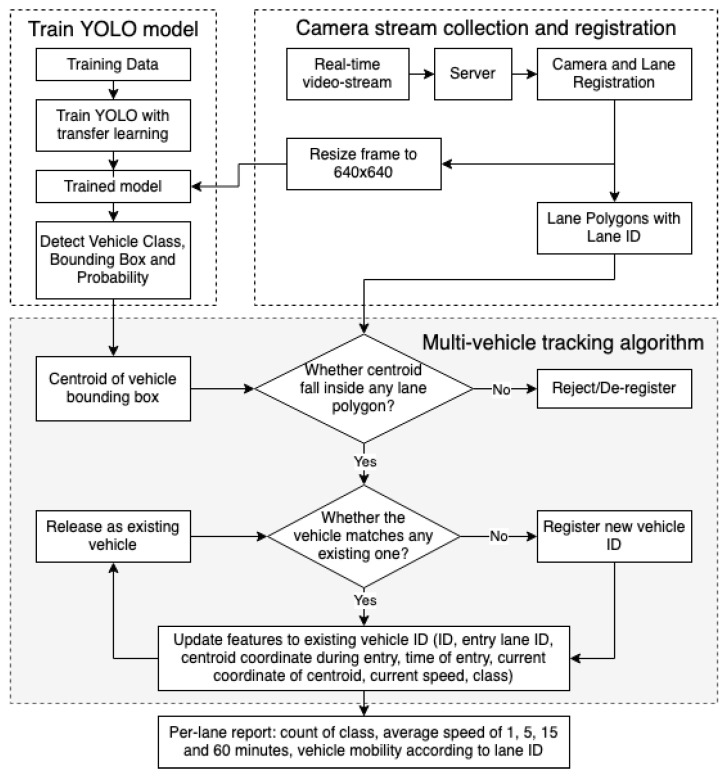
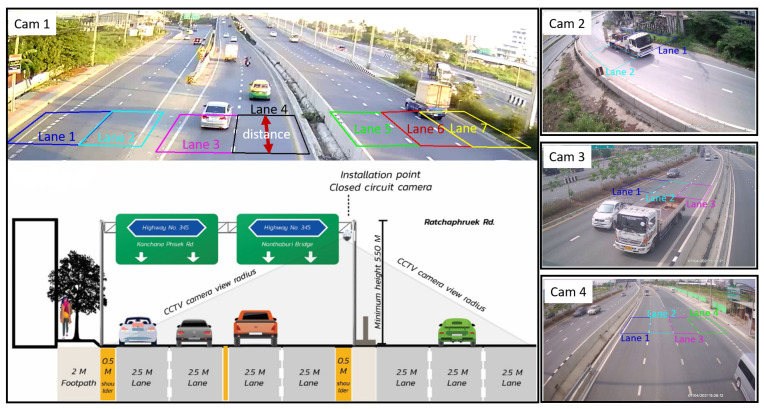
- Added a centroid-based multi-vehicle tracking algorithm that uses detected bounding boxes and lane polygons to register vehicles, count per lane, estimate speed, and produce lane-based reports in real time.
## Limitations
- The paper states that there is “more room for improvement” in detection, counting, and tracking, and that metrics were calculated on full image frames; limiting detection to a smaller ROI could further improve accuracy.
- Performance dropped in adverse conditions, especially at night, due to black-and-white streaming, headlights, and sudden light changes; the paper notes nighttime classification was highly affected.
- Evident from the text: the system depends on manually drawn lane polygons, camera placement, and specific road geometry, which may limit generality across sites.
Model-written summary. Check it against the paper before relying on it.
Integrity signals
Registry
Cites
Statistics
Figures
Verification
Claims the paper makes
8 Valid · 6 Not valid · 7 Not checked · 62 Own results and interpretations
The cited sources support only part of this claim — read each source’s verdict below.
In the paper
“This neck generates feature pyramids that help the overall network to generalize objects of different scales and sizes.”
§ Real-Time Vehicle Classification and Tracking Using a Transfer Learning-Improved Deep Learning Network > 3. Method > 3.2. YOLO-Based Detection and Classification
What the sources say
- Not checked — no full text of the sourcecites [54] Liu, S., Qi, L., Qin, H., Shi, J., and Jia, J. (2018, January 18–23). Path aggregation network for instance segmentation. Proceedings of the 2018 IEEE/CVF Conference on Computer Vision and Pattern Recognition, Salt Lake City, UT, USA. source
- Partly supportedcites [55] He, 2015, Spatial pyramid pooling in deep convolutional networks for visual recognition, IEEE Trans. Pattern Anal. Mach. Intell. sourceExperimental — accuracy not yet measured
The Conclusion (p. 12) describes SPP as a solution for handling different scales and sizes, and the Introduction (p. 2) says it pools features at multiple levels. The paper does not establish that a CSP/PANet neck generates feature pyramids or that this particular neck improves generalization across object scales. (LLM, conf=0.85)
plainstates a cause- Asserted: passes — The authors put it forward as true.
- Checkable: passes — It can be checked against evidence.
- Load-bearing: unclear — It is unclear whether the paper’s conclusions depend on it.
- Based: passes — The paper gives a reason why it holds.
The cited sources that could be checked couldn’t confirm or dispute this claim.
In the paper
“Traditional detectors, such as contour-based target detection [29], the Harris corner detector [30], SIFT, and feature point-based methods [31,32], were used to produce false detection that resulted further in false matching.”
§ Real-Time Vehicle Classification and Tracking Using a Transfer Learning-Improved Deep Learning Network > 2. Related Works and Background > 2.3. Vehicle Tracking
What the sources say
- Not checked — no full text of the sourcecites [29] Meyer, 1997, Model based extraction of articulated objects in image sequences for gait analysis, Proceedings of the International Conference on Image Processing source
- Not matchedcites [30] Harris, C., and Stephens, M. (September, January 31). A combined corner and edge detector. Proceedings of the Alvey Vision Conference, Manchester, UK.
Its entry has no title and year that we can search by.
- Could not verifycites [31] Henriques, 2014, High-speed tracking with kernelized correlation filters, IEEE Trans. Pattern Anal. Mach. Intell. sourceExperimental — accuracy not yet measured
Section 2.1 (pp. 1–2) discusses tracking-by-detection, and Section 2.2 (p. 2) mentions wrong detections in the context of hard-negative mining. Neither passage says that contour-based, Harris, SIFT, or feature-point detectors produce false detections that lead to false matches. Searches for those detector names and for false matching found no supporting passage in our copy. (LLM, conf=0.74)
- Not matchedcites [32] Cui, Z., Xiao, S., Feng, J., and Yan, S. (July, January 26). Recurrently target-attending tracking. Proceedings of the IEEE Conference on Computer Vision and Pattern Recognition, Las Vegas, NV, USA.
Its entry has no title and year that we can search by.
plainstates a cause- Asserted: passes — The authors put it forward as true.
- Checkable: passes — It can be checked against evidence.
- Load-bearing: passes — The paper’s conclusions depend on it.
- Based: passes — The paper gives a reason why it holds.
The cited sources support only part of this claim — read each source’s verdict below.
In the paper
“Song et al. [25] improved the accuracy of detection and classification of cars, buses, and trucks from 49% to 95% by segmenting road pixels first, before object detection, using YOLOv3.”
§ Real-Time Vehicle Classification and Tracking Using a Transfer Learning-Improved Deep Learning Network > 4. Results and Discussion > 4.2. The Domain-Shift Problem and Transfer Learning
What the sources say
- Partly supportedcites [25] Song, 2019, Vision-based vehicle detection and counting system using deep learning in highway scenes, Eur. Transp. Res. Rev. sourceExperimental — accuracy not yet measured
The Road surface segmentation and Network training and vehicle detection sections describe segmenting the road before using YOLOv3 to detect cars, buses, and trucks; the latter says this improves detection compared with full-image detection. They do not report an accuracy increase from 49% to 95%. Instead, the Network training and vehicle detection section reports 87.88% mean average precision and an 83.46% overall correct detection rate. (LLM, conf=0.90)
plainstates a cause- Asserted: passes — The authors put it forward as true.
- Checkable: passes — It can be checked against evidence.
- Load-bearing: unclear — It is unclear whether the paper’s conclusions depend on it.
- Based: passes — The paper gives a reason why it holds.
- Partly supported
The cited sources support only part of this claim — read each source’s verdict below.
In the paper
“Using feature pyramids, PANet, and SPP blocks improves object identification on unseen data as well.”
§ Real-Time Vehicle Classification and Tracking Using a Transfer Learning-Improved Deep Learning Network > 3. Method > 3.2. YOLO-Based Detection and Classification
What the sources say
- Not checked — no full text of the sourcecites [54] Liu, S., Qi, L., Qin, H., Shi, J., and Jia, J. (2018, January 18–23). Path aggregation network for instance segmentation. Proceedings of the 2018 IEEE/CVF Conference on Computer Vision and Pattern Recognition, Salt Lake City, UT, USA. source
- Partly supportedcites [55] He, 2015, Spatial pyramid pooling in deep convolutional networks for visual recognition, IEEE Trans. Pattern Anal. Mach. Intell. sourceExperimental — accuracy not yet measured
Section 3.1.2 (p. 5) reports that spatial pyramid pooling improved accuracy over no-SPP baselines on the ImageNet validation set. The paper does not evaluate PANet or show that the stated combination of feature pyramids, PANet, and SPP blocks improves identification on unseen data. (LLM, conf=0.90)
plainstates a cause- Asserted: passes — The authors put it forward as true.
- Checkable: passes — It can be checked against evidence.
- Load-bearing: unclear — It is unclear whether the paper’s conclusions depend on it.
- Based: passes — The paper gives a reason why it holds.
The cited sources support only part of this claim — read each source’s verdict below.
In the paper
“DL-based methods have the advantage of accurate detection and classification, but only if the training and test datasets are from the same or similar environment [42] such that they are not affected by contextual and spatial uncertainties [43].”
§ Real-Time Vehicle Classification and Tracking Using a Transfer Learning-Improved Deep Learning Network > 2. Related Works and Background > 2.4. The Domain-Shift Problem and Transfer Learning
What the sources say
- Supportedcites [42] Neupane, B., Horanont, T., and Aryal, J. (2021). Deep learning-based semantic segmentation of urban features in satellite images: A review and meta-analysis. Remote Sensing, 13. source
Section 2.5 (Generative Adversarial Networks) states directly that 'Most CNN based methods perform well when they are tested on the images that are similar to the train images, but fail when the domain shifts to a new domain,' attributing the shift to imaging sensors, resolution and class representation — i.e. the same/similar-environment condition the claim paraphrases. Section 3.2.3/4.3 reinforces this by noting that papers such as Benjdira et al. [127] and Liu et al. [107] were aimed specifically at improving segmentation when train and test datasets come from different domains (OA rising only from 35% to 52% going Potsdam→Vaihingen), and the Conclusions (Section 5) still list minimisation of the domain-shift problem as an open future direction. The 'only if' phrasing is thus consistent with our copy, which treats cross-domain remedies as limited and not yet standard. (LLM, conf=0.85)
- Partly supportedcites [43] Majid Roodposhti, S., Aryal, J., Lucieer, A., and Bryan, B. (2019). Uncertainty assessment of hyperspectral image classification: Deep learning vs. random forest. Entropy, 21. sourceExperimental — accuracy not yet measured
The Methods (§2.1) say training and test samples were randomly drawn from each dataset, and the Results (§3.2) report that the deep neural network classified more accurately than random forest on Indian Pines. The paper does not compare performance across different training and test environments, so it does not establish that accurate classification occurs only when those environments are similar. (LLM, conf=0.84)
plainstates a possible cause- Asserted: passes — The authors put it forward as true.
- Checkable: passes — It can be checked against evidence.
- Load-bearing: passes — The paper’s conclusions depend on it.
- Based: passes — The paper gives a reason why it holds.
- Supported
32 more claims
Create a free account to see all 83 claims and to verify the 1 reference still open.
- Probably not a substantial claim. 16
- It may state two separate claims as one. 33
- The quote only partly states this claim. 1
Citations
Cites
Deep Residual Learning for Image Recognition
He, K., Zhang, X., Ren, S., & Sun, J. (2016) · 2016 IEEE Conference on Computer Vision and Pattern Recognition (CVPR) · doi:10.1109/cvpr.2016.90 · Cited by 235,474
Faster R-CNN: Towards Real-Time Object Detection with Region Proposal Networks
Ren, S., He, K., Girshick, R., & Sun, J. (2017) · IEEE Transactions on Pattern Analysis and Machine Intelligence · doi:10.1109/tpami.2016.2577031 · Cited by 73,472 · cited 5×
“Compared to other fast models such as Faster-RCNN [20], single shot multibox object detection (SSD) [21], and Center Net [22] on the COCO-2017 dataset, YOLOv3 is able to produce a similar mAP, but 17 times faster (see https://cv.”
MethodInfluentialYou Only Look Once: Unified, Real-Time Object Detection
Redmon, J., Divvala, S., Girshick, R., & Farhadi, A. (2016) · 2016 IEEE Conference on Computer Vision and Pattern Recognition (CVPR) · doi:10.1109/cvpr.2016.91 · Cited by 53,803 · cited 2×
“Several SOTA DL models in the domain of near real-time multi-object classification belonging to the YOLO family [4] (two versions of improved YOLOv3 [5] and two versions of YOLOv5 [6]) were trained.”
BackgroundMethodDensely Connected Convolutional Networks
Huang, G., Liu, Z., Van Der Maaten, L., & Weinberger, K. Q. (2017) · 2017 IEEE Conference on Computer Vision and Pattern Recognition (CVPR) · doi:10.1109/cvpr.2017.243 · Cited by 48,566 · cited 1×
“For the first component of the backbone, we used a Focus layer and a Cross Stage Partial (CSP) network [51,52].”
MethodGoing deeper with convolutions
Szegedy, C., Liu, W., Jia, Y., Sermanet, P., Reed, S., Anguelov, D., Erhan, D., Vanhoucke, V., & Rabinovich, A. (2015) · 2015 IEEE Conference on Computer Vision and Pattern Recognition (CVPR) · doi:10.1109/cvpr.2015.7298594 · Cited by 48,562 · cited 2×
“[13] introduced vehicle classification using a CNN named GoogleNet [14] for large-scale traffic surveillance.”
Method(2016) · Cited by 31,590
Feature Pyramid Networks for Object Detection
Lin, T.-Y., Dollar, P., Girshick, R., He, K., Hariharan, B., & Belongie, S. (2017) · 2017 IEEE Conference on Computer Vision and Pattern Recognition (CVPR) · doi:10.1109/cvpr.2017.106 · Cited by 30,939 · cited 2×
“Unlike our choice of PANet, the neck can be replaced with other networks, such as a feature pyramid network (FPN), a path aggregation network (PAN), and a bidirectional FPN (BiFPN).”
MethodSSD: Single Shot MultiBox Detector
Liu, W., Anguelov, D., Erhan, D., Szegedy, C., Reed, S., Fu, C.-Y., & Berg, A. C. (2016) · Lecture Notes in Computer Science · doi:10.1007/978-3-319-46448-0_2 · Cited by 22,128 · cited 3×
“Compared to other fast models such as Faster-RCNN [20], single shot multibox object detection (SSD) [21], and Center Net [22] on the COCO-2017 dataset, YOLOv3 is able to produce a similar mAP, but 17 times faster (see https://cv.gluon.ai/model_zoo/detection.html (accessed on 21 April 2022) for comparison).”
MethodYOLO9000: Better, Faster, Stronger
Redmon, J., & Farhadi, A. (2017) · 2017 IEEE Conference on Computer Vision and Pattern Recognition (CVPR) · doi:10.1109/cvpr.2017.690 · Cited by 19,892 · cited 1×
“With continuous upgrades, five generations of YOLO architecture have been produced since its introduction: YOLO, YOLOv2 [16], YOLOv3 [5], YOLOv4 [17], and YOLOv5 [6].”
MethodYOLOv3: An Incremental Improvement
Redmon, J., & Farhadi, A. (2018) · arXiv · doi:10.48550/arxiv.1804.02767 · Cited by 17,141
Research works printed but not linked: 1
- Kouw, W.M., and Loog, M. (2018). An introduction to domain adaptation and transfer learning. arXiv.
Cited by
Object Detection in Traffic Videos: A Survey
Ghahremannezhad, H., Shi, H., & Liu, C. (2023) · IEEE Transactions on Intelligent Transportation Systems · doi:10.1109/tits.2023.3258683 · Cited by 141
Real Time Car Model and Plate Detection System by Using Deep Learning Architectures
Mustafa, T. S., & Karabatak, M. (2024) · IEEE Access · doi:10.1109/access.2024.3430857 · Cited by 44
“Third, we further explore false classifications within an VMMR classify system to find shortcomings in a system and information handling [10], [11].”
BackgroundSemantic Segmentation and YOLO Detector over Aerial Vehicle Images
Qureshi, A. M. (2024) · Computers, materials & continua/Computers, materials & continua (Print) · doi:10.32604/cmc.2024.052582 · Cited by 65
TranSDet: Toward Effective Transfer Learning for Small-Object Detection
Xu, X., Zhang, H., Ma, Y., Liu, K., Bao, H., & Xu, Q. (2023) · Remote Sensing · doi:10.3390/rs15143525 · Cited by 36
Shokri, D., Larouche, C., & Homayouni, S. (2023) · Smart Cities · doi:10.3390/smartcities6050134 · Cited by 43
Esmaeili, F., Cassie, E., Nguyen, H. P. T., Plank, N. O. V., Unsworth, C. P., & Wang, A. (2023) · Bioengineering · doi:10.3390/bioengineering10121348 · Cited by 35
A Study on Object Detection Performance of YOLOv4 for Autonomous Driving of Tram
Woo, J., Baek, J.-H., Jo, S.-H., Kim, S. Y., & Jeong, J. H. (2022) · Sensors · doi:10.3390/s22229026 · Cited by 32
“Experiments and results in the above chapter were obtained by referring to the description of GitHub uploaded by the author of YOLOv4 [9,23].”
Semantic Segmentation Based Real-Time Traffic Monitoring via Res-UNet Classifier and Kalman Filter
Qureshi, A. M., Algarni, A. M., Aljuaid, H., Alatiyyah, M. H., Alnowaiser, K., & Jalal, A. (2024) · SN Computer Science · doi:10.1007/s42979-024-03586-7 · Cited by 19
Bihanda, Y. G., Fatichah, C., & Yuniarti, A. (2024) · IEEE Access · doi:10.1109/access.2024.3453249 · Cited by 26
“Neupane et al. [11] add transfer learning using different dataset to solve domain shift problem in vehicle counting.”
BackgroundMethodTraffic Monitoring from the Perspective of an Unmanned Aerial Vehicle
Kainz, O., Dopiriak, M., Michalko, M., Jakab, F., & Nováková, I. (2022) · Applied Sciences · doi:10.3390/app12167966 · Cited by 18
Aryal, J., & Neupane, B. (2023) · Remote Sensing · doi:10.3390/rs15020488 · Cited by 18
Self-citationZhang, R. (2024) · Scientific Reports · doi:10.1038/s41598-024-51865-3 · Cited by 16
“A lightweight underwater TD system based on YOLO v4 and MFF was proposed by Zhang et al. in 2022) studied and fine-tuned You Only Look Once (YOLO) network, and proposed a multi-vehicle tracking algorithm, which can obtain the vehicle count, classification and speed of each lane in real time 15 .”
MethodPillai, B. S., Kulkarni, R., Kondeti, V. S. S. K., et al. (2025) · International Conference on Expert Clouds and Applications (ICOECA) · doi:10.1109/icoeca66273.2025.00053 · Cited by 15
“Real-time vehicle classification and tracking system for intelligent transport systems (ITS) and location intelligence planning was designed by [11] using YOLO model.”
GPS and GSM Based Vehicle Tracking System
Hussain, A.-S. T., Fadhil, M., Taha, T. A., et al. (2023) · International Symposium on Innovative Approaches in Smart Technologies (ISAS) · doi:10.1109/isas60782.2023.10391720 · Cited by 12
“However, this system can undergo significant enhancements by exploring alternative methods to transmit alarms to car owners, track vehicles, and promptly notify them of any potential theft [4].”
BackgroundLyu, Y., Schiopu, I., Cornelis, B., & Munteanu, A. (2022) · Sensors · doi:10.3390/s22218439 · Cited by 17
“In [4,18,27,28], the proposed CNN-based solutions follow an approach, by which existing successful architectures, usually applied for image classification and commonly known as backbones, are employed to perform VMMR on a specific dataset.”
MethodLi, T., Bian, Z., Lei, H., Zuo, F., Yang, Y.-T. C., Zhu, Q., Li, Z., & Özbay, K. M. A. (2024) · Transportation Research Part C Emerging Technologies · doi:10.1016/j.trc.2024.104804 · Cited by 22
“Specifically, the detector component utilizes established video extraction methods, including multiple-object-detection (MOD)[6], tracking[7, 8, 9], and re-identification (Re-ID)[10, 11].”
MethodBoosting Vehicle Classification with Augmentation Techniques across Multiple YOLO Versions
Tan, S. X., Ong, J. Y., Goh, M. K. O., & Connie, T. (2024) · JOIV International Journal on Informatics Visualization · doi:10.62527/joiv.8.1.2313 · Cited by 15
Vehicle Classification Algorithm Based on Improved Vision Transformer
Dong, X., Shi, P., Tang, Y., Yang, L., Yang, A., & Liang, T. (2024) · World Electric Vehicle Journal · doi:10.3390/wevj15080344 · Cited by 10
“Neupane et al. [18] proposed a simplified CNN-based model for classifying vehicles in low-resolution surveillance images, with the potential to achieve high accuracy with low complexity in low-quality images, providing a new idea for the application of standard low-cost cameras to enhance the…”
BackgroundForecasting and managing urban EV charging demand with spatiotemporal graph models
Xi, Z., Guo, G., Yang, X., et al. (2025) · Journal of Renewable and Sustainable Energy · doi:10.1063/5.0244546 · Cited by 7
Al-Tarawneh, M., Alhomaidat, F., & Twaissi, M. (2023) · Results in Engineering · doi:10.1016/j.rineng.2023.101691 · Cited by 7
CrowdTransfer: Enabling Crowd Knowledge Transfer in AIoT Community
Liu, Y., Guo, B., Li, N., Ding, Y., Zhang, Z., & Yu, Z. (2024) · IEEE Communications Surveys & Tutorials · doi:10.1109/comst.2024.3423319 · Cited by 17
Bangladeshi Native Vehicle Classification Employing YOLOv8
Salekin, S. U., Ullah, M. H., Khan, A. A. A., et al. (2023) · Communications in computer and information science · doi:10.1007/978-981-99-7649-2_14 · Cited by 6
Dehradun Vision 2025: Smart City Traffic Optimization Using YOLOv11, U-Net, and Deep SORT
Saklani, S., & Manchanda, M. (2025) · doi:10.1109/netcrypt65877.2025.11102216 · Cited by 5
“Modern algorithms and deep learning neural networks, as well as computer vision technology provide excellent resources for monitoring traffic in real time, such as YOLOv11, a powerful object detection algorithm that is unmatched in speed and precision for discerning automobiles and pedestrians [2].”
Fu, L., Zhang, Q., & Tian, S. (2024) · Heliyon · doi:10.1016/j.heliyon.2024.e26467 · Cited by 9
“[9] addresses three key challenges in real-time vehicle classification and tracking using deep learning: a lack of large training datasets, domain shifts, and integrating deep learning with multi-vehicle tracking algorithms.”
BackgroundReal-Time Driver Sleepiness Detection and Classification Using Fusion Deep Learning Algorithm
Rajawat, A. S., Goyal, S. B., Bhaladhare, P., et al. (2023) · Lecture notes in electrical engineering · doi:10.1007/978-981-19-9876-8_34 · Cited by 5
Vehicle State Classification from Drone Image
Lee, Y., Kim, S., Choi, J., & Jo, K.-H. (2023) · IEEE International Conference on Industrial Technology (ICIT) · doi:10.1109/icit58465.2023.10143168 · Cited by 5
“Several studies have investigated real-time vehicle and lane detection for vehicle movement detection [17], as well as vehicle motion estimation based on CCTV data [18], [19].”
BackgroundStrategic Mobility Insights: Optimizing Parking and Operational Efficiency through Density Analysis
Praharsh, P. R., Tarun, M., Priya, V. V. S., Reddy, A. A., & Lalithamani, N. (2024) · International Conference on Intelligent Systems for Cybersecurity (ISCS) · doi:10.1109/iscs61804.2024.10581307 · Cited by 4
“Additionally, insights from real-time vehicle classification and tracking using transfer learning improved deep learning networks [17] inform our methodology for real-time analysis and tracking of individuals within public spaces.”
BackgroundVehicle Classification Using Deep Learning-Assisted Triboelectric Sensor
Kinden, S., & Batmaz, Z. (2023) · Arabian Journal for Science and Engineering · doi:10.1007/s13369-023-08394-4 · Cited by 4
Gutierrez-Cabello, G. S., Talavera, E., Clavijo, M., Iglesias, G., & Jiménez, F. (2023) · Applied Sciences · doi:10.3390/app13074334 · Cited by 6
Vehicle Counting and Classification from a traffic scene
Pancharatnam, M. (2025) · REST Journal on Data Analytics and Artificial Intelligence · doi:10.46632/jdaai/4/1/76 · Cited by 4
Computer Vision-Based Intelligent Traffic Surveillance: Multi-Vehicle Tracking and Detection
Husein, A. M., Lubis, K. N., Sidabutar, D. S., Yuanda, Y., Kevry, K., & Waren, A. (2024) · SinkrOn · doi:10.33395/sinkron.v9i1.13204 · Cited by 4
“…Luo, Fang, Shao, Zhong, & Hua, 2021; Meng et al., 2020), vehicle counting (Lu et al., 2021; Nam Bui, Yi, & Cho, 2020; Yang et al., 2021), vehicle tracking (C. Liu et al., 2021; Sun, Zhang, Yang, & Fan, 2023), vehicle classification (Butt et al., 2021; Neupane, Horanont, & Aryal, 2022), and others.”
Pandya, D., Rana, K., & Padhiyar, A. (2025) · Education and Information Technologies · doi:10.1007/s10639-025-13351-9 · Cited by 3
“Nowadays, apart from images and text, researchers have also started focusing on video data for object tracking (Neupane et al., 2022), video classification (Islam et al., 2021), and video summarization (Apostolidis et al., 2021).”
Comparative Analysis of ConvNext and Mobilenet on Traffic Vehicle Detection
Bihanda, Y. G., Fatichah, C., & Yuniarti, A. (2023) · doi:10.1109/icsecs58457.2023.10256339 · Cited by 3
Truck Detection and Counting in Low-Light Condition: Do We Need Infrared Camera?
Yoo, J., Kim, S. H., Sukhani, K., et al. (2024) · IEEE International Conference on Big Data and Smart Computing (BigComp) · doi:10.1109/bigcomp60711.2024.00057 · Cited by 3
Venkatasivarambabu, P., Babu, R. K., Jagan, B. O. L., et al. (2025) · Signal Image and Video Processing · doi:10.1007/s11760-025-04379-y · Cited by 2
Freight Truck Turnaround Time Prediction at Container Ports Using Transfer Learning
Yusung, M. I. N., Shin, B., Park, Z., Kim, J., & Lee, G. (2026) · Journal of Marine Science and Engineering · doi:10.3390/jmse14080727 · Cited by 3
Enhancing Traffic Management with Embedded Machine Learning for Vehicle Detection
Talip, M. S. A., Razak, M. Z. A., Mohamad, M., Khairuddin, A. S. M., Izam, T. F. T. M. N., & Azizan, A. (2023) · doi:10.1109/icm60448.2023.10378908 · Cited by 2
Computer Vision Application: Vehicle Counting and Classification System from Real Time Videos
Thakare, A. N., Kamble, P. K., Patil, K. P., et al. (2024) · International Journal of Advanced Research in Science Communication and Technology · doi:10.48175/ijarsct-15032 · Cited by 2
Deep Learning-Based Image Analysis to Track Vehicles
Prabakaran, P., Jayasudha, R., Sandhu, M., & Gupta, S. (2024) · International Conference on Disruptive Technologies (ICDT) · doi:10.1109/icdt61202.2024.10489331 · Cited by 4
“Hence, they have been frequently utilized for traffic monitoring [13].”
MethodShamimullah, S., & Hanirex, D. K. (2024) · Advances in computational intelligence and robotics book series · doi:10.4018/979-8-3693-8659-0.ch019 · Cited by 2
Improving vehicle classification accuracy with convolutional neural networks
Joodi, M. A., Al-Obaidi, F. E. M., & Al-Zuky, A. A. D. (2024) · AIP conference proceedings · doi:10.1063/5.0229765 · Cited by 2
Enhanced Vehicle Detection and License Plate Recognition for Intelligent Transportation Systems
Ghotekar, A., Kanade, S., Kanade, O., et al. (2024) · doi:10.1109/picet60765.2024.10716133 · Cited by 2
Maliki, I., & Solahudin, M. R. P. (2024) · doi:10.1109/incitest64888.2024.11121519 · Cited by 2
“YOLO (You Only Look Once) is a well-known deep learning algorithm capable of real-time object detection [5].”
Multi-class Vehicle Counting System for Multi-view Traffic Videos
Kuntintara, W., Lertniphonphan, K., & Siricharoen, P. (2022) · Asia-Pacific Signal and Information Processing Association Annual Summit and Conference (APSIPA ASC) · doi:10.23919/apsipaasc55919.2022.9980202 · Cited by 3
“Neupane B. et al. [7] applied centroid tracking in surveillance videos.”
BackgroundMethodInfluentialDevelopment prediction algorithm of vehicle travel time based traffic data
Saleh, M. H., Ayesh, A. N., & Sathyaprakash, P. (2023) · Periodicals of Engineering and Natural Sciences (PEN) · doi:10.21533/pen.v11i1.3447 · Cited by 2
“It is essential to perceive the traffic states for each segment before starting the assumption [14].”
BackgroundAnkireddy, P., S., S. G., & Reddy, V. L. (2024) · Journal of Advanced Research in Applied Sciences and Engineering Technology · doi:10.37934/araset.40.2.221241 · Cited by 3
ROBUST AND SCALABLE REAL-TIME VEHICLE CLASSIFICATION AND TRACKING: A CASE STUDY OF THAILAND
Neupane, B., Horanont, T., Pattarapongsin, P., & Thapa, A. (2022) · ISPRS annals of the photogrammetry, remote sensing and spatial information sciences · doi:10.5194/isprs-annals-x-4-w3-2022-181-2022 · Cited by 3
“An assessment of road conditions is necessary to determine any maintenance program (Radopoulou and Brilakis, 2016) for a large road network.”
BackgroundSelf-citationReal-Time Vehicle Classification Using Deep Neural Networks Based Model
Verdhan, A., Saini, V., Kukreti, D. C., Negi, R., Bohra, M., & Kumar, I. (2024) · International Conference on Technological Innovations and Advance Computing (TIACOMP) · doi:10.1109/tiacomp64125.2024.00027 · Cited by 2
Xu, T., Zhang, G., Ruan, Y., et al. (2025) · International Journal of Parallel Emergent and Distributed Systems · doi:10.1080/17445760.2025.2518139 · Cited by 1
“As deep learning algorithms advance, researchers have developed numerous enhanced network models to improve detection accuracy [15].”
Computer vision-based real-time vehicle and traffic management and classification system
Bahadure, N. B., Parashar, D., Patni, J. C., et al. (2025) · OPJU International Technology Conference on Smart Computing for Innovation and Advancement in Industry (OTCON) · doi:10.1109/otcon65728.2025.11071088 · Cited by 1
Sifuentes, E., Bravo, G., Enriquez-Aguilera, F., et al. (2026) · Signals and communication technology · doi:10.1007/978-3-031-89700-9_1 · Cited by 1
Molina, J. M., Sotis, A. S., Pascual, R. C., Cubillas, J. E., & Matias, J. B. (2022) · International Conference on Networks, Communication and Computing (ICNCC) · doi:10.1145/3579895.3579919 · Cited by 1
“YOLOv1, the first single-stage object detector, treated detection as a regression problem and a detection model limited to object closeness and did not require region proposal [14].”
BackgroundMethodA Research Survey on Real-Time Intelligent Traffic System
Mane, D., Kumbharkar, P. B., Earan, N., Patil, K., Bonde, S., & Uke, N. (2023) · International Journal of Emerging Technology and Advanced Engineering · doi:10.46338/ijetae0423_05 · Cited by 1
Madhukaro, E. A. J. R. (2023) · International Journal on Recent and Innovation Trends in Computing and Communication · doi:10.17762/ijritcc.v11i10.8620 · Cited by 1
Indicator of Highway Conditions on Traffic Density Levels
Rosita, Y. D., Akbar, R. M., & Kurniawan, F. I. (2023) · IJEEIT International Journal of Electrical Engineering and Information Technology · doi:10.29138/ijeeit.v6i1.2133 · Cited by 1
Nguyen, D. T., Singh, H. K., Elsayed, S. M., Hunjet, R., & Abbass, H. A. (2023) · International Joint Conference on Neural Networks (IJCNN) · doi:10.1109/ijcnn54540.2023.10191371
“Other studies have developed knowledge-transfer techniques for NN by customising essential characteristics for various applications such as identifying automobiles, tumours, and lesions in clinical images [10]–[12].”
Backgroundระบบการนับยานพาหนะแยกตามประเภทสำหรับวีดิทัศน์จราจรหลายมุมมอง
คันธินทระ, ว. (2022) · Chula Digiverse · doi:10.58837/chula.the.2022.782
Mono6D++: Learning Point Cloud Visibility for 3D Prior-based Vehicle 6D Pose Estimation
Lyu, Y., Ducastel, O., Royen, R., et al. (2023) · European Workshop on Visual Information Processing · doi:10.1109/euvip58404.2023.10323075
Occlusion-Aware 3D Priors for Deep Learning-Based Applications
Ducastel, O., Lyu, Y., Denis, L., & Munteanu, A. (2023) · IEEE International Workshop on Multimedia Signal Processing (MMSP) · doi:10.1109/mmsp59012.2023.10337644
A Framework for on Road Vehicle Counting and Detection
Kumar, T. G. K., Kaur, B., Sharma, S., et al. (2023) · doi:10.1109/icraset59632.2023.10419936
Deep CNN Framework for Object Detection and Classification System from Real Time Videos
BORRA, D. S. R. B. D. S. R. (2023) · Journal of Science and Technology · doi:10.46243/jst.2023.v8.i12.pp78-93
Hemalakshmi, K., & Muthukumaravel, A. (2024) · Advances in computational intelligence and robotics book series · doi:10.4018/979-8-3693-5951-8.ch007
Mira, A. (2024) · Communications in computer and information science · doi:10.1007/978-3-031-62814-6_13
Desanamukula, V. S., Sricharan, B., Aman, S. Z., & Gopinath, K. (2024) · International Conference on Intelligent Technologies (CONIT) · doi:10.1109/conit61985.2024.10626391
Sensor Networks as a Support Mechanism in Intelligent Transportation Systems
Pop, M.-D., & Ramasamy, V. (2024) · Studies in systems, decision and control · doi:10.1007/978-3-031-62158-1_5 · Cited by 5
Enhancing Vehicle Count and Classification in Videos via Deep Machine-Learning Models
Shamimullah, S., & Hanirex, D. K. (2024) · Lecture notes in networks and systems · doi:10.1007/978-981-97-6681-9_48
Detecting Vehicle Traffic Violations Using Deep Learning Using Retina-LPD and GFP-GAN
Thuc, H. B., Nhu, C. N. V., Quoc, H. L., et al. (2024) · IEEE International Symposium on Telecommunication Technologies · doi:10.1109/istt63363.2024.10750774
Lee, M., Kim, H., Baek, S., et al. (2025) · International Journal of Highway Engineering · doi:10.7855/ijhe.2025.27.1.017
Deep Learning for Real-Time Vehicle Counting and Categorization in Traffic Videos
Burde, A. R. (2025) · INTERANTIONAL JOURNAL OF SCIENTIFIC RESEARCH IN ENGINEERING AND MANAGEMENT · doi:10.55041/ijsrem46005
Deep Learning for Real-Time Vehicle Counting and Categorization in Traffic Videos
Burde, A. R. (2025) · INTERANTIONAL JOURNAL OF SCIENTIFIC RESEARCH IN ENGINEERING AND MANAGEMENT · doi:10.55041/ijsrem45971
Real-Time Tow Truck Detection: Filling the E-Challan Knowledge Gap Using YOLOv8 and YOLOv9
Singh, J., Rathod, D., Shah, P. D., & Prajapati, P. (2024) · Lecture notes in networks and systems · doi:10.1007/978-981-97-8591-9_35
Raman, V., Sumari, P., Prabhavathy, M., & Akshaya, R. (2025) · Information systems engineering and management · doi:10.1007/978-3-031-90478-3_16
Sridher, T., Ammana, S. R., & Mahesh, C. (2025) · Advances in Science, Technology & Innovation/Advances in science, technology & innovation · doi:10.1007/978-3-031-76937-5_37
Kalyani, K. R., & Umamaheswaran, S. (2025) · Algorithms for intelligent systems · doi:10.1007/978-981-96-6847-2_15
Adaptive Speed Breakers Powered by YOLOv8 and MRF Dampers
Chilwan, S., Powar, S., Shaikh, K., et al. (2025) · doi:10.1109/icamida64673.2025.11209718
“[8] Moreover, successful It will thus involve compatibility with other roads and vehicles; sometimes periodic observation and adjustment must take place to get maximum operation.”
Lifted truck axles detection by a combined method and their impact on road pavement
Tankeu, B. T., Bouteldja, M., & Grignard, N. (2025) · ce/papers · doi:10.1002/cepa.3393
Raza, A., Abdullah, J., Khan, R. U., Hipiny, I., & Ujir, H. B. (2025) · doi:10.1109/iceei68459.2025.11330380
“According to [5] the development of hybrid systems that can provide insights into the dynamics of traffic and reduce the limitations of individual approaches by combining the strengths of both mechanical and deep learning methods.”
Jain, M., & Sharma, R. (2025) · doi:10.1109/ice2cpt66440.2025.11340007
“Conversely, the YOLO[3][4]family of models has set the pace in real-time object detection solutions by casting it as a single regression problem.”
Deep Learning Enabled Vehicle Classification System for EV Charging Station Management
Kumar, V. S., Ramana, J. R., Manoj, G., Das, S. C., & Anand, S. (2025) · International Conference for Advancement in Technology (ICONAT) · doi:10.1109/iconat66879.2025.11362421
Smart Car Rental Parking Monitoring: Pickup or Return Using AI and IoT
Luo, T., Luo, Y., Zhang, W., et al. (2025) · IEEE Canadian Conference on Electrical and Computer Engineering (CCECE) · doi:10.1109/ccece64018.2025.11364402
“In [7], authors applied transfer learning techniques to adapt general models for specific tasks such as vehicle classification.”
Cross-modality learning between aerial and mobile LiDAR for vegetation segmentation
Aditya, A., Lohani, B., Aryal, J., et al. (2026) · International Journal of Remote Sensing · doi:10.1080/01431161.2026.2661835
“…robust semantic segmentation, including constrained viewpoints, occlusions, and partial scene representations, cross-modality learning has emerged as a preferred approach, capitalizing on the complementary strengths of diverse data sources (He et al. 2019; Neupane, Horanont, and Aryal 2022).”
Self-citationALPR-Based Vehicle Access Control and Visitor Management for Sri Lankan Campuses
Thevarajan, J., Ravi, V., & Ganesalingam, V. (2026) · doi:10.1109/scse70081.2026.11499929
“Using a combination of real-time camera feeds and optical character recognition, ALPR systems can automatically identify vehicles without physical tokens [5], [6].”
Worachairungreung, M., Kulpanich, N., SAE-NGOW, P., Thanakunwutthirot, K., Doddacha, S., Nilnarong, J., & Ninsawat, S. (2026) · Transportation Research Interdisciplinary Perspectives · doi:10.1016/j.trip.2026.102104 · Cited by 2
Semi-Supervised Object Detection with Noisy Urban Street Image Datasets for Smart City
Sajja, B., & Kim, S. H. (2026) · IEEE International Conference on Data Engineering Workshops (ICDEW) · doi:10.1109/icdew71238.2026.00030
“Neupane et al. [10] leverage transfer learning for real-time vehicle detection on cropped images with well-defined edges.”
AIMS-YOLOv11n: Small target defect detection model for power line insulators
Longyun, J., & Baohong, Y. (2026) · AIP Advances · doi:10.1063/5.0321714
Automated Detection of Illegally Blue-Light Modified Cars by Using Computer Vision
Pataravesaruch, P., & Banditwattanawong, T. (2026) · International Electrical Engineering Congress (iEECON) · doi:10.1109/ieecon68065.2026.11707134
“Neupane et al. (2022) [6] compared YOLO variants for real-time vehicle detection, where YOLOv5l achieved mAP50 = 80.3% and YOLOv5s = 79.0%, with the latter offering efficiency for resource-limited systems.”
Influential
Metadata
- Authors
- Neupane, B., Horanont, T., & Aryal, J.
- Affiliations
- Advanced Geospatial Technology Research Unit, Sirindhorn International Institute of Technology, 131 Moo 5, Tiwanon Road, Bangkadi, Mueang Pathum Thani 12000, Pathum Thani, Thailand
- School of Information, Computer, and Communication Technology (ICT), Sirindhorn International Institute of Technology, 131 Moo 5, Tiwanon Road, Bangkadi, Mueang Pathum Thani 12000, Pathum Thani, Thailand
- The University of Melbourne (AU)
- Corresponding author
- Horanont, Teerayut
- Venue
- Sensors
- Publisher
- MDPI AG
- Published
- 2022-05-18
- Volume
- 22
- Issue
- 10
- Pages
- 3813
- ISSN
- 1424-8220 (ISSN-L)
- PMC
- PMC9144024
- OpenAlex
- W4280527735
- Semantic Scholar
- 9ba2c82d9fe60eac659d461e72322e4c306b5184
- Cited by
- 85
- References
- 56
- Citations by year
- 2026: 8 · 2025: 19 · 2024: 28 · 2023: 23 · 2022: 7
- FWCI
- 6.30
- Type
- journal article
- Language
- en
- Open access
- gold
- doi.org
- Licence
- Locations
- Sensors (publishedVersion, cc-by)
- PubMed Central (publishedVersion, cc-by)
- PubMed (publishedVersion)
- DOAJ (DOAJ: Directory of Open Access Journals) (submittedVersion, cc-by-sa)
- Minerva Access (University of Melbourne) (submittedVersion, cc-by)
- Funders
- Thammasat University Research Fund under the TU Research Scholar (TUFT 88/2564, TUFF19/2564, TUFF24/2565)
- Thailand Science Research and Innovation Fundamental Fund (TUFT 88/2564, TUFF19/2564, TUFF24/2565)
- Topics
- Physical Sciences › Computer Science › Computer Vision and Pattern Recognition › Advanced Neural Network Applications
- Physical Sciences › Computer Science › Computer Vision and Pattern Recognition › Video Surveillance and Tracking Methods
- Physical Sciences › Engineering › Automotive Engineering › Autonomous Vehicle Technology and Safety
- Keywords
- vehicle classification, multi-vehicle tracking, real-time object detection, transfer learning, domain shift, YOLOv5, fine-tuning, vehicle speed estimation, intelligent transportation systems, training dataset construction
- MeSH terms
- Deep Learning, Algorithms, Humans, Neural Networks, Computer
About these checks
Registry, retraction, Cites and statistics results are computed, not judged, with one exception: a printed reference that no index lists is read once by a model before it counts as a citation error. Claims are extracted by a model and kept only when their quote appears verbatim in the text; each cited source is then checked, with a model’s help, for whether it says what the claim relies on. Those verdicts can be wrong — read the claim’s quote and the cited source before relying on one.
The claim verdicts this report counts are experimental: their accuracy is not yet measured.
A language model drew the claims from the paper on 2026-10-10, under version 3 of the claim definition (model deepseek-v4.1-flash, prompt extract-v3).
A second model labelled each claim on 2026-10-10 (model jev-1.13-20260917, definition revision gold-guideline-v0.2).
Cited sources are checked with a language model’s help (gpt-6-sol and qwen3.8-omni-flash).
Statistics and arithmetic are recomputed, not judged.
Confidence bands are shown only for fields calibrated on our annotated test set. None is calibrated yet, so no band is shown.
What counts as a claim ›How we measure confidence ›How we check this ›
Are you an author, or do you see a problem with this page? Request a review
Data sources
Bibliographic data: Semantic Scholar, OpenAlex, Crossref.
Contains information from the Semantic Scholar Academic Graph Datasets, made available under the ODC Attribution License (ODC-BY 1.0).
Semantic Scholar’s data is described in: Kinney, R., et al. (2023). The Semantic Scholar Open Data Platform. arXiv:2301.10140.
