

Inertial-Measurement-Unit-Based Novel Human Activity Recognition Algorithm Using Conformer
Open accessThe DOI matches its Crossref record; 48 of the 48 references it cites were found in a registry or an index.
Abstract
Inertial-measurement-unit (IMU)-based human activity recognition (HAR) studies have improved their performance owing to the latest classification model. In this study, the conformer, which is a state-of-the-art (SOTA) model in the field of speech recognition, is introduced in HAR to improve the performance of the transformer-based HAR model. The transformer model has a multi-head self-attention structure that can extract temporal dependency well, similar to the recurrent neural network (RNN) series while having higher computational efficiency than the RNN series. However, recent HAR studies have shown good performance by combining an RNN-series and convolutional neural network (CNN) model. Therefore, the performance of the transformer-based HAR study can be improved by adding a CNN layer that extracts local features well. The model that improved these points is the conformer-based-model model. To evaluate the proposed model, WISDM, UCI-HAR, and PAMAP2 datasets were used. A synthetic minority oversampling technique was used for the data augmentation algorithm to improve the dataset. From the experiment, the conformer-based HAR model showed better performance than baseline models: the transformer-based-model and the 1D-CNN HAR models. Moreover, the performance of the proposed algorithm was superior to that of algorithms proposed in recent similar studies which do not use RNN-series.
Overview
The claims and statistics of this paper haven’t been checked yet.
Free: it reads the open-access text and checks the first 5 claims that cite a source we can check. Create a free account to check every claim.
Integrity signals
Registry
Cites
Statistics
Figures
Verification
Claims the paper makes
The claims and statistics of this paper haven’t been checked yet.
Free: it reads the open-access text and checks the first 5 claims that cite a source we can check. Create a free account to check every claim.
Claims other papers make about this one
Each is checked against this paper’s own text: does it say what the citing paper says it does?
In the citing paper
“As a result, they achieved SOTA performance on a variety of HAR datasets.”
From TS2ACT: Few-Shot Human Activity Sensing with Cross-Modal Co-Learning (2023) · cites this paper as [25]
Self-check
Percentages, sums and reported differences re-computed from the paper’s own numbers.
The self-check needs the paper’s full text.
Citations
Cites
Vaswani, A., Shazeer, N., Parmar, N., Uszkoreit, J., Jones, L., Gomez, A. N., Kaiser, L., & Polosukhin, I. (2017) · arXiv · doi:10.48550/arxiv.1706.03762 · Cited by 120,404 · cited 2×
“The transformer model is known to have good computational efficiency while extracting temporal dependency similar to the RNN model [17] and has been recently introduced into IMU-based HAR research.”
BackgroundMethodHochreiter, S., & Schmidhuber, J. (1997) · Neural Computation · doi:10.1162/neco.1997.9.8.1735 · Cited by 102,318 · cited 1×
“Long short-term memory (LSTM) and Sensors 2022 , 22 , 3932 2 of 13 gated recurrent units (GRUs), which are types of RNN series models, feature a gate structure that can memorize the long-term state of the previous input and learn the sequential context of time-series data [13,14].”
BackgroundSMOTE synthetic minority over-sampling technique
Chawla, N. V., Bowyer, K. W., Hall, L. O., & Kegelmeyer, W. P. (2002) · Journal of Artificial Intelligence Research · doi:10.1613/jair.953 · Cited by 32,865 · cited 15×
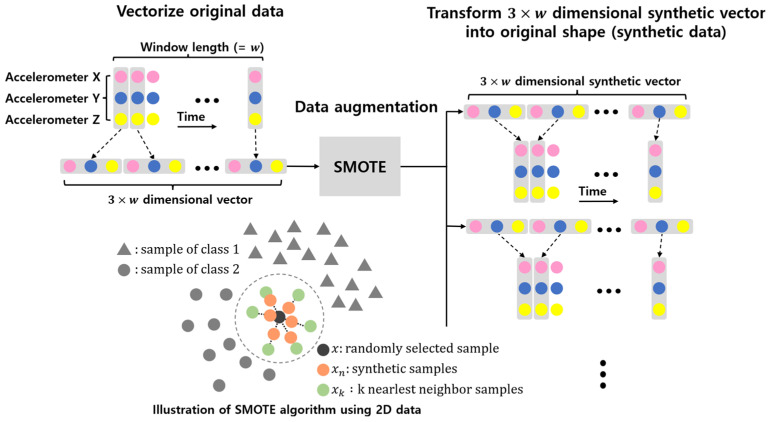
“The SMOTE algorithm augments windowed data because it has little effect on high-dimensional data for most trained classifiers [42].”
MethodInfluentialLearning Phrase Representations using RNN Encoder–Decoder for Statistical Machine Translation
Cho, K., van Merrienboer, B., Gulcehre, C., Bahdanau, D., Bougares, F., Schwenk, H., & Bengio, Y. (2014) · Proceedings of the 2014 Conference on Empirical Methods in Natural Language Processing (EMNLP) · doi:10.3115/v1/d14-1179 · Cited by 25,545 · cited 1×
“Long short-term memory (LSTM) and Sensors 2022 , 22 , 3932 2 of 13 gated recurrent units (GRUs), which are types of RNN series models, feature a gate structure that can memorize the long-term state of the previous input and learn the sequential context of time-series data [13,14].”
BackgroundHan (2023) · doi:10.1109/tpami.2022.3152247 · Cited by 4,682 · cited 1×
“The transformer’s efficient, global information capture and interpretable advantages were applied to the vision field and showed similar or superior performance to conventional CNN and RNN-based models [19–21].”
MethodTemporal Fusion Transformers for interpretable multi-horizon time series forecasting
Lim, B., Arık, S. Ö., Loeff, N., & Pfister, T. (2021) · International Journal of Forecasting · doi:10.1016/j.ijforecast.2021.03.012 · Cited by 3,291
Conformer: Convolution-augmented Transformer for Speech Recognition
Gulati, A., Qin, J., Chiu, C.-C., Parmar, N., Zhang, Y., Yu, J., Han, W., Wang, S., Zhang, Z., Wu, Y., et al. (2020) · Interspeech 2020 · doi:10.21437/interspeech.2020-3015 · Cited by 3,150
Conformer: Convolution-augmented Transformer for Speech Recognition
Gulati, A., Qin, J., Chiu, C.-C., Parmar, N., Zhang, Y., Yu, J., Han, W., Wang, S., Zhang, Z., Wu, Y., et al. (2020) · arXiv · doi:10.48550/arxiv.2005.08100 · Cited by 3,150 · cited 3×
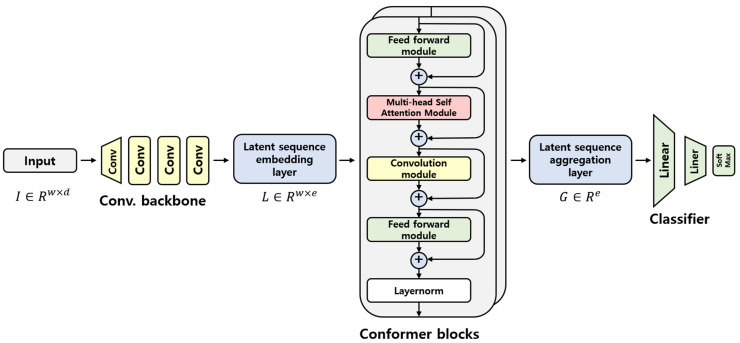
“Unlike the transformer, however, the conformer incorporates a CNN structure to extract local features with slightly better performance [24–26].”
BackgroundSurvey on deep learning with class imbalance
Johnson, J. M., & Khoshgoftaar, T. M. (2019) · Journal of Big Data · doi:10.1186/s40537-019-0192-5 · Cited by 3,032 · cited 4×
“(1) The windowed data are 2D, and these 2D data are converted into a vector before applying the SMOTE to solve this problem is to equalize the amount of data in the majority and minority classes through data augmentation, which generates synthetic data similar to the original data [39–41].”
BackgroundMethodInfluentialActivity recognition using cell phone accelerometers
Kwapisz, J. R., Weiss, G. M., & Moore, S. A. (2011) · ACM SIGKDD Explorations Newsletter · doi:10.1145/1964897.1964918 · Cited by 2,912 · cited 2×
“The execution time of participants’ motions were different from each other, and the data were imbalanced [34].”
Background
Research works printed but not linked: 3
- Kuang X. He J. Hu Z. Zhou Y. Comparison of deep feature learning methods for human activity recognition Appl. Res. Comput. 2018 35 2815 2817
- Boin J.B. Roth N. Doshi J. Llueca P. Borensztein N. Multi-class segmentation under severe class imbalance: A case study in roof damage assessment arXiv 2020 2010.07151
- Abedin A. Rezatofighi H. Ranasinghe D.C. Guided-GAN: Adversarial Representation Learning for Activity Recognition with Wearables arXiv 2021 2110.05732
Cited by
Transformer-based models to deal with heterogeneous environments in Human Activity Recognition
Ek, S., Portet, F., & Lalanda, P. (2023) · Personal and Ubiquitous Computing · doi:10.1007/s00779-023-01776-3 · Cited by 103
“Comparison with recent Transformer based HAR models [50, 22] was not directly possible since most papers do not publicly release their code and there is no consensual benchmark in HAR for mobile phones.”
InfluentialChu, X., Kim, S., Cho, Y., & Park, K.-S. (2024) · Electronics · doi:10.3390/electronics13040747 · Cited by 42
Conformer-Based Human Activity Recognition Using Inertial Measurement Units
Seenath, S., & Dharmaraj, M. (2023) · Sensors · doi:10.3390/s23177357 · Cited by 22
“The key contributions of this paper are as follows:”
MethodTS2ACT: Few-Shot Human Activity Sensing with Cross-Modal Co-Learning
Xia, K., Li, W., Gan, S., & Lu, S. (2023) · Proceedings of the ACM on Interactive, Mobile, Wearable and Ubiquitous Technologies · doi:10.1145/3631445 · Cited by 19
Haresamudram, H., Essa, I., & Plötz, T. (2024) · Sensors · doi:10.3390/s24041238 · Cited by 14
Metadata
- Authors
- Kim, Y.-W., Cho, W.-H., Kim, K.-S., & Lee, S.
- Affiliations
- Inha University (KR)
- Corresponding author
- Lee, Sangmin
- Venue
- Sensors
- Publisher
- MDPI AG
- Published
- 2022-05-23
- Volume
- 22
- Issue
- 10
- Pages
- 3932
- ISSN
- 1424-8220 (ISSN-L)
- PMC
- PMC9144209
- OpenAlex
- W4282928124
- Cited by
- 31
- References
- 46
- Citations by year
- 2026: 3 · 2025: 4 · 2024: 9 · 2023: 13 · 2022: 2
- FWCI
- 2.29
- Type
- journal article
- Language
- en
- Open access
- gold
- doi.org
- Licence
- Locations
- Sensors (publishedVersion, cc-by)
- PubMed Central (publishedVersion, cc-by)
- PubMed (publishedVersion)
- DOAJ (DOAJ: Directory of Open Access Journals) (submittedVersion, cc-by-sa)
- Funders
- Inha University (NRF-2018R1A6A1A03025523)
- Basic Science Research Program of the National Research Foundation of Korea (NRF-2018R1A6A1A03025523)
- Topics
- Physical Sciences › Computer Science › Computer Vision and Pattern Recognition › Context-Aware Activity Recognition Systems
- Physical Sciences › Engineering › Biomedical Engineering › Gait Recognition and Analysis
- Physical Sciences › Computer Science › Signal Processing › Time Series Analysis and Forecasting
- Keywords
- human activity recognition, inertial measurement unit, conformational isomers, transformer models, recurrent neural networks, temporal dependencies, local feature extraction, SMOTE, data augmentation, wearable sensor data
- MeSH terms
- Algorithms, Humans, Human Activities, Neural Networks, Computer
About these checks
Registry, retraction, Cites and statistics results are computed, not judged, with one exception: a printed reference that no index lists is read once by a model before it counts as a citation error. Claims are extracted by a model and kept only when their quote appears verbatim in the text; each cited source is then checked, with a model’s help, for whether it says what the claim relies on. Those verdicts can be wrong — read the claim’s quote and the cited source before relying on one.
Statistics and arithmetic are recomputed, not judged.
Confidence bands are shown only for fields calibrated on our annotated test set. None is calibrated yet, so no band is shown.
What counts as a claim ›How we measure confidence ›How we check this ›
Are you an author, or do you see a problem with this page? Request a review
Data sources
Bibliographic data: Semantic Scholar, OpenAlex, Crossref.
Contains information from the Semantic Scholar Academic Graph Datasets, made available under the ODC Attribution License (ODC-BY 1.0).
Semantic Scholar’s data is described in: Kinney, R., et al. (2023). The Semantic Scholar Open Data Platform. arXiv:2301.10140.
