

Cloud-Edge Collaborative Defect Detection Based on Efficient Yolo Networks and Incremental Learning
Open accessThe DOI matches its Crossref record; 25 of the 25 references it cites were found in a registry or an index; 4 of the 7 sources its claims cite were checked for support.
Abstract
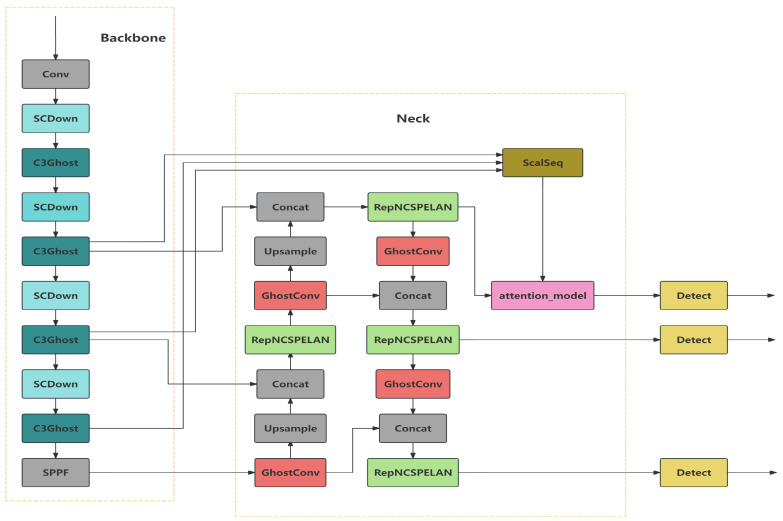
Defect detection constitutes one of the most crucial processes in industrial production. With a continuous increase in the number of defect categories and samples, the defect detection model underpinned by deep learning finds it challenging to expand to new categories, and the accuracy and real-time performance of product defect detection are also confronted with severe challenges. This paper addresses the problem of insufficient detection accuracy of existing lightweight models on resource-constrained edge devices by presenting a new lightweight YoloV5 model, which integrates four modules, SCDown, GhostConv, RepNCSPELAN4, and ScalSeq. Here, this paper abbreviates it as SGRS-YoloV5n. Through the incorporation of these modules, the model notably enhances feature extraction and computational efficiency while reducing the model size and computational load, making it more conducive for deployment on edge devices. Furthermore, a cloud-edge collaborative defect detection system is constructed to improve detection accuracy and efficiency through initial detection by edge devices, followed by additional inspection by cloud servers. An incremental learning mechanism is also introduced, enabling the model to adapt promptly to new defect categories and update its parameters accordingly. Experimental results reveal that the SGRS-YoloV5n model exhibits superior detection accuracy and real-time performance, validating its value and stability for deployment in resource-constrained environments. This system presents a novel solution for achieving efficient and accurate real-time defect detection.
Overview
CoChat Summary
## TL;DR
This paper proposes SGRS-YoloV5n, a lightweight YOLOv5n-based defect detector with GhostConv, SCDown, RepNCSPELAN4, and ScalSeq, plus a cloud-edge collaborative workflow for low-latency inspection. It also adds an incremental learning scheme to incorporate new defect categories without full retraining.
## Key findings
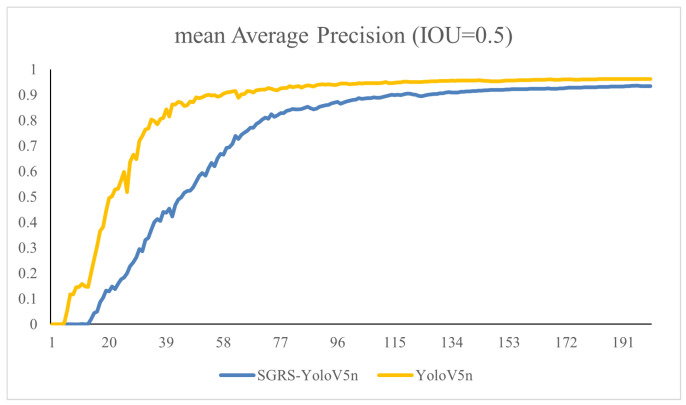
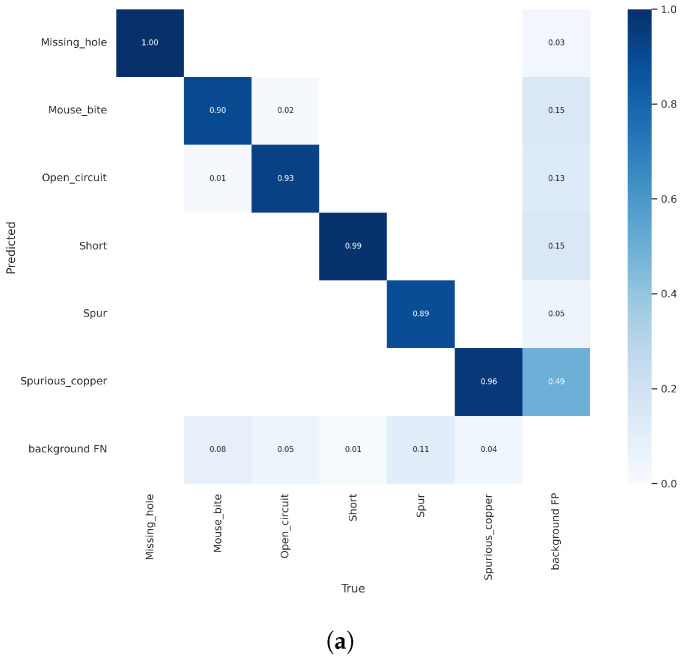
- On the PCB defect dataset, the paper reports the model with all optimization modules achieves 2.7 GFLOPS, mAP 0.935, precision 0.971, and recall 0.900.
- An ablation result reported mAP up to 0.923 with 3.1 GFLOPS for the backbone using SCDown + GhostConv; adding RepNCSPELAN4 gave mAP 0.924 and 2.4 GFLOPS.
- Adding ScalSeq + attention-model raised performance to mAP 0.938 and recall 0.902, though with higher GFLOPS.
- For model size/computation comparison, the paper reports SGRS-YoloV5n is 2.2 MB versus Faster R-CNN’s 76.1 MB, with 2.7 GFLOPs versus 16.87 GFLOPs.
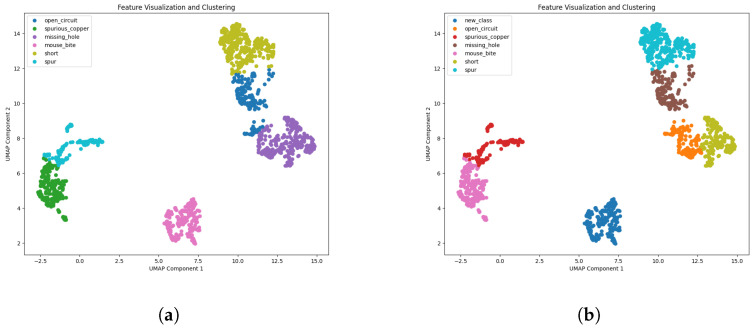
- In the incremental learning experiment, after adding a seventh defect class (Pad-damage) to a six-class PCB dataset, mAP@0.5 reached 0.338 after simple training.
## Methods
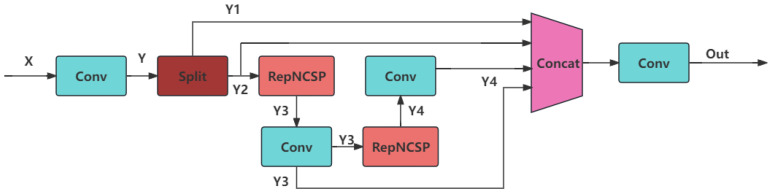
- The paper designs a lightweight YOLOv5n variant (SGRS-YoloV5n) by integrating GhostConv, C3Ghost, SCDown, RepNCSPELAN4, and ScalSeq to improve feature extraction while reducing computation.
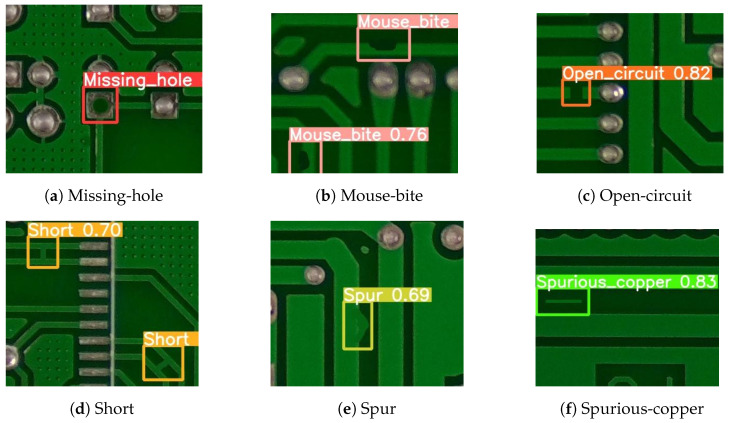
- It evaluates the method on a public synthetic PCB dataset from Peking University’s Open Laboratory for Intelligent Robotics: 1386 images, expanded to 6237 images by brightness/contrast adjustment, rotation, and flipping; the split is 8:1:1 for training/test/validation.
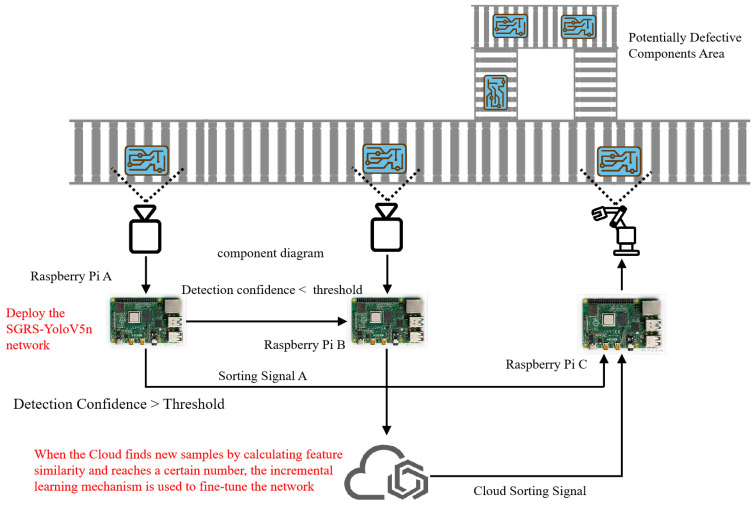
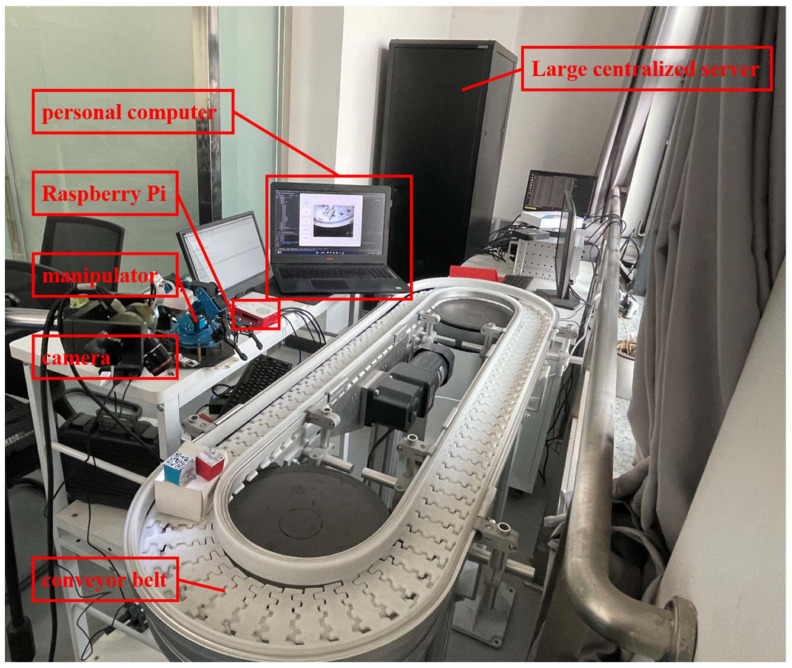
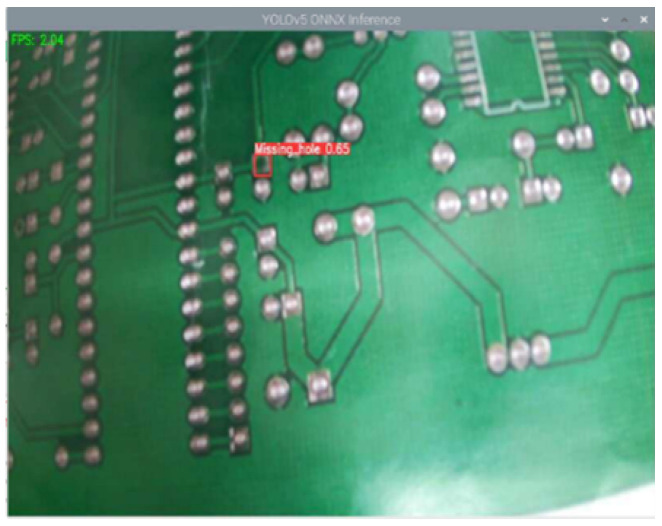
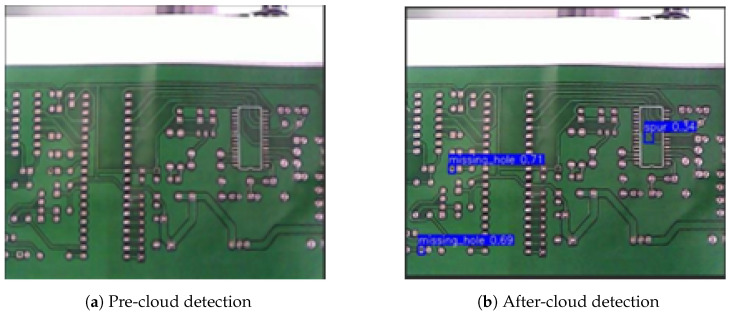
- Main analysis includes ablation experiments, comparison with Faster R-CNN and YOLO variants, and a cloud-edge collaborative detection deployment using Raspberry Pi 4 edge devices and a cloud server; incremental learning uses EfficientNet-B0 features, cosine similarity, and fine-tuning with frozen layers.
## Limitations
- The paper states that in the incremental learning experiment, further optimization is needed to balance detection capabilities of new and old categories.
- Evident from the text: the reported incremental learning result for the new class is low (mAP@0.5 = 0.338 after simple training), suggesting the method is not yet strong for new-category adaptation.
- Evident from the text: the method is evaluated on a single PCB defect dataset, so broader generalization beyond this dataset is not demonstrated in the provided text.
Model-written summary. Check it against the paper before relying on it.
Integrity signals
Registry
Cites
Statistics
Figures



Verification
Claims the paper makes
4 Valid · 0 Not valid · 2 Not checked · 25 Own results and interpretations
Every source the paper cites for this claim was checked and supports it.
In the paper
“Referring to [24], this paper embraces a paradigm of knowledge renewal, namely, forgetting before learning, and implements it in defect detection.”
§ Cloud-Edge Collaborative Defect Detection Based on Efficient Yolo Networks and Incremental Learning > 2. Materials and Methods > 2.3. Incremental Learning Mechanism
What the sources say
- Supportedcites [24] Ni, S., Chen, D., Li, C., Hu, X., Xu, R., and Yang, M. (2023). Forgetting before learning: Utilizing parametric arithmetic for knowledge updating in large language models. arXiv. source
The Abstract and Introduction (p. 1) of our copy define the 'Forgetting before Learning' (F-Learning) paradigm — first forget old knowledge via parametric subtraction, then fine-tune on data containing new knowledge — and state that it 'obviously improve[s] the knowledge updating performance of both full fine-tuning and LoRA fine-tuning, simultaneously outperforming the existing baselines in most cases'. Section 4.2 formalises the new-knowledge learning step and the Conclusion (Section 7) confirms gains on zsRE and COUNTERFACT. The citing sentence's own application to defect detection is the citing authors' contribution and is not judged here. (LLM, conf=0.90)
plainstates a cause- Asserted: passes — The authors put it forward as true.
- Checkable: passes — It can be checked against evidence.
- Load-bearing: passes — The paper’s conclusions depend on it.
- Based: passes — The paper gives a reason why it holds.
- Supported
Every source the paper cites for this claim was checked and supports it.
In the paper
“Relying solely on edge devices may not handle all complex or rare defects, affecting overall inspection results, whereas relying entirely on cloud computing may encounter bottlenecks in network latency and data transmission [6].”
§ Cloud-Edge Collaborative Defect Detection Based on Efficient Yolo Networks and Incremental Learning > 1. Introduction
What the sources say
- Supportedcites [6] Liang, 2022, Edge yolo: Real-time intelligent object detection system based on edge-cloud cooperation in autonomous vehicles, IEEE Trans. Intell. Transp. Syst. source
The Introduction says cloud computing can struggle to ensure real-time performance and faces insufficient communication resources. In “D. Comparation With Cloud Computing,” the paper reports that transmission delay slows cloud-based processing and increases as more images are sent. The supplied passages do not give page numbers. (LLM, conf=0.93)
hedgedstates a possible cause- Asserted: passes — The authors put it forward as true.
- Checkable: passes — It can be checked against evidence.
- Load-bearing: passes — The paper’s conclusions depend on it.
- Based: passes — The paper gives a reason why it holds.
- Supported
The sources with a verdict support this claim; the rest weren’t checked yet, have no full text we could read, or their verdicts aren’t rated yet.
In the paper
“Lightweight models, such as MobileNet [4] and ShuffleNet [5], although optimized in terms of computation and model size, are often inferior to full-size models in terms of detection accuracy.”
§ Cloud-Edge Collaborative Defect Detection Based on Efficient Yolo Networks and Incremental Learning > 1. Introduction
What the sources say
- Supportedcites [4] Howard, A.G., Zhu, M., Chen, B., Kalenichenko, D., Wang, W., Weyand, T., Andreetto, M., and Adam, H. (2017). Mobilenets: Efficient convolutional neural networks for mobile vision applications. arXiv. source
Section 4.6 (p. 7), Table 13 reports that MobileNet uses fewer parameters and less computation than the comparison networks and has lower COCO detection mAP in five of six matched comparisons. The paper calls the results comparable, but the table supports the citing sentence’s qualified claim that detection accuracy is often lower. ShuffleNet is attributed to a separate citation and is not assessed here. (LLM, conf=0.90)
- Not checked — no full text of the sourcecites [5] Zhang, X., Zhou, X., Lin, M., and Sun, J. (2018, January 18–23). Shufflenet: An extremely efficient convolutional neural network for mobile devices. Proceedings of the IEEE Conference on Computer Vision and Pattern Recognition, Salt Lake City, UT, USA. source
plainstates an association- Asserted: passes — The authors put it forward as true.
- Checkable: passes — It can be checked against evidence.
- Load-bearing: passes — The paper’s conclusions depend on it.
- Based: passes — The paper gives a reason why it holds.
- Supported
The cited sources support only part of this claim — read each source’s verdict below.
In the paper
“Relying solely on edge devices may not handle all complex or rare defects, affecting overall inspection results, whereas relying entirely on cloud computing may encounter bottlenecks in network latency and data transmission [6].”
§ Cloud-Edge Collaborative Defect Detection Based on Efficient Yolo Networks and Incremental Learning > 1. Introduction
What the sources say
- Partly supportedcites [6] Liang, 2022, Edge yolo: Real-time intelligent object detection system based on edge-cloud cooperation in autonomous vehicles, IEEE Trans. Intell. Transp. Syst. sourceExperimental — accuracy not yet measured
The Introduction (page unavailable) identifies real-time performance, communication resources, and image-transmission costs as limitations of cloud computing. It also notes limited edge computing power, but the paper concerns object detection in autonomous vehicles and does not establish that edge-only inspection misses complex or rare defects or worsens inspection results. (LLM, conf=0.86)
hedgedstates a possible cause- Asserted: passes — The authors put it forward as true.
- Checkable: passes — It can be checked against evidence.
- Load-bearing: passes — The paper’s conclusions depend on it.
- Based: passes — The paper gives a reason why it holds.
- Partly supported
A result the paper reports from its own data — it cites no other source for it, so there is none to check. The quote shows it is in the paper.
In the paper
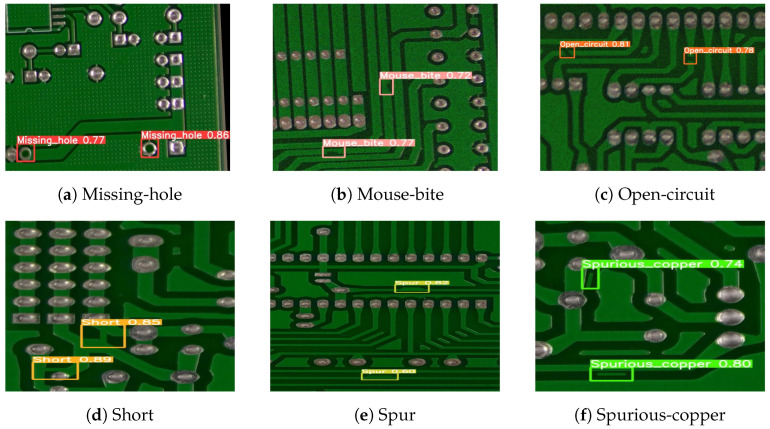
“Compared to other YoloV5 variants, SGRS-YoloV5n greatly reduces model size and computation, outperforming other models in the Missing-hole and Short categories.”
§ Cloud-Edge Collaborative Defect Detection Based on Efficient Yolo Networks and Incremental Learning > 3. Experimental Analysis > 3.4. Model Performance Comparison
plainstates a cause- Asserted: passes — The authors put it forward as true.
- Checkable: passes — It can be checked against evidence.
- Load-bearing: passes — The paper’s conclusions depend on it.
- Based: passes — The paper gives a reason why it holds.
5 more claims
Create a free account to see all 31 claims and to verify the 1 reference still open.
- It may state two separate claims as one. 19
- The quote only partly states this claim. 1
- Probably not a substantial claim. 5
Citations
Cites
MobileNets: Efficient Convolutional Neural Networks for Mobile Vision Applications
Howard, A. G., Zhu, M., Chen, B., Kalenichenko, D., Wang, W., Weyand, T., Andreetto, M., & Adam, H. (2017) · arXiv · doi:10.48550/arxiv.1704.04861 · Cited by 19,015
Distilling the Knowledge in a Neural Network
Hinton, G., Vinyals, O., & Dean, J. (2015) · arXiv · doi:10.48550/arxiv.1503.02531 · Cited by 14,204
YOLOv7: Trainable Bag-of-Freebies Sets New State-of-the-Art for Real-Time Object Detectors
Wang, C.-Y., Bochkovskiy, A., & Liao, H.-Y. M. (2023) · 2023 IEEE/CVF Conference on Computer Vision and Pattern Recognition (CVPR) · doi:10.1109/cvpr52729.2023.00721 · Cited by 13,198 · cited 1×
“For example, YOLOv7 and YOLOv8 have been optimized in terms of detection speed and accuracy, and have improved circuit board defect detection by introducing more efficient network architectures and data enhancement techniques [7].”
MethodShuffleNet: An Extremely Efficient Convolutional Neural Network for Mobile Devices
Zhang, X., Zhou, X., Lin, M., & Sun, J. (2018) · 2018 IEEE/CVF Conference on Computer Vision and Pattern Recognition · doi:10.1109/cvpr.2018.00716 · Cited by 9,982
EfficientDet: Scalable and Efficient Object Detection
Tan, M., Pang, R., & Le, Q. V. (2019) · arXiv · Cited by 9,841
ShuffleNet V2: Practical Guidelines for Efficient CNN Architecture Design
Ma, N., Zhang, X., Zheng, H.-T., & Sun, J. (2018) · Lecture notes in computer science · doi:10.1007/978-3-030-01264-9_8 · Cited by 7,356 · cited 1×
“ShuffleNetV2 [12] improves computational efficiency by optimizing channel segmentation and information flow.”
BackgroundCSPNet: A New Backbone that can Enhance Learning Capability of CNN
Wang, C.-Y., Mark Liao, H.-Y., Wu, Y.-H., Chen, P.-Y., Hsieh, J.-W., & Yeh, I.-H. (2020) · 2020 IEEE/CVF Conference on Computer Vision and Pattern Recognition Workshops (CVPRW) · doi:10.1109/cvprw50498.2020.00203 · Cited by 5,265 · cited 1×
“For example, GhostNetv2 [16] improves computational efficiency by reducing redundant computation through the introduction of the Ghost module, and CSPNetv2 [17] reduces computation by partially connecting across stages while retaining more feature information.”
MethodGhostNet: More Features From Cheap Operations
Han, K., Wang, Y., Tian, Q., Guo, J., Xu, C., & Xu, C. (2020) · 2020 IEEE/CVF Conference on Computer Vision and Pattern Recognition (CVPR) · doi:10.1109/cvpr42600.2020.00165 · Cited by 5,222 · cited 3×
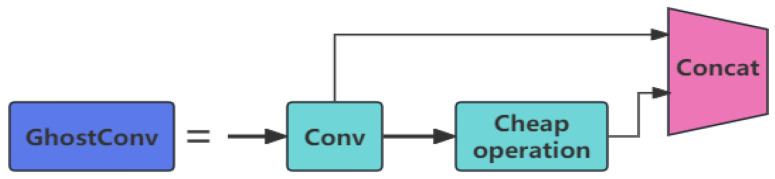
“The GhostConv module is a lightweight convolutional operation proposed in Ghost-Net [16], which aims to reduce the computational and parametric counts while maintaining the expressive power of the model.”
BackgroundMethodYOLOv9: Learning What You Want to Learn Using Programmable Gradient Information
Wang, C.-Y., Yeh, I.-H., & Mark Liao, H.-Y. (2025) · Lecture Notes in Computer Science · doi:10.1007/978-3-031-72751-1_1 · Cited by 4,823
Quantization and Training of Neural Networks for Efficient Integer-Arithmetic-Only Inference
Jacob, B., Kligys, S., Chen, B., Zhu, M., Tang, M., Howard, A., Adam, H., & Kalenichenko, D. (2018) · 2018 IEEE/CVF Conference on Computer Vision and Pattern Recognition · doi:10.1109/cvpr.2018.00286 · Cited by 4,114 · cited 1×
“…[13]; the quantization technique reduces computation and storage costs by lowering the accuracy of model parameters (e.g., 8-bit quantization) [14]; and the knowledge distillation technique enables small models to be more computationally efficient while maintaining a high level of accuracy by…”
Background
Cited by
Wang, Z., Lan, X., Zhou, Y. Z., Wang, F., Wang, M., Chen, Y., Zhou, G., & Hu, Q. (2024) · Energies · doi:10.3390/en17246404 · Cited by 17
Liao, K.-C., Lau, J., & Hidayat, M. (2025) · Aerospace · doi:10.3390/aerospace12010031 · Cited by 8
“Despite the successful detections, certain challenges persist, particularly in detection of subtle defects such as paint o ff and scratches, which achieved mAP@0.”
Ahmad, I., Kim, J., & Shin, S. (2025) · IEEE Internet of Things Journal · doi:10.1109/jiot.2025.3558289 · Cited by 8
“In the latter case, for consistent accurate predictions over a longer period, several works [8], [9], [10], [11], [12], [13] implemented a cloud–edge collaborative training framework that shares data with CS to continually update the pretrained model.”
A systematic literature review of lightweight YOLO models for object detection
Wang, L., Wang, H., Letchmunan, S., Xiao, R., Ahmed, O. H., & Liu, Z. (2025) · PeerJ Computer Science · doi:10.7717/peerj-cs.3357 · Cited by 18
Chen, R., Zhu, Z., Shen, B., Zeng, J., Yang, Z., Yang, X., & Yao, L. (2025) · Applied Sciences · doi:10.3390/app15179767 · Cited by 5
Metadata
- Authors
- Lei, Z., Zhang, Y., Wang, J., & Zhou, M.
- Affiliations
- North China University of Technology (CN)
- Corresponding author
- Wang, Jing
- Venue
- Sensors
- Publisher
- MDPI AG
- Published
- 2024-09-12
- Volume
- 24
- Issue
- 18
- Pages
- 5921
- ISSN
- 1424-8220 (ISSN-L)
- PMC
- PMC11435656
- OpenAlex
- W4402483118
- Cited by
- 16
- References
- 19
- Citations by year
- 2026: 7 · 2025: 8 · 2024: 1
- FWCI
- 3.26
- Type
- journal article
- Language
- en
- Open access
- gold
- doi.org
- Licence
- Locations
- Sensors (publishedVersion, cc-by)
- PubMed Central (publishedVersion, cc-by)
- PubMed (publishedVersion)
- DOAJ (DOAJ: Directory of Open Access Journals) (submittedVersion, cc-by-sa)
- Funders
- National Natural Science Foundation of China (62373005, 62273007)
- Topics
- Physical Sciences › Engineering › Industrial and Manufacturing Engineering › Industrial Vision Systems and Defect Detection
- Physical Sciences › Computer Science › Computer Vision and Pattern Recognition › Advanced Neural Network Applications
- Physical Sciences › Engineering › Civil and Structural Engineering › Infrastructure Maintenance and Monitoring
- Keywords
- product defect detection, cloud-edge collaboration, YOLOv5, incremental learning, edge devices, resource-constrained deployment, real-time object detection, industrial inspection, GhostConv
About these checks
Registry, retraction, Cites and statistics results are computed, not judged, with one exception: a printed reference that no index lists is read once by a model before it counts as a citation error. Claims are extracted by a model and kept only when their quote appears verbatim in the text; each cited source is then checked, with a model’s help, for whether it says what the claim relies on. Those verdicts can be wrong — read the claim’s quote and the cited source before relying on one.
The claim verdicts this report counts are experimental: their accuracy is not yet measured.
A language model drew the claims from the paper on 2026-10-10, under version 3 of the claim definition (model deepseek-v4.1-flash, prompt extract-v3).
A second model labelled each claim on 2026-10-10 (model jev-1.13-20260917, definition revision gold-guideline-v0.2).
Cited sources are checked with a language model’s help (qwen3.8-omni-flash and gpt-6-sol).
Statistics and arithmetic are recomputed, not judged.
Confidence bands are shown only for fields calibrated on our annotated test set. None is calibrated yet, so no band is shown.
What counts as a claim ›How we measure confidence ›How we check this ›
Are you an author, or do you see a problem with this page? Request a review
How to cite
Cite CoChat for the checks on this page, and the paper for its own findings.
- This page
- CoChat. (2026). Citation check: Cloud-Edge Collaborative Defect Detection Based on Efficient Yolo Networks and Incremental Learning. https://app.cochat.ai/papers/10.3390/s24185921
- The paper
- Lei, Z., Zhang, Y., Wang, J., & Zhou, M. (2024). Cloud-Edge Collaborative Defect Detection Based on Efficient Yolo Networks and Incremental Learning. Sensors. https://doi.org/10.3390/s24185921
Data sources
Bibliographic data: Semantic Scholar, OpenAlex, Crossref.
Contains information from the Semantic Scholar Academic Graph Datasets, made available under the ODC Attribution License (ODC-BY 1.0).
Semantic Scholar’s data is described in: Kinney, R., et al. (2023). The Semantic Scholar Open Data Platform. arXiv:2301.10140.
