

The DOI matches its Crossref record; 32 of the 32 references it cites were found in a registry or an index.
Sustainable Curriculum Planning for Artificial Intelligence Education: A Self-Determination Theory Perspective
Open accessAbstract
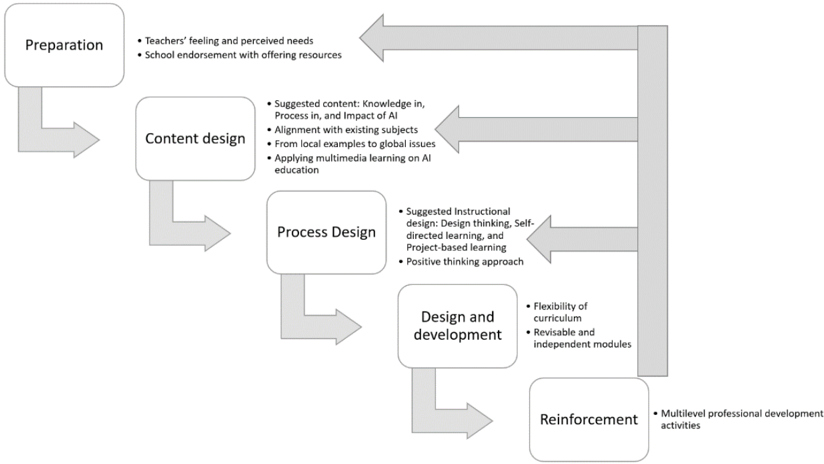
The teaching of artificial intelligence (AI) topics in school curricula is an important global strategic initiative in educating the next generation. As AI technologies are new to K-12 schools, there is a lack of studies that inform schools’ teachers about AI curriculum design. How to prepare and engage teachers, and which approaches are suitable for planning the curriculum for sustainable development, are unclear. Therefore, this case study aimed to explore the views of teachers with and without AI teaching experience on key considerations for the preparation, implementation and continuous refinement of a formal AI curriculum for K-12 schools. It drew on the self-determination theory (SDT) and four basic curriculum planning approaches—content, product, process and praxis—as theoretical frameworks to explain the research problems and findings. We conducted semi-structured interviews with 24 teachers—twelve with and twelve without experience in teaching AI—and used thematic analysis to analyze the interview data. Our findings revealed that genuine curriculum creation should encompass all four forms of curriculum design approach that are coordinated by teachers’ self-determination to be orchestrators of student learning experiences. This study also proposed a curriculum development cycle for teachers and curriculum officers.
Overview
The claims and statistics of this paper haven’t been checked yet.
Free: it reads the open-access text and checks the first 5 claims that cite a source we can check. Create a free account to check every claim.
Integrity signals
Registry
Cites
Statistics
Figures

Verification
Claims the paper makes
The claims and statistics of this paper haven’t been checked yet.
Free: it reads the open-access text and checks the first 5 claims that cite a source we can check. Create a free account to check every claim.
Claims other papers make about this one
Each is checked against this paper’s own text: does it say what the citing paper says it does?
The cited source doesn’t support the claim as written.
In the citing paper
“Teachers are key players for the integration of AI literacy in K-12, as proven by the numerous studies that examine this issue”
From AI literacy in K-12: a systematic literature review (2023) · cites this paper as Chiu & Chai, 2020
Checked by a reasoning model — may be wrong.
Experimental — accuracy not yet measuredThe source backs part of the claim, not all of it — or backs it for a different population, condition or comparison.
In the citing paper
“Although AI education in schools has become a global initiative, it is not seen as a traditional core subject, such as language, mathematics, and science (Chiu & Chai, 2020).”
From The impact of Generative AI (GenAI) on practices, policies and research direction in education: a case of ChatGPT and Midjourney (2024) · cites this paper as Chiu & Chai, 2020
Experimental — accuracy not yet measuredThe cited source says what the claim attributes to it.
In the citing paper
“Furthermore, the initial version of the instrument was developed by adapting a list of prior research such as Chiu & Chai (2020, Ng & Chu, 2021)'s and Ng & Chu (2021)'s questionnaire, the Motivational Strategies for Learning Questionnaire (MSLQ), Park et al. (2012)'s behavioural intention, Song and Keller (1999)'s confidence scale and ethical guidelines (Jobin et al., 2019;Microsoft, 2023).”
From Design and validation of the AI literacy questionnaire: The affective, behavioural, cognitive and ethical approach (2024) · cites this paper as Chiu & Chai (2020)
The check wasn’t confident either way, so it gives no verdict — never disputed.
In the citing paper
“Only a few of the studies have validated their questionnaires and even less retested them to ensure reliability in other settings (Chai et al., 2021;Chiu & Chai., 2020;Dai et al., 2020).”
From Design and validation of the AI literacy questionnaire: The affective, behavioural, cognitive and ethical approach (2024) · cites this paper as Chiu & Chai., 2020
Experimental — accuracy not yet measured
Self-check
Percentages, sums and reported differences re-computed from the paper’s own numbers.
The self-check needs the paper’s full text.
Citations
Cites
Using thematic analysis in psychology
Braun, V., & Clarke, V. (2006) · Qualitative Research in Psychology · doi:10.1191/1478088706qp063oa · Cited by 194,414
Ryan, R. M., & Deci, E. L. (2000) · American Psychologist · doi:10.1037//0003-066x.55.1.68 · Cited by 54,599
Zawacki-Richter, O., Marín, V. I., Bond, M., & Gouverneur, F. (2019) · International Journal of Educational Technology in Higher Education · doi:10.1186/s41239-019-0171-0 · Cited by 7,242 · cited 3×
“To date, very few studies on AI school teaching have been conducted [1,5,6].”
BackgroundPurposive sampling as a tool for informant selection
Tongco, M. D. C. (2007) · Ethnobotany Research and Applications · doi:10.17348/era.5.0.147-158 · Cited by 2,597 · cited 1×
“Therefore, we used purposeful sampling [19] to make sure that participants with all the conditions were recruited (broad categorization of the academic ability of students and AI teaching experience) from the pool of 48 partnership schools.”
MethodNiemiec, C. P., & Ryan, R. M. (2009) · Theory and Research in Education · doi:10.1177/1477878509104318 · Cited by 2,542
Teachers’ Perception of STEM Integration and Education: A Systematic Literature Review
Margot, K. C., & Kettler, T. (2019) · International Journal of STEM Education · doi:10.1186/s40594-018-0151-2 · Cited by 992 · cited 3×
“Therefore, schools should take immediate actions rather than make prolonged promises [10,25], and technology teachers prefer to receive direct, rather than indirect, support [9,25].”
BackgroundResultWang, Y.-Y., & Wang, Y.-S. (2022) · Interactive Learning Environments · doi:10.1080/10494820.2019.1674887 · Cited by 716
Achieving Saturation in Thematic Analysis: Development and Refinement of a Codebook
Ando, H., Cousins, R., & Young, C. (2014) · Comprehensive Psychology · doi:10.2466/03.cp.3.4 · Cited by 577
Hopes and fears for intelligent machines in fiction and reality
Cave, S., & Dihal, K. (2019) · Nature Machine Intelligence · doi:10.1038/s42256-019-0020-9 · Cited by 355
What do engineering students learn in sustainability courses? The effect of the pedagogical approach
Segalàs, J., Ferrer-Balas, D., & Mulder, K. F. (2010) · Journal of Cleaner Production · doi:10.1016/j.jclepro.2009.09.012 · Cited by 302 · cited 1×
“This approach supports different types of students to better understand the complex world of AI by ensuring the participation of more students [34].”
Background
Research works printed but not linked: 1
- Glatthorn, A.A., Boschee, F., Whitehead, B.M., and Boschee, B.F. (2018). Curriculum Leadership: Strategies for Development and Implementation, SAGE.
Cited by
Celik, I. (2023) · Computers in Human Behavior · doi:10.1016/j.chb.2022.107468 · Cited by 1,012
The promises and challenges of artificial intelligence for teachers: A systematic review of research
Celik, I., Dindar, M., Muukkonen, H., & Järvelä, S. (2022) · TechTrends · doi:10.1007/s11528-022-00715-y · Cited by 984
“…Lu (2019) Lack of technological knowledge of teachers on AI use Teachers may not have the technological knowledge needed for AI-based teaching 1 Chiu and Chai (2020) Lack of interest of teachers in AI Teachers may perceive AI as uninteresting and unenjoyable for teaching 1 McCarthy et al.”
BackgroundChiu, T. K. F. (2024) · Interactive Learning Environments · doi:10.1080/10494820.2023.2253861 · Cited by 852
“Although AI education in schools has become a global initiative, it is not seen as a traditional core subject, such as language, mathematics, and science (Chiu & Chai, 2020).”
Self-citationTeachers’ AI digital competencies and twenty-first century skills in the post-pandemic world
(2023) · doi:10.1007/s11423-023-10203-6 · Cited by 734
AI literacy in K-12: a systematic literature review
Casal-Otero, L., Catala, A., Fernández-Morante, C., Taboada, M., Cebreiro, B., & Barro, S. (2023) · International Journal of STEM Education · doi:10.1186/s40594-023-00418-7 · Cited by 724
Metadata
- Authors
- Chiu, T. K. F., & Chai, C.-S.
- Affiliations
- Chinese University of Hong Kong (HK)
- Corresponding author
- Chiu, Thomas K.F.
- Venue
- Sustainability
- Publisher
- MDPI AG
- Published
- 2020-07-10
- Volume
- 12
- Issue
- 14
- Pages
- 5568
- ISSN
- 2071-1050 (ISSN-L)
- OpenAlex
- W3041706899
- Cited by
- 448
- References
- 32
- Citations by year
- 2026: 98 · 2025: 133 · 2024: 102 · 2023: 62 · 2022: 36 · 2021: 16 · 2020: 1
- FWCI
- 27.05
- Type
- journal article
- Language
- en
- Open access
- gold
- dx.doi.org
- Licence
- Locations
- Sustainability (publishedVersion, cc-by)
- RePEc: Research Papers in Economics (submittedVersion)
- DOAJ (DOAJ: Directory of Open Access Journals) (submittedVersion)
- Topics
- Social Sciences › Education › Artificial Intelligence in Education
- Physical Sciences › Computer Science › Computer Science Applications › Teaching and Learning Programming
- Social Sciences › Education › Educational Curriculum and Learning Methods
- Keywords
- artificial intelligence in education, AI curriculum design, K-12 schools, self-determination theory, teacher perceptions, teacher preparation, sustainable development
About these checks
Registry, retraction, Cites and statistics results are computed, not judged, with one exception: a printed reference that no index lists is read once by a model before it counts as a citation error. Claims are extracted by a model and kept only when their quote appears verbatim in the text; each cited source is then checked, with a model’s help, for whether it says what the claim relies on. Those verdicts can be wrong — read the claim’s quote and the cited source before relying on one.
Statistics and arithmetic are recomputed, not judged.
Confidence bands are shown only for fields calibrated on our annotated test set. None is calibrated yet, so no band is shown.
What counts as a claim ›How we measure confidence ›How we check this ›
Are you an author, or do you see a problem with this page? Request a review
How to cite
Cite CoChat for the checks on this page, and the paper for its own findings.
- This page
- CoChat. (2026). Citation check: Sustainable Curriculum Planning for Artificial Intelligence Education: A Self-Determination Theory Perspective. https://app.cochat.ai/papers/10.3390/su12145568
- The paper
- Chiu, T. K. F., & Chai, C.-S. (2020). Sustainable Curriculum Planning for Artificial Intelligence Education: A Self-Determination Theory Perspective. Sustainability. https://doi.org/10.3390/su12145568
Data sources
Bibliographic data: Semantic Scholar, OpenAlex, Crossref.
Contains information from the Semantic Scholar Academic Graph Datasets, made available under the ODC Attribution License (ODC-BY 1.0).
Semantic Scholar’s data is described in: Kinney, R., et al. (2023). The Semantic Scholar Open Data Platform. arXiv:2301.10140.
