

Sustainable Curriculum Planning for Artificial Intelligence Education: A Self-Determination Theory Perspective
Open accessThe DOI matches its Crossref record; 32 of the 32 references it cites were found in a registry or an index.
Abstract
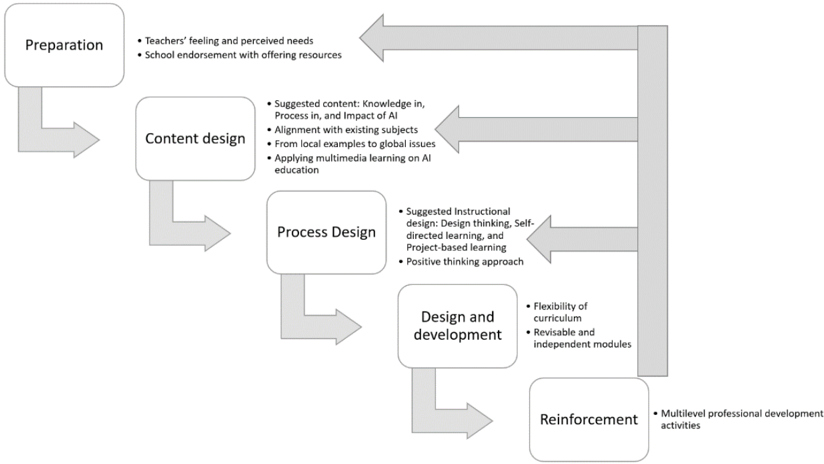
The teaching of artificial intelligence (AI) topics in school curricula is an important global strategic initiative in educating the next generation. As AI technologies are new to K-12 schools, there is a lack of studies that inform schools’ teachers about AI curriculum design. How to prepare and engage teachers, and which approaches are suitable for planning the curriculum for sustainable development, are unclear. Therefore, this case study aimed to explore the views of teachers with and without AI teaching experience on key considerations for the preparation, implementation and continuous refinement of a formal AI curriculum for K-12 schools. It drew on the self-determination theory (SDT) and four basic curriculum planning approaches—content, product, process and praxis—as theoretical frameworks to explain the research problems and findings. We conducted semi-structured interviews with 24 teachers—twelve with and twelve without experience in teaching AI—and used thematic analysis to analyze the interview data. Our findings revealed that genuine curriculum creation should encompass all four forms of curriculum design approach that are coordinated by teachers’ self-determination to be orchestrators of student learning experiences. This study also proposed a curriculum development cycle for teachers and curriculum officers.
Overview
The claims and statistics of this paper haven’t been checked yet.
Free: it reads the open-access text and checks the first 5 claims that cite a source we can check. Create a free account to check every claim.
Integrity signals
Registry
Cites
Statistics
Figures

Verification
Claims the paper makes
The claims and statistics of this paper haven’t been checked yet.
Free: it reads the open-access text and checks the first 5 claims that cite a source we can check. Create a free account to check every claim.
Claims other papers make about this one
Each is checked against this paper’s own text: does it say what the citing paper says it does?
The cited source doesn’t support the claim as written.
In the citing paper
“Teachers are key players for the integration of AI literacy in K-12, as proven by the numerous studies that examine this issue”
From AI literacy in K-12: a systematic literature review (2023) · cites this paper as Chiu & Chai, 2020
Checked by a reasoning model — may be wrong.
Experimental — accuracy not yet measuredThe source backs part of the claim, not all of it — or backs it for a different population, condition or comparison.
In the citing paper
“Although AI education in schools has become a global initiative, it is not seen as a traditional core subject, such as language, mathematics, and science (Chiu & Chai, 2020).”
From The impact of Generative AI (GenAI) on practices, policies and research direction in education: a case of ChatGPT and Midjourney (2024) · cites this paper as Chiu & Chai, 2020
Experimental — accuracy not yet measuredThe cited source says what the claim attributes to it.
In the citing paper
“Furthermore, the initial version of the instrument was developed by adapting a list of prior research such as Chiu & Chai (2020, Ng & Chu, 2021)'s and Ng & Chu (2021)'s questionnaire, the Motivational Strategies for Learning Questionnaire (MSLQ), Park et al. (2012)'s behavioural intention, Song and Keller (1999)'s confidence scale and ethical guidelines (Jobin et al., 2019;Microsoft, 2023).”
From Design and validation of the AI literacy questionnaire: The affective, behavioural, cognitive and ethical approach (2024) · cites this paper as Chiu & Chai (2020)
The check wasn’t confident either way, so it gives no verdict — never disputed.
In the citing paper
“Only a few of the studies have validated their questionnaires and even less retested them to ensure reliability in other settings (Chai et al., 2021;Chiu & Chai., 2020;Dai et al., 2020).”
From Design and validation of the AI literacy questionnaire: The affective, behavioural, cognitive and ethical approach (2024) · cites this paper as Chiu & Chai., 2020
Experimental — accuracy not yet measured
Self-check
Percentages, sums and reported differences re-computed from the paper’s own numbers.
The self-check needs the paper’s full text.
Citations
Cites
Using thematic analysis in psychology
Braun, V., & Clarke, V. (2006) · Qualitative Research in Psychology · doi:10.1191/1478088706qp063oa · Cited by 194,414 · cited 1×
“This offers a useful method for working within a participatory research paradigm to inform policy/curriculum development [21].”
MethodRyan, R. M., & Deci, E. L. (2000) · American Psychologist · doi:10.1037//0003-066x.55.1.68 · Cited by 54,599 · cited 4×
“This motivational process can be explained by the self-determination theory (SDT), which provides a theoretical framework to explain the teachers’ fundamental psychological needs—autonomy, relatedness and competence—for educational innovation [11,12].”
BackgroundMethodInfluentialZawacki-Richter, O., Marín, V. I., Bond, M., & Gouverneur, F. (2019) · International Journal of Educational Technology in Higher Education · doi:10.1186/s41239-019-0171-0 · Cited by 7,242 · cited 3×
“To date, very few studies on AI school teaching have been conducted [1,5,6].”
BackgroundPurposive sampling as a tool for informant selection
Tongco, M. D. C. (2007) · Ethnobotany Research and Applications · doi:10.17348/era.5.0.147-158 · Cited by 2,597 · cited 1×
“Therefore, we used purposeful sampling [19] to make sure that participants with all the conditions were recruited (broad categorization of the academic ability of students and AI teaching experience) from the pool of 48 partnership schools.”
MethodNiemiec, C. P., & Ryan, R. M. (2009) · Theory and Research in Education · doi:10.1177/1477878509104318 · Cited by 2,542
Teachers’ Perception of STEM Integration and Education: A Systematic Literature Review
Margot, K. C., & Kettler, T. (2019) · International Journal of STEM Education · doi:10.1186/s40594-018-0151-2 · Cited by 992 · cited 3×
“Therefore, schools should take immediate actions rather than make prolonged promises [10,25], and technology teachers prefer to receive direct, rather than indirect, support [9,25].”
BackgroundResultWang, Y.-Y., & Wang, Y.-S. (2022) · Interactive Learning Environments · doi:10.1080/10494820.2019.1674887 · Cited by 716 · cited 2×
“As machine learning becomes more powerful and narrow AI are performing more jobs, AI technologies and products are replacing jobs such as cashiers and proofreaders [17].”
BackgroundAchieving Saturation in Thematic Analysis: Development and Refinement of a Codebook
Ando, H., Cousins, R., & Young, C. (2014) · Comprehensive Psychology · doi:10.2466/03.cp.3.4 · Cited by 577 · cited 1×
“The sample size of 24 has been recommended by Ando, Cousins and Young [20] as sufficient to generate codes for thematic analysis.”
MethodHopes and fears for intelligent machines in fiction and reality
Cave, S., & Dihal, K. (2019) · Nature Machine Intelligence · doi:10.1038/s42256-019-0020-9 · Cited by 355 · cited 1×
“This is supported by the studies that generally find that peoples’ perceived worries of loss of control of AI, ethical concerns about AI and the negative impact of AI on work have grown in recent years [18,28].”
ResultWhat do engineering students learn in sustainability courses? The effect of the pedagogical approach
Segalàs, J., Ferrer-Balas, D., & Mulder, K. F. (2010) · Journal of Cleaner Production · doi:10.1016/j.jclepro.2009.09.012 · Cited by 302 · cited 1×
“This approach supports different types of students to better understand the complex world of AI by ensuring the participation of more students [34].”
Background
Research works printed but not linked: 1
- Glatthorn, A.A.; Boschee, F.; Whitehead, B.M.; Boschee, B.F. Curriculum Leadership: Strategies for Development and Implementation; SAGE: London, UK, 2018.
Cited by
Celik, I. (2023) · Computers in Human Behavior · doi:10.1016/j.chb.2022.107468 · Cited by 1,012
The promises and challenges of artificial intelligence for teachers: A systematic review of research
Celik, I., Dindar, M., Muukkonen, H., & Järvelä, S. (2022) · TechTrends · doi:10.1007/s11528-022-00715-y · Cited by 984
“…Lu (2019) Lack of technological knowledge of teachers on AI use Teachers may not have the technological knowledge needed for AI-based teaching 1 Chiu and Chai (2020) Lack of interest of teachers in AI Teachers may perceive AI as uninteresting and unenjoyable for teaching 1 McCarthy et al.”
BackgroundChiu, T. K. F. (2024) · Interactive Learning Environments · doi:10.1080/10494820.2023.2253861 · Cited by 852
“Although AI education in schools has become a global initiative, it is not seen as a traditional core subject, such as language, mathematics, and science (Chiu & Chai, 2020).”
Self-citationTeachers’ AI digital competencies and twenty-first century skills in the post-pandemic world
(2023) · doi:10.1007/s11423-023-10203-6 · Cited by 734
“Teachers need to upgrade their skills and knowledge, and connect the tools to content knowledge and pedagogy through continuous professional training (Kim et al., 2021) such as technical support, guidelines, and teacher education programs (Chiu & Chai, 2020; Luan et al., 2020).”
BackgroundAI literacy in K-12: a systematic literature review
Casal-Otero, L., Catala, A., Fernández-Morante, C., Taboada, M., Cebreiro, B., & Barro, S. (2023) · International Journal of STEM Education · doi:10.1186/s40594-023-00418-7 · Cited by 724
Southworth, J., Migliaccio, K., Glover, J., Glover, J., Reed, D., McCarty, C., Brendemuhl, J., & Thomas, A. (2023) · Computers and Education: Artificial Intelligence · doi:10.1016/j.caeai.2023.100127 · Cited by 647
“In 2018, AI was officially introduced into the curriculum by the Education Ministry, and the first AI textbook was utilized (Chiu & Chai, 2020; Dai et al., 2020; Su et al., 2022).”
BackgroundMethodA review of AI teaching and learning from 2000 to 2020
Ng, D. T. K., Lee, M., Tan, R. J. Y., Hu, X., Downie, J. S., & Chu, S. K. W. (2023) · Education and Information Technologies · doi:10.1007/s10639-022-11491-w · Cited by 411
“Educators have started to engage non-computer science undergraduates, and even K-12 students in learning about AI (Chai et al., 2021; Chiu & Chai, 2020; Xia et al., 2022).”
BackgroundIn search of artificial intelligence (AI) literacy in teacher education: A scoping review
Sperling, K., Stenberg, C.-J., McGrath, C., Åkerfeldt, A., Heintz, F., & Stenliden, L. (2024) · Computers and Education Open · doi:10.1016/j.caeo.2024.100169 · Cited by 498
Xia, Q., Chiu, T. K. F., Lee, M., Sanusi, I. T., Dai, Y., & Chai, C. S. (2022) · Computers & Education · doi:10.1016/j.compedu.2022.104582 · Cited by 469
“Due to the breadth of topics and wide range of skills in the AI field, it is challenging to design and implement a coherent AI curriculum for K–12 without deliberate research and planning (Chiu & Chai, 2020).”
BackgroundSelf-citationModeling English teachers’ behavioral intention to use artificial intelligence in middle schools
An, X., Chai, C. S., Li, Y., Zhou, Y., Shen, X., Zheng, C., & Chen, M. (2023) · Education and Information Technologies · doi:10.1007/s10639-022-11286-z · Cited by 290
“Research on teachers’ perceptions of the use of AI has only just emerged (Chiu & Chai, 2020).”
BackgroundSelf-citationLee, D., Arnold, M., Srivastava, A., Plastow, K., Strelan, P., Ploeckl, F., Lekkas, D., & Palmer, E. (2024) · Computers and Education: Artificial Intelligence · doi:10.1016/j.caeai.2024.100221 · Cited by 402
Yue, M., Jong, M. S.-Y., & Ng, D. T. K. (2024) · Education and Information Technologies · doi:10.1007/s10639-024-12621-2 · Cited by 202
“However, most teachers involved in teaching AI have not majored in computer science or received formal prior training (Chiu & Chai, 2020).”
Digital support for student engagement in blended learning based on self-determination theory
Chiu, T. K. F. (2021) · Computers in Human Behavior · doi:10.1016/j.chb.2021.106909 · Cited by 395
“…learning environment, e.g., levels 1 and 5 indicate basic and most advanced exercises (Hong Kong public examination results use five levels); apply multimedia learning principles to the design of digital materials (Chiu et al., 2020; Chiu & & Churchill, 2015; Chiu & Chai, 2020) (see Fig.”
BackgroundSelf-citationNg, D. T. K., Wu, W., Leung, J. K. L., Chiu, T. K. F., & Chu, S. K. W. (2024) · British Journal of Educational Technology · doi:10.1111/bjet.13411 · Cited by 390
Self-citationCreation and Evaluation of a Pretertiary Artificial Intelligence (AI) Curriculum
Chiu, T. K. F., Meng, H., Chai, C.-S., King, I., Wong, S., & Yam, Y. (2022) · IEEE Transactions on Education · doi:10.1109/te.2021.3085878 · Cited by 380
Self-citationVelander, J., Taiye, M. A., Otero, N., & Milrad, M. (2024) · Education and Information Technologies · doi:10.1007/s10639-023-11990-4 · Cited by 208
“As most previous studies on AI literacy focus on what content is relevant for teaching and learning AI literacy this study also considers teachers’ perspectives as these are important for interpreting and operationalising policy and curriculum (Chiu & Chai, 2020).”
Al-Kumaim, N. H., Alhazmi, A. K., Mohammed, F., Gazem, N. A., Shabbir, M. S., & Fazea, Y. (2021) · Sustainability · doi:10.3390/su13052546 · Cited by 268
“As reported by Chiu and Chai (2020) [43], university leaders should consider the instructor’s perspective, allowing them to better plan and motivating them to reduce unnecessary tasks that cause stress to both students and lecturers themselves.”
BackgroundPromoting students' well-being by developing their readiness for the artificial intelligence age
Dai, Y., Chai, C.-S., Lin, P.-Y., Jong, M. S.-Y., Guo, Y., & Qin, J. (2020) · Sustainability · doi:10.3390/su12166597 · Cited by 330
Self-citationArtificial intelligence (AI) literacy education in secondary schools: a review
Ng, D. T. K., Su, J., Leung, J. K. L., & Chu, S. K. W. (2024) · Interactive Learning Environments · doi:10.1080/10494820.2023.2255228 · Cited by 225
“Some scholars consider AI literacy as a subset of AI education (Wang & Cheng, 2021), while others use the terms interchangeably without specifying di ff erences (Chiu & Chai, 2020; Yau et al., 2023).”
Su, J., Zhong, Y., & Ng, D. T. K. (2022) · Computers and Education: Artificial Intelligence · doi:10.1016/j.caeai.2022.100065 · Cited by 229
Kong, S.-C., & Yang, Y. (2024) · IEEE Transactions on Learning Technologies · doi:10.1109/tlt.2024.3392830 · Cited by 298
“During the performance phase, generative AI can provide immediate feedback to empower students to monitor their understanding and quickly adjust their learning strategies [14].”
BackgroundThe use of ChatGPT in the digital era: Perspectives on chatbot implementation
(2023) · Journal of Applied Learning & Teaching · doi:10.37074/jalt.2023.6.1.32 · Cited by 216
Exploring the effects of AI literacy in teacher learning: an empirical study
Du, H., Sun, Y., Jiang, H., Islam, A. Y. M. A., & Gu, X. (2024) · Humanities and Social Sciences Communications · doi:10.1057/s41599-024-03101-6 · Cited by 167
“…is regarded as a “ highly technology-dependent and cross-disciplinary fi eld ” (Hwang et al. 2020, p. 1), most practitioners (including teachers) do not know how AI functions and cannot make full use of AI in education (Celik et al. 2022; Chounta et al. 2021; Chiu and Chai 2020; Hwang et al. 2020).”
A Holistic Approach to the Design of Artificial Intelligence (AI) Education for K-12 Schools
Chiu, T. K. F. (2021) · TechTrends · doi:10.1007/s11528-021-00637-1 · Cited by 271
“Curriculum design theory can inform practitioners and researchers (Chiu & Chai et al., 2020; Chiu et al., 2021), so this study applied this theoretical approach, in terms of the four aspects of curriculum as content, product, process, and praxis, as a framework for holistic AI education design for…”
BackgroundInfluentialSelf-citationGalindo‐Domínguez, H., Delgado, N., Campo, L., & Iglesias, D. L. (2024) · International Journal of Educational Research · doi:10.1016/j.ijer.2024.102381 · Cited by 310
Exploring the AI competencies of elementary school teachers in South Korea
Kim, K., & Kwon, K. (2023) · Computers and Education: Artificial Intelligence · doi:10.1016/j.caeai.2023.100137 · Cited by 172
Artificial intelligence (AI) learning tools in K-12 education: A scoping review
Yim, I. H. Y., & Su, J. (2024) · Journal of Computers in Education · doi:10.1007/s40692-023-00304-9 · Cited by 249
“…(Rizvi et al., 2023; Van Brummelen et al., 2021), such as Turtle Robot (Papert & Solomon, 1971), PopBots (Williams et al., 2019a) and LearningML applications (Rodríguez-García et al., 2020), many educators are concerned about the suitability of these tools (Chiu & Chai, 2020; Su & Yang, 2023).”
Teachers and AI: Understanding the factors influencing AI integration in K-12 education
Filiz, O., Kaya, M. H., & Adıgüzel, T. (2025) · Education and Information Technologies · doi:10.1007/s10639-025-13463-2 · Cited by 271
“Psychological factors are particularly critical as teachers’ viewpoints on AI largely determine their ability or reluctance to embrace these technologies within school environments (Chiu & Chai, 2020).”
A systematic review of teaching and learning machine learning in K-12 education
Sanusi, I. T., Oyelere, S. S., Vartiainen, H., Suhonen, J., & Tukiainen, M. (2023) · Education and Information Technologies · doi:10.1007/s10639-022-11416-7 · Cited by 212
“…inadequate or paucity of data for confirming the precision, execution, and consistency of machine learning system (Burgsteiner, et al., 2016; Chiu & Chai, 2020; Hitron et al., 2018, 2019; Lin et al., 2020; Van Brummelen & Lin, 2020; Van Brummelen et al., 2020; Wan et al., 2020;…”
BackgroundMethodInfluentialCreativity and artificial intelligence—a student perspective
Marrone, R., Taddeo, V., & Hill, G. (2022) · Journal of Intelligence · doi:10.3390/jintelligence10030065 · Cited by 208
Wang, K., Ruan, Q., Zhang, X., Fu, C., & Duan, B. (2024) · Behavioral Sciences · doi:10.3390/bs14050373 · Cited by 137
“However, comprehensive research on the factors influencing teachers’ adoption of GenAI remains limited [22].”
BackgroundXia, Q., Chiu, T. K. F., Chai, C. S., & Xie, K. (2023) · British Journal of Educational Technology · doi:10.1111/bjet.13305 · Cited by 203
Self-citationSanusi, I. T., Oyelere, S. S., & Omidiora, J. O. (2022) · Computers and Education Open · doi:10.1016/j.caeo.2021.100072 · Cited by 143
The effectiveness of gamification in programming education: Evidence from a meta-analysis
Zhan, Z., He, L., Tong, Y., Liang, X., Guo, S., & Lan, X. (2022) · Computers and Education Artificial Intelligence · doi:10.1016/j.caeai.2022.100096 · Cited by 191
Ren, X., & Wu, M. L. (2025) · TechTrends · doi:10.1007/s11528-025-01055-3 · Cited by 194
“However, instructors’ knowledge, skills, and attitudes toward using these intelligent tools were far behind (Chiu & Chai, 2020; Seufert et al., 2021).”
Yau, K. W., CHAI, C. S., Chiu, T. K. F., Meng, H., King, I., & Yam, Y. (2023) · Education and Information Technologies · doi:10.1007/s10639-022-11161-x · Cited by 160
“As intelligent machines become ubiquitous, equipping all K-12 students with basic AI knowledge has emerged as an important global strategic move to educate the next generation (Chiu & Chai, 2020; Touretzky et la., 2019).”
BackgroundResultInfluentialSelf-citationChee, H., Ahn, S., & Lee, J. (2025) · British Journal of Educational Technology · doi:10.1111/bjet.13556 · Cited by 158
Ethical Challenges Associated with the Use of Artificial Intelligence in University Education
Marín, Y. R., Caro, O. C., Rituay, A. M. C., Llanos, K. A. G., Perez, D. T., Bardales, E. S., Tuesta, J. N. A., & Santos, R. C. (2025) · Journal of Academic Ethics · doi:10.1007/s10805-025-09660-w · Cited by 183
“A lack of knowledge and resistance to change has caused many professors to incorporate AI technologies into their academic work (Chiu & Chai, 2020).”
Cheng, E. C. K., & Wang, T. (2023) · Computers and Education Artificial Intelligence · doi:10.1016/j.caeai.2023.100171 · Cited by 172
Karataş, F., & Ataç, B. A. (2024) · Education and Information Technologies · doi:10.1007/s10639-024-13164-2 · Cited by 162
“The call for more targeted and sustainable AI curriculum planning (Karataş et al., 2024b; Chiu & Chai, 2020; Hava & Babayiğit, 2024) is needed, but it remains unclear how such curricula can effectively keep pace with the rapidly evolving AI technologies in education (Karataş et al., 2024b).”
Fundi, M., Sanusi, I. T., Oyelere, S. S., & Ayere, M. A. (2024) · Computers in Human Behavior Reports · doi:10.1016/j.chbr.2024.100412 · Cited by 165
“…have highlighted perceived threats as a major predictor of readiness to engage with AI (Balakrishnan et al., 2021; Yu et al., 2023), this study ’ s findings are consistent with the findings of Chiu and Chai (2020) that teachers perceived threats of AI did not predict their readiness to teach AI.”
Wang, T., & Cheng, E. C. K. (2021) · Computers and Education: Artificial Intelligence · doi:10.1016/j.caeai.2021.100031 · Cited by 141
The role of learners’ competencies in artificial intelligence education
Sanusi, I. T., Olaleye, S. A., Agbo, F. J., & Chiu, T. K. F. (2022) · Computers and Education: Artificial Intelligence · doi:10.1016/j.caeai.2022.100098 · Cited by 139
Self-citationJang, Y., Choi, S., & Kim, H. (2022) · Education and Information Technologies · doi:10.1007/s10639-022-11086-5 · Cited by 135
Teachers’ Perceptions of Teaching Sustainable Artificial Intelligence: A Design Frame Perspective
Lin, X.-F., Chen, L., Chan, K. K., Peng, S., Chen, X., Xie, S., Liu, J., & Hu, Q. (2022) · Sustainability · doi:10.3390/su14137811 · Cited by 88
Attitudes, perceptions and AI self-efficacy in K-12 education
Bergdahl, N., & Sjöberg, J. (2025) · Computers and Education: Artificial Intelligence · doi:10.1016/j.caeai.2024.100358 · Cited by 86
Teachers’ perspective on artificial intelligence education: An initial investigation
Polak, S., Schiavo, G., & Zancanaro, M. (2022) · CHI Conference on Human Factors in Computing Systems Extended Abstracts · doi:10.1145/3491101.3519866 · Cited by 132
“Teachers need to recognise how their newly learned knowledge will help students in their (educational) development, for example, by making a connection between teaching content and real life [2].”
BackgroundSharif, M. N., Zhang, L., Asif, M., Alshdaifat, S. M., & Hanaysha, J. R. (2025) · Acta Psychologica · doi:10.1016/j.actpsy.2025.104733 · Cited by 148
Lan, Y. (2024) · Teaching and Teacher Education · doi:10.1016/j.tate.2024.104736 · Cited by 124
Potential Risks of Artificial Intelligence Integration into School Education: A Systematic Review
Karan, B., & Angadi, G. R. (2023) · Bulletin of Science, Technology & Society · doi:10.1177/02704676231224705 · Cited by 87
“According to Chiu and Chai (2020), this automation and computerization of teaching and learning will cause teachers ’ jobs loss.”
BackgroundThe role of generative AI and hybrid feedback in improving L2 writing skills: a comparative study
Zhang, Z., Aubrey, S., Huang, X., & Chiu, T. K. F. (2025) · Innovation in Language Learning and Teaching · doi:10.1080/17501229.2025.2503890 · Cited by 83
Self-citationHuang, X., & Qiao, C. (2024) · Science & Education · doi:10.1007/s11191-022-00392-6 · Cited by 116
“Chiu and Chai (2020) examined the AI curriculum for K-12 schools.”
Artificial intelligence in business curriculum: The pedagogy and learning outcomes
Xu, J. J., & Babaian, T. (2021) · The International Journal of Management Education · doi:10.1016/j.ijme.2021.100550 · Cited by 113
Meylani, R. (2024) · Journal of Computer and Education Research · doi:10.18009/jcer.1477709 · Cited by 133
Woodruff, K. A., Hutson, J., & Arnone, K. (2023) · IntechOpen eBooks · doi:10.5772/intechopen.1002741 · Cited by 126
A systematic review on how educators teach AI in K-12 education
Liu, X., & Zhong, B. (2024) · Educational Research Review · doi:10.1016/j.edurev.2024.100642 · Cited by 113
Zhu, Y., Liu, Q., & Zhao, L. (2025) · Education and Information Technologies · doi:10.1007/s10639-025-13420-z · Cited by 141
Teachers’ perspectives on artificial intelligence in education
Uygun, D. (2024) · Advances in Mobile Learning Educational Research · doi:10.25082/amler.2024.01.005 · Cited by 99
ÜZÜMCÜ, Ö., & AÇILMIŞ, H. (2023) · Technology Knowledge and Learning · doi:10.1007/s10758-023-09687-1 · Cited by 111
“Similarly, studies have shown that teachers have concerns about the use of AI in education and have problems integrating it into lessons (Chiu & Chai, 2020).”
Collaborative construction of artificial intelligence curriculum in primary schools
Dai, Y., Liu, A., Qin, J., Guo, Y., Jong, M. S., Chai, C., & Lin, Z. (2023) · Journal of Engineering Education · doi:10.1002/jee.20503 · Cited by 96
Self-citationLin, X., Wang, Z., Zhou, W., Luo, G., Hwang, G., Zhou, Y., Wang, J., Hu, Q., Li, W., & Liang, Z. (2023) · Computers & Education · doi:10.1016/j.compedu.2023.104813 · Cited by 93
THE READINESS TO USE AI IN TEACHING SCIENCE: SCIENCE TEACHERS' PERSPECTIVE
Alshorman, S. (2024) · Journal of Baltic Science Education · doi:10.33225/jbse/24.23.432 · Cited by 87
“This trend is characterised by an emphasis on utilising AI to enhance students’ understanding of scientific concepts and develop their 21st-century skills (Chiu & Chai, 2020).”
BackgroundInfluentialLi, S., Wang, C., & Wang, Y. (2024) · Scientific Reports · doi:10.1038/s41598-024-53177-y · Cited by 86
“Based on the standpoint of the theory of self-determination, Chiu and Chai 17 suggested an ecologically sound instructional framework for AI in PET.”
MethodThe Educational Value of Artificial Intelligence and Social Robots
Λαμπρόπουλος, Γ., & Papadakis, S. (2025) · Studies in computational intelligence · doi:10.1007/978-3-031-82915-4_1 · Cited by 96
Lan, G., Feng, X., Du, S., Song, F., & Xiao, Q. (2025) · Education and Information Technologies · doi:10.1007/s10639-025-13427-6 · Cited by 92
“For example, collaboration and support provide teachers with opportunities to notice the GenAI-driven intelligent tools commonly used in their disciplines, which enhances them understanding of GenAI technology (Chiu & Chai, 2020).”
The artificial intelligence literacy (AIL) scale for teachers: A tool for enhancing AI education
Younis, B. (2025) · Journal of Digital Learning in Teacher Education · doi:10.1080/21532974.2024.2441682 · Cited by 89
Mariyono, D., & Hd, A. N. A. (2025) · Quality Education for All · doi:10.1108/qea-08-2024-0071 · Cited by 95
Martínez, C. M., Roger‐Monzó, V., & Sirvent, F. C. (2025) · RIED Revista Iberoamericana de Educación a Distancia · doi:10.5944/ried.28.2.43556 · Cited by 93
Perceived support and AI literacy: the mediating role of psychological needs satisfaction
Shen, Y., & Cui, W. (2024) · Frontiers in Psychology · doi:10.3389/fpsyg.2024.1415248 · Cited by 76
“Additionally, Xia et al. (2022) discovered that SDT is pivotal in promoting inclusion and diversity, enhancing learners’ readiness, confidence, and positive attitudes towards AI, reducing anxiety, and boosting intrinsic motivation to learn.”
BackgroundInfluentialTaskiran, N. (2023) · Nurse Educator · doi:10.1097/nne.0000000000001446 · Cited by 75
Artificial Intelligence Technologies for Teaching and Learning in Higher Education
Chang, Q., Pan, X., Manikandan, N., & Ramesh, S. (2022) · International Journal of Reliability Quality and Safety Engineering · doi:10.1142/s021853932240006x · Cited by 73
Λαμπρόπουλος, Γ. (2023) · Springer series on cultural computing · doi:10.1007/978-3-031-27166-3_8 · Cited by 89
Wang, Y. J., Wei, Z., Wijaya, T. T., Cao, Y., & Ning, Y. (2025) · BMC Psychology · doi:10.1186/s40359-025-02781-2 · Cited by 80
Assessing the assessments: toward a multidimensional approach to AI literacy
Biagini, G. (2024) · Media Education · doi:10.36253/me-15831 · Cited by 48
“Instead, AI literacy involves both lower and higher-order thinking skills to comprehend the knowledge and skills behind AI technologies and to facilitate work tasks (e.g., creation, collaboration, evaluation) (Chiu et al., 2020; Ng et al., 2021).”
BackgroundExploring the landscape of artificial intelligence in education: Challenges and opportunities
Rizvi, M. (2023) · International Congress on Human-Computer Interaction, Optimization and Robotic Applications (ICHORA) · doi:10.1109/hora58378.2023.10156773 · Cited by 86
“To this end, training programs must be established so that educators are equipped with the necessary competencies required to effectively utilize AI technologies in their classrooms [7].”
BackgroundGökçe, A. T., Topal, A. D., Geçer, A. K., & Eren, C. D. (2024) · Education and Information Technologies · doi:10.1007/s10639-024-13081-4 · Cited by 78
“Thus Chiu and Chai (2020) emphasized that the inclusion of AI topics in school curricula has been recognized as a global strategic initiative to educate the next generation and the importance of integrating AI literacy into higher education to prepare students for the evolving technological…”
Artificial Intelligence (AI) Literacy Questionnaire with Confirmatory Factor Analysis
Kit Ng, D. T., Wu, W., Lok Leung, J. K., & Wah Chu, S. K. (2023) · 2023 IEEE International Conference on Advanced Learning Technologies (ICALT) · doi:10.1109/icalt58122.2023.00074 · Cited by 68
“The domain “AI literacy” (as suggested by [1,2,7,20]) was modified to the lower and higher cognition levels.”
InfluentialTeacher Experiences with AI-based Educational Tools
Arvin, N., Hoseinabady, M., Bayat, B., & Zahmatkesh, E. (2023) · AI and Tech in Behavioral and Social Sciences · doi:10.61838/kman.aitech.1.2.5 · Cited by 78
Kölemen, E. B., & Yıldırım, B. (2025) · Education and Information Technologies · doi:10.1007/s10639-025-13478-9 · Cited by 77
“…use of artificial intelligence in early childhood education and offer practical recommendations for developing programs, guidelines, and materials to enhance teachers’ professional development about AI (Chiu & Chai, 2020; Chounta et al., 2022; Kim et al., 2021; Lindner & Romeike, 2019; Yang, 2022).”
InfluentialFactors influencing educators' AI adoption: A grounded meta-analysis review
Taheri, R., Nazemi, N., Pennington, S. E., Clark, J. A., & Dadgostari, F. (2025) · Computers and Education Artificial Intelligence · doi:10.1016/j.caeai.2025.100464 · Cited by 88
The Use of Artificial Intelligence in Higher Education – Systematic Review
Al-Dhaen, F. (2022) · Springer eBooks · doi:10.1007/978-3-031-13351-0_13 · Cited by 71
Yim, I. H. Y. (2024) · Computers and Education Artificial Intelligence · doi:10.1016/j.caeai.2024.100321 · Cited by 75
Karan, B., & Angadi, G. R. (2023) · Millennial Asia · doi:10.1177/09763996231158229 · Cited by 75
“Especially experts, researchers, educators of various countries are working hard to explore and build sound AI curriculum, innovative pedagogy, learning resources, artifacts, and tools for their learners (Chiu & Chai, 2020; Touretzky et al., 2020).”
What is Critical (about) AI Literacy? Exploring Conceptualizations Present in AI Literacy Discourse
Velander, J., Otero, N., & Milrad, M. (2024) · Postdigital science and education · doi:10.1007/978-3-031-58622-4_8 · Cited by 78
Learning ethics in AI-teaching non-engineering undergraduates through situated learning
Shih, P.-K., Lin, C.-H., Wu, L. Y., & Yu, C.-C. (2021) · Sustainability · doi:10.3390/su13073718 · Cited by 59
Artificial intelligence tools and higher education student’s engagement
Ezeoguine, E. P., & Eteng-Uket, S. (2024) · Edukasiana Jurnal Inovasi Pendidikan · doi:10.56916/ejip.v3i3.733 · Cited by 67
Weng, X., Gu, M. M., Xia, Q., & Chiu, T. K. F. (2025) · Thinking Skills and Creativity · doi:10.1016/j.tsc.2025.101763 · Cited by 65
Self-citationK-12 teachers’ ethical competencies for AI literacy: Insights from a systematic literature review
Tagare, D., Karki, T., & Yu, W. (2025) · Computers & Education · doi:10.1016/j.compedu.2025.105435 · Cited by 66
Unveiling AI literacy in K-12 education: a systematic literature review of empirical research
Tan, Q., & Tang, X. (2025) · Interactive Learning Environments · doi:10.1080/10494820.2025.2482586 · Cited by 61
“For example, the Chinese Ministry of Education has officially integrated AI into the curriculum and introduced a pilot textbook about fundamental AI technologies (Chiu & Chai, 2020; Dai et al., 2020; Liu, 2020).”
Huang, L., & Zhao, Y. (2025) · Frontiers in Psychology · doi:10.3389/fpsyg.2025.1669247 · Cited by 55
“High AI literacy equips teachers to select suitable AI functions, customize workflows, and adapt teaching strategies without relying heavily on external guidance (Chiu and Chai, 2020).”
Lin, X., Zhou, Y., Shen, W., Luo, G., Xian, X., & Pang, B. (2023) · Education and Information Technologies · doi:10.1007/s10639-023-12029-4 · Cited by 60
“However, the existing computational thinking measurements proposed by the above studies do not focus on the AI learning context, especially during the K-12 period (Chiu & Chai, 2020).”
Yeter, I. H., Yang, W., & Sturgess, J. B. (2024) · Future in Educational Research · doi:10.1002/fer3.59 · Cited by 60
Cai, B., Yin, C., & Ayub, A. (2023) · Sustainability · doi:10.3390/su15053895 · Cited by 63
Challenging critical thinking in education: new paradigms of artificial intelligence
Chaparro‐Banegas, N., Mas‐Tur, A., & Roig‐Tierno, N. (2024) · Cogent Education · doi:10.1080/2331186x.2024.2437899 · Cited by 60
“Hence, adopting AI technology may be problematic (Chiu & Chai, 2020; Kopcha et al., 2020).”
Aksakallı, C. (2025) · SAGE Open · doi:10.1177/21582440251379712 · Cited by 64
“At this juncture, researchers appear to be unanimous that teachers can leverage AI to facilitate students’ learning and to improve the efficiency of their teaching (Chiu & Chai, 2020; Lesia Viktorivna et al., 2022; X.-F. Lin et al., 2022; Pokrivcakova, 2019).”
Marzano, D. (2026) · Technology, Knowledge and Learning · doi:10.1007/s10758-025-09853-7 · Cited by 51
“Providing guidance to teachers on how to use AI to create efficient learning environments is crucial (Chiu, 2020; Miao et al., 2021), as the technological literacy among students (Wong & Looi, 2024).”
Using PBL and Agile to Teach Artificial Intelligence to Undergraduate Computing Students
de Barros, V. A. M., Paiva, H. M., & Hayashi, V. T. (2023) · IEEE Access · doi:10.1109/access.2023.3298294 · Cited by 62
“Only three studies [37], [38], [39] mentioned the following ideas of AI literacy: know and understand AI; use AI technologies; and critically evaluate AI technologies by applying them with more effective communication and collaboration.”
BackgroundDai, Y. (2022) · Research in Science Education · doi:10.1007/s11165-022-10072-8 · Cited by 54
“To address such issues, a widely adopted strategy is to engage external content experts from universities or industries for preparing the teachers’ content knowledge (Chiu & Chai, 2020).”
BackgroundAlshebami, A. S., Alholiby, M. S., Elshaer, I. A., Sobaih, A. E. E., & Marri, S. H. A. (2023) · Administrative Sciences · doi:10.3390/admsci13100226 · Cited by 59
“According to SDT, when these psychological needs are satisfied, individuals are more likely to experience greater well-being, optimal development, and improved performance in various domains of life, including work, education, relationships, and health (Chiu and Chai 2020).”
BackgroundHu, X., Liu, Y., Huang, J., & Mu, S. (2022) · Sustainability · doi:10.3390/su141912674 · Cited by 51
Metadata
- Authors
- Chiu, T. K. F., & Chai, C.-S.
- Affiliations
- Chinese University of Hong Kong (HK)
- Corresponding author
- Chiu, Thomas K.F.
- Venue
- Sustainability
- Publisher
- MDPI AG
- Published
- 2020-07-10
- Volume
- 12
- Issue
- 14
- Pages
- 5568
- ISSN
- 2071-1050 (ISSN-L)
- OpenAlex
- W3041706899
- Cited by
- 448
- References
- 32
- Citations by year
- 2026: 98 · 2025: 133 · 2024: 102 · 2023: 62 · 2022: 36 · 2021: 16 · 2020: 1
- FWCI
- 27.05
- Type
- journal article
- Language
- en
- Open access
- gold
- dx.doi.org
- Licence
- Locations
- Sustainability (publishedVersion, cc-by)
- RePEc: Research Papers in Economics (submittedVersion)
- DOAJ (DOAJ: Directory of Open Access Journals) (submittedVersion)
- Topics
- Social Sciences › Education › Artificial Intelligence in Education
- Physical Sciences › Computer Science › Computer Science Applications › Teaching and Learning Programming
- Social Sciences › Education › Educational Curriculum and Learning Methods
- Keywords
- artificial intelligence in education, AI curriculum design, K-12 schools, self-determination theory, teacher perceptions, teacher preparation, sustainable development
About these checks
Registry, retraction, Cites and statistics results are computed, not judged, with one exception: a printed reference that no index lists is read once by a model before it counts as a citation error. Claims are extracted by a model and kept only when their quote appears verbatim in the text; each cited source is then checked, with a model’s help, for whether it says what the claim relies on. Those verdicts can be wrong — read the claim’s quote and the cited source before relying on one.
Statistics and arithmetic are recomputed, not judged.
Confidence bands are shown only for fields calibrated on our annotated test set. None is calibrated yet, so no band is shown.
What counts as a claim ›How we measure confidence ›How we check this ›
Are you an author, or do you see a problem with this page? Request a review
Data sources
Bibliographic data: Semantic Scholar, OpenAlex, Crossref.
Contains information from the Semantic Scholar Academic Graph Datasets, made available under the ODC Attribution License (ODC-BY 1.0).
Semantic Scholar’s data is described in: Kinney, R., et al. (2023). The Semantic Scholar Open Data Platform. arXiv:2301.10140.
