

Drinking Water Security Challenges in Rohingya Refugee Camps of Cox’s Bazar, Bangladesh
Open accessThe DOI matches its Crossref record; 51 of the 52 references it cites were found in a registry or an index; 6 of the 71 sources its claims cite were checked for support.
Abstract
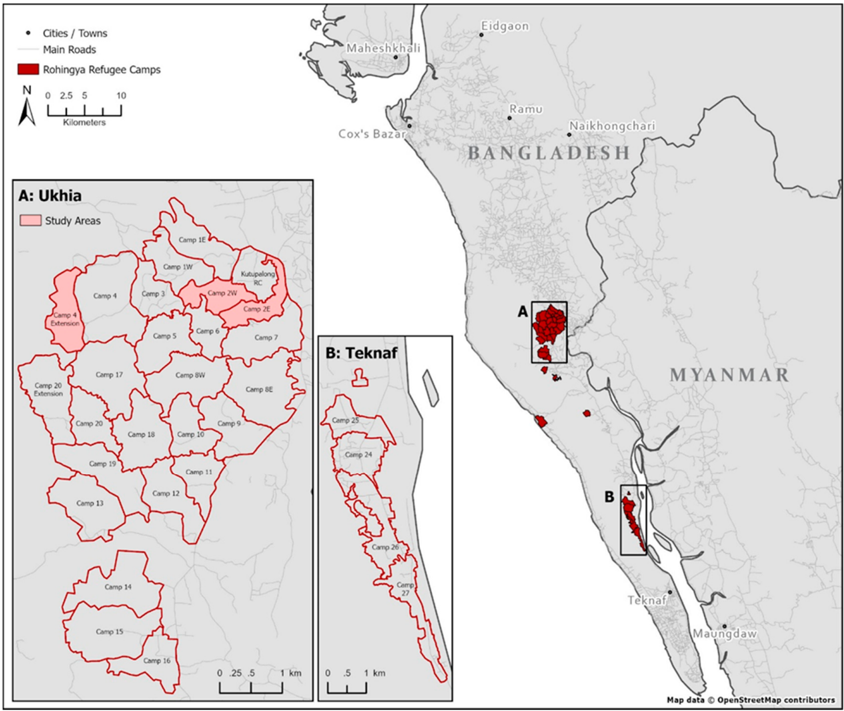
This exploratory study reports drinking water security challenges in two Rohingya refugee camps—Camp 2 and Camp 4 Extension (Camp 4Ext)—to discover the key everyday issues refugees are facing. The results show that Camp 4Ext is more suited for living in several respects compared with other camps, attributable to significantly better planning during its construction: lower water collection times, higher standards of sanitation, and better access to water sources.
Overview
CoChat Summary
## TL;DR
This exploratory mixed-methods study assessed drinking water security in two Rohingya refugee camps in Cox’s Bazar—Camp 2 and Camp 4Ext—by combining surveys, water testing, interviews, focus groups, observations, and secondary data. It found that Camp 4Ext had better water access, shorter collection times, and better sanitation than Camp 2, while both camps still faced concerns about storage/handling, sanitation, and future water insecurity.
## Key findings
- In the study’s own water tests, none of the samples were positive for total coliform or fecal coliform, but residual chlorine was nil in all samples, below the recommended minimum 0.2 mg/L.
- Water quality differed by camp: Camp 2 samples had pH 5.38 and 5.43, below the WHO range 6.5–8.5, while Camp 4Ext samples had pH 7.12 and 7.06; all turbidity values were below the WHO limit of 5 NTU.
- Collection time was higher in Camp 2: 14.3% of households spent <1 hour daily collecting water, 64.3% spent 1–3 h, 11.4% spent 3–5 h, and 10% spent >5 h; in Camp 4Ext, 30%, 60%, 10%, and 0% reported those same categories, respectively.
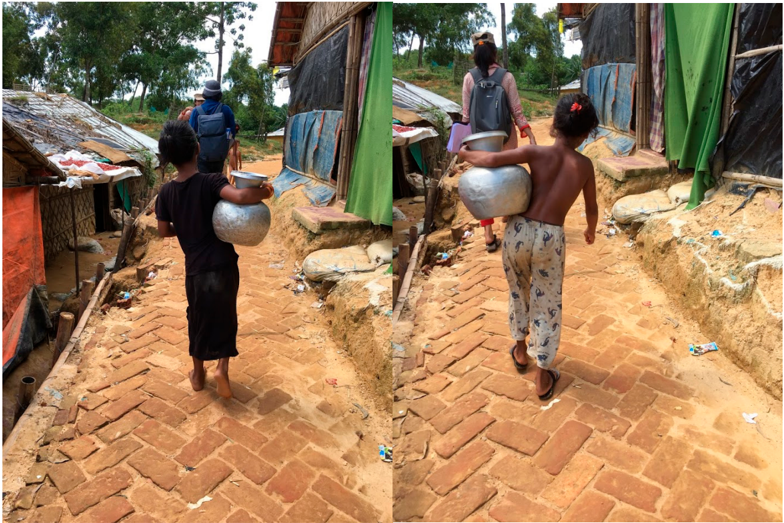
- Water collection burden fell mainly on women: in 57% of households women were the sole collectors, 15% had women and girls collecting, and 28% used a mixed combination of household members.
## Methods
- Design: Exploratory mixed-methods study combining quantitative and qualitative approaches, with supplementary secondary data and climate/water-balance analysis.
- Sample/data: Conducted in Camp 2 and Camp 4Ext in Kutupalong, Cox’s Bazar; 100 households were surveyed (70 in Camp 2, 30 in Camp 4Ext). Water sampling included 4 samples total: 2 deep tube-well samples and 2 storage-container samples from each camp.
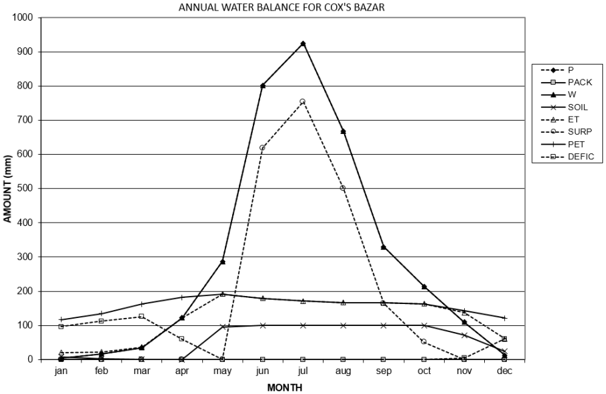
- Main analysis: Used a structured questionnaire, water quality testing (pH, turbidity, residual chlorine, dissolved oxygen, total coliform, fecal coliform), 3 FGDs, KIIs, direct observation, and secondary sources. Data were analyzed in SPSS version 22.0; water availability was also modeled with the Thornthwaite Monthly Water Balance Model.
## Limitations
- The paper states that its exploratory approach was adopted because of limited resources and a rapidly evolving situation in Cox’s Bazar, and that the sample size was constrained by time and resources.
- The authors state that some responses may have been under-reported or over-reported due to perception bias and socially desirable responding.
- Evident from the text: the direct water-quality sampling was very small (4 samples total), so the laboratory results may not represent conditions across the camps broadly.
Model-written summary. Check it against the paper before relying on it.
Integrity signals
Registry
Cites
Statistics
Figures
Verification
Claims the paper makes
6 Valid · 7 Not valid · 57 Not checked · 191 Own results and interpretations
Every source the paper cites for this claim was checked and supports it.
In the paper
“This suggests that the high-density population in the camps, along with inadequate hygienic practices, is possibly resulting in the secondary contamination of drinking water during collection, transportation, and storage [29].”
What the sources say
- Supportedcites [29] 29. Mahmud, Z.H.; Islam, M.S.; Imran, K.M.; Hakim, S.A.; Worth, M.; Ahmed, A.; Hossan, S.; Haider, M.; Islam, M.R.; Hossain, F.; et al. Occurrence of Escherichia coli and faecal coliforms in drinking water at source and household point-of-use in Rohingya camps, Bangladesh. Gut Pathog. 2019 , 11 , 1-11. [CrossRef] [PubMed] source
The Introduction (page not provided) describes the camps as highly crowded and says secondary contamination may occur during water collection, carriage, and storage because of inadequate hygiene awareness. The Conclusion (page not provided) likewise identifies collection and storage as possible points of contamination. The citing sentence preserves that uncertainty rather than presenting the proposed mechanism as proven. (LLM, conf=0.93)
hedgedstates a possible causen = 12,650- Asserted: passes — The authors put it forward as true.
- Checkable: passes — It can be checked against evidence.
- Load-bearing: passes — The paper’s conclusions depend on it.
- Based: passes — The paper gives a reason why it holds.
- Supported
Every source the paper cites for this claim was checked and supports it.
In the paper
“Water, both at source and storage in Rohingya refugee camps, has been found to have high levels of contamination.”
What the sources say
- Supportedcites [29] 29. Mahmud, Z.H.; Islam, M.S.; Imran, K.M.; Hakim, S.A.; Worth, M.; Ahmed, A.; Hossan, S.; Haider, M.; Islam, M.R.; Hossain, F.; et al. Occurrence of Escherichia coli and faecal coliforms in drinking water at source and household point-of-use in Rohingya camps, Bangladesh. Gut Pathog. 2019 , 11 , 1-11. [CrossRef] [PubMed] source
The Results report faecal coliform contamination in 28% of tubewell-source samples and 73.96% of stored household samples, with E. coli found in 10.5% and 34.7%, respectively. This supports contamination at both points, while showing that stored water was substantially more contaminated than source water. (LLM, conf=0.89)
plainn = 12,650- Asserted: passes — The authors put it forward as true.
- Checkable: passes — It can be checked against evidence.
- Load-bearing: passes — The paper’s conclusions depend on it.
- Based: passes — The paper gives a reason why it holds.
- Supported
A result the paper states — it cites no source for it, so there is none to check. The quote shows it is in the paper.
In the paper
“better access to water sources”
plain- Asserted: passes — The authors put it forward as true.
- Checkable: passes — It can be checked against evidence.
- Load-bearing: passes — The paper’s conclusions depend on it.
- Based: passes — The paper gives a reason why it holds.
A result the paper states — it cites no source for it, so there is none to check. The quote shows it is in the paper.
In the paper
“lower water collection times”
plain- Asserted: passes — The authors put it forward as true.
- Checkable: passes — It can be checked against evidence.
- Load-bearing: passes — The paper’s conclusions depend on it.
- Based: passes — The paper gives a reason why it holds.
A result the paper states — it cites no source for it, so there is none to check. The quote shows it is in the paper.
In the paper
“there is a lower prevalence of diseases”
plain- Asserted: passes — The authors put it forward as true.
- Checkable: passes — It can be checked against evidence.
- Load-bearing: passes — The paper’s conclusions depend on it.
- Based: passes — The paper gives a reason why it holds.
105 more claims
Create a free account to see all 261 claims and to verify the 28 references still open.
- It may state two separate claims as one. 117
- Probably not a substantial claim. 70
Self-check
Percentages, sums and reported differences re-computed from the paper’s own numbers.
Rated major: it would touch a result — a value a result rests on, reported and recomputed p-values on opposite sides of the significance level, two passages that conflict with no sign which is right, or a cited work retracted before this paper was published.
In the paper
“As of August 2019, the total area of Camp 2 is 782,714 m 2 , sheltering a total of 13,278 households and 56,216 individuals, making a population density of 21 m 2 / person.”
Reported 21 · recomputed 13.923331
Citations
Cites
An Approach toward a Rational Classification of Climate
Thornthwaite, C. W. (1948) · Geographical Review · doi:10.2307/210739 · Cited by 9,087
An Approach Toward a Rational Classification of Climate
THORNTHWAITE, C. W. (1948) · Soil Science · doi:10.1097/00010694-194807000-00007 · Cited by 1,081
Wright, J., Gundry, S., & Conroy, R. (2004) · Tropical Medicine & International Health · doi:10.1046/j.1365-3156.2003.01160.x · Cited by 840
Pit Latrines and Their Impacts on Groundwater Quality: A Systematic Review
Graham, J. P., & Polizzotto, M. L. (2013) · Environmental Health Perspectives · doi:10.1289/ehp.1206028 · Cited by 431 · cited 1×
“source through overflowing, leaching, or due to a lack of sewage treatment facilities [37].”
BackgroundYoung, S. L., Boateng, G. O., Jamaluddine, Z., Miller, J. D., Frongillo, E. A., Neilands, T. B., Collins, S. M., Wutich, A., Jepson, W. E., & Stoler, J. (2019) · BMJ Global Health · doi:10.1136/bmjgh-2019-001750 · Cited by 365 · cited 1×
“It is also, as recent studies by the Household Water Insecurity Experience Consortium (HWISE) have shown, a matter of experience rather than mere top-down planning or investment—experienced water insecurity can coexist with active water and sanitation programmes emanating from government or the humanitarian sector [13…”
BackgroundUnderstanding Focus Group Discussions
Hennink, M. M., & Leavy, P. (2014) · Oxford University Press eBooks · doi:10.1093/acprof:osobl/9780199856169.001.0001 · Cited by 324
Risk factors contributing to microbiological contamination of shallow groundwater in Kampala, Uganda
Howard, G., Pedley, S., Barrett, M., Nalubega, M., & Johal, K. (2003) · Water Research · doi:10.1016/s0043-1354(03)00235-5 · Cited by 312
Clasen, T. F., & Bastable, A. (2003) · Journal of Water and Health · doi:10.2166/wh.2003.0013 · Cited by 244
Trapped in Statelessness: Rohingya Refugees in Bangladesh
Milton, A., Rahman, M., Hussain, S., Jindal, C., Choudhury, S., Akter, S., Ferdousi, S., Mouly, T., Hall, J., & Efird, J. (2017) · International Journal of Environmental Research and Public Health · doi:10.3390/ijerph14080942 · Cited by 219 · cited 1×
“The Rohingyas’ position in Myanmar has been repeatedly questioned and they have been mistreated often in the past [14].”
BackgroundDzwairo, B., Hoko, Z., Love, D., & Guzha, E. (2006) · Physics and Chemistry of the Earth, Parts A/B/C · doi:10.1016/j.pce.2006.08.031 · Cited by 206
Research works printed but not linked: 6
- 12. UNESCO. Final Report. In Proceedings of the 20th Session of the Intergovernmental Council, Paris, France, 4-7 June 2012.
- 17. Islam, M.M.; Jarna, R.N.; Khan, D.H.; Nayeem, M.; Rushmi, Z.T.; Rahman, M.M.; Reza, H.M. Prevalence of Diseases among Rohingya Refugees in Bangladesh: A Comprehensive Study. IOSR J. Nurs. Health Sci. 2019 , 8 , 14-21.
- 46. Duru, M.; Amadi, C.; Amadi, B.; Nsofor, C.; Nze, H. E ect of di erent storage vessels on water quality. Glob. Res. J. Sci. 2013 , 2 , 9-13.
- 49. Mohanan, N.; Manju, E.K.; Jacob, S. The e ect of di erent types of storage vessels on water quality. Int. J. Innov. Res. Sci. Eng. Technol. 2017 , 6 , 2347-6710.
- 56. Kumar, K. Conducting Key Informant Interviews in Developing Countries ; Agency for International Development: Washington, DC, USA, 1989; pp. 1-40.
- 61. Sharma, R. Water Handling Practices and Level of Contamination between Source and Point-of Use in Kolladiba Town, Ethiopia. Int. J. Environ. Sci. Technol. 2013 , 8 , 25-35.
Cited by
Calderón-Villarreal, A., Schweitzer, R., & Kayser, G. (2022) · International Journal for Equity in Health · doi:10.1186/s12939-022-01626-3 · Cited by 78
Refugee settlements are highly exposed to extreme weather conditions
Fransen, S., Werntges, A., Hunns, A., Sirenko, M., & Comes, T. (2023) · Proceedings of the National Academy of Sciences · doi:10.1073/pnas.2206189120 · Cited by 63
Ullah, S. M. A., ASAHIRO, K., Moriyama, M., & Tani, M. (2021) · Sustainability · doi:10.3390/su13084240 · Cited by 47
Refugee settlements in transition: Energy access and development challenges in Northern Uganda
van Hove, E., & Johnson, N. G. (2021) · Energy Research & Social Science · doi:10.1016/j.erss.2021.102103 · Cited by 39
Rafa, N., Uddin, S. M. N., & Staddon, C. (2020) · Water International · doi:10.1080/02508060.2020.1803018 · Cited by 26
Self-citationRafa, N., Khalid, R., & Uddin, S. M. N. (2024) · Energy Research & Social Science · doi:10.1016/j.erss.2024.103621 · Cited by 25
Self-citationYasmin, T., Dhesi, S., Кузнецова, И. Б., Cooper, R., Krause, S., & Lynch, I. (2022) · International Journal of Water Resources Development · doi:10.1080/07900627.2022.2131362 · Cited by 35
Rohingya refugees in the pandemic: Crisis and policy responses
Hossain, M. A., Ullah, A. A., & Mohiuddin, M. (2022) · Global Policy · doi:10.1111/1758-5899.13156 · Cited by 28
Role of Biogas in Achieving Sustainable Development Goals in Rohingya Refugee Camps in Bangladesh
Chowdhury, H., Chowdhury, T., Sharifi, A., Corkish, R., & Sait, S. M. (2022) · Sustainability · doi:10.3390/su141911842 · Cited by 30
Faruque, A. S. G., Alam, B., Nahar, B., Parvin, I., Barman, A. K., Khan, S. H., Hossain, N., Widiati, Y., Hasan, A. M., Kim, M., et al. (2022) · International Journal of Environmental Research and Public Health · doi:10.3390/ijerph19159635 · Cited by 34
Shapna, K. J., Hasan, K., Kabir, K. H., Li, J., & Hossain, L. (2023) · Journal of Water and Health · doi:10.2166/wh.2023.045 · Cited by 23
Water, sanitation, and hygiene global research: evolution, trends, and knowledge structure
Zyoud, S. H., & Zyoud, A. H. (2023) · Environmental Science and Pollution Research · doi:10.1007/s11356-023-30813-0 · Cited by 22
Mitu, K., Jones, N., Vintges, J., & Devonald, M. (2022) · Sustainability · doi:10.3390/su14084466 · Cited by 20
Dutta, H. (2022) · Journal of International Migration and Integration / Revue de l integration et de la migration internationale · doi:10.1007/s12134-022-00986-7 · Cited by 19
Sultana, N., Sultana, S., Saha, R., & Alam, M. M. (2023) · Southeast Asia A Multidisciplinary Journal · doi:10.1108/seamj-04-2023-0033 · Cited by 24
Shayamunda, R. H. (2024) · Developments in environmental science · doi:10.1016/b978-0-443-21948-1.00004-2 · Cited by 12
Soundararajan, M., Jaishankar, K., Bushell, M., Telford, L., & Treadwell, J. (2023) · The British Journal of Criminology · doi:10.1093/bjc/azad069 · Cited by 5
Regional Drinking Water Supply in Pakistan: Regional Disparity, Inequality, and Development Pattern
Wu, Y., & Wei, Y. D. (2023) · The Professional Geographer · doi:10.1080/00330124.2023.2183414 · Cited by 5
Butt, S., Chowdhury, M. S. R., Sadique, S., Faisal, A.-A., Mahama, A., Gorski, A., Pop-Stefanija, B., Beversluis, D., Lochokon, J. M., Velivela, K., et al. (2025) · BMC Health Services Research · doi:10.1186/s12913-025-12874-8 · Cited by 6
Sadeak, S., Maria, F. Z., Amin, A., Chowdhury, T., Alam, M. J., Mia, M. B., Ahmed, K. M., & Khan, M. R. (2025) · Environmental Geochemistry and Health · doi:10.1007/s10653-025-02801-5 · Cited by 3
Yohannes, L., Belete, B., Yirdaw, A. A., Sergindo, M. T., Bezie, A. E., Weldegebriel, F., & Belay, H. (2025) · Scientific Reports · doi:10.1038/s41598-025-96490-w · Cited by 4
Nowreen, S., Qayum, K. A., Zzaman, R. U., Shamma, T. K., Amin, R., Hossain, K., Mahmud, R., Arif, M. T. A., Ritu, S., Agnew, P. J., et al. (2025) · Water Policy · doi:10.2166/wp.2025.150 · Cited by 2
Shohel, M. M. C., Ashrafuzzaman, M., Chowdhury, S., Rashedujjaman, S. M., Akter, T., Surav, K. H., Tasnim, N., Rubayet, T., & Shabnam, S. (2024) · International Journal of Positivity & Well-Being · doi:10.61518/ijpw-35 · Cited by 4
Water Insecurity and Rights Erosion: A Comprehensive Analysis of Rohingya Refugee Camps in New Delhi
Dasgupta, A., Kar, S., Sundberg, T., Gautam, A. K., & Mukherjee, S. (2024) · Water · doi:10.3390/w16162268 · Cited by 3
Ashrafuzzaman, K., Roy, S. K., Hasan, M. M., Mojumder, P., & Hossain, N. J. (2025) · Advances in geographic information science · doi:10.1007/978-3-031-89246-2_6 · Cited by 3
Adnyana, I. M. D. M., Utomo, B., Dewanti, L., Sulistiawati, S., Eljatin, D. S., Setyawan, M. F., Sudaryati, N. L. G., & Darmawan, K. (2023) · Research Square · doi:10.21203/rs.3.rs-3378318/v1 · Cited by 2
Ullah, S. M. A., Rahman, M. A., Riyadh, Z. A., Das, K. R., & Tani, M. (2024) · Asian Journal of Human Services · doi:10.14391/ajhs.26.135 · Cited by 2
Social and Environmental Imperatives for Risk Management: Lessons from the Rohingya Refugee Crisis
Kumar, S. (2022) · Springer eBooks · doi:10.1007/978-3-030-85829-2_7 · Cited by 1
When boundaries are blurred: infrastructure needs in support of the climate displaced
Best, K. B., Niemeier, D., & Hadden, J. (2025) · Frontiers in Climate · doi:10.3389/fclim.2025.1584877 · Cited by 1
Amin, N., Rahman, M. M., Alam, M., Shoab, A. K., Alome, M. K., Amin, M., Huda, T. M. N., & UNICOMB, L. E. (2021) · International Journal of Environmental Research and Public Health · doi:10.3390/ijerph182412917 · Cited by 3
Insights into different facets of the refugee crises–environment nexus
Dutta, H. (2023) · Journal of Social and Economic Development · doi:10.1007/s40847-023-00297-2 · Cited by 4
Unveiling the Inherent Struggles and Adjustments of Rohingya Women in the Camp Environment
Khatun, H., Kabir, M. H., & Haque, M. (2025) · Springer eBooks · doi:10.1007/978-981-96-7929-4_13 · Cited by 1
Transportation in refugee camps: A path towards sustainable development and inclusive communities
Wardeh, M., & Marques, R. C. (2025) · City Culture and Society · doi:10.1016/j.ccs.2025.100649 · Cited by 1
Mitra, J. R., & Ahmed, T. T. (2023) · Research Square · doi:10.21203/rs.3.rs-3253487/v1
Liu, J., Zevenbergen, C., Lu, J., Qi, Q., Veerbeek, W., Chowdhury, S. W., & Qian, L. (2026) · Land · doi:10.3390/land15061024
Haque, C. E., Mahjabin, R., & Ahmed, K. (2026) · Sustainability · doi:10.3390/su18125946
Irregular maritime migration and legal protections: the Rohingya refugee crisis
Islam, M. S., & Faısal, M. M. (2026) · SN Social Sciences · doi:10.1007/s43545-026-01612-4
Sultana, U. B. F., & Rahman, M. M. (2025) · Social Science Review · doi:10.3329/ssr.v41i2.80871 · Cited by 1
Nyuot, B. C., Degefa, G. H., Lenjissa, D., Endale, H., & Fekadu, S. (2026) · Journal of Water Sanitation and Hygiene for Development · doi:10.2166/washdev.2026.114
Hussain, M. T., Rahman, A., Hossain, M. S., Alam, M. A. U., Haque, N., Galib, F. C., Abedin, M. F., Rahman, M. H., Haque, A., Moniruzzaman, M., et al. (2026) · Scientific Reports · doi:10.1038/s41598-026-58907-y
Water and Sanitation at Rohingya Refugee Camps in Bangladesh: A Risk Assessment
Rahaman, H. A., Afrin, N., Mim, S. T., Rafi, R. S. M. H., Suhas, P. P., Anindita, M., & Rahman, A. (2026) · Lecture notes in civil engineering · doi:10.1007/978-3-032-18708-6_45
Metadata
- Authors
- Akhter, M., Uddin, S. M. N., Rafa, N., Hridi, S. M., Staddon, C., & Powell, W.
- Affiliations
- Asian University for Women (BD)
- University of Victoria (CA)
- University of the West of England (GB)
- Corresponding author
- Uddin, Sayed Mohammad Nazim
- Venue
- Sustainability
- Publisher
- MDPI AG
- Published
- 2020-09-07
- Volume
- 12
- Issue
- 18
- Pages
- 7325
- ISSN
- 2071-1050 (ISSN-L)
- OpenAlex
- W3083321702
- Cited by
- 68
- References
- 52
- Citations by year
- 2026: 14 · 2025: 13 · 2024: 7 · 2023: 12 · 2022: 15 · 2021: 6 · 2020: 1
- FWCI
- 2.61
- Type
- journal article
- Language
- en
- Open access
- gold
- doi.org
- Licence
- Locations
- Sustainability (publishedVersion, cc-by)
- UVic’s Research and Learning Repository (University of Victoria) (submittedVersion, other-oa)
- UWE Research Repository (UWE Bristol) (submittedVersion, cc-by)
- Apollo (University of Cambridge) (submittedVersion, cc-by)
- RePEc: Research Papers in Economics (submittedVersion)
- DOAJ (DOAJ: Directory of Open Access Journals) (submittedVersion, cc-by-sa)
- Funders
- Center for Asia Pacific Initiatives, University of Victoria, Canada (n/a)
- Topics
- Physical Sciences › Environmental Science › Water Science and Technology › Water Resource Management and Quality
- Health Sciences › Nursing › Nutrition and Dietetics › Child Nutrition and Water Access
- Social Sciences › Political Science and International Relations › Asian Geopolitics and Ethnography
- Keywords
- drinking water security, Rohingya refugees, refugee camps, Cox's Bazar, water pollution, water storage, water collection, sanitation, waterborne diseases, cholera, typhoid fever, diarrhea
About these checks
Registry, retraction, Cites and statistics results are computed, not judged, with one exception: a printed reference that no index lists is read once by a model before it counts as a citation error. Claims are extracted by a model and kept only when their quote appears verbatim in the text; each cited source is then checked, with a model’s help, for whether it says what the claim relies on. Those verdicts can be wrong — read the claim’s quote and the cited source before relying on one.
The claim verdicts this report counts are experimental: their accuracy is not yet measured.
A language model drew the claims from the paper on 2026-10-10, under version 3 of the claim definition (model deepseek-v4.1-flash, prompt extract-v3).
A second model labelled each claim on 2026-10-10 (model jev-1.13-20260917, definition revision gold-guideline-v0.2).
Cited sources are checked with a language model’s help (gpt-6-sol).
Statistics and arithmetic are recomputed, not judged.
Confidence bands are shown only for fields calibrated on our annotated test set. None is calibrated yet, so no band is shown.
What counts as a claim ›How we measure confidence ›How we check this ›
Are you an author, or do you see a problem with this page? Request a review
Data sources
Bibliographic data: Semantic Scholar, OpenAlex, Crossref.
Contains information from the Semantic Scholar Academic Graph Datasets, made available under the ODC Attribution License (ODC-BY 1.0).
Semantic Scholar’s data is described in: Kinney, R., et al. (2023). The Semantic Scholar Open Data Platform. arXiv:2301.10140.
