

Nanoparticles from the Cosmetics and Medical Industries in Legal and Environmental Aspects
Open accessThe DOI matches its Crossref record; 69 of the 72 references it cites were found in a registry or an index.
Abstract
This paper presents the application and role of nanomaterials, with particular emphasis on the cosmetics and medical industries. Methods of obtaining materials at the nanoscale and their characteristic structure, which determines their attractiveness and risk, especially in recent years, have been described. The subject of the work was to indicate the hazards and risks that are associated with the properties of nanomaterials; dimension, and high chemical and physical activity, thus making ways to capture and monitor them difficult. Legal and environmental aspects were taken into account, and the involvement of the European Commission in this subject and the activities carried out in a few European countries as well as in Japan, the USA and Canada were analyzed.
Overview
The claims and statistics of this paper haven’t been checked yet.
Free: it reads the open-access text and checks the first 5 claims that cite a source we can check. Create a free account to check every claim.
Integrity signals
Registry
Cites
Statistics
Figures
Verification
Claims the paper makes
The claims and statistics of this paper haven’t been checked yet.
Free: it reads the open-access text and checks the first 5 claims that cite a source we can check. Create a free account to check every claim.
Claims other papers make about this one
Each is checked against this paper’s own text: does it say what the citing paper says it does?
The source backs part of the claim, not all of it — or backs it for a different population, condition or comparison.
In the citing paper
“The process of toxicity consists of oxidative stress (OS), which results in the formation of reactive oxygen species such as superoxide anion (O2−), hydrogen peroxide (H2O2), and hydroxyl radical (HO−) in various dermal cells (82).”
From The dark side of beauty: an in-depth analysis of the health hazards and toxicological impact of synthetic cosmetics and personal care products (2024) · cites this paper as [82]
Experimental — accuracy not yet measured
Self-check
Percentages, sums and reported differences re-computed from the paper’s own numbers.
The self-check needs the paper’s full text.
Citations
Cites
Nanoparticles: Properties, applications and toxicities
Khan, I., Saeed, K., & Khan, I. (2019) · Arabian Journal of Chemistry · doi:10.1016/j.arabjc.2017.05.011 · Cited by 6,244
Lewinski, N., Colvin, V., & Drezek, R. (2008) · Small · doi:10.1002/smll.200700595 · Cited by 2,810
Applications of nanoparticles in biology and medicine
Salata, O. (2004) · Journal of Nanobiotechnology · doi:10.1186/1477-3155-2-3 · Cited by 2,327
Occurrence, behavior and effects of nanoparticles in the environment
Nowack, B., & Bucheli, T. D. (2007) · Environmental Pollution · doi:10.1016/j.envpol.2007.06.006 · Cited by 2,286 · cited 3×
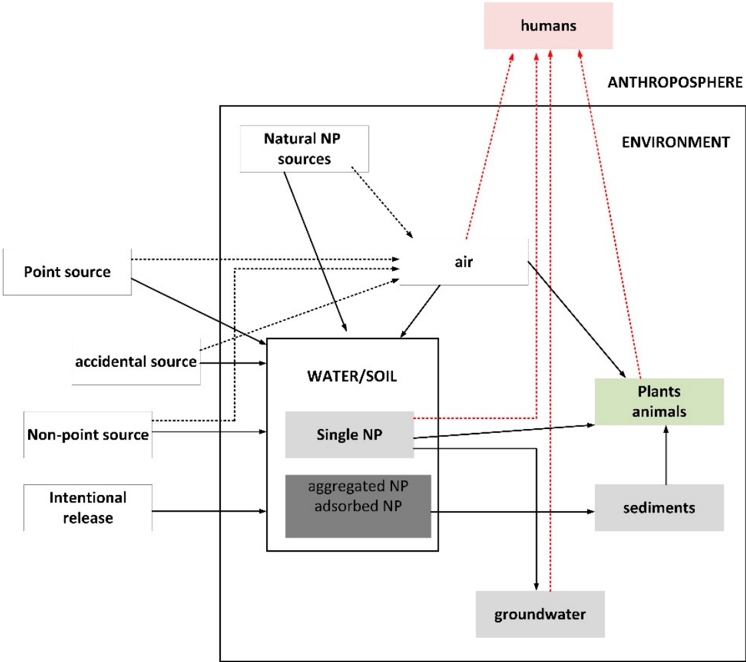
“Aggregated or adsorbed NPs will be less mobile, but collection by sedimented animals creates a risk of inclusion in the food chain [6].”
BackgroundInfluentialTowards a definition of inorganic nanoparticles from an environmental, health and safety perspective
Auffan, M., Rose, J., Bottero, J.-Y., Lowry, G. V., Jolivet, J.-P., & Wiesner, M. R. (2009) · Nature Nanotechnology · doi:10.1038/nnano.2009.242 · Cited by 1,950 · cited 2×
“In the presence of che icals (including surfactants), the surface and interfacial properties of nanoparticles can be odified [16,17].”
BackgroundCytotoxicity of Colloidal CdSe and CdSe/ZnS Nanoparticles
Kirchner, C., Liedl, T., Kudera, S., Pellegrino, T., Muñoz Javier, A., Gaub, H. E., Stölzle, S., Fertig, N., & Parak, W. J. (2005) · Nano Letters · doi:10.1021/nl047996m · Cited by 1,619
Titanium dioxide nanoparticles: a review of current toxicological data
Shi, H., Magaye, R., Castranova, V., & Zhao, J. (2013) · Particle and Fibre Toxicology · doi:10.1186/1743-8977-10-15 · Cited by 1,498
Green Synthesis of Metallic Nanoparticles via Biological Entities
Shah, M., Fawcett, D., Sharma, S., Tripathy, S., & Poinern, G. (2015) · Materials · doi:10.3390/ma8115377 · Cited by 1,292
Transformations of Nanomaterials in the Environment
Lowry, G. V., Gregory, K. B., Apte, S. C., & Lead, J. R. (2012) · Environmental Science & Technology · doi:10.1021/es300839e · Cited by 1,272 · cited 1×
“Due to their small size, they can: penetrate the blood–brain barrier (BBB), accumulate in the nervous system, cause inflammation and oxidative stress, and cause other various health problems in humans and animals [45,51,52].”
BackgroundTitanium dioxide and zinc oxide nanoparticles in sunscreens: focus on their safety and effectiveness
Smijs, T., & Pavel (2011) · Nanotechnology, Science and Applications · doi:10.2147/nsa.s19419 · Cited by 1,135 · cited 2×
“Nanoparticles may pose an ecotoxicological risk in natural receivers and their bioaccumulation in the natural environment and potential inclusion in food chains may also affect human health [4,30,36].”
Background
Research works printed but not linked: 12
- 1. American Society for Testing and Materials (ASTM). Standard terminology relating to nanotechnology. ASTM E 2006 , 6 , 2456-2506.
- 2. Commission, E.E. Commission recommendation of 18 October 2011 on the definition of nanomaterial. Off. J. Eur. Union 2011 , 50 , 38-40.
- 4. Madeła, M.; Neczaj, E.; Wor ˛ ag, M.; Grosser, A. Zagro˙ zenia ´ srodowiskowe nanocz ˛ asteczkami. Przemysł Chem. 2015 , 94 , 2138-2141. (In Polish)
- 5. ´ Swidwi´ nska-Gajewska, A.M. Nanocz ˛ asteczki-produkt nowoczesnej technologii i nowe zagro˙ zenie w ´ srodowisku pracy. Med. Pract. 2007 , 58 , 243-251. (In Polish)
- 9. Waszkiewicz-Robak, B.; ´ Swiderski, F. Nanotechnologia-korzy´ sci i zagro˙ zenia zdrowotne. Bromat. Chem. Toksykol. 2008 , 3 , 202-208. (In Polish)
- 19. Langauer-Lewowicka, H.; Pawlas, K. Nanocz ˛ astki, nanotechnologia-Potencjalne zagro˙ zenia ´ srodowiskowe i zawodowe. Environ. Med. 2014 , 17 , 7-14. (In Polish)
- 23. Parlament Europejski. Rozporz ˛ adzenie (WE) nr 1272/2008 z Dnia 16 Grudnia 2008 r. W Sprawie Klasyfikacji, Oznakowania i Pakowania Substancji i Mieszanin ; Parlament Europejski: Bruksela, Belgia, 2006. (In Polish) Author Contributions: Idea of manuscript, R.W.; writing-original draft preparation, R.W., A.K.-K.; writing-review and editing, supervision, R.W. and A.K.-K. All authors have read and agreed to the published version of the manuscript. Funding: The scientific research was funded by the statute subvention of Czestochowa University of Technology, Faculty of Infrastructure and Environment. The research was funded by the project No. BS/PB400/301/21. Institutional Review Board Statement: Not applicable. Informed Consent Statement: Not applicable. Data Availability Statement: Not applicable. Conflicts of Interest: The authors declare no conflict of interest.
- 24. Rzeszutek, J.; Matysiak, M.; Czajka, M.; Sawicki, K.; Rachubik, P.; Kruszewski, M.; Kapka-Skrzypczak, L. Zastosowanie nanocz ˛ astek i nanomateriał ó wwmedycynie, Hygeia. Public Health 2014 , 49 , 49-457. (In Polish)
- 28. Snopczy´ nski, T.; G ó ralczyk, K.; Czajka, K.; Struci´ nski, P.; Hernik, A.; Korcz, W.; Ludwicki, J.K. Nanotechnologia- mo˙ zliwo´ sci i zagro˙ zenia. Rocz. PZK 2009 , 60 , 101-111. (In Polish)
- 43. Jakubczyk, E. Nanotechnologia w technologii ˙ zywno´ sci. Przemysł Spo˙ zywczy 2007 , 4 , 15-22. (In Polish)
- 44. Mrowiec, B. Nanomateriały-nowe zagro˙ zenie ´ srodowiska. Ecol. Eng. 2017 , 18 , 105-110. (In Polish)
- 73. Rezolucja Parlamentu Europejskiego. Aspekty regulacyjne nanomateriał ó w. Dz. Urz. UE C 2010 , 184 , 82. (In Polish)
Cited by
Nanotechnology in Cosmetics and Cosmeceuticals—A Review of Latest Advancements
Gupta, V., Mohapatra, S., Mishra, H., Farooq, U., Kumar, K., Ansari, M., Aldawsari, M., Alalaiwe, A., Mirza, M., & Iqbal, Z. (2022) · Gels · doi:10.3390/gels8030173 · Cited by 370
“There are compilations in the literature that summarize the legal aspects of nanomaterials [138] or the use of nanomaterials specifically in cosmetics [139].”
BackgroundAkombaetwa, N., Ilangala, A. B., Thom, L., Memvanga, P. B., Witika, B. A., & Buya, A. B. (2023) · Pharmaceutics · doi:10.3390/pharmaceutics15020656 · Cited by 215
Mascarenhas‐Melo, F., Mathur, A., Murugappan, S., Sharma, A., Tanwar, K., Dua, K., Singh, S. K., Mazzola, P. G., Yadav, D. N., Rengan, A. K., et al. (2023) · European Journal of Pharmaceutics and Biopharmaceutics · doi:10.1016/j.ejpb.2023.09.011 · Cited by 138
Chen, Q., Riviere, J. E., & Lin, Z. (2022) · Wiley Interdisciplinary Reviews Nanomedicine and Nanobiotechnology · doi:10.1002/wnan.1808 · Cited by 105
Alnuqaydan, A. M. (2024) · Frontiers in Public Health · doi:10.3389/fpubh.2024.1439027 · Cited by 84
Metadata
- Authors
- Włodarczyk, R., & Kwarciak-Kozłowska, A.
- Affiliations
- Częstochowa University of Technology (PL)
- Faculty of Infrastructure and Environment, Czestochowa University of Technology, Dabrowskiego 69, 42-201 Czestochowa, Poland
- Corresponding author
- Włodarczyk, Renata
- Venue
- Sustainability
- Publisher
- MDPI AG
- Published
- 2021-05-21
- Volume
- 13
- Issue
- 11
- Pages
- 5805
- ISSN
- 2071-1050 (ISSN-L)
- OpenAlex
- W3161702077
- Cited by
- 34
- References
- 72
- Citations by year
- 2026: 3 · 2025: 7 · 2024: 5 · 2023: 9 · 2022: 7 · 2021: 3
- FWCI
- 1.82
- Type
- journal article
- Language
- en
- Open access
- gold
- doi.org
- Licence
- Locations
- Sustainability (publishedVersion, cc-by)
- RePEc: Research Papers in Economics (submittedVersion)
- DOAJ (DOAJ: Directory of Open Access Journals) (submittedVersion, cc-by-sa)
- Funders
- The scientific research was funded by the statute subvention of Czestochowa University of Tech-nology, Faculty of Infrastructure and Environment. (The research was funded by the project No. BS/PB400/301/21.)
- Topics
- Physical Sciences › Materials Science › General Materials Science › Nanotechnology research and applications
- Physical Sciences › Materials Science › Materials Chemistry › Nanoparticles: synthesis and applications
- Physical Sciences › Environmental Science › Environmental Engineering › Environmental remediation with nanomaterials
- Keywords
- nanoparticles, nanomaterials, cosmetics, health sector, nanomaterial risks, nanomaterial regulation, environmental impact of nanoparticles, European Commission, nanomaterial synthesis
About these checks
Registry, retraction, Cites and statistics results are computed, not judged, with one exception: a printed reference that no index lists is read once by a model before it counts as a citation error. Claims are extracted by a model and kept only when their quote appears verbatim in the text; each cited source is then checked, with a model’s help, for whether it says what the claim relies on. Those verdicts can be wrong — read the claim’s quote and the cited source before relying on one.
Statistics and arithmetic are recomputed, not judged.
Confidence bands are shown only for fields calibrated on our annotated test set. None is calibrated yet, so no band is shown.
What counts as a claim ›How we measure confidence ›How we check this ›
Are you an author, or do you see a problem with this page? Request a review
Data sources
Bibliographic data: Semantic Scholar, OpenAlex, Crossref.
Contains information from the Semantic Scholar Academic Graph Datasets, made available under the ODC Attribution License (ODC-BY 1.0).
Semantic Scholar’s data is described in: Kinney, R., et al. (2023). The Semantic Scholar Open Data Platform. arXiv:2301.10140.
