

Fusion of Deep Sort and Yolov5 for Effective Vehicle Detection and Tracking Scheme in Real-Time Traffic Management Sustainable System
Open accessThe DOI matches its Crossref record; 71 of the 71 references it cites were found in a registry or an index; 5 of the 20 sources its claims cite were checked for support.
Abstract
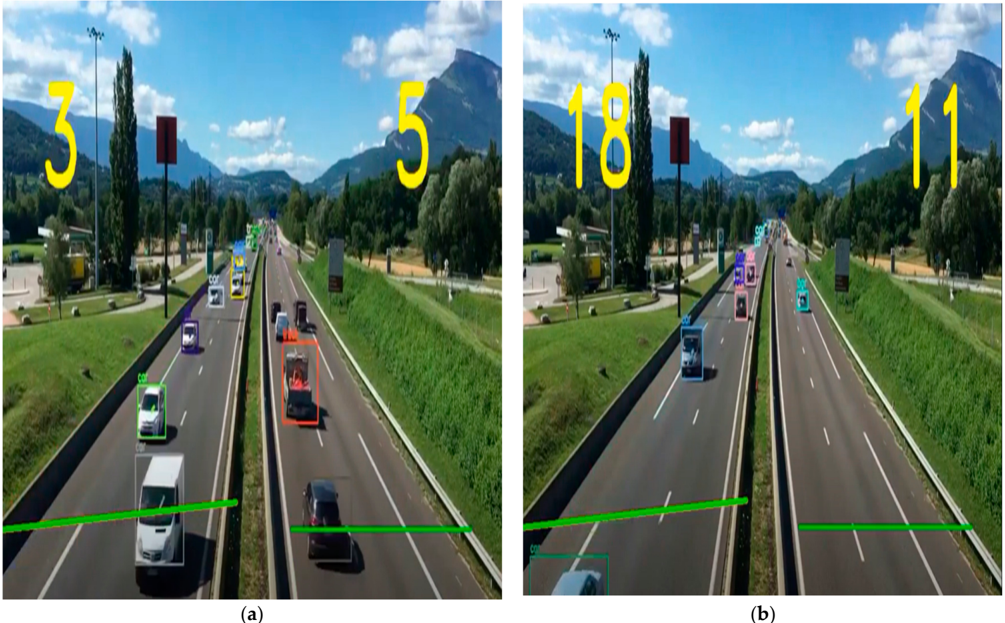
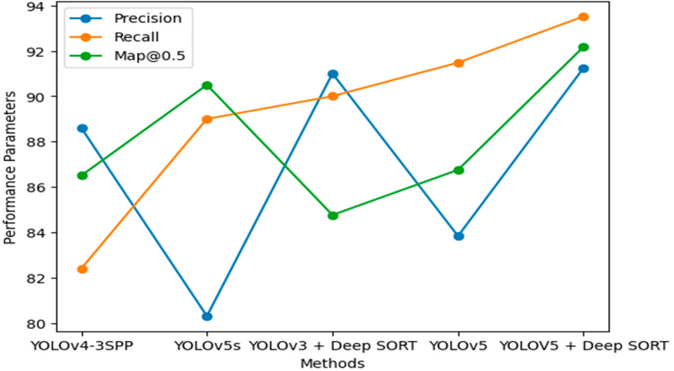
In recent years, advancements in sustainable intelligent transportation have emphasized the significance of vehicle detection and tracking for real-time traffic flow management on the highways. However, the performance of existing methods based on deep learning is still a big challenge due to the different sizes of vehicles, occlusions, and other real-time traffic scenarios. To address the vehicle detection and tracking issues, an intelligent and effective scheme is proposed which detects vehicles by You Only Look Once (YOLOv5) with a speed of 140 FPS, and then, the Deep Simple Online and Real-time Tracking (Deep SORT) is integrated into the detection result to track and predict the position of the vehicles. In the first phase, YOLOv5 extracts the bounding box of the target vehicles, and in second phase, it is fed with the output of YOLOv5 to perform the tracking. Additionally, the Kalman filter and the Hungarian algorithm are employed to anticipate and track the final trajectory of the vehicles. To evaluate the effectiveness and performance of the proposed algorithm, simulations were carried out on the BDD100K and PASCAL datasets. The proposed algorithm surpasses the performance of existing deep learning-based methods, yielding superior results. Finally, the multi-vehicle detection and tracking process illustrated that the precision, recall, and mAP are 91.25%, 93.52%, and 92.18% in videos, respectively.
Overview
CoChat Summary
## TL;DR
This paper proposes a real-time vehicle detection and tracking pipeline that fuses YOLOv5 for detection with Deep SORT, Kalman filtering, and Hungarian matching for tracking and counting vehicles in traffic scenes. On the reported tests, the combined method reached 91.25% precision, 93.52% recall, and 92.18% mAP, and the authors report 58 FPS in their hardware environment.
## Key findings
- The proposed YOLOv5 + Deep SORT method is reported to outperform compared methods on the paper’s benchmarks:
- On BDD100K validation: precision 34.7, recall 59.3, mAP 51.7, FPS 58.
- On PASCAL VOC: precision 65.7, recall 83.4, mAP 81.2, FPS 57.
- In the paper’s vehicle video experiments, the final multi-vehicle detection and tracking results are reported as:
- precision 91.25%
- recall 93.52%
- mAP 92.18%
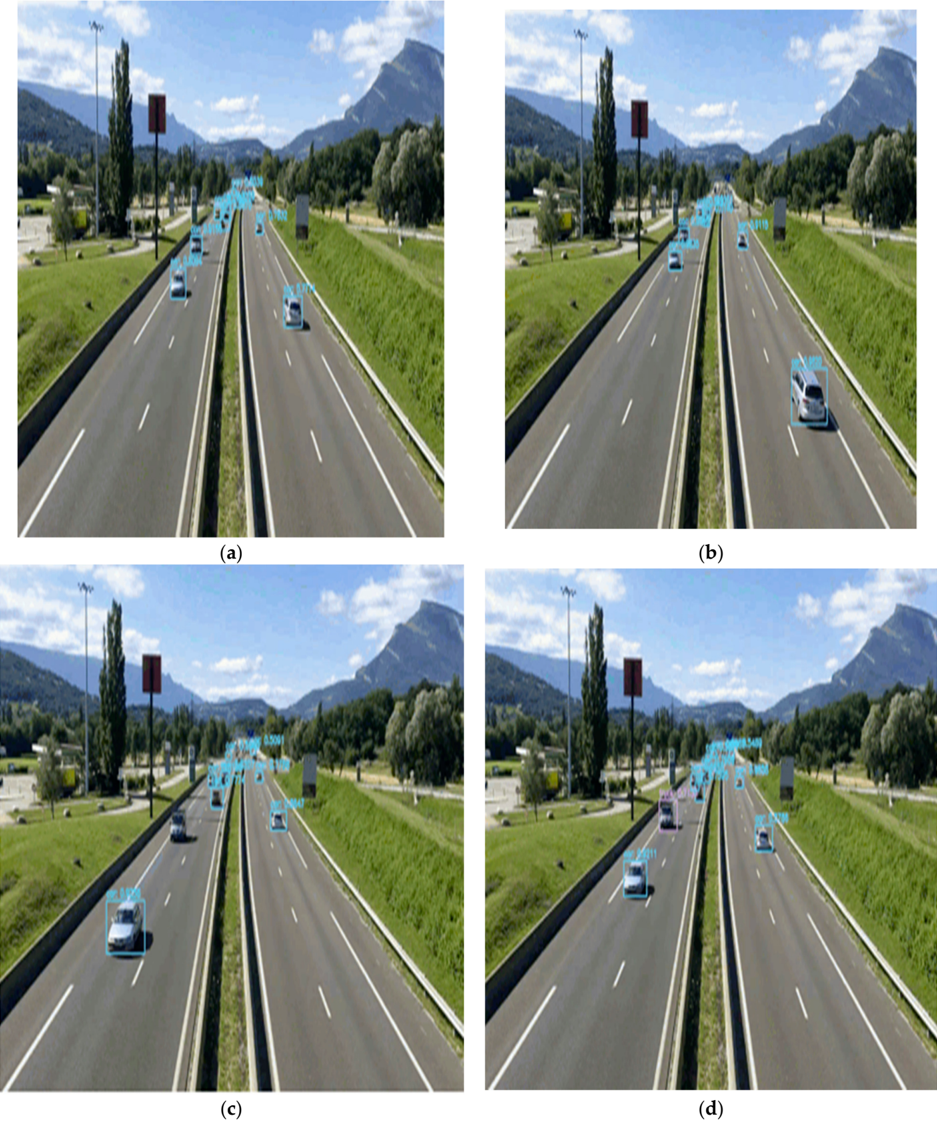
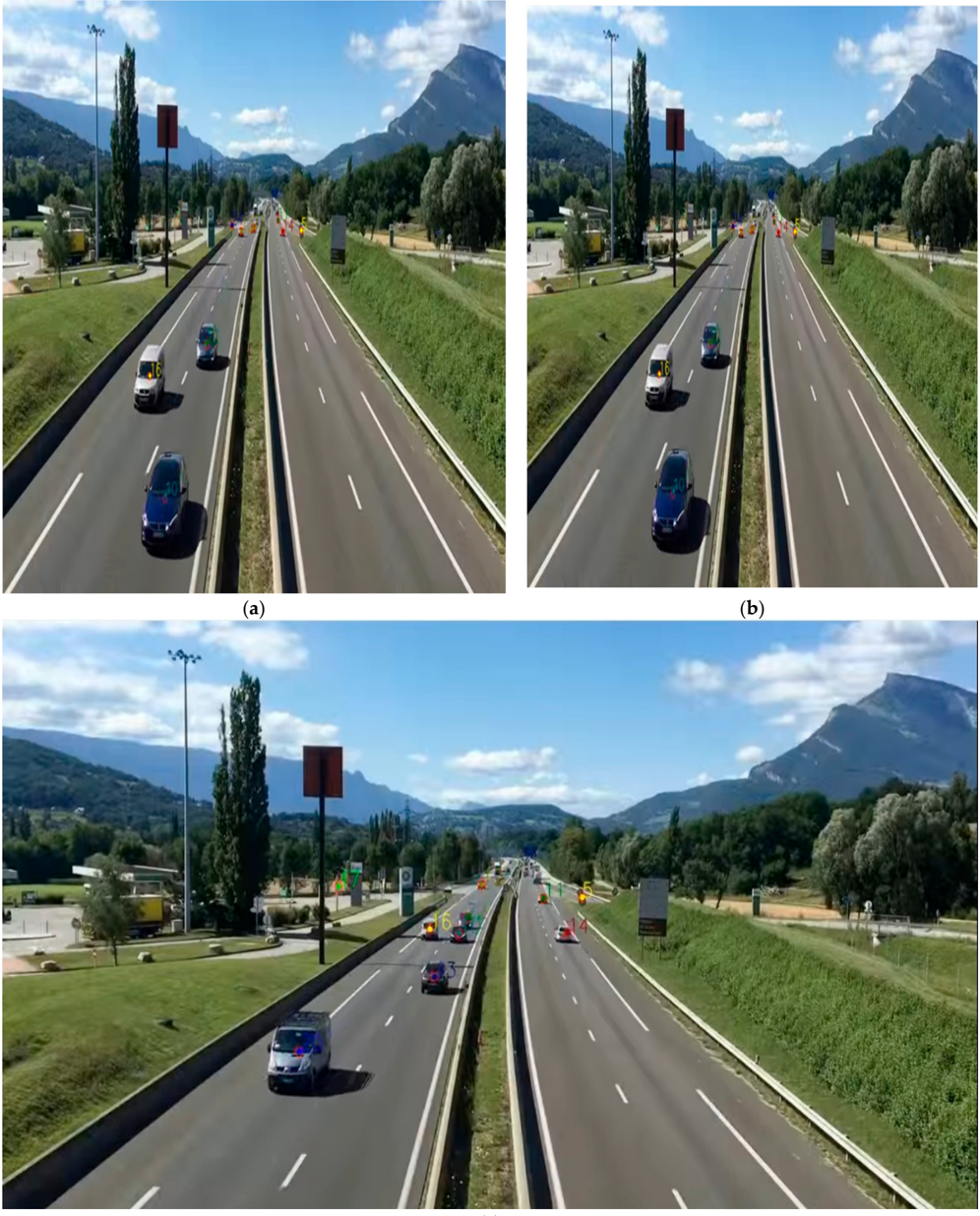
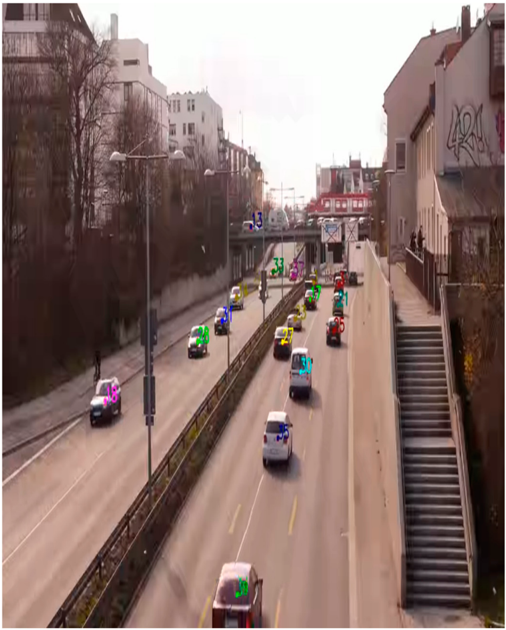
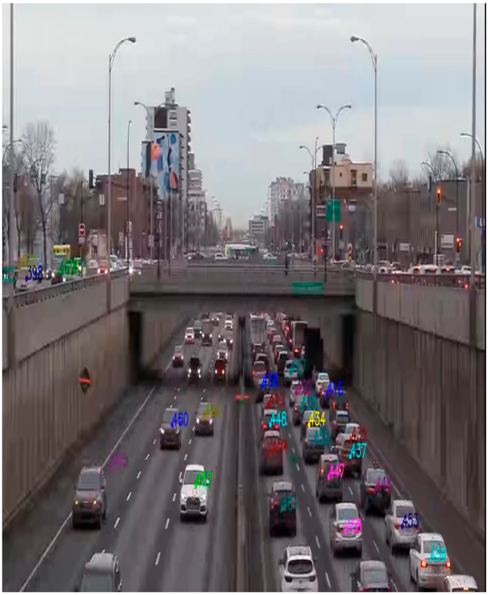
- The authors report that the system maintains track IDs under occlusion, including when a vehicle is blocked by a pillar and when one vehicle partially obscures another; in one example, car ID 4 remained unchanged.
- They report a processing speed of 58 FPS for the YOLOv5s_DSC + Deep SORT setup in their stated hardware environment.
## Methods
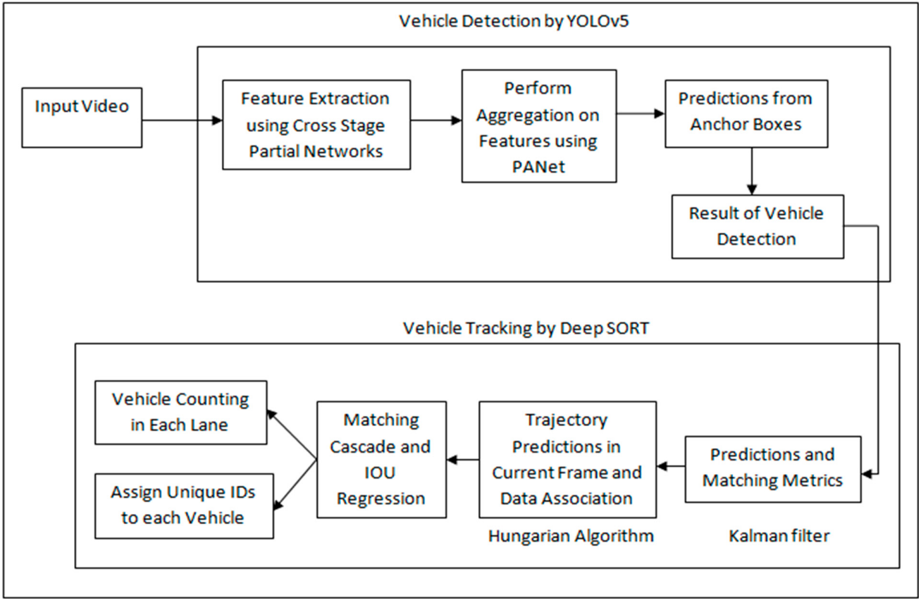
- The paper proposes a two-stage pipeline: YOLOv5 first detects vehicles and outputs bounding boxes and class labels, then Deep SORT tracks those detections across frames using appearance features, motion information, the Kalman filter, and Hungarian matching.
- Evaluation used the BDD100K dataset and the auxiliary PASCAL VOC dataset for validation and testing.
- Performance was assessed using precision, recall, F1 score, IoU, mAP, and FPS; the paper also reports qualitative occlusion and ID-tracking examples.
## Limitations
- The paper explicitly notes that the proposed system still faces challenges from occlusions and low illumination in traffic scenes, even though it is presented as improved over prior methods.
- The paper states that future work will explore advanced combinations of deep learning methods and individual optimizations for YOLOv5 and Deep SORT; this indicates the current work is not presented as final or fully optimized.
- Evident from the text: the evaluation is described through reported dataset benchmarks and example videos, but the paper does not provide a full reproducible experimental protocol in the provided text (for example, exact train/test splits or full implementation details are not stated).
Model-written summary. Check it against the paper before relying on it.
Integrity signals
Registry
Cites
Statistics
Figures
Verification
Claims the paper makes
1 Valid · 7 Not valid · 13 Not checked · 24 Own results and interpretations
At least one cited source doesn’t support this claim or points to a different paper, and none confirmed it — see the verdicts below.
In the paper
“Kumar et al. [20] integrated the YOLO model with the Kalman filter to track the objects for counting.However, this system was not efficient in real-time detection and tracking due to the constraints in speed.”
§ Fusion of Deep Sort and Yolov5 for Effective Vehicle Detection and Tracking Scheme in Real-Time Traffic Management Sustainable System > 1.1. Contribution
What the sources say
- Disputedcites [20] 20. Kumar, S.; Jailia, M.; Varshney, S. Improved YOLOv4 approach: A real time occluded vehicle detection. Int. J. Comput. Digit. Syst. 2022, 12, 489-497. [CrossRef] [PubMed] sourceExperimental — accuracy not yet measured
Our copy of Kumar et al. (2022) describes no YOLO–Kalman integration: the proposed system is YOLOv4 plus Hard Negative Example Mining (HNEM) for occluded vehicle detection (Abstract; 5. Conclusion), and a Kalman filter appears only as a cited third-party work (Reference 30, Itakura et al., pear/apple detection). More decisively, the paper claims the opposite of the speed criticism: the Abstract reports 'good real-time performance and high detection accuracy', the Conclusion states the advantage is 'to reduce the vehicle detection time compared with the existing methods', and 4. Results and Analysis (Tables II–III) gives 18 ms/frame versus 26–450 ms for the compared methods and 317 FPS on an NVIDIA V100 against 38–40 FPS for YOLOv3/YOLOv4. The only 'low efficiency in detection' remark in 2. Related Work concerns one-stage detectors generally, credited to reference [20] (Carranza-García et al.), not this paper's own system. (LLM, conf=0.78)
Checked by a reasoning model — may be wrong.
plainstates a cause- Asserted: passes — The authors put it forward as true.
- Checkable: passes — It can be checked against evidence.
- Load-bearing: passes — The paper’s conclusions depend on it.
- Based: passes — The paper gives a reason why it holds.
- Disputed
The cited sources that could be checked couldn’t confirm or dispute this claim.
In the paper
“The foremost advantage of selecting the YOLOv5 model for real-time vehicle detection is its superior detection accuracy compared to all the previous versions of the YOLO model.[54].”
§ Fusion of Deep Sort and Yolov5 for Effective Vehicle Detection and Tracking Scheme in Real-Time Traffic Management Sustainable System > 3.2. YOLOv5 Model Overview
What the sources say
- Could not verifycites [54] 54. Kang, H.; Chen, C. Fast implementation of real-time fruit detection in apple orchards using deep learning. Comput. Electron. Agric. 2020, 168, 105108. [CrossRef] sourceExperimental — accuracy not yet measured
Our copy of Kang, Hanwen and Chen (2019/2020, Comput. Electron. Agric.) never mentions YOLOv5; it evaluates LedNet against YOLO-V3, YOLO-V3 (Tiny) and Faster-RCNN (VGG) on apple fruit detection (Sec. 4.4 'Comparison to state of the art' and Table 7/Table 8, Conclusion p. ~404-409), where YOLO-V3 is described as 'the state of the art in the one-stage detector'. The only version-to-version statement is in Sec. 2.2 (Multi-level Feature Fusion): 'Compared to the YOLO-V1 ... and YOLO-V2 ..., YOLO-V3 ... improves the detection performance on objects of different scales by using FPN' — nothing about YOLOv5 or about all previous YOLO versions, and nothing about vehicle detection. Searches for 'YOLOv5' and for comparisons of YOLO versions returned only these passages, so the attributed claim cannot be checked against this source. (LLM, conf=0.72)
plain- Asserted: passes — The authors put it forward as true.
- Checkable: passes — It can be checked against evidence.
- Load-bearing: passes — The paper’s conclusions depend on it.
- Based: passes — The paper gives a reason why it holds.
- Could not verify
The cited sources that could be checked couldn’t confirm or dispute this claim.
In the paper
“Li, D. et al. [54] introduced Deep SORT for virtual lines and multi-vehicle tracking.However, the vehicle movement direction was not considered to obtain the traffic flow.”
§ Fusion of Deep Sort and Yolov5 for Effective Vehicle Detection and Tracking Scheme in Real-Time Traffic Management Sustainable System > 2.3. Previous Works
What the sources say
- Could not verifycites [54] 54. Kang, H.; Chen, C. Fast implementation of real-time fruit detection in apple orchards using deep learning. Comput. Electron. Agric. 2020, 168, 105108. [CrossRef] sourceExperimental — accuracy not yet measured
Our copy of Kang et al. (2020, Comput. Electron. Agric.) is entirely about an auto label-generation module and the LedNet one-stage apple detector in orchards (Abstract; Sections 1, 2.1, 2.2), and contains no passage on Deep SORT, virtual lines, multi-vehicle tracking, traffic flow or vehicle movement direction (searched: 'Deep SORT multi-vehicle tracking virtual line traffic flow'; 'vehicle movement direction traffic counting license plate recognition'). The only vehicle-related mention is the reference list entry 14 (Laroca et al., 2018, real-time license plate recognition based on YOLO), cited in the Introduction merely as an example of one-stage detectors applied to automatic driving — it neither reports nor credits the Li et al. Deep SORT traffic-flow method. Since our copy does not address the claim's point and names no such work, the attribution can be neither confirmed nor contradicted here. (LLM, conf=0.78)
plain- Asserted: passes — The authors put it forward as true.
- Checkable: passes — It can be checked against evidence.
- Load-bearing: passes — The paper’s conclusions depend on it.
- Based: passes — The paper gives a reason why it holds.
- Could not verify
A result the paper reports from its own data — it cites no other source for it, so there is none to check. The quote shows it is in the paper.
In the paper
“Finally, the multi-vehicle detection and tracking process illustrated that the precision, recall, and mAP are 91.25%,93.52%, and 92.18% in videos, respectively.”
§ Fusion of Deep Sort and Yolov5 for Effective Vehicle Detection and Tracking Scheme in Real-Time Traffic Management Sustainable System > Abstract
plain- Asserted: passes — The authors put it forward as true.
- Checkable: passes — It can be checked against evidence.
- Load-bearing: passes — The paper’s conclusions depend on it.
- Based: passes — The paper gives a reason why it holds.
- Rests on an assumption not shown here.
A result the paper reports from its own data — it cites no other source for it, so there is none to check. The quote shows it is in the paper.
In the paper
“As depicted in Figure 6, despite the occlusion, the tracking ID for the car (ID 4) remains unchanged.”
§ Fusion of Deep Sort and Yolov5 for Effective Vehicle Detection and Tracking Scheme in Real-Time Traffic Management Sustainable System > 4.1. Results Discussion
plainSingle case- Asserted: passes — The authors put it forward as true.
- Checkable: passes — It can be checked against evidence.
- Load-bearing: passes — The paper’s conclusions depend on it.
- Based: passes — The paper gives a reason why it holds.
- Rests on an assumption not shown here.
20 more claims
Create a free account to see all 45 claims and to verify the 7 references still open.
- It may state two separate claims as one. 14
- Probably not a substantial claim. 10
Citations
Cites
Faster R-CNN: Towards Real-Time Object Detection with Region Proposal Networks
Ren, S., He, K., Girshick, R., & Sun, J. (2017) · IEEE Transactions on Pattern Analysis and Machine Intelligence · doi:10.1109/tpami.2016.2577031 · Cited by 73,472
Faster R-CNN: Towards Real-Time Object Detection with Region Proposal Networks
Ren, S., He, K., Girshick, R., & Sun, J. (2015) · arXiv · doi:10.48550/arxiv.1506.01497 · Cited by 70,812
ImageNet Large Scale Visual Recognition Challenge
Russakovsky, O., Deng, J., Su, H., Krause, J., Satheesh, S., Ma, S., Huang, Z., Karpathy, A., Khosla, A., Bernstein, M., et al. (2015) · International Journal of Computer Vision · doi:10.1007/s11263-015-0816-y · Cited by 39,380
A New Approach to Linear Filtering and Prediction Problems
Kalman, R. E. (1960) · Journal of Basic Engineering · doi:10.1115/1.3662552 · Cited by 31,751
He, K., Gkioxari, G., Dollar, P., & Girshick, R. (2017) · 2017 IEEE International Conference on Computer Vision (ICCV) · doi:10.1109/iccv.2017.322 · Cited by 29,137
YOLO9000: Better, Faster, Stronger
Redmon, J., & Farhadi, A. (2017) · 2017 IEEE Conference on Computer Vision and Pattern Recognition (CVPR) · doi:10.1109/cvpr.2017.690 · Cited by 19,892
The pascal visual object classes (VOC) challenge
Everingham, M., Van Gool, L., Williams, C. K. I., Winn, J., & Zisserman, A. (2010) · International Journal of Computer Vision · doi:10.1007/s11263-009-0275-4 · Cited by 19,599
YOLOv3: An Incremental Improvement
Redmon, J., & Farhadi, A. (2018) · arXiv · doi:10.48550/arxiv.1804.02767 · Cited by 17,141
The Hungarian method for the assignment problem
Kuhn, H. W. (1955) · Naval Research Logistics Quarterly · doi:10.1002/nav.3800020109 · Cited by 13,120
Spatial Pyramid Pooling in Deep Convolutional Networks for Visual Recognition
He, K., Zhang, X., Ren, S., & Sun, J. (2015) · IEEE Transactions on Pattern Analysis and Machine Intelligence · doi:10.1109/tpami.2015.2389824 · Cited by 11,971
Cited by
Ullah, I., Singh, S. K., Adhikari, D., Khan, H. U., Jiang, W., & Bai, X. (2025) · Swarm and Evolutionary Computation · doi:10.1016/j.swevo.2025.101878 · Cited by 66
Self-citationVehicle recognition pipeline via DeepSort on aerial image datasets
Hanzla, M., Yusuf, M. O., Al Mudawi, N., Sadiq, T., Almujally, N. A., Rahman, H., Alazeb, A., & Algarni, A. (2024) · Frontiers in Neurorobotics · doi:10.3389/fnbot.2024.1430155 · Cited by 18
Khiem, N. M., Thanh, T. V., Dung, N. H., & Takahashi, Y. (2025) · PLoS ONE · doi:10.1371/journal.pone.0323547 · Cited by 14
“This combination allows for precise object tracking even when objects temporarily disappear or overlap [18].”
A dataset of drilling site object detection in underground coal mines
Zhou, W. H., Dong, L., Ye, O., Xiangyang, S. H. E., Xueyao, D. U. A. N., Zhikui, P. E. N. G., Siqian, W. A. N. G., Zhao, N., & Xupeng, G. U. O. (2024) · China Scientific Data · doi:10.11922/11-6035.csd.2024.0006.zh · Cited by 17
Vehicle Flow Detection and Tracking Based on an Improved YOLOv8n and ByteTrack Framework
Liu, J., Xie, Y., Zhang, Y., & Li, H. (2024) · World Electric Vehicle Journal · doi:10.3390/wevj16010013 · Cited by 11
Zheng, B., Zhou, J. L., Hong, Z., Tang, J., & Huang, X. (2025) · Sensors · doi:10.3390/s25092788 · Cited by 8
Partheepan, S., Sanati, F., & Hassan, J. A. (2025) · IEEE Access · doi:10.1109/access.2025.3577251 · Cited by 9
“With the release of YOLOv4 and YOLOv5, efficiency was enhanced through modifications such as CSPDarknet53 backbone and PANet for path aggregation, leading to superior detection precision and recall rates [21], [22].”
Drone Swarm for Distributed Video Surveillance of Roads and Car Tracking
Pedroche, D. S., Amigo, D., García, J., Molina, J. M., & Zubasti, P. (2024) · Drones · doi:10.3390/drones8110695 · Cited by 12
Optimal Layout Method for Roadside LiDAR and Camera
Li, Y., Zhang, H., Cheng, Z., et al. (2024) · IEEE Access · doi:10.1109/access.2024.3366180 · Cited by 5
“Regarding the YOLOv5 algorithm, Kumar et al. [9] proposed an intelligent and efficient solution based on YOLOv5 to address the detection and tracking of vehicles.”
MethodKumar, S., Varshney, S., Jain, U., et al. (2025) · PLoS ONE · doi:10.1371/journal.pone.0322738 · Cited by 5
Self-citationStudy on Nighttime Pedestrian Trajectory-Tracking from the Perspective of Driving Blind Spots
Zhao, W., Ren, C., & Tan, A. (2024) · Electronics · doi:10.3390/electronics13173460 · Cited by 5
Urban Functional Zone Classification via Advanced Multi-Modal Data Fusion
Liu, T., Chen, H., Ren, J., Zhang, L., Chen, H., Hong, R., Li, C., Cui, W., Guo, W., & Wen, C. (2024) · Sustainability · doi:10.3390/su162411145 · Cited by 8
Quantized YOLOv11 for Real-Time Road Object Detection in Smart City Environments
Rami, C., Lamaakal, I., Ouahbi, I., Makkaoui, K. E., & Maleh, Y. (2025) · International Conference on Circuit, Systems and Communication (ICCSC) · doi:10.1109/iccsc66714.2025.11135434 · Cited by 5
“Sunil Kumar et al. [21] proposed an integrated real-time vehicle detection and tracking system using YOLOv5 and Deep SORT to enhance traffic monitoring in intelligent transportation systems.”
Shili, M., Sohaib, O., & Hammedi, S. (2024) · Algorithms · doi:10.3390/a17110525 · Cited by 2
Venkatasivarambabu, P., Babu, R. K., Jagan, B. O. L., Rai, H. M., Agarwal, N., & Agarwal, S. (2025) · Signal Image and Video Processing · doi:10.1007/s11760-025-04379-y · Cited by 3
Securing Vehicle-to-Grid Communications: A Cyber-Physical Approach
Pandey, R., Koranga, M., Thakur, S. N., Khan, H. U., Singh, S. K., & Ravikumar, R. N. (2024) · Advances in mechatronics and mechanical engineering (AMME) book series · doi:10.4018/979-8-3693-6844-2.ch012 · Cited by 4
Self-citationPremanand, V., Sai, P. P. N., & Bhattacharya, A. (2025) · Journal of Computational Social Science · doi:10.1007/s42001-025-00411-w · Cited by 1
“[19] Accurate vehicle detection and tracking techniques remains paramount in ensuring efficient traffic management and road safety.”
Phang, W. C., Chor, W. T., & Goh, K. M. (2025) · IEEE International Conference on Automatic Control and Intelligent Systems (I2CACIS) · doi:10.1109/i2cacis65476.2025.11100567 · Cited by 1
“In [16], pairing YOLOv5 with DeepSORT for urban vehicle tracking demonstrated high precision, effectively handling occlusions and providing a solid foundation for cyclist safety applications like the proposed system.”
An Automated Traffic Violation Detection System Based on YOLOv5
Kusumaningtyas, E. M., Ahsan, A. S., & Ardystama, T. F. (2025) · International Electronics Symposium (IES) · doi:10.1109/ies67184.2025.11161248 · Cited by 1
Predicting congregational and crowd spread-out flow using YOLOv4 and DeepSORT
Aljojo, N., Ardah, H., Alamri, A., Tashkandi, A., Habibullah, S., & Almutawa, A. (2026) · Scientific Reports · doi:10.1038/s41598-026-44719-7 · Cited by 1
“Although datasets in 43,44 offer useful benchmarks for generic object detection and tracking tasks, their characteristics differ significantly from Hajj-specific environments, where visual homogeneity and extreme occlusions dominate.”
Gong, D., Zhao, S., Wang, S., Li, Y., Ye, Y., Huo, L., & Bai, Z. (2024) · Foods · doi:10.3390/foods13162562 · Cited by 1
Pedestrian tracking method based on S-YOFEO framework in complex scene
Sheng, W., Shen, J., Chen, Q., & Huang, Q. (2025) · PLoS ONE · doi:10.1371/journal.pone.0322919 · Cited by 1
“For tracking, the framework employs an enhanced version of the DeepSORT [3] algorithm, referred to as Optimized Feature Extraction and Occlusion Handling (OFEO).”
RETRACTED: Pedestrian tracking method based on S-YOFEO framework in complex scene
Sheng, W., Shen, J., Huang, Q., Liu, Z., & Ding, Z. (2024) · Journal of Intelligent & Fuzzy Systems · doi:10.3233/jifs-237208
RetractedResearch on recognition and localization method of maize weeding robot based on improved YOLOv5Preprint
Zhao, L., Jia, Y., Yin, W., et al. (2024) · Research Square · doi:10.21203/rs.3.rs-4800448/v1
YOLOv7-Based Object Detection Model for Effective Aquarium
Thumar, D., Singh, S. K., Ravikumar, R. N., et al. (2024) · Lecture notes in networks and systems · doi:10.1007/978-981-97-4149-6_19
Self-citationAnh, K. D., Bùi, P. H., Trinh, P. T. T., Hiep, N. Q., Linh, V. T., & Hung, P. D. (2024) · Lecture notes in computer science · doi:10.1007/978-3-031-77003-6_1
Singh, B., & Kaunert, C. (2024) · Advances in hospitality, tourism and the services industry (AHTSI) book series · doi:10.4018/979-8-3693-6110-8.ch017
Wang, W., & Song, C. (2025) · International Conference on Smart Transportation and City Engineering (STCE) · doi:10.1117/12.3062191
“…and detection of stabilized video, i.e., detecting features such as location and category of vehicles, tracking detected vehicles, assigning unique IDs to each vehicle, and obtaining motion information such as speed and direction of vehicles, to realize the vehicle trajectory extraction [8].”
Advancing Vehicle Detection: YOLOv5 Innovations for Enhanced Transformation Systems
Ankireddy, P., Gopalakrishnan, S., Reddy, V. L., et al. (2025) · Lecture notes in networks and systems · doi:10.1007/978-3-031-90921-4_87
A Survey on Real-Time Traffic Signal Optimization using Deep Learning and Vehicle Tracking
Saini, A., & Srivastava, J. (2025) · International Conference on Intelligent Communication Technologies and Virtual Mobile Networks (ICICV) · doi:10.1109/icicv64824.2025.11085920
“The convergence of vehicle tracking systems with sophisticated machine learning algorithms represents a pivotal advancement in modern traffic management infrastructure [3].”
InfluentialChaudhary, P. S., Bhatt, N., & Prajapati, P. (2025) · Lecture notes in networks and systems · doi:10.1007/978-3-032-06703-6_3
Zhang, Y., Zhang, Y., Yan, Y., et al. (2025) · Transportation Research Record Journal of the Transportation Research Board · doi:10.1177/03611981251380270
“The You Only Look Once v5 (YOLOv5) target detection algorithm ( 31 ) is used to quantify the number of vehicles perceived by the driver within a 300-m forward field of view ( 25 ) and lateral visible range.”
Application of Fuzzy Logic Mamdani to Optimize Traffic Light Timing at Intersections
Danuarta, I. K. D., Manuel, D., Wisnuwardana, C. J., Jabar, B. A., & Moniaga, J. V. (2025) · International Conference on Cybernetics and Intelligent System (ICORIS) · doi:10.1109/icoris67789.2025.11296078
“Kumar et al. reported that YOLOv5 combined with DeepSORT tracking achieved 91.3% precision and 93.5% recall in vehicle detection [8].”
InfluentialZhang, H., Li, N., Wang, Y., et al. (2026) · AIP Advances · doi:10.1063/5.0315288
Design of Intelligent Traffic Light Control System Using YoLov5 and LSTM
Tran, H. Q., Long, T. T. H., Linh, P. Q., & Kamath, H. S. (2025) · International Conference on Emerging Research in Electronics, Computer Science and Technology (ICERECT) · doi:10.1109/icerect65215.2025.11376243 · Cited by 1
“As the demand for intelligent urban infrastructure rises, smart traffic light control systems that adapt to real-time traffic density have emerged as a critical research area [2].”
PreCollision Detection and Context-Aware Airbag Deployment Using YOLOv8-DeepSORT and XGBoost
Karunarathna, D., & Asanka, D. (2025) · doi:10.1109/icest65883.2025.11428554
Vehicle Detection and Counting using YOLOv11 on Raspberry Pi 5
Pravallika, A., Kumar, C. N., Kumar, C. N., et al. (2026) · International Conference on Inventive Computation Technologies (ICICT) · doi:10.1109/icict68280.2026.11510840
“The majority of methods add YOLO detectors to object trackers, such as DeepSORT, to improve counting reliability, but at the cost of reduced temporal consistency to minimize computational complexity [Kumar et al., 2023], [Zuraimi and Zaman, 2021].”
Universal Robust Vehicle Identification System for Monitoring Using YOLOv12 and DeepSORT
Ambata, L. U., & Dadios, E. J. P. (2026) · Smart Cities · doi:10.3390/smartcities9050085
Rani, S., Dalal, S., & Alam, M. (2026) · Discover Applied Sciences · doi:10.1007/s42452-026-08933-2
“Current object detectors have demonstrated excellent results in real-time vehicle detection that can endure various environmental conditions, particularly those that employ the YOLO family [1].”
ViLi-Speed: A Real-Time Lightweight Computer Vision Approach for Virtual Line-Based Speed Estimation
Wei, C., Qin, Z., Boriboonsomsin, K., & Wu, G. (2026) · International Conference on Multimedia Computing, Networking and Applications (MCNA) · doi:10.1109/mcna69896.2026.11574303
“Kumar et al. [33] combined YOLOv5 with DeepSORT for real-time vehicle monitoring, while Liu et al. [34] integrated YOLOv8 with ByteTrack for urban traffic flow analysis.”
Wu, Q., Xie, Q., Zheng, Z., et al. (2026) · Industry science and engineering. · doi:10.62381/i265402
Elshebli, E., Erdős, F., Khan, A., & Varadarajan, V. (2026) · Engineering Technology & Applied Science Research · doi:10.48084/etasr.18369
“For example, in [5], precision, recall, and mAP values of 91.25%, 93.52%, and 92.18%, respectively, were reported for a YOLOv5+DeepSORT traffic-monitoring scheme evaluated on BDD100K and PASCAL-based experiments, while a more recent YOLOv9s+DeepSORT system [42] reported mAP@0.5 of 91.4%,…”
InfluentialPatil, A. D., Bijwe, S., & Kanmani, S. (2026) · International Conference on Sustainable Computing and Smart Systems (ICSCSS) · doi:10.1109/icscss69635.2026.11646080
“Several works adopt the YOLO + DeepSORT pairing: a YOLOv5–DeepSORT fusion for real-time traffic management [18] and a YOLOv5s– DeepSORT pipeline for highway speed estimation with multi-sensor verification [19], while more recent work extends the pattern to YOLOv11 [20].”
Drone-Based Vehicle Detection Using YOLOv11 for Urban Traffic Monitoring in Bandung, Indonesia
Naufan, M. R., & Bayuwindra, A. (2026) · International Conference on Smart Mechatronics (ICSMech) · doi:10.1109/icsmech69390.2026.11647140
“Most existing studies rely on publicly available datasets such as COCO and UA-DETRAC, which do not fully reflect traffic conditions in developing countries [7][8].”
Real-time Vehicle Speed Detection Based on YOLOv11 and DeepSORT
Jin, G., Ma, W., Jiang, D., et al. (2026) · SAE technical papers on CD-ROM/SAE technical paper series · doi:10.4271/2026-99-1595
Metadata
- Authors
- Kumar, S., Singh, S. K., Varshney, S., Singh, S., Kumar, P., Kim, B.-G., & Ra, I.-H.
- Affiliations
- Galgotias University (IN)
- Marwadi University (IN)
- Sharda University (IN)
- Dongguk University (KR)
- Kunsan National University (KR)
- Corresponding author
- Singh, Sushil Kumar
- Ra, In-Ho
- Venue
- Sustainability
- Publisher
- MDPI AG
- Published
- 2023-12-15
- Volume
- 15
- Issue
- 24
- Pages
- 16869
- ISSN
- 2071-1050 (ISSN-L)
- OpenAlex
- W4389784941
- Cited by
- 46
- References
- 61
- Citations by year
- 2026: 12 · 2025: 19 · 2024: 15
- FWCI
- 4.17
- Type
- journal article
- Language
- en
- Open access
- gold
- doi.org
- Licence
- Locations
- Sustainability (publishedVersion, cc-by)
- RePEc: Research Papers in Economics (submittedVersion)
- Funders
- National Research Foundation of Korea (NRF) (2021R1A2C2014333, MU/R&D/22-23/MRP/FT13)
- Woosong University Academic Research Fund (2021R1A2C2014333, MU/R&D/22-23/MRP/FT13)
- Marwadi University, Rajkot, Gujrat (2021R1A2C2014333, MU/R&D/22-23/MRP/FT13)
- Topics
- Physical Sciences › Computer Science › Computer Vision and Pattern Recognition › Video Surveillance and Tracking Methods
- Physical Sciences › Engineering › Automotive Engineering › Autonomous Vehicle Technology and Safety
- Physical Sciences › Computer Science › Computer Vision and Pattern Recognition › Advanced Neural Network Applications
- Keywords
- vehicle detection, vehicle tracking, DeepSORT, YOLOv5, real-time traffic management, Kalman filter, Hungarian algorithm, multi-target tracking, occlusion handling, intelligent transportation systems, highway traffic flow
About these checks
Registry, retraction, Cites and statistics results are computed, not judged, with one exception: a printed reference that no index lists is read once by a model before it counts as a citation error. Claims are extracted by a model and kept only when their quote appears verbatim in the text; each cited source is then checked, with a model’s help, for whether it says what the claim relies on. Those verdicts can be wrong — read the claim’s quote and the cited source before relying on one.
The claim verdicts this report counts are experimental: their accuracy is not yet measured.
A language model drew the claims from the paper on 2026-10-10, under version 3 of the claim definition (model deepseek-v4.1-flash, prompt extract-v3).
A second model labelled each claim on 2026-10-10 (model jev-1.13-20260917, definition revision gold-guideline-v0.2).
Cited sources are checked with a language model’s help (qwen3.8-omni-flash).
Statistics and arithmetic are recomputed, not judged.
Confidence bands are shown only for fields calibrated on our annotated test set. None is calibrated yet, so no band is shown.
What counts as a claim ›How we measure confidence ›How we check this ›
Are you an author, or do you see a problem with this page? Request a review
Data sources
Bibliographic data: Semantic Scholar, OpenAlex, Crossref.
Contains information from the Semantic Scholar Academic Graph Datasets, made available under the ODC Attribution License (ODC-BY 1.0).
Semantic Scholar’s data is described in: Kinney, R., et al. (2023). The Semantic Scholar Open Data Platform. arXiv:2301.10140.
