

Corporate Concentration and Technological Change in the Global Seed Industry
Open accessThe DOI matches its Crossref record; 37 of the 38 references it cites were found in a registry or an index.
Abstract
In the past three decades, the seed sector has experienced, and is now again experiencing, corporate concentration trends. The fallout of this consolidation is the subject of numerous concerns. However, the seed sector is rather poorly understood. Thus, it is useful to understand it better and to investigate the potential impact on the agri-food chain of the trend toward increased corporate concentration. The first part of this paper presents the main characteristics of the global seed sector, its stakeholders, and its size in the agri-food chain. Next, the corporate consolidation trends of the seed industry over the past two years are examined. The technological evolution of the seed sector is also briefly presented. In the last part of this paper, the fallout of recent mergers and acquisitions in the seed industry are analyzed. Opposing views are expressed on the impact of these mergers and acquisitions in the agri-food chain: while certain stakeholders worry about the risk of food power by the biggest companies, some others expect useful innovations.
Overview
The claims and statistics of this paper haven’t been checked yet.
Free: it reads the open-access text and checks the first 5 claims that cite a source we can check. Create a free account to check every claim.
Integrity signals
Registry
Cites
Statistics
Figures
Verification
Claims the paper makes
The claims and statistics of this paper haven’t been checked yet.
Free: it reads the open-access text and checks the first 5 claims that cite a source we can check. Create a free account to check every claim.
Claims other papers make about this one
Each is checked against this paper’s own text: does it say what the citing paper says it does?
The cited source says what the claim attributes to it.
In the citing paper
“Measurement of a concentration ratio depends on knowing the overall size of the market, which is not always easily available and is often an estimate (Bonny 2017).”
From Corporate concentration and power matter for agency in food systems (2025) · cites this paper as Bonny 2017
Self-check
Percentages, sums and reported differences re-computed from the paper’s own numbers.
The self-check needs the paper’s full text.
Citations
Cites
Myers, J. P., Antoniou, M. N., Blumberg, B., Carroll, L., Colborn, T., Everett, L. G., Hansen, M., Landrigan, P. J., Lanphear, B. P., Mesnage, R., et al. (2016) · Environmental Health · doi:10.1186/s12940-016-0117-0 · Cited by 903
Corporate Power in Global Agrifood Governance
(2009) · The MIT Press eBooks · doi:10.7551/mitpress/9780262012751.001.0001 · Cited by 492
Precision genome engineering and agriculture: opportunities and regulatory challenges
Voytas, D. F., & Gao, C. (2014) · PLoS Biology · doi:10.1371/journal.pbio.1001877 · Cited by 458
Public Acceptance of Plant Biotechnology and GM Crops
Lucht, J. (2015) · Viruses · doi:10.3390/v7082819 · Cited by 409 · cited 1×
“In addition, food products from authorized GE crops could be rejected by consumers if there are many articles presenting them as hazardous, as the case has been for GM food products [65,66].”
BackgroundTarazona, J. V., Court-Marques, D., Tiramani, M., Reich, H., Pfeil, R., Istace, F., & Crivellente, F. (2017) · Archives of Toxicology · doi:10.1007/s00204-017-1962-5 · Cited by 402 · cited 1×
“For example, in the past few years, glyphosate, which is the most widely used pesticide and furthermore is associated with more than 80% of GM crops, has been at the heart of a controversy about its carcinogenic risks [41,42].”
BackgroundDeployment of new biotechnologies in plant breeding
Lusser, M., Parisi, C., Plan, D., & Rodríguez-Cerezo, E. (2012) · Nature Biotechnology · doi:10.1038/nbt.2142 · Cited by 342
Perspectives on the agrochemical industry and agrochemical discovery
Sparks, T. C., & Lorsbach, B. A. (2017) · Pest Management Science · doi:10.1002/ps.4457 · Cited by 293 · cited 1×
“Therefore, regulatory processes for pesticides and GMOs are tightening [40], and are subject to polemics in a number of countries.”
BackgroundThe Regulatory Status of Genome‐edited Crops
Wolt, J. D., Wang, K., & Yang, B. (2016) · Plant Biotechnology Journal · doi:10.1111/pbi.12444 · Cited by 283
Hartung, F., & Schiemann, J. (2014) · The Plant Journal · doi:10.1111/tpj.12413 · Cited by 277 · cited 2×
“If gene-edited (GE) plants are considered as GMOs, the cost corresponding to the regulatory aspects will be higher [65], which will favor the largest companies to the detriment of SMEs.”
BackgroundVisualizing Consolidation in the Global Seed Industry: 1996–2008
Howard, P. H. (2009) · Sustainability · doi:10.3390/su1041266 · Cited by 231 · cited 1×
“In addition, there is the risk of an increase in the dependence of SMEs on the three most important seed companies because of the numerous patents held by the latter, and because of licensing agreements [6,8,29,52].”
BackgroundGenetically Modified Herbicide-Tolerant Crops, Weeds, and Herbicides: Overview and Impact
Bonny, S. (2016) · Environmental Management · doi:10.1007/s00267-015-0589-7 · Cited by 225 · cited 1×
“However, these possible advantages need to be analyzed over a rather long period by considering the durability of such savings or returns, as well as some unexpected consequences [74].”
BackgroundSelf-citationA proposed regulatory framework for genome-edited crops
Huang, S., Weigel, D., Beachy, R. N., & Li, J. (2016) · Nature Genetics · doi:10.1038/ng.3484 · Cited by 218
Regulatory uncertainty over genome editing
Jones, H. D. (2015) · Nature Plants · doi:10.1038/nplants.2014.11 · Cited by 214
Concentration and Power in the Food System: Who Controls What We Eat?
Howard, P. H. (2016) · Bloomsbury Academic eBooks · doi:10.5040/9781474264365 · Cited by 209
Compliance costs for regulatory approval of new biotech crops
Kalaitzandonakes, N., Alston, J. M., & Bradford, K. J. (2007) · Nature Biotechnology · doi:10.1038/nbt0507-509 · Cited by 198
The political economy of food systems reform
De Schutter, O. (2017) · European Review of Agricultural Economics · doi:10.1093/erae/jbx009 · Cited by 194 · cited 1×
“The major player is the downstream food retail sector, which has a strong influence on the entire agri-food chain [73], but this is often little-known and is rarely taken into account by the general public.”
BackgroundGenetically Engineered Crops: From Idea to Product
Prado, J. R., Segers, G., Voelker, T., Carson, D., Dobert, R., Phillips, J., Cook, K., Cornejo, C., Monken, J., Grapes, L., et al. (2014) · Annual Review of Plant Biology · doi:10.1146/annurev-arplant-050213-040039 · Cited by 193
Integrating Agroecology and Participatory Action Research (PAR): Lessons from Central America
Méndez, V., Caswell, M., Gliessman, S., & Cohen, R. (2017) · Sustainability · doi:10.3390/su9050705 · Cited by 188 · cited 1×
“Even if these models are customized according to different situations, there remains a strong controversy between those advocating agroecology, participatory research methods, and changes in consumption patterns [71] and those advocating the use of new techniques, biotechnology, and high-tech tools or methods.”
BackgroundSongstad, D. D., Petolino, J. F., Voytas, D. F., & Reichert, N. A. (2017) · Critical Reviews in Plant Sciences · doi:10.1080/07352689.2017.1281663 · Cited by 161 · cited 2×
““The domestication of crop plants began approximately 10,000 years ago by selecting for increased seeds per inflorescence, increased seedling vigor, reduced seed dormancy and dispersal/shatter, and altered plant architecture such as compact/dwarf growth and reduced branching/tillering” [36].”
BackgroundIntellectual Property and Consolidation in the Seed Industry
Howard, P. H. (2015) · Crop Science · doi:10.2135/cropsci2014.09.0669 · Cited by 146 · cited 1×
“In addition, there is the risk of an increase in the dependence of SMEs on the three most important seed companies because of the numerous patents held by the latter, and because of licensing agreements [6,8,29,52].”
Background(2016) · bepress Legal Repository · Cited by 126
Preparing for Future Products of Biotechnology
Board on Life Sciences, Board on Agriculture and Natural Resources, Board on Chemical Sciences and Technology, Studies, D. O. E. A. L., & National Academies of Sciences, E. (2017) · National Academies Press eBooks · doi:10.17226/24605 · Cited by 97
Scheben, A., & Edwards, D. (2017) · Science · doi:10.1126/science.aal4680 · Cited by 76
Climate Change: Seed Production and Options for Adaptation
Hampton, J. G., Conner, A. J., Boelt, B., Chastain, T. G., & Rolston, P. (2016) · Agriculture · doi:10.3390/agriculture6030033 · Cited by 72 · cited 1×
“), the characteristics of production, their environmental impact, and food security issues, including some nutritional aspects [13].”
BackgroundTaking stock of the genetically modified seed sector worldwide: market, stakeholders, and prices
Bonny, S. (2014) · Food Security · doi:10.1007/s12571-014-0357-1 · Cited by 51 · cited 2×
“• much controversy on the impact on food safety, food security, and the environment; • strong debates regarding the authorization of GMOs for their cultivation and importation; • poor image of the seed industry in the minds of the general public: indeed, this sector has often been strongly criticized and pictured by m…”
BackgroundSelf-citationIntellectual Property Rights and the Ascent of Proprietary Innovation in Agriculture
Clancy, M. S., & Moschini, G. (2017) · Annual Review of Resource Economics · doi:10.1146/annurev-resource-100516-053524 · Cited by 47 · cited 2×
“This development, however, is also the result of several contributing factors in the last few decades, such as public policies and regulatory regimes [24,25].”
BackgroundEnding event-based regulation of GMO crops
Strauss, S. H., & Sax, J. K. (2016) · Nature Biotechnology · doi:10.1038/nbt.3541 · Cited by 43
Baines, J. (2013) · New Political Economy · doi:10.1080/13563467.2013.768611 · Cited by 36 · cited 1×
“Could the rather depressed agricultural prices in the 1990s have also favored the consolidation wave [34]? This factor certainly played a role, however, only in interplay with the other drivers mentioned above.”
BackgroundDiversification strategies in the pesticide industry: from seeds to biopesticides
Peláez, V., & Mizukawa, G. (2016) · Ciência Rural · doi:10.1590/0103-8478cr20160007 · Cited by 32
The Global Seed Market, Competition Law and Intellectual Property Rights: Untying the Gordian KnotPreprint
Lianos, I., & Ivanov, A. (2016) · SSRN Electronic Journal · doi:10.2139/ssrn.2773422 · Cited by 19
Seed Prices, Proposed Mergers and Acquisitions Among Biotech Firms
Maisashvili, A., Bryant, H. L., Raulston, J. M., Knapek, G. M., Outlaw, J. L., & Richardson, J. (2016) · RePEc: Research Papers in Economics · doi:10.22004/ag.econ.246985 · Cited by 16
Biotechnology of major cereals
(2016) · CABI eBooks · doi:10.1079/9781780645193.0000 · Cited by 12
High-tech agriculture or agroecology for tomorrow's agriculture?
Bonny, S. (2017) · HAL (Le Centre pour la Communication Scientifique Directe) · Cited by 11
Self-citationPrivate-Sector Research and Development
Fuglie, K. O., Clancy, M., & Heisey, P. W. (2017) · Innovation, technology and knowledge management · doi:10.1007/978-3-319-67958-7_3 · Cited by 8
Bhattacharya, H., & Innes, R. D. (2016) · American Journal of Agricultural Economics · doi:10.1093/ajae/aaw070 · Cited by 5
Competition Law and Policy and the Food Value ChainPreprint
Lianos, I., Moss, D. L., Carstensen, P. C., Lombardi, C. M., & MacDonald, J. M. (2016) · SSRN Electronic Journal · Cited by 3
Manne, G. A., & Stout, K. (2017) · SSRN Electronic Journal · doi:10.2139/ssrn.3405711 · Cited by 2
Research works printed but not linked: 8
- Keller, M.; Gabsi, R. The ISF (International Seed federation) Rules for Trade. In Proceedings of the Congress of AFSTA (African Seed Trade Association), Nairobi, Kenya, 3 March 2016.
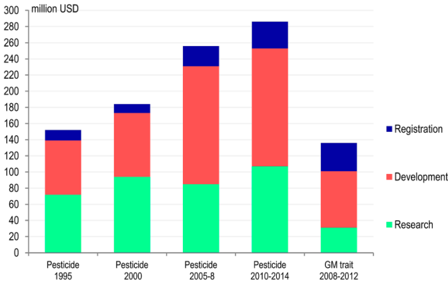
- Phillips McDougall. The Cost of New Agrochemical Product Discovery, Development and Registration in 1995, 2000, 2005-8 and 2010 to 2014;
- IMAA. Number and Value and Largest Mergers, Acquisitions and Alliances Transactions by Year, 1985-2017; IMAA (Institute of Mergers, Acquisitions and Alliances), Webster University: Vienna, Austria, 2017; Available online: https://imaa-institute.org/m-and-a-statistics-transaction-type/ (accessed on 11 July 2017).
- Jorasch, P. How Much Plant Breeding Innovation is Politically Intended? Eur. Seed 2017, 3, 2016. Available online: http://european-seed.com/much-plant-breeding-innovation-politically-intended/ (accessed on 11 July 2017).
- Stucke, M.E.; Grunes, A.P. An Antitrust Review of a Bayer-Monsanto Merger; The Konkurrenz Group: Washington, DC, USA, 2016.
- Bayer; Monsanto. Joint Statement: Monsanto, Bayer CEOs Meet with New Administration. Bayer, Monsanto Press Release 17 January 2017. Available online: https://www.advancingtogether.com/en/ir-media/press- releases/ (accessed on 11 July 2017).
- Robin, M.M. The World According to Monsanto: Pollution, Corruption, and the Control of the World's Food Supply; The New Press: New York, NY, USA, 2008; p. 384.
- Bayer. Advancing together. Bayer to Acquire Monsanto. Creating a Global Leader in Agriculture. Available online: http://www.press.bayer.com/baynews/baynews.nsf/id/Bayer-Offers-to-Acquire-Monsanto-to- Create-a-Global-Leader-in-Agriculture (accessed on 7 September 2017).
Cited by
The problem with growing corporate concentration and power in the global food system
Clapp, J. (2021) · Nature Food · doi:10.1038/s43016-021-00297-7 · Cited by 359
Explaining Growing Glyphosate Use: The Political Economy of Herbicide-Dependent Agriculture
Clapp, J. (2021) · Global Environmental Change · doi:10.1016/j.gloenvcha.2021.102239 · Cited by 168
Navigating toward resilient and inclusive seed systems
Westengen, O. T., Dalle, S. P., & Mulesa, T. H. (2023) · Proceedings of the National Academy of Sciences · doi:10.1073/pnas.2218777120 · Cited by 122
“The four largest multinational companies in seed trade today control about 60% of the ~50 billion USD annual global commercial seed market (160, 161).”
Corporate concentration and power matter for agency in food systems
Clapp, J., Vriezen, R., Laila, A., Conti, C., Gordon, L., Hicks, C., & Rao, N. (2025) · Food Policy · doi:10.1016/j.foodpol.2025.102897 · Cited by 64
Abendroth, L., Miguez, F. E., Castellano, M. J., Carter, P. R., Messina, C. D., Dixon, P. M., & Hatfield, J. L. (2021) · Global Change Biology · doi:10.1111/gcb.15565 · Cited by 72
“Because Pioneer hybrids are planted on approximately one- third of maize area globally (Begemann, 2015; Bonny, 2017; Fernandez- Cornejo, 2004), these data reasonably characterize regional preferences.”
Background
Metadata
- Authors
- Bonny, S.
- Affiliations
- AgroParisTech (FR)
- Corresponding author
- Bonny, Sylvie
- Venue
- Sustainability
- Publisher
- MDPI AG
- Published
- 2017-09-14
- Volume
- 9
- Issue
- 9
- Pages
- 1632
- ISSN
- 2071-1050 (ISSN-L)
- OpenAlex
- W2754564638
- Cited by
- 121
- References
- 38
- Citations by year
- 2026: 4 · 2025: 12 · 2024: 7 · 2023: 17 · 2022: 14 · 2021: 45 · 2020: 12 · 2019: 6 · 2018: 4
- FWCI
- 15.83
- Type
- journal article
- Language
- en
- Open access
- gold
- doi.org
- Licence
- Locations
- Sustainability (publishedVersion, cc-by)
- RePEc: Research Papers in Economics (submittedVersion)
- SSRN Electronic Journal (submittedVersion)
- HAL (submittedVersion, cc-by)
- DOAJ (DOAJ: Directory of Open Access Journals) (submittedVersion, cc-by-sa)
- Topics
- Social Sciences › Development › Agriculture, Land Use, Rural Development
- Life Sciences › Agricultural and Biological Sciences › Plant Science › Genetically Modified Organisms Research
- Social Sciences › Economics, Econometrics and Finance › Economics and Econometrics › Merger and Competition Analysis
- Keywords
- seed industry, business concentration, mergers and acquisitions, technological change, agri-food chain, food power, agricultural innovation
About these checks
Registry, retraction, Cites and statistics results are computed, not judged, with one exception: a printed reference that no index lists is read once by a model before it counts as a citation error. Claims are extracted by a model and kept only when their quote appears verbatim in the text; each cited source is then checked, with a model’s help, for whether it says what the claim relies on. Those verdicts can be wrong — read the claim’s quote and the cited source before relying on one.
Statistics and arithmetic are recomputed, not judged.
Confidence bands are shown only for fields calibrated on our annotated test set. None is calibrated yet, so no band is shown.
What counts as a claim ›How we measure confidence ›How we check this ›
Are you an author, or do you see a problem with this page? Request a review
Data sources
Bibliographic data: Semantic Scholar, OpenAlex, Crossref.
Contains information from the Semantic Scholar Academic Graph Datasets, made available under the ODC Attribution License (ODC-BY 1.0).
Semantic Scholar’s data is described in: Kinney, R., et al. (2023). The Semantic Scholar Open Data Platform. arXiv:2301.10140.
