

The DOI matches its Crossref record; 204 of the 206 references it cites were found in a registry or an index.
The Relationship between Typical Environmental Endocrine Disruptors and Kidney Disease
Open accessAbstract
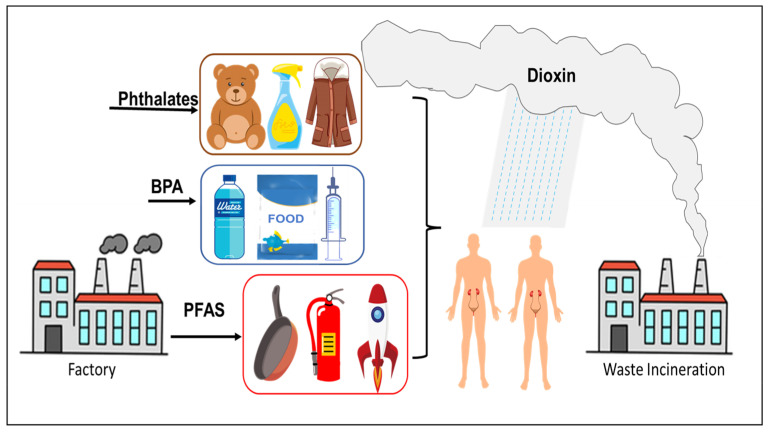
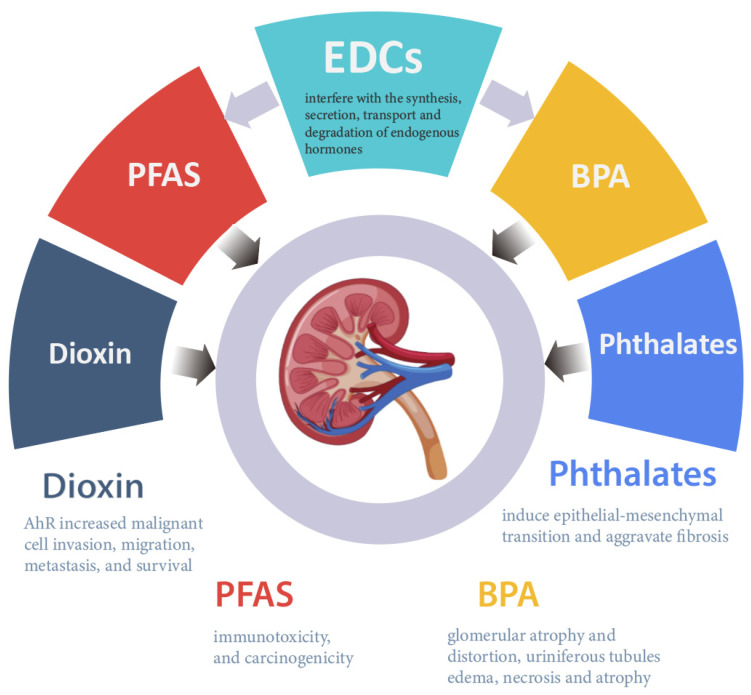
Endocrine disrupting chemicals (EDCs) are exogenous substances that alter the endocrine function of an organism, to result in adverse effects on growth and development, metabolism, and reproductive function. The kidney is one of the most important organs in the urinary system and an accumulation point. Studies have shown that EDCs can cause proteinuria, affect glomeruli and renal tubules, and even lead to diabetes and renal fibrosis in animal and human studies. In this review, we discuss renal accumulation of select EDCs such as dioxins, per- and polyfluoroalkyl substances (PFAS), bisphenol A (BPA), and phthalates, and delineate how exposures to such EDCs cause renal lesions and diseases, including cancer. The regulation of typical EDCs with specific target genes and the activation of related pathways are summarized.
Overview
The claims and statistics of this paper haven’t been checked yet.
Run the check — free, no account needed. It reads the open-access text and checks the sources it cites.
Integrity signals
Registry
Cites
Statistics
Figures
Verification
Claims the paper makes
The claims and statistics of this paper haven’t been checked yet.
Run the check — free, no account needed. It reads the open-access text and checks the sources it cites.
Claims other papers make about this one
Each is checked against this paper’s own text: does it say what the citing paper says it does?
The source backs part of the claim, not all of it — or backs it for a different population, condition or comparison.
In the citing paper
“Zhang et al. [204] compared long-chain and short-chain PFASs, highlighting that short-chain PFASs, such as perfluorobutyric acid (PFBA), have a shorter half-life in blood and do not accumulate as extensively in kidney tissue. In contrast, PFOS was found to be more prevalent in human kidneys.”
From Industrial Applications, Environmental Fate, Human Exposure, and Health Effects of PFAS (2025) · cites this paper as [204]
Experimental — accuracy not yet measuredThe source backs part of the claim, not all of it — or backs it for a different population, condition or comparison.
In the citing paper
“Numerous epidemiological and mechanistic investigations have implied a connection between exposure to PFAS and a wide range of diseases, such as altered immune function, adverse reproductive effects, liver and kidney damage, obesity, and cancers (25–31).”
From Toward the development of a molecular toolkit for the microbial remediation of per-and polyfluoroalkyl substances (2024) · cites this paper as [30]
Experimental — accuracy not yet measured
Self-check
Percentages, sums and reported differences re-computed from the paper’s own numbers.
The self-check needs the paper’s full text.
Citations
Cites
1 retracted
RETRACTED: 2,3,7,8-Tetrachlorodibenzo-p-dioxin induced autophagy in a bovine kidney cell line
Fiorito, F., Ciarcia, R., Granato, G. E., Marfè, G., Iovane, V., Florio, S., Martino, L. D., & Pagnini, U. (2011) · Toxicology · doi:10.1016/j.tox.2011.10.004 · Cited by 40
RetractedProduction, use, and fate of all plastics ever made
Geyer, R., Jambeck, J. R., & Law, K. L. (2017) · Science Advances · doi:10.1126/sciadv.1700782 · Cited by 18,606
Lost at sea: where is all the plastic?
Thompson, R. C., Olsen, Y., Mitchell, R. P., Davis, A., Rowland, S. J., John, A. W. G., McGonigle, D., & Russell, A. E. (2004) · Science · doi:10.1126/science.1094559 · Cited by 7,765
Sunderland, E. M., Hu, X. C., Dassuncao, C., Tokranov, A. K., Wagner, C. C., & Allen, J. G. (2019) · Journal of Exposure Science & Environmental Epidemiology · doi:10.1038/s41370-018-0094-1 · Cited by 2,786
Fenton, S. E., Ducatman, A., Boobis, A., DeWitt, J. C., Lau, C., Ng, C., Smith, J. S., & Roberts, S. M. (2020) · Environmental Toxicology and Chemistry · doi:10.1002/etc.4890 · Cited by 2,445
Per- and polyfluoroalkyl substances in the environment
Evich, M. G., Davis, M. J. B., McCord, J. P., Acrey, B., Awkerman, J. A., Knappe, D. R. U., Lindstrom, A. B., Speth, T. F., Tebes-Stevens, C., Strynar, M. J., et al. (2022) · Science · doi:10.1126/science.abg9065 · Cited by 2,157 · cited 1×
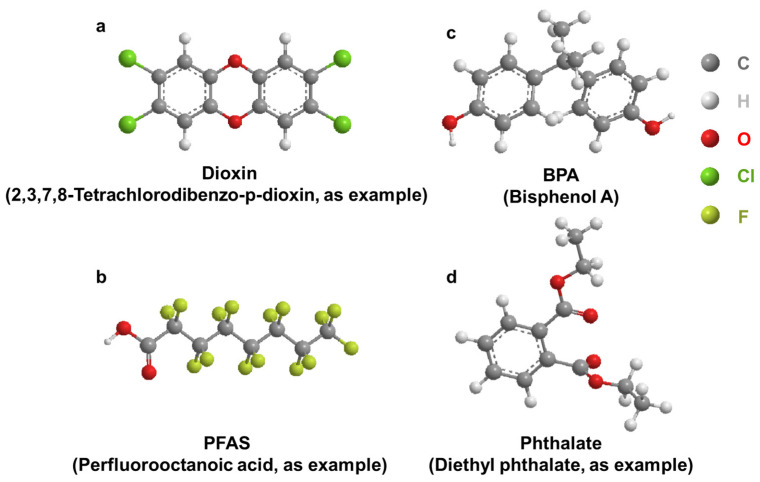
“Per- and polyfluoroalkyl substances are a class of chemicals (Figure 2b) used in many industrial and consumer products with the main function of resisting heat, stains, water, and grease [62,63].”
BackgroundClassify plastic waste as hazardous
Rochman, C. M., Browne, M. A., Halpern, B. S., Hentschel, B. T., Hoh, E., Karapanagioti, H. K., Rios-Mendoza, L. M., Takada, H., Teh, S., & Thompson, R. C. (2013) · Nature · doi:10.1038/494169a · Cited by 1,752
Hu, X. C., Andrews, D. Q., Lindstrom, A. B., Bruton, T. A., Schaider, L. A., Grandjean, P., Lohmann, R., Carignan, C. C., Blum, A., Balan, S. A., et al. (2016) · Environmental Science & Technology Letters · doi:10.1021/acs.estlett.6b00260 · Cited by 1,333
Nebert, D. W., Dalton, T. P., Okey, A. B., & Gonzalez, F. J. (2004) · Journal of Biological Chemistry · doi:10.1074/jbc.r400004200 · Cited by 1,211
Polystyrene Spherules in Coastal Waters
Carpenter, E. J., Anderson, S. J., Harvey, G. R., Miklas, H. P., & Peck, B. B. (1972) · Science · doi:10.1126/science.178.4062.749 · Cited by 1,115
Research works printed but not linked: 2
- Hussein, 2015, Histopathological study of lung, kidney, spleen and prostate in adult male rats treated with Bisphenol A, Basrah J. Vet. Res., 14, 74
- Mourad, 2012, The sensetivity of liver, kidney andtestis of rats to oxidative stress induced by different doses of bisphenol A, Life, 50, 19
Cited by
Sorted by citations
Oxygenated Wound Dressings for Hypoxia Mitigation and Enhanced Wound Healing
Han, X., Ju, L., & Irudayaraj, J. (2023) · Molecular Pharmaceutics · doi:10.1021/acs.molpharmaceut.3c00352 · Cited by 174
Self-citationPei, J., Peng, J., Wu, M., Zhan, X., Wang, D., Zhu, G., Wang, W., An, N., & Pan, X. (2024) · The Science of The Total Environment · doi:10.1016/j.scitotenv.2024.177980 · Cited by 69
Hu, M., & Scott, C. (2024) · Applied and Environmental Microbiology · doi:10.1128/aem.00157-24 · Cited by 63
Song, J. G., Pan, T., Xu, Z., Yi, W., Pan, R., Cheng, J., Hu, W., & Su, H. (2023) · The Science of The Total Environment · doi:10.1016/j.scitotenv.2023.168189 · Cited by 38
Association of Combined Per- and Polyfluoroalkyl Substances and Metals with Chronic Kidney Disease
Haruna, I., & Obeng-Gyasi, E. (2024) · International Journal of Environmental Research and Public Health · doi:10.3390/ijerph21040468 · Cited by 30
Metadata
- Authors
- Zhang, X., Flaws, J. A., Spinella, M. J., & Irudayaraj, J.
- Affiliations
- University of Illinois Urbana-Champaign (US)
- Corresponding author
- Irudayaraj, Joseph
- Venue
- Toxics
- Publisher
- MDPI AG
- Published
- 2022-12-29
- Volume
- 11
- Issue
- 1
- Pages
- 32
- ISSN
- 2305-6304 (ISSN-L)
- PMC
- PMC9863798
- OpenAlex
- W4313362030
- Cited by
- 63
- References
- 206
- Citations by year
- 2026: 12 · 2025: 22 · 2024: 21 · 2023: 8
- FWCI
- 1.24
- Type
- journal article
- Language
- en
- Open access
- gold
- doi.org
- Licence
- Locations
- Toxics (publishedVersion, cc-by)
- PubMed Central (publishedVersion, cc-by)
- PubMed (publishedVersion)
- DOAJ (DOAJ: Directory of Open Access Journals) (submittedVersion)
- Funders
- External Research Board, OVCRI, University of Illinois at Urbana-Champaign (R01ES034112-01A1)
- NIEHS (R01ES034112-01A1)
- Topics
- Physical Sciences › Environmental Science › Health, Toxicology and Mutagenesis › Effects and risks of endocrine disrupting chemicals
- Physical Sciences › Environmental Science › Health, Toxicology and Mutagenesis › Toxic Organic Pollutants Impact
- Physical Sciences › Environmental Science › Environmental Chemistry › Per- and polyfluoroalkyl substances research
- Keywords
- endocrine disruptors, kidney disease, dioxins, per- and polyfluoroalkyl substances, bisphenol A, phthalates, proteinuria, glomerular lesions, renal tubules, renal fibrosis, kidney cancer, renal accumulation, target genes, signaling pathways
About these checks
Registry, retraction, Cites and statistics results are computed, not judged, with one exception: a printed reference that no index lists is read once by a model before it counts as a citation error. Claims are extracted by a model and kept only when their quote appears verbatim in the text; each cited source is then checked, with a model’s help, for whether it says what the claim relies on. Those verdicts can be wrong — read the claim’s quote and the cited source before relying on one.
Statistics and arithmetic are recomputed, not judged.
Confidence bands are shown only for fields calibrated on our annotated test set. None is calibrated yet, so no band is shown.
What counts as a claim ›How we measure confidence ›How we check this ›
Are you an author, or do you see a problem with this page? Request a review
