

Snake Antivenoms—Toward Better Understanding of the Administration Route
Open accessThe DOI matches its Crossref record; 150 of the 151 references it cites were found in a registry or an index.
Abstract
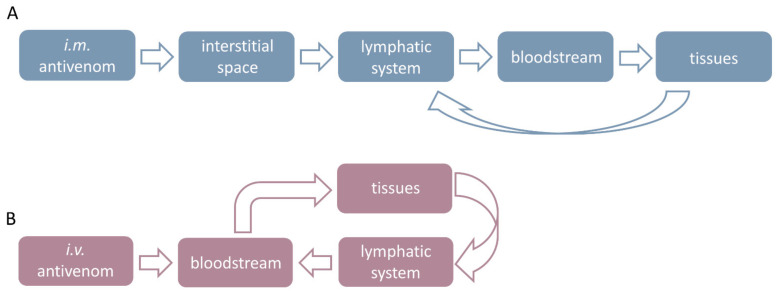
Envenomations induced by animal bites and stings constitute a significant public health burden. Even though a standardized protocol does not exist, parenterally administered polyclonal antivenoms remain the mainstay in snakebite therapy. There is a prevailing opinion that their application by the i.m. route has poor efficacy and that i.v. administration should preferentially be chosen in order to achieve better accomplishment of the antivenom therapeutic activity. Recently, it has been demonstrated that neutralization not only in the systemic circulation but also in the lymphatic system might be of great importance for the clinical outcome since it represents another relevant body compartment through which the absorption of the venom components occurs. In this review, the present-day and summarized knowledge of the laboratory and clinical findings on the i.v. and i.m. routes of antivenom administration is provided, with a special emphasis on the contribution of the lymphatic system to the process of venom elimination. Until now, antivenom-mediated neutralization has not yet been discussed in the context of the synergistic action of both blood and lymph. A current viewpoint might help to improve the comprehension of the venom/antivenom pharmacokinetics and the optimal approach for drug application. There is a great need for additional dependable, practical, well-designed studies, as well as more practice-related experience reports. As a result, opportunities for resolving long-standing disputes over choosing one therapeutic principle over another might be created, improving the safety and effectiveness of snakebite management.
Overview
The claims and statistics of this paper haven’t been checked yet.
Free: it reads the open-access text and checks the first 5 claims that cite a source we can check. Create a free account to check every claim.
Integrity signals
Registry
Cites
Statistics
Figures
Verification
Claims the paper makes
The claims and statistics of this paper haven’t been checked yet.
Free: it reads the open-access text and checks the first 5 claims that cite a source we can check. Create a free account to check every claim.
Claims other papers make about this one
Each is checked against this paper’s own text: does it say what the citing paper says it does?
The source backs part of the claim, not all of it — or backs it for a different population, condition or comparison.
In the citing paper
“their large molecular size severely impedes tissue penetration, making them ineffective in reducing rapid local tissue damage”
From Role of Regulated Cell Death Pathways in Snakebite Envenomation: Mechanisms, Crosstalk, and Therapeutic Opportunities (2026) · cites this paper as [77]
Experimental — accuracy not yet measured
Self-check
Percentages, sums and reported differences re-computed from the paper’s own numbers.
The self-check needs the paper’s full text.
Citations
Cites
Gutiérrez, J. M., Calvete, J. J., Habib, A. G., Harrison, R. A., Williams, D. J., & Warrell, D. A. (2017) · Nature Reviews Disease Primers · doi:10.1038/nrdp.2017.63 · Cited by 955
Antibody Pharmacokinetics and Pharmacodynamics
Lobo, E. D., Hansen, R. J., & Balthasar, J. P. (2004) · Journal of Pharmaceutical Sciences · doi:10.1002/jps.20178 · Cited by 909
Warrell, D. A. (2010) · The Lancet · doi:10.1016/s0140-6736(09)61754-2 · Cited by 774
Snake Bite in South Asia: A Review
Alirol, E., Sharma, S. K., Bawaskar, H. S., Kuch, U., & Chappuis, F. (2010) · PLoS Neglected Tropical Diseases · doi:10.1371/journal.pntd.0000603 · Cited by 493
The Global Snake Bite Initiative: an antidote for snake bite
Williams, D., Gutiérrez, J. M., Harrison, R., Warrell, D. A., White, J., Winkel, K. D., & Gopalakrishnakone, P. (2010) · The Lancet · doi:10.1016/s0140-6736(09)61159-4 · Cited by 397 · cited 1×
“Nowadays, the whole world faces a critical and longstanding shortage of antivenoms, affecting, in the first place, developing countries [13–16] but high-income countries as well [17–19], whose alleviation aims for the development of feasible and profitable production strategies, rational use of medications and impleme…”
BackgroundSlagboom, J., Kool, J., Harrison, R. A., & Casewell, N. R. (2017) · British Journal of Haematology · doi:10.1111/bjh.14591 · Cited by 278
Williams, D. J., Gutiérrez, J.-M., Calvete, J. J., Wüster, W., Ratanabanangkoon, K., Paiva, O., Brown, N. I., Casewell, N. R., Harrison, R. A., Rowley, P. D., et al. (2011) · Journal of Proteomics · doi:10.1016/j.jprot.2011.05.027 · Cited by 244
Isbister, G. K., & Kiernan, M. C. (2005) · The Lancet Neurology · doi:10.1016/s1474-4422(05)70041-7 · Cited by 241
Snake Venoms in Drug Discovery: Valuable Therapeutic Tools for Life Saving
Mohamed Abd El-Aziz, T., Soares, A. G., & Stockand, J. D. (2019) · Toxins · doi:10.3390/toxins11100564 · Cited by 241
Current Treatment for Venom-Induced Consumption Coagulopathy Resulting from Snakebite
Maduwage, K., & Isbister, G. K. (2014) · PLoS Neglected Tropical Diseases · doi:10.1371/journal.pntd.0003220 · Cited by 235
Research works printed but not linked: 10
- Kalil J. Fan H.W. Production and Utilization of Snake Antivenoms in South America Toxins and Drug Discovery Gopalakrishnakone P. Cruz L.J. Luo S. Springer São Paulo, Brazil 2017 81 101 9789400764521
- Kakhi M. Delavadia P. Suarez-Sharp S. Biopharmaceutic Considerations in Drug Product Design and In Vitro Drug Product Performance Shargel and Yu’s Applied Biopharmaceutics and Pharmacokinetics 8th ed. Ducharme M.P. Shargel L. McGraw Hill New York, NY, USA 2022 183 243 9781260142990
- Gad S.C. Chengelis C.P. Safety Considerations for the Administration of Agents by the Parenteral Routes Acute Toxicology Testing Academic Press Cambridge, MA, USA 1998 197 220 978-0-12-272250-9
- Polania Gutierrez J.J. Munakomi S. Intramuscular Injection StatPearls Tampa, FL, USA 2023 Available online: https://www.ncbi.nlm.nih.gov/books/NBK556121/ (accessed on 11 May 2023) 32310581
- Schou J. Subcutaneous and Intramuscular Injection of Drugs Concepts in Biochemical Pharmacology Ackerman H.S. Brodie B.B. Gillette J.R. Springer Heidelberg, Germany 1971 47 63 978-3-642-65054-3
- Persson H. Clinical Toxicology of Snake Bite in Europe Handbook of Clinical Toxicology of Animal Venoms and Poisons 1st ed. White J. Meier J. CRC Press Boca Raton, FL, USA 1995 413 433 978-0-8493-4489-3
- Claassen V. Neglected Factors in Pharmacology and Neuroscience Research Huston J.P. Elsevier Amsterdam, The Netherlands 1994 0-444-81871-5
- Chippaux J.P. Stock R.P. Massougbodji A. Antivenom Safety and Tolerance for the Strategy of Snake Envenomation Management Snake Venoms Springer Dordrecht, The Netherlands 2015 1 16 9789400766488
- Seifert S.A. Pharmacokinetic Analysis of a Crotalid Fab Antivenom and Theoretical Considerations for the Prevention of Coagulopathic Recurrence Proceedings of the North American Congress of Clinical Toxicology Orlando, FL, USA 9–15 September 1998
- Win-Aung Intramuscular Antivenom Administration as an Effective First-Aid Measure in Management of Snakebites Proceedings of the Management of Snakebite and Research—Report and Working Papers of a Seminar Yangon, Myanmar 11–12 December 2001 29 33
Cited by
The Chinese guideline for management of snakebites
Lai, R., Yan, S., Wang, S., Yang, S., Yan, Z., Lan, P., Wang, Y., Li, Q., Wang, J., Wang, W., et al. (2024) · World Journal of Emergency Medicine · doi:10.5847/wjem.j.1920-8642.2024.076 · Cited by 32
A Guide to the Clinical Management of Vipera Snakebite in Italy
Nicola, M. R. D., Crevani, M., Avella, I., Cerullo, A., Dorne, J. L. C. M., Paolino, G., & Zattera, C. (2024) · Toxins · doi:10.3390/toxins16060255 · Cited by 22
“…important to consider the best antivenom format according to the type of envenoming: Fab antivenoms are considered more suitable for elapid venoms, rich of low-molecular mass toxins, while F(ab’) 2 antivenoms proved more effective in counteracting larger molecules characteristic of viperids [118].”
BackgroundSnakebites in the Americas: a Neglected Problem in Public Health
C, E. A. F., & Youssef, P. (2023) · Current Tropical Medicine Reports · doi:10.1007/s40475-023-00309-5 · Cited by 26
Alvitigala, B. Y., Dissanayake, H. A., Weeratunga, P. N., Padmaperuma, P. A. C. D., Gooneratne, L. V., & Gnanathasan, C. A. (2025) · Transactions of the Royal Society of Tropical Medicine and Hygiene · doi:10.1093/trstmh/trae058 · Cited by 21
Alvitigala, B. Y., Gooneratne, L. V., Gnanathasan, C. A., & Wijewickrama, E. S. (2025) · Transactions of the Royal Society of Tropical Medicine and Hygiene · doi:10.1093/trstmh/trae077 · Cited by 15
Metabolomics and proteomics: synergistic tools for understanding snake venom inhibition
Hussain, S. S., & Kingsley, D. J. (2025) · Archives of Toxicology · doi:10.1007/s00204-024-03947-4 · Cited by 9
“Insights derived from STAB Profiles can also inform the development of next-generation antivenoms and pave the way for novel therapeutic agents derived from venom components (Krause et al. 2020; Gamulin et al. 2023).”
An alternative source of medicines: pharmaceutical utilization of animal-derived metabolites
Renda, G. (2025) · Phytochemistry Reviews · doi:10.1007/s11101-025-10086-w · Cited by 6
“They are usually obtained from the plasma of poisonous animals after the venom is injected into animals such as horses or sheep (Gamulin et al. 2023).”
Puzari, U., Khan, M. R., & Mukherjee, A. K. (2025) · PLoS neglected tropical diseases · doi:10.1371/journal.pntd.0012913 · Cited by 5
“In contrast, Viperid venoms containing high-molecular-weight toxins are absorbed gradually from the injection site via the lymphatic system, resulting in prolonged and heightened presence in the bloodstream [70,79,80].”
Zhao, J., Wang, L., Shi, X., Yang, Y., & Huang, C. (2025) · Archives of Toxicology · doi:10.1007/s00204-025-04250-6 · Cited by 5
Gamulin, E., Lukačević, S. M., Balija, M. L., Smajlović, A., Vnuk, D., Harcet, J. G., Tomičić, M., Hećimović, A., Halassy, B., & Kurtović, T. (2025) · Pharmaceutics · doi:10.3390/pharmaceutics17020212 · Cited by 6
Self-citationAntiparasitic activity of Cerastes cerastes venom on Schistosoma mansoni infected mice
Mahdy, A., Mostafa, O., Aboueldahab, M. M., & Nigm, A. H. (2024) · Experimental Parasitology · doi:10.1016/j.exppara.2024.108866 · Cited by 4
Majeed, R., Bester, J., Kgarosi, K., & Strydom, M. A. (2025) · Tropical Medicine and Infectious Disease · doi:10.3390/tropicalmed10080228 · Cited by 5
“Over 2.7 million people are estimated to suffer the consequences of SBE annually, with up to 138,000 fatalities and 400,000 victims left with disabilities [2,3].”
InfluentialPolymeric Nanoparticles for the Diagnosis and Treatment of Snakebite
Prabhakar, N., Oliver, T., & Baker, A. N. (2026) · Macromolecular Chemistry and Physics · doi:10.1002/macp.202500382 · Cited by 3
“…further advantage of fragment therapy has been observed in Fab-based antivenoms, which may penetrate more deeply into affected tissue, a challenge that IgG immunoglobulins ( ∼ 150 kDa) and, to a lesser extent, F(ab’) 2 fragments ( ∼ 100 kDa) struggle with due to their large size [ 15, 16, 21, 22 ].”
Silva-Neto, A. V., Mouta, G. D. S., Nascimento, T. P., Balieiro, A. A. D. S., Cordeiro, J. S. M., Valente, J., Sachett, A., Balieiro, P. C. D. S., Baia-da-Silva, D. C., Val, F., et al. (2026) · PLoS neglected tropical diseases · doi:10.1371/journal.pntd.0013873 · Cited by 3
Diagnostic platforms for snakebite: Current approaches and challenges in medically important species
Brilhante-da-Silva, N., Roberto, S. A., Prado, N. D. R., Soares-de-Souza, L. R., Marinho, A. C. M., Fernandes, C. F. C., & Pereira, S. D. S. (2025) · Analytical Biochemistry · doi:10.1016/j.ab.2025.115823 · Cited by 3
Ojha, A., Hadimani, P., Anthony, D., Raj, V., Bhasker, S., Mishra, M., & Johri, S. (2025) · Cureus · doi:10.7759/cureus.84090 · Cited by 3
“While intravenous (IV) administration is generally preferred, evidence from India regarding differences between IV and intramuscular (IM) routes remains limited [6].”
Sofyantoro, F., Sudaryadi, I., Yudha, D. S., Raharjo, S., Purwestri, Y. A., & Nuringtyas, T. R. (2025) · Journal of Current Science and Technology · doi:10.59796/jcst.v15n4.2025.138 · Cited by 2
“Intravenous administration is preferred over intramuscular routes due to its superior efficacy in neutralizing venom in both the systemic and lymphatic circulation, which is critical for optimal clinical outcomes (Gamulin et al., 2023).”
Kutsenko, V., Nosov, A., Ushal, I., Papina, E., Seliverstov, P. V., Golovanov, M., Medvedeva, E., Nurgaliev, A., & Koichuev, S. (2026) · Problems of Biological Medical and Pharmaceutical Chemistry · doi:10.29296/25877313-2026-04-13 · Cited by 2
Development of a neutralizing monoclonal antibody targeting Bothrops atrox venom metalloproteinases
Costa, T. G. F., de Assis, T. C. S., Costa, J. M. C., Saavedra-Langer, R., Santo, T. S., Ferreira, C. A. B., Machado‐de‐Ávila, R. A., Felicori, L. F., Guerra-Duarte, C., Lopes-de-Souza, L., et al. (2025) · International Journal of Biological Macromolecules · doi:10.1016/j.ijbiomac.2025.143608 · Cited by 1
Maoz, H., & Elalouf, A. (2026) · Proteins Structure Function and Bioinformatics · doi:10.1002/prot.70125 · Cited by 1
“The cornerstone of clinical management remains the administration of antivenom, which, for over a century, has been produced by immunizing large animals (typically horses or sheep) with snake venoms and purifying the resulting polyclonal antibodies [4].”
Alangode, A., Rajasekhar, A., Sabu, J. J., Krishna, S., Anuja, D., Sreeja, A., Remesh, G., Kaladevi, A., & Nair, B. G. (2026) · International Journal of Molecular Sciences · doi:10.3390/ijms27156830
“While the only approved treatment currently relies on intravenous administration of antibody-based antivenoms, which neutralize free toxins in systemic circulation, their large molecular size severely impedes tissue penetration, making them ineffective in reducing rapid local tissue damage [77].”
Darkaoui, B., Lafnoune, A., Irahal, I. N., Chakir, S., Aassila, H., Aksim, M., Filali, O. A., & Oukkache, N. (2025) · Journal of Applied Toxicology · doi:10.1002/jat.4941
“While our lethality assays (LD 50 /sLD) quantified systemic toxicity, prior work by Gamulin et al. demonstrated that the lymphatic system plays a dual role in envenomation in facilitating venom distribution and neutralizing toxins before they enter systemic circulation (Gamulin et al. 2023).”
BiteSage: A Snake Bite Antidote Suggester
Cholke, P., Suhagir, O. Y., Gadiwale, M. M. M., Mane, S. P., Mohite, S. S., & Phalke, S. R. (2025) · Lecture notes in networks and systems · doi:10.1007/978-3-032-06662-6_5
Milovanović, V. (2024) · National Repository of Dissertations in Serbia
Gaonkar, A. N., Saha, K., Harmalkar, N., Kadam, H. K., Sarkel, S., Mandrekar, V. K., & Dhuri, S. N. (2025) · ChemistrySelect · doi:10.1002/slct.202504352
Čikeš, M., Leonardi, A., Križaj, I., & Karabuva, S. (2026) · Toxins · doi:10.3390/toxins18040178
“It has been demonstrated that venom neutralisation in both the systemic circulation and the lymphatic system is important for a favourable clinical outcome in severe envenomation cases [31].”
InfluentialMousavi, S. S., Mojahedi, M. J., Zareh, P., Mousavi, S. S., Abad, M. J. Y., Hakemi, A., & Rafati, S. S. (2026) · Tropical Diseases Travel Medicine and Vaccines · doi:10.1186/s40794-026-00299-y
“Antivenom works by binding to venom components, preventing their interaction with target tissues and the development of serious complications such as myocarditis, compartment syndrome, activation of the coagulation cascade, and DIC [13].”
Uppal, A., Hamman, N. A., Mohammed, N., Umar, A. M., Surya, M., Nyarko, E. N. Y., Abdulkarim, S., Lang, T. A., & Difa, J. A. (2026) · Wellcome Open Research · doi:10.12688/wellcomeopenres.26196.2
Adiseshan, S., Geetha Rani, A., Meenakumari, Nisha Maheswari, Y., Lakshmi Prabha, M., & Ezhil Ramya, J. (2026) · National Journal of Community Medicine · doi:10.55489/njcm.170620266224
“29 Our study found a low incidence (approximately 10”
Clinical Practice Recommendations: Snakebite-envenomation-associated Acute Kidney Injury
Sharma, S., Sahoo, T. K., Ramanathan, K. R., Krishna, R., Singh, A. K., Sharma, N., Bandi, V. K., Nasa, P., Dash, S. K., Kalra, S., et al. (2026) · Journal of the Association of Physicians of India · doi:10.59556/japi.74.1528
Wang, L., Zhao, J., Xia, F., Sun, D., Lei, Q., Liu, M., Xiao, S., Yang, Y., & Huang, C. (2026) · Pharmaceuticals · doi:10.3390/ph19071050
“Furthermore, potential hypersensitivity reactions and serum sickness, coupled with restricted availability in remote regions, limit its clinical utility [13,14].”
Ho, C.-H., Chiang, Y.-W., Mao, Y., Hsu, C., Chen, F.-C., Tsai, S., & Liu, S. (2026) · PLoS neglected tropical diseases · doi:10.1371/journal.pntd.0014689
“Pharmacokinetically, FHAV has a maximum plasma concentration ( Tmax ) of 36 min [32], an initial distribution half-life ( t 1/2 α ) of 15 min [33], a terminal elimination half-life ( t 1/2 β ) of 48–96 h [34], and a mean residence time (MRT) of 10.4 d [33].”
InfluentialSaidu, H., Musa, B. O. P., Isa, M. S., Gwarzo, M. Y., Abdullahi, H. L., Balla, S. A., Mohammed, N., Hamman, N. A., Olatunde, A. O., Mkamel, M., et al. (2026) · Transactions of the Royal Society of Tropical Medicine and Hygiene · doi:10.1093/trstmh/trag133
Metadata
- Authors
- Gamulin, E., Mateljak Lukačević, S., Halassy, B., & Kurtović, T.
- Affiliations
- University of Zagreb (HR)
- Centre for Research and Knowledge Transfer in Biotechnology, University of Zagreb, Rockefellerova 10, 10000 Zagreb, Croatia
- Corresponding author
- Kurtović, Tihana
- Venue
- Toxins
- Publisher
- MDPI AG
- Published
- 2023-06-15
- Volume
- 15
- Issue
- 6
- Pages
- 398
- ISSN
- 2072-6651 (ISSN-L)
- PMC
- PMC10302821
- OpenAlex
- W4380998154
- Cited by
- 30
- References
- 151
- Citations by year
- 2026: 11 · 2025: 13 · 2024: 5 · 2023: 1
- FWCI
- 1.16
- Type
- journal article
- Language
- en
- Open access
- gold
- doi.org
- Licence
- Locations
- Toxins (publishedVersion, cc-by)
- PubMed Central (publishedVersion, cc-by)
- PubMed (publishedVersion)
- DOAJ (DOAJ: Directory of Open Access Journals) (submittedVersion, cc-by-sa)
- Funders
- Croatian Science Foundation (UIP-2020-02-1317)
- Topics
- Life Sciences › Pharmacology, Toxicology and Pharmaceutics › Toxicology › Venomous Animal Envenomation and Studies
- Life Sciences › Agricultural and Biological Sciences › Ecology, Evolution, Behavior and Systematics › Amphibian and Reptile Biology
- Health Sciences › Medicine › Emergency Medicine › Poisoning and overdose treatments
- Keywords
- snake antivenom, snakebite, route of administration, intravenous administration, intramuscular administration, lymphatic system, venom neutralization, snakebite treatment
- MeSH terms
- Animals, Antivenins, Elapid Venoms, Snake Bites, Snake Venoms, Snakes
About these checks
Registry, retraction, Cites and statistics results are computed, not judged, with one exception: a printed reference that no index lists is read once by a model before it counts as a citation error. Claims are extracted by a model and kept only when their quote appears verbatim in the text; each cited source is then checked, with a model’s help, for whether it says what the claim relies on. Those verdicts can be wrong — read the claim’s quote and the cited source before relying on one.
Statistics and arithmetic are recomputed, not judged.
Confidence bands are shown only for fields calibrated on our annotated test set. None is calibrated yet, so no band is shown.
What counts as a claim ›How we measure confidence ›How we check this ›
Are you an author, or do you see a problem with this page? Request a review
Data sources
Bibliographic data: Semantic Scholar, OpenAlex, Crossref.
Contains information from the Semantic Scholar Academic Graph Datasets, made available under the ODC Attribution License (ODC-BY 1.0).
Semantic Scholar’s data is described in: Kinney, R., et al. (2023). The Semantic Scholar Open Data Platform. arXiv:2301.10140.
