

Snake Antivenoms—Toward Better Understanding of the Administration Route
Open accessThe DOI matches its Crossref record; 150 of the 151 references it cites were found in a registry or an index.
Abstract
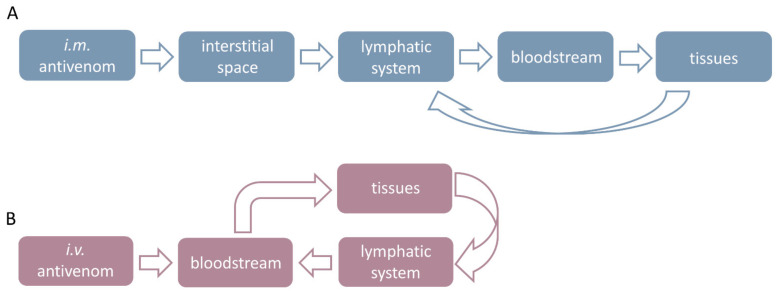
Envenomations induced by animal bites and stings constitute a significant public health burden. Even though a standardized protocol does not exist, parenterally administered polyclonal antivenoms remain the mainstay in snakebite therapy. There is a prevailing opinion that their application by the i.m. route has poor efficacy and that i.v. administration should preferentially be chosen in order to achieve better accomplishment of the antivenom therapeutic activity. Recently, it has been demonstrated that neutralization not only in the systemic circulation but also in the lymphatic system might be of great importance for the clinical outcome since it represents another relevant body compartment through which the absorption of the venom components occurs. In this review, the present-day and summarized knowledge of the laboratory and clinical findings on the i.v. and i.m. routes of antivenom administration is provided, with a special emphasis on the contribution of the lymphatic system to the process of venom elimination. Until now, antivenom-mediated neutralization has not yet been discussed in the context of the synergistic action of both blood and lymph. A current viewpoint might help to improve the comprehension of the venom/antivenom pharmacokinetics and the optimal approach for drug application. There is a great need for additional dependable, practical, well-designed studies, as well as more practice-related experience reports. As a result, opportunities for resolving long-standing disputes over choosing one therapeutic principle over another might be created, improving the safety and effectiveness of snakebite management.
Overview
The claims and statistics of this paper haven’t been checked yet.
Free: it reads the open-access text and checks the first 5 claims that cite a source we can check. Create a free account to check every claim.
Integrity signals
Registry
Cites
Statistics
Figures
Verification
Claims the paper makes
The claims and statistics of this paper haven’t been checked yet.
Free: it reads the open-access text and checks the first 5 claims that cite a source we can check. Create a free account to check every claim.
Claims other papers make about this one
Each is checked against this paper’s own text: does it say what the citing paper says it does?
The source backs part of the claim, not all of it — or backs it for a different population, condition or comparison.
In the citing paper
“their large molecular size severely impedes tissue penetration, making them ineffective in reducing rapid local tissue damage”
From Role of Regulated Cell Death Pathways in Snakebite Envenomation: Mechanisms, Crosstalk, and Therapeutic Opportunities (2026) · cites this paper as [77]
Experimental — accuracy not yet measured
Self-check
Percentages, sums and reported differences re-computed from the paper’s own numbers.
The self-check needs the paper’s full text.
Citations
Cites
Gutiérrez, J. M., Calvete, J. J., Habib, A. G., Harrison, R. A., Williams, D. J., & Warrell, D. A. (2017) · Nature Reviews Disease Primers · doi:10.1038/nrdp.2017.63 · Cited by 955
Antibody Pharmacokinetics and Pharmacodynamics
Lobo, E. D., Hansen, R. J., & Balthasar, J. P. (2004) · Journal of Pharmaceutical Sciences · doi:10.1002/jps.20178 · Cited by 909
Warrell, D. A. (2010) · The Lancet · doi:10.1016/s0140-6736(09)61754-2 · Cited by 774
Snake Bite in South Asia: A Review
Alirol, E., Sharma, S. K., Bawaskar, H. S., Kuch, U., & Chappuis, F. (2010) · PLoS Neglected Tropical Diseases · doi:10.1371/journal.pntd.0000603 · Cited by 493
The Global Snake Bite Initiative: an antidote for snake bite
Williams, D., Gutiérrez, J. M., Harrison, R., Warrell, D. A., White, J., Winkel, K. D., & Gopalakrishnakone, P. (2010) · The Lancet · doi:10.1016/s0140-6736(09)61159-4 · Cited by 397 · cited 1×
“Nowadays, the whole world faces a critical and longstanding shortage of antivenoms, affecting, in the first place, developing countries [13–16] but high-income countries as well [17–19], whose alleviation aims for the development of feasible and profitable production strategies, rational use of medications and impleme…”
BackgroundSlagboom, J., Kool, J., Harrison, R. A., & Casewell, N. R. (2017) · British Journal of Haematology · doi:10.1111/bjh.14591 · Cited by 278
Williams, D. J., Gutiérrez, J.-M., Calvete, J. J., Wüster, W., Ratanabanangkoon, K., Paiva, O., Brown, N. I., Casewell, N. R., Harrison, R. A., Rowley, P. D., et al. (2011) · Journal of Proteomics · doi:10.1016/j.jprot.2011.05.027 · Cited by 244
Isbister, G. K., & Kiernan, M. C. (2005) · The Lancet Neurology · doi:10.1016/s1474-4422(05)70041-7 · Cited by 241
Snake Venoms in Drug Discovery: Valuable Therapeutic Tools for Life Saving
Mohamed Abd El-Aziz, T., Soares, A. G., & Stockand, J. D. (2019) · Toxins · doi:10.3390/toxins11100564 · Cited by 241
Current Treatment for Venom-Induced Consumption Coagulopathy Resulting from Snakebite
Maduwage, K., & Isbister, G. K. (2014) · PLoS Neglected Tropical Diseases · doi:10.1371/journal.pntd.0003220 · Cited by 235
Research works printed but not linked: 10
- Kalil J. Fan H.W. Production and Utilization of Snake Antivenoms in South America Toxins and Drug Discovery Gopalakrishnakone P. Cruz L.J. Luo S. Springer São Paulo, Brazil 2017 81 101 9789400764521
- Kakhi M. Delavadia P. Suarez-Sharp S. Biopharmaceutic Considerations in Drug Product Design and In Vitro Drug Product Performance Shargel and Yu’s Applied Biopharmaceutics and Pharmacokinetics 8th ed. Ducharme M.P. Shargel L. McGraw Hill New York, NY, USA 2022 183 243 9781260142990
- Gad S.C. Chengelis C.P. Safety Considerations for the Administration of Agents by the Parenteral Routes Acute Toxicology Testing Academic Press Cambridge, MA, USA 1998 197 220 978-0-12-272250-9
- Polania Gutierrez J.J. Munakomi S. Intramuscular Injection StatPearls Tampa, FL, USA 2023 Available online: https://www.ncbi.nlm.nih.gov/books/NBK556121/ (accessed on 11 May 2023) 32310581
- Schou J. Subcutaneous and Intramuscular Injection of Drugs Concepts in Biochemical Pharmacology Ackerman H.S. Brodie B.B. Gillette J.R. Springer Heidelberg, Germany 1971 47 63 978-3-642-65054-3
- Persson H. Clinical Toxicology of Snake Bite in Europe Handbook of Clinical Toxicology of Animal Venoms and Poisons 1st ed. White J. Meier J. CRC Press Boca Raton, FL, USA 1995 413 433 978-0-8493-4489-3
- Claassen V. Neglected Factors in Pharmacology and Neuroscience Research Huston J.P. Elsevier Amsterdam, The Netherlands 1994 0-444-81871-5
- Chippaux J.P. Stock R.P. Massougbodji A. Antivenom Safety and Tolerance for the Strategy of Snake Envenomation Management Snake Venoms Springer Dordrecht, The Netherlands 2015 1 16 9789400766488
- Seifert S.A. Pharmacokinetic Analysis of a Crotalid Fab Antivenom and Theoretical Considerations for the Prevention of Coagulopathic Recurrence Proceedings of the North American Congress of Clinical Toxicology Orlando, FL, USA 9–15 September 1998
- Win-Aung Intramuscular Antivenom Administration as an Effective First-Aid Measure in Management of Snakebites Proceedings of the Management of Snakebite and Research—Report and Working Papers of a Seminar Yangon, Myanmar 11–12 December 2001 29 33
Cited by
The Chinese guideline for management of snakebites
Lai, R., Yan, S., Wang, S., Yang, S., Yan, Z., Lan, P., Wang, Y., Li, Q., Wang, J., Wang, W., et al. (2024) · World Journal of Emergency Medicine · doi:10.5847/wjem.j.1920-8642.2024.076 · Cited by 32
A Guide to the Clinical Management of Vipera Snakebite in Italy
Nicola, M. R. D., Crevani, M., Avella, I., Cerullo, A., Dorne, J. L. C. M., Paolino, G., & Zattera, C. (2024) · Toxins · doi:10.3390/toxins16060255 · Cited by 22
“…important to consider the best antivenom format according to the type of envenoming: Fab antivenoms are considered more suitable for elapid venoms, rich of low-molecular mass toxins, while F(ab’) 2 antivenoms proved more effective in counteracting larger molecules characteristic of viperids [118].”
BackgroundSnakebites in the Americas: a Neglected Problem in Public Health
C, E. A. F., & Youssef, P. (2023) · Current Tropical Medicine Reports · doi:10.1007/s40475-023-00309-5 · Cited by 26
Alvitigala, B. Y., Dissanayake, H. A., Weeratunga, P. N., Padmaperuma, P. A. C. D., Gooneratne, L. V., & Gnanathasan, C. A. (2025) · Transactions of the Royal Society of Tropical Medicine and Hygiene · doi:10.1093/trstmh/trae058 · Cited by 21
Alvitigala, B. Y., Gooneratne, L. V., Gnanathasan, C. A., & Wijewickrama, E. S. (2025) · Transactions of the Royal Society of Tropical Medicine and Hygiene · doi:10.1093/trstmh/trae077 · Cited by 15
Metadata
- Authors
- Gamulin, E., Mateljak Lukačević, S., Halassy, B., & Kurtović, T.
- Affiliations
- University of Zagreb (HR)
- Centre for Research and Knowledge Transfer in Biotechnology, University of Zagreb, Rockefellerova 10, 10000 Zagreb, Croatia
- Corresponding author
- Kurtović, Tihana
- Venue
- Toxins
- Publisher
- MDPI AG
- Published
- 2023-06-15
- Volume
- 15
- Issue
- 6
- Pages
- 398
- ISSN
- 2072-6651 (ISSN-L)
- PMC
- PMC10302821
- OpenAlex
- W4380998154
- Cited by
- 30
- References
- 151
- Citations by year
- 2026: 11 · 2025: 13 · 2024: 5 · 2023: 1
- FWCI
- 1.16
- Type
- journal article
- Language
- en
- Open access
- gold
- doi.org
- Licence
- Locations
- Toxins (publishedVersion, cc-by)
- PubMed Central (publishedVersion, cc-by)
- PubMed (publishedVersion)
- DOAJ (DOAJ: Directory of Open Access Journals) (submittedVersion, cc-by-sa)
- Funders
- Croatian Science Foundation (UIP-2020-02-1317)
- Topics
- Life Sciences › Pharmacology, Toxicology and Pharmaceutics › Toxicology › Venomous Animal Envenomation and Studies
- Life Sciences › Agricultural and Biological Sciences › Ecology, Evolution, Behavior and Systematics › Amphibian and Reptile Biology
- Health Sciences › Medicine › Emergency Medicine › Poisoning and overdose treatments
- Keywords
- snake antivenom, snakebite, route of administration, intravenous administration, intramuscular administration, lymphatic system, venom neutralization, snakebite treatment
- MeSH terms
- Animals, Antivenins, Elapid Venoms, Snake Bites, Snake Venoms, Snakes
About these checks
Registry, retraction, Cites and statistics results are computed, not judged, with one exception: a printed reference that no index lists is read once by a model before it counts as a citation error. Claims are extracted by a model and kept only when their quote appears verbatim in the text; each cited source is then checked, with a model’s help, for whether it says what the claim relies on. Those verdicts can be wrong — read the claim’s quote and the cited source before relying on one.
Statistics and arithmetic are recomputed, not judged.
Confidence bands are shown only for fields calibrated on our annotated test set. None is calibrated yet, so no band is shown.
What counts as a claim ›How we measure confidence ›How we check this ›
Are you an author, or do you see a problem with this page? Request a review
Data sources
Bibliographic data: Semantic Scholar, OpenAlex, Crossref.
Contains information from the Semantic Scholar Academic Graph Datasets, made available under the ODC Attribution License (ODC-BY 1.0).
Semantic Scholar’s data is described in: Kinney, R., et al. (2023). The Semantic Scholar Open Data Platform. arXiv:2301.10140.
