

Intestinal Parasitic Infection and Nutritional Status in Children under Five Years Old: A Systematic Review
Open accessThe DOI matches its Crossref record; 81 of the 85 references it cites were found in a registry or an index; 17 of the 29 sources its claims cite were checked for support.
Abstract
Intestinal parasitic infections are common infectious diseases causing many health problems and impaired growth and physical development.. Children under five years old are the most vulnerable to infections, due to their immature immunity and feeding and exploratory behaviours. This systematic review aimed to assess the relationship between intestinal parasitic infections and undernutrition among children under 5 years old. Fifteen studies met the inclusion and exclusion criteria and were classified as high-quality studies. Twelve parasites were reported, including Ascaris lumbricoides, Cryptosporodium spp., Entamoeba histolytica, Enterobius vermicularis, Giardia lamblia, hookworm, Hymenolepis nana, Strongyloides sterocalis, Taenia spp. and Trichuris trichuria. Ascariasis is the most reported infection, with a prevalence ranging from 10.77% in Ethiopia to 57.14% in Malaysia, and is correlated with stunting (OR 2.17 (95% CI 1.14, 4.13), p = 0.02). Giardiasis is the second most reported infection, with a prevalence ranging from 4.43% in Ethiopia to 66.33% in the Central African Republic, and is related to an increased risk of stunting (OR 2.34 (95% CI 1.07, 5.10), p = 0.03)), wasting (OR 2.90 (95% CI 1.12, 7.49, p = 0.03)), and being underweight (OR 1.53 (95% CI 1.02, 2.29, p = 0.04)). The third and fourth most prevalent infections are T. trichiura and hookworm infections. Intestinal parasitic infections can occur very early in life and cause significant growth retardation. It is important to understand the prevalence and effects of infection based on the parasite species in order to implement therapeutic interventions and prevention controls.
Overview
CoChat Summary
## TL;DR
This systematic review found that intestinal parasitic infections in children under five are associated with undernutrition, especially stunting and underweight, and identified *Ascaris lumbricoides* and *Giardia lamblia* as the most frequently reported parasites. The evidence suggests early-life infection can contribute to growth retardation, but the review notes important uncertainty and heterogeneity across studies.
## Key findings
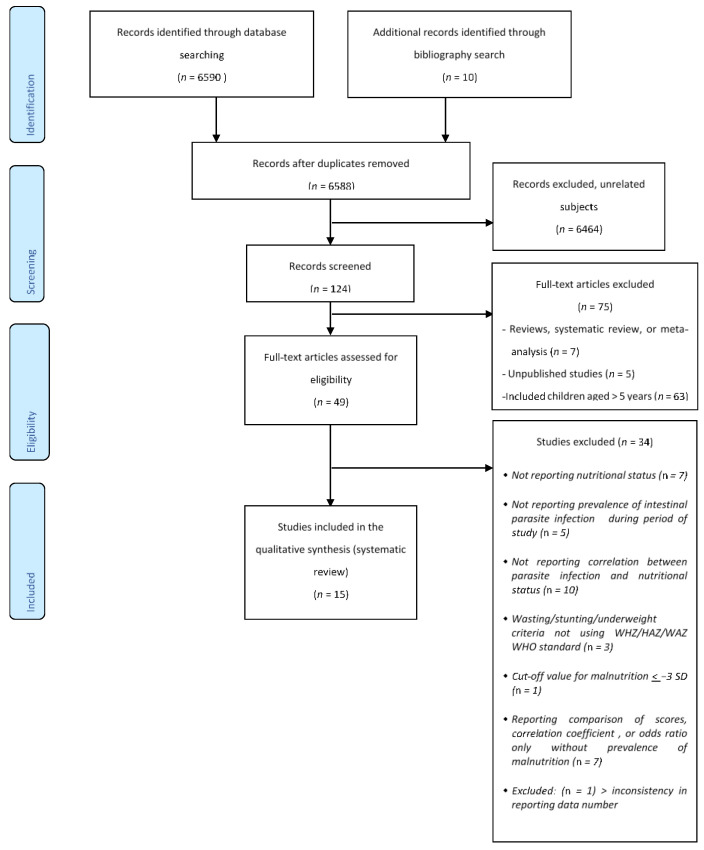
- The review screened 6590 records plus 10 from reference lists, reviewed 124 full texts, and included 15 studies in the abstract summary; the Results section reports 16 studies met criteria and were appraised, with one later excluded for inconsistency in cohorts.
- *Ascaris lumbricoides* was the most reported infection, stated in 8 studies, with prevalence ranging from 10.77% in Ethiopia to 57.14% in Malaysia; *G. lamblia* was also stated in 8 studies, with prevalence ranging from 4.43% in Ethiopia to 66.33% in the Central African Republic.
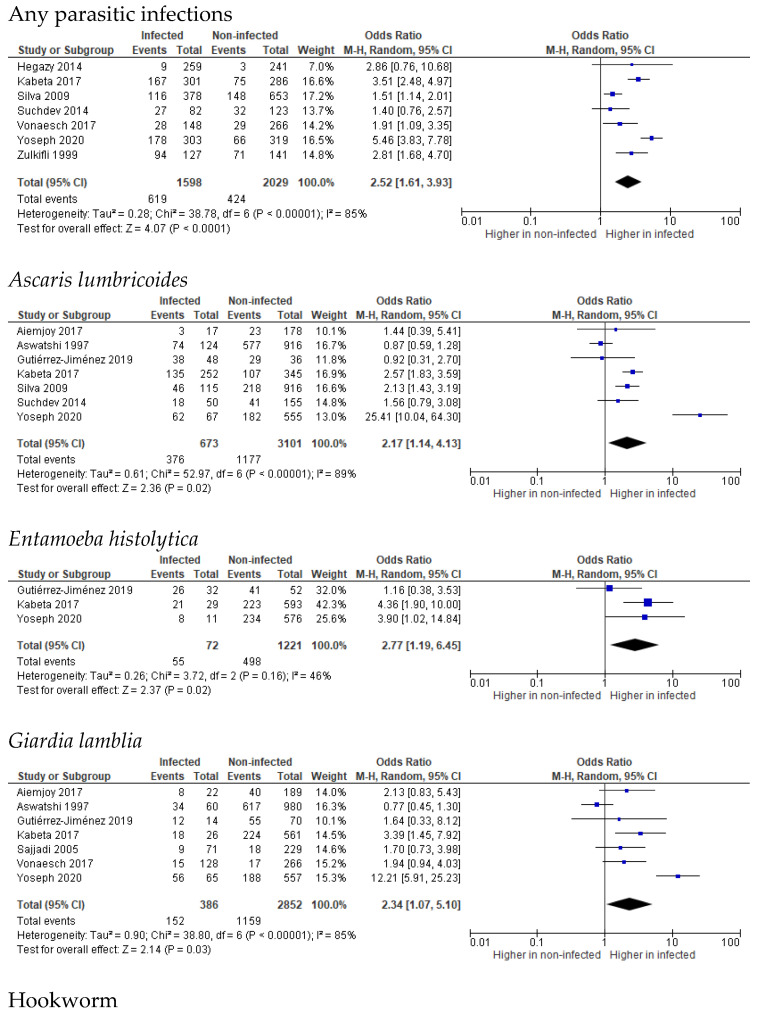
- Infected children had higher odds of stunting: overall effect size OR 2.52 (95% CI 1.61, 3.93; p < 0.0001; I2 = 85%). Specific parasites associated with stunting included *A. lumbricoides* (OR 2.17, 95% CI 1.14, 4.13; p = 0.02), *E. histolytica* (OR 2.77, 95% CI 1.19, 6.45; p = 0.02), and *G. lamblia* (OR 2.34, 95% CI 1.07, 5.10; p = 0.03).
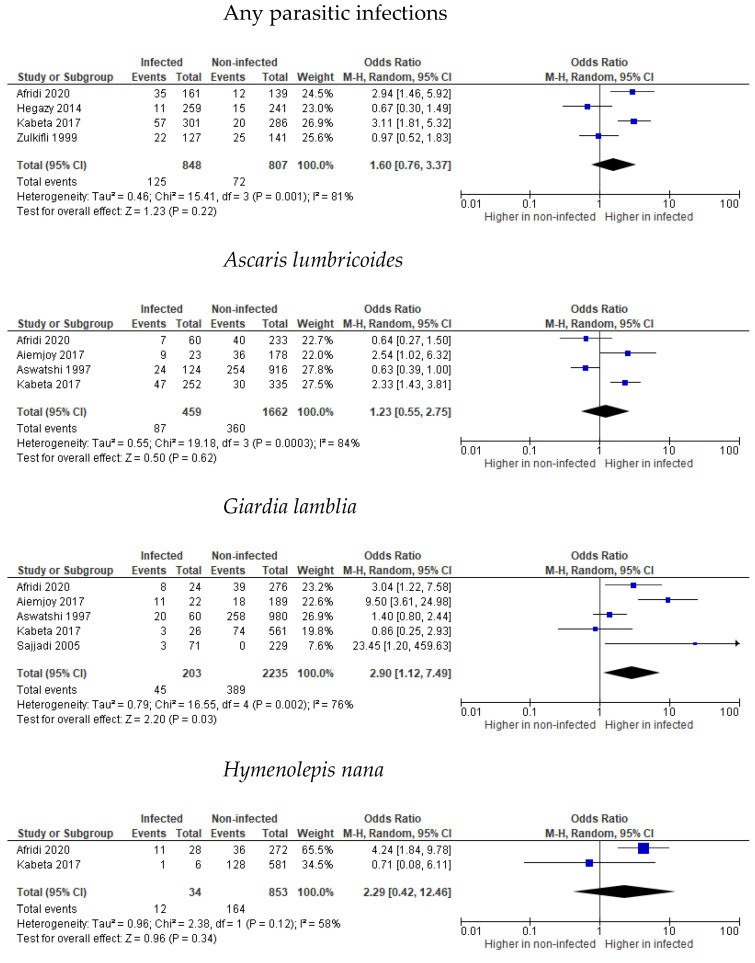
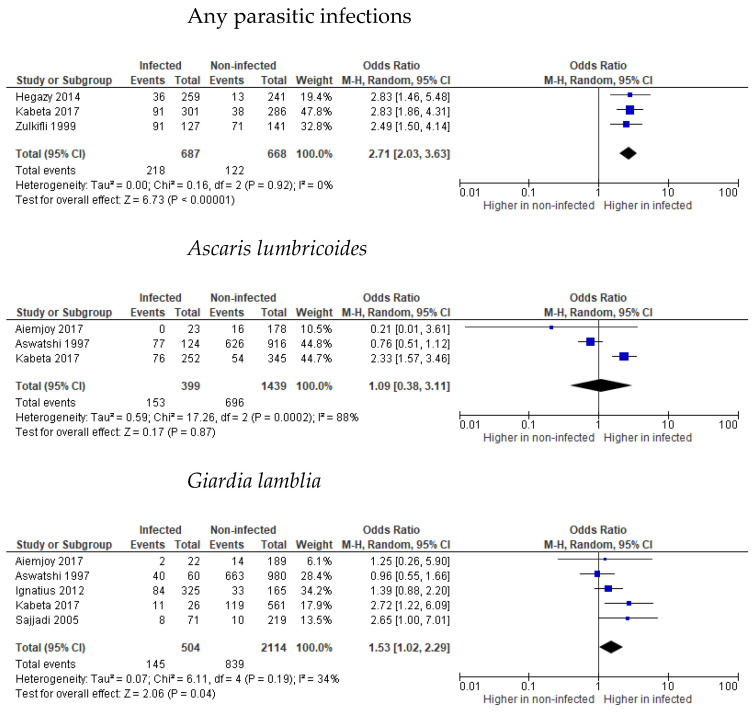
- For underweight, unspecified intestinal parasites were associated with a 2.71-fold higher prevalence (95% CI 2.03, 3.63; p < 0.00001; I2 = 0%). *G. lamblia* was associated with a 1.53-fold increase in underweight (95% CI 1.02, 2.29; p = 0.04), while wasting was not associated overall with parasitic infection (p = 0.22).
## Methods
- Systematic review conducted according to PRISMA, searching PubMed/MEDLINE, Ovid, Embase, Scopus, Web of Science, and Google Scholar up to 21 September 2021, plus reference-list screening.
- Included studies had to concern children aged ≤5 years and report stunting, wasting, or underweight with intestinal parasitic infection during the study period; studies without original data, without a comparison group, non-English papers, unpublished papers, or those not using WHO Z-score standards were excluded.
- Titles/abstracts and full texts were screened independently by all authors; study quality was assessed with the Joanna Briggs Institute Critical Appraisal Tools Checklist for Analytical Cross-Sectional Studies. When multiple studies reported an outcome, Mantel–Haenszel odds ratios with 95% CIs were pooled in RevMan 5.3, with heterogeneity assessed using I2.
## Limitations
- The paper states that many included studies were cross-sectional, so temporal association is lacking and causality cannot be concluded.
- The paper states that small sample sizes, unmeasured risk factors (e.g., antenatal care, breastfeeding, prior anthelminthic therapy), unreported infection severity, and geographical/seasonal variation contributed to inconsistencies.
- Evident from the text: the review combines studies from 12 countries with high heterogeneity for some pooled outcomes (e.g., stunting I2 = 85%, wasting I2 up to 84%), which makes the summary effects less precise.
Model-written summary. Check it against the paper before relying on it.
Integrity signals
Registry
Cites
Statistics
Figures
Verification
Claims the paper makes
13 Valid · 4 Not valid · 20 Not checked · 47 Own results and interpretations
Every source the paper cites for this claim was checked and supports it.
In the paper
“Several studies had shown the relationship between ascariasis and iron-deficiency anaemia (IDA) [64,65].”
§ Intestinal Parasitic Infection and Nutritional Status in Children under Five Years Old: A Systematic Review > 4. Discussion
What the sources say
- Supportedcites [64] Hossain S. Das S. Gazi A. Mahfuz M. Ahmed T. Ascaris lumbricoides infection: Still a threat for iron deficiency anaemia in 2-year-old Bangladeshi slum-dwelling children J. Infect. Dev. Ctries. 2019 13 933 938 10.3855/jidc.11340 32084025 PMC7722353 source
The Results report a significant association between ascariasis and IDA at 24 months of age (OR 3.76; 95% CI, 1.08–13.11), and the Conclusion reiterates it. This paper supports the relationship claimed; the sentence cites it alongside another study. (LLM, conf=0.91)
- Supportedcites [65] Ngui R. Lim Y. Kin L.C. Chuen C.S. Jaffar S. Association between Anaemia, Iron Deficiency Anaemia, Neglected Parasitic Infections and Socioeconomic Factors in Rural Children of West Malaysia PLoS Negl. Trop. Dis. 2012 6 e1550 10.1371/journal.pntd.0001550 22413027 PMC3295806 source
The Results (page not available) report that Ascaris lumbricoides infection was significantly associated with iron-deficiency anaemia in rural children in West Malaysia. This paper therefore provides one of the studies supporting the citing sentence’s relationship claim; the citation does not need to establish that several studies did so on its own. (LLM, conf=0.91)
plainstates an association- Asserted: passes — The authors put it forward as true.
- Checkable: passes — It can be checked against evidence.
- Load-bearing: unclear — It is unclear whether the paper’s conclusions depend on it.
- Based: passes — The paper gives a reason why it holds.
- Supported
The cited sources that could be checked couldn’t confirm or dispute this claim.
In the paper
“However, to date, no studies have found an association between enterobiasis and anaemia [74,75].”
§ Intestinal Parasitic Infection and Nutritional Status in Children under Five Years Old: A Systematic Review > 4. Discussion
What the sources say
- Could not verifycites [74] Tsuyuoka R. Bailey J.W. Guimaraes A.M.D.N. Gurgel R.Q. Cuevas L.E. Anemia and intestinal parasitic infections in primary school students in Aracaju, Sergipe, Brazil Cad. Saúde Pública 1999 15 413 421 10.1590/S0102-311X1999000200026 10409794 sourceExperimental — accuracy not yet measured
The Results report no association between anemia and the parasites analyzed, but Table 2 does not include E. vermicularis (the cause of enterobiasis). The paper therefore does not establish whether enterobiasis was associated with anemia in its students, let alone whether no studies to date had found an association. Searched for enterobiasis, E. vermicularis, and the anemia comparison. (LLM, conf=0.76)
- Not matchedcites [75] Al Qadhi B.N. Al-Warid H.S.J. Anemia and enterobiasis among Iraqi children J. Coll. B Educ. 2012 76 57 62
We searched by its title and found no matching paper.
plain- Asserted: passes — The authors put it forward as true.
- Checkable: passes — It can be checked against evidence.
- Load-bearing: unclear — It is unclear whether the paper’s conclusions depend on it.
- Based: passes — The paper gives a reason why it holds.
- Could not verify
Every source the paper cites for this claim was checked and supports it.
In the paper
“Daoody and Al-Bazzaz (2020) found significantly lower serum total protein and iron levels in infected children [73].”
§ Intestinal Parasitic Infection and Nutritional Status in Children under Five Years Old: A Systematic Review > 4. Discussion
What the sources say
- Supportedcites [73] Al-Daoody A.A.K. Al-Bazzaz E.N.H. Impact of Enterobius vermicularis infection on biochemical parameters in the blood of children in Erbil Province, Iraq BMC Infect Dis. 2020 20 336 10.1186/s12879-020-05064-w 32397998 PMC7216599 source
The Results section reports significantly lower mean serum total protein (P < 0.001) and iron (P < 0.05) in infected children than in uninfected children. The Discussion likewise states that both levels were significantly lower in the enterobiasis-positive group. (LLM, conf=0.95)
plainstates an association- Asserted: passes — The authors put it forward as true.
- Checkable: passes — It can be checked against evidence.
- Load-bearing: unclear — It is unclear whether the paper’s conclusions depend on it.
- Based: passes — The paper gives a reason why it holds.
- Supported
The cited sources support only part of this claim — read each source’s verdict below.
In the paper
“T. trichiuris infection is correlated with chronic colitis [60].”
§ Intestinal Parasitic Infection and Nutritional Status in Children under Five Years Old: A Systematic Review > 4. Discussion
What the sources say
- Partly supportedcites [60] Else K.J. Keiser J. Holland C.V. Grencis R.K. Sattelle D.B. Fujiwara R.T. Bueno L.L. Asaolu S.O. Sowemimo O.A. Cooper P.J. Whipworm and roundworm infections Nat. Rev. Dis. Prim. 2020 6 44 10.1038/s41572-020-0171-3 32467581 sourceExperimental — accuracy not yet measured
The Clinical presentation section says heavy T. trichiura infections are often associated with colitis and may produce a chronic inflammatory response. It does not describe colitis itself as chronic, and it ties the association to heavy infection rather than infection generally. (LLM, conf=0.84)
plainstates an association- Asserted: passes — The authors put it forward as true.
- Checkable: passes — It can be checked against evidence.
- Load-bearing: unclear — It is unclear whether the paper’s conclusions depend on it.
- Based: passes — The paper gives a reason why it holds.
- Partly supported
A result the paper reports from its own data — it cites no other source for it, so there is none to check. The quote shows it is in the paper.
In the paper
“and is correlated with stunting (OR 2.17 (95% CI 1.14, 4.13), p = 0.02).”
- Also stated in: § 3.2. Stunting Stunting is the most reported nutritional status in these studies. Stunting prevalence was reported to be significantly higher in children infected with unspecified intestinal parasites by five studies [40,41,45,47,49] with 1.51- to 5.46-fold increased risks, while two studies found no significant difference between infected and non-infected children [39,48]. Effect size analysis showed 2.52-times (95% CI 1.61, 3.93 (p < 0.0001), I2 = 85% (p < 0.00001)) higher odds of stunting cases in infected children (Figure 2). Several studies reported the significance of specific parasite manifestations toward stunting, including A. lumbricoides in three studies [41,43,45] from eight reporting studies [37,41,43,45,46,47,48,49] with a 25.41-, 2.46-, and 2.13-fold increased risk, respectively, E. histolytica in one study [41] from three reporting studies [37,41,45] with a 4.36-fold increased risk, G. lamblia in two studies [41,45] from seven reporting studies [36,38,40,41,43,45,46] with a 12.31- and 3.39-fold increased risk, Hookworm in one study [41] from three reporting studies [41,45,47] with a 16.41-fold increased risk, and T. trichiura in two studies [41,47] from four reporting studies [41,45,47,48] with 3.02- and 2.52-fold increase risks. Effect size analysis showed significant odds of stunting in children infected with Ascaris lumbricoides (OR 2.17 (95% CI 1.14, 4.13), p = 0.02, I2 89% (p < 0.00001)), Entamoeba histolytica (OR 2.77 (95% CI 1.19, 6.45), p = 0.02, I2 46% (p = 0.16)), and Giardia lamblia (OR 2.34 (CI 1.07, 5.10), p = 0.03, I2 = 85% (p < 0.00001)), as shown in Figure 2. Meanwhile, the overall effect sizes for hookworm, T. trichiura, and S.stercocalis were not significant. High heterogeneity between studies was noted (I2 ranging from 72% to 95%). E. vermicularis [45], H. nana [45], and Taenia spp. [41] were only reported in one study each with no significant difference between infected and non-infected children. · plain
“Effect size analysis showed significant odds of stunting in children infected with Ascaris lumbricoides (OR 2.17 (95% CI 1.14, 4.13), p = 0.02, I2 89% (p < 0.00001))”
§ Intestinal Parasitic Infection and Nutritional Status in Children under Five Years Old: A Systematic Review > Abstract Intestinal parasitic infections are common infectious diseases causing many health problems and impaired growth and physical development.. Children under five years old are the most vulnerable to infections, due to their immature immunity and feeding and exploratory behaviours. This systematic review aimed to assess the relationship between intestinal parasitic infections and undernutrition among children under 5 years old. Fifteen studies met the inclusion and exclusion criteria and were classified as high-quality studies. Twelve parasites were reported, including Ascaris lumbricoides, Cryptosporodium spp., Entamoeba histolytica, Enterobius vermicularis, Giardia lamblia, hookworm, Hymenolepis nana, Strongyloides sterocalis, Taenia spp. and Trichuris trichuria. Ascariasis is the most reported infection, with a prevalence ranging from 10.77% in Ethiopia to 57.14% in Malaysia, and is correlated with stunting (OR 2.17 (95% CI 1.14, 4.13), p = 0.02). Giardiasis is the second most reported infection, with a prevalence ranging from 4.43% in Ethiopia to 66.33% in the Central African Republic, and is related to an increased risk of stunting (OR 2.34 (95% CI 1.07, 5.10), p = 0.03)), wasting (OR 2.90 (95% CI 1.12, 7.49, p = 0.03)), and being underweight (OR 1.53 (95% CI 1.02, 2.29, p = 0.04)). The third and fourth most prevalent infections are T. trichiura and hookworm infections. Intestinal parasitic infections can occur very early in life and cause significant growth retardation. It is important to understand the prevalence and effects of infection based on the parasite species in order to implement therapeutic interventions and prevention controls.
plainstates an association- Asserted: passes — The authors put it forward as true.
- Checkable: passes — It can be checked against evidence.
- Load-bearing: passes — The paper’s conclusions depend on it.
- Based: passes — The paper gives a reason why it holds.
- Also stated in: § 3.2. Stunting Stunting is the most reported nutritional status in these studies. Stunting prevalence was reported to be significantly higher in children infected with unspecified intestinal parasites by five studies [40,41,45,47,49] with 1.51- to 5.46-fold increased risks, while two studies found no significant difference between infected and non-infected children [39,48]. Effect size analysis showed 2.52-times (95% CI 1.61, 3.93 (p < 0.0001), I2 = 85% (p < 0.00001)) higher odds of stunting cases in infected children (Figure 2). Several studies reported the significance of specific parasite manifestations toward stunting, including A. lumbricoides in three studies [41,43,45] from eight reporting studies [37,41,43,45,46,47,48,49] with a 25.41-, 2.46-, and 2.13-fold increased risk, respectively, E. histolytica in one study [41] from three reporting studies [37,41,45] with a 4.36-fold increased risk, G. lamblia in two studies [41,45] from seven reporting studies [36,38,40,41,43,45,46] with a 12.31- and 3.39-fold increased risk, Hookworm in one study [41] from three reporting studies [41,45,47] with a 16.41-fold increased risk, and T. trichiura in two studies [41,47] from four reporting studies [41,45,47,48] with 3.02- and 2.52-fold increase risks. Effect size analysis showed significant odds of stunting in children infected with Ascaris lumbricoides (OR 2.17 (95% CI 1.14, 4.13), p = 0.02, I2 89% (p < 0.00001)), Entamoeba histolytica (OR 2.77 (95% CI 1.19, 6.45), p = 0.02, I2 46% (p = 0.16)), and Giardia lamblia (OR 2.34 (CI 1.07, 5.10), p = 0.03, I2 = 85% (p < 0.00001)), as shown in Figure 2. Meanwhile, the overall effect sizes for hookworm, T. trichiura, and S.stercocalis were not significant. High heterogeneity between studies was noted (I2 ranging from 72% to 95%). E. vermicularis [45], H. nana [45], and Taenia spp. [41] were only reported in one study each with no significant difference between infected and non-infected children. · plain
38 more claims
Create a free account to see all 84 claims and to verify the 3 references still open.
- It may state two separate claims as one. 32
- Probably not a substantial claim. 15
- The quote only partly states this claim. 2
Citations
Cites
Liberati, A., Altman, D. G., Tetzlaff, J., Mulrow, C., Gotzsche, P. C., Ioannidis, J. P. A., Clarke, M., Devereaux, P. J., Kleijnen, J., & Moher, D. (2009) · BMJ · doi:10.1136/bmj.b2700 · Cited by 17,648
ESPEN guidelines on definitions and terminology of clinical nutrition
Cederholm, T., Barazzoni, R., Austin, P., Ballmer, P., Biolo, G., Bischoff, S. C., Compher, C., Correia, I., Higashiguchi, T., Holst, M., et al. (2017) · Clinical Nutrition · doi:10.1016/j.clnu.2016.09.004 · Cited by 2,560
Soil-transmitted helminth infections: ascariasis, trichuriasis, and hookworm
Bethony, J., Brooker, S., Albonico, M., Geiger, S. M., Loukas, A., Diemert, D., & Hotez, P. J. (2006) · The Lancet · doi:10.1016/s0140-6736(06)68653-4 · Cited by 2,478
The epidemiology of global micronutrient deficiencies
Bailey, R. L., West Jr., K. P., & Black, R. E. (2015) · Annals of Nutrition and Metabolism · doi:10.1159/000371618 · Cited by 2,035
Evolution of the immune system in humans from infancy to old age
Simon, A. K., Hollander, G. A., & McMichael, A. (2015) · Proceedings of the Royal Society B: Biological Sciences · doi:10.1098/rspb.2014.3085 · Cited by 1,796
Adam, R. D. (2001) · Clinical Microbiology Reviews · doi:10.1128/cmr.14.3.447-475.2001 · Cited by 1,216 · cited 1×
“The cyst is inert, allowing it to survive in various environmental conditions [56].”
BackgroundSoil-transmitted helminth infections
Jourdan, P. M., Lamberton, P. H. L., Fenwick, A., & Addiss, D. G. (2018) · The Lancet · doi:10.1016/s0140-6736(17)31930-x · Cited by 994
Malnutrition and Infection: Complex Mechanisms and Global Impacts
Schaible, U. E., & Kaufmann, S. H. E. (2007) · PLoS Medicine · doi:10.1371/journal.pmed.0040115 · Cited by 954
The Interaction between Nutrition and Infection
Katona, P., & Katona‐Apte, J. (2008) · Clinical Infectious Diseases · doi:10.1086/587658 · Cited by 922
Torgerson, P. R., Devleesschauwer, B., Praet, N., Speybroeck, N., Willingham, A. L., Kasuga, F., Rokni, M. B., Zhou, X.-N., Fèvre, E. M., Sripa, B., et al. (2015) · PLOS Medicine · doi:10.1371/journal.pmed.1001920 · Cited by 777 · cited 1×
“2 million cases of illnesses were reported to be caused by foodborne enteric protozoa [10].”
Background
Research works printed but not linked: 4
- Afridi M.F. Farhat K. Ali S. Qaisrani M.N. Ahmed Z. Prevalence of intestinal parasitic infestations in relation to wasting among children under 5 years of age in Skardu, Pakistan: A cross sectional observational study Isra Med. J. 2021 13 130 133
- Waterlow J.C. Summary of causes and mechanisms of linear growth retardation Eur. J. Clin. Nutr. 1994 48 (Suppl. S1) S210 S211 8005078
- Celiksoz A. Acioz M. Degerli S. Oztop A.Y. Alim A. Effect of Enterobiasis on primary school children Afr. J. Microbiol. Res. 2010 4 634 639
- Al Qadhi B.N. Al-Warid H.S.J. Anemia and enterobiasis among Iraqi children J. Coll. B Educ. 2012 76 57 62
Cited by
Items 101–119 of 119
Smart nanotherapeutics against chronic infections
Kumar, A., Singh, A. K., Verma, I. K., Keshri, A., Chauhan, G., Agrawal, S., Ratn, A., Dhakad, M. S., & Sharma, D. (2026) · Elsevier eBooks · doi:10.1016/b978-0-443-33070-4.00011-3
Sharhan, S. B., & AL-Aboody, B. A. (2025) · Клиническая инфектология и паразитология · doi:10.34883/pi.2025.14.4.033
Showell, J. O., & Mwasaru, B. M. (2026) · Integrated Science Education Journal · doi:10.37251/isej.v7i1.2137
Copeticona-Callejas, C., Jimenez, S., Torrez-Mamani, A., Choque-Pardo, B., Agramont, J., Mamani-Jarro, J., Inchauste, L., Priet, S., Soto, A., Liera, C., et al. (2026) · Journal of Water and Health · doi:10.2166/wh.2026.243
Gelaw, N., & Hailegebriel, T. (2026) · Journal of Parasitic Diseases · doi:10.1007/s12639-026-01922-7
Prabhu, S., Bairy, G. M., Sampathila, N., & Darshan, B. S. D. (2026) · Information · doi:10.3390/info17030227
Epidemiology of intestinal parasitic infection in Iraq for 2021 and 2022 years
Zeadan, A. M., Rashid, R. F., Mohammed, D. A. O., et al. (2026) · AIP conference proceedings · doi:10.1063/5.0321960
Betirbieva, Z. R., Sultygov, M. A., Evloeva, A. Y., et al. (2026) · International Journal of Medical Parasitology and Epidemiology Sciences · doi:10.34172/ijmpes.6225
“Specialists are especially concerned about the vulnerability of the pediatric population, as the effects of this infection extend far beyond gastrointestinal symptoms and have a complex negative impact on physical, nutritional, and cognitive development (2, 3).”
Azizi, K. A., Kamala, A., Mushumbusi, D. G., et al. (2026) · Journal of Parasitology Research · doi:10.1155/japr/6492754
Mahato, M. K., Gautam, J., Bharati, N., et al. (2026) · Public Health Challenges · doi:10.1002/puh2.70275
“These include personal habits [ 5 ], level of knowledge [ 13 ], socioeconomic status [ 19 ], cultural, and bioenvironmental conditions [ 20 ].”
Chiamah, O. C., Ogueme, O. S., Nwobodo, D. N., et al. (2026) · ABUAD International Journal of Natural and Applied Sciences · doi:10.53982/aijnas.2026.03-j
Sánchez, L. J., Bukari, M., & Adokiya, M. N. (2026) · Tropical Medicine & International Health · doi:10.1111/tmi.70171
Ifa, A. C., & Kure, A. (2026) · Journal of Parasitic Diseases · doi:10.1007/s12639-026-01980-x
Zonta, M. L., Zucol, J. U., & Garraza, M. (2026) · American Journal of Human Biology · doi:10.1002/ajhb.70312
“They directly affect children's nutritional status and physical and immunological development, making them a major public health problem (Fauziah et al. 2022; Mrimi et al. 2023 Zonta et al. 2022).”
Ortiz‐Prado, E., Cadena, S., Durán, M., Larrea, X., Páez, N., Sarlabous, V., Sánchez, M., Toledo, P., Vergara, H., Vasconez-Gonzalez, J., et al. (2026) · International Journal of Infectious Diseases · doi:10.1016/j.ijid.2026.109026
Alharazi, T. H., Alcantara, J. C., Hulse, R., Alharbi, B., & Alshammari, F. D. (2026) · Frontiers in Public Health · doi:10.3389/fpubh.2026.1896791
“Together, these symptoms interfere with proper physical growth (28).”
Govea-Flores, D. V., Garza-Ontiveros, M., Gutiérrez‐Gutiérrez, F., Gómez-Ibarra, A. G., Nery‐Flores, S. D., Ascacio‐Valdés, J. A., Campos‐Múzquiz, L. G., Rodríguez-Herrera, R., & Palomo‐Ligas, L. (2026) · Advances in Pharmacological and Pharmaceutical Sciences · doi:10.1155/adpp/4133207
“Children under 5 years old are particularly vulnerable and often experience stunting, wasting, and underweight due to chronic infections [4].”
Ijaz, M. K., Nims, R. W., Rubino, J. R., Hasan, B. S. F., Ijaz, M. K., Xu, F. Y., & Gerba, C. P. (2026) · Frontiers in Public Health · doi:10.3389/fpubh.2026.1792466
“Certain life stages of parasites and helminths, especially, are capable of remaining infectious for extended periods of time in feces and in soil contaminated with feces (118).”
Maphasa, R. E., Rambharose, S., Chigorimbo‐Murefu, N. T. L., Fielding, B. C., & Dube, A. (2026) · Discover Nano · doi:10.1186/s11671-026-04933-8
Metadata
- Authors
- Fauziah, N., Aviani, J. K., Agrianfanny, Y. N., & Fatimah, S. N.
- Affiliations
- Padjadjaran University (ID)
- Bandung Institute of Technology (ID)
- Corresponding author
- Fauziah, Nisa
- Venue
- Tropical Medicine and Infectious Disease
- Publisher
- MDPI AG
- Published
- 2022-11-12
- Volume
- 7
- Issue
- 11
- Pages
- 371
- ISSN
- 2414-6366 (ISSN-L)
- PMC
- PMC9697828
- OpenAlex
- W4309000849
- Cited by
- 122
- References
- 85
- Citations by year
- 2026: 29 · 2025: 43 · 2024: 33 · 2023: 17
- FWCI
- 4.50
- Type
- journal article
- Language
- en
- Open access
- gold
- doi.org
- Licence
- Locations
- Tropical Medicine and Infectious Disease (publishedVersion, cc-by)
- PubMed Central (publishedVersion, cc-by)
- PubMed (publishedVersion)
- DOAJ (DOAJ: Directory of Open Access Journals) (submittedVersion, cc-by-sa)
- Topics
- Life Sciences › Immunology and Microbiology › Parasitology › Parasites and Host Interactions
- Health Sciences › Nursing › Nutrition and Dietetics › Child Nutrition and Water Access
- Life Sciences › Immunology and Microbiology › Parasitology › Parasitic Infections and Diagnostics
- Keywords
- intestinal parasitic infections, malnutrition, children under five, stunting, wasting, underweight, Ascaris lumbricoides, ascariasis, giardiasis, Giardia lamblia, Trichuris trichiura, hookworm, growth retardation, parasite prevalence
About these checks
Registry, retraction, Cites and statistics results are computed, not judged, with one exception: a printed reference that no index lists is read once by a model before it counts as a citation error. Claims are extracted by a model and kept only when their quote appears verbatim in the text; each cited source is then checked, with a model’s help, for whether it says what the claim relies on. Those verdicts can be wrong — read the claim’s quote and the cited source before relying on one.
The claim verdicts this report counts are experimental: their accuracy is not yet measured.
A language model drew the claims from the paper on 2026-10-11, under version 3 of the claim definition (model deepseek-v4.1-flash, prompt extract-v3).
A second model labelled each claim on 2026-10-11 (model jev-1.13-20260917, definition revision gold-guideline-v0.2).
Cited sources are checked with a language model’s help (gpt-6-sol).
Statistics and arithmetic are recomputed, not judged.
Confidence bands are shown only for fields calibrated on our annotated test set. None is calibrated yet, so no band is shown.
What counts as a claim ›How we measure confidence ›How we check this ›
Are you an author, or do you see a problem with this page? Request a review
Data sources
Bibliographic data: Semantic Scholar, OpenAlex, Crossref.
Contains information from the Semantic Scholar Academic Graph Datasets, made available under the ODC Attribution License (ODC-BY 1.0).
Semantic Scholar’s data is described in: Kinney, R., et al. (2023). The Semantic Scholar Open Data Platform. arXiv:2301.10140.
