

Clinical and Parasitological Profiles of Gestational, Placental and Congenital Malaria in Northwestern Colombia
Open accessThe DOI matches its Crossref record; 28 of the 28 references it cites were found in a registry or an index.
Abstract
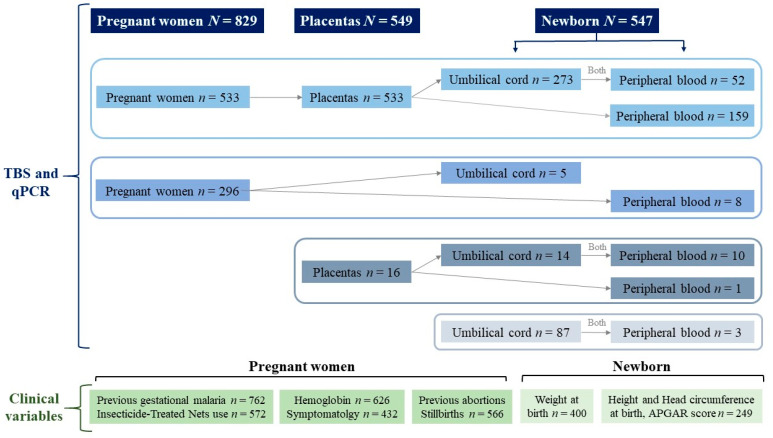
This study compared the clinical–parasitological profiles of gestational (GM), placental (PM), and congenital (CM) malaria in northwestern Colombia. A cross-sectional study with 829 pregnant women, 549 placentas, and 547 newborns was conducted. The frequency of GM was 35.8%, PM 20.9%, and CM 8.5%. P. vivax predominated in GM; in PM, the proportion of P. vivax and P. falciparum was similar; in CM, P. falciparum predominated. The main clinical findings were headache (49%), anemia (32%), fever (24%), and musculoskeletal pain (13%). The clinical manifestations were statistically higher in P. vivax infections. In submicroscopic GM (positive with qPCR and negative with thick blood smear), the frequency of anemia, sore throat, and a headache was statistically higher compared with pregnant women without malaria. GM, PM, and CM reduce birth weight and head circumference. In Colombia, this is the first research on the clinical characteristics of GM, PM, and CM; contrary to evidence from other countries, P. vivax and submicroscopic infections are associated with clinical outcomes.
Overview
The claims and statistics of this paper haven’t been checked yet.
Free: it reads the open-access text and checks the first 5 claims that cite a source we can check. Create a free account to check every claim.
Integrity signals
Registry
Cites
Statistics
Figures
Verification
Claims the paper makes
The claims and statistics of this paper haven’t been checked yet.
Free: it reads the open-access text and checks the first 5 claims that cite a source we can check. Create a free account to check every claim.
Claims other papers make about this one
Each is checked against this paper’s own text: does it say what the citing paper says it does?
The source backs part of the claim, not all of it — or backs it for a different population, condition or comparison.
In the citing paper
“In addition, reduced birth weight and head circumference have been associated with P.vivax infections and gestational, placental, and congenital malaria [178].”
From Current update on malaria in pregnancy: a systematic review (2025) · cites this paper as [178]
Experimental — accuracy not yet measured
Self-check
Percentages, sums and reported differences re-computed from the paper’s own numbers.
The self-check needs the paper’s full text.
Citations
Cites
“Asymptomatic” Malaria: A Chronic and Debilitating Infection That Should Be Treated
Chen, I., Clarke, S. E., Gosling, R., Hamainza, B., Killeen, G., Magill, A., O’Meara, W., Price, R. N., & Riley, E. M. (2016) · PLOS Medicine · doi:10.1371/journal.pmed.1001942 · Cited by 386
The role of submicroscopic parasitemia in malaria transmission: What is the evidence?
Lin, J. T., Saunders, D. L., & Meshnick, S. R. (2014) · Trends in Parasitology · doi:10.1016/j.pt.2014.02.004 · Cited by 271
New insights into malaria pathogenesis
Moxon, C. A., Gibbins, M. P., McGuinness, D., Milner, D. A., & Marti, M. (2020) · Annual Review of Pathology: Mechanisms of Disease · doi:10.1146/annurev-pathmechdis-012419-032640 · Cited by 207 · cited 2×
“falciparum, as has been described by other authors [22].”
ResultCottrell, G., Moussiliou, A., Luty, A. J. F., Cot, M., Fievet, N., Massougbodji, A., Deloron, P., & Tuikue Ndam, N. (2015) · Clinical Infectious Diseases · doi:10.1093/cid/civ122 · Cited by 151 · cited 4×
“PCR is the main molecular diagnosis of malaria with a detection limit of <0.02 parasites/µL. qPCR avoids post-amplification manipulation and quantifies the number of microorganisms; it includes a highly conserved region 18S rRNA of Plasmodium and primers polymorphic specific to P. falciparum, P. vivax, P. malariae, an…”
BackgroundInfluentialCongenital malaria: The least known consequence of malaria in pregnancy
Menéndez, C., & Mayor, A. G. (2007) · Seminars in Fetal and Neonatal Medicine · doi:10.1016/j.siny.2007.01.018 · Cited by 132
Epidemiology, drug resistance, and pathophysiology of Plasmodium vivax malaria
Gowda, D., Dayananda, K., & Achur, R. (2018) · Journal of Vector Borne Diseases · doi:10.4103/0972-9062.234620 · Cited by 111 · cited 1×
“vivax with serious effects such as anemia and other hematological complications, severe malaria, acute respiratory distress, and multiple organ failure [28], as well as Colombian studies that reported the pathological effects of P.”
BackgroundComparison of real-time PCR and microscopy for malaria parasite detection in Malawian pregnant women
Rantala, A.-M., Taylor, S. M., Trottman, P. A., Luntamo, M., Mbewe, B., Maleta, K., Kulmala, T., Ashorn, P., & Meshnick, S. R. (2010) · Malaria Journal · doi:10.1186/1475-2875-9-269 · Cited by 110
Malaria diagnostic methods with the elimination goal in view
Oyegoke, O. O., Maharaj, L., Akoniyon, O. P., Kwoji, I., Roux, A. T., Adewumi, T. S., Maharaj, R., Oyebola, B. T., Adeleke, M. A., & Okpeku, M. (2022) · Parasitology Research · doi:10.1007/s00436-022-07512-9 · Cited by 82
Zakama, A. K., Ozarslan, N., & Gaw, S. L. (2020) · Current Tropical Medicine Reports · doi:10.1007/s40475-020-00213-2 · Cited by 72 · cited 1×
“It is important to highlight that the frequency of GM, parasitemia density, and the infection trimester are the main risk factors for PM; therefore, intermittent preventive treatment, screening, and treatment of GM from the first trimester must be provided [29,30].”
BackgroundGestational Malaria: Assessment of its Consequences on Fetal Growth
Meuris, S., Piko, B. B., Eerens, P., Vanbellinghen, A.-M., Dramaix, M., & Hennart, P. (1993) · The American Journal of Tropical Medicine and Hygiene · doi:10.4269/ajtmh.1993.48.603 · Cited by 71
Advances in molecular diagnosis of malaria
(2017) · Advances in Clinical Chemistry · doi:10.1016/bs.acc.2016.11.006 · Cited by 41
Briggs, J. J., Ategeka, J., Kajubi, R., Ochieng, T., Kakuru, A., Ssemanda, C., Wasswa, R., Jagannathan, P., Greenhouse, B., Rodríguez-Barraquer, I., et al. (2019) · The Journal of Infectious Diseases · doi:10.1093/infdis/jiz130 · Cited by 38 · cited 1×
“It is important to highlight that the frequency of GM, parasitemia density, and the infection trimester are the main risk factors for PM; therefore, intermittent preventive treatment, screening, and treatment of GM from the first trimester must be provided [29,30].”
BackgroundLopez-Perez, M., Pacheco, M. A., Buriticá, L., Escalante, A. A., Herrera, S., & Arévalo-Herrera, M. (2016) · Malaria Journal · doi:10.1186/s12936-016-1125-9 · Cited by 34 · cited 1×
“Evidence of this is found in the following search strategies: “malaria pregnant*”[Title/Abstract] AND “clinical manifestations”[Title/Abstract] and “malaria pregnant*”[Title/Abstract] AND “clinical profile”[Title/Abstract], with which only one Colombian study was found, this research concluded that most cases in pregn…”
ResultInfluentialDombrowski, J. G., Souza, R. M. D., Lima, F. A., Bandeira, C. L., Murillo, O., Costa, D. D. S., Peixoto, E. P. M., Cunha, M. D. P., Zanotto, P. M. D. A., Bevilacqua, E., et al. (2019) · JAMA Network Open · doi:10.1001/jamanetworkopen.2019.3300 · Cited by 31
Meta-analysis of the prevalence of malaria associated with pregnancy in Colombia 2000–2020
Cardona-Arias, J. A., & Carmona-Fonseca, J. (2021) · PLOS ONE · doi:10.1371/journal.pone.0255028 · Cited by 29 · cited 3×
“5%; this coincides with a meta-analysis of the studies from Colombia [19].”
BackgroundSelf-citationWalther, B., Miles, D. J. C., Waight, P., Palmero, M. S., Ojuola, O. O., Touray, E. S., Whittle, H. C., van der Sande, M. A. B., Crozier, S., & Flanagan, K. L. (2012) · BMC Infectious Diseases · doi:10.1186/1471-2334-12-6 · Cited by 25
Assessment of perinatal outcomes of pregnant women with severe versus simple malaria
Kwizera, A., Ntasumumuyange, D., Small, M., Rulisa, S., Moscovitz, A. N., & Magriples, U. (2021) · PLOS ONE · doi:10.1371/journal.pone.0247053 · Cited by 25 · cited 1×
“Evidence of this is found in the following search strategies: “malaria pregnant*”[Title/Abstract] AND “clinical manifestations”[Title/Abstract] and “malaria pregnant*”[Title/Abstract] AND “clinical profile”[Title/Abstract], with which only one Colombian study was found, this research concluded that most cases in pregn…”
ResultInfluentialAgudelo-García, O. M., Arango-Flórez, E. M., & Carmona-Fonseca, J. (2017) · Journal of Tropical Medicine · doi:10.1155/2017/3680758 · Cited by 23
Self-citationFitri, L. E., Jahja, N. E., Huwae, I. R., Nara, M. B. R., & Berens‐Riha, N. (2014) · Korean Journal of Parasitology · doi:10.3347/kjp.2014.52.6.639 · Cited by 14
Congenital malaria: Frequency and epidemiology in Colombia, 2009-2020
Cardona‐Arias, J. A., & Carmona‐Fonseca, J. (2022) · PLoS ONE · doi:10.1371/journal.pone.0263451 · Cited by 10
Self-citationDiagnosis of placental malaria in poorly fixed and processed placental tissue
Liu, Y., Griffin, J. B., Muehlenbachs, A., Rogerson, S. J., Bailis, A. J., Sharma, R., Sullivan, D. J., Tshefu, A. K., Landis, S. H., Kabongo, J.-M. M., et al. (2016) · Malaria Journal · doi:10.1186/s12936-016-1314-6 · Cited by 9
The Importance of Submicroscopic Diagnosis of Malaria
Alkan, M. (2019) · Clinical Infectious Diseases · doi:10.1093/cid/ciz752 · Cited by 8 · cited 4×
“PCR is the main molecular diagnosis of malaria with a detection limit of <0.02 parasites/µL. qPCR avoids post-amplification manipulation and quantifies the number of microorganisms; it includes a highly conserved region 18S rRNA of Plasmodium and primers polymorphic specific to P. falciparum, P. vivax, P. malariae, an…”
BackgroundInfluentialOtuli, N. L., Jean-Didier, B. N., Mike-Antoine, M. A., Gédéon, K. B., Jean-Paulin, M. M., Joris, L. L., & Jean-Pascal, M. O. (2020) · Infectious Diseases in Obstetrics and Gynecology · doi:10.1155/2020/2176140 · Cited by 7 · cited 1×
“This coincides with the available evidence on this topic [6,7,10,19] and is worrying given that recent studies have reported a high frequency of low birth weight, preterm birth, and perinatal mortality in areas with stable malaria transmission, where intermittent preventive treatment in pregnancy with sulfadoxine–pyri…”
Koladjo, F., Yovo, E., Accrombessi, M., Agbota, G., Atade, W., Ladikpo, O. T., Mehoba, M., Degbe, A., Jackson, N., Massougbodji, A., et al. (2022) · The Journal of Infectious Diseases · doi:10.1093/infdis/jiac012 · Cited by 7
Knudson-Ospina, A., Pedraza, R. S., Mazorra, M. A. P., Cortés, L. J., Vega, Á. P. G., & Orejuela, R. S. N. (2015) · Revista de la Facultad de Medicina · doi:10.15446/revfacmed.v63.n4.47953 · Cited by 6 · cited 1×
“vivax [23]; this is different from our results in pregnant women, which demonstrate that pregnancy generates changes in the clinical profile.”
ResultMalaria in pregnancy in Hodiedah, Republic of Yemen
Assabri, A. M., & Muharram, A. A. (2002) · Eastern Mediterranean Health Journal · doi:10.26719/2002.8.2-3.245 · Cited by 6 · cited 1×
“Evidence of this is found in the following search strategies: “malaria pregnant*”[Title/Abstract] AND “clinical manifestations”[Title/Abstract] and “malaria pregnant*”[Title/Abstract] AND “clinical profile”[Title/Abstract], with which only one Colombian study was found, this research concluded that most cases in pregn…”
ResultInfluentialFrequency of gestational malaria and maternal–neonatal outcomes, in Northwestern Colombia 2009–2020
Cardona‐Arias, J. A., & Carmona‐Fonseca, J. (2022) · Scientific Reports · doi:10.1038/s41598-022-15011-1 · Cited by 6
Self-citationCardona-Arias, J. A., & Carmona-Fonseca, J. (2022) · PLOS ONE · doi:10.1371/journal.pone.0268949 · Cited by 5
Self-citation
Research works printed but not linked: 3
- Agenjo González M. Malaria and Pregnancy: Complications, Prevention and Treatment Elsevier Amsterdam, The Netherlands 2014 Volume 57 468 471 Available online: https://www.elsevier.es/es-revista-progresos-obstetricia-ginecologia-151 (accessed on 15 January 2023)
- World Health Organization, Malaria Policy Advisory Group—WHO Meeting Report of the Evidence Review Group on Malaria in Pregnancy WHO Geneva, Switzerland 2017
- Carmona-Fonseca J. La Región “Urabá Antioqueño-Cuencas altas de los ríos Sinú y San Jorge-Bajo Cauca Antioqueño”: “Guarida” del paludismo colombiano Revista de la Universidad Industrial de Santander Salud 2017 49 577 589
Cited by
Current update on malaria in pregnancy: a systematic review
Minwuyelet, A., Yewhalaw, D., Siferih, M., & Atenafu, G. (2025) · Tropical Diseases, Travel Medicine and Vaccines · doi:10.1186/s40794-025-00248-1 · Cited by 49
“In addition, reduced birth weight and head circumference have been associated with P.vivax infections and gestational, placental, and congenital malaria [178].”
Gilder, M. E., Saito, M., Haohankhunnatham, W., Ling, C. L., Gornsawun, G., Bancone, G., Chu, C. S., Christensen, P. R., Imwong, M., Charunwatthana, P., et al. (2025) · PLOS Medicine · doi:10.1371/journal.pmed.1004529 · Cited by 15
“Relatively few studies address submicroscopic malaria in pregnancy (sMiP) in Asia and South America [10–14] where transmission is generally much lower and Plasmodium vivax predominates.”
Alemayehu, A., Getachew, H., Kedir, A., Abere, M., Zeynudin, A., Beyene, J., & Yewhalaw, D. (2024) · Malaria Journal · doi:10.1186/s12936-024-05201-9 · Cited by 12
Prospective study of malaria in pregnancy, placental and congenital malaria in Northwest Colombia
Cardona-Arias, J. A., & Carmona-Fonseca, J. (2024) · Malaria Journal · doi:10.1186/s12936-024-04948-5 · Cited by 8
“…contexts, the highest proportion of PAM infections are submicroscopic (positive with qPCR and negative with thick blood smear TBS), and they are associated with clinical outcomes [11] and constitute a great challenge for the elimination of malaria because the majority are asymptomatic [13, 14].”
BackgroundResultSelf-citationMenon, S., D’Alessio, F., Chaudhuri, N., Onwuchekwa, C., Kaur, M., Nkumama, I. N., & Olesen, O. F. (2025) · Journal of Global Health · doi:10.7189/jogh.15.04355 · Cited by 8
Metadata
- Authors
- Cardona-Arias, J. A., Higuita-Gutiérrez, L. F., & Carmona-Fonseca, J.
- Affiliations
- School of Microbiology, Universidad de Antioquia (UdeA), Medellín 050010, Colombia
- Grupo de Investigación Salud y Comunidad César Uribe Piedrahíta, Universidad de Antioquia, Medellín 050010, Colombia
- Venue
- Tropical Medicine and Infectious Disease
- Publisher
- MDPI AG
- Published
- 2023-05-25
- Volume
- 8
- Issue
- 6
- Pages
- 292
- ISSN
- 2414-6366 (ISSN-L)
- PMC
- PMC10302000
- OpenAlex
- W4378469513
- Cited by
- 8
- References
- 28
- Citations by year
- 2025: 4 · 2024: 3 · 2023: 1
- FWCI
- 2.04
- Type
- journal article
- Language
- en
- Open access
- gold
- doi.org
- Licence
- Locations
- Tropical Medicine and Infectious Disease (publishedVersion, cc-by)
- PubMed Central (publishedVersion, cc-by)
- PubMed (publishedVersion)
- DOAJ (DOAJ: Directory of Open Access Journals) (submittedVersion, cc-by-sa)
- Funders
- Universidad de Antioquia and Universidad Cooperativa de Colombia (INV3161)
- Universidad Cooperativa de Colombia (INV3161)
- Topics
- Health Sciences › Medicine › Public Health, Environmental and Occupational Health › Malaria Research and Control
- Health Sciences › Medicine › Genetics (clinical) › Hemoglobinopathies and Related Disorders
- Life Sciences › Immunology and Microbiology › Parasitology › Bird parasitology and diseases
- Keywords
- malaria in pregnancy, placental malaria, congenital malaria, Plasmodium vivax, Plasmodium falciparum, submicroscopic malaria infection, clinical features, anemia in pregnancy, birth weight, head circumference, neonates, northwestern Colombia
About these checks
Registry, retraction, Cites and statistics results are computed, not judged, with one exception: a printed reference that no index lists is read once by a model before it counts as a citation error. Claims are extracted by a model and kept only when their quote appears verbatim in the text; each cited source is then checked, with a model’s help, for whether it says what the claim relies on. Those verdicts can be wrong — read the claim’s quote and the cited source before relying on one.
Statistics and arithmetic are recomputed, not judged.
Confidence bands are shown only for fields calibrated on our annotated test set. None is calibrated yet, so no band is shown.
What counts as a claim ›How we measure confidence ›How we check this ›
Are you an author, or do you see a problem with this page? Request a review
Data sources
Bibliographic data: Semantic Scholar, OpenAlex, Crossref.
Contains information from the Semantic Scholar Academic Graph Datasets, made available under the ODC Attribution License (ODC-BY 1.0).
Semantic Scholar’s data is described in: Kinney, R., et al. (2023). The Semantic Scholar Open Data Platform. arXiv:2301.10140.
