

The DOI matches its Crossref record; 375 of the 392 references it cites were found in a registry or an index; none of the 411 sources its claims cite is checked for support yet.
The Not-So-Good, the Bad and the Ugly: HPV E5, E6 and E7 Oncoproteins in the Orchestration of Carcinogenesis
Open accessAbstract
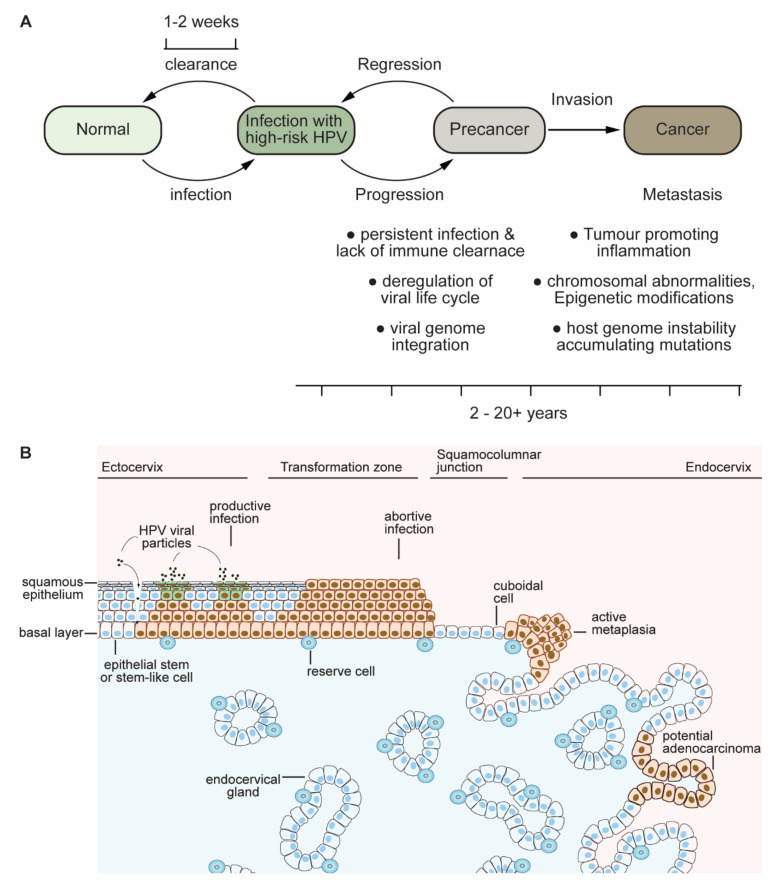
Infection with HPV starts with the access of the viral particles to basal cells in the epidermis, potentially via microtraumas to the skin. The basal cells are able to keep away these pathogens in normal circumstances through a robust immune response from the host, as HPV infections are, in general, cleared within 2 to 3 weeks. However, the rare instances of persistent infection and/or in cases where the host immune system is compromised are major risk factors for the development of lesions potentially leading to malignancy. Evolutionarily, obligatory pathogens such as HPVs would not be expected to risk exposing the host to lethal cancer, as this would entail challenging their own life cycle, but infection with these viruses is highly correlated with cancer and malignancy—as in cancer of the cervix, which is almost always associated with these viruses. Despite this key associative cause and the availability of very effective vaccines against these viruses, therapeutic interventions against HPV-induced cancers are still a challenge, indicating the need for focused translational research. In this review, we will consider the key roles that the viral proteins play in driving the host cells to carcinogenesis, mainly focusing on events orchestrated by early proteins E5, E6 and E7—the not-so-good, the bad and the ugly—and discuss and summarize the major events that lead to these viruses mechanistically corrupting cellular homeostasis, giving rise to cancer and malignancy.
Overview
CoChat Summary
Written by AI from the paper’s full text.
TL;DR
This review argues that HPV E5, E6, and E7 oncoproteins collectively rewire host cellular homeostasis to drive carcinogenesis, with E6/E7 inactivating p53/pRB and E5 contributing to proliferation, apoptosis resistance, and immune evasion. It synthesizes mechanisms across cancer hallmarks and notes that therapeutic agents against HPV-mediated cancers remain lacking.
Key findings
- HPV infection is usually cleared: 70–90% of infections are asymptomatic and resolved within 1–2 years, but 5–10% of infected individuals develop persistent infection that can lead to malignancy; >70% of HPV-mediated cancers are caused by high-risk types 16 and 18.
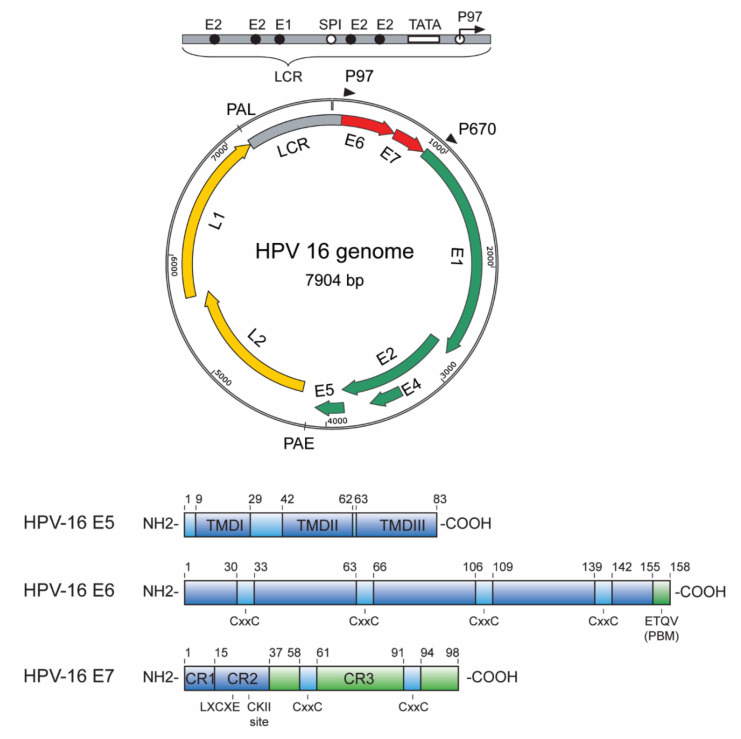
- Viral integration disrupts E2 repression and drives high E6/E7 expression; HPV-18 genome is integrated in 100% of HPV-18-positive cancers, while HPV-16 can remain episomal in up to 25% of cancers.
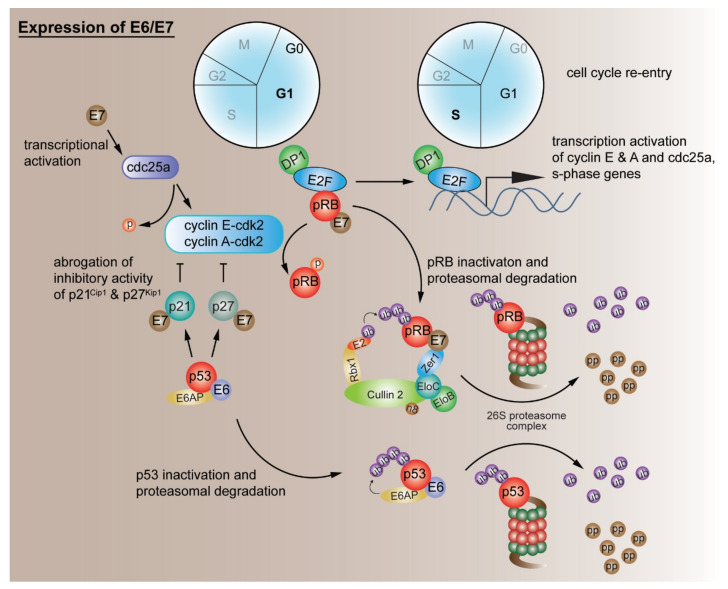
- E6 and E7 inactivate tumor suppressors: E7 binds pRB via LXCXE and destabilizes pocket proteins, while E6 forms an E6–E6AP complex to ubiquitinate and degrade p53; low-risk E7 binds pRB approximately 10-fold less efficiently and cannot target all pRB family proteins.
- E5 contributes via EGFR/MAPK signaling, apoptosis resistance, and immune evasion, including downregulation of MHC class I/II and CD1d; in HNSCC, E5-expressing tumors were resistant to anti-PD-1/PD-L1 immunotherapy, and rimantadine improved checkpoint blockade response.
Methods
- Narrative review; no primary experimental data or systematic search described.
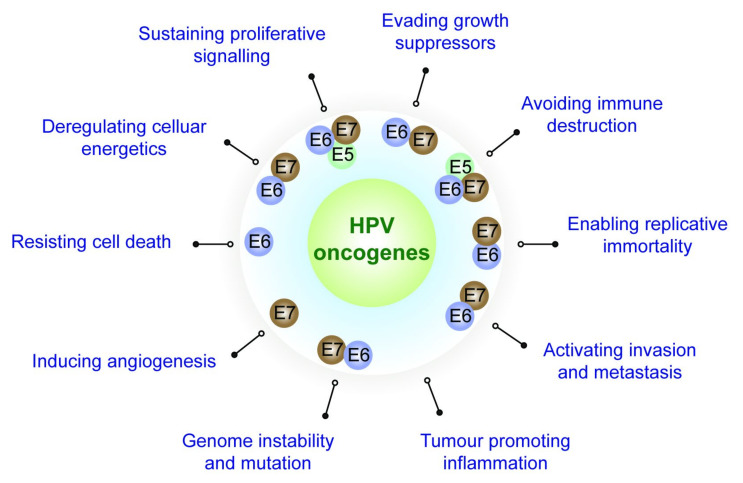
- Synthesizes published literature on HPV E5, E6, and E7, organized around cancer hallmarks such as evading growth suppressors, resisting cell death, sustaining proliferation, replicative immortality, invasion/metastasis, angiogenesis, metabolism, genome instability, immune evasion, and inflammation.
- Main analysis is thematic/mechanistic synthesis of cited studies.
Limitations
- Stated: many mechanisms behind the carcinogenic effects of these viral oncoproteins remain uncovered, and specific therapeutic agents against HPV-mediated cancer have not yet been found; how detected somatic mutations contribute to HPV-mediated carcinogenesis is not fully understood.
- Evident: as a narrative review, it does not perform systematic literature retrieval, quality appraisal, or quantitative meta-analysis, so conclusions depend on selected cited studies.
Model-written summary. Check it against the paper before relying on it.
Integrity signals
Registry
Cites
Statistics
Figures
Verification
Claims the paper makes
157 Check pending · 37 No full text of the sources · 18 Own interpretation · 6 Not checked yet
In the paper
“the presence of the E5 gene in the viral genome correlates with the carcinogenic potential [27,30]”
§ The Not-So-Good, the Bad and the Ugly: HPV E5, E6 and E7 Oncoproteins in the Orchestration of Carcinogenesis > 1. Carcinogenic Orchestration by E5, E6 and E7 > 1.1. E5, E6 and E7 Oncoproteins—An Overview
What the sources say
- Check pendingcites [27] Bravo, 2004, Mucosal human papillomaviruses encode four different E5 proteins whose chemistry and phylogeny correlate with malignant or benign growth, J. Virol. source
- Check pendingcites [30] Schiffman, 2005, The carcinogenicity of human papillomavirus types reflects viral evolution, Virology source
plainstates an association- Asserted: passes — The authors put it forward as true.
- Checkable: passes — It can be checked against evidence.
- Load-bearing: unclear — It is unclear whether the paper’s conclusions depend on it.
- Based: passes — The paper gives a reason why it holds.
In the paper
“recent evidence of circular RNA encompassing the E7 oncogene (circE7) has been demonstrated to make a significant contribution to the E7 protein levels and transforming properties, despite being a less abundant species (~1–3% of total E7 transcripts) [51]”
§ The Not-So-Good, the Bad and the Ugly: HPV E5, E6 and E7 Oncoproteins in the Orchestration of Carcinogenesis > 1. Carcinogenic Orchestration by E5, E6 and E7 > 1.1. E5, E6 and E7 Oncoproteins—An Overview
What the sources say
- Check pendingcites [51] Zhao, 2019, Transforming activity of an oncoprotein-encoding circular RNA from human papillomavirus, Nat. Commun. source
boostedstates a cause- Asserted: passes — The authors put it forward as true.
- Checkable: passes — It can be checked against evidence.
- Load-bearing: unclear — It is unclear whether the paper’s conclusions depend on it.
- Based: passes — The paper gives a reason why it holds.
In the paper
“Persistent infection with HR-HPVs may lead to inadvertent integration of the viral episomes into the host genome [7,8].”
§ The Not-So-Good, the Bad and the Ugly: HPV E5, E6 and E7 Oncoproteins in the Orchestration of Carcinogenesis > 1. Carcinogenic Orchestration by E5, E6 and E7
What the sources say
- Check pendingcites [7] McBride, A.A., and Warburton, A. (2017). The role of integration in oncogenic progression of HPV-associated cancers. PLoS Pathog., 13. source
- Not checked — no full text of the sourcecites [8] McBride, 2017, Mechanisms and strategies of papillomavirus replication, Biol. Chem. source
hedgedstates a possible cause- Asserted: passes — The authors put it forward as true.
- Checkable: passes — It can be checked against evidence.
- Load-bearing: passes — The paper’s conclusions depend on it.
- Based: passes — The paper gives a reason why it holds.
In the paper
“the integration event disrupts the repressive function of the E2 gene on the early promoter, leading to an overwhelming expression of E6 and E7, thereby rewiring cellular functions towards a carcinogenic fate [16]”
§ The Not-So-Good, the Bad and the Ugly: HPV E5, E6 and E7 Oncoproteins in the Orchestration of Carcinogenesis > 1. Carcinogenic Orchestration by E5, E6 and E7
What the sources say
- Check pendingcites [16] Munger, 2004, Mechanisms of human papillomavirus-induced oncogenesis, J. Virol. source
plainstates a cause- Asserted: passes — The authors put it forward as true.
- Checkable: passes — It can be checked against evidence.
- Load-bearing: passes — The paper’s conclusions depend on it.
- Based: passes — The paper gives a reason why it holds.
In the paper
“More than 70% of HPV-mediated cancers are caused by high-risk types 16 and 18 alone”
§ The Not-So-Good, the Bad and the Ugly: HPV E5, E6 and E7 Oncoproteins in the Orchestration of Carcinogenesis > 1. Carcinogenic Orchestration by E5, E6 and E7
What the sources say
- Check pendingcites [13] Burk, 2017, Integrated genomic and molecular characterization of cervical cancer, Nature source
- Not checked — no full text of the sourcecites [14] Cullen, 1991, Analysis of the physical state of different human papillomavirus DNAs in intraepithelial and invasive cervical neoplasm, J. Virol. source
- Check pendingcites [15] Morgan, I.M., DiNardo, L.J., and Windle, B. (2017). Integration of Human Papillomavirus Genomes in Head and Neck Cancer: Is It Time to Consider a Paradigm Shift?. Viruses, 9. source
plainstates a cause- Asserted: passes — The authors put it forward as true.
- Checkable: passes — It can be checked against evidence.
- Load-bearing: unclear — It is unclear whether the paper’s conclusions depend on it.
- Based: passes — The paper gives a reason why it holds.
- It may state two separate claims as one. 82
- Probably not a substantial claim. 9
Create a free account to see these claims.
Create a free account to see these assumptions.
126 more claims
Create a free account to see all 218 claims and to verify the 259 references still open.
Self-check
Percentages, sums and reported differences re-computed from the paper’s own numbers.
Each contradiction between two passages listed here was confirmed by an independent check.
Rated minor: it would not touch a result — a value no result rests on, a p-value that stays on the same side of the significance level, or a conflict that is clerical, resolved elsewhere in the paper, or outside its own findings.
In the paper
§ The Not-So-Good, the Bad and the Ugly: HPV E5, E6 and E7 Oncoproteins in the Orchestration of Carcinogenesis > 2. Role Played by the HPV Oncoproteins towards Attaining the Cancer Hallmarks > 2.8. Genome Instability and the Consequent Mutation of Hallmark-Enabling Genes
“Higher expression of p16INK4A caused by HPV-16 E7 mediated KDM6D upregulation represents an E7-triggered oncogene-induced senescence (OIS) response.”
§ The Not-So-Good, the Bad and the Ugly: HPV E5, E6 and E7 Oncoproteins in the Orchestration of Carcinogenesis > 2. Role Played by the HPV Oncoproteins towards Attaining the Cancer Hallmarks > 2.8. Genome Instability and the Consequent Mutation of Hallmark-Enabling Genes
“Further, KDM6B induction mediates increased expression of the cervical cancer biomarker p16INK4A.”
Rated minor: it would not touch a result — a value no result rests on, a p-value that stays on the same side of the significance level, or a conflict that is clerical, resolved elsewhere in the paper, or outside its own findings.
In the paper
§ The Not-So-Good, the Bad and the Ugly: HPV E5, E6 and E7 Oncoproteins in the Orchestration of Carcinogenesis > 2. Role Played by the HPV Oncoproteins towards Attaining the Cancer Hallmarks > 2.3. Sustaining Proliferative Signalling
“One of the key roles that HPV E5 plays towards development of cancer is to thwart the activation of certain growth factor signalling pathways.”
§ The Not-So-Good, the Bad and the Ugly: HPV E5, E6 and E7 Oncoproteins in the Orchestration of Carcinogenesis > 2. Role Played by the HPV Oncoproteins towards Attaining the Cancer Hallmarks > 2.3. Sustaining Proliferative Signalling
“HPV-E5 has been shown to activate proliferative signalling in a number of ways.”
Citations
Cites
Hallmarks of Cancer: The Next Generation
Hanahan, D., & Weinberg, R. A. (2011) · Cell · doi:10.1016/j.cell.2011.02.013 · Cited by 66,590
The serial cultivation of human diploid cell strains
Hayflick, L., & Moorhead, P. S. (1961) · Experimental Cell Research · doi:10.1016/0014-4827(61)90192-6 · Cited by 8,508
WAF1, a potential mediator of p53 tumor suppression
El-Deiry, W. S., Tokino, T., Velculescu, V. E., Levy, D. B., Parsons, R., Trent, J. M., Lin, D., Mercer, W. E., Kinzler, K. W., & Vogelstein, B. (1993) · Cell · doi:10.1016/0092-8674(93)90500-p · Cited by 8,321
Patterns and emerging mechanisms of the angiogenic switch during tumorigenesis
Hanahan, D., & Folkman, J. (1996) · Cell · doi:10.1016/s0092-8674(00)80108-7 · Cited by 6,885
The limited in vitro lifetime of human diploid cell strains
Hayflick, L. (1965) · Experimental Cell Research · doi:10.1016/0014-4827(65)90211-9 · Cited by 5,876
The E6 oncoprotein encoded by human papillomavirus types 16 and 18 promotes the degradation of p53
Scheffner, M., Werness, B. A., Huibregtse, J. M., Levine, A. J., & Howley, P. M. (1990) · Cell · doi:10.1016/0092-8674(90)90409-8 · Cited by 3,995
Comprehensive genomic characterization of head and neck squamous cell carcinomas
The Cancer Genome Atlas Network (2015) · Nature · doi:10.1038/nature14129 · Cited by 3,877
On Respiratory Impairment in Cancer Cells
Warburg, O. H. (1956) · Science · doi:10.1126/science.124.3215.269 · Cited by 3,513
The human papilloma virus-16 E7-oncoprotein is able to bind to the retinoblastoma gene product
Dyson, N., Howley, P. M., Münger, K., & Harlow, E. (1989) · Science · doi:10.1126/science.2537532 · Cited by 3,017
Proliferation, cell cycle and apoptosis in cancer
Evan, G. I., & Vousden, K. H. (2001) · Nature · doi:10.1038/35077213 · Cited by 2,724
Cited by
Roles of human papillomavirus in cancers: oncogenic mechanisms and clinical use
Zhang, Y., Qiu, K., Ren, J., Zhao, Y. Q., & Cheng, P. (2025) · Signal Transduction and Targeted Therapy · doi:10.1038/s41392-024-02083-w · Cited by 150
Pérez‐González, A., Cachay, E. R., Ocampo, A., & Poveda, E. (2022) · Microorganisms · doi:10.3390/microorganisms10051047 · Cited by 83
Galati, L., Chiantore, M. V., Marinaro, M., & Bonito, P. D. (2024) · Viruses · doi:10.3390/v16030416 · Cited by 59
Innovations in graphene-based electrochemical biosensors in healthcare applications
Ozbey, S., Keles, G., & Kurbanoğlu, S. (2025) · Microchimica Acta · doi:10.1007/s00604-025-07141-w · Cited by 58
Human Papillomavirus: Challenges and Opportunities for the Control of Cervical Cancer
Piña‐Sánchez, P. (2022) · Archives of Medical Research · doi:10.1016/j.arcmed.2022.11.009 · Cited by 54
Metadata
- Authors
- Basukala, O., & Banks, L.
- Affiliations
- International Centre for Genetic Engineering and Biotechnology (IT)
- Corresponding author
- Banks, Lawrence
- Venue
- Viruses
- Publisher
- MDPI AG
- Published
- 2021-09-22
- Volume
- 13
- Issue
- 10
- Pages
- 1892
- ISSN
- 1999-4915 (ISSN-L)
- PMC
- PMC8541208
- OpenAlex
- W3200328701
- Cited by
- 137
- References
- 392
- Citations by year
- 2026: 25 · 2025: 35 · 2024: 34 · 2023: 22 · 2022: 20 · 2021: 1
- FWCI
- 3.32
- Type
- journal article
- Language
- en
- Open access
- gold
- doi.org
- Licence
- Locations
- Viruses (publishedVersion, cc-by)
- Europe PMC (PubMed Central) (publishedVersion, other-oa)
- PubMed (publishedVersion)
- PubMed Central (publishedVersion, cc-by)
- DOAJ (DOAJ: Directory of Open Access Journals) (submittedVersion, cc-by-sa)
- Funders
- Associazione Italiana per la Ricerca sul Cancro (IG2019 - ID. 23572)
- Topics
- Health Sciences › Medicine › Epidemiology › Cervical Cancer and HPV Research
- Health Sciences › Medicine › Oncology › Cancer-related Molecular Pathways
- Health Sciences › Medicine › Oncology › Viral-associated cancers and disorders
- Keywords
- human papillomavirus, E6 oncoprotein, E7 oncoprotein, viral oncogenesis, carcinogenesis, persistent HPV infection, cervical cancer, basal keratinocytes, host immune response, cellular homeostasis, HPV vaccine, therapeutic interventions
- MeSH terms
- Persistent Infection, Animals, Female, Humans, Oncogene Proteins, Viral, Papillomaviridae, Papillomavirus Infections, Mice, Carcinogenesis
About these checks
Registry, retraction, Cites and statistics results are computed, not judged, with one exception: a printed reference that no index lists is read once by a model before it counts as a citation error. Claims are extracted by a model and kept only when their quote appears verbatim in the text; each cited source is then checked, with a model’s help, for whether it says what the claim relies on. Those verdicts can be wrong — read the claim’s quote and the cited source before relying on one.
A language model drew the claims from the paper on 2026-11-12, under version 3 of the claim definition (model deepseek-v4.1-flash, prompt extract-v3).
A second model labelled each claim on 2026-11-12 (model jev-1.13-20260917, definition revision gold-guideline-v0.2).
Statistics and arithmetic are recomputed, not judged.
Confidence bands are shown only for fields calibrated on our annotated test set. None is calibrated yet, so no band is shown.
What counts as a claim ›How we measure confidence ›How we check this ›
Are you an author, or do you see a problem with this page? Request a review
How to cite
Cite CoChat for the checks on this page, and the paper for its own findings.
- This page
- CoChat. (2026). Citation check: The Not-So-Good, the Bad and the Ugly: HPV E5, E6 and E7 Oncoproteins in the Orchestration of Carcinogenesis. https://app.cochat.ai/papers/10.3390/v13101892
- The paper
- Basukala, O., & Banks, L. (2021). The Not-So-Good, the Bad and the Ugly: HPV E5, E6 and E7 Oncoproteins in the Orchestration of Carcinogenesis. Viruses. https://doi.org/10.3390/v13101892
