

Longitudinal Ramsey spectroscopy of atoms for continuous operation of optical clocks
Open accessThe DOI matches its Crossref record; 46 of the 47 references it cites were found in a registry or an index.
Abstract
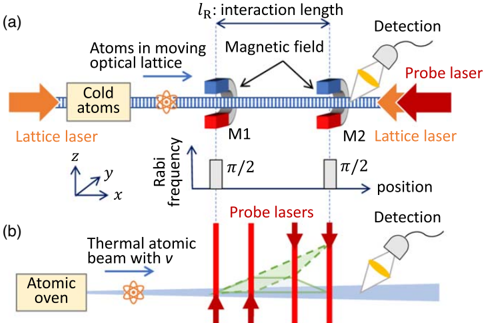
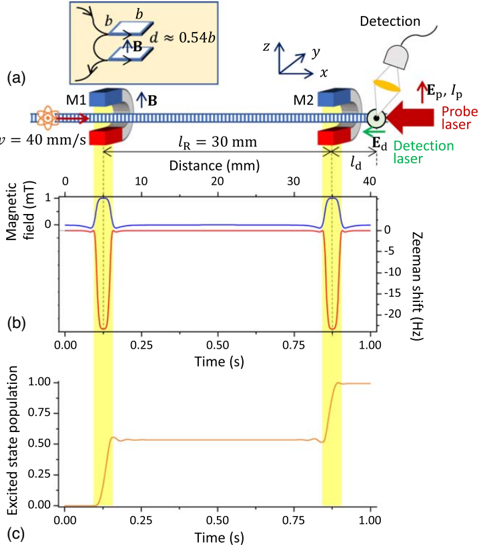
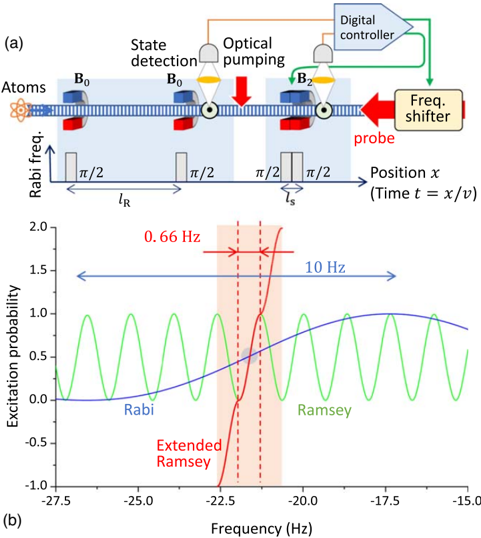
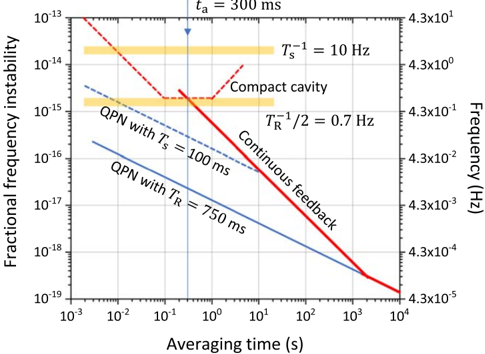
We propose a longitudinal Ramsey spectroscopy of atoms in a moving optical lattice. Spatially separated magnetic fields, which open the forbidden 1 S 0 − 3 P 0 transition by mixing with the dipole-allowed states, create Ramsey pulses for a probe laser introduced along the optical lattice. Excitation of atoms in the Lamb-Dicke regime by a single probe laser avoids residual Doppler effects as well as mechanical instabilities that deteriorate Ramsey spectroscopy on an atomic beam. Continuous measurement and control of the probe laser improves the Allan deviation as τ −1 for an averaging time τ until the quantum projection noise limit is reached. For 88 Sr atoms with an atomic flux of 10 4 s −1 , we speculate a clock instability of 5 × 10 −16 ( τ s −1 ) −1 down to its floor at around 10 −18 .
Overview
The claims and statistics of this paper haven’t been checked yet.
Free: it reads the open-access text and checks the first 5 claims that cite a source we can check. Create a free account to check every claim.
Integrity signals
Registry
Cites
Statistics
Figures
Verification
Claims the paper makes
The claims and statistics of this paper haven’t been checked yet.
Free: it reads the open-access text and checks the first 5 claims that cite a source we can check. Create a free account to check every claim.
Claims other papers make about this one
Each is checked against this paper’s own text: does it say what the citing paper says it does?
The source backs part of the claim, not all of it — or backs it for a different population, condition or comparison.
In the citing paper
“The main contribution is Dick noise [61] of the transportable clock laser [56].”
From Long-distance chronometric leveling with a portable optical clock (2024) · cites this paper as [56]
Experimental — accuracy not yet measuredThe check wasn’t confident either way, so it gives no verdict — never disputed.
In the citing paper
“The instability is slightly higher in the remote clock comparison (1 . 7 × 10 -15 / √ τ/ s, Fig. 4) than in the local one (1 . 0 × 10 -15 / √ τ/ s, Fig. 2) as the transportable clock laser [56] was pre-stabilized to the ultrastable lasers at PTB [57, 58] during the local comparisons.”
From Long-distance chronometric leveling with a portable optical clock (2024) · cites this paper as [56]
Experimental — accuracy not yet measured
Self-check
Percentages, sums and reported differences re-computed from the paper’s own numbers.
The self-check needs the paper’s full text.
Citations
Cites
The Effect of Collisions upon the Doppler Width of Spectral Lines
Dicke, R. H. (1953) · Physical Review · doi:10.1103/physrev.89.472 · Cited by 1,491
A Molecular Beam Resonance Method with Separated Oscillating Fields
Ramsey, N. F. (1950) · Physical Review · doi:10.1103/physrev.78.695 · Cited by 1,045
Systematic evaluation of an atomic clock at 2 × 10⁻¹⁸ total uncertainty
Nicholson, T. L., Campbell, S. L., Hutson, R. B., Marti, G. E., Bloom, B. J., McNally, R. L., Zhang, W., Barrett, M. D., Safronova, M. S., Strouse, G. F., et al. (2015) · Nature Communications · doi:10.1038/ncomms7896 · Cited by 780
Atomic clock performance enabling geodesy below the centimetre level
McGrew, W. F., Zhang, X., Fasano, R. J., Schäffer, S. A., Beloy, K., Nicolodi, D., Brown, R. C., Hinkley, N., Milani, G., Schioppo, M., et al. (2018) · Nature · doi:10.1038/s41586-018-0738-2 · Cited by 727
(2019) · doi:10.1103/physrevlett.123.033201 · Cited by 711
Single-Ion Atomic Clock with 3 × 10 − 18 Systematic Uncertainty
Huntemann, N., Sanner, C., Lipphardt, B., Tamm, C., & Peik, E. (2016) · Physical Review Letters · doi:10.1103/physrevlett.116.063001 · Cited by 677
Quantum Logic Gates in Optical Lattices
Brennen, G. K., Caves, C. M., Jessen, P. S., & Deutsch, I. H. (1999) · Physical Review Letters · doi:10.1103/physrevlett.82.1060 · Cited by 665
Cryogenic optical lattice clocks
Ushijima, I., Takamoto, M., Das, M., Ohkubo, T., & Katori, H. (2015) · Nature Photonics · doi:10.1038/nphoton.2015.5 · Cited by 627
Self-citationQuantum projection noise: Population fluctuations in two-level systems
Itano, W. M., Bergquist, J. C., Bollinger, J. J., Gilligan, J. M., Heinzen, D. J., Moore, F. L., Raizen, M. G., & Wineland, D. J. (1993) · Physical Review A · doi:10.1103/physreva.47.3554 · Cited by 613
Ultrastable Optical Clock with Neutral Atoms in an Engineered Light Shift Trap
Katori, H., Takamoto, M., Pal’chikov, V. G., & Ovsiannikov, V. D. (2003) · Physical Review Letters · doi:10.1103/physrevlett.91.173005 · Cited by 572
Self-citation
Cited by
A perspective on the future of transportable optical lattice clocks
Takamoto, M., Tanaka, Y., & Katori, H. (2022) · Applied Physics Letters · doi:10.1063/5.0087894 · Cited by 40
Self-citationLong-distance chronometric leveling with a portable optical clock
Grotti, J., Nosske, I., Koller, S. B., Herbers, S., Denker, H., Timmen, L., Vishnyakova, G., Grosche, G., Waterholter, T., Kuhl, A., et al. (2024) · Physical Review Applied · doi:10.1103/physrevapplied.21.l061001 · Cited by 33
“Consequently, it offers an attractive way to resolve existing discrepancies (at the centimeter to decimeter level) between the established geodetic methods, overcome their limitations, improve continental and global height reference frames, connect island and mainland height systems, connect tide gauges for sea level…”
InfluentialExploring potential applications of optical lattice clocks in a plate subduction zone
Tanaka, Y., & Katori, H. (2021) · Journal of Geodesy · doi:10.1007/s00190-021-01548-y · Cited by 31
“2016; Katori 2021), which improves clocks’ stability as −1 , will be used to access low 10−19 uncertainty in an averaging time of less than an hour (dashed-green line).”
BackgroundSelf-citationQuantum enhanced time synchronisation for communication network
Nande, S. S., Paul, M., Senk, S., Ulbricht, M., Bassoli, R., Fitzek, F. H. P., & Boche, H. (2023) · Computer Networks · doi:10.1016/j.comnet.2023.109772 · Cited by 30
“These phase oscillations are fundamental and can provide us time using a protocol like Ramsey interferometry [12].”
MethodSubnatural Linewidth Superradiant Lasing with Cold Sr 88 Atoms
Kristensen, S. L., Bohr, E. A., Robinson-Tait, J., Zelevinsky, T., Thomsen, J. W., & Müller, J. H. (2023) · Physical Review Letters · doi:10.1103/physrevlett.130.223402 · Cited by 41
Continuous Collective Strong Coupling of Strontium Atoms to a High Finesse Ring Cavity
Cline, J., Schäfer, V. M., Niu, Z., Young, D. J., Yoon, T. H., & Thompson, J. K. (2025) · Physical Review Letters · doi:10.1103/physrevlett.134.013403 · Cited by 34
Optical atomic clocks: defining the future of time and frequency metrology
Fortier, T. M., Luiten, A. N., & Margolis, H. S. (2026) · Optica · doi:10.1364/optica.575770 · Cited by 45
Atom-Number Enhancement by Shielding Atoms From Losses in Strontium Magneto-Optical Traps
Höschele, J., Buob, S., Rubio-Abadal, A., Makhalov, V., & Tarruell, L. (2023) · Physical Review Applied · doi:10.1103/physrevapplied.19.064011 · Cited by 20
“Optical atomic clocks could also profit in certain next-generation approaches, such as quantum-degenerate optical lattice clocks [51], continuous Ramsey clocks [52] or interleaved cold-atom clocks [53].”
BackgroundContinuous generation of an ultracold atomic beam using crossed moving optical lattices
岡場, 翔., Takeuchi, R., Tsuji, S., & Katori, H. (2024) · Physical Review Applied · doi:10.1103/physrevapplied.21.034006 · Cited by 20
Self-citationContinuous outcoupling of ultracold strontium atoms combining three different traps
Takeuchi, R., Chiba, H., 岡場, 翔., Takamoto, M., Tsuji, S., & Katori, H. (2023) · Applied Physics Express · doi:10.35848/1882-0786/accb3c · Cited by 18
Self-citationContinuous cavity QED with an atomic beam
Famà, F., Zhou, S., Heizenreder, B., Tang, M., Bennetts, S., Jäger, S. B., Schäffer, S. A., & Schreck, F. (2024) · Physical Review A · doi:10.1103/physreva.110.063721 · Cited by 17
Zero-Dead-Time Strontium Lattice Clock with a Stability at 10 − 19 Level
Liu, X.-Y., Liu, P., Li, J., Zhang, Y.-C., Wang, Y.-B., Jia, Z.-P., Zhang, X., Zhu, X.-Q., Kong, D.-Q., Song, W.-L., et al. (2025) · Physical Review Letters · doi:10.1103/zbpb-6qxb · Cited by 24
Clock-Line-Mediated Sisyphus Cooling
Chen, C.-C., Siegel, J. L., Hunt, B. D., Grogan, T., Hassan, Y. S., Beloy, K., Gibble, K., Brown, R. C., & Ludlow, A. D. (2024) · Physical Review Letters · doi:10.1103/physrevlett.133.053401 · Cited by 22
Dubey, S., Kazakov, G. A., Heizenreder, B., Zhou, S., Bennetts, S., Schäffer, S. A., Sitaram, A., & Schreck, F. (2025) · Physical Review Research · doi:10.1103/physrevresearch.7.013292 · Cited by 18
N G Basov's legacy: from the first masers to optical frequency standards
Belyaev, A. A., Voronzov, V. G., Александрович, Д. Н., Khabarova, K. Y., & Kolachevsky, N. (2022) · Physics-Uspekhi · doi:10.3367/ufne.2022.11.039347 · Cited by 8
Prospective Optical Lattice Clocks in Neutral Atoms with Hyperfine Structure
Bothwell, T. (2024) · Atoms · doi:10.3390/atoms12030014 · Cited by 6
“Such continuous trapping of atoms from a single MOT stage that is decoupled from other atomic states of interest would be a vital resource with applications from active clocks [52–54] to continuous atom lasers [55].”
Transportable optical lattice clocks and general relativity
Shinkai, H.-A., Takamoto, M., & Katori, H. (2025) · International Journal of Modern Physics D · doi:10.1142/s0218271825400127 · Cited by 6
Self-citationQuasicontinuous sub- μ K strontium source without a high-finesse cavity-stabilized laser
Boughdachi, S., Heizenreder, B., Sitaram, A., Dierikx, E. F., Xie, Y., Klemann, S., Klop, P., Koelemeij, J. C. J., Wilk, R., Schreck, F., et al. (2026) · Physical Review Applied · doi:10.1103/3gnx-4s97 · Cited by 4
“…quasi-continuous out-coupling of sub-µ K atoms from the MOT, highlighting the potential of this platform for zero-dead-time optical lattice clocks [31, 32], portable clocks [33, 34], and quantum devices that require quasi-continuous atomic sources [9, 15–17, The remainder of this article is…”
Continuous operation of a bicolor thulium optical lattice clock
Mishin, D., Provorchenko, D. I., Tregubov, D. O., Kolachevsky, N., & Golovizin, A. A. (2021) · Applied Physics Express · doi:10.35848/1882-0786/ac3186 · Cited by 6
Loading of the narrow line Tm MOT from a pulsed cold atomic beam
Yaushev, M. O., Mishin, D., Tregubov, D. O., Kolachevsky, N., & Golovizin, A. A. (2025) · Review of Scientific Instruments · doi:10.1063/5.0252998 · Cited by 4
“Additionally, 2D-MOTs can provide a continuous flux of cold atoms, which could enable the development of a new generation of optical clocks that continuously interrogate a clock transition 14–16 .”
BackgroundResearch on Quantum Materials and Quantum Technology at RIKEN
Ishibashi, K., Yorozu, S., Arima, T., Kawamura, M., Tokura, Y., Karube, K., Yu, X., Taguchi, Y., Hanaguri, T., Machida, T., et al. (2025) · ACS Nano · doi:10.1021/acsnano.4c15409 · Cited by 4
Self-citationTanaka, Y., & Aoki, Y. (2022) · International Association of Geodesy symposia · doi:10.1007/1345_2022_147 · Cited by 3
Narrow-line-mediated Sisyphus cooling in the P 2 3 metastable state of strontium
Chen, C.-C., Takeuchi, R., Okaba, S., & Katori, H. (2025) · Physical Review Research · doi:10.1103/b26p-12j4 · Cited by 4
Self-citationGravitational-wave astronomy with a space-based optical clock network
Ganapathy, D., Singh, D., Singamsetty, S., & Kolkowitz, S. (2026) · Physical review. D/Physical review. D. · doi:10.1103/xr78-l2zs · Cited by 3
Two-Dimensional Magneto-optical Trap for Producing a Flux of Cold Thulium Atoms
Yaushev, M. O., Mishin, D., Tregubov, D. O., Provorchenko, D. I., Колачевский, Н. Н., & Golovizin, A. A. (2023) · Journal of Experimental and Theoretical Physics · doi:10.1134/s1063776123080162 · Cited by 3
The path to continuous Bose-Einstein condensation
Chen, C.-C., Bennetts, S., & Schreck, F. (2023) · Advances in atomic, molecular, and optical physics · doi:10.1016/bs.aamop.2023.04.004 · Cited by 3
Two-Dimensional Magneto-optical Trap for Producing a Flux of Cold Thulium Atoms
Yaushev, M. O., Mishin, D., Tregubov, D. O., Provorchenko, D. I., Kolachevskiy, N. N., & Golovizin, A. A. (2023) · Журнал Экспериментальной и Теоретической Физики · doi:10.31857/s0044451023080060
Optical lattice clocks and related platforms
Takamoto, M., & Katori, H. (2024) · Elsevier eBooks · doi:10.1016/b978-0-323-98378-5.00002-7 · Cited by 1
Self-citationVerification of Gravitational Redshift Using Transportable Optical Lattice Clocks
Ohmae, N., Takamoto, M., Ushijima, I., & Katori, H. (2023) · The Review of Laser Engineering · doi:10.2184/lsj.51.8_506
Self-citationNon-Markovian dynamics in guanidinium-based perovskites
Triviño, H., Mesa, F., Zapata, S., Rojas, E. C., & Aristizábal, A. J. (2026) · Scientific Reports · doi:10.1038/s41598-025-34897-1
“( Similarly, the measures N C and N γ T ) are based on the decay rates associated with the interaction between the environment and the quantum system 46,47 .”
Foucault, Y. (2022) · theses.fr (ABES) · doi:10.70675/18f7a653zb116z498fz8a18zddca5d8bf64a · Cited by 1
Collimation of dense atomic beams by Swept Velocity ShelvingPreprint
Fama, F., Heizenreder, B., Sitaram, A., Silva, C. B., Spreeuw, R. J. C., Schäffer, S. A., & Schreck, F. (2026) · arXiv (Cornell University) · doi:10.48550/arxiv.2607.28873
“…effort include continuous quantum simulators [ 1–3 ] , atom interferometry [ 4,5 ] , scalable quantum-computing architectures [ 6–9 ] , and optical lattice clocks aiming to overcome the Dick effect through steady-state interrogation and approach 1 / time scaling of clock uncertainty [ 10–13 ] .”
Spatially defined Rabi spectroscopy for uninterrupted optical clock interrogation
Nishida, K., Takeuchi, R., Tsuji, S., 岡場, 翔., & Katori, H. (2026) · Nature Communications · doi:10.1038/s41467-026-76017-1
“In particular, a two-zone architecture combining short and long interrogation zones 24 provides both a wide frequency capture range and a low-QPN instability limit, potentially relaxing local-oscillator pre-stabilisation requirements and supporting more compact optical-clock architectures.”
Self-citation
Metadata
- Authors
- Katori, H.
- Affiliations
- RIKEN (JP)
- Corresponding author
- Katori, Hidetoshi
- ORCID
- Katori, Hidetoshi
- Venue
- Applied Physics Express
- Publisher
- IOP Publishing
- Published
- 2021-07-01
- Volume
- 14
- Issue
- 7
- Pages
- 072006
- ISSN
- 1882-0778 (ISSN-L)
- 1882-0786
- OpenAlex
- W3174162694
- Cited by
- 31
- References
- 47
- Citations by year
- 2026: 2 · 2025: 7 · 2024: 7 · 2023: 8 · 2022: 5 · 2021: 2
- FWCI
- 2.40
- Type
- journal article
- Language
- lv
- Open access
- hybrid
- doi.org
- Licence
- cc-by
- creativecommons.org/licenses/by/4.0/ (vor, 4 d)
- iopscience.iop.org/info/page/text-and-data-mining (tdm, 4 d)
- Locations
- Applied Physics Express (publishedVersion, cc-by)
- Funders
- Japan Science and Technology Agency (JPMJMI18A1)
- Japan Society for the Promotion of Science (JP16H06284)
- Topics
- Physical Sciences › Physics and Astronomy › Atomic and Molecular Physics, and Optics › Advanced Frequency and Time Standards
- Physical Sciences › Physics and Astronomy › Atomic and Molecular Physics, and Optics › Cold Atom Physics and Bose-Einstein Condensates
- Physical Sciences › Physics and Astronomy › Atomic and Molecular Physics, and Optics › Atomic and Subatomic Physics Research
- Keywords
- optical atomic clocks, moving optical lattice, 88Sr, 1S0-3P0 transition, Lamb-Dicke regime, Allan deviation, quantum projection noise, clock instability, Doppler-free spectroscopy
About these checks
Registry, retraction, Cites and statistics results are computed, not judged, with one exception: a printed reference that no index lists is read once by a model before it counts as a citation error. Claims are extracted by a model and kept only when their quote appears verbatim in the text; each cited source is then checked, with a model’s help, for whether it says what the claim relies on. Those verdicts can be wrong — read the claim’s quote and the cited source before relying on one.
Statistics and arithmetic are recomputed, not judged.
Confidence bands are shown only for fields calibrated on our annotated test set. None is calibrated yet, so no band is shown.
What counts as a claim ›How we measure confidence ›How we check this ›
Are you an author, or do you see a problem with this page? Request a review
Data sources
Bibliographic data: Semantic Scholar, OpenAlex, Crossref.
Contains information from the Semantic Scholar Academic Graph Datasets, made available under the ODC Attribution License (ODC-BY 1.0).
Semantic Scholar’s data is described in: Kinney, R., et al. (2023). The Semantic Scholar Open Data Platform. arXiv:2301.10140.
