

The DOI matches its Crossref record; 112 of the 112 references it cites were found in a registry or an index.
Liver fibrosis and hepatic stellate cells: Etiology, pathological hallmarks and therapeutic targets
Open accessAbstract
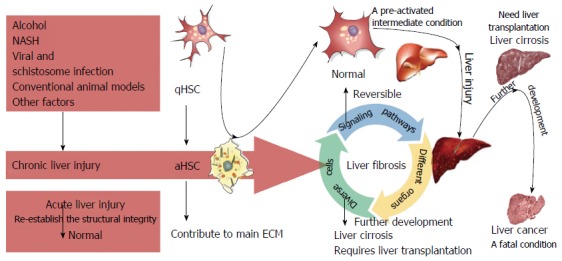
Liver fibrosis is a reversible wound-healing process aimed at maintaining organ integrity, and presents as the critical pre-stage of liver cirrhosis, which will eventually progress to hepatocellular carcinoma in the absence of liver transplantation.Fibrosis generally results from chronic hepatic injury caused by various factors, mainly viral infection, schistosomiasis, and alcoholism; however, the exact pathological mechanisms are still unknown.Although numerous drugs have been shown to have antifibrotic activity in vitro and in animal models, none of these drugs have been shown to be efficacious in the clinic.Importantly, hepatic stellate cells (HSCs) play a key role in the initiation, progression, and regression of liver fibrosis by secreting fibrogenic factors that encourage portal fibrocytes, fibroblasts, and bone marrow-derived myofibroblasts to produce collagen and thereby propagate fibrosis.These cells are subject to intricate cross-talk with adjacent cells, resulting in scarring and subsequent liver damage.Thus, an understanding of the molecular mechanisms of liver fibrosis and their relationships with HSCs is essential for the discovery of new therapeutic targets.This comprehensive review outlines the role of HSCs in liver fibrosis and details novel strategies to suppress HSC activity, thereby providing new insights into potential treatments for liver fibrosis.
Overview
The claims and statistics of this paper haven’t been checked yet.
Run the check — free, no account needed. It reads the open-access text and checks the sources it cites.
Integrity signals
Registry
Cites
Statistics
Figures
Verification
Claims the paper makes
The claims and statistics of this paper haven’t been checked yet.
Run the check — free, no account needed. It reads the open-access text and checks the sources it cites.
Claims other papers make about this one
Each is checked against this paper’s own text: does it say what the citing paper says it does?
The source backs part of the claim, not all of it — or backs it for a different population, condition or comparison.
In the citing paper
“Hepatic stellate cells, characterized by DES and VIM expressions, are central to liver fibrosis and extracellular matrix remodeling34,36.”
From Temporal proteomic profiling of iPSC-derived human liver organoids reveals optimal maturation for drug metabolism and toxicology (2026) · cites this paper as [34]
Experimental — accuracy not yet measuredThe source backs part of the claim, not all of it — or backs it for a different population, condition or comparison.
In the citing paper
“Interestingly, the mesenchymal shift by Day 45 suggests greater cellular complexity at later stages, potentially facilitating iHLO use in modeling liver pathologies such as fibrosis, cirrhosis, and liver remodeling, as indicated by increased expression of hepatic stellate cell markers such as DES and VIM33,34.”
From Temporal proteomic profiling of iPSC-derived human liver organoids reveals optimal maturation for drug metabolism and toxicology (2026) · cites this paper as [34]
Experimental — accuracy not yet measuredThe check wasn’t confident either way, so it gives no verdict — never disputed.
In the citing paper
“The expansion of mesenchymal-like population at Day 45 suggests that these organoids could serve as an advanced model for studying fibrogenesis and testing anti-fibrotic therapies34.”
From Temporal proteomic profiling of iPSC-derived human liver organoids reveals optimal maturation for drug metabolism and toxicology (2026) · cites this paper as [34]
Experimental — accuracy not yet measured
Self-check
Percentages, sums and reported differences re-computed from the paper’s own numbers.
The self-check needs the paper’s full text.
Citations
Cites
Resveratrol improves health and survival of mice on a high-calorie diet
Baur, J. A., Pearson, K. J., Price, N. L., Jamieson, H. A., Lerin, C., Kalra, A., Prabhu, V. V., Allard, J. S., Lopez-Lluch, G., Lewis, K., et al. (2006) · Nature · doi:10.1038/nature05354 · Cited by 4,290
Lagouge, M., Argmann, C., Gerhart-Hines, Z., Meziane, H., Lerin, C., Daussin, F., Messadeq, N., Milne, J., Lambert, P., Elliott, P., et al. (2006) · Cell · doi:10.1016/j.cell.2006.11.013 · Cited by 4,057
Small molecule activators of sirtuins extend Saccharomyces cerevisiae lifespan
Howitz, K. T., Bitterman, K. J., Cohen, H. Y., Lamming, D. W., Lavu, S., Wood, J. G., Zipkin, R. E., Chung, P., Kisielewski, A., Zhang, L.-L., et al. (2003) · Nature · doi:10.1038/nature01960 · Cited by 3,796
Vernon, G. C., Baranova, A. V., & Younossi, Z. M. (2011) · Alimentary Pharmacology & Therapeutics · doi:10.1111/j.1365-2036.2011.04724.x · Cited by 3,116
The burden of liver disease in Europe: A review of available epidemiological data
Blachier, M., Leleu, H., Peck‐Radosavljevic, M., Valla, D. C., & Roudot‐Thoraval, F. (2013) · Journal of Hepatology · doi:10.1016/j.jhep.2012.12.005 · Cited by 1,340
The natural history of nonalcoholic fatty liver: A follow-up study
Teli, M. R., James, O., Burt, A. D., Bennett, M. K., & Day, C. P. (1995) · Hepatology · doi:10.1002/hep.1840220616 · Cited by 913
Feldstein, A. E., Werneburg, N. W., Canbay, A. E., Guicciardi, M. E., Bronk, S. F., Rydzewski, R. M., Burgart, L. J., & Gores, G. J. (2004) · Hepatology · doi:10.1002/hep.20283 · Cited by 851
CYP2E1 and oxidative liver injury by alcohol
Lu, Y., & Cederbaum, A. I. (2008) · Free Radical Biology and Medicine · doi:10.1016/j.freeradbiomed.2007.11.004 · Cited by 805
Hepatic fibrosis: concept to treatment
Trautwein, C., Friedman, S. L., Schuppan, D., & Pinzani, M. (2015) · Journal of Hepatology · doi:10.1016/j.jhep.2015.02.039 · Cited by 677
AMP-activated protein kinase-deficient mice are resistant to the metabolic effects of resveratrol
Um, J.-H., Park, S.-J., Kang, H., Yang, S., Foretz, M., McBurney, M. W., Kim, M. K., Viollet, B., & Chung, J. H. (2010) · Diabetes · doi:10.2337/db09-0482 · Cited by 647
Research works printed but not linked: 1
- 10.1002/cphy.c120035 · DOI · Paper page
Cited by
Sorted by citations
Items 401–500 of 595
Mitigation of TGF-β/Smad signaling pathway-associated liver fibrosis by paeoniflorin
Li, W., & Wei, Z. (2017) · Tropical Journal of Pharmaceutical Research · doi:10.4314/tjpr.v16i9.9 · Cited by 5
Yang, D., Shi, J., Xia, Z., Guo, W.-Z., Ahmed, M. S., & Zhang, S. (2021) · Scientific Reports · doi:10.1038/s41598-021-83516-2 · Cited by 5
Stem Cell Delivery Routes: From Preclinical Models to Clinical Applications
Fagoonee, S. (2021) · BENTHAM SCIENCE PUBLISHERS eBooks · doi:10.2174/97898150401041210101 · Cited by 5
Wu, Z., Wang, J., Feng, J.-Y., & Ying, L. (2022) · Human & Experimental Toxicology · doi:10.1177/09603271221084672 · Cited by 5
Wang, F., Chen, L., Zhang, B., Li, Z., Shen, M., Li, T., Zhang, Z., Shao, J., Zhang, F., Zheng, S., et al. (2022) · Journal of Clinical and Translational Hepatology · doi:10.14218/jcth.2021.00413 · Cited by 5
Denga, T. M., Gunter, S., Fourie, S., Roux, R. L., Manilall, A., Millen, A. M. E., & Mokotedi, L. P. (2022) · Endocrine Metabolic & Immune Disorders - Drug Targets · doi:10.2174/1871530323666221017153157 · Cited by 5
Circulating cell-free messenger RNA secretome characterization of primary sclerosing cholangitis
Chalasani, N., Vuppalanchi, R., Lammert, C. S., Gawrieh, S., Braun, J. V., Zhuang, J., Ibarra, A., Ross, D. A., Nerenberg, M. I., Quake, S. R., et al. (2023) · Hepatology Communications · doi:10.1097/hc9.0000000000000140 · Cited by 6
Progress in the Correlation Between Inflammasome NLRP3 and Liver Fibrosis
Sun, M., Zhang, Y., Guo, A., Xia, Z., & Peng, L. (2023) · Journal of Clinical and Translational Hepatology · doi:10.14218/jcth.2023.00231 · Cited by 5
Guo, L., An, Y., Huang, X., Liu, W., Chen, F., Fan, Y., Gao, S., Han, L., & Wang, K. (2024) · Frontiers in Medicine · doi:10.3389/fmed.2024.1390049 · Cited by 5
Almanza, M. C. T., Martínez-Aguilar, M., Buist‐Homan, M., Bömer, N., Gomez, K. F. A., de Meijer, V. E., van Vilsteren, F. G. I., Blokzijl, H., & Moshage, H. J. (2024) · Molecular Biology Reports · doi:10.1007/s11033-024-10027-4 · Cited by 7
Kim, D.-S., Funcke, J., Chen, S., Min, K., Onodera, T., Kim, M., Lin, Q., Joung, C., Velasco, J., Virostek, M., et al. (2025) · Experimental & Molecular Medicine · doi:10.1038/s12276-025-01567-1 · Cited by 6
Stellate cells in livers of dogs with portal vein hypoperfusion
Sobczak-Filipiak, M., Szarek, J., Czopowicz, M., Galanty, M., Dolka, I., Trębacz, P., Frymus, J., & Lechowski, R. (2018) · Medycyna Weterynaryjna · doi:10.21521/mw.6017 · Cited by 5
Li, L., Ran, J., Li, L., Chen, G., Zhang, S., & Wang, Y. (2020) · Molecular Medicine Reports · doi:10.3892/mmr.2020.10997 · Cited by 5
Zhang, X., Xie, X., Wang, Y., Li, W., & Lin, Z. (2019) · PubMed Central · Cited by 5
Molecular factors associated with regression of liver fibrosis of alcoholic etiology
Kiseleva, Y. V., Zharikov, Y. O., Maslennikov, R. V., Pavlov, C. S., & Nikolenko, V. N. (2021) · Terapevticheskii arkhiv · doi:10.26442/00403660.2021.02.200617 · Cited by 5
Liu, L., Zhou, Y., Dai, D., Xia, H., Zhao, K. F., & Zhang, J. (2021) · Evidence-based Complementary and Alternative Medicine · doi:10.1155/2021/5649575 · Cited by 6
Paula, R. D. S., Colares, F. C. D. J., de Toledo, J. O., & Nóbrega, O. D. T. (2010) · Americanae (AECID Library) · doi:10.23925/2176-901x.2008v11i1p%p · Cited by 5
Salama, M. M., Nomir, M., Fahmi, M. W., El-Gayar, A. M., & El‐Shishtawy, M. M. (2018) · Scientia Pharmaceutica · doi:10.3390/scipharm86040044 · Cited by 5
Patel, S. S., Sandur, A., El-Kebir, M., Gaba, R. C., Schook, L. B., & Schachtschneider, K. M. (2021) · Frontiers in Genetics · doi:10.3389/fgene.2021.657330 · Cited by 5
Phomopsterone B Alleviates Liver Fibrosis through mTOR-Mediated Autophagy and Apoptosis Pathway
Peng, M.-L., Zhang, L., Luo, Y., Xu, S.-Y., Long, X.-M., Ao, J.-L., Liao, S., Zhu, Q., He, X., & Xu, G. (2024) · Molecules · doi:10.3390/molecules29020417 · Cited by 4
Li, Z., Wu, X., Chen, Z., Wei, X., & Chen, W. (2023) · Gastroenterology report · doi:10.1093/gastro/goad076 · Cited by 4
Bai, Y.-M., Liang, S., & Zhou, B. (2024) · Aging · doi:10.18632/aging.205559 · Cited by 4
Li, Y., Chen, L., Li, S., Song, H., Chen, Y., & Wang, S. (2024) · Journal of Gastroenterology and Hepatology · doi:10.1111/jgh.16765 · Cited by 4
Jiao, X., Lai, L., Bo, S., Qian, Y., & Yang, W. (2025) · Experimental Cell Research · doi:10.1016/j.yexcr.2025.114513 · Cited by 4
VitroBert: modeling DILI by pretraining BERT on in vitro data
Masood, M. A., Nagaraja, A. A., Belaid, K., Mesens, N., Ceulemans, H., Samuel Kaski, A., Herman, D., & Heinonen, M. (2025) · Journal of Cheminformatics · doi:10.1186/s13321-025-01048-7 · Cited by 4
Cell type heterogeneity in gene co-expression networks: implications for toxicological research
Bruns, I. B., Li, Y., Stevens, J. L., van de Water, B., & Callegaro, G. (2025) · Briefings in Bioinformatics · doi:10.1093/bib/bbaf421 · Cited by 5
Cheung, C. Y. Y., Wan, P., Wan, H., Xu, C., Jia, X., Fong, C. H.-Y., Lui, D. T. W., Song, E., Chen, X., Chow, W.-S., et al. (2025) · Journal of Advanced Research · doi:10.1016/j.jare.2025.09.033 · Cited by 4
Self-citationLi, Y., Zhou, Y., Wu, L., Gao, Q., & Wang, W. (2025) · Biomaterials Science · doi:10.1039/d5bm01262g · Cited by 5
Deng, X., Li, Z., Xu, Z., & Peng, F. (2025) · Biochimica et Biophysica Acta (BBA) - Molecular Cell Research · doi:10.1016/j.bbamcr.2025.120075 · Cited by 4
Pathogenesis, diagnosis and management of chronic hepatitis B related liver fibrosis
Kösekli, M. A., & Aktaş, G. (2025) · Minerva Gastroenterology · doi:10.23736/s2724-5985.25.03862-8 · Cited by 4
Wang, G., Zhang, N., Zhou, Y., Yan, J., Liu, Y., Liu, M., Xue, M., & Liang, H. W. (2025) · Journal of Food Science · doi:10.1111/1750-3841.70682 · Cited by 4
Voutilainen, S. H., Kosola, S. K., Lohi, J., Jahnukainen, T., Pakarinen, M. P., & Jalanko, H. (2021) · Clinical Transplantation · doi:10.1111/ctr.14373 · Cited by 4
Trairatphisan, P., de Souza, T. M., Kleinjans, J. C. S., Jennen, D. G. J., & Sáez-Rodríguez, J. (2021) · Toxicology Letters · doi:10.1016/j.toxlet.2021.06.020 · Cited by 4
Mohammadtaghvaei, N., Afarin, R., Mavalizadeh, F., Shakerian, E., Bavarsad, S. S., & Mohammadzadeh, G. (2021) · Hepatitis Monthly · doi:10.5812/hepatmon.116875 · Cited by 4
Liqiu, Z., Zhang, H., Wang, Q., Zhong, W., Du, Y., Liu, H., & Xing, W. (2022) · Magnetic Resonance Imaging · doi:10.1016/j.mri.2022.08.013 · Cited by 4
Lee, J., Hong, S., Kim, M.-J., Lim, Y.-M., Moon, S. J., Kwon, H., Park, S. E., Rhee, E., & Lee, W. (2024) · Biochemical and Biophysical Research Communications · doi:10.1016/j.bbrc.2024.150620 · Cited by 4
Hidden Hunger: A Forgotten Comorbidity of Metabolic‐Syndrome‐Associated Fatty Liver Disease
Agu, P. C., & Lu, J. (2025) · Molecular Nutrition & Food Research · doi:10.1002/mnfr.70134 · Cited by 4
Alhusseiny, S. M., El-Beshbishi, S. N., Hashim, M. M. A., El-nemr, H. E.-D. E., & Handoussa, A. E. (2018) · Acta Tropica · doi:10.1016/j.actatropica.2018.06.010 · Cited by 4
Liver fibrosis mechanisms – the role of stellate cells, oxidative and nitrosative stress
Czechowska, G., Celiński, K., & Wójcicka, G. (2019) · Postępy Higieny i Medycyny Doświadczalnej · doi:10.5604/01.3001.0013.1974 · Cited by 4
Liao, Y., Wang, Y.-H., Liu, C.-L., Fang, C.-C., Hsu, M.-H., & Suk, F. (2020) · Applied Sciences · doi:10.3390/app10175941 · Cited by 4
Li, M., He, F., Ji, L., Gao, Y., Zhang, X., Yu, Z., Fang, M., Wu, J., & Gao, Y. (2021) · RSC Advances · doi:10.1039/d0ra09430g · Cited by 4
Advances on Nanomedicines for Diagnosis and Theranostics of Hepatic Fibrosis
Dai, X., Zeng, Y., Zhang, H., Gu, Z., Gong, Q., & Luo, K. (2021) · Advanced NanoBiomed Research · doi:10.1002/anbr.202000091 · Cited by 4
Mohamed, M., El-Meligy, M., Bushra, R., & Mohamed, E. (2019) · The Egyptian Journal of Anatomy · doi:10.21608/ejana.2019.251310 · Cited by 4
MicroRNA-181b promotes schistosomiasis-induced hepatic fibrosis by targeting Smad7
Wang, S., Zhang, J., Chen, H., Zhan, X., Nie, H., Wang, C., Zhang, Y., Zheng, B., & Gong, Q. (2022) · Molecular and Biochemical Parasitology · doi:10.1016/j.molbiopara.2022.111523 · Cited by 4
Self-citationBaltă, C., Herman, H., Ciceu, A., Mladin, B., Roșu, M., Sasu, A., Peteu, V. E., Voicu, S. N., Balaș, M., Gherghiceanu, M., et al. (2023) · Biomedicines · doi:10.3390/biomedicines11061771 · Cited by 4
Fan, G., Ya, Y., Ni, X., Hou, J., & Yu, R. (2019) · BioMed Research International · doi:10.1155/2019/5095934 · Cited by 4
Liang, J., Yuan, H., Xu, L., Wang, F., Bao, X., Yan, Y., Wang, H., Zhang, C., Jin, R., Ma, L., et al. (2021) · Bioscience Biotechnology and Biochemistry · doi:10.1093/bbb/zbab001 · Cited by 4
Self-citationCheng, J., Chen, Z., Zuo, G., & Cao, W. (2022) · Journal of International Medical Research · doi:10.1177/03000605221074525 · Cited by 4
Oshins, R. A., Greenberg, Z., Tai, Y., Zhao, D., Wang, X., Mehrad, B., He, M., Patel, I. J., Khartabil, L., Zhou, H., et al. (2024) · bioRxiv (Cold Spring Harbor Laboratory) · doi:10.1101/2024.08.20.608832 · Cited by 4
Aslan, M., Çırçırlı, B., Öztüzün, A., Tuzcu, H., Yılmaz, Ç., Çeker, T., & Elpek, G. Ö. (2025) · Journal of Cellular and Molecular Medicine · doi:10.1111/jcmm.70677 · Cited by 3
Cui, Y., Wang, Z., Zhang, Q., Yang, J., Liu, Y., Wang, Y., Zhang, H., Chen, L., Hao, W., Jiang, J., et al. (2025) · Environmental Research · doi:10.1016/j.envres.2025.123278 · Cited by 3
Qiang, N., Cheng, L., An, L. K., Kanzaki, H., Inoue, M., Kanogawa, N., Kondo, T., Ogasawara, S., Nakamura, M. R., Nakamoto, S., et al. (2025) · Cellular Signalling · doi:10.1016/j.cellsig.2025.112263 · Cited by 3
Preclinical research of dihydromyricetin for fibrotic diseases
Wang, X., Mai, P., Yuan, Z.-H., & Qiu, Z. (2025) · Frontiers in Pharmacology · doi:10.3389/fphar.2025.1691796 · Cited by 3
Wang, Y., Xiao, X., Wang, X., Guo, F., & Wang, X. (2021) · PLoS ONE · doi:10.1371/journal.pone.0258194 · Cited by 3
Yuri, G., Sanhueza, S., Paredes, A., Morales, G., Cifuentes, M., & Ormazabal, P. (2023) · Molecular and Cellular Endocrinology · doi:10.1016/j.mce.2023.111882 · Cited by 3
Takano, K., Kaneda, M., Aoki, Y., Fujita, N., Chiba, S., Michihara, S., Han, L., & Takahashi, R. (2024) · Journal of Natural Medicines · doi:10.1007/s11418-024-01786-2 · Cited by 3
Xu, F., Gao, Y., Li, T., Jiang, T., Wu, X., Yu, Z., Zhang, J., Hu, Y., & Cao, J. (2025) · International Journal of Molecular Sciences · doi:10.3390/ijms26073211 · Cited by 3
Tan, Y., Zhang, L.-Y., Sun, Y. L., Luo, X., Wu, S., Wu, X., Zhang, Y., Wang, Y., Li, B.-T., Ni, Y., et al. (2025) · Molecular Therapy — Nucleic Acids · doi:10.1016/j.omtn.2025.102607 · Cited by 3
Zhai, S., Xu, H., Xue, J., Gan, L., Gao, F., & Hu, L. (2025) · Innate Immunity · doi:10.1177/17534259251352623 · Cited by 3
The immunopathogenesis of fibrosis
Ihnatovich, T., & Zafranskaya, M. M. (2019) · Immunopathology Allergology Infectology · doi:10.14427/jipai.2019.1.6 · Cited by 3
Das, P., DiVito, M. D., Wertheim, J. A., & Tan, L. P. (2021) · PubMed · doi:10.1093/intbio/zyab011 · Cited by 4
Evaluate the effect of licorice on anti-liver fibrosis: a systematic review and meta-analysis
Li-Ping, C. H. E. N., Wu, X., ZHANG, Z.-L., Ling, W. A. N. G., ZHANG, F., Zheng, S., & Kong, D.-S. (2022) · Food Science and Technology · doi:10.1590/fst.103321 · Cited by 3
Yang, L., & Zhang, B. (2022) · Evidence-based Complementary and Alternative Medicine · doi:10.1155/2022/1745244 · Cited by 3
Witarto, A. P. (2022) · Annals of Gastroenterology · doi:10.20524/aog.2022.0751 · Cited by 3
Łotowska, J. M., Sobaniec-Lotowska, M. E., Bobrus‐Chociej, A., & Sobaniec, P. (2023) · Journal of Clinical Medicine · doi:10.3390/jcm12031024 · Cited by 3
Wang, X., Song, L., Zhuang, Y., Han, L., Chen, K., Lin, J., & Luo, Y. (2023) · Sensors · doi:10.3390/s23125450 · Cited by 3
Handin, N., Yuan, D., Ölander, M., Wegler, C., Karlsson, C., Jansson‐Löfmark, R., Hjelmesaeth, J. S., Åsberg, A., Lauschke, V. M., & Artursson, P. (2023) · Computational and Structural Biotechnology Journal · doi:10.1016/j.csbj.2023.08.037 · Cited by 3
Human hepatocytes response to pathological shifts in liver fibrosis
Chrysanthus, C. S. (2024) · The Journal of Medical Research · doi:10.31254/jmr.2024.10108 · Cited by 3
Liu, X., Fang, C., Yu, H., Huang, L., Feng, J., Luo, S., Li, S., Wu, M., Tan, Y., Dong, J., et al. (2025) · Pharmaceutics · doi:10.3390/pharmaceutics17030351 · Cited by 3
Molecular aspects of alcoholic liver fibr
Kiseleva, Y. V., Zharikov, Y., Maslennikov, R. V., Pavlov, C. S., & Nikolenko, V. N. (2020) · Medical news of the North Caucasus · doi:10.14300/mnnc.2020.15070 · Cited by 3
Liver pathology and biochemistry in patients with mutations in TRIM37 gene (Mulibrey nanism)
Sivunen, J., Karlberg, S., Kivisaari, R., Lohi, J., Karlberg, N., Jokinen, E. V., Sarkola, T., Jahnukainen, T., Lipsanen‐Nyman, M., & Jalanko, H. (2022) · Liver International · doi:10.1111/liv.15213 · Cited by 3
Ma, P., Wang, X., Wen, X., Pu, L., & Ou, Y. (2024) · Toxicology Research · doi:10.1093/toxres/tfae068 · Cited by 2
Rahimian, G., Heidari-Soureshjani, S., & Kasiri, K. (2024) · The Natural Products Journal · doi:10.2174/0122103155333233240906193500 · Cited by 3
Wang, J.-F., Shi, K., Xu, Q., Wang, H.-W., Wang, Y.-R., Liu, S.-C., Jiang, W.-J., Chen, R., Chen, Y., Zhang, Y.-D., et al. (2025) · Free Radical Biology & Medicine · doi:10.1016/j.freeradbiomed.2025.04.045 · Cited by 3
Chaulagain, R. P., Shrestha, Y., Dinislam, K., & Jin, S. (2025) · International Journal of Hepatology · doi:10.1155/ijh/5532643 · Cited by 2
Reframing fibrosis as a barrier to regeneration and gene delivery in muscular diseases
Kılıç, H. B., & Kocaefe, Ç. (2026) · FEBS Journal · doi:10.1111/febs.70427 · Cited by 3
Recent updates on engineered nanomedicines for treatment of fibrosis
Ziada, A. R., Xin, C., & Elzoghby, A. O. (2026) · Nanomedicine · doi:10.1080/17435889.2026.2628236 · Cited by 2
Pesticides Drive Liver Diseases Through Non-Apoptotic Regulated Cell Death Pathways
Khairullina, Z. S., Kurmangaliyeva, S. S., Yussupov, R., Kelimberdiyeva, E., Tryfonyuk, L., Shapambayev, N., Seidakhmetova, A., Medetbekov, T., & Tkachenko, A. (2026) · Diseases · doi:10.3390/diseases14030096 · Cited by 3
Sater, M. S., & Giha, H. A. (2026) · Biomedicines · doi:10.3390/biomedicines14040901 · Cited by 2
Effect of long non‑coding RNA AK021443 on promoting hepatic fibrosis in vitro
Yang, Y., & Min, Z. (2021) · Molecular Medicine Reports · doi:10.3892/mmr.2021.11835 · Cited by 2
Zhang, Y., Li, H., Xu, Z., Shi, Y., Li, B., Li, J., Aisa, H. A., Zang, Y., & Zhu, W. (2022) · Natural Product Research · doi:10.1080/14786419.2022.2099387 · Cited by 2
Liang, X., Shan, X., Guan, J., Zhang, R., Yang, J., Zhang, Y., jin, J., Zhang, Y., Xu, F., & Fu, J. (2022) · PubMed Central · doi:10.19723/j.issn.1671-167x.2022.06.014 · Cited by 2
Xie, D., Ying, M., Lian, J., Li, X., Liu, F., Yu, X., & Ni, C. (2022) · Journal of Cancer Research and Therapeutics · doi:10.4103/jcrt.jcrt_1394_22 · Cited by 2
Dong, S., Miao, X., Zhang, K., Zhu, X., Gao, Y., & Chen, H. (2023) · World Journal of Surgical Oncology · doi:10.1186/s12957-023-03140-4 · Cited by 2
Cao, J., Sun, Y., Ding, X., Li, S., Chen, B., & Lan, T. (2024) · PubMed Central · doi:10.12122/j.issn.1673-4254.2024.04.05 · Cited by 2
Qiu, X., Li, W., Li, X., Wu, B., Dai, M., Xia, Y., Zhang, G., Bian, Y., Chen, J., Wu, K., et al. (2025) · Analytical Chemistry · doi:10.1021/acs.analchem.4c03743 · Cited by 2
Circ_0098181 binds PKM2 to attenuate liver fibrosis
Luo, Y., Guan, Y., Zhan, H.-F., Sun, C.-Y., Cai, L.-Y., Tao, K.-G., Lin, Y., & Zeng, X. Y. (2025) · Frontiers in Pharmacology · doi:10.3389/fphar.2025.1517250 · Cited by 2
Deng, X., Liang, X.-Q., Lu, F.-G., Zhao, X., Fu, L., & Liang, J. (2017) · World Journal of Gastroenterology · doi:10.3748/wjg.v23.i31.5713 · Cited by 2
Clinical and immunomorphological predictors of the adverse course of chronic hepatitis C
Karabak, I. A., Lobzin, D. Y., & Karev, V. E. (2020) · Journal Infectology · doi:10.22625/2072-6732-2020-12-2-79-87 · Cited by 2
Marchyshak, T., Yakovenko, T., & Tkachuk, Z. Y. (2020) · ScienceRise Biological Science · doi:10.15587/2519-8025.2020.214418 · Cited by 2
Ultrasound Image Computerized Analysis for Non-invasive Quantitative Evaluation of Hepatic Fibrosis
Nagy, G. A., Neag, M. A., Gordan, M. L., Crişan, D., Mircea, P. A., & Chira, R. I. (2021) · The Turkish Journal of Gastroenterology · doi:10.5152/tjg.2021.20951 · Cited by 2
The Promising Role of Anti-Fibrotic Agent Halofuginone in Liver Fibrosis/Cirrhosis
Karakoyun, B. (2017) · InTech eBooks · doi:10.5772/intechopen.68641 · Cited by 2
Hung, C., Napoli, E., Ross‐Inta, C., Graham, J. L., Flores, A., Stanhope, K. L., Froment, P., Havel, P. J., & Giulivi, C. (2019) · The FASEB Journal · doi:10.1096/fj.201802714r · Cited by 2
Characterization of Pro-Fibrotic Signaling Pathways using Human Hepatic OrganoidsPreprint
Guan, Y., Fang, Z., Hu, A., Roberts, S., Wang, M., Ren, W., Johansson, P. K., Heilshorn, S. C., Enejder, A. M. K., & Peltz, G. (2023) · bioRxiv (Cold Spring Harbor Laboratory) · doi:10.1101/2023.04.25.538102 · Cited by 2
Cytoskeleton Remodeling-Related Proteins Represent a Specific Salivary Signature in PSC Patients
Ceccherini, E., Morlando, A., Norelli, F., Coco, B. A., Bellini, M., Brunetto, M. R., Cecchettini, A., & Rocchiccioli, S. (2024) · Molecules · doi:10.3390/molecules29235783 · Cited by 1
Liu, Y., Feng, L., Han, B., Cai, L.-J., Liu, R.-Y., Tang, S., & Yang, Q. (2025) · Cellular Signalling · doi:10.1016/j.cellsig.2025.111747 · Cited by 1
Tudor staphylococcal nuclease (Tudor‐ SN ) regulates activation of quiescent hepatic stellate cells
Qian, B., Zhao, Y., Zhang, X., Zhao, C., Cui, X., Wang, F., Jing, X., Ge, L., Yao, Z., Gao, X., et al. (2025) · FEBS Journal · doi:10.1111/febs.70073 · Cited by 1
cPLA2α on the influence of Th17 and its role in the formation of liver fibrosis
Ma, L., Wang, W., Gu, L., & Wang, L. (2025) · Cytotechnology · doi:10.1007/s10616-025-00750-6 · Cited by 1
Therapeutic approaches for liver fibrosis/cirrhosis by targeting pyroptosis
Qiao, G., Li, P., Wang, M., Li, C., Wang, Y., Xin, S., & Liu, H. (2025) · Open Life Sciences · doi:10.1515/biol-2025-1092 · Cited by 2
Manganas, K., Delicou, S., Hadziyannis, E. S., Giannouli, S., & Koskinas, J. S. (2025) · International Journal of Hematology · doi:10.1007/s12185-025-04035-8 · Cited by 1
Metadata
- Authors
- Zhang, C.-Y., Yuan, W.-G., He, P., Lei, J.-H., & Wang, C.-X.
- Affiliations
- Huazhong University of Science and Technology (CN)
- Venue
- World Journal of Gastroenterology
- Publisher
- Baishideng Publishing Group Inc.
- Published
- 2016
- Volume
- 22
- Issue
- 48
- Pages
- 10512
- ISSN
- 1007-9327 (ISSN-L)
- PMC
- PMC5192262
- OpenAlex
- W2565367159
- Cited by
- 594
- References
- 112
- Citations by year
- 2026: 37 · 2025: 70 · 2024: 75 · 2023: 80 · 2022: 84 · 2021: 88 · 2020: 60 · 2019: 59 · 2018: 24 · 2017: 15
- FWCI
- 4.07
- Type
- journal article
- Language
- en
- Open access
- hybrid
- doi.org
- Licence
- cc-by-nc
- Locations
- World Journal of Gastroenterology (publishedVersion, cc-by-nc)
- Europe PMC (PubMed Central) (publishedVersion, cc-by-nc)
- PubMed Central (publishedVersion, cc-by-nc)
- PubMed (publishedVersion)
- Funders
- National Natural Science Foundation of China (81300251)
- Topics
- Health Sciences › Medicine › Hepatology › Liver physiology and pathology
- Health Sciences › Medicine › Hepatology › Liver Disease Diagnosis and Treatment
- Health Sciences › Medicine › Hepatology › Liver Disease and Transplantation
- Keywords
- liver fibrosis, hepatic stellate cells, liver cirrhosis, hepatocellular carcinoma, antifibrotic therapy, fibrogenic factors, collagen synthesis, myofibroblasts, viral hepatitis, schistosomiasis, alcoholic liver disease, cell-cell crosstalk, therapeutic target
- MeSH terms
- Resveratrol, Ursolic Acid, Acetyl-CoA C-Acetyltransferase, Animals, Fatty Liver, Alcoholic, Humans, Interleukins, Liver Cirrhosis, Macrophages, Schistosomiasis, Stilbenes, Triterpenes, Ursodeoxycholic Acid, Virus Diseases, Signal Transduction, CD4-Positive T-Lymphocytes, Disease Progression, MicroRNAs, Intracellular Signaling Peptides and Proteins, T-Lymphocytes, Regulatory, Hepatic Stellate Cells, Molecular Targeted Therapy, LIM Domain Proteins, Non-alcoholic Fatty Liver Disease
About these checks
Registry, retraction, Cites and statistics results are computed, not judged, with one exception: a printed reference that no index lists is read once by a model before it counts as a citation error. Claims are extracted by a model and kept only when their quote appears verbatim in the text; each cited source is then checked, with a model’s help, for whether it says what the claim relies on. Those verdicts can be wrong — read the claim’s quote and the cited source before relying on one.
Statistics and arithmetic are recomputed, not judged.
Confidence bands are shown only for fields calibrated on our annotated test set. None is calibrated yet, so no band is shown.
What counts as a claim ›How we measure confidence ›How we check this ›
Are you an author, or do you see a problem with this page? Request a review
