

The role of the opioid system in decision making and cognitive control: A review
Open accessPublished version of a preprint
The DOI matches its Crossref record; 249 of the 249 references it cites were found in a registry or an index.
Abstract
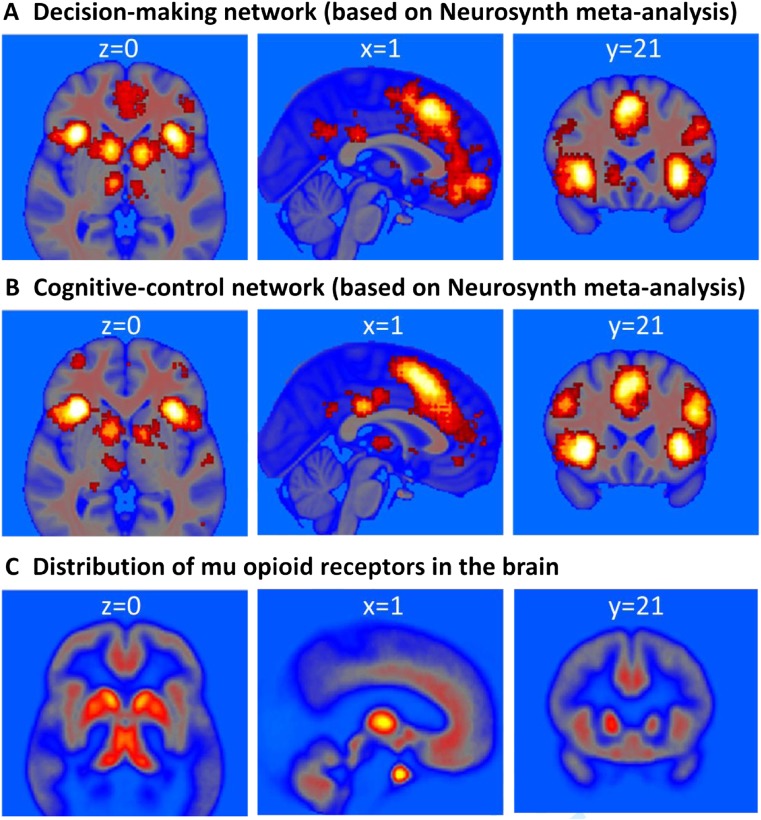
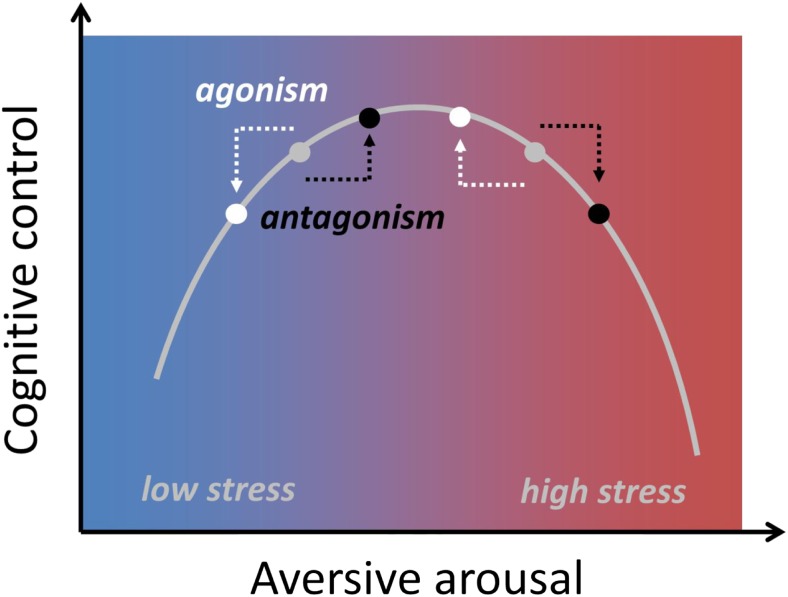
The opioid system regulates affective processing, including pain, pleasure, and reward. Restricting the role of this system to hedonic modulation may be an underestimation, however. Opioid receptors are distributed widely in the human brain, including the more "cognitive" regions in the frontal and parietal lobes. Nonhuman animal research points to opioid modulation of cognitive and decision-making processes. We review emerging evidence on whether acute opioid drug modulation in healthy humans can influence cognitive function, such as how we choose between actions of different values and how we control our behavior in the face of distracting information. Specifically, we review studies employing opioid agonists or antagonists together with experimental paradigms of reward-based decision making, impulsivity, executive functioning, attention, inhibition, and effort. Although this field is still in its infancy, the emerging picture suggests that the mu-opioid system can influence higher-level cognitive function via modulation of valuation, motivation, and control circuits dense in mu-opioid receptors, including orbitofrontal cortex, basal ganglia, amygdalae, anterior cingulate cortex, and prefrontal cortex. The framework that we put forward proposes that opioids influence decision making and cognitive control by increasing the subjective value of reward and reducing aversive arousal. We highlight potential mechanisms that might underlie the effects of mu-opioid signaling on decision making and cognitive control and provide directions for future research.
Overview
The claims and statistics of this paper haven’t been checked yet.
Free: it reads the open-access text and checks the first 5 claims that cite a source we can check. Create a free account to check every claim.
Integrity signals
Registry
Cites
Statistics
Figures
Verification
Claims the paper makes
The claims and statistics of this paper haven’t been checked yet.
Free: it reads the open-access text and checks the first 5 claims that cite a source we can check. Create a free account to check every claim.
Claims other papers make about this one
Each is checked against this paper’s own text: does it say what the citing paper says it does?
The source backs part of the claim, not all of it — or backs it for a different population, condition or comparison.
In the citing paper
“Supporting Hume, latter-day empirical studies indicate that reasoning is an inherently emotional process [see van Steenbergen et al. (2019)].”
From Can Damasio's Somatic Marker Hypothesis Explain More Than Its Originator Will Admit? (2021) · cites this paper as van Steenbergen et al. (2019)
Experimental — accuracy not yet measured
Self-check
Percentages, sums and reported differences re-computed from the paper’s own numbers.
The self-check needs the paper’s full text.
Citations
Cites
Prospect Theory: An Analysis of Decision under Risk
Kahneman, D., & Tversky, A. (1979) · Econometrica · doi:10.2307/1914185 · Cited by 48,524
Prospect theory: An analysis of decision under risk
Kahneman, D., & Tversky, A. (1988) · Decision, Probability and Utility · doi:10.1017/cbo9780511609220.014 · Cited by 32,474 · cited 1×
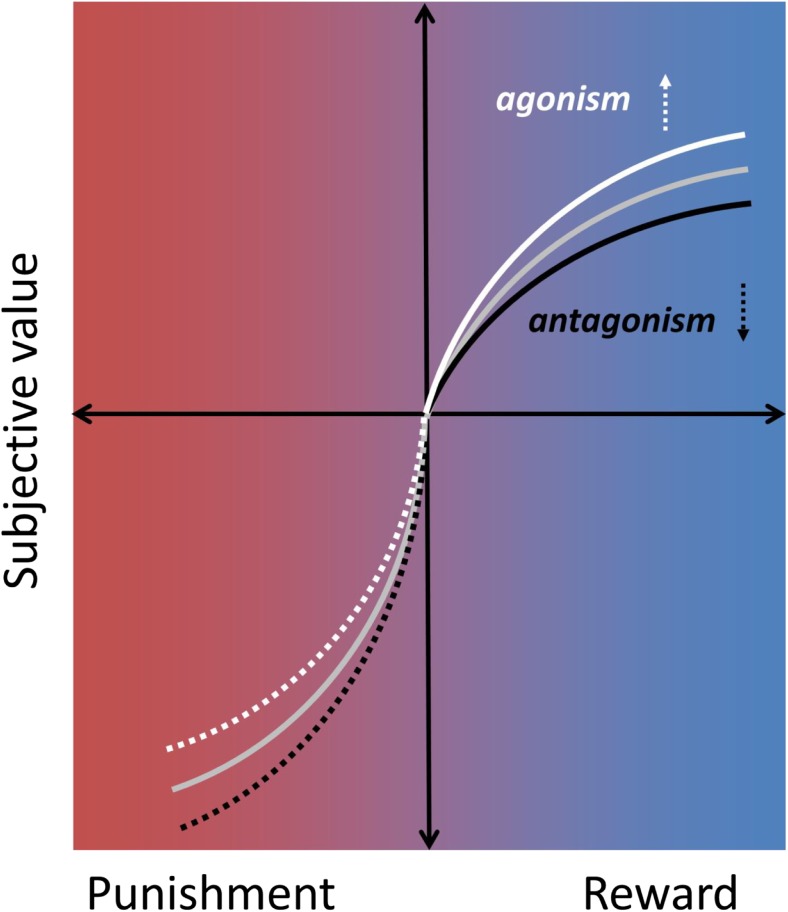
“As for tasks including punishments as well as rewards, it is possible that mu-opioid stimulation would cause a shift primarily of aversive stimuli but not rewards, because aversive stimuli are typically more salient (Kahneman & Tversky, 1979).”
BackgroundA JOURNAL OF PHARMACOLOGY AND EXPERIMENTAL THERAPEUTICS
(1909) · Journal of the American Medical Association · doi:10.1001/jama.1909.02550020033007 · Cited by 7,866
Conflict monitoring and cognitive control
Botvinick, M. M., Braver, T. S., Barch, D. M., Carter, C. S., & Cohen, J. D. (2001) · Psychological Review · doi:10.1037/0033-295x.108.3.624 · Cited by 7,351
Egeth, H., & Kahneman, D. (1975) · The American Journal of Psychology · doi:10.2307/1421603 · Cited by 6,972
Core affect and the psychological construction of emotion.
Russell, J. A. (2003) · Psychological Review · doi:10.1037/0033-295x.110.1.145 · Cited by 6,113 · cited 1×
“In models that describe affect as a two-dimensional space with the factors arousal and valence (Russell, 2003), aversive arousal can be conceptualized as a diagonal in the quadrant that combines high levels of arousal with negative valence (Thayer, 1989; Yik, Russell, & Barrett, 1999).”
BackgroundAston-Jones, G., & Cohen, J. D. (2005) · Annual Review of Neuroscience · doi:10.1146/annurev.neuro.28.061604.135709 · Cited by 4,472
Large-scale automated synthesis of human functional neuroimaging data.
Yarkoni, T., Poldrack, R. A., Nichols, T. E., Van Essen, D. C., & Wager, T. D. (2011) · Nature Methods · doi:10.1038/nmeth.1635 · Cited by 3,686
Normal personality assessment in clinical practice: the NEO personality inventory
Costa, P. T., & McCrae, R. R. (1992) · Psychological Assessment · doi:10.1037/1040-3590.4.1.5 · Cited by 3,414
Drug Addiction, Dysregulation of Reward, and Allostasis
Koob, G. (2001) · Neuropsychopharmacology · doi:10.1016/s0893-133x(00)00195-0 · Cited by 2,953
Research works printed but not linked: 6
- Allen ME Coen D Naloxone blooking of running-induced mood changes Annals of Sports Medicine 1987 3 190 195
- De Quincey, T. (2000). Confessions of an English Opium-eater. The Works of Thomas De Quincey, Vol. 2: Confessions of an English Opium-Eater, 1821–1856 (Vol. 89). Oxford University Press.
- Gendolla GHE Wright RA Richter M Ryan R Effort intensity: Studies of cardiovascular response The Oxford handbook on motivation 2011 New York Oxford University Press
- Mayberg, H. S., & Frost, J. J. (1990). Opiate receptors. In Quantitative imaging: neuroreceptors, neurotransmitters, and enzymes (pp. 81–95). New York: Raven Press.
- Thayer RE The biopsychology of mood and activation 1989 New York Oxford University Press
- Yeomans MR Opioids and human food choice Appetite 1995 24 302
Cited by
Items 101–133 of 133
A Shift Left: Revised Regulations for Opioid Prescribing in New Jersey
Metzger, S., & Metzger, O. (2023) · Journal of Medical Regulation · doi:10.30770/2572-1852-109.1.29 · Cited by 1
Exploration of the opioidergic system in the olfactory bulbectomized rat model of depression
McHugh, K. (2020) · Arrow@dit (Dublin Institute of Technology) · doi:10.13025/17019 · Cited by 1
Kantonen, T. (2022) · UTUPub (University of Turku) · Cited by 1
Welsch, L. (2023) · eScholarship@McGill (McGill) · doi:10.82308/24918 · Cited by 1
The Problem of Induction and the Problem of Free WillPreprint
Lahiri, A. (2020) · PsyArXiv (OSF Preprints) · doi:10.31234/osf.io/84npe
Multisignature Scheme Based on Discrete Logarithms in the Plain Public Key Model
Shao, Z. (2010) · Informatica
Adaptive Inhibition for Optimal Energy Consumption by Animals, Robots and Neurocomputers
Tjøstheim, T. A., Johansson, B., & Balkenius, C. (2022) · Lecture notes in computer science · doi:10.1007/978-3-031-16770-6_9
Efficacy of Cingulotomy for Refractory Malignant Cancer Pain: A Case SeriesPreprint
Fitzgerald, H., Sandhu, H., Tombazzi, C. R., Paulo, D. L., Tillman, S., Misra, S., Shah, H. M., & Karlekar, M. B. (2023) · Research Square · doi:10.21203/rs.3.rs-2398981/v1
Script Based Pattern Recognition for a Portrait Tracking System on Broadcast Online Scenes
Liu, Q., & Xu, X. (2022) · IEEE International Conference on Software Quality, Reliability and Security Companion (QRS-C) · doi:10.1109/qrs-c57518.2022.00110
“Intelligent control theory is to establish the characteristic pattern recognition of controlled dynamic process, and control based on knowledge, experience reasoning and intelligent decision-making [7].”
BackgroundThermoethics: morality through the lens of neurophysiologyPreprint
Tjøstheim, T. A., & Stenseke, J. (2024) · PsyArXiv (OSF Preprints) · doi:10.31234/osf.io/ksje5
Hira, N., Keferl, J. E., & Huber, M. J. (2024) · Journal of Applied Rehabilitation Counseling · doi:10.1891/jarc-2024-0016
Blouzard, E. (2024) · theses.fr (ABES) · doi:10.70675/6b5733e6zca20z48adz8fb8zad22e082a5b2
Dionisio, M. A., Velasco, P. G., Clavarana, L. V., del Águila, M. J. S., & Rivera, I. V. (2025) · Multidisciplinary Pain Journal · doi:10.20986/mpj.2025.1091/2024
Quantitative Economon Model of Transactions for Drugs and Other CommoditiesPreprint
Haynes, J. M., da Rosa, J. C., Butelman, E. R., Hursh, S. R., & Negus, S. S. (2025) · bioRxiv (Cold Spring Harbor Laboratory) · doi:10.1101/2025.07.08.663082
“Moreover, this Q 0 could also be sensitive to transaction outcomes because consumption of a commodity may “carry over” (Baucells & Sarin, 2007) to influence the motor and/or cognitive competence of the consumer to engage in further consumption (van Steenbergen et al., 2019).”
UÇAR, Z. M., & Akbolat, M. (2025) · Behavioural Brain Research · doi:10.1016/j.bbr.2025.115737
Hodapp, A., & Meyniel, F. (2025) · eLife · doi:10.1101/2025.07.31.667879
“This test is stringent because the permuted null maps retain the histogram and autocorrelation of the empirical maps.”
邹, 枫. (2025) · Advances in Psychology · doi:10.12677/ap.2025.1511612
Yao, X., Rama, A.-A., Mazzitelli, J., McFaull, S. R., & Thompson, W. (2024) · Figshare · doi:10.6084/m9.figshare.27058951
Yao, X., Rama, A.-A., Mazzitelli, J., McFaull, S. R., & Thompson, W. (2024) · Figshare · doi:10.6084/m9.figshare.27058948
Forero, S. (2024) · eCommons (Cornell University) · doi:10.7298/q0f1-hy35
Chen, K. (2024) · Refubium (Universitätsbibliothek der Freien Universität Berlin) · doi:10.17169/refubium-42125
Dubey, S. (2026) · Indian Journal of Clinical Anatomy and Physiology · doi:10.18231/j.ijcap.71363.1770716346
The quantitative economon model as a novel computational tool for addiction research.
Haynes, J. M., da Rosa, J. C., Butelman, E. R., Hursh, S. R., & Negus, S. S. (2026) · Experimental and Clinical Psychopharmacology · doi:10.1037/pha0000835
Opioids modulate Curiosity-Driven Exploration in MusicPreprint
Álvarez-Martín, C., Buehler, R., Cardona, G. G., Willeit, M., Gottlieb, J. P., Silani, G., & Rodríguez‐Fornells, A. (2026) · bioRxiv (Cold Spring Harbor Laboratory) · doi:10.64898/2026.05.05.722646
“Interestingly, van Steenbergen et al.(2019) (see also Eikemo et al., 2021) proposed that mu-opioid receptor stimulation might fine-tune reward valuation in affective contexts, especially for high-salience stimuli, rather than fully mediating hedonic states (see Buchel et al., 2018; Chelnokova et…”
Endogenous Opioid System Modulates Neural Activation During Emotion RegulationPreprint
Putkinen, V., Ravindran, A., Seppälä, K., Harju, H., Song, A., & Nummenmaa, L. (2026) · bioRxiv (Cold Spring Harbor Laboratory) · doi:10.64898/2026.07.30.739761
“…such as management of stress and anxiety (Ribeiro et al. 2005; Nummenmaa et al. 2020), potentially influencing the allocation of regulatory resources through their effects on motivation and affective arousal rather than through direct modulation of executive control (van Steenbergen et al. 2019).”
Argenbright, C. M., Scully, I. F., Scully, I. F., & Greer, T. L. (2026) · Journal of College Student Mental Health · doi:10.1080/28367138.2026.2721340
Tsapos, M., Tjøstheim, T. A., Ekström, A. G., & Stephens, A. (2026) · Synthese · doi:10.1007/s11229-026-05786-5
“…in activating and modulating approach behaviour; these include e.g. dopamine, noradrenalin, and serotonin (Wright & Pank - sepp, 2012 ); the availability of high-quality food sources (Bourre, 2006 ), and the positive experience of consumption (Peciña & Berridge, 2005; van Steenbergen et al., 2019).”
Placebo and Nocebo Effects in Memory Performance: A Narrative Review
Lombardi, F., Frisoni, M., Committeri, G., & Sestieri, C. (2026) · Journal of Cognitive Enhancement · doi:10.1007/s41465-026-00371-7
Meier, I. M., Trøstheim, M., Jensen, E. N., Roland, M. N., Løseth, G. E., Eikemo, M., & Leknes, S. (2026) · Pain · doi:10.1097/j.pain.0000000000004097 · Cited by 1
“23,29,41 The small effect sizes uncovered here are in line with evidence of opioid modulation in other domains such as stress, fear, reward, or affiliation, 44,47,68 and do not suggest clinically relevant pain modulation.”
Self-citationPost-error slowing is modulated by emotional words
Cramer, F., & Dignath, D. (2026) · Cognitive Affective & Behavioral Neuroscience · doi:10.3758/s13415-026-01493-3
Mohammadmirzaei, N. (2026) · Library, Museums and Press - UDSpace (University of Delaware)
Gorzelańczyk, E. J., Kawala‐Sterniuk, A., Laskowska, E., Kamiński, P., & Walecki, P. K. (2026) · Brain Sciences · doi:10.3390/brainsci16101077
Metadata
- Authors
- van Steenbergen, H., Eikemo, M., & Leknes, S.
- Affiliations
- Oslo University Hospital (NO)
- University of Oslo (NO)
- Venue
- Cognitive, Affective, & Behavioral Neuroscience
- Published
- 2019-04-08
- Volume
- 19
- Issue
- 3
- Pages
- 435-458
- ISSN
- 1530-7026 (ISSN-L)
- 1531-135X
- PMC
- PMC6599188
- OpenAlex
- W2937558409
- Semantic Scholar
- e8e4093332b6551c803f624e6b0145eca00a0809
- Cited by
- 118
- References
- 248
- Citations by year
- 2026: 9 · 2025: 14 · 2024: 28 · 2023: 12 · 2022: 18 · 2021: 14 · 2020: 17 · 2019: 5
- FWCI
- 1.80
- Type
- journal article
- Language
- en
- Open access
- hybrid
- doi.org
- Licence
- cc-by
- creativecommons.org/licenses/by/4.0 (tdm)
- Locations
- Cognitive Affective & Behavioral Neuroscience (publishedVersion, cc-by)
- Europe PMC (PubMed Central) (publishedVersion, cc-by)
- PubMed Central (publishedVersion, cc-by)
- PubMed (publishedVersion)
- Leiden Repository (Leiden University) (submittedVersion, cc-by)
- Leiden Repository (Leiden University) (submittedVersion)
- OSF Preprints (OSF Preprints) (submittedVersion)
- NORA - Norwegian Open Research Archives (submittedVersion, cc-by)
- Data Archiving and Networked Services (DANS) (submittedVersion, cc-by)
- Funders
- Leiden University
- Topics
- Life Sciences › Neuroscience › Cellular and Molecular Neuroscience › Neurotransmitter Receptor Influence on Behavior
- Life Sciences › Neuroscience › Cognitive Neuroscience › Neural and Behavioral Psychology Studies
- Life Sciences › Neuroscience › Cellular and Molecular Neuroscience › Neuropeptides and Animal Physiology
- Keywords
- opioid system, mu-opioid receptor, decision-making, cognitive control, reward valuation, impulsivity, executive function, attention, inhibition, effort, motivation, orbitofrontal cortex, basal ganglia, amygdala, anterior cingulate cortex, prefrontal cortex, opioid agonists, opioid antagonists
- MeSH terms
- Animals, Brain, Decision Making, Humans, Narcotic Antagonists, Narcotics, Reward, Signal Transduction, Executive Function
About these checks
Registry, retraction, Cites and statistics results are computed, not judged, with one exception: a printed reference that no index lists is read once by a model before it counts as a citation error. Claims are extracted by a model and kept only when their quote appears verbatim in the text; each cited source is then checked, with a model’s help, for whether it says what the claim relies on. Those verdicts can be wrong — read the claim’s quote and the cited source before relying on one.
Statistics and arithmetic are recomputed, not judged.
Confidence bands are shown only for fields calibrated on our annotated test set. None is calibrated yet, so no band is shown.
What counts as a claim ›How we measure confidence ›How we check this ›
Are you an author, or do you see a problem with this page? Request a review
Data sources
Bibliographic data: Semantic Scholar, OpenAlex, Crossref.
Contains information from the Semantic Scholar Academic Graph Datasets, made available under the ODC Attribution License (ODC-BY 1.0).
Semantic Scholar’s data is described in: Kinney, R., et al. (2023). The Semantic Scholar Open Data Platform. arXiv:2301.10140.
