

The fallacy of placing confidence in confidence intervals
Open accessThe DOI matches its Crossref record; 99 of the 108 references it cites were found in a registry or an index.
Abstract
Interval estimates - estimates of parameters that include an allowance for sampling uncertainty - have long been touted as a key component of statistical analyses. There are several kinds of interval estimates, but the most popular are confidence intervals (CIs): intervals that contain the true parameter value in some known proportion of repeated samples, on average. The width of confidence intervals is thought to index the precision of an estimate; CIs are thought to be a guide to which parameter values are plausible or reasonable; and the confidence coefficient of the interval (e.g., 95 %) is thought to index the plausibility that the true parameter is included in the interval. We show in a number of examples that CIs do not necessarily have any of these properties, and can lead to unjustified or arbitrary inferences. For this reason, we caution against relying upon confidence interval theory to justify interval estimates, and suggest that other theories of interval estimation should be used instead.
Overview
The claims and statistics of this paper haven’t been checked yet.
Free: it reads the open-access text and checks the first 5 claims that cite a source we can check. Create a free account to check every claim.
Integrity signals
Registry
Cites
Statistics
Figures
Verification
Claims the paper makes
The claims and statistics of this paper haven’t been checked yet.
Free: it reads the open-access text and checks the first 5 claims that cite a source we can check. Create a free account to check every claim.
Claims other papers make about this one
Each is checked against this paper’s own text: does it say what the citing paper says it does?
The cited source says what the claim attributes to it.
In the citing paper
“These intervals operate directly in the probabilistic space, thereby avoiding the common interpretational issues associated with confidence intervals[47], emerging as well suited solutions for one-shot settings[44].”
From Provenance-driven nanopublications: representing source lineage and trust networks for multi-source assertions (2025) · cites this paper as [47]
In the citing paper
“The credible interval [L,U] has a x% probability that the true parameter lies in the interval that ranges from L to U (an interpretation that is often wrongly attributed to frequentist confidence intervals, see Morey, Hoekstra, Rouder, Lee, & Wagenmakers, 2016).”
From The JASP guidelines for conducting and reporting a Bayesian analysis (2021) · cites this paper as Morey, Hoekstra, Rouder, Lee, & Wagenmakers, 2016
Self-check
Percentages, sums and reported differences re-computed from the paper’s own numbers.
The self-check needs the paper’s full text.
Citations
Cites
Gelman, A., Carlin, J. B., Stern, H. S., & Rubin, D. B. (2003) · doi:10.1201/9780429258480 · Cited by 27,276
Casella, G., & Berger, R. (2024) · Chapman & Hall/CRC eBooks · doi:10.1201/9781003456285 · Cited by 5,711
Testing Statistical Hypotheses
(2021) · Wiley Series in Probability and Statistics · doi:10.1002/9781119243830.ch12 · Cited by 5,106
Probability theory the logic of science
Jaynes, E. T., & Bretthorst, G. L. (2003) · Cited by 4,643
Essentials of Psychological Testing
Rosner, B., & Cronbach, L. J. (1960) · The American Journal of Psychology · doi:10.2307/1419921 · Cited by 4,513
Probability Theory: The Logic of Science
Jaynes, E. T. (2003) · doi:10.1017/cbo9780511790423 · Cited by 4,045
Bayesian t tests for accepting and rejecting the null hypothesis
Rouder, J. N., Speckman, P. L., Sun, D., Morey, R. D., & Iverson, G. (2009) · Psychonomic Bulletin & Review · doi:10.3758/pbr.16.2.225 · Cited by 3,688
Self-citationInterval Estimation for a Binomial Proportion
Brown, L. D., Cai, T. T., & DasGupta, A. (2001) · Statistical Science · doi:10.1214/ss/1009213286 · Cited by 3,538
The New Statistics: Why and How
Cumming, G. (2014) · Psychological Science · doi:10.1177/0956797613504966 · Cited by 3,200
Statistical methods in psychology journals: Guidelines and explanations.
Wilkinson, L., & Task Force on Statistical Inference (1999) · American Psychologist · doi:10.1037/0003-066x.54.8.594 · Cited by 2,791
A practical solution to the pervasive problems ofp values
Wagenmakers, E.-J. (2007) · Psychonomic Bulletin & Review · doi:10.3758/bf03194105 · Cited by 2,490
Self-citationDefault Bayes factors for ANOVA designs
Rouder, J. N., Morey, R. D., Speckman, P. L., & Province, J. M. (2012) · Journal of Mathematical Psychology · doi:10.1016/j.jmp.2012.08.001 · Cited by 1,800 · cited 2×
“We do not generally advocate noninformative priors on parameters of interest (Rouder et al., 2012; Wetzels et al., 2012); in this instance we use them as a comparison because many people believe, incorrectly, that confidence intervals numerically correspond to Bayesian credible intervals with noninformative priors.”
MethodSelf-citationBayesian Cognitive Modeling: A Practical Course
Lee, M. D., & Wagenmakers, E.-J. (2014) · doi:10.1017/cbo9781139087759 · Cited by 1,795
Self-citationInference by Eye: Confidence Intervals and How to Read Pictures of Data.
Cumming, G., & Finch, S. (2005) · American Psychologist · doi:10.1037/0003-066x.60.2.170 · Cited by 1,449 · cited 2×
“…data by making dichotomous statements (Neyman 1937, 1941), eventually becoming a method that many believe is the best way to reason from data (e.g. Cumming & Finch, 2005; Cumming & Fidler, 2009) and a way to avoid dichotomous statements (e.g. Cumming, 2014; Hoekstra, Finch, Kiers, & Johnson,…”
Method(2013) · Cited by 1,351
Self-citationStatistical Methods and Scientific Inference.
Bartlett, M. S., & Fisher, R. A. (1957) · Biometrika · doi:10.2307/2333276 · Cited by 1,278
Scientific reasoning: the Bayesian approach
(1990) · Choice Reviews Online · doi:10.5860/choice.27-2696 · Cited by 1,245
JEFFREYS, H. (1922) · Nature · doi:10.1038/109132a0 · Cited by 1,217
Outline of a Theory of Statistical Estimation Based on the Classical Theory of Probability
Neyman, J. (1937) · Philosophical Transactions of the Royal Society of London. Series A, Mathematical and Physical Sciences · doi:10.1098/rsta.1937.0005 · Cited by 1,087 · cited 8×
“Better intervals are shorter on average, excluding false values more often (Lehmann, 1959; Neyman, 1937; 1941; Welch, 1939).”
InfluentialNeyman, J. (1934) · Journal of the Royal Statistical Society · doi:10.2307/2342192 · Cited by 1,086
Nedelman, J. R. (2005) · Computational Statistics · doi:10.1007/bf02741321 · Cited by 1,078
Bayesian Modeling Using WinBUGS
Ntzoufras, I. (2009) · Wiley eBooks · doi:10.1002/9780470434567 · Cited by 1,001
Wagenmakers, E.-J., Wetzels, R., Borsboom, D., & van der Maas, H. L. J. (2011) · Journal of Personality and Social Psychology · doi:10.1037/a0022790 · Cited by 977
Self-citationBayesian Versus Orthodox Statistics: Which Side Are You On?
Dienes, Z. (2011) · Perspectives on Psychological Science · doi:10.1177/1745691611406920 · Cited by 938 · cited 2×
“scope of this paper; see Rouder, Speckman, Sun, Morey, and Iverson (2009), Wagenmakers, Lee, Lodewyckx, and Iverson (2008), or Dienes (2011) for accessible accounts.”
BackgroundNeyman, J. (1992) · Springer Series in Statistics · doi:10.1007/978-1-4612-4380-9_12 · Cited by 932 · cited 7×
“Skepticism about the usefulness of confidence intervals arose as soon as Neyman first articulated the theory (Neyman, 1934).2 In the discussion of Neyman (1934), Bowley, pointing out what we call the fundamental confidence fallacy, expressed skepticism that the confidence interval answers the right question:”
BackgroundInfluentialStock, J. H., & Wright, J. H. (2000) · Econometrica · doi:10.1111/1468-0262.00151 · Cited by 812 · cited 5×
“This interval was suggested by Steiger (2004, see also Steiger & Fouladi, 1997), cited approvingly by Cumming (2014), implemented in software for social scientists (e.g., Kelley, 2007a, b), and evaluated, solely for its frequentist properties, by Finch and French (2012).”
BackgroundInfluentialIntroduction to Probability and Statistics from a Bayesian Viewpoint
Lindley, D. V. (1965) · Cambridge University Press eBooks · doi:10.1017/cbo9780511662973 · Cited by 760
Bayesian Analysis for the Social Sciences
Jackman, S. (2009) · Wiley Series in Probability and Statistics · doi:10.1002/9780470686621 · Cited by 756 · cited 1×
“…statistics, including estimation of posterior distributions and credible intervals: on the less technical side, there are texts by Bolstad (2007), Lee and Wagenmakers (2013), and Lynch (2007); on the more technical side are texts by Jackman (2009), Ntzoufras (2009), and Gelman et al. (2004).”
BackgroundToward using confidence intervals to compare correlations.
Zou, G. Y. (2007) · Psychological Methods · doi:10.1037/1082-989x.12.4.399 · Cited by 740 · cited 2×
“…to mean that inference by confidence intervals is not problematic even in this simple case; see e.g., Brown (1967) and Buehler & Feddersen (1963). d (Cumming and Finch, 2001), medians (Bonett & Price, 2002; Olive, 2008), correlations (Zou, 2007), ordinal association (Woods, 2007), and many others.”
BackgroundUsing confidence intervals for graphically based data interpretation.
Masson, M. E. J., & Loftus, G. R. (2003) · Canadian Journal of Experimental Psychology / Revue canadienne de psychologie expérimentale · doi:10.1037/h0087426 · Cited by 730 · cited 1×
“For instance, with respect to 95 % confidence intervals, Masson and Loftus (2003) state that “in the absence of any other information, there is a 95 % probability that the obtained confidence interval includes the population mean.””
BackgroundIntroduction to Statistical Decision Theory.
Schervish, M. J., Pratt, J. W., Raiffa, H., & Schlaifer, R. (1996) · Journal of the American Statistical Association · doi:10.2307/2291759 · Cited by 705 · cited 1×
“The longrun probability that the true value is inside a fixed interval is unknown and is either 0 or 1, and hence no confidence procedure can be constructed, even though such information may be critically important to a researcher, policy maker, or criminal defendant (Pratt et al., 1995).”
BackgroundWhat If There Were No Significance Tests?
(2013) · Psychology Press eBooks · doi:10.4324/9781315827353 · Cited by 667
Introduction to Bayesian Statistics
(2009) · Understanding Computational Bayesian Statistics · doi:10.1002/9780470567371.ch1 · Cited by 660
Berger, J. O., & Wolpert, R. L. (1988) · doi:10.1214/lnms/1215466210 · Cited by 616
Testing Statistical Hypotheses.
Stuart, A., & Lehmann, E. L. (1960) · Journal of the Royal Statistical Society. Series A (General) · doi:10.2307/2342657 · Cited by 616
Statistical Methods and Scientific Induction
Fisher, R. (1955) · Journal of the Royal Statistical Society Series B: Statistical Methodology · doi:10.1111/j.2517-6161.1955.tb00180.x · Cited by 596 · cited 1×
“Guidelines for interpreting and reporting intervals Frequentist theory can be counter-intuitive at times; as Fisher was fond of pointing out, frequentist theorists often seemed disconnected with the concerns of scientists, developing methods that did not suit their needs (e.g., Fisher, 1955, p. 70).”
BackgroundTHE FIDUCIAL ARGUMENT IN STATISTICAL INFERENCE
FISHER, R. A. (1935) · Annals of Eugenics · doi:10.1111/j.1469-1809.1935.tb02120.x · Cited by 593 · cited 3×
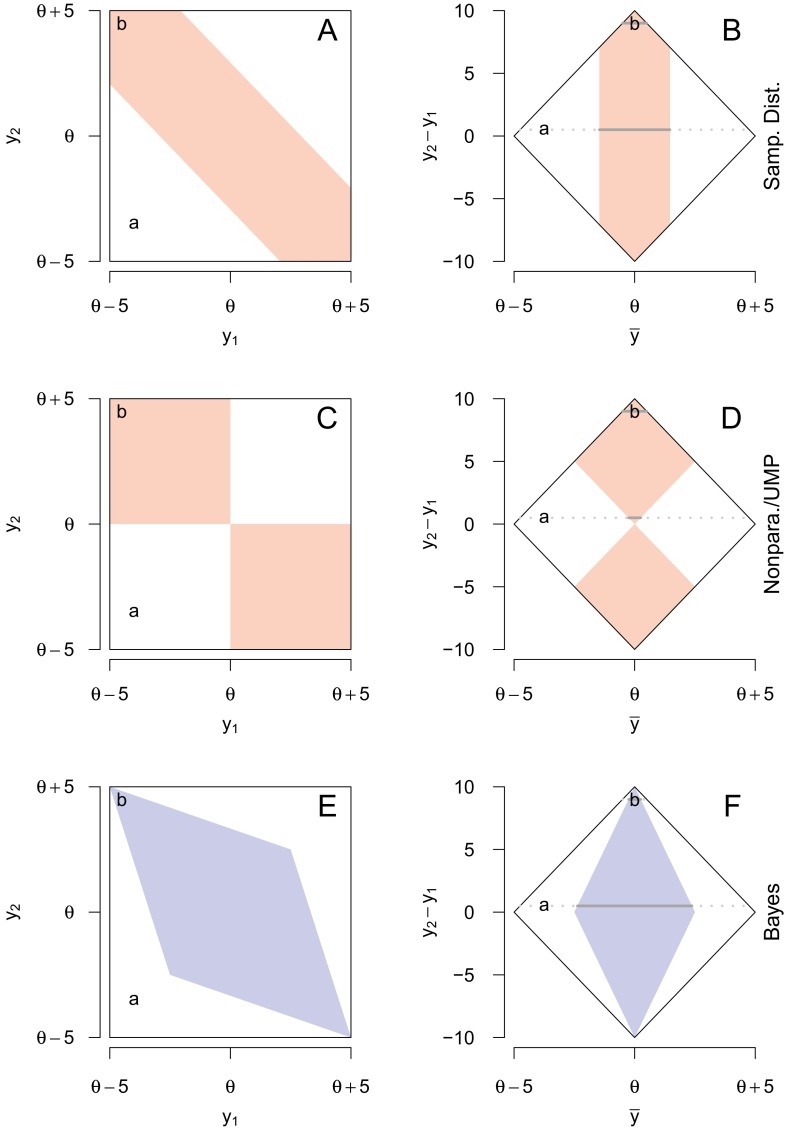
“The figures in the right column are 45◦ clockwise rotations of those in the left.”
BackgroundSome Impossibility Theorems in Econometrics With Applications to Structural and Dynamic Models
Dufour, J.-M. (1997) · Econometrica · doi:10.2307/2171740 · Cited by 556 · cited 1×
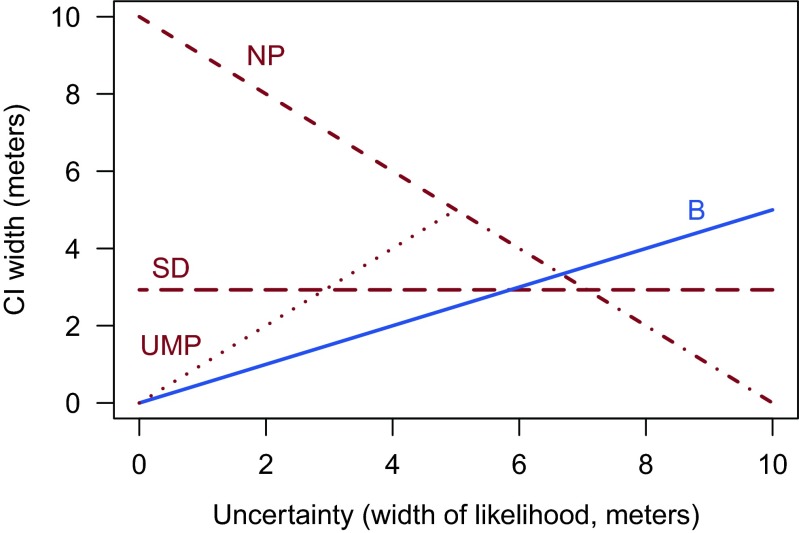
“Moreover, in this case the interval will contain impossible values, because it will be wider than the likelihood.”
BackgroundIntroduction to Applied Bayesian Statistics and Estimation for Social Scientists
(2007) · Springer eBooks · doi:10.1007/978-0-387-71265-9 · Cited by 555 · cited 1×
“…statistics, including estimation of posterior distributions and credible intervals: on the less technical side, there are texts by Bolstad (2007), Lee and Wagenmakers (2013), and Lynch (2007); on the more technical side are texts by Jackman (2009), Ntzoufras (2009), and Gelman et al. (2004).”
BackgroundSteiger, J. H. (2004) · Psychological Methods · doi:10.1037/1082-989x.9.2.164 · Cited by 547 · cited 11×
“If a bound does not exist, Steiger (2004) arbitrarily sets it at 0.”
BackgroundMethodInfluentialCumming, G., & Finch, S. (2001) · Educational and Psychological Measurement · doi:10.1177/0013164401614002 · Cited by 528 · cited 2×
“…to mean that inference by confidence intervals is not problematic even in this simple case; see e.g., Brown (1967) and Buehler & Feddersen (1963). d (Cumming and Finch, 2001), medians (Bonett & Price, 2002; Olive, 2008), correlations (Zou, 2007), ordinal association (Woods, 2007), and many…”
BackgroundACM transactions on database systems: aim and scope
(1976) · ACM Transactions on Database Systems · doi:10.1145/320434.320436 · Cited by 514
Robust misinterpretation of confidence intervals
Hoekstra, R., Morey, R. D., Rouder, J. N., & Wagenmakers, E.-J. (2014) · Psychonomic Bulletin & Review · doi:10.3758/s13423-013-0572-3 · Cited by 425 · cited 3×
“Authors choosing to report CIs have a responsibility to keep their readers from invalid inferences, because it is almost certain that without a warning readers will misinterpret them (Hoekstra et al., 2014).”
BackgroundInfluentialSelf-citationPsychology Will Be a Much Better Science When We Change the Way We Analyze Data
Loftus, G. R. (1996) · Current Directions in Psychological Science · doi:10.1111/1467-8721.ep11512376 · Cited by 361 · cited 6×
“, 2008) or to argue for the null (or practically null) hypothesis (Loftus, 1996).”
BackgroundMethodInfluentialWhat to believe: Bayesian methods for data analysis
Kruschke, J. K. (2010) · Trends in Cognitive Sciences · doi:10.1016/j.tics.2010.05.001 · Cited by 342 · cited 1×
“With modern scientific graphics so easy to create, we see no reason why likelihoods and posteriors cannot augment or even replace intervals in most circumstances (e.g., Kruschke, 2010).”
BackgroundTallent, N. (1960) · The American Journal of Nursing · doi:10.2307/3418216 · Cited by 304
Theory of Probability (3rd Edition)
Litton, C. D. (1984) · Journal of the Operational Research Society · doi:10.1057/jors.1984.141 · Cited by 282 · cited 1×
“In the case where data are normally distributed, for instance, there is a particular prior that will lead to a confidence interval that is numerically identical to Bayesian credible intervals computed using the Bayesian posterior (Jeffreys, 1961; Lindley, 1965).”
Severe Testing as a Basic Concept in a Neyman–Pearson Philosophy of Induction
Mayo, D. G., & Spanos, A. (2006) · The British Journal for the Philosophy of Science · doi:10.1093/bjps/axl003 · Cited by 270 · cited 2×
“…procedure, warn readers that the confidence interval cannot be 8Some recent writers have suggested the replacement of Neyman’s behavioral view on confidence intervals with a frequentist view focused on tests at various levels of “stringency” (see, e.g., Mayo & Cox, 2006; Mayo & Spanos, 2006).”
BackgroundScientific Reasoning: The Bayesian Approach
Shafer, G. (2007) · Journal of the American Statistical Association · doi:10.1198/jasa.2007.s176 · Cited by 261
Introduction to Bayesian Statistics
Bolstad, W. M. (2007) · Wiley eBooks · doi:10.1002/9780470181188 · Cited by 260
Methods for the Behavioral, Educational, and Social Sciences: An R package
Kelley, K. (2007) · Behavior Research Methods · doi:10.3758/bf03192993 · Cited by 255 · cited 1×
“This interval was suggested by Steiger (2004, see also Steiger & Fouladi, 1997), cited approvingly by Cumming (2014), implemented in software for social scientists (e.g., Kelley, 2007a, b), and evaluated, solely for its frequentist properties, by Finch and French (2012).”
MethodConfidence Intervals for Standardized Effect Sizes: Theory, Application, and Implementation
Kelley, K. (2007) · Journal of Statistical Software · doi:10.18637/jss.v020.i08 · Cited by 236
Frequentist probability and frequentist statistics
Neyman, J. (1977) · Synthese · doi:10.1007/bf00485695 · Cited by 230 · cited 1×
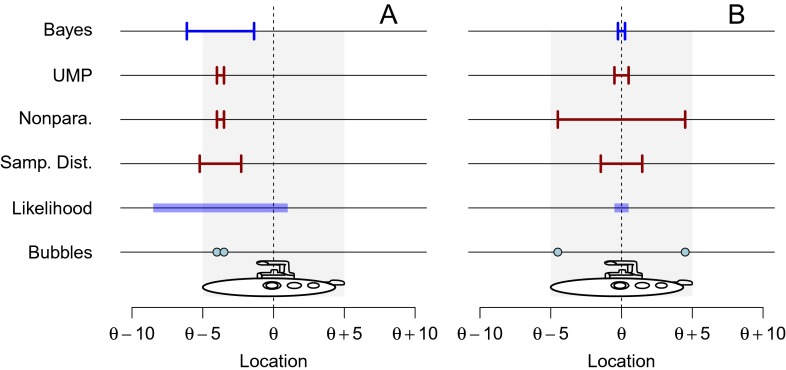
“However, as Neyman (1977) points out, the likelihood has no special status to a frequentist; what matters is the frequentist properties of the procedure, not how it was constructed. might occur if some other information about the location of the submersible were available.”
BackgroundBonett, D. G., & Price, R. M. (2002) · Psychological Methods · doi:10.1037//1082-989x.7.3.370 · Cited by 209 · cited 1×
“…to mean that inference by confidence intervals is not problematic even in this simple case; see e.g., Brown (1967) and Buehler & Feddersen (1963). d (Cumming and Finch, 2001), medians (Bonett & Price, 2002; Olive, 2008), correlations (Zou, 2007), ordinal association (Woods, 2007), and many others.”
BackgroundBayesian Versus Frequentist Inference
Wagenmakers, E.-J., Lee, M., Lodewyckx, T., & Iverson, G. J. (2008) · Bayesian Evaluation of Informative Hypotheses · doi:10.1007/978-0-387-09612-4_9 · Cited by 205 · cited 2×
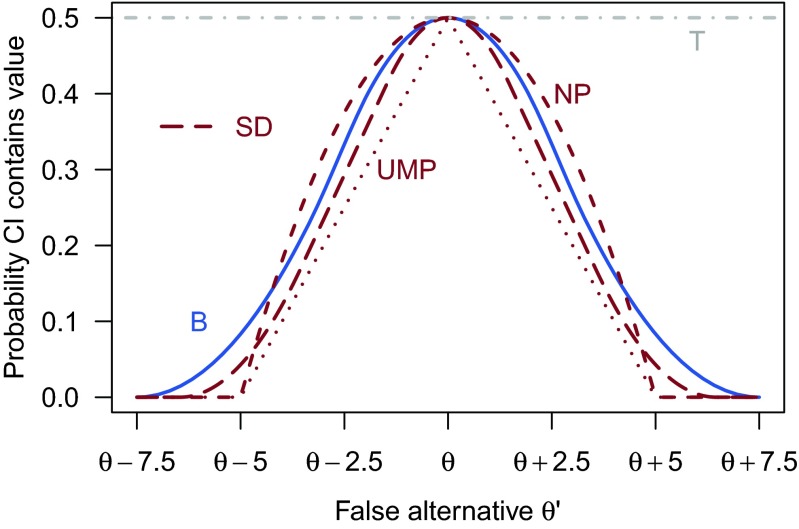
“Welch (1939) remarked that the Bayes procedure is “not the best way of constructing confidence limits” using precisely the frequentist comparison shown in Fig.”
BackgroundMethodSelf-citationEducational and psychological measurement
(1982) · Serials Review · doi:10.1016/0098-7913(82)90053-3 · Cited by 186
Loftus, G. R. (1993) · Behavior Research Methods, Instruments, & Computers · doi:10.3758/bf03204506 · Cited by 168 · cited 1×
“This is cited as one of the primary reasons confidence procedures should be used over null hypothesis significance tests (e.g., Cumming and Finch, 2005; Cumming, 2014; Fidler & Loftus, 2009; Loftus, 1993, 1996).”
REICHENBACH, H. (1949) · Andalas University Repository (Andalas University) · Cited by 166
FIDUCIAL ARGUMENT AND THE THEORY OF CONFIDENCE INTERVALS
NEYMAN, J. (1941) · Biometrika · doi:10.1093/biomet/32.2.128 · Cited by 137 · cited 9×
“This thinking can be clearly seen in Neyman (1941) as quoted above: reasoning ends once the procedure is derived.”
BackgroundMethodInfluentialLectures and Conferences on Mathematical Statistics and Probability
Whittle, P., & Neyman, J. (1954) · Econometrica · doi:10.2307/1907447 · Cited by 133
Some Validity Criteria for Statistical Inferences
Buehler, R. J. (1959) · The Annals of Mathematical Statistics · doi:10.1214/aoms/1177706070 · Cited by 126 · cited 1×
“Relevant subsets are identifiable in many confidence procedures, including the common classical Student’s t interval, where wider CIs have a greater probability of containing the true value (Buehler, 1959; Buehler & Feddersen, 1963; Casella, 1992; Robinson, 1979).”
BackgroundA Default Bayesian Hypothesis Test for ANOVA Designs
Wetzels, R., Grasman, R. P. P. P., & Wagenmakers, E.-J. (2012) · The American Statistician · doi:10.1080/00031305.2012.695956 · Cited by 122 · cited 2×
“We do not generally advocate noninformative priors on parameters of interest (Rouder et al., 2012; Wetzels et al., 2012); in this instance we use them as a comparison because many people believe, incorrectly, that confidence intervals numerically correspond to Bayesian credible intervals with noninformative priors.”
MethodSelf-citationFrequentist statistics as a theory of inductive inference
Mayo, D. G., & Cox, D. R. (2006) · Institute of Mathematical Statistics Lecture Notes - Monograph Series · doi:10.1214/074921706000000400 · Cited by 119 · cited 1×
“…procedure, warn readers that the confidence interval cannot be 8Some recent writers have suggested the replacement of Neyman’s behavioral view on confidence intervals with a frequentist view focused on tests at various levels of “stringency” (see, e.g., Mayo & Cox, 2006; Mayo & Spanos, 2006).”
BackgroundProbability as certainty: Dichotomous thinking and the misuse ofp values
Hoekstra, R., Finch, S. J., Kiers, H. A. L., & Johnson, A. (2006) · Psychonomic Bulletin & Review · doi:10.3758/bf03213921 · Cited by 112
Self-citationLindley, D. V. (1986) · Biometrics · doi:10.2307/2531230 · Cited by 108
Computing Correct Confidence Intervals for ANOVA Fixed- and Random-Effects Effect Sizes
Fidler, F., & Thompson, B. (2001) · Educational and Psychological Measurement · doi:10.1177/00131640121971383 · Cited by 107 · cited 2×
“(2008) for an example of CI proponents including impossible values in confidence intervals, and Fidler and Thompson (2001) for a defense of this practice.”
BackgroundNote on a Conditional Property of Student's $t^1$
Buehler, R. J., & Feddersen, A. P. (1963) · The Annals of Mathematical Statistics · doi:10.1214/aoms/1177704034 · Cited by 103 · cited 2×
“Relevant subsets are identifiable in many confidence procedures, including the common classical Student’s t interval, where wider CIs have a greater probability of containing the true value (Buehler, 1959; Buehler & Feddersen, 1963; Casella, 1992; Robinson, 1979).”
BackgroundThe Conditional Level of Student's $t$ Test
Brown, L. (1967) · The Annals of Mathematical Statistics · doi:10.1214/aoms/1177698776 · Cited by 100 · cited 2×
“, Brown (1967) and Buehler & Feddersen (1963).”
BackgroundWagenmakers, E., Verhagen, J., Ly, A., Bakker, M., Lee, M. D., Matzke, D., Rouder, J. N., & Morey, R. D. (2014) · Behavior Research Methods · doi:10.3758/s13428-014-0517-4 · Cited by 94 · cited 1×
“This problem is not limited to the pedagogical submersible example (Berger and Wolpert, 1988; Wagenmakers et al., 2014) though this simple example is instructive for identifying these issues.”
BackgroundSelf-citationConditional Properties of Statistical Procedures
Robinson, G. K. (1979) · The Annals of Statistics · doi:10.1214/aos/1176344725 · Cited by 92
Confidence Intervals: Better Answers to Better Questions
Cumming, G., & Fidler, F. (2009) · Zeitschrift für Psychologie / Journal of Psychology · doi:10.1027/0044-3409.217.1.15 · Cited by 83 · cited 1×
“…statements (Neyman 1937, 1941), eventually becoming a method that many believe is the best way to reason from data (e.g. Cumming & Finch, 2005; Cumming & Fidler, 2009) and a way to avoid dichotomous statements (e.g. Cumming, 2014; Hoekstra, Finch, Kiers, & Johnson, 2006; Wilkinson & the Task…”
MethodTesting Statistical Hypotheses.
Pratt, J. W., & Lehmann, E. L. (1961) · Journal of the American Statistical Association · doi:10.2307/2282344 · Cited by 83
Sketches for size of join estimation
Rusu, F., & Dobra, A. (2008) · ACM Transactions on Database Systems · doi:10.1145/1386118.1386121 · Cited by 80
Why Hypothesis Tests Are Essential for Psychological Science: A Comment on Cumming (2014)
Morey, R. D., Rouder, J. N., Verhagen, J., & Wagenmakers, E. (2014) · Psychological Science · doi:10.1177/0956797614525969 · Cited by 79 · cited 1×
“We support these goals (Morey et al., 2014), but confidence interval theory is not the way to achieve them.”
Self-citationDale, A. I. (2012) · Notices of the American Mathematical Society · Cited by 78
Ferconi, M. (2013) · Quantitative Finance · doi:10.1080/14697688.2013.771819 · Cited by 72
Fidler, F., & Loftus, G. R. (2009) · Zeitschrift für Psychologie / Journal of Psychology · doi:10.1027/0044-3409.217.1.27 · Cited by 72 · cited 2×
“This is cited as one of the primary reasons confidence procedures should be used over null hypothesis significance tests (e.g., Cumming and Finch, 2005; Cumming, 2014; Fidler & Loftus, 2009; Loftus, 1993, 1996).”
BackgroundMethodHu, M., Liu, Y., & Lin, J. (2013) · Springer proceedings in mathematics & statistics · doi:10.1007/978-1-4614-7846-1 · Cited by 58
The Effect of Online Violent Video Games on Levels of Aggression
Hollingdale, J., & Greitemeyer, T. (2014) · PLoS ONE · doi:10.1371/journal.pone.0111790 · Cited by 54 · cited 1×
“The others did not use confidence intervals, instead relying on point estimates of effect size and p values (e.g., Hollingdale & Greitemeyer, 2014); but from the p values it could be inferred that if they had followed “good practice” and computed such confidence intervals, they would have obtained…”
On Confidence Limits and Sufficiency, with Particular Reference to Parameters of Location
Welch, B. L. (1939) · The Annals of Mathematical Statistics · doi:10.1214/aoms/1177732246 · Cited by 54 · cited 6×
“In this section, we present an example taken from the confidence interval literature (Berger and Wolpert, 1988; Lehmann, 1959; Pratt, 1961;Welch, 1939) designed to bring into focus how CI theory works.”
BackgroundMethodInfluentialOn Some Difficulties in a Frequency Theory of Inference
Pierce, D. A. (1973) · The Annals of Statistics · doi:10.1214/aos/1176342362 · Cited by 53 · cited 2×
“Consider the following scheme, suggested by Pierce (1973). Suppose we sample”
Un-Bayesian implications of improper Bayes inference in routine statistical problems
Stone, M., & Dawid, A. P. (1972) · Biometrika · doi:10.1093/biomet/59.2.369 · Cited by 51
Mechanisms of renewal after the extinction of discriminated operant behavior.
Todd, T. P., Vurbic, D., & Bouton, M. E. (2014) · Journal of Experimental Psychology: Animal Learning and Cognition · doi:10.1037/xan0000021 · Cited by 51
What Is Confidence? Part 1: The Use and Interpretation of Confidence Intervals
Young, K. D., & Lewis, R. J. (1997) · Annals of Emergency Medicine · doi:10.1016/s0196-0644(97)70166-5 · Cited by 49 · cited 2×
“The rescuers want to use these bubbles to infer where the hatch is located.”
BackgroundReliance on Luck: Identifying Which Achievement Goals Elicit Superstitious Behavior
Hamerman, E. J., & Morewedge, C. K. (2015) · Personality and Social Psychology Bulletin · doi:10.1177/0146167214565055 · Cited by 45
Theory Testing Using Quantitative Predictions of Effect Size
Velicer, W. F., Cumming, G., Fava, J. L., Rossi, J. S., Prochaska, J. O., & Johnson, J. (2008) · Applied Psychology · doi:10.1111/j.1464-0597.2008.00348.x · Cited by 43 · cited 3×
“However, see Velicer et al. (2008) for an example of CI proponents including impossible values in confidence intervals, and Fidler and Thompson (2001) for a defense of this practice.”
BackgroundMethodBerger, J. O. (2005) · Wiley eBooks · doi:10.1002/0471667196.ess0985.pub2 · Cited by 43
Winter, C., Acker, F. V., Bonduelle, M., Desmyttere, S., Schrijver, F. D., & Nekkebroeck, J. (2014) · Human Reproduction · doi:10.1093/humrep/deu165 · Cited by 39 · cited 1×
“…and reported, without note, suspect confidence intervals bounded at 0 (e.g., Cumming, Sherar, Gammon, Standage, & Malina, 2012; Gilroy & Pearce 2014; Hamerman & Morewedge,2015; Lahiri, Maloney, Rogers, & Ge, 2013; Hamerman & Morewedge, 2015; Todd, Vurbic, & Bouton, 2014; Winter et al., 2014).”
Wasserman, L. (2008) · Bayesian Analysis · doi:10.1214/08-ba318d · Cited by 30
Visual 'normalization' near the vertical and horizontal.
Prentice, W. C. H., & Beardslee, D. C. (1950) · Journal of Experimental Psychology · doi:10.1037/h0058231 · Cited by 30
In Defense of the Neyman-Pearson Theory of Confidence Intervals
Mayo, D. G. (1981) · Philosophy of Science · doi:10.1086/288996 · Cited by 24 · cited 4×
“It looks forward, devising procedures that will have particular average properties in repeated sampling (Jaynes, 2003; Mayo, 1981; 1982) in the future (see also Neyman, 1937, p.”
BackgroundInfluentialConfidence intervals for gamma-family measures of ordinal association.
Woods, C. M. (2007) · Psychological Methods · doi:10.1037/1082-989x.12.2.185 · Cited by 23 · cited 2×
“…to mean that inference by confidence intervals is not problematic even in this simple case; see e.g., Brown (1967) and Buehler & Feddersen (1963). d (Cumming and Finch, 2001), medians (Bonett & Price, 2002; Olive, 2008), correlations (Zou, 2007), ordinal association (Woods, 2007), and many others.”
BackgroundCumming, S. P., Sherar, L. B., Gammon, C., Standage, M., & Malina, R. M. (2012) · Journal of Research on Adolescence · doi:10.1111/j.1532-7795.2012.00821.x · Cited by 19
Paradoxes and Improvements in Interval Estimation
Blaker, H., & Spjøtvoll, E. (2000) · The American Statistician · doi:10.1080/00031305.2000.10474555 · Cited by 17 · cited 3×
“As we will show, confidence intervals — even “good” confidence intervals, from a CI-theory perspective — can exclude almost all reasonable values, and can be empty or infinitesimally narrow, excluding all possible values (Blaker and Spjøtvoll, 2000; Dufour, 1997; Steiger, 2004; Steiger & Fouladi, 1997; Stock & Wright,…”
BackgroundGelman, A. (2008) · Bayesian Analysis · doi:10.1214/08-ba318rej · Cited by 17
Conditional inference from confidence sets
Casella, G. (1992) · Lecture notes-monograph series · doi:10.1214/lnms/1215458835 · Cited by 16 · cited 3×
“Relevant subsets are identifiable in many confidence procedures, including the common classical Student’s t interval, where wider CIs have a greater probability of containing the true value (Buehler, 1959; Buehler & Feddersen, 1963; Casella, 1992; Robinson, 1979).”
BackgroundA Comparison of Methods for Estimating Confidence Intervals for Omega-Squared Effect Size
Finch, W. H., & French, B. F. (2011) · Educational and Psychological Measurement · doi:10.1177/0013164411406533 · Cited by 15 · cited 1×
“This interval was suggested by Steiger (2004, see also Steiger & Fouladi, 1997), cited approvingly by Cumming (2014), implemented in software for social scientists (e.g., Kelley, 2007a, b), and evaluated, solely for its frequentist properties, by Finch and French (2012).”
The role of local, distal, and global information in latent spatial learning.
Gilroy, K. E., & Pearce, J. M. (2014) · Journal of Experimental Psychology Animal Learning and Cognition · doi:10.1037/xan0000017 · Cited by 13 · cited 1×
“…many that obtained and reported, without note, suspect confidence intervals bounded at 0 (e.g., Cumming, Sherar, Gammon, Standage, & Malina, 2012; Gilroy & Pearce 2014; Hamerman & Morewedge,2015; Lahiri, Maloney, Rogers, & Ge, 2013; Hamerman & Morewedge, 2015; Todd, Vurbic, & Bouton, 2014;…”
On After-Trial Criticisms of Neyman-Pearson Theory of Statistics
Mayo, D. G. (1982) · PSA Proceedings of the Biennial Meeting of the Philosophy of Science Association · doi:10.1086/psaprocbienmeetp.1982.1.192663 · Cited by 9 · cited 1×
“It looks forward, devising procedures that will have particular average properties in repeated sampling (Jaynes, 2003; Mayo, 1981; 1982) in the future (see also Neyman, 1937, p. 349).”
BackgroundLahiri, D. K., Maloney, B., Rogers, J. T., & Ge, Y. (2013) · BMC Genomics · doi:10.1186/1471-2164-14-68 · Cited by 7
Ancillary Statistics, Pivotal Quantities and Confidence Statements
Ghosh, J. K. (1988) · Lecture notes in statistics · doi:10.1007/978-1-4612-3894-2_9 · Cited by 4 · cited 1×
“We describe this interval merely to show that by itself, a procedure including the true valueX % of the time means nothing (see also Basu, 1981).”
Method
Research works printed but not linked: 3
- Psychonomics Society (2012). Psychonomic Society guidelines on statistical issues. Retrieved from http://www.springer.com/psychology?SGWID=0-10126-6-1390050-0
- Spanos A Revisiting the Welch uniform model: A case for conditional inference? Advances and Applications in Statistical Science 2011 5 33 52
- Venn, J. (1888). The logic of chance (third edition). London: Macmillan. Retrieved from https://archive.org/details/logicofchance029416mbp
Cited by
Statistical tests, P values, confidence intervals, and power: a guide to misinterpretations
Greenland, S., Senn, S. J., Rothman, K. J., Carlin, J. B., Poole, C., Goodman, S. N., & Altman, D. G. (2016) · European Journal of Epidemiology · doi:10.1007/s10654-016-0149-3 · Cited by 3,200
Bayesian inference for psychology. Part I: Theoretical advantages and practical ramifications
Wagenmakers, E.-J., Marsman, M., Jamil, T., Ly, A., Verhagen, J., Love, J., Selker, R., Gronau, Q. F., Šmíra, M., Epskamp, S., et al. (2018) · Psychonomic Bulletin & Review · doi:10.3758/s13423-017-1343-3 · Cited by 1,627
Self-citationThe JASP guidelines for conducting and reporting a Bayesian analysis
van Doorn, J., van den Bergh, D., Böhm, U., Dablander, F., Derks, K., Draws, T., Etz, A., Evans, N. J., Gronau, Q. F., Haaf, J. M., et al. (2021) · Psychonomic Bulletin & Review · doi:10.3758/s13423-020-01798-5 · Cited by 1,114
Self-citationBrysbaert, M. (2019) · Journal of Cognition · doi:10.5334/joc.72 · Cited by 996
Ordinal Regression Models in Psychology: A Tutorial
Bürkner, P.-C., & Vuorre, M. (2019) · Advances in Methods and Practices in Psychological Science · doi:10.1177/2515245918823199 · Cited by 689
Metadata
- Authors
- Morey, R. D., Hoekstra, R., Rouder, J. N., Lee, M. D., & Wagenmakers, E.-J.
- Affiliations
- Cardiff University (GB)
- University of Groningen (NL)
- University of Missouri (US)
- University of California, Irvine (US)
- University of Amsterdam (NL)
- Corresponding author
- Morey, Richard D.
- Venue
- Psychonomic Bulletin & Review
- Published
- 2015-10-08
- Volume
- 23
- Issue
- 1
- Pages
- 103-123
- ISSN
- 1069-9384 (ISSN-L)
- 1531-5320
- PMC
- PMC4742505
- OpenAlex
- W1913823733
- Cited by
- 577
- References
- 108
- Citations by year
- 2026: 32 · 2025: 49 · 2024: 58 · 2023: 51 · 2022: 47 · 2021: 55 · 2020: 65 · 2019: 64 · 2018: 74 · 2017: 49 · 2016: 30 · 2015: 3
- FWCI
- 42.74
- Type
- journal article
- Language
- en
- Open access
- hybrid
- doi.org
- Locations
- Psychonomic Bulletin & Review (publishedVersion, cc-by)
- Europe PMC (PubMed Central) (publishedVersion, cc-by)
- PubMed Central (publishedVersion, cc-by)
- PubMed (publishedVersion)
- UvA-DARE (University of Amsterdam) (publishedVersion, cc-by)
- University of Groningen research database (University of Groningen / Centre for Information Technology) (publishedVersion, cc-by)
- ORCA Online Research @Cardiff (Cardiff University) (acceptedVersion)
- eScholarship (California Digital Library) (submittedVersion)
- University of Groningen research database (University of Groningen / Centre for Information Technology) (submittedVersion, cc-by)
- Data Archiving and Networked Services (DANS) (submittedVersion, other-oa)
- Funders
- National Science Foundation (SES-102408, BCS‐1240359)
- Topics
- Physical Sciences › Mathematics › Statistics and Probability › Statistical Methods and Bayesian Inference
- Physical Sciences › Mathematics › Statistics and Probability › Probability and Statistical Research
- Physical Sciences › Mathematics › Statistics and Probability › Statistics Education and Methodologies
- Keywords
- confidence intervals, interval estimation, sampling uncertainty, confidence level, estimation precision, statistical inference
- MeSH terms
- Bayes Theorem, Data Interpretation, Statistical, Humans, Confidence Intervals
About these checks
Registry, retraction, Cites and statistics results are computed, not judged, with one exception: a printed reference that no index lists is read once by a model before it counts as a citation error. Claims are extracted by a model and kept only when their quote appears verbatim in the text; each cited source is then checked, with a model’s help, for whether it says what the claim relies on. Those verdicts can be wrong — read the claim’s quote and the cited source before relying on one.
Statistics and arithmetic are recomputed, not judged.
Confidence bands are shown only for fields calibrated on our annotated test set. None is calibrated yet, so no band is shown.
What counts as a claim ›How we measure confidence ›How we check this ›
Are you an author, or do you see a problem with this page? Request a review
Data sources
Bibliographic data: Semantic Scholar, OpenAlex, Crossref.
Contains information from the Semantic Scholar Academic Graph Datasets, made available under the ODC Attribution License (ODC-BY 1.0).
Semantic Scholar’s data is described in: Kinney, R., et al. (2023). The Semantic Scholar Open Data Platform. arXiv:2301.10140.
