

The DOI matches its Crossref record; 89 of the 89 references it cites were found in a registry or an index.
Direct and indirect effects of age on interoceptive accuracy and awareness across the adult lifespan
Open accessAbstract
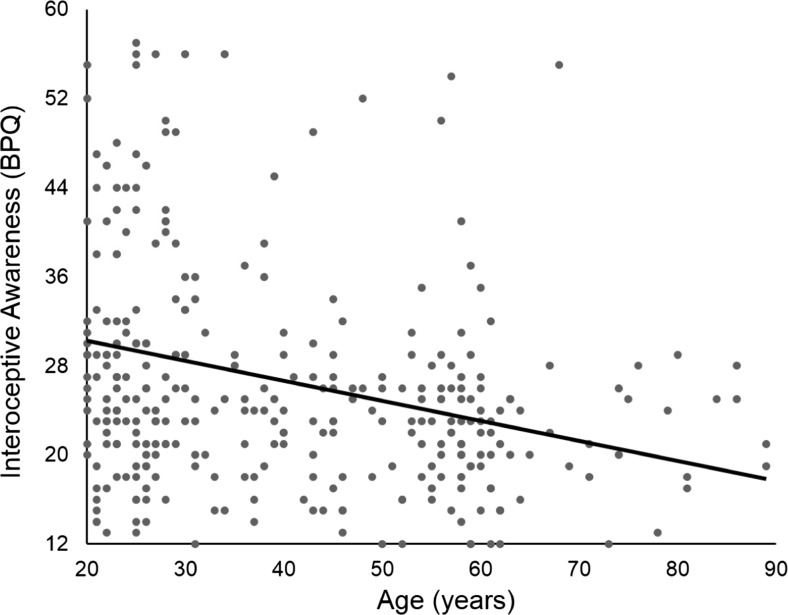
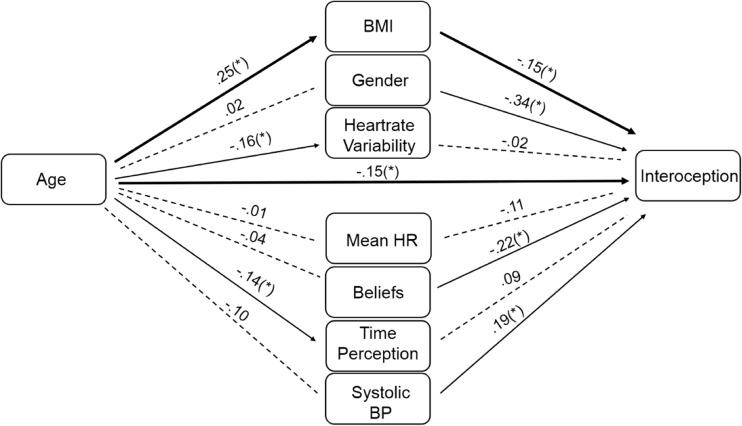
Various aspects of physical and mental health have been linked to an individual's ability to perceive the physical condition of their body ('interoception'). In addition, numerous studies have demonstrated a role for interoception in higher-order cognitive abilities such as decision-making and emotion processing. The importance of interoception for health and typical cognitive functioning has prompted interest in how interoception varies over the lifespan. However, few studies have investigated interoception into older adulthood, and no studies account for the set of physiological changes that may influence task performance. The present study examined interoception from young to very late adulthood (until 90 years of age) utilising a self-report measure of interoception (Study One) and an objective measure of cardiac interoception (Study Two). Across both studies, interoception decreased with age, and changes in interoceptive accuracy were observed which were not explained by accompanying physiological changes. In addition to a direct effect of age on interoception, an indirect effect of ageing on cardiac interoceptive accuracy mediated by body mass index (BMI) was found, such that ageing was associated with increased BMI which was, in turn, associated with reduced interoceptive accuracy. Such findings support and extend previous research demonstrating interoceptive decline with advancing age, and highlight the importance of assessing whether decreasing interoceptive ability is responsible for some aspects of age-related ill-health and cognitive impairment.
Overview
The claims and statistics of this paper haven’t been checked yet.
Run the check — free, no account needed. It reads the open-access text and checks the sources it cites.
Integrity signals
Registry
Cites
Statistics
Figures
Verification
Claims the paper makes
The claims and statistics of this paper haven’t been checked yet.
Run the check — free, no account needed. It reads the open-access text and checks the sources it cites.
Claims other papers make about this one
Each is checked against this paper’s own text: does it say what the citing paper says it does?
The cited source says what the claim attributes to it.
In the citing paper
“we have previously proposed that interoceptive atypicalities may represent a common vulnerability factor for psychopathology (Brewer and Bird, 2019; Brewer et al., 2016a; Murphy, Geary, et al., 2017).”
From Atypical interoception as a common risk factor for psychopathology: A review (2021) · cites this paper as Murphy, Geary, et al., 2017
Self-check
Percentages, sums and reported differences re-computed from the paper’s own numbers.
The self-check needs the paper’s full text.
Citations
Cites
Folstein, M. F., Folstein, S. E., & McHugh, P. R. (1975) · Journal of Psychiatric Research · doi:10.1016/0022-3956(75)90026-6 · Cited by 88,282
(2013) · Cited by 44,563
Preacher, K. J., & Hayes, A. F. (2008) · Behavior Research Methods · doi:10.3758/brm.40.3.879 · Cited by 34,117
Hirono, N., Mori, E., Ikejiri, Y., Imamura, T., Shimomura, T., Hashimoto, M., Yamashita, H., & Ikeda, M. (1997) · PubMed · Cited by 21,012
Kok, J. S., Berg, I. J., & Scherder, E. J. A. (2013) · Dementia and Geriatric Cognitive Disorders Extra · doi:10.1159/000353441 · Cited by 20,589
Older Adults' Reasons for Using Technology while Aging in Place
Peek, S. T. M., Luijkx, K. G., Rijnaard, M. D., Nieboer, M. E., van der Voort, C. S., Aarts, S., van Hoof, J., Vrijhoef, H. J., & Wouters, E. (2015) · Gerontology · doi:10.1159/000430949 · Cited by 19,852
Sensitivity and False Alarm Rate of a Fall Sensor in Long-Term Fall Detection in the Elderly
Kangas, M., Korpelainen, R., Vikman, I., Nyberg, L., & Jämsä, T. J. (2014) · Gerontology · doi:10.1159/000362720 · Cited by 19,007
SPSS and SAS procedures for estimating indirect effects in simple mediation models
Preacher, K. J., & Hayes, A. F. (2004) · Behavior Research Methods, Instruments, & Computers · doi:10.3758/bf03206553 · Cited by 17,383
Asymptotic Confidence Intervals for Indirect Effects in Structural Equation Models
Sobel, M. E. (1982) · Sociological Methodology · doi:10.2307/270723 · Cited by 12,810
(1994) · DigitalGeorgetown (Georgetown University Library) · Cited by 10,542
Cited by
Sorted by citations
Testing the independence of self-reported interoceptive accuracy and attention
Murphy, J., Brewer, R., Plans, D., Khalsa, S. S., Catmur, C., & Bird, G. (2020) · Quarterly Journal of Experimental Psychology · doi:10.1177/1747021819879826 · Cited by 235
Self-citationJenkinson, P. M., Taylor, L., & Laws, K. R. (2018) · Journal of Psychosomatic Research · doi:10.1016/j.jpsychores.2018.04.005 · Cited by 227
Cabrera, A., Kolacz, J., Pailhez, G., Bulbena‐Cabre, A., Bulbena, A., & Porges, S. W. (2018) · International Journal of Methods in Psychiatric Research · doi:10.1002/mpr.1596 · Cited by 224
Murphy, J., Brewer, R., Hobson, H., Catmur, C., & Bird, G. (2018) · Biological Psychology · doi:10.1016/j.biopsycho.2018.05.010 · Cited by 180
Self-citationAtypical interoception as a common risk factor for psychopathology: A review
Brewer, R., Murphy, J., & Bird, G. (2021) · Neuroscience & Biobehavioral Reviews · doi:10.1016/j.neubiorev.2021.07.036 · Cited by 180
Self-citation
Metadata
- Authors
- Murphy, J., Geary, H., Millgate, E., Catmur, C., & Bird, G.
- Affiliations
- King's College London (GB)
- Corresponding author
- Murphy, Jennifer
- Venue
- Psychonomic Bulletin & Review
- Published
- 2017-07-06
- Volume
- 25
- Issue
- 3
- Pages
- 1193-1202
- ISSN
- 1069-9384 (ISSN-L)
- 1531-5320
- PMC
- PMC5990557
- OpenAlex
- W2733981984
- Cited by
- 137
- References
- 89
- Citations by year
- 2026: 14 · 2025: 14 · 2024: 27 · 2023: 22 · 2022: 12 · 2021: 19 · 2020: 12 · 2019: 10 · 2018: 5 · 2017: 2
- FWCI
- 6.52
- Type
- journal article
- Language
- en
- Open access
- hybrid
- doi.org
- Locations
- Psychonomic Bulletin & Review (publishedVersion, cc-by)
- Europe PMC (PubMed Central) (publishedVersion, other-oa)
- PubMed Central (publishedVersion, cc-by)
- PubMed (publishedVersion)
- Research Portal (King's College London) (submittedVersion, cc-by)
- University of Birmingham Research Portal (University of Birmingham) (submittedVersion, other-oa)
- Funders
- King's College London
- Topics
- Health Sciences › Medicine › Psychiatry and Mental health › Psychosomatic Disorders and Their Treatments
- Health Sciences › Medicine › Cardiology and Cardiovascular Medicine › Heart Rate Variability and Autonomic Control
- Social Sciences › Psychology › Developmental and Educational Psychology › Aging and Gerontology Research
- Keywords
- interoception, interoceptive accuracy, interoceptive awareness, aging, old age, lifespan development, cardiac interoception, body mass index, physiological changes, age-related cognitive decline
- MeSH terms
- Adult, Aged, Aged, 80 and over, Aging, Awareness, Female, Humans, Human Development, Male, Middle Aged, Body Mass Index, Young Adult, Interoception
About these checks
Registry, retraction, Cites and statistics results are computed, not judged, with one exception: a printed reference that no index lists is read once by a model before it counts as a citation error. Claims are extracted by a model and kept only when their quote appears verbatim in the text; each cited source is then checked, with a model’s help, for whether it says what the claim relies on. Those verdicts can be wrong — read the claim’s quote and the cited source before relying on one.
Statistics and arithmetic are recomputed, not judged.
Confidence bands are shown only for fields calibrated on our annotated test set. None is calibrated yet, so no band is shown.
What counts as a claim ›How we measure confidence ›How we check this ›
Are you an author, or do you see a problem with this page? Request a review
