

The DOI matches its Crossref record; 89 of the 89 references it cites were found in a registry or an index.
Direct and indirect effects of age on interoceptive accuracy and awareness across the adult lifespan
Open accessAbstract
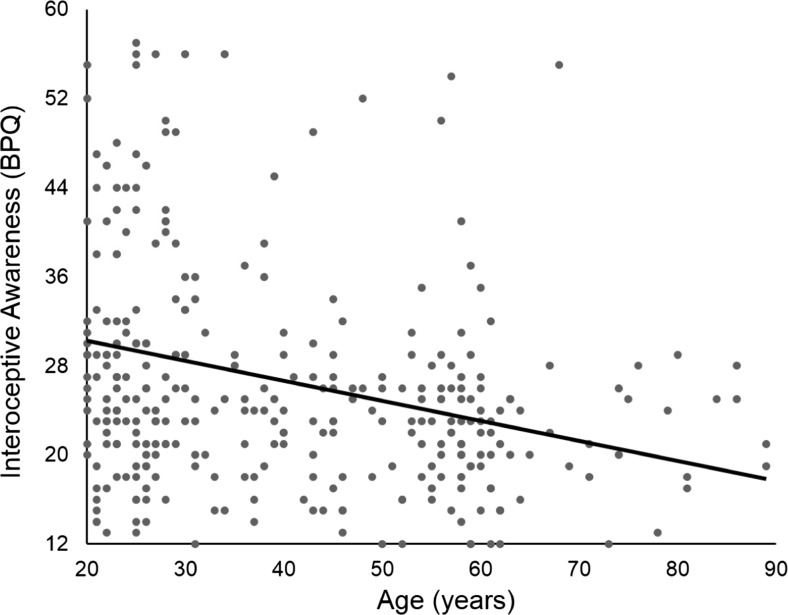
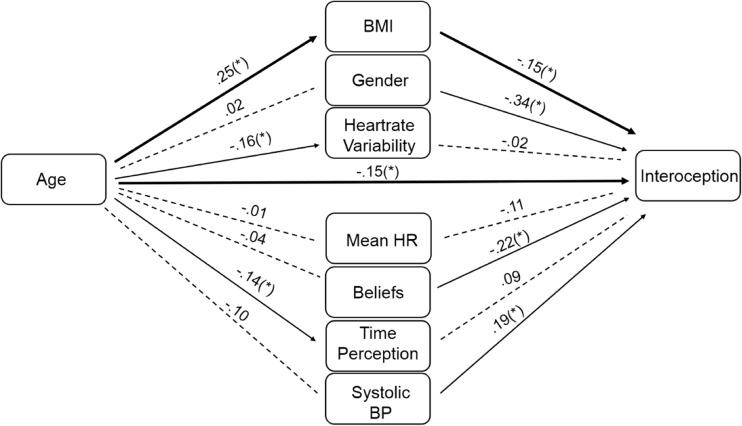
Various aspects of physical and mental health have been linked to an individual's ability to perceive the physical condition of their body ('interoception'). In addition, numerous studies have demonstrated a role for interoception in higher-order cognitive abilities such as decision-making and emotion processing. The importance of interoception for health and typical cognitive functioning has prompted interest in how interoception varies over the lifespan. However, few studies have investigated interoception into older adulthood, and no studies account for the set of physiological changes that may influence task performance. The present study examined interoception from young to very late adulthood (until 90 years of age) utilising a self-report measure of interoception (Study One) and an objective measure of cardiac interoception (Study Two). Across both studies, interoception decreased with age, and changes in interoceptive accuracy were observed which were not explained by accompanying physiological changes. In addition to a direct effect of age on interoception, an indirect effect of ageing on cardiac interoceptive accuracy mediated by body mass index (BMI) was found, such that ageing was associated with increased BMI which was, in turn, associated with reduced interoceptive accuracy. Such findings support and extend previous research demonstrating interoceptive decline with advancing age, and highlight the importance of assessing whether decreasing interoceptive ability is responsible for some aspects of age-related ill-health and cognitive impairment.
Overview
The claims and statistics of this paper haven’t been checked yet.
Run the check — free, no account needed. It reads the open-access text and checks the sources it cites.
Integrity signals
Registry
Cites
Statistics
Figures
Verification
Claims the paper makes
The claims and statistics of this paper haven’t been checked yet.
Run the check — free, no account needed. It reads the open-access text and checks the sources it cites.
Claims other papers make about this one
Each is checked against this paper’s own text: does it say what the citing paper says it does?
The cited source says what the claim attributes to it.
In the citing paper
“we have previously proposed that interoceptive atypicalities may represent a common vulnerability factor for psychopathology (Brewer and Bird, 2019; Brewer et al., 2016a; Murphy, Geary, et al., 2017).”
From Atypical interoception as a common risk factor for psychopathology: A review (2021) · cites this paper as Murphy, Geary, et al., 2017
Self-check
Percentages, sums and reported differences re-computed from the paper’s own numbers.
The self-check needs the paper’s full text.
Citations
Cites
Folstein, M. F., Folstein, S. E., & McHugh, P. R. (1975) · Journal of Psychiatric Research · doi:10.1016/0022-3956(75)90026-6 · Cited by 88,282
(2013) · Cited by 44,563
Preacher, K. J., & Hayes, A. F. (2008) · Behavior Research Methods · doi:10.3758/brm.40.3.879 · Cited by 34,117
Hirono, N., Mori, E., Ikejiri, Y., Imamura, T., Shimomura, T., Hashimoto, M., Yamashita, H., & Ikeda, M. (1997) · PubMed · Cited by 21,012
Kok, J. S., Berg, I. J., & Scherder, E. J. A. (2013) · Dementia and Geriatric Cognitive Disorders Extra · doi:10.1159/000353441 · Cited by 20,589
Older Adults' Reasons for Using Technology while Aging in Place
Peek, S. T. M., Luijkx, K. G., Rijnaard, M. D., Nieboer, M. E., van der Voort, C. S., Aarts, S., van Hoof, J., Vrijhoef, H. J., & Wouters, E. (2015) · Gerontology · doi:10.1159/000430949 · Cited by 19,852
Sensitivity and False Alarm Rate of a Fall Sensor in Long-Term Fall Detection in the Elderly
Kangas, M., Korpelainen, R., Vikman, I., Nyberg, L., & Jämsä, T. J. (2014) · Gerontology · doi:10.1159/000362720 · Cited by 19,007
SPSS and SAS procedures for estimating indirect effects in simple mediation models
Preacher, K. J., & Hayes, A. F. (2004) · Behavior Research Methods, Instruments, & Computers · doi:10.3758/bf03206553 · Cited by 17,383
Asymptotic Confidence Intervals for Indirect Effects in Structural Equation Models
Sobel, M. E. (1982) · Sociological Methodology · doi:10.2307/270723 · Cited by 12,810
(1994) · DigitalGeorgetown (Georgetown University Library) · Cited by 10,542
A comparison of methods to test mediation and other intervening variable effects
MacKinnon, D. P., Lockwood, C. M., Hoffman, J. M., West, S. G., & Sheets, V. (2002) · Psychological Methods · doi:10.1037/1082-989x.7.1.83 · Cited by 9,406
DESCARTES' ERROR: Emotion, Reason, and the Human Brain
Marg, E. (1995) · Optometry and Vision Science · doi:10.1002/j.1538-9235.1995.tb03988.x · Cited by 8,178
Confidence Limits for the Indirect Effect: Distribution of the Product and Resampling Methods
MacKinnon, D. P., Lockwood, C. M., & Williams, J. (2004) · Multivariate Behavioral Research · doi:10.1207/s15327906mbr3901_4 · Cited by 7,806
Cognitive, social, and physiological determinants of emotional state.
Schachter, S., & Singer, J. (1962) · Psychological Review · doi:10.1037/h0046234 · Cited by 6,223
How do you feel? Interoception: The sense of the physiological condition of the body
Craig, A. D. (2002) · Nature Reviews Neuroscience · doi:10.1038/nrn894 · Cited by 6,006
The Mini‐Mental State Examination: A Comprehensive Review
Tombaugh, T. N., & McIntyre, N. J. (1992) · Journal of the American Geriatrics Society · doi:10.1111/j.1532-5415.1992.tb01992.x · Cited by 5,152
Tests for comparing elements of a correlation matrix
Steiger, J. H. (1980) · Psychological Bulletin · doi:10.1037/0033-2909.87.2.245 · Cited by 4,621
Hemodynamic Patterns of Age-Related Changes in Blood Pressure: The Framingham Heart Study
Franklin, S. S., Gustin, W., Wong, N. D., Larson, M. G., Weber, M. A., Kannel, W. B., & Levy, D. (1997) · Circulation · doi:10.1161/01.cir.96.1.308 · Cited by 2,321
Descartes’ Error. Emotion, Reason and the Human Brain. New York (Grosset/Putnam) 1994.
Damasio, A. R. (1994) · Cited by 2,266
Interoceptive inference, emotion, and the embodied self
Seth, A. K. (2013) · Trends in Cognitive Sciences · doi:10.1016/j.tics.2013.09.007 · Cited by 1,816
The Psychology of Physical Symptoms
Pennebaker, J. W. (1982) · Springer eBooks · doi:10.1007/978-1-4613-8196-9 · Cited by 1,789
Knowing your own heart: Distinguishing interoceptive accuracy from interoceptive awareness
Garfinkel, S. N., Seth, A. K., Barrett, A. B., Suzuki, K., & Critchley, H. D. (2015) · Biological Psychology · doi:10.1016/j.biopsycho.2014.11.004 · Cited by 1,624
Heart beat perception and emotional experience
Schandry, R. (1981) · Psychophysiology · doi:10.1111/j.1469-8986.1981.tb02486.x · Cited by 1,335
Paulus, M. P., & Stein, M. B. (2006) · Biological Psychiatry · doi:10.1016/j.biopsych.2006.03.042 · Cited by 1,325
Umetani, K., Singer, D. H., McCraty, R., & Atkinson, M. (1998) · Journal of the American College of Cardiology · doi:10.1016/s0735-1097(97)00554-8 · Cited by 1,145
Ruffman, T., Henry, J. D., Livingstone, V., & Phillips, L. H. (2008) · Neuroscience & Biobehavioral Reviews · doi:10.1016/j.neubiorev.2008.01.001 · Cited by 984
How accurate is pulse rate variability as an estimate of heart rate variability?
Schäfer, A., & Vagedes, J. (2013) · International Journal of Cardiology · doi:10.1016/j.ijcard.2012.03.119 · Cited by 661
The insula and drug addiction: an interoceptive view of pleasure, urges, and decision-making
Naqvi, N. H., & Bechara, A. (2010) · Brain Structure and Function · doi:10.1007/s00429-010-0268-7 · Cited by 598
Listening to Your Heart: How Interoception Shapes Emotion Experience and Intuitive Decision Making
Dunn, B. D., Galton, H. C., Morgan, R., Evans, D., Oliver, C., Meyer, M., Cusack, R., Lawrence, A. D., & Dalgleish, T. (2010) · Psychological Science · doi:10.1177/0956797610389191 · Cited by 566
On the embodiment of emotion regulation: interoceptive awareness facilitates reappraisal
Füstös, J., Gramann, K., Herbert, B. M., & Pollatos, O. (2013) · Social Cognitive and Affective Neuroscience · doi:10.1093/scan/nss089 · Cited by 530
Discrepancies between dimensions of interoception in autism: implications for emotion and anxiety
Garfinkel, S. N., Tiley, C., O'Keeffe, S., Harrison, N. A., Seth, A. K., & Critchley, H. D. (2016) · Biological Psychology · doi:10.1016/j.biopsycho.2015.12.003 · Cited by 512
Relation of heart rate control to heartbeat perception
Whitehead, W. E., Drescher, V. M., Heiman, P., & Blackwell, B. (1977) · Applied Psychophysiology and Biofeedback · doi:10.1007/bf00998623 · Cited by 483
Doing Statistical Mediation and Moderation
Jose, P. E. (2013) · CERN Document Server (European Organization for Nuclear Research) · Cited by 456
Reduced perception of bodily signals in anorexia nervosa
Pollatos, O., Kurz, A.-L., Albrecht, J., Schreder, T., Kleemann, A. M., Schöpf, V., Kopietz, R., Wiesmann, M., & Schandry, R. (2008) · Eating Behaviors · doi:10.1016/j.eatbeh.2008.02.001 · Cited by 449
Herbert, B. M., Herbert, C., & Pollatos, O. (2011) · Journal of Personality · doi:10.1111/j.1467-6494.2011.00717.x · Cited by 437
Validity of (ultra-)short recordings for heart rate variability measurements.
Munoz, M. L., van Roon, A., Riese, H., Thio, C., Oostenbroek, E., Westrik, I., de Geus, E. J. C., Gansevoort, R., Lefrandt, J., Nolte, I. M., et al. (2015) · PLOS ONE · doi:10.1371/journal.pone.0138921 · Cited by 423
The inner sense of time: how the brain creates a representation of duration
Wittmann, M. (2013) · Nature reviews. Neuroscience · doi:10.1038/nrn3452 · Cited by 415
Interoception and psychopathology: A developmental neuroscience perspective
Murphy, J., Brewer, R., Catmur, C., & Bird, G. (2017) · Developmental Cognitive Neuroscience · doi:10.1016/j.dcn.2016.12.006 · Cited by 404
Self-citationAlexithymia: A general deficit of interoception
Brewer, R., Cook, R., & Bird, G. (2016) · Royal Society Open Science · doi:10.1098/rsos.150664 · Cited by 400
Self-citationAutism, oxytocin and interoception
Quattrocki, E., & Friston, K. (2014) · Neuroscience & Biobehavioral Reviews · doi:10.1016/j.neubiorev.2014.09.012 · Cited by 393
Garfinkel, S. N., & Critchley, H. D. (2013) · Social Cognitive and Affective Neuroscience · doi:10.1093/scan/nss140 · Cited by 386
Can interoception improve the pragmatic search for biomarkers in psychiatry?
Khalsa, S. S., & Lapidus, R. C. (2016) · Frontiers in Psychiatry · doi:10.3389/fpsyt.2016.00121 · Cited by 366
reconstructing the past: a century of ideas about emotion in psychology
Gendron, M., & Feldman Barrett, L. (2009) · Emotion Review · doi:10.1177/1754073909338877 · Cited by 361
Ramaekers, D. (1998) · European Heart Journal · doi:10.1053/euhj.1998.1084 · Cited by 354
Agelink, M. W., Malessa, R., Baumann, B., Majewski, T., Akila, F., Zeit, T., & Ziegler, D. (2001) · Clinical Autonomic Research · doi:10.1007/bf02322053 · Cited by 349
Heartbeat detection and the experience of emotions
Wiens, S., Mezzacappa, E. S., & Katkin, E. S. (2000) · Cognition & Emotion · doi:10.1080/026999300378905 · Cited by 347
Alexithymia, not autism, is associated with impaired interoception
Shah, P., Hall, R., Catmur, C., & Bird, G. (2016) · Cortex · doi:10.1016/j.cortex.2016.03.021 · Cited by 326
Self-citationInteroceptive dimensions across cardiac and respiratory axes
Garfinkel, S. N., Manassei, M. F., Hamilton-Fletcher, G., In den Bosch, Y., Critchley, H. D., & Engels, M. (2016) · Philosophical Transactions of the Royal Society B: Biological Sciences · doi:10.1098/rstb.2016.0014 · Cited by 326
Increased cardiac awareness in panic disorder
Ehlers, A., & Breuer, P. (1992) · Journal of Abnormal Psychology · doi:10.1037/0021-843x.101.3.371 · Cited by 315
Harshaw, C. (2015) · Psychological Bulletin · doi:10.1037/a0038101 · Cited by 302
The role of interoception in addiction: A critical review
Verdejo‐García, A., Clark, L., & Dunn, B. D. (2012) · Neuroscience & Biobehavioral Reviews · doi:10.1016/j.neubiorev.2012.05.007 · Cited by 290
Ring, C., Brener, J., Knapp, K., & Mailloux, J. (2015) · Biological Psychology · doi:10.1016/j.biopsycho.2014.12.010 · Cited by 272
Dunn, B. D., Stefanovitch, I., Evans, D., Oliver, C., Hawkins, A., & Dalgleish, T. (2010) · Behaviour Research and Therapy · doi:10.1016/j.brat.2010.07.006 · Cited by 235
How does interoceptive awareness interact with the subjective experience of emotion? An fMRI Study
Terasawa, Y., Fukushima, H., & Umeda, S. (2013) · Human Brain Mapping · doi:10.1002/hbm.21458 · Cited by 228
Cabrera, A., Kolacz, J., Pailhez, G., Bulbena‐Cabre, A., Bulbena, A., & Porges, S. W. (2018) · International Journal of Methods in Psychiatric Research · doi:10.1002/mpr.1596 · Cited by 224
Attenuated interoceptive sensitivity in overweight and obese individuals
Herbert, B. M., & Pollatos, O. (2014) · Eating Behaviors · doi:10.1016/j.eatbeh.2014.06.002 · Cited by 221
Interoceptive awareness declines with age
Khalsa, S. S., Rudrauf, D., & Tranel, D. (2009) · Psychophysiology · doi:10.1111/j.1469-8986.2009.00859.x · Cited by 211
Enhanced cardiac perception is associated with benefits in decision‐making
Werner, N. S., Jung, K., Duschek, S., & Schandry, R. (2009) · Psychophysiology · doi:10.1111/j.1469-8986.2009.00855.x · Cited by 189
Pain and aging: the emergence of a new subfield of pain research
Gagliese, L. (2009) · The Journal of Pain · doi:10.1016/j.jpain.2008.10.013 · Cited by 187
St‐Onge, M. (2005) · Current Opinion in Clinical Nutrition & Metabolic Care · doi:10.1097/01.mco.0000171150.49248.14 · Cited by 165
Effects of age on metacognitive efficiency
Palmer-Cooper, E. C., David, A. S., & Fleming, S. M. (2014) · Consciousness and Cognition · doi:10.1016/j.concog.2014.06.007 · Cited by 163
Pediatric obesity phenotyping by magnetic resonance methods.
Shen, W., Liu, H., Punyanitya, M., Chen, J., & Heymsfield, S. B. (2005) · PubMed · Cited by 159
Influence of beliefs about heart rate and actual heart rate on heartbeat counting
RING, C., & BRENER, J. (1996) · Psychophysiology · doi:10.1111/j.1469-8986.1996.tb02430.x · Cited by 153
Heartbeat detection: judgments of the simultaneity of external stimuli and heartbeats
Brener, J., & Kluvitse, C. (1988) · Psychophysiology · doi:10.1111/j.1469-8986.1988.tb01891.x · Cited by 150
Canales-Johnson, A., Silva, C., Huepe, D., Rivera-Rei, Á., Noreika, V., Garcia, M. D. C., Silva, W., Ciraolo, C., Vaucheret, E., Sedeño, L., et al. (2015) · Cerebral Cortex · doi:10.1093/cercor/bhv076 · Cited by 146
The psychophysiological mechanisms of alexithymia in autism spectrum disorder
Gaigg, S. B., Cornell, A. S., & Bird, G. (2018) · Autism · doi:10.1177/1362361316667062 · Cited by 142
Self-citationTaste sensitivity and aging: High incidence of decline revealed by repeated threshold measures
Stevens, J. C., Cruz, L. A., Hoffman, J. M., & Patterson, M. Q. (1995) · Chemical Senses · doi:10.1093/chemse/20.4.451 · Cited by 135
Interoception and Positive Symptoms in Schizophrenia
Ardizzi, M., Ambrosecchia, M., Buratta, L., Ferri, F., Peciccia, M., Donnari, S., Mazzeschi, C., & Gallese, V. (2016) · Frontiers in Human Neuroscience · doi:10.3389/fnhum.2016.00379 · Cited by 135
Clark, W. C., & Mehl, L. (1971) · Journal of Abnormal Psychology · doi:10.1037/h0031800 · Cited by 133
Schaefer, M., Egloff, B., Gerlach, A. L., & Witthöft, M. (2014) · Biological Psychology · doi:10.1016/j.biopsycho.2014.05.012 · Cited by 130
Heart Beat Perception in Patients with Depressive, Somatoform, and Personality Disorders
Mussgay, L., Klinkenberg, N., & Rüddel, H. (1999) · Journal of Psychophysiology · doi:10.1027//0269-8803.13.1.27 · Cited by 128
Enhancement of heartbeat-related brain potentials through cardiac awareness training
Schandry, R., & Weitkunat, R. (1990) · International Journal of Neuroscience · doi:10.3109/00207459008986611 · Cited by 128
Brewer, R., Happé, F., Cook, R., & Bird, G. (2015) · Neuroscience & Biobehavioral Reviews · doi:10.1016/j.neubiorev.2015.07.006 · Cited by 117
Self-citationKnapp-Kline, K., & Kline, J. P. (2005) · Biological Psychology · doi:10.1016/j.biopsycho.2004.09.002 · Cited by 117
A Comparison between Two Methods for Assessing Heartbeat Perception
Knoll, J. F., & Hodapp, V. (1992) · Psychophysiology · doi:10.1111/j.1469-8986.1992.tb01689.x · Cited by 116
Cognitive Aging and Time Perception: Roles of Bayesian Optimization and Degeneracy
Turgeon, M., Lustig, C., & Meck, W. H. (2016) · Frontiers in Aging Neuroscience · doi:10.3389/fnagi.2016.00102 · Cited by 114
Interoceptive sensitivity deficits in women recovered from bulimia nervosa
Klabunde, M., Acheson, D. T., Boutelle, K. N., Matthews, S. C., & Kaye, W. H. (2013) · Eating Behaviors · doi:10.1016/j.eatbeh.2013.08.002 · Cited by 109
Phillips, G. C., Jones, G. E., Rieger, E. J., & Snell, J. B. (1999) · Psychophysiology · doi:10.1017/s0048577299980071 · Cited by 100
Dissociating beliefs about heart rates and actual heart rates in patients with cardiac pacemakers
Windmann, S., Schonecke, O. W., Fröhlig, G., & Maldener, G. (1999) · Psychophysiology · doi:10.1017/s0048577299980381 · Cited by 93
Heartfelt imitation: high interoceptive awareness is linked to greater automatic imitation
Ainley, V., Brass, M., & Tsakiris, M. (2014) · Neuropsychologia · doi:10.1016/j.neuropsychologia.2014.05.010 · Cited by 87
Interoception and panic disorder
Ehlers, A. (1993) · Advances in Behaviour Research and Therapy · doi:10.1016/0146-6402(93)90001-i · Cited by 84
The effect of body composition and gender on cardiac awareness
Rouse, C. H., Jones, G. E., & Jones, K. R. (1988) · Psychophysiology · doi:10.1111/j.1469-8986.1988.tb01876.x · Cited by 84
Interoceptive ability predicts aversion to losses
Sokol-Hessner, P., Hartley, C. A., Hamilton, J. R., & Phelps, E. A. (2015) · Cognition and Emotion · doi:10.1080/02699931.2014.925426 · Cited by 72
How Emotions Are Shaped by Bodily States
Critchley, H. D., & Nagai, Y. (2012) · Emotion Review · doi:10.1177/1754073911430132 · Cited by 68
Bakračevič, K. (2005) · Journal of Adult Development · doi:10.1007/s10804-005-7089-6 · Cited by 60
O'Brien, W. H., Reid, G. J., & Jones, K. R. (1998) · International Journal of Psychophysiology · doi:10.1016/s0167-8760(98)00004-x · Cited by 57
Yashin, A. I., Akushevich, I. V., Arbeev, K. G., Akushevich, L., Ukraintseva, S. V., & Kulminski, A. (2006) · AGE · doi:10.1007/s11357-006-9023-7 · Cited by 54
Aging and risks for dehydration
Silver, A. J. (1990) · Cleveland Clinic Journal of Medicine · doi:10.3949/ccjm.57.4.341 · Cited by 54
Age-Related Changes in Decision Making
Sparrow, E. P., & Spaniol, J. (2016) · Current Behavioral Neuroscience Reports · doi:10.1007/s40473-016-0091-4 · Cited by 33
Cited by
Sorted by citations
Testing the independence of self-reported interoceptive accuracy and attention
Murphy, J., Brewer, R., Plans, D., Khalsa, S. S., Catmur, C., & Bird, G. (2020) · Quarterly Journal of Experimental Psychology · doi:10.1177/1747021819879826 · Cited by 235
Self-citationJenkinson, P. M., Taylor, L., & Laws, K. R. (2018) · Journal of Psychosomatic Research · doi:10.1016/j.jpsychores.2018.04.005 · Cited by 227
Cabrera, A., Kolacz, J., Pailhez, G., Bulbena‐Cabre, A., Bulbena, A., & Porges, S. W. (2018) · International Journal of Methods in Psychiatric Research · doi:10.1002/mpr.1596 · Cited by 224
Murphy, J., Brewer, R., Hobson, H., Catmur, C., & Bird, G. (2018) · Biological Psychology · doi:10.1016/j.biopsycho.2018.05.010 · Cited by 180
Self-citationAtypical interoception as a common risk factor for psychopathology: A review
Brewer, R., Murphy, J., & Bird, G. (2021) · Neuroscience & Biobehavioral Reviews · doi:10.1016/j.neubiorev.2021.07.036 · Cited by 180
Self-citation
Metadata
- Authors
- Murphy, J., Geary, H., Millgate, E., Catmur, C., & Bird, G.
- Affiliations
- King's College London (GB)
- Corresponding author
- Murphy, Jennifer
- Venue
- Psychonomic Bulletin & Review
- Published
- 2017-07-06
- Volume
- 25
- Issue
- 3
- Pages
- 1193-1202
- ISSN
- 1069-9384 (ISSN-L)
- 1531-5320
- PMC
- PMC5990557
- OpenAlex
- W2733981984
- Cited by
- 137
- References
- 89
- Citations by year
- 2026: 14 · 2025: 14 · 2024: 27 · 2023: 22 · 2022: 12 · 2021: 19 · 2020: 12 · 2019: 10 · 2018: 5 · 2017: 2
- FWCI
- 6.52
- Type
- journal article
- Language
- en
- Open access
- hybrid
- doi.org
- Locations
- Psychonomic Bulletin & Review (publishedVersion, cc-by)
- Europe PMC (PubMed Central) (publishedVersion, other-oa)
- PubMed Central (publishedVersion, cc-by)
- PubMed (publishedVersion)
- Research Portal (King's College London) (submittedVersion, cc-by)
- University of Birmingham Research Portal (University of Birmingham) (submittedVersion, other-oa)
- Funders
- King's College London
- Topics
- Health Sciences › Medicine › Psychiatry and Mental health › Psychosomatic Disorders and Their Treatments
- Health Sciences › Medicine › Cardiology and Cardiovascular Medicine › Heart Rate Variability and Autonomic Control
- Social Sciences › Psychology › Developmental and Educational Psychology › Aging and Gerontology Research
- Keywords
- interoception, interoceptive accuracy, interoceptive awareness, aging, old age, lifespan development, cardiac interoception, body mass index, physiological changes, age-related cognitive decline
- MeSH terms
- Adult, Aged, Aged, 80 and over, Aging, Awareness, Female, Humans, Human Development, Male, Middle Aged, Body Mass Index, Young Adult, Interoception
About these checks
Registry, retraction, Cites and statistics results are computed, not judged, with one exception: a printed reference that no index lists is read once by a model before it counts as a citation error. Claims are extracted by a model and kept only when their quote appears verbatim in the text; each cited source is then checked, with a model’s help, for whether it says what the claim relies on. Those verdicts can be wrong — read the claim’s quote and the cited source before relying on one.
Statistics and arithmetic are recomputed, not judged.
Confidence bands are shown only for fields calibrated on our annotated test set. None is calibrated yet, so no band is shown.
What counts as a claim ›How we measure confidence ›How we check this ›
Are you an author, or do you see a problem with this page? Request a review
