

The (mis)reporting of statistical results in psychology journals
Open accessThe DOI matches its Crossref record; 34 of the 34 references it cites were found in a registry or an index.
Abstract
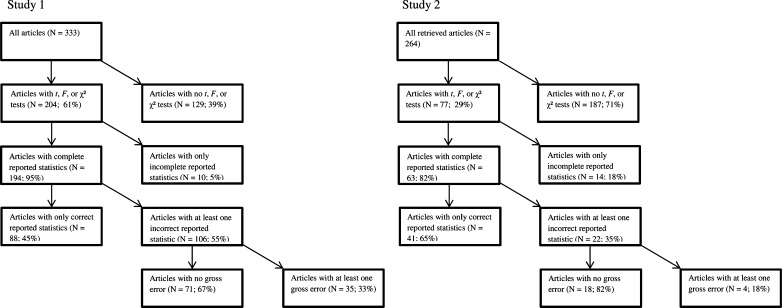
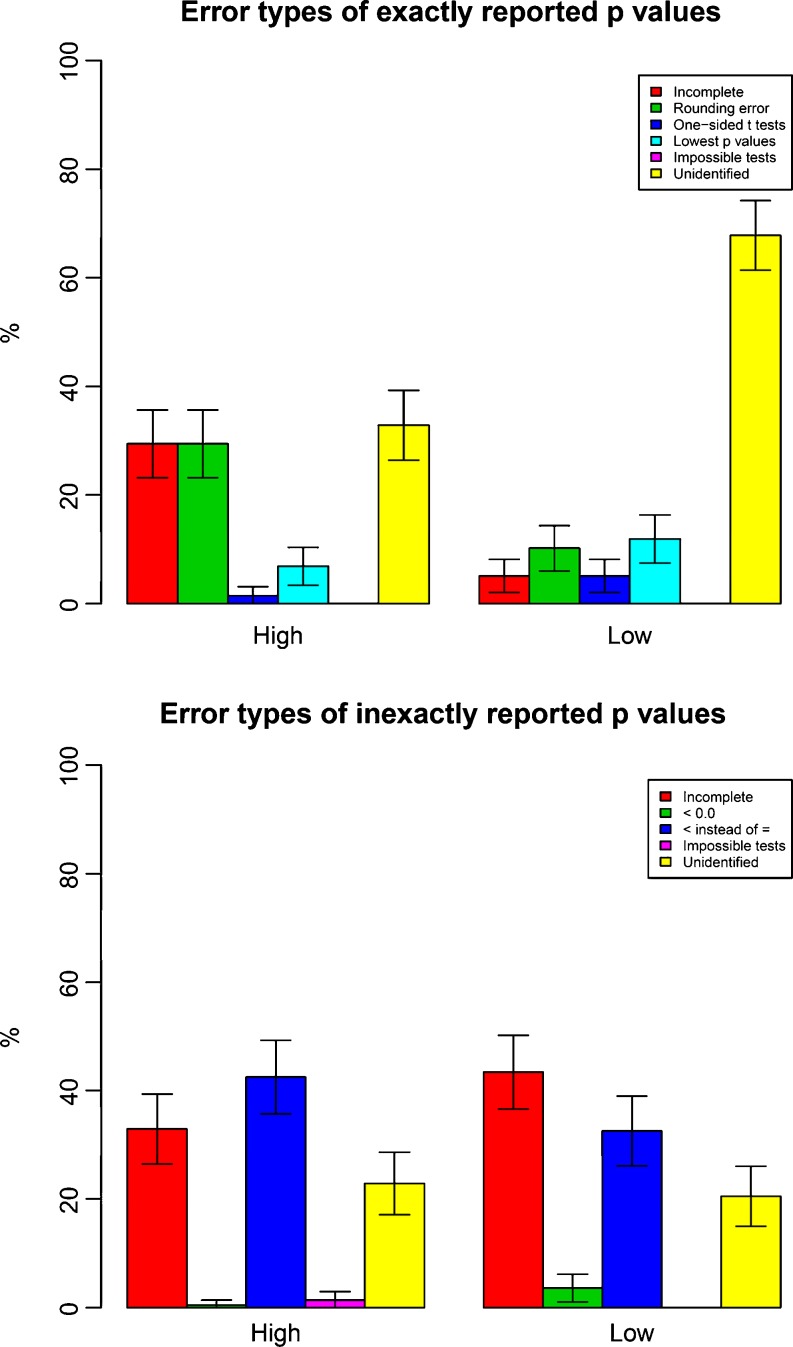
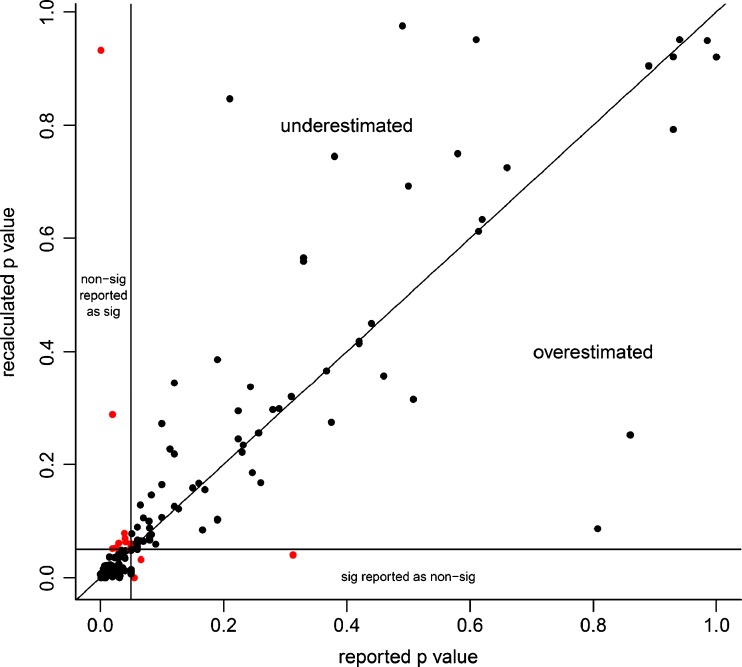
In order to study the prevalence, nature (direction), and causes of reporting errors in psychology, we checked the consistency of reported test statistics, degrees of freedom, and p values in a random sample of high- and low-impact psychology journals. In a second study, we established the generality of reporting errors in a random sample of recent psychological articles. Our results, on the basis of 281 articles, indicate that around 18% of statistical results in the psychological literature are incorrectly reported. Inconsistencies were more common in low-impact journals than in high-impact journals. Moreover, around 15% of the articles contained at least one statistical conclusion that proved, upon recalculation, to be incorrect; that is, recalculation rendered the previously significant result insignificant, or vice versa. These errors were often in line with researchers' expectations. We classified the most common errors and contacted authors to shed light on the origins of the errors.
Overview
The claims and statistics of this paper haven’t been checked yet.
Free: it reads the open-access text and checks the first 5 claims that cite a source we can check. Create a free account to check every claim.
Integrity signals
Registry
Cites
Statistics
Figures
Verification
Claims the paper makes
The claims and statistics of this paper haven’t been checked yet.
Free: it reads the open-access text and checks the first 5 claims that cite a source we can check. Create a free account to check every claim.
Claims other papers make about this one
Each is checked against this paper’s own text: does it say what the citing paper says it does?
The source backs part of the claim, not all of it — or backs it for a different population, condition or comparison.
In the citing paper
“From this perspective, it is not surprising that analysis pipelines are peppered with errors, ranging from the mundane to the serious [53–55].”
From Data availability, reusability, and analytic reproducibility: evaluating the impact of a mandatory open data policy at the journal Cognition (2018) · cites this paper as [53]
Experimental — accuracy not yet measuredThe cited source says what the claim attributes to it.
In the citing paper
“However, there is evidence that many reported p-values do not match their accompanying test statistic and degrees of freedom (Bakker & Wicherts, 2011; Bakker & Wicherts, 2014; Berle & Starcevic, 2007; Caperos & Pardo, 2013; Garcia-Berthou & Alcaraz, 2004; Veldkamp, Nuijten, Dominguez-Alvarez, Van Assen, & Wicherts, 2014; Wicherts, Bakker, & Molenaar, 2011).”
From The prevalence of statistical reporting errors in psychology (1985–2013) (2016) · cites this paper as Bakker & Wicherts, 2011
The cited source says what the claim attributes to it.
In the citing paper
“If the test statistic is incorrect and it is used to calculate the effect size for a meta-analysis, this effect size will be incorrect as well, which could affect the outcome of the meta-analysis (Bakker & Wicherts, 2011; in fact, the misreporting of all kinds of statistics is a problem for meta-analyses; Gotzsche, Hrobjartsson, Maric, & Tendal, 2007; Levine & Hullett, 2002).”
From The prevalence of statistical reporting errors in psychology (1985–2013) (2016) · cites this paper as Bakker & Wicherts, 2011
Experimental — accuracy not yet measuredThe cited source says what the claim attributes to it.
In the citing paper
“Bakker and Wicherts (2011) included only t, F, and χ 2 values”
From The prevalence of statistical reporting errors in psychology (1985–2013) (2016) · cites this paper as Bakker and Wicherts (2011)
The cited source says what the claim attributes to it.
In the citing paper
“it has been found that journals with lower impact factors have a higher prevalence of reporting inconsistencies than high impact journals (Bakker & Wicherts, 2011).”
From The prevalence of statistical reporting errors in psychology (1985–2013) (2016) · cites this paper as Bakker & Wicherts, 2011
2 more claims about this paper
Create a free account to see every claim other papers make about this one.
Self-check
Percentages, sums and reported differences re-computed from the paper’s own numbers.
The self-check needs the paper’s full text.
Citations
Cites
Borenstein, M., Hedges, L. V., Higgins, J. P. T., & Rothstein, H. R. (2009) · doi:10.1002/9780470743386 · Cited by 14,225
Borenstein, M., Hedges, L. V., Higgins, J. P. T., & Rothstein, H. R. (2021) · doi:10.1002/9781119558378 · Cited by 9,799
Reason, J. (1990) · doi:10.1017/cbo9781139062367 · Cited by 5,108
Cohen, J. (1994) · American Psychologist · doi:10.1037/0003-066x.49.12.997 · Cited by 4,003 · cited 9×
“These results show that NHST continues to be used in ways that defy the guidelines as proposed by the Task Force on Statistical Inference (Wilkinson and Task Force on Statistical Inference, 1999) and the last two versions of the APA Publication Manual (American Psychological Association, 2001, 2010).”
BackgroundMethodInfluentialPublication Manual of the American Psychological Association
DeCleene, K. E., & Fogo, J. (2012) · Occupational Therapy In Health Care · doi:10.3109/07380577.2011.629024 · Cited by 3,167
Statistical methods in psychology journals: Guidelines and explanations.
Wilkinson, L., & Task Force on Statistical Inference (1999) · American Psychologist · doi:10.1037/0003-066x.54.8.594 · Cited by 2,791
A practical solution to the pervasive problems ofp values
Wagenmakers, E.-J. (2007) · Psychonomic Bulletin & Review · doi:10.3758/bf03194105 · Cited by 2,490 · cited 1×
“This method has been extensively criticized (Cohen, 1994; Nickerson, 2000; Wagenmakers, 2007; Wilkinson and Task Force on Statistical Inference, 1999).”
MethodThe statistical power of abnormal-social psychological research: A review.
Cohen, J. (1962) · The Journal of Abnormal and Social Psychology · doi:10.1037/h0045186 · Cited by 1,824 · cited 9×
“These results show that NHST continues to be used in ways that defy the guidelines as proposed by the Task Force on Statistical Inference (Wilkinson and Task Force on Statistical Inference, 1999) and the last two versions of the APA Publication Manual (American Psychological Association, 2001, 2010).”
BackgroundInfluentialPublication Manual of the American Psychological Association (4th ed.).
Gullickson, T. (1996) · Contemporary Psychology: A Journal of Reviews · doi:10.1037/004700 · Cited by 1,240
Null hypothesis significance testing: a review of an old and continuing controversy
Nickerson, R. S. (2000) · Psychological Methods · doi:10.1037/1082-989x.5.2.241 · Cited by 1,090 · cited 1×
“This method has been extensively criticized (Cohen, 1994; Nickerson, 2000; Wagenmakers, 2007; Wilkinson and Task Force on Statistical Inference, 1999).”
Method
Research works printed but not linked: 1
- American Psychological Association Publication Manual of the American Psychological Association 2001 5 Washington, DC Author
Cited by
Items 101–200 of 358
Effect Sizes, Power, and Biases in Intelligence Research: A Meta-Meta-Analysis
Nuijten, M. B., van Assen, M. A. L. M., Augusteijn, H. E. M., Crompvoets, E. A. V., & Wicherts, J. M. (2020) · Journal of Intelligence · doi:10.3390/jintelligence8040036 · Cited by 45
Self-citationThe Evolution of Behavior Analysis: Toward a Replication Crisis?
Locey, M. L. (2020) · Perspectives on Behavior Science · doi:10.1007/s40614-020-00264-w · Cited by 47
Schroeders, U., & Gnambs, T. (2018) · European Journal of Psychological Assessment · doi:10.1027/1015-5759/a000500 · Cited by 46
“Recently, Cortina and colleagues (2017) reviewed 784 SEMs published in two leading organizational journals to examine whether the reported df matched the information given in the text.”
BackgroundInfluentialResearch integrity: environment, experience, or ethos?
Hofmann, B., & Holm, S. (2019) · Research Ethics · doi:10.1177/1747016119880844 · Cited by 43
Single-case experimental research designs.
Kazdin, A. E. (2015) · Methodological issues and strategies in clinical research (4th ed.). · doi:10.1037/14805-029 · Cited by 39
Schuffelen, J., Maurer, L., Lorenz, N., Rötger, A., Pietrowsky, R., & Gieselmann, A. (2023) · SLEEP · doi:10.1093/sleep/zsad184 · Cited by 47
“However, we reported exact values and effect sizes to allow the reader to judge [77].”
BackgroundPrime Numbers: Anchoring and its Implications for Theories of Behavior Priming
Newell, B. R., & Shanks, D. R. (2014) · Social Cognition · doi:10.1521/soco.2014.32.supp.88 · Cited by 48
“…simply unreplicable (excellent discussions of these issues in relation to experimental psychology generally can be found in Asendorpf et al., 2013; Bakker & Wicherts, 2011; Bertamini & Munafò, 2012; Francis, 2012; Klein et al., 2012; Kruschke, 2013; Pashler & Harris, 2012; Rouder, Speckman, Sun,…”
BackgroundPhaf, R. H. (2020) · Theory & Psychology · doi:10.1177/0959354319898250 · Cited by 42
“Undetected errors in statistical testing, which are quite prevalent (Bakker & Wicherts, 2011), may further inflate effect sizes when calculated from test statistics.”
BackgroundFull disclosure: Doing behavioural science necessitates sharing
Peters, G.-J., Abraham, C., & Crutzen, R. (2012) · PsycEXTRA Dataset · doi:10.1037/e544792013-002 · Cited by 36
Ehring, T. W., Limburg, K., Kunze, A. E., Wittekind, C. E., Werner, G. G., Wolkenstein, L., Guzey, M., & Cludius, B. (2022) · Clinical Psychology Review · doi:10.1016/j.cpr.2022.102163 · Cited by 49
Stricker, J., & Günther, A. (2019) · Zeitschrift für Psychologie · doi:10.1027/2151-2604/a000356 · Cited by 48
“Yet, a considerable proportion of statistical inconsistencies may be a result of inadvertent honest errors rather than scientific misconduct (Bakker & Wicherts, 2011).”
BackgroundThe Validity of the Tool “statcheck” in Discovering Statistical Reporting Inconsistencies
Nuijten, M. B., van Assen, M. A. L. M., Hartgerink, C. H. J., Epskamp, S., & Wicherts, J. M. (2017) · doi:10.31234/osf.io/tcxaj · Cited by 33
Self-citationThe empirical march: Making science better at self-correction.
Makel, M. (2014) · Psychology of Aesthetics Creativity and the Arts · doi:10.1037/a0035803 · Cited by 32
“The failure of the current system to enforce rigor is further exemplified by a report that found that 15% of published peer-reviewed articles in psychology journals made statistical inference errors (Bakker & Wicherts, 2011).”
BackgroundJekel, M., Fiedler, S., Torras, R. A., Mischkowski, D., Dorrough, A. R., & Glöckner, A. (2019) · Psychology Learning & Teaching · doi:10.1177/1475725719868149 · Cited by 39
Analytic Review as a Solution to the Misreporting of Statistical Results in Psychological Science
Sakaluk, J., Williams, A., & Biernat, M. (2014) · Perspectives on Psychological Science · doi:10.1177/1745691614549257 · Cited by 32
“Bakker and Wicherts (2011) recently adopted a different approach: sampling articles to study misreporting.”
BackgroundAn Introduction to Replication Research in Gifted Education: Shiny and New Is Not the Same as Useful
Makel, M. C., & Plucker, J. A. (2015) · Gifted Child Quarterly · doi:10.1177/0016986215578747 · Cited by 32
“However, neither is methodological rigor limited to advanced statistics, nor are statistics being universally correctly applied (Bakker & Wicherts, 2011).”
BackgroundBest (but oft forgotten) practices: sample size planning for powerful studies
Anderson, S. F. (2019) · American Journal of Clinical Nutrition · doi:10.1093/ajcn/nqz058 · Cited by 38
Arithmetic word problem solving. Analysis of Singaporean and Spanish textbooks
Vicente, S., Verschaffel, L., Sánchez, R., & Múñez, D. (2022) · Educational Studies in Mathematics · doi:10.1007/s10649-022-10169-x · Cited by 69
“1 Additionally, to see the differences calculated by Fisher’s exact test, see Bakker and Wicherts (2011).”
MethodVerify original results through reanalysis before replicating
Nuijten, M. B., Bakker, M., Maassen, E., & Wicherts, J. M. (2018) · Behavioral and Brain Sciences · doi:10.1017/s0140525x18000791 · Cited by 31
Self-citationScience revolves around the data
(2013) · Journal of Open Psychology Data · doi:10.5334/jopd.e1 · Cited by 29
Self-citationYeager, D. S., Krosnick, J. A., Visser, P. S., Holbrook, A. L., & Tahk, A. M. (2019) · Journal of Personality and Social Psychology · doi:10.1037/pspa0000171 · Cited by 33
“…apparent effect sizes, including publication bias, studying small samples, selective reporting, p-hacking, accidental errors in analysis, and more (Bakker & Wicherts, 2011; Francis, 2012; Franco et al., 2014; Hartgerink, van Aert, Nuijten, Wicherts, & van Assen, 2016; Ioannidis, 2005; John,…”
King, K. M., Pullmann, M. D., Lyon, A. R., Dorsey, S., & Lewis, C. C. (2019) · Journal of Abnormal Psychology · doi:10.1037/abn0000417 · Cited by 39
“In short, even simple statistics such as p values are frequently misreported, often in directions that alter the study’s conclusions in favor of the researcher’s hypotheses (Bakker & Wicherts, 2011).”
BackgroundResultTransplant Renal Vein Thrombosis.
Elzorkany, K. M. A., Bridson, J.-M., Sharma, A. K., & Halawa, A. M. (2017) · Experimental and Clinical Transplantation · doi:10.6002/ect.2016.0060 · Cited by 33
Wicherts, J. M., Veldkamp, C. L. S., Augusteijn, H. E. M., Bakker, M., van Aert, R. C. M., & van Assen, M. A. L. M. (2016) · OSF Preprints (OSF Preprints) · doi:10.31219/osf.io/umq8d · Cited by 37
Self-citationAssociations between attitudes towards scientific misconduct and self-reported behavior
Holm, S., & Hofmann, B. (2018) · Accountability in Research · doi:10.1080/08989621.2018.1485493 · Cited by 32
“…e.g. authorship misconduct and problematic data manipulation are even more prevalent (Ana et al. 2013; Anderson, Martinson, and de Vries 2007; Bakker and Wicherts 2011; Bozeman and Youtie 2016; Davis, Riske-Morris, and Diaz 2007; de Vries, Anderson, and CONTACT Søren Holm…”
BackgroundAdapting open science and pre‐registration to longitudinal research
Petersen, I. T., Apfelbaum, K. S., & McMurray, B. (2022) · Infant and Child Development · doi:10.1002/icd.2315 · Cited by 30
“…that suppress non-significant results, that is, the file drawer problem (Franco et al., 2014; Rosenthal, 1979), (f) statistical reporting errors (Bakker & Wicherts, 2011; Nuijten et al., 2016), (g) measurement error (Clayson et al., 2019; Loken & Gelman, 2017), (h) questionable research…”
BackgroundHensel, W. (2020) · European Journal for Philosophy of Science · doi:10.1007/s13194-020-00317-6
Vankelecom, L., Loeys, T., & Moerkerke, B. (2024) · Advances in Methods and Practices in Psychological Science · doi:10.1177/25152459231212128 · Cited by 40
Bergh, D. D., Sharp, B. M., & Li, M. (2016) · Academy of Management Learning and Education · doi:10.5465/amle.2015.0406 · Cited by 28
Assessing and Improving Robustness of Psychological Research Findings in Four Steps
Nuijten, M. B. (2022) · Springer eBooks · doi:10.1007/978-3-031-04968-2_17 · Cited by 30
Brand, A., & Bradley, M. T. (2016) · Psychological Reports · doi:10.1177/0033294115625265 · Cited by 25
“In a survey of 281 articles from the psychological literature, Bakker and Wicherts (2011) found that around 18% of statistical results were incorrectly reported.”
BackgroundInfluentialStatistical reporting inconsistencies in experimental philosophy
Colombo, M., Duev, G., Nuijten, M. B., & Sprenger, J. (2018) · PLoS ONE · doi:10.1371/journal.pone.0194360 · Cited by 29
“[8] Bakker and Wicherts (2011) 333 4,248(3) 11.”
BackgroundPublication Bias in Recent Empirical Accounting ResearchPreprint
Basu, S., & Park, H. (2014) · SSRN Electronic Journal · doi:10.2139/ssrn.2379889 · Cited by 25
Konijn, E. A., van de Schoot, R., Winter, S. D., & Ferguson, C. J. (2015) · Communication Methods and Measures · doi:10.1080/19312458.2015.1096332 · Cited by 31
“Unfortunately, non-significance is often misinterpreted as support for the null hypothesis (Bakker & Wicherts, 2011), which is abundantly illustrated in the Journal of Articles in Support of the Null Hypothesis : “Offering an outlet for experiments that do not reach the traditional significance…”
Why Cognitive Sciences Do Not Prove That Free Will Is an Epiphenomenon
Lavazza, A. (2019) · Frontiers in Psychology · doi:10.3389/fpsyg.2019.00326 · Cited by 33
“Failure in replication and problems with statistical processing have been detected for some time (Bakker and Wicherts, 2011), as a result of which 15% of studies have been reversed in their conclusions.”
Open Science is for Aging Research, Too
Isaacowitz, D. M., & Lind, M. (2019) · Innovation in Aging · doi:10.1093/geroni/igz028 · Cited by 26
Consistency errors in p-values reported in Spanish psychology journals
Caperos, J., & Pardo, A. (2013) · Psicothema · doi:10.7334/psicothema2012.207 · Cited by 23
“2% reported by Bakker and Wicherts (2011) for low impact journals. Bakker and Wicherts (2011) point out that most of the conclusion changes are produced in the direction expected by the researchers (rejecting the null hypothesis when it should in fact be maintained).”
BackgroundMethodResultInfluentialA Metascientific Review of the Evidential Value of Acceptance and Commitment Therapy for Depression
Williams, A. J., Botanov, Y., Giovanetti, A. K., Perko, V. L., Sutherland, C. L., Youngren, W., & Sakaluk, J. K. (2023) · Behavior Therapy · doi:10.1016/j.beth.2022.06.004 · Cited by 23
Replication in music psychology
Frieler, K., Müllensiefen, D., Fischinger, T., Schlemmer, K., Jakubowski, K., & Lothwesen, K. (2013) · Musicae Scientiae · doi:10.1177/1029864913495404 · Cited by 26
“Email: klaus.frieler@hfm-weimar.de”
MethodSchnell, S. D. (2018) · Bulletin of Mathematical Biology · doi:10.1007/s11538-018-0500-9 · Cited by 28
“…cannot be replicated in the biomedical sciences (Hirschhorn et al. 2002, Ioannidis 2005, Prinz et al. 2011, Begley and Ellis 2012), psychology (Bakker and Wicherts 2011, John et al 2012, Pashler and Wagenmakers 2012, Van Bavel et al. 2016), sociology and economy (Bollen et al 2015, Ioannidis…”
BackgroundChanging the logic of replication: A case from infant studies
Margoni, F., & Shepperd, M. (2020) · Infant Behavior and Development · doi:10.1016/j.infbeh.2020.101483 · Cited by 22
Moeller, J., Dietrich, J., Neubauer, A. B., Brose, A., Kühnel, J., Dehne, M., Jaehne, M. F., Schmiedek, F., Bellhäuser, H., Malmberg, L., et al. (2022) · PsyArXiv (OSF Preprints) · doi:10.31234/osf.io/5wsna · Cited by 30
Perspectives on Open Science and scientific data sharing:an interdisciplinary workshop.
Destro‐Bisol, G., Anagnostou, P., Capocasa, M., Bencivelli, S., Cerroni, A., Contreras, J. L., Enke, N., Fantini, B., Greco, P., Heeney, C., et al. (2014) · Edinburgh Research Explorer (University of Edinburgh) · doi:10.4436/jass.92006 · Cited by 50
“It is also common for statistical analyses of data to be prone to error (Bakker & Wicherts, 2011) and for unwillingness to share data to be associated with the prevalence of errors in papers from which data were requested (Wicherts et al. , 2011).”
Self-citationStatistical errors in software engineering experiments: a preliminary literature review
Ch., R. P. R., Dieste, Ó., Fonseca, E. R., & Juristo, N. (2018) · ACM/IEEE International Conference on Software Engineering: Companion Proceedings (ICSE-Companion) · doi:10.1145/3180155.3180161 · Cited by 26
“Hence, statistical techniques have experienced an increase in use, particularly in medicine [2, 63, 83], psychology [5], education [21], and social sciences [25, 58].”
BackgroundAnticipating consequences of sharing raw data and code and of awarding badges for sharing
Ioannidis, J. P. A. (2015) · Journal of Clinical Epidemiology · doi:10.1016/j.jclinepi.2015.04.015 · Cited by 25
Open developmental science: An overview and annotated reading list
Kalandadze, T., & Hart, S. A. (2022) · Infant and Child Development · doi:10.1002/icd.2334 · Cited by 25
7 Deadly Sins in Educational Research
Picho, K., & Artino, A. R. (2016) · Journal of Graduate Medical Education · doi:10.4300/jgme-d-16-00332.1 · Cited by 22
“049).(16) Another popular yet questionable practice is fishing, which refers to mining data for statistically significant findings that do not stem from prespecified hypotheses.”
BackgroundExcess success for three related papers on racial bias
Francis, G. (2015) · Frontiers in Psychology · doi:10.3389/fpsyg.2015.00512 · Cited by 34
“Such p-value misreporting is not uncommon (Bakker and Wicherts, 2011; Wicherts et al., 2011).”
A Functional Model for Unifying Brain Computer Interface Terminology
Easttom, C., Bianchi, L., Valeriani, D., Nam, C. S., Hossaini, A. A., Zapała, D., Roman–Gonzalez, A., Singh, A. K., Antonietti, A., Sahonero-Alvarez, G., et al. (2021) · IEEE Open Journal of Engineering in Medicine and Biology · doi:10.1109/ojemb.2021.3057471 · Cited by 21
“cessful replication or comparison of research problematic [3].”
BackgroundRe: The Charité cesarean birth: a family-orientated approach of cesarean section
Armbrust, R., & Henrich, W. (2016) · The Journal of Maternal-Fetal & Neonatal Medicine · doi:10.3109/14767058.2016.1153028 · Cited by 21
Yang, S., Qi, F., Diao, H., & Ajiferuke, I. (2022) · Journal of Information Science · doi:10.1177/01655515221097623 · Cited by 28
“An analysis of approximately 250 scientific literature in psychology revealed that approximately 12% reported incorrect p -values to strongly favour the researchers’ expectations, resulting in non-significant findings being reported as significant ones [55].”
BackgroundImproving the Conduct and Reporting of Statistical Analysis in Psychology
Sijtsma, K., Veldkamp, C. L. S., & Wicherts, J. M. (2016) · Psychometrika · doi:10.1007/s11336-015-9444-2 · Cited by 24
“Recent research shows that one in five to seven articles in psychology contains at least one statistical error (Bakker & Wicherts, 2011, 2014; Veldkamp, Nuijten, Domingues-Alvarez, Van Assen, & Wicherts, 2014) and that in most psychological research articles, only one person is involved in the…”
BackgroundSelf-citationError tight: Exercises for lab groups to prevent research mistakes.
Strand, J. F. (2025) · Psychological Methods · doi:10.1037/met0000547 · Cited by 22
Comparisons in research and reasoning: Toward an integrative theory of social induction
Krueger, J., Freestone, D., & Macinnis, M. L. M. (2013) · New Ideas in Psychology · doi:10.1016/j.newideapsych.2012.11.002 · Cited by 13
Bestiary of Questionable Research Practices in Psychology
Nagy, T., Hergert, J., Elsherif, M. M., Wallrich, L., Schmidt, K., Waltzer, T., Payne, J. W., Gjoneska, B., Seetahul, Y., Wang, Y. A., et al. (2025) · Advances in Methods and Practices in Psychological Science · doi:10.1177/25152459251348431 · Cited by 37
Luijken, K., Lohmann, A., Alter, U., Gonzalez, J. C., Clouth, F. J., Fossum, J. L., Hesen, L., Huizing, A., Ketelaar, J., Montoya, A. K., et al. (2024) · Royal Society Open Science · doi:10.1098/rsos.231003 · Cited by 26
On the significance of statistically insignificant results in consumer behavior experiments
Peterson, R. A., & Umesh, U. N. (2017) · Journal of the Academy of Marketing Science · doi:10.1007/s11747-017-0528-7 · Cited by 22
“…and books have been written about the importance of calculating measures of the variance accounted for by treatments, undertaking power analyses, properly interpreting p-values, and computing confidence intervals around various point estimates (e.g., Bakker and Wicherts 2011; Steiger 2004).”
MethodResultTrends in Catastrophic Occupational Incidents among Electrical Contractors, 2007–2013
Gholizadeh, P., Onuchukwu, I. S., & Esmaeili, B. (2021) · International Journal of Environmental Research and Public Health · doi:10.3390/ijerph18105126 · Cited by 18
“Researchers have used this test for more than 100 years [35]: in psychology studies that were published in six journals in 2008 alone, the results of the chi-square test were reported more than 600 times [36].”
MethodShould Psychology Journals Adopt Specialized Statistical Review?
Hardwicke, T. E., Frank, M. C., Vazire, S., & Goodman, S. N. (2019) · Advances in Methods and Practices in Psychological Science · doi:10.1177/2515245919858428 · Cited by 23
P-curving x-phi: Does experimental philosophy have evidential value?
Stuart, M. T., Colaço, D., & Machery, É. (2019) · Analysis · doi:10.1093/analys/anz007 · Cited by 24
Olsen, J., Mosen, J., Voracek, M., & Kirchler, E. M. (2019) · Royal Society Open Science · doi:10.1098/rsos.190738 · Cited by 20
“Bakker & Wicherts [60] found that either p-values, d.f., or test statistics were missing in around 31% of cases in high-impact journals.”
BackgroundInfluentialDecades of Trivers-Willard research on humans: What conclusions can be drawn?
Thouzeau, V., Bollée, J., Cristià, A., & Chevallier, C. (2022) · Evolution and Human Behavior · doi:10.1016/j.evolhumbehav.2023.03.005 · Cited by 18
Stereotype Threat and Its Problems: Theory Misspecification in Research, Consequences, and Remedies
Picho, K., Turnbull, A., & Rodriguez-Leahy, A. (2021) · Journal of Advanced Academics · doi:10.1177/1932202x20986161 · Cited by 27
“…of “various research design, data analysis and presentation factors which produce findings when they should not be produced” (Ioannidis, 2005, p. 696)—might account for error variance at the empirical level of inference (e.g., Bakker et al., 2012; Bakker & Wicherts, 2011; Ioannidis, 2005, 2007).”
BackgroundSeel, N. M., & Zierer, K. (2019) · Research in Comparative and International Education · doi:10.1177/1745499919846189 · Cited by 21
Psychology’s Replication Crisis and Clinical Psychological SciencePreprint
Tackett, J. L., Brandes, C. M., King, K. M., & Markon, K. E. (2018) · PsyArXiv (OSF Preprints) · doi:10.31234/osf.io/kc8xt · Cited by 16
When Shooting for the Stars Becomes Aiming for Asterisks: P -Hacking in Family Business Research
Brinkerink, J. (2021) · Entrepreneurship Theory and Practice · doi:10.1177/10422587211050354 · Cited by 16
“Following Baum & Bromiley (2019), two-tailed p -values were hand-calculated whenever possible based on reported coef fi cients, standard errors, and/or critical ratios, given prior evidence of misreported p -values in related fi elds (e.g., Bakker & Wicherts, 2011; Bergh et al., 2017).”
MethodOpen Access, Scholarly Communication, and Open Science in Psychology: An Overview for Researchers
Mullen, L. B. (2024) · SAGE Open · doi:10.1177/21582440231205390 · Cited by 23
ROCZNIKI PSYCHOLOGICZNE / ANNALS OF PSYCHOLOGY
Soroko, E., & Psychologii, I. (2013) · Cited by 14
Cochran’s Q Test of Stimulus Overselectivity within the Verbal Repertoire of Children with Autism
Mason, L. L., Otero, M., & Andrews, A. A. (2021) · Perspectives on Behavior Science · doi:10.1007/s40614-021-00315-w · Cited by 14
Statistics in science and in society: From a state-of-the-art to a new research agenda
von Roten, F. C., & de Roten, Y. (2013) · Public Understanding of Science · doi:10.1177/0963662513495769 · Cited by 20
“Instead of demonstrating it, authors underlined the frequent statistical misuses of scientists (Crettaz von Roten, 2006; Siegfried, 2010b; Bakker and Wicherts, 2011).”
BackgroundThe Pursuit of Happiness Measurement: A Psychometric Model Based on Psychophysiological Correlates
Cipresso, P., Serino, S., & Riva, G. (2014) · The Scientific World JOURNAL · doi:10.1155/2014/139128 · Cited by 18
“It is highly suggested to follow the recommendation of Bakker and Wicherts in reporting statistical results [100].”
BackgroundQuestionable Research Practices and Open Science in Quantitative CriminologyPreprint
Chin, J. M., Pickett, J. T., Vazire, S., & Holcombe, A. O. (2021) · SocArXiv (OSF Preprints) · doi:10.31235/osf.io/bwm7s · Cited by 12
When ab ≠ c – c′: Published errors in the reports of single-mediator models
Petrocelli, J. V., Clarkson, J. J., Whitmire, M. B., & Moon, P. E. (2012) · Behavior Research Methods · doi:10.3758/s13428-012-0262-5 · Cited by 14
Promoting replicable sexual science: A methodological review and call for metascience
Sakaluk, J. K. (2016) · The Canadian Journal of Human Sexuality · doi:10.3138/cjhs.251-co1 · Cited by 13
“…contain a misreported p-value, and somewhere between 10%-20% of articles contained at least one grossly misreported p-value that impact conclusions about statistical significance (Bakker & Wicherts, 2011; Nuijten et al., 2015; Veldkamp, Nuijten, Dominguez-Alvarez, van Assen, & Wicherts, 2014).”
BackgroundThe Open Science Framework: Improving Science by Making It Open and Accessible
Spies, J. R. (2013) · doi:10.18130/v35c6x · Cited by 18
Beyond statistical significance: Five principles for the new era of data analysis and reporting
Wedel, M., & Gal, D. (2023) · Journal of Consumer Psychology · doi:10.1002/jcpy.1379 · Cited by 13
“The use of QRPs has increased false positive findings (Bakker & Wicherts, 2011; John et al., 2012), but their prevalence has likely been overestimated (Fiedler & Schwarz, 2016).”
Haziot, C. B., & Birak, K. S. (2023) · Journal of Alzheimer s Disease Reports · doi:10.3233/adr-220097 · Cited by 14
“While authors consistently informed on the significance of their results, they did not always state the effect sizes and therefore reporting can often be inconsistent [59].”
BackgroundSakaluk, J. K., & Graham, C. A. (2017) · The Journal of Sex Research · doi:10.1080/00224499.2017.1395387 · Cited by 13
“Studies using human eyeball coding (Bakker & Wicherts, 2011) and automated computer checks (Nuijten et al., 2016) suggest that statistical reporting errors (including those that affect declarations of statistical significance) are disturbingly common.”
MethodNuijten, M. B., Bakker, M., Maassen, E., & Wicherts, J. M. (2018) · PsyArXiv (OSF Preprints) · doi:10.31234/osf.io/fuzkh · Cited by 12
Self-citationConstantine, N. A. (2013) · Springer eBooks · doi:10.1007/978-1-4614-6633-8_20 · Cited by 14
“Errors in reporting of statistical results have been found widely prevalent in peer reviewed articles published in natural science and medicine (Garcia-Berthou & Alcarz, 2004 ) , psychiatry (Berle & Starcevic, 2007 ) , and psychology (Bakker & Wicherts, 2011 ) .”
BackgroundHuang, Q. E., Peng, W., & Simmons, J. V. (2020) · Group Processes & Intergroup Relations · doi:10.1177/1368430220957081 · Cited by 14
“These traces of QRPs were also echoed in the findings of Bakker and Wicherts (2011), which reported that studies published in both low- and high-impact psychological journals usually reported their results incompletely or incorrectly.”
MethodResultEnd of the line: Line bisection, an unreliable measure of approach and avoidance motivation
Leggett, N. C., Thomas, N. A., & Nicholls, M. E. R. (2015) · Cognition & Emotion · doi:10.1080/02699931.2015.1053842 · Cited by 14
Open Up – the Mission Statement of the Control of Impulsive Action (Ctrl-ImpAct) Lab on Open Science
Reimer, C. B., Chen, Z., Bundt, C., Eben, C., London, R. E., & Vardanian, S. (2019) · Psychologica Belgica · doi:10.5334/pb.494 · Cited by 11
Giraldo-Huertas, J. J., & Schafer, G. (2021) · Frontiers in Psychology · doi:10.3389/fpsyg.2021.725146 · Cited by 12
Practice what you preach: Credibility-enhancing displays and the growth of open science
Kraft‐Todd, G., & Rand, D. G. (2021) · Organizational Behavior and Human Decision Processes · doi:10.1016/j.obhdp.2020.10.009 · Cited by 14
Research practices and assessment of research misconduct
Hartgerink, C. H. J., & Wicherts, J. M. (2016) · ScienceOpen Research · doi:10.14293/s2199-1006.1.sor-socsci.arysbi.v1 · Cited by 11
“Large-scale research in psychology has indicated that 12.5–20% of sampled articles include at least one such gross error, with approximately 1% of all reported test results being affected by such gross errors (Bakker & Wicherts, 2011; Nuijten et al., 2015; Veldkamp et al., 2014).”
BackgroundInfluentialSelf-citationInaccuracy in the Scientific Record and Open Postpublication Critique
Brewin, C. R. (2023) · Perspectives on Psychological Science · doi:10.1177/17456916221141357 · Cited by 14
“Concerningly, investigators frequently report that these errors are not random but appear biased toward supporting the authors’ hypotheses (Bakker & Wicherts, 2011; Bishop, 2020; Hosseini et al., 2020; Rosenthal, 1978).”
BackgroundKeener, S. K., Kepes, S., & Torka, A. (2023) · Acta Psychologica · doi:10.1016/j.actpsy.2023.104005 · Cited by 14
Research Integrity: Perspectives from Australia and Netherlands
Israel, M., & Drenth, P. (2016) · Springer eBooks · doi:10.1007/978-981-287-098-8_64 · Cited by 9
Cook, B. G. (2016) · Behavioral Disorders · doi:10.17988/0198-7429-41.3.161 · Cited by 9
“Bakker and Wicherts (2011) reported similar findings when examining studies in psychology: Almost 10% of p values were erroneous, more than half of all empirical articles contained at least one error in p value, and 18% of articles contained an error that changed the statistical significance of an…”
ResultThe Open Science Framework: Improving Science by Making It Open and AccessiblePreprint
Spies, J. R. (2017) · Thesis Commons (OSF Preprints) · doi:10.31237/osf.io/t23za · Cited by 9
Robust statistical methods and the credibility movement of psychological science
Sladekova, M., & Field, A. P. (2025) · PeerJ · doi:10.7717/peerj.20043 · Cited by 13
“…family of models accounts for a major proportion of analyses reported in psychology and psychiatry journals over the years ( Kashy et al., 2009 ; Bakker & Wicherts, 2011 ; Counsell & Harlow Lisa, 2017 ; Nieminen & Kaur, 2019 ; also see Kieffer, Reese & Thompson, 2001 for a historical overview…”
Science’s Reproducibility and Replicability Crisis: International Business Is Not Immune
Aguinis, H., Cascio, W. F., & Ramani, R. S. (2019) · JIBS special collections · doi:10.1007/978-3-030-22113-3_2 · Cited by 12
Claesen, A., Vanpaemel, W., Maerten, A.-S., Verliefde, T., Tuerlinckx, F., & Heyman, T. (2023) · PLoS ONE · doi:10.1371/journal.pone.0284243 · Cited by 9
“They can also result from mere typos in the test statistic, degrees of freedom, or p-value, which seem to happen commonly [8].”
BackgroundNeoh, M. J. Y., Carollo, A., Lee, A., & Esposito, G. (2023) · Royal Society Open Science · doi:10.1098/rsos.230677 · Cited by 17
“Similarly, the scope of the cited references is also largely centred around these areas of study [64 – 68].”
BackgroundOlalla-Soler, C. (2021) · The International Journal of Translation and Interpreting Research · doi:10.12807/ti.113202.2021.a01 · Cited by 12
P -CURVING AS A SAFEGUARD AGAINST P -HACKING IN SLA RESEARCH: A CASE STUDY
Lindstromberg, S. (2021) · Studies in Second Language Acquisition · doi:10.1017/s0272263121000516 · Cited by 8
“To give an example of a different sort, Bakker and Wicherts (2011) examined 281 randomly selected articles in high-and low-impact journals of psychology and found that about 18% of the reported p -values were inconsistent with the reported degrees of freedom and/or the test statistic.”
BackgroundSen, U., & Gredebäck, G. (2024) · Child Development · doi:10.1111/cdev.13850 · Cited by 7
EEG-Based Emotion Recognition Using Convolutional Neural Networks
Mamica, M., Kapłon, P., & Jemioło, P. (2021) · Lecture notes in computer science · doi:10.1007/978-3-030-77977-1_7 · Cited by 7
“Studies that have been considered credible for decades have been criticized as they contained methodological flaws [3, 14].”
BackgroundEditorial: Bayesian benefits for child psychology and psychiatry researchers
Oldehinkel, A. J. (2016) · Journal of Child Psychology and Psychiatry · doi:10.1111/jcpp.12619 · Cited by 7
“The average number of statistical results reported per article was estimated to be 14.5 in 2008 (Bakker & Wicherts, 2011), and will probably not have changed much since then.”
BackgroundInfluential
Metadata
- Authors
- Bakker, M., & Wicherts, J. M.
- Affiliations
- University of Amsterdam (NL)
- Corresponding author
- Bakker, Marjan
- Venue
- Behavior Research Methods
- Published
- 2011-04-15
- Volume
- 43
- Issue
- 3
- Pages
- 666-678
- ISSN
- 1554-351X (ISSN-L)
- 1554-3528
- PMC
- PMC3174372
- OpenAlex
- W2168452606
- Semantic Scholar
- 1f3ffc1fefe267e6fd77ef972882d943fd72a317
- Cited by
- 356
- References
- 34
- Citations by year
- 2026: 7 · 2025: 12 · 2024: 9 · 2023: 34 · 2022: 16 · 2021: 49 · 2020: 21 · 2019: 34 · 2018: 29 · 2017: 33 · 2016: 31 · 2015: 23 · 2014: 18 · 2013: 20 · 2012: 19
- FWCI
- 24.30
- Type
- journal article
- Language
- en
- Open access
- hybrid
- doi.org
- Licence
- cc-by-nc
- www.springer.com/tdm (tdm)
- Locations
- Behavior Research Methods (publishedVersion, cc-by-nc)
- Europe PMC (PubMed Central) (publishedVersion, cc-by-nc)
- PubMed Central (publishedVersion, cc-by-nc)
- PubMed (publishedVersion)
- UvA-DARE (University of Amsterdam) (publishedVersion, other-oa)
- Data Archiving and Networked Services (DANS) (submittedVersion, other-oa)
- Research portal (Tilburg University) (submittedVersion, cc-by-nc)
- UvA-DARE (University of Amsterdam) (submittedVersion, other-oa)
- Topics
- Social Sciences › Psychology › Experimental and Cognitive Psychology › Psychology Research and Bibliometrics
- Social Sciences › Decision Sciences › Statistics, Probability and Uncertainty › Meta-analysis and systematic reviews
- Social Sciences › Library and Information Sciences › Academic Writing and Publishing
- Keywords
- statistical reporting errors, p-values, test statistics, degrees of freedom, journal impact factor, significance testing, research integrity, psychology literature
- MeSH terms
- Humans, Periodicals as Topic, Psychology, Research Design, Statistics as Topic
About these checks
Registry, retraction, Cites and statistics results are computed, not judged, with one exception: a printed reference that no index lists is read once by a model before it counts as a citation error. Claims are extracted by a model and kept only when their quote appears verbatim in the text; each cited source is then checked, with a model’s help, for whether it says what the claim relies on. Those verdicts can be wrong — read the claim’s quote and the cited source before relying on one.
Statistics and arithmetic are recomputed, not judged.
Confidence bands are shown only for fields calibrated on our annotated test set. None is calibrated yet, so no band is shown.
What counts as a claim ›How we measure confidence ›How we check this ›
Are you an author, or do you see a problem with this page? Request a review
Data sources
Bibliographic data: Semantic Scholar, OpenAlex, Crossref.
Contains information from the Semantic Scholar Academic Graph Datasets, made available under the ODC Attribution License (ODC-BY 1.0).
Semantic Scholar’s data is described in: Kinney, R., et al. (2023). The Semantic Scholar Open Data Platform. arXiv:2301.10140.
