

The (mis)reporting of statistical results in psychology journals
Open accessThe DOI matches its Crossref record; 34 of the 34 references it cites were found in a registry or an index.
Abstract
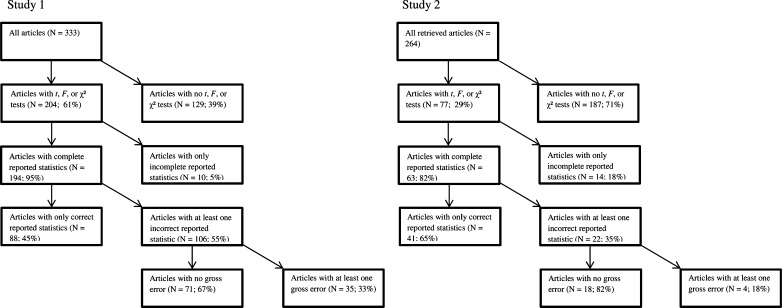
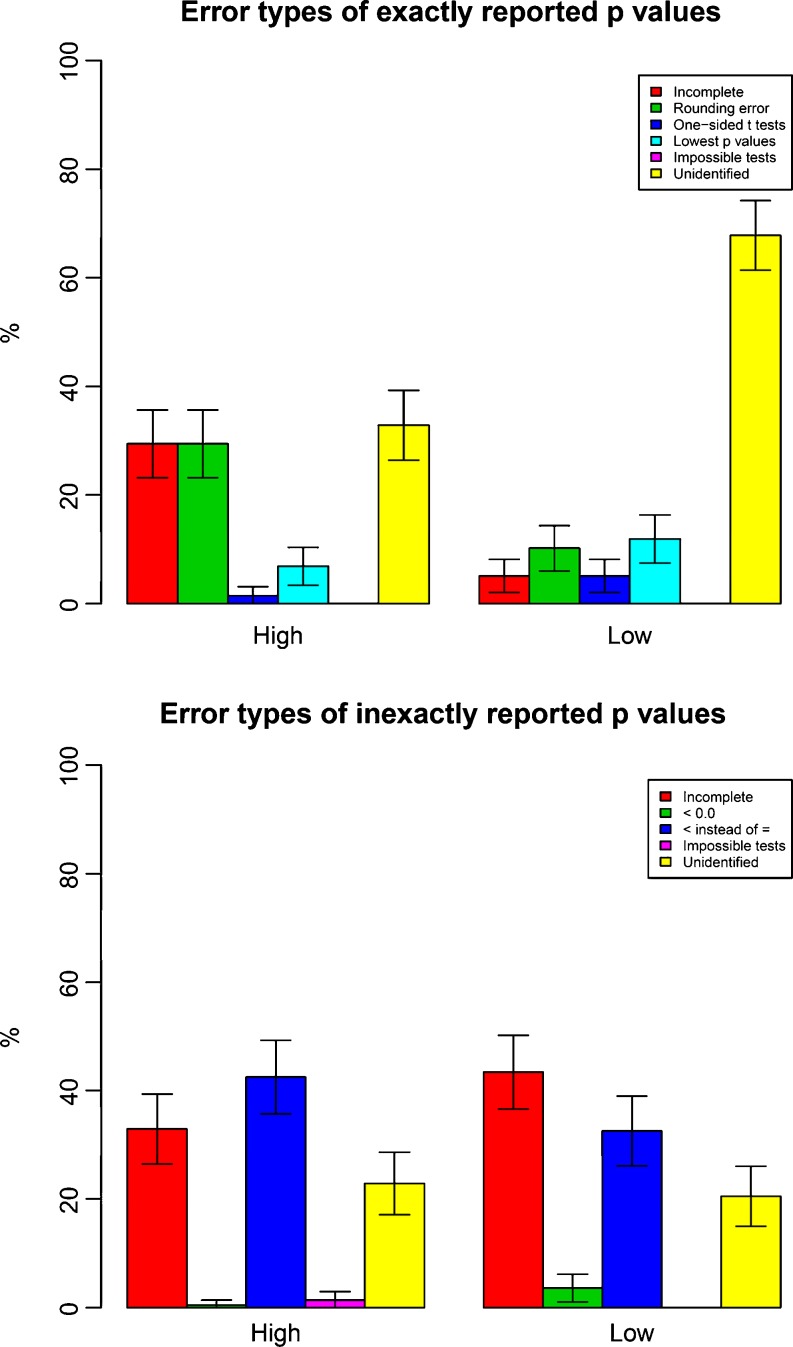
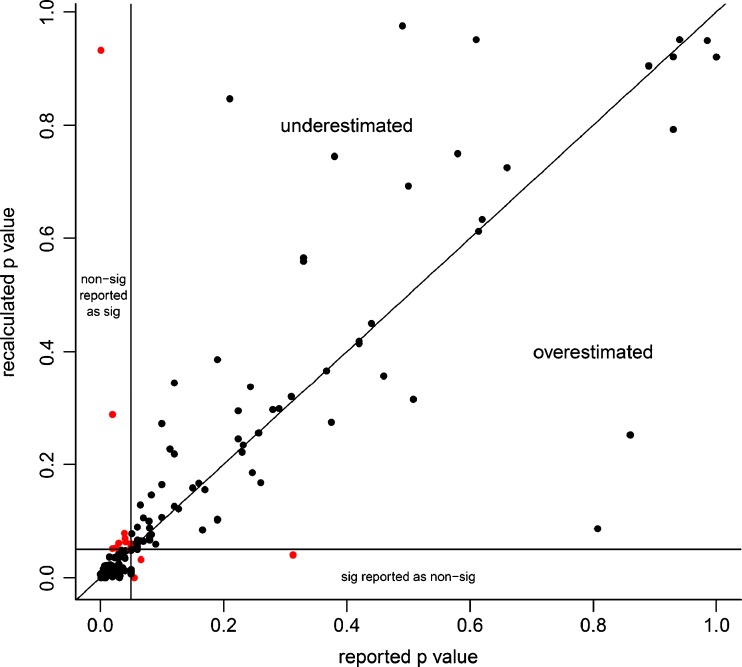
In order to study the prevalence, nature (direction), and causes of reporting errors in psychology, we checked the consistency of reported test statistics, degrees of freedom, and p values in a random sample of high- and low-impact psychology journals. In a second study, we established the generality of reporting errors in a random sample of recent psychological articles. Our results, on the basis of 281 articles, indicate that around 18% of statistical results in the psychological literature are incorrectly reported. Inconsistencies were more common in low-impact journals than in high-impact journals. Moreover, around 15% of the articles contained at least one statistical conclusion that proved, upon recalculation, to be incorrect; that is, recalculation rendered the previously significant result insignificant, or vice versa. These errors were often in line with researchers' expectations. We classified the most common errors and contacted authors to shed light on the origins of the errors.
Overview
The claims and statistics of this paper haven’t been checked yet.
Free: it reads the open-access text and checks the first 5 claims that cite a source we can check. Create a free account to check every claim.
Integrity signals
Registry
Cites
Statistics
Figures
Verification
Claims the paper makes
The claims and statistics of this paper haven’t been checked yet.
Free: it reads the open-access text and checks the first 5 claims that cite a source we can check. Create a free account to check every claim.
Claims other papers make about this one
Each is checked against this paper’s own text: does it say what the citing paper says it does?
The source backs part of the claim, not all of it — or backs it for a different population, condition or comparison.
In the citing paper
“From this perspective, it is not surprising that analysis pipelines are peppered with errors, ranging from the mundane to the serious [53–55].”
From Data availability, reusability, and analytic reproducibility: evaluating the impact of a mandatory open data policy at the journal Cognition (2018) · cites this paper as [53]
Experimental — accuracy not yet measuredThe cited source says what the claim attributes to it.
In the citing paper
“However, there is evidence that many reported p-values do not match their accompanying test statistic and degrees of freedom (Bakker & Wicherts, 2011; Bakker & Wicherts, 2014; Berle & Starcevic, 2007; Caperos & Pardo, 2013; Garcia-Berthou & Alcaraz, 2004; Veldkamp, Nuijten, Dominguez-Alvarez, Van Assen, & Wicherts, 2014; Wicherts, Bakker, & Molenaar, 2011).”
From The prevalence of statistical reporting errors in psychology (1985–2013) (2016) · cites this paper as Bakker & Wicherts, 2011
The cited source says what the claim attributes to it.
In the citing paper
“If the test statistic is incorrect and it is used to calculate the effect size for a meta-analysis, this effect size will be incorrect as well, which could affect the outcome of the meta-analysis (Bakker & Wicherts, 2011; in fact, the misreporting of all kinds of statistics is a problem for meta-analyses; Gotzsche, Hrobjartsson, Maric, & Tendal, 2007; Levine & Hullett, 2002).”
From The prevalence of statistical reporting errors in psychology (1985–2013) (2016) · cites this paper as Bakker & Wicherts, 2011
Experimental — accuracy not yet measuredThe cited source says what the claim attributes to it.
In the citing paper
“Bakker and Wicherts (2011) included only t, F, and χ 2 values”
From The prevalence of statistical reporting errors in psychology (1985–2013) (2016) · cites this paper as Bakker and Wicherts (2011)
The cited source says what the claim attributes to it.
In the citing paper
“it has been found that journals with lower impact factors have a higher prevalence of reporting inconsistencies than high impact journals (Bakker & Wicherts, 2011).”
From The prevalence of statistical reporting errors in psychology (1985–2013) (2016) · cites this paper as Bakker & Wicherts, 2011
2 more claims about this paper
Create a free account to see every claim other papers make about this one.
Self-check
Percentages, sums and reported differences re-computed from the paper’s own numbers.
The self-check needs the paper’s full text.
Citations
Cites
Borenstein, M., Hedges, L. V., Higgins, J. P. T., & Rothstein, H. R. (2009) · doi:10.1002/9780470743386 · Cited by 14,225
Borenstein, M., Hedges, L. V., Higgins, J. P. T., & Rothstein, H. R. (2021) · doi:10.1002/9781119558378 · Cited by 9,799
Reason, J. (1990) · doi:10.1017/cbo9781139062367 · Cited by 5,108
Cohen, J. (1994) · American Psychologist · doi:10.1037/0003-066x.49.12.997 · Cited by 4,003 · cited 9×
“These results show that NHST continues to be used in ways that defy the guidelines as proposed by the Task Force on Statistical Inference (Wilkinson and Task Force on Statistical Inference, 1999) and the last two versions of the APA Publication Manual (American Psychological Association, 2001, 2010).”
BackgroundMethodInfluentialPublication Manual of the American Psychological Association
DeCleene, K. E., & Fogo, J. (2012) · Occupational Therapy In Health Care · doi:10.3109/07380577.2011.629024 · Cited by 3,167
Statistical methods in psychology journals: Guidelines and explanations.
Wilkinson, L., & Task Force on Statistical Inference (1999) · American Psychologist · doi:10.1037/0003-066x.54.8.594 · Cited by 2,791
A practical solution to the pervasive problems ofp values
Wagenmakers, E.-J. (2007) · Psychonomic Bulletin & Review · doi:10.3758/bf03194105 · Cited by 2,490 · cited 1×
“This method has been extensively criticized (Cohen, 1994; Nickerson, 2000; Wagenmakers, 2007; Wilkinson and Task Force on Statistical Inference, 1999).”
MethodThe statistical power of abnormal-social psychological research: A review.
Cohen, J. (1962) · The Journal of Abnormal and Social Psychology · doi:10.1037/h0045186 · Cited by 1,824 · cited 9×
“These results show that NHST continues to be used in ways that defy the guidelines as proposed by the Task Force on Statistical Inference (Wilkinson and Task Force on Statistical Inference, 1999) and the last two versions of the APA Publication Manual (American Psychological Association, 2001, 2010).”
BackgroundInfluentialPublication Manual of the American Psychological Association (4th ed.).
Gullickson, T. (1996) · Contemporary Psychology: A Journal of Reviews · doi:10.1037/004700 · Cited by 1,240
Null hypothesis significance testing: a review of an old and continuing controversy
Nickerson, R. S. (2000) · Psychological Methods · doi:10.1037/1082-989x.5.2.241 · Cited by 1,090 · cited 1×
“This method has been extensively criticized (Cohen, 1994; Nickerson, 2000; Wagenmakers, 2007; Wilkinson and Task Force on Statistical Inference, 1999).”
Method
Research works printed but not linked: 1
- American Psychological Association Publication Manual of the American Psychological Association 2001 5 Washington, DC Author
Cited by
Items 201–300 of 358
THE (NON‐)SIGNIFICANCE OF REPORTING ERRORS IN ECONOMICS: EVIDENCE FROM THREE TOP JOURNALS
Pütz, P., & Bruns, S. B. (2020) · Journal of Economic Surveys · doi:10.1111/joes.12397 · Cited by 8
“Previous research from psychology indicates that reporting errors may be related to copy-paste mistakes 83 (Bakker and Wicherts, 2011), that authors of studies with reporting errors are reluctant to share data (Wicherts et al.”
BackgroundDistrust: Big Data, Data-Torturing, and the Assault on Science
Smith, G. (2023) · doi:10.1093/oso/9780192868459.001.0001 · Cited by 12
van Aert, R. C. M., Nuijten, M. B., Olsson-Collentine, A., Stoevenbelt, A. H., van den Akker, O. R., Klein, R. A., & Wicherts, J. M. (2023) · Royal Society Open Science · doi:10.1098/rsos.202326 · Cited by 6
“There are indications that there is a systematic tendency of inconsistencies to be in favour of the authors’ conclusions [19,35], but the bulk of reporting inconsistencies does not seem to have a direct effect on statistical conclusions [22].”
ResultSelf-citationWider die „Sternchenkunde“! Diskussionsbeitrag zur empirischen Sportwissenschaft
Büsch, D., & Strauß, B. (2015) · German Journal of Exercise and Sport Research · doi:10.1007/s12662-015-0376-x · Cited by 7
Anvari, F., Olsen, J., Yiu, H. W., & Feldman, G. (2020) · Journal of Experimental Social Psychology · doi:10.1016/j.jesp.2020.104052 · Cited by 9
Mounce, R. (2017) · Thesis Commons (OSF Preprints) · doi:10.31237/osf.io/7sa6d · Cited by 6
Veldkamp, C. L. S. (2017) · PsyArXiv (OSF Preprints) · doi:10.31234/osf.io/g8cjq · Cited by 6
Replicability in psychological research: a reflection
Leyva, S. B. C., & Domínguez-Lara, S. (2020) · Interacciones Revista de Avances en Psicología · doi:10.24016/2020.v6n3.172 · Cited by 12
Future of processing and facilitating change and learning
Löffler‐Stastka, H., & Steinmair, D. (2021) · World Journal of Psychiatry · doi:10.5498/wjp.v11.i9.507 · Cited by 6
Reconsidering what makes syntheses of psychological intervention studies useful
Sakaluk, J. K., Santis, C. D., Kilshaw, R. E., Pittelkow, M.-M., Brandes, C. M., Boness, C. L., Botanov, Y., Williams, A. J., Wendt, D. C., Lorenzo‐Luaces, L., et al. (2023) · Nature Reviews Psychology · doi:10.1038/s44159-023-00213-9 · Cited by 5
Two replications of Raymond, Shapiro, and Arnell (1992), The Attentional Blink
Grassi, M., Crotti, C., Giofrè, D., Boedker, I., & Toffalini, E. (2020) · Behavior Research Methods · doi:10.3758/s13428-020-01457-6 · Cited by 7
“…the focus on the effect size and its uncertainty—rather than the mere statistical significance—is a crucial practice which is not always observed (Bakker & Wicherts, 2011; Cumming et al., 2007; Giofrè et al., 2017), despite having been explicitly recommended by the American Psychological…”
BackgroundPresenting your results-II: Inferential statistics.
Omair, A. A. (2012) · PubMed · Cited by 5
Ready-Made Regression Tables from the Stargazer Package in Statistics EducationPreprint
Hlaváč, M. (2014) · SSRN Electronic Journal · doi:10.2139/ssrn.2407759 · Cited by 5
How to End Selective Reporting in Animal Research
ter Riet, G., & Bouter, L. M. (2016) · Methods and principles in medicinal chemistry · doi:10.1002/9783527695881.ch5 · Cited by 6
Michaels, J. L., Vallacher, R. R., & Nowak, A. K. (2021) · Elsevier eBooks · doi:10.1016/b978-0-12-813995-0.00038-8 · Cited by 6
Reproducibility, replicability, robustness, and generalizability in corpus linguistics
Flanagan, J. (2025) · International Journal of Corpus Linguistics · doi:10.1075/ijcl.24113.fla · Cited by 8
Sladekova, M., & Field, A. P. (2026) · Psychological Methods · doi:10.1037/met0000821 · Cited by 4
COLLEGE STUDENTS’ INTERPRETATION OF RESEARCH REPORTS ON GROUP DIFFERENCES: THE TALL-TALE EFFECT
Hogan, T. P., Zaboski, B. A., & PERRY, T. R. (2015) · Statistics Education Research Journal · doi:10.52041/serj.v14i1.270 · Cited by 3
The Role of Theory in Quantitative Data Analysis
Pigott, T. (2017) · SAGE Publications Ltd eBooks · doi:10.4135/9781473983953.n35 · Cited by 6
“As discussed above, many are concerned about research quality in medicine and the social sciences (for example, Ioannidis, 2005; Bakker and Wicherts, 2011; Simmons, Nelson and Simonsohn, 2011).”
BackgroundInfluentialCrowdsourcing Global Perspectives in Ecology Using Social Media
Graham, E. B., & Smith, A. P. (2021) · Frontiers in Ecology and Evolution · doi:10.3389/fevo.2021.588894 · Cited by 6
“Indeed, research from small teams is more error prone (García-Berthou and Alcaraz, 2004; Bakker and Wicherts, 2011; Salter et al., 2014), and work done by untrained citizen scientists yields comparable error to professional scientists (Kosmala et al.”
ResultAssessing Statistical Results in MOR Articles: An Essay on Verifiability and Ways to Enhance It
Li, M., Sharp, B. M., & Bergh, D. D. (2017) · Management and Organization Review · doi:10.1017/mor.2017.18 · Cited by 4
“The overall verifiability rate of reported statistics published in MOR is 91% based on Test One, which is slightly better than 89% in medical journals (GarcíaBerthou & Alcaraz, 2004), 86% in psychiatry journals (Berle & Starcevic, 2007), and 82% in psychology journals (Bakker & Wicherts, 2011).”
BackgroundMethodResultInfluentialKato, T. (2018) · The Japanese Journal of Personality · doi:10.2132/personality.27.2.11 · Cited by 6
Multimorbidity in general practice : adverse health effects and innovative research strategies
Aarts, S. (2012) · Research Publications (Maastricht University) · doi:10.26481/dis.20120413sa · Cited by 6
Hardwicke, T. E. (2017) · Thesis Commons (OSF Preprints) · doi:10.31237/osf.io/r4c32 · Cited by 5
“…2012; Giner-Sorolla, 2012; Nosek, Spies, & Motyl, 2012), their interpretations of the data are highly susceptible to bias and error, even when this is unintentional (Marjan Bakker & Wicherts, 2011; Chamberlin, 1965; John, Loewenstein, & Prelec, 2012; O’Boyle, Banks, & Gonzalez-Mule, 2014).”
BackgroundMeticulous manuscripts, messy results: Working together for robust science reporting
Barber, L. K. (2017) · Stress and Health · doi:10.1002/smi.2756 · Cited by 4
“Given that statistical inaccuracies are a common issue in published research (Bakker & Wicherts, 2011; Nuijten, Hartgerink, van Assen, Epskamp, & Wicherts, 2016), I encourage authors to use freely available resources (e.g., http://statcheck.io) to check their statistical reporting.”
BackgroundP-curving x-phi: Does experimental philosophy have evidential value?Preprint
Stuart, M. T., Colaço, D., & Machery, É. (2018) · PsyArXiv (OSF Preprints) · doi:10.31234/osf.io/p7ube · Cited by 4
Scholarly Communication and Open Access in Psychology: Current Considerations for ResearchersPreprint
Mullen, L. B. (2019) · PsyArXiv (OSF Preprints) · doi:10.31234/osf.io/2d7um · Cited by 4
“(Bakker & Wicherts, 2011, p.666) Even with the publication of corrective guidelines about the use and misuse of p-values, for instance, by the American Statistical Association in 2016 (and many other such guidelines published over the years), the problems of “misuse of statistical procedures and…”
BackgroundThe emerging submission crisis in behavioral science
Spitzer, M. (2026) · Trends in Neuroscience and Education · doi:10.1016/j.tine.2026.100276 · Cited by 5
Dunn, J., Mishra, V., Shandhi, M. M. H., Jeong, H., Yamane, N., Watanabe, Y., Chen, B. B., & Goodwin, M. S. (2025) · Frontiers in Digital Health · doi:10.3389/fdgth.2024.1467424 · Cited by 5
“In addition, reported results are frequently incorrect or misstated (20).”
La significación estadística no es suficiente. [Statistical significance is not enough].
Moro, M. I. B. (2015) · RICYDE Revista Internacional de Ciencias del Deporte · doi:10.5232/ricyde2015.040ed · Cited by 6
A critical re-analysis of six implicit learning papers
McKay, B., & Carter, M. J. (2023) · Meta-Psychology · doi:10.15626/mp.2021.2938 · Cited by 3
“Statistical reporting errors may commonly occur in psychology articles (Brown & Heathers, 2017; Nuijten et al., 2016) and such errors are often consistent with hypothesized results (Bakker & Wicherts, 2011).”
ResultConflicting Results and Statistical Malleability: Embracing Pluralism of Empirical Results
Maziarz, M. (2024) · Perspectives on Science · doi:10.1162/posc_a_00627 · Cited by 6
“Replication projects indicate that calculation errors or fraudulent practices are present in as many as 1 in 7 studies (Bakker and Wicherts 2011).”
BackgroundData Hazards as An Ethical Toolkit for Neuroscience
García, S. R., Welsh, C., Cara, N. H. D., Sterratt, D. C., Romanò, N., & Stefan, M. I. (2025) · Neuroethics · doi:10.1007/s12152-024-09580-3 · Cited by 9
“Faulty results can manifest in many ways, such as (but not restricted to) inconsistencies in graph outputs; erroneous statistical reporting [123],errors in the use of programming languages due to typos or mis-interpretation of function documentation; misreporting of methods in wet-lab research.”
Sources of bias in general linear models: evaluating the analytic practice in psychological research
Sladekova, M., Poupa, V. L., & Field, A. P. (2026) · Royal Society Open Science · doi:10.1098/rsos.250076 · Cited by 7
Amoroso, T. (2018) · Drug Science Policy and Law · doi:10.1177/2050324518789214 · Cited by 4
“Conscious and unconscious manipulation of research data has been found in many areas of research (Bakker and Wicherts, 2011; Pashler and Wagenmakers, 2012; Simmons et al., 2011) and is not only a potential issue for ecstasy research.”
BackgroundCharan, J., & Saxena, D. B. (2014) · Journal of Postgraduate Medicine · doi:10.4103/0022-3859.143954 · Cited by 4
Research Integrity: Perspectives from Australia and Netherlands
Israel, M., & Drenth, P. J. D. (2015) · Springer eBooks · doi:10.1007/978-981-287-079-7_64-2 · Cited by 3
Montalbán, J. M. C., Olmos, R., & Pardo, A. (2016) · Methodology · doi:10.1027/1614-2241/a000107 · Cited by 3
EĞİTİM BİLİMLERİ ALANINDAKİ LİSANSÜSTÜ TEZLERDE VARSAYIM KULLANIMI
Başman, M., Uluman, M., & Tunç, E. B. (2018) · Abant İzzet Baysal Üniversitesi Eğitim Fakültesi Dergisi · doi:10.17240/aibuefd.2018.18.37322-431426 · Cited by 3
Les pratiques de recherche ouvertes en psychologie
Lantian, A. (2020) · Psychologie Française · doi:10.1016/j.psfr.2020.09.001 · Cited by 6
Compassion Fatigue and Crisis Workers' Attitude to Work
Loolo, M. A. (2016) · ScholarWorks (Walden University) · Cited by 6
Contributions towards understanding and building sustainable sciencePreprint
Hartgerink, C. H. J. (2019) · Thesis Commons (OSF Preprints) · doi:10.31237/osf.io/4wtpc · Cited by 3
Hodges, C. B., Lindsey, H. M., Stone, B. M., Johnson, P. K., & Carter, J. H. (2020) · PsyArXiv (OSF Preprints) · doi:10.31234/osf.io/zem2w · Cited by 4
Questionable Research Practices and Open Science in Quantitative CriminologyPreprint
Chin, J. M., Pickett, J. T., Vazire, S., & Holcombe, A. O. (2024) · CrimRxiv · doi:10.21428/cb6ab371.0d3ec44f · Cited by 3
Examining retraction counts to evaluate journal quality in psychology
Behera, P. K., Jain, S. J., & Kumar, A. (2024) · Current Psychology · doi:10.1007/s12144-024-06044-y · Cited by 5
“These errors signifi - cantly favored the researchers’ anticipated outcomes, result - ing in non-significant findings being presented as significant (Bakker & Wicherts, 2011 ).”
de Leeuw, T., & Keijl, S. (2021) · Sociological Methods & Research · doi:10.1177/0049124120986184 · Cited by 3
“…on research quality, the verifiability, reliability, and replicability of research in general and strategic management specifically (see, e.g., Bakker and Wicherts 2011; Bergh et al. 2017; Goldfarb and King 2016; Kepes et al. 2014), by showing that also the MM is an important element which…”
BackgroundQuestionable Research Practices (QRPs) and Their Devastating Scientific Effects
Bausell, R. B. (2021) · Oxford University Press eBooks · doi:10.1093/oso/9780197536537.003.0004 · Cited by 2
Murphy, T. (2013) · Criminal Justice Matters · doi:10.1080/09627251.2013.865503 · Cited by 2
Empirically Supported Treatments and Efficacy Trials: What Steps Do We Still Need to Take?
Nasser, J. D. (2013) · Journal of Contemporary Psychotherapy · doi:10.1007/s10879-013-9236-x · Cited by 2
“In a random sample of 281 psychology articles, 15 and 18 % of statistical results were incorrectly calculated and reported, respectively (Bakker and Wicherts 2011).”
BackgroundMethodResultInfluentialStatistics in Public Understanding of Science review: How to achieve high statistical standards?
von Roten, F. C. (2015) · Public Understanding of Science · doi:10.1177/0963662515595195 · Cited by 3
“Consequences of statistical errors in academic journal articles have long been studied in various fields (Bakker and Wicherts, 2011; Ioannidis, 2005).”
BackgroundImproving the ACGIH threshold limit value (TLV) process
Smith, C. J., & Perfetti, T. A. (2018) · Toxicology Research and Application · doi:10.1177/2397847318801758 · Cited by 3
Nasr, S. S., Sherif, G. M., Ibrahim, A. S., & Allam, R. M. (2020) · Journal of the Egyptian National Cancer Institute · doi:10.1186/s43046-020-00050-4 · Cited by 2
Open Science Practices in The Journal Human Factors : 2017–2022
McCarley, J. S., Rose, L. E., Fischer, S., Haney, M. S., Hyk, A., Kuhn, K., Meredith, B., Moussaoui, J. R., Andrade, F. M. G., Pietrok, E. M., et al. (2023) · Proceedings of the Human Factors and Ergonomics Society Annual Meeting · doi:10.1177/21695067231192276 · Cited by 4
“Nonetheless, given the reputational advantages that accrue from open science practices (Schneider et al., 2022; Wicherts et al., 2011), and the move toward openness and transparency in peer journals, the current low rate of open science adoption is potentially concerning.”
BackgroundThe balancing effect in brain-machine interactionPreprint
Pallikari, F. (2016) · arXiv (Cornell University) · doi:10.48550/arxiv.1602.00808 · Cited by 2
Opinions on the value of direct replication: A survey of 2,000 psychologistsPreprint
Buttliere, B., & Wicherts, J. M. (2018) · PsyArXiv (OSF Preprints) · doi:10.31234/osf.io/z9kx6 · Cited by 3
Self-citationAnalytic Review as a Solution to the Misreporting of Statistical Results in Psychological SciencePreprint
Sakaluk, J. K., Williams, A. J., & Biernat, M. (2017) · PsyArXiv (OSF Preprints) · doi:10.31234/osf.io/y6g89 · Cited by 2
ÖZDEMİR, A., SAYIN, İ., & ULUYOL, A. (2022) · Sakarya University Journal of Education · doi:10.19126/suje.883817 · Cited by 2
Kingston, N. M., Wilson, T. D., Quintana, R., & Peng, A. (2025) · Frontiers in Psychology · doi:10.3389/fpsyg.2025.1641211 · Cited by 1
Pozitivist-Ampirik Araştırmalarda İnsan: Yanıltmacanın Dünü, Bugünü ve Yarını - 2
Yüksel, A. (2020) · Seyahat ve Otel İşletmeciliği Dergisi · doi:10.24010/soid.720112 · Cited by 1
Response to Chris Crandall and John Symons
Machery, É. (2020) · Inquiry · doi:10.1080/0020174x.2020.1804175 · Cited by 1
“Statistical reporting is also faulty in psychology: For instance, Bakker and Wicherts (2011) have shown that 18% of statistical results are misreported (see also Nuijten et al. 2016).”
BackgroundInfluentialInternal and External Validity
Kazdin, A. E. (2021) · Cambridge University Press eBooks · doi:10.1017/9781108993647.003 · Cited by 1
Research Integrity: Perspectives from Australia and Netherlands
Israel, M., & Drenth, P. (2015) · Springer eBooks · doi:10.1007/978-981-287-079-7_64-1 · Cited by 1
Can the Null Hypothesis Be “Proven” by Using Large Numbers of Predictor Variables?
Perez, M., Schumm, W. R., AlRashed, A., & Crawford, D. W. (2019) · Psychology Research and Applications · doi:10.22606/pra.2019.12001 · Cited by 1
p-Values Less Than 0.05 in Psychology: What is Going on?
Hartgerink, C. H. J., van Aert, R. C. M., Nuijten, M. B., Wicherts, J. M., van Assen, M. A. L. M., & Gruber, C. W. (2020) · Springer eBooks · doi:10.1007/978-3-030-48043-1_3 · Cited by 1
Self-citationCase-Control and Cohort Designs
Kazdin, A. E. (2021) · Cambridge University Press eBooks · doi:10.1017/9781108993647.008 · Cited by 2
Null Hypothesis Significance Testing
Kazdin, A. E. (2021) · Cambridge University Press eBooks · doi:10.1017/9781108993647.014 · Cited by 1
La investigación en el síndrome de burnout: reflexión crítica desde una perspectiva metodológica
ESTREMERA, R. A. (2018) · LA Referencia (Red Federada de Repositorios Institucionales de Publicaciones Científicas) · Cited by 1
Smith, G. (2023) · Oxford University Press eBooks · doi:10.1093/oso/9780192868459.003.0002 · Cited by 1
Good science, bad science: Questioning research practices in psychological research
Bakker, M. (2014) · UvA-DARE (University of Amsterdam) · Cited by 1
Self-citationBrown, N. (2019) · University of Groningen research database (University of Groningen / Centre for Information Technology) · doi:10.33612/diss.99196913 · Cited by 2
Heterogeneity of research results: New perspectives on psychological science
Linden, A. H. (2019) · Northumbria Research Link (Northumbria University) · Cited by 2
Improving Research in Educational Psychology, Psychology, and the Social SciencesPreprint
Smith, K. N., Makel, M. C., & Plucker, J. A. (2019) · PsyArXiv (OSF Preprints) · doi:10.31234/osf.io/ams9e · Cited by 1
Publication Bias and Evidential Value in Speech, Language, and Hearing ResearchPreprint
Alexander, J., & Green, J. (2021) · OSF Preprints (OSF Preprints) · doi:10.31219/osf.io/vncbs · Cited by 1
Beyond Statistical Significance: Five Principles for the New Era of Data Analysis and ReportingPreprint
Wedel, M., & Gal, D. (2023) · PsyArXiv (OSF Preprints) · doi:10.31234/osf.io/6kvnf · Cited by 1
Translational neuroscience requires better design and analysis of preclinical studiesPreprint
Lazic, S. E. (2012) · Nature Precedings · doi:10.1038/npre.2012.6987.1 · Cited by 2
“[48] Bakker M, Wicherts JM.”
Allen, B. N. (2015) · Scholarship@Western (Western University) · Cited by 1
Does an academic copy-editor require knowledge of statistics?
Fonseca, M. (2019) · Editage Insights · doi:10.34193/ei-a-6302
Menie, M. A. W. O. (2012) · Intelligence · doi:10.1016/j.intell.2012.08.002
Tressoldi, P. E., Cumming, G., Fresc, L., & Giofrr, D. (2016) · SSRN Electronic Journal · doi:10.2139/ssrn.2712603
Macroscopic Neural Theories of Cognition
Uttal, W. R. (2014) · Defense Technical Information Center (DTIC) · doi:10.21236/ada597175
“Similar points have been made by Simmons, Nelson, and Simonsohn (2011) and Bakker and Wicherts (2011) for purely psychological studies.”
BackgroundPreprint of Too good to be false: Nonsignificant results revisitedPreprint
Hartgerink, C. H. J., Wicherts, J. M., & van Assen, M. A. L. M. (2016) · OSF Preprints (OSF Preprints) · doi:10.31219/osf.io/rkumy · Cited by 1
Self-citationSetting-up a clinical trial: Some methodological recommendations
Colombo, D., Cipresso, P., Pedroli, E., & Riva, G. (2017) · Anuario de Psicología/The UB Journal of Psychology · doi:10.1016/j.anpsic.2017.12.001 · Cited by 1
Ch., R. P. R. (2018) · UPM Digital Archive (Technical University of Madrid) · doi:10.20868/upm.thesis.50368
Nonparametric Statistical Analysis in Psychology
Privitera, G. J., & Gillespie, J. J. (2018) · doi:10.1093/obo/9780199828340-0221
Scientific Utopia: I. Opening scientific communicationPreprint
Nosek, B. A., & Bar‐Anan, Y. (2012) · arXiv (Cornell University) · doi:10.48550/arxiv.1205.1055
“Rosenthal (1979) named this the “file-drawer effect,” which can be very costly for knowledge accumulation.”
BackgroundScientific Utopia: II. Restructuring incentives and practices to promote truth over publishabilityPreprint
Nosek, B. A., Spies, J. R., & Motyl, M. S. (2016) · OSF Preprints (OSF Preprints) · doi:10.31219/osf.io/k4bgq_v1
Nature of Occupational Incidents among Electrical ContractorsPreprint
Gholizadeh, P., & Esmaeili, B. (2019) · Preprints.org · doi:10.20944/preprints201912.0411.v1
“Researchers have used this test for more than 100 years [35]: in psychology studies that were published in six journals in 2008 alone, the results of the chi-square test were reported more than 600 times [36].”
MethodCommunication Inefficiencies and Research Validity in International Studies
Walker, L. D. (2020) · International Studies Review · doi:10.1093/isr/viaa015 · Cited by 1
Advancing best practices in data analysis with automatic and optimized output data analysis softwarePreprint
Krajcsi, A. (2021) · PsyArXiv (OSF Preprints) · doi:10.31234/osf.io/hnmsq · Cited by 2
A critical re-analysis of six implicit learning papersPreprint
McKay, B., & Carter, M. J. (2021) · doi:10.31234/osf.io/n8mab
Kazdin, A. E. (2021) · Cambridge University Press eBooks · doi:10.1017/9781108993647.001
Construct and Data-Evaluation Validity
Kazdin, A. E. (2021) · Cambridge University Press eBooks · doi:10.1017/9781108993647.004
Single-Case Experimental Research Designs
Kazdin, A. E. (2021) · Cambridge University Press eBooks · doi:10.1017/9781108993647.009
Kazdin, A. E. (2021) · Cambridge University Press eBooks · doi:10.1017/9781108993647.007
Cautions, Negative Effects, and Replication
Kazdin, A. E. (2021) · Cambridge University Press eBooks · doi:10.1017/9781108993647.016
Selecting Measures for Research
Kazdin, A. E. (2021) · Cambridge University Press eBooks · doi:10.1017/9781108993647.011
Kazdin, A. E. (2021) · Cambridge University Press eBooks · doi:10.1017/9781108993647.021
Kazdin, A. E. (2021) · Cambridge University Press eBooks · doi:10.1017/9781108993647.013
Kazdin, A. E. (2021) · Cambridge University Press eBooks · doi:10.1017/9781108993647.022
Ideas that Begin the Research Process
Kazdin, A. E. (2021) · Cambridge University Press eBooks · doi:10.1017/9781108993647.005
Metadata
- Authors
- Bakker, M., & Wicherts, J. M.
- Affiliations
- University of Amsterdam (NL)
- Corresponding author
- Bakker, Marjan
- Venue
- Behavior Research Methods
- Published
- 2011-04-15
- Volume
- 43
- Issue
- 3
- Pages
- 666-678
- ISSN
- 1554-351X (ISSN-L)
- 1554-3528
- PMC
- PMC3174372
- OpenAlex
- W2168452606
- Semantic Scholar
- 1f3ffc1fefe267e6fd77ef972882d943fd72a317
- Cited by
- 356
- References
- 34
- Citations by year
- 2026: 7 · 2025: 12 · 2024: 9 · 2023: 34 · 2022: 16 · 2021: 49 · 2020: 21 · 2019: 34 · 2018: 29 · 2017: 33 · 2016: 31 · 2015: 23 · 2014: 18 · 2013: 20 · 2012: 19
- FWCI
- 24.30
- Type
- journal article
- Language
- en
- Open access
- hybrid
- doi.org
- Licence
- cc-by-nc
- www.springer.com/tdm (tdm)
- Locations
- Behavior Research Methods (publishedVersion, cc-by-nc)
- Europe PMC (PubMed Central) (publishedVersion, cc-by-nc)
- PubMed Central (publishedVersion, cc-by-nc)
- PubMed (publishedVersion)
- UvA-DARE (University of Amsterdam) (publishedVersion, other-oa)
- Data Archiving and Networked Services (DANS) (submittedVersion, other-oa)
- Research portal (Tilburg University) (submittedVersion, cc-by-nc)
- UvA-DARE (University of Amsterdam) (submittedVersion, other-oa)
- Topics
- Social Sciences › Psychology › Experimental and Cognitive Psychology › Psychology Research and Bibliometrics
- Social Sciences › Decision Sciences › Statistics, Probability and Uncertainty › Meta-analysis and systematic reviews
- Social Sciences › Library and Information Sciences › Academic Writing and Publishing
- Keywords
- statistical reporting errors, p-values, test statistics, degrees of freedom, journal impact factor, significance testing, research integrity, psychology literature
- MeSH terms
- Humans, Periodicals as Topic, Psychology, Research Design, Statistics as Topic
About these checks
Registry, retraction, Cites and statistics results are computed, not judged, with one exception: a printed reference that no index lists is read once by a model before it counts as a citation error. Claims are extracted by a model and kept only when their quote appears verbatim in the text; each cited source is then checked, with a model’s help, for whether it says what the claim relies on. Those verdicts can be wrong — read the claim’s quote and the cited source before relying on one.
Statistics and arithmetic are recomputed, not judged.
Confidence bands are shown only for fields calibrated on our annotated test set. None is calibrated yet, so no band is shown.
What counts as a claim ›How we measure confidence ›How we check this ›
Are you an author, or do you see a problem with this page? Request a review
Data sources
Bibliographic data: Semantic Scholar, OpenAlex, Crossref.
Contains information from the Semantic Scholar Academic Graph Datasets, made available under the ODC Attribution License (ODC-BY 1.0).
Semantic Scholar’s data is described in: Kinney, R., et al. (2023). The Semantic Scholar Open Data Platform. arXiv:2301.10140.
