

The (mis)reporting of statistical results in psychology journals
Open accessThe DOI matches its Crossref record; 34 of the 34 references it cites were found in a registry or an index.
Abstract
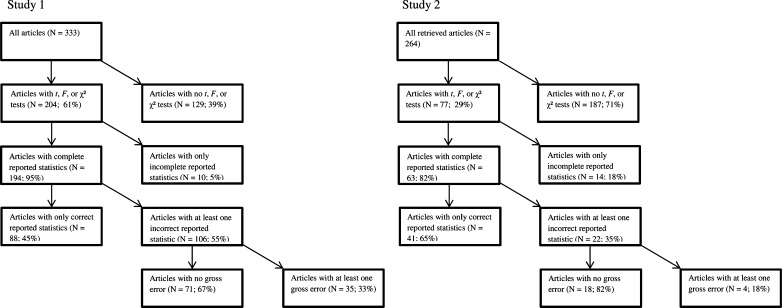
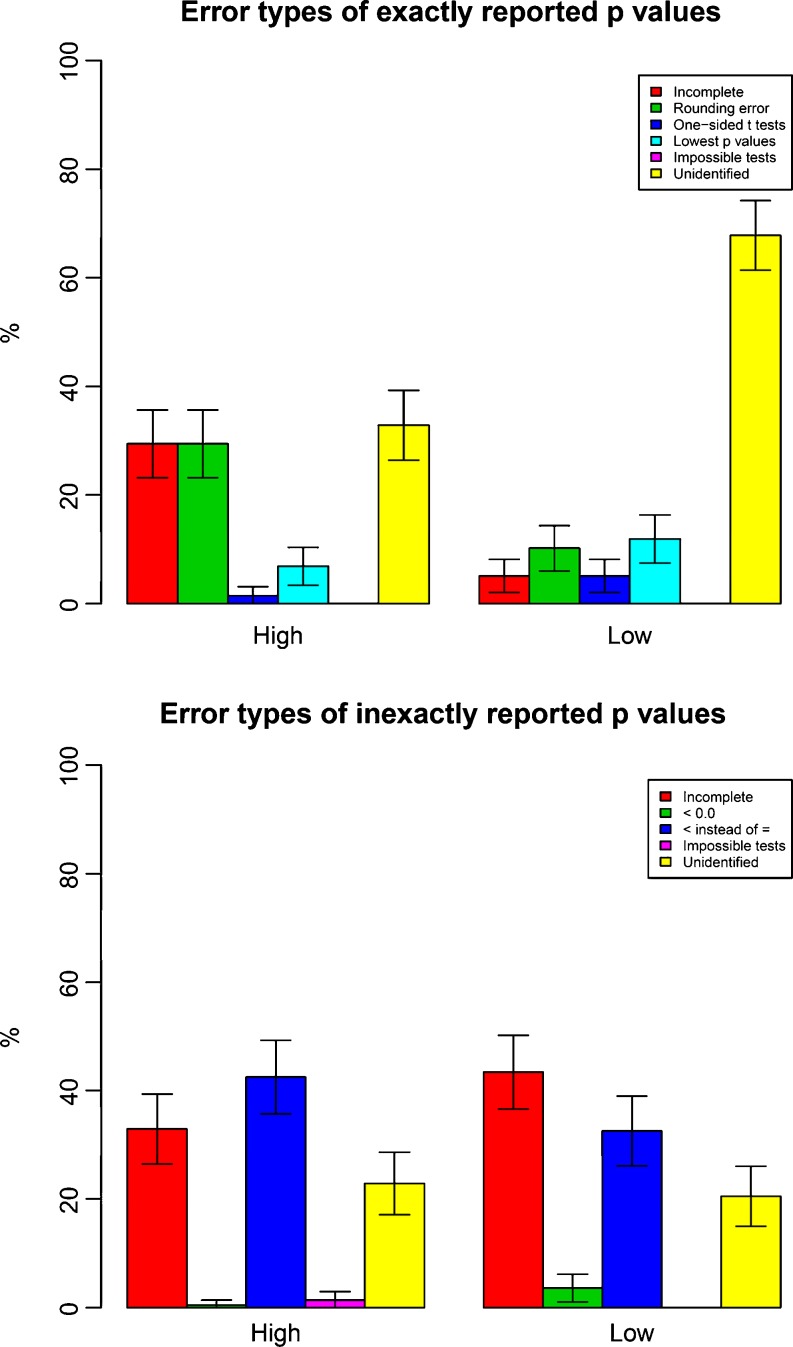
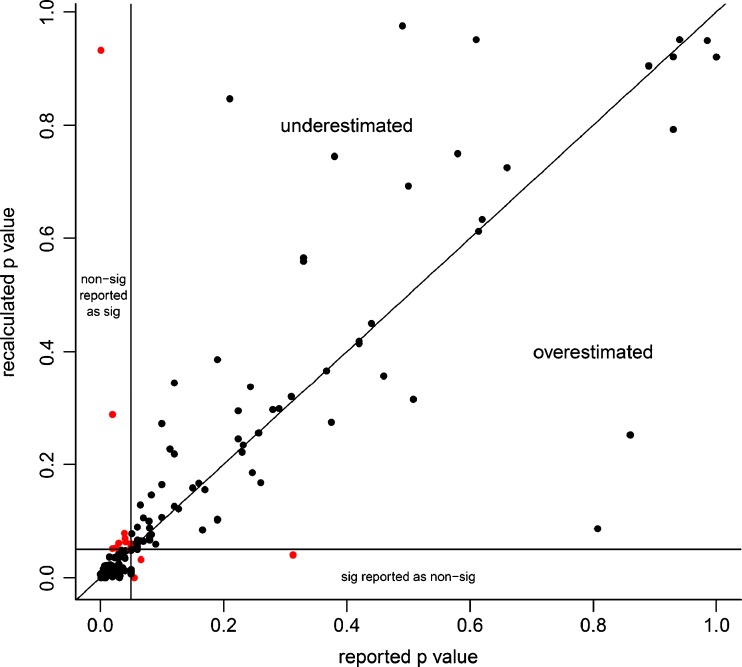
In order to study the prevalence, nature (direction), and causes of reporting errors in psychology, we checked the consistency of reported test statistics, degrees of freedom, and p values in a random sample of high- and low-impact psychology journals. In a second study, we established the generality of reporting errors in a random sample of recent psychological articles. Our results, on the basis of 281 articles, indicate that around 18% of statistical results in the psychological literature are incorrectly reported. Inconsistencies were more common in low-impact journals than in high-impact journals. Moreover, around 15% of the articles contained at least one statistical conclusion that proved, upon recalculation, to be incorrect; that is, recalculation rendered the previously significant result insignificant, or vice versa. These errors were often in line with researchers' expectations. We classified the most common errors and contacted authors to shed light on the origins of the errors.
Overview
The claims and statistics of this paper haven’t been checked yet.
Free: it reads the open-access text and checks the first 5 claims that cite a source we can check. Create a free account to check every claim.
Integrity signals
Registry
Cites
Statistics
Figures
Verification
Claims the paper makes
The claims and statistics of this paper haven’t been checked yet.
Free: it reads the open-access text and checks the first 5 claims that cite a source we can check. Create a free account to check every claim.
Claims other papers make about this one
Each is checked against this paper’s own text: does it say what the citing paper says it does?
The source backs part of the claim, not all of it — or backs it for a different population, condition or comparison.
In the citing paper
“From this perspective, it is not surprising that analysis pipelines are peppered with errors, ranging from the mundane to the serious [53–55].”
From Data availability, reusability, and analytic reproducibility: evaluating the impact of a mandatory open data policy at the journal Cognition (2018) · cites this paper as [53]
Experimental — accuracy not yet measuredThe cited source says what the claim attributes to it.
In the citing paper
“However, there is evidence that many reported p-values do not match their accompanying test statistic and degrees of freedom (Bakker & Wicherts, 2011; Bakker & Wicherts, 2014; Berle & Starcevic, 2007; Caperos & Pardo, 2013; Garcia-Berthou & Alcaraz, 2004; Veldkamp, Nuijten, Dominguez-Alvarez, Van Assen, & Wicherts, 2014; Wicherts, Bakker, & Molenaar, 2011).”
From The prevalence of statistical reporting errors in psychology (1985–2013) (2016) · cites this paper as Bakker & Wicherts, 2011
The cited source says what the claim attributes to it.
In the citing paper
“If the test statistic is incorrect and it is used to calculate the effect size for a meta-analysis, this effect size will be incorrect as well, which could affect the outcome of the meta-analysis (Bakker & Wicherts, 2011; in fact, the misreporting of all kinds of statistics is a problem for meta-analyses; Gotzsche, Hrobjartsson, Maric, & Tendal, 2007; Levine & Hullett, 2002).”
From The prevalence of statistical reporting errors in psychology (1985–2013) (2016) · cites this paper as Bakker & Wicherts, 2011
Experimental — accuracy not yet measuredThe cited source says what the claim attributes to it.
In the citing paper
“Bakker and Wicherts (2011) included only t, F, and χ 2 values”
From The prevalence of statistical reporting errors in psychology (1985–2013) (2016) · cites this paper as Bakker and Wicherts (2011)
The cited source says what the claim attributes to it.
In the citing paper
“it has been found that journals with lower impact factors have a higher prevalence of reporting inconsistencies than high impact journals (Bakker & Wicherts, 2011).”
From The prevalence of statistical reporting errors in psychology (1985–2013) (2016) · cites this paper as Bakker & Wicherts, 2011
2 more claims about this paper
Create a free account to see every claim other papers make about this one.
Self-check
Percentages, sums and reported differences re-computed from the paper’s own numbers.
The self-check needs the paper’s full text.
Citations
Cites
Borenstein, M., Hedges, L. V., Higgins, J. P. T., & Rothstein, H. R. (2009) · doi:10.1002/9780470743386 · Cited by 14,225
Borenstein, M., Hedges, L. V., Higgins, J. P. T., & Rothstein, H. R. (2021) · doi:10.1002/9781119558378 · Cited by 9,799
Reason, J. (1990) · doi:10.1017/cbo9781139062367 · Cited by 5,108
Cohen, J. (1994) · American Psychologist · doi:10.1037/0003-066x.49.12.997 · Cited by 4,003 · cited 9×
“These results show that NHST continues to be used in ways that defy the guidelines as proposed by the Task Force on Statistical Inference (Wilkinson and Task Force on Statistical Inference, 1999) and the last two versions of the APA Publication Manual (American Psychological Association, 2001, 2010).”
BackgroundMethodInfluentialPublication Manual of the American Psychological Association
DeCleene, K. E., & Fogo, J. (2012) · Occupational Therapy In Health Care · doi:10.3109/07380577.2011.629024 · Cited by 3,167
Statistical methods in psychology journals: Guidelines and explanations.
Wilkinson, L., & Task Force on Statistical Inference (1999) · American Psychologist · doi:10.1037/0003-066x.54.8.594 · Cited by 2,791
A practical solution to the pervasive problems ofp values
Wagenmakers, E.-J. (2007) · Psychonomic Bulletin & Review · doi:10.3758/bf03194105 · Cited by 2,490 · cited 1×
“This method has been extensively criticized (Cohen, 1994; Nickerson, 2000; Wagenmakers, 2007; Wilkinson and Task Force on Statistical Inference, 1999).”
MethodThe statistical power of abnormal-social psychological research: A review.
Cohen, J. (1962) · The Journal of Abnormal and Social Psychology · doi:10.1037/h0045186 · Cited by 1,824 · cited 9×
“These results show that NHST continues to be used in ways that defy the guidelines as proposed by the Task Force on Statistical Inference (Wilkinson and Task Force on Statistical Inference, 1999) and the last two versions of the APA Publication Manual (American Psychological Association, 2001, 2010).”
BackgroundInfluentialPublication Manual of the American Psychological Association (4th ed.).
Gullickson, T. (1996) · Contemporary Psychology: A Journal of Reviews · doi:10.1037/004700 · Cited by 1,240
Null hypothesis significance testing: a review of an old and continuing controversy
Nickerson, R. S. (2000) · Psychological Methods · doi:10.1037/1082-989x.5.2.241 · Cited by 1,090 · cited 1×
“This method has been extensively criticized (Cohen, 1994; Nickerson, 2000; Wagenmakers, 2007; Wilkinson and Task Force on Statistical Inference, 1999).”
Method
Research works printed but not linked: 1
- American Psychological Association Publication Manual of the American Psychological Association 2001 5 Washington, DC Author
Cited by
P-curve: A key to the file-drawer.
Simonsohn, U., Nelson, L. D., & Simmons, J. P. (2014) · Journal of Experimental Psychology: General · doi:10.1037/a0033242 · Cited by 1,500
Nosek (2012) · doi:10.1177/1745691612459058 · Cited by 1,301
“The rate of errors in published research is unknown, but a study by Bakker and Wicherts (2011) is breathtaking.”
The rules of the game called psychological science
Bakker, M., van Dijk, A., & Wicherts, J. M. (2012) · Perspectives on Psychological Science · doi:10.1177/1745691612459060 · Cited by 800
“In NHST, the researcher defines a null hypothesis of no effect (H0) and then determines the chance of finding at least the observed effect given that this null hypothesis is true.”
MethodInfluentialSelf-citationReplicability, Robustness, and Reproducibility in Psychological Science
Nosek, B. A., Hardwicke, T. E., Moshontz, H., Allard, A., Corker, K. S., Dreber, A., Fidler, F., Hilgard, J., Kline Struhl, M., Nuijten, M. B., et al. (2022) · Annual Review of Psychology · doi:10.1146/annurev-psych-020821-114157 · Cited by 770
Szucs, D., & Ioannidis, J. P. A. (2017) · PLOS Biology · doi:10.1371/journal.pbio.2000797 · Cited by 761
Wicherts, J. M., Veldkamp, C. L. S., Augusteijn, H. E. M., Bakker, M., van Aert, R. C. M., & van Assen, M. A. L. M. (2016) · Frontiers in Psychology · doi:10.3389/fpsyg.2016.01832 · Cited by 754
“First, researcher(s) could R5: Misreport results and p-values (Bakker and Wicherts, 2011), for instance by presenting a statistically non-significant result as being significant.”
BackgroundSelf-citationPsychology, Science, and Knowledge Construction: Broadening Perspectives from the Replication Crisis
Shrout, P. E., & Rodgers, J. L. (2018) · Annual Review of Psychology · doi:10.1146/annurev-psych-122216-011845 · Cited by 725
“Bakker & Wicherts checked 281 articles and found statistical errors in 18% of them.”
BackgroundLang, T. A., & Altman, D. G. (2015) · International Journal of Nursing Studies · doi:10.1016/j.ijnurstu.2014.09.006 · Cited by 642
MorePower 6.0 for ANOVA with relational confidence intervals and Bayesian analysis
Campbell, J. I. D., & Thompson, V. A. (2012) · Behavior Research Methods · doi:10.3758/s13428-012-0186-0 · Cited by 653
“Bakker and Wicherts (2011) estimated that a high percentage (perhaps 18”
BackgroundFacts Are More Important Than Novelty: Replication in the Education Sciences
Makel, M. C., & Plucker, J. A. (2014) · Educational Researcher · doi:10.3102/0013189x14545513 · Cited by 609
“…1995), low reliability among peer reviewers (e.g., Cicchetti, 1991; Cole, 1992; D. Peters & Ceci, 1982), hypothesizing after the results are known (e.g., N. Kerr, 1998; Makel, 2014; Maxwell, 2004), misuse of statistical tests and results (e.g., Bakker & Wicherts, 2011: Kruskal & 545513 EDRXXX10.”
BackgroundWhy Science Is Not Necessarily Self-Correcting
Ioannidis, J. P. A. (2012) · Perspectives on Psychological Science · doi:10.1177/1745691612464056 · Cited by 563
“…have highlighted some of the mechanisms that lead to such selective reporting without necessarily classic file-drawer type of publication bias (Bakker & Wicherts, 2011; Fiedler, 2011; Simmons, Nelson, & Simonsohn, 2011) and Wagenmakers et al. (2012) make a lively presentation of how this fine…”
BackgroundNelson, L. D., Simmons, J., & Simonsohn, U. (2018) · Annual Review of Psychology · doi:10.1146/annurev-psych-122216-011836 · Cited by 548
The prevalence of statistical reporting errors in psychology (1985–2013)
Nuijten, M. B., Hartgerink, C. H. J., van Assen, M. A. L. M., Epskamp, S., & Wicherts, J. M. (2016) · Behavior Research Methods · doi:10.3758/s13428-015-0664-2 · Cited by 510
“For instance, it has been found that journals with lower impact factors have a higher prevalence of reporting inconsistencies than high impact journals (Bakker & Wicherts, 2011).”
InfluentialSelf-citationWhat You See Is What You Get? Enhancing Methodological Transparency in Management Research
Aguinis, H., Ramani, R. S., & Alabduljader, N. (2018) · Academy of Management Annals · doi:10.5465/annals.2016.0011 · Cited by 463
“…tenable, researchers use a variety of arbitrary cutoffs to report p-values (e.g., p , .05 or p , .01) as opposed to the exact p-value computed by default by most contemporary statistical packages (Bakker & Wicherts, 2011; Finch, Cumming, & Thomason, 2001; Hoekstra, Finch, Kiers, & Johnson, 2006).”
MethodWicherts, J. M., Bakker, M., & Molenaar, D. (2011) · PLoS ONE · doi:10.1371/journal.pone.0026828 · Cited by 424
“As discussed elsewhere [33], likely causes include (1) errors in the retrieval and copying of test statistics, degrees of freedom, and/or p-value (e.”
BackgroundResultInfluentialSelf-citationContextual sensitivity in scientific reproducibility
Van Bavel, J. J., Mende-Siedlecki, P., Brady, W. J., & Reinero, D. A. (2016) · Proceedings of the National Academy of Sciences · doi:10.1073/pnas.1521897113 · Cited by 398
“published data on potential drug targets? Nat Rev Drug Discov 10(9):712.”
BackgroundScientific Utopia: I. Opening Scientific Communication
Nosek, B. A., & Bar-Anan, Y. (2012) · Psychological Inquiry · doi:10.1080/1047840x.2012.692215 · Cited by 368
“Rosenthal (1979) named this the “file-drawer effect,” which can be very costly for knowledge accumulation.”
BackgroundSimonsohn, U., Simmons, J. P., & Nelson, L. D. (2015) · Journal of Experimental Psychology General · doi:10.1037/xge0000104 · Cited by 343
“Reviews comparing reported test statistics (e.g., “ t (83) (cid:5) 2.47”) with reported p values (e.g., “ p (cid:5) .016”) find that a substantial share of published results, about 15%, have errors (Bakker & Wicherts, 2011; Berle & Starcevic, 2007; McGuigan, 1995).”
InfluentialHardwicke, T. E., Mathur, M. B., MacDonald, K., Nilsonne, G., Banks, G. C., Kidwell, M. C., Hofelich Mohr, A., Clayton, E., Yoon, E. J., Henry Tessler, M., et al. (2018) · Royal Society Open Science · doi:10.1098/rsos.180448 · Cited by 428
Phaf, R. H., Mohr, S. E., Rotteveel, M., & Wicherts, J. M. (2014) · Frontiers in Psychology · doi:10.3389/fpsyg.2014.00378 · Cited by 326
Self-citationWhen Null Hypothesis Significance Testing Is Unsuitable for Research: A Reassessment
Szucs, D., & Ioannidis, J. P. A. (2017) · Frontiers in Human Neuroscience · doi:10.3389/fnhum.2017.00390 · Cited by 298
“Publishing scripts will also provide more information on potential statistical errors (Bakker and Wicherts, 2001; Nuijten et al., 2016).”
BackgroundHow scientists fool themselves – and how they can stop
Nuzzo, R. (2015) · Nature · doi:10.1038/526182a · Cited by 296
(2021) · Research Design in Clinical Psychology · doi:10.1017/9781108993647.010 · Cited by 276
Statistical Rituals: The Replication Delusion and How We Got There
Gigerenzer, G. (2018) · Advances in Methods and Practices in Psychological Science · doi:10.1177/2515245918771329 · Cited by 263
Priming Intelligent Behavior: An Elusive Phenomenon
Shanks, D. R., Newell, B. R., Lee, E. H., Balakrishnan, D., Ekelund, L., Cenac, Z., Kavvadia, F., & Moore, C. (2013) · PLoS ONE · doi:10.1371/journal.pone.0056515 · Cited by 241
“As an illustration [39], imagine that an experimenter runs a series of experiments but makes errors in some of his statistical analyses, something which has been shown to occur in a surprisingly high proportion of research reports in psychology [40].”
BackgroundResearch Design in Clinical Psychology
Kazdin, A. E. (2021) · doi:10.1017/9781108993647 · Cited by 240
Lazic, S. E., & Essioux, L. (2013) · BMC Neuroscience · doi:10.1186/1471-2202-14-37 · Cited by 237
“It is perhaps not surprising that there is a relationship between study quality and the willingness to share data [53-55].”
BackgroundUttley, J. (2019) · LEUKOS · doi:10.1080/15502724.2018.1533851 · Cited by 231
“Previous research has identified frequent inconsistencies in the reporting of statistics (Bakker and Wicherts 2011; GarciaBerthou and Alcaraz 2004; Nuijten et al. 2016).”
BackgroundFiedler, K., Kutzner, F., & Krueger, J. I. (2012) · Perspectives on Psychological Science · doi:10.1177/1745691612462587 · Cited by 229
“From inappropriate significance testing (Bakker & Wicherts, 2011; Wagenmakers, Wetzels, Borsboom, & van der Maas, 2011) to questionable research practices (John, Loewenstein, & Prelec, 2012; LeBel & Peters, 2011; Simmons, Nelson, & Simonsohn, 2011) and even fraud, these articles have revived an…”
BackgroundPublication bias and the failure of replication in experimental psychology
Francis, G. (2012) · Psychonomic Bulletin & Review · doi:10.3758/s13423-012-0322-y · Cited by 213
Bakker, M., & Wicherts, J. M. (2014) · Psychological Methods · doi:10.1037/met0000014 · Cited by 209
“Likewise, in our recent study of the prevalence of reporting errors in a sample of fairly representative sample of 281 psychological articles that involved null hypothesis significance testing (NHST; Bakker & Wicherts, 2011), we found an average of 4.29 t tests per article.”
BackgroundInfluentialSelf-citationToo good to be true: Publication bias in two prominent studies from experimental psychology
Francis, G. (2012) · Psychonomic Bulletin & Review · doi:10.3758/s13423-012-0227-9 · Cited by 206
“Given the high frequency of errors in reporting statistical findings (Bakker & Wicherts, 2011; Wicherts, Bakker, & Molenaar, 2011), researchers can introduce a publication bias by being very careful when the results are contrary to what was expected, but not double-checking results that agree with…”
ResultFinkel, E. J., Eastwick, P. W., & Reis, H. T. (2015) · Journal of Personality and Social Psychology · doi:10.1037/pspi0000007 · Cited by 202
Psychology's Replication Crisis and Clinical Psychological Science
Tackett, J. L., Brandes, C. M., King, K. M., & Markon, K. E. (2019) · Annual Review of Clinical Psychology · doi:10.1146/annurev-clinpsy-050718-095710 · Cited by 198
“…studies have estimated that between 10% and 20% of the psychological literature reports incorrect significance tests (Bakker & Wicherts 2011, Berle & Starcevic 2007, García-Berthou & Alcaraz 2004, Nuijten et al. 2016), frequently in favor of the researcher’s hypotheses (Bakker & Wicherts 2011).”
BackgroundErnst, A. F., & Albers, C. J. (2017) · PeerJ · doi:10.7717/peerj.3323 · Cited by 194
Lazic, S. E., & Essioux, L. (2016) · Cited by 182
Bergh, D. D., Sharp, B. M., Aguinis, H., & Li, M. (2017) · Strategic Organization · doi:10.1177/1476127017701076 · Cited by 182
“Authors are required to review their findings before their articles are published, check proofs, are held responsible for their study’s disclosures, and generally make few reporting errors (Bakker and Wicherts, 2011).”
BackgroundResultScientific Utopia III: Crowdsourcing Science
Uhlmann, E. L., Ebersole, C. R., Chartier, C. R., Errington, T. M., Kidwell, M. C., Lai, C. K., McCarthy, R. J., Riegelman, A., Silberzahn, R., & Nosek, B. A. (2019) · Perspectives on Psychological Science · doi:10.1177/1745691619850561 · Cited by 174
“Research done by lone scientists and small teams is already known to be prone to error (Bakker & Wicherts, 2011; Berle & Starcevic, 2007; Garcia-Berthou & Alcaraz, 2004; Salter et al., 2014; Westra et al., 2011), and the quality-quantity trade-off that can accompany scaling up is potentially offset…”
BackgroundSingle‐case experimental designs: Characteristics, changes, and challenges
Kazdin, A. E. (2021) · Journal of the Experimental Analysis of Behavior · doi:10.1002/jeab.638 · Cited by 166
Questions About Questionable Research Practices in the Field of Management: A Guest Commentary
Banks, G. C., O’Boyle, E. H., Pollack, J. M., White, C. D., Batchelor, J. H., Whelpley, C. E., Abston, K. A., Bennett, A. A., & Adkins, C. L. (2016) · Journal of Management · doi:10.1177/0149206315619011 · Cited by 163
“Other investigations into the misreporting of p values and corresponding journal impact factors provide additional inconclusive evidence (Bakker & Wicherts, 2011).”
Questionable research practices among italian research psychologists
Agnoli, F., Wicherts, J. M., Veldkamp, C. L. S., Albiero, P., & Cubelli, R. (2017) · PLOS ONE · doi:10.1371/journal.pone.0172792 · Cited by 162
Self-citationScience’s reproducibility and replicability crisis: International business is not immune
Aguinis, H., Cascio, W. F., & Ramani, R. S. (2017) · Journal of International Business Studies · doi:10.1057/s41267-017-0081-0 · Cited by 162
Vanhove, J. (2013) · PLoS ONE · doi:10.1371/journal.pone.0069172 · Cited by 158
“the confirmation bias does not seem to have resulted in the blatant misreportings found elsewhere (see [74] for empirical evidence and discussion).”
BackgroundIssues with data and analyses: Errors, underlying themes, and potential solutions
Brown, A. W., Kaiser, K. A., & Allison, D. B. (2018) · Proceedings of the National Academy of Sciences · doi:10.1073/pnas.1708279115 · Cited by 157
“Bakker and Wicherts surveyed reporting of statistical analyses in psychology journals and noted that 55% of articles had errors, with 18% having gross errors (67).”
BackgroundResearchers’ Intuitions About Power in Psychological Research
Bakker, M., Hartgerink, C. H. J., Wicherts, J. M., & van der Maas, H. L. J. (2016) · Psychological Science · doi:10.1177/0956797616647519 · Cited by 146
“Much recent debate on how researchers use NHST in practice has concerned the inflation of the number of Type I errors, or rejection of the null hypothesis when it is in fact true (Asendorpf et al., 2013; Bakker, van Dijk, & Wicherts, 2012; Simmons, Nelson, & Simonsohn, 2011; Wagenmakers et al., 2011).”
BackgroundMethodInfluentialSelf-citationAre Assumptions of Well-Known Statistical Techniques Checked, and Why (Not)?
Hoekstra, R., Kiers, H. A. L., & Johnson, A. (2012) · Frontiers in Psychology · doi:10.3389/fpsyg.2012.00137 · Cited by 184
US studies may overestimate effect sizes in softer research
Fanelli, D., & Ioannidis, J. P. A. (2013) · Proceedings of the National Academy of Sciences · doi:10.1073/pnas.1302997110 · Cited by 130
Schweinsberg, M., Feldman, M., Staub, N., van den Akker, O. R., van Aert, R. C. M., van Assen, M. A. L. M., Liu, Y., Althoff, T., Heer, J., Kale, A. M., et al. (2021) · Organizational Behavior and Human Decision Processes · doi:10.1016/j.obhdp.2021.02.003 · Cited by 175
“The overall rate of problems identified is not surprising since scientific errors are quite common (Bakker & Wicherts, 2011; Bergh et al., 2017; Rohrer et al., in press).”
BackgroundResearch Practices That Can Prevent an Inflation of False-Positive Rates
Murayama, K., Pekrun, R., & Fiedler, K. (2014) · Personality and Social Psychology Review · doi:10.1177/1088868313496330 · Cited by 129
“…susceptible to a variety of factors that increase false-positive rates, which make it difficult to draw valid and reliable scientific conclusions (Bakker & Wicherts, 2011; Fiedler, 2011; Garcia-Perez, 2012; Ioannidis, 2005; John, Loewenstein, & Prelec, 2012; Simmons, Nelson, & Simonsohn, 2011;…”
Brown, N. J. L., & Heathers, J. A. J. (2017) · Social Psychological and Personality Science · doi:10.1177/1948550616673876 · Cited by 127
Replicability Crisis in Social Psychology: Looking at the Past to Find New Pathways for the Future
Świątkowski, W., & Dompnier, B. (2017) · International Review of Social Psychology · doi:10.5334/irsp.66 · Cited by 114
“Last but not least, methodologists have also highlighted a prevalent issue of misreporting statistical analyses in published articles (Bakker & Wicherts, 2011; Nuijten, Hartgerink, van Assen, Epskamp, & Wicherts, 2015).”
BackgroundScientific Utopia: II. Restructuring incentives and practices to promote truth over publishabilityPreprint
Nosek, B. A., Spies, J. R., & Motyl, M. S. (2016) · OSF Preprints (OSF Preprints) · doi:10.31219/osf.io/k4bgq · Cited by 115
Motyl, M., Demos, A. P., Carsel, T. S., Hanson, B. E., Melton, Z. J., Mueller, A. B., Prims, J. P., Sun, J., Washburn, A. N., Wong, K. M., et al. (2017) · Journal of Personality and Social Psychology · doi:10.1037/pspa0000084 · Cited by 110
“…that past research has demonstrated that articles commonly include misreported p-values that are smaller than they should be considering the test statistic and degrees of freedom (e.g., Bakker & Wicherts, 2011), we also examined the prevalence of misreported p-values in the current set of studies.”
Outlier Removal and the Relation with Reporting Errors and Quality of Psychological Research
Bakker, M., & Wicherts, J. M. (2014) · PLoS ONE · doi:10.1371/journal.pone.0103360 · Cited by 101
“We found a proportion of reporting errors comparable with our earlier results [13,14].”
BackgroundMethodResultInfluentialSelf-citationGiofrè, D., Cumming, G., Fresc, L., Boedker, I., & Tressoldi, P. (2017) · PLOS ONE · doi:10.1371/journal.pone.0175583 · Cited by 98
“These include, for example, the exclusion of data or relevant variables from the analyses, which is used to obtain desirable (typically significant) results [6,7], or the use of summation scores instead of the original measures [8].”
MethodA Call for Examining Replication and Bias in Special Education Research
Cook, B. G. (2014) · Remedial and Special Education · doi:10.1177/0741932514528995 · Cited by 108
“In two related studies, Bakker and Wicherts (2011) reported 55% and 35% of research reports in psychology journals contained errors in reporting p levels (based on reported test statistics and degrees of freedom); 15% of articles contained an error that changed the statistical significance of at…”
BackgroundCalibrating the Scientific Ecosystem Through Meta-Research
Hardwicke, T. E., Serghiou, S., Janiaud, P., Danchev, V., Crüwell, S., Goodman, S. N., & Ioannidis, J. P. A. (2020) · Annual Review of Statistics and Its Application · doi:10.1146/annurev-statistics-031219-041104 · Cited by 98
“…and p-value are incompatible, or the reported combination of means for integer data, sample size, and number of items is incompatible) Bakker & Wicherts 2011, Brown & Heathers 2017, Nuijten et al. 2016 Misleading or suboptimal graphical presentation (e.g., inappropriate truncation of…”
Statistical Conclusion Validity: Some Common Threats and Simple Remedies
García-Pérez, M. A. (2012) · Frontiers in Psychology · doi:10.3389/fpsyg.2012.00325 · Cited by 92
“More recently, Bakker and Wicherts (2011) conducted a thorough analysis of psychological papers and estimated that roughly 50% of published papers contain reporting errors, although they only checked whether the reported p value was correct and not whether the statistical test used was appropriate.”
BackgroundResultInfluentialMesquida, C., Murphy, J., Lakens, D., & Warne, J. P. (2022) · Royal Society Open Science · doi:10.1098/rsos.220946 · Cited by 118
“Firstly, it has been reported that about 50% of published studies in psychology contain at least one inconsistent p-value and about 13% contain a grossly inconsistent p-value [77,78].”
BackgroundDistributions of p -values smaller than .05 in psychology: what is going on?
Hartgerink, C. H. J., van Aert, R. C. M., Nuijten, M. B., Wicherts, J. M., & van Assen, M. A. L. M. (2016) · PeerJ · doi:10.7717/peerj.1935 · Cited by 89
“Third, we distinguish between reported and96 recalculated p-value distributions for the same set of test results and show that this distinction affects97 answers to the two questions because of common mismatches (Bakker and Wicherts, 2011).”
BackgroundResultInfluentialSelf-citationThe present and future of peer review: Ideas, interventions, and evidence
Aczel, B., Barwich, A.-S., Diekman, A. B., Fishbach, A., Goldstone, R. L., Gomez, P., Gundersen, O. E., von Hippel, P. T., Holcombe, A. O., Lewandowsky, S., et al. (2025) · Proceedings of the National Academy of Sciences · doi:10.1073/pnas.2401232121 · Cited by 87
“In psychological journals, for example, 18% of statistical results were found to be incorrectly reported (16), and the inconsistencies discovered in P - value reporting were demonstrated to affect conclusions once in every eight cases (17 NAN J I I N S ).”
Laraway, S., Snycerski, S., Pradhan, S., & Huitema, B. E. (2019) · Perspectives on Behavior Science · doi:10.1007/s40614-019-00193-3 · Cited by 104
“In addition, Bakker and Wicherts (2011) found evidence that research studies in psychology journals sometimes misreport their statistical results “often in line with the researchers’ expectations” (p. 666); these incidents could be honest (possibly “unconscious”) errors or scientific misconduct.”
BackgroundPublish (your data) or (let the data) perish! Why not publish your data too?
Wicherts, J. M., & Bakker, M. (2012) · Intelligence · doi:10.1016/j.intell.2012.01.004 · Cited by 95
“…(2012), doi:10.1016/j.intell.2012.01.004 they may result in the correction of potential errors in the analyses and in the reporting of results (which are quite common; Bakker & Wicherts, 2011; Wicherts et al., 2011) and may even help prevent such errors in the first place (Wicherts, 2011).”
BackgroundInfluentialSelf-citationA comprehensive meta-analysis of money priming.
Lodder, P., Ong, H. H., Grasman, R. P. P. P., & Wicherts, J. M. (2019) · Journal of Experimental Psychology: General · doi:10.1037/xge0000570 · Cited by 81
Self-citationJournal Data Sharing Policies and Statistical Reporting Inconsistencies in Psychology
Nuijten, M. B., Borghuis, J., Veldkamp, C. L. S., Dominguez-Alvarez, L., van Assen, M. A. L. M., & Wicherts, J. M. (2017) · Collabra: Psychology · doi:10.1525/collabra.102 · Cited by 79
“Our findings are not directly in line with Wicherts et al. (2011), who found that reluctance to share data was related to, among other things, an increased rate of reporting inconsistencies.”
BackgroundResultInfluentialSelf-citationA Call for Openness in Research Reporting: How to Turn Covert Practices Into Helpful Tools
Schwab, A., & Starbuck, W. H. (2016) · Academy of Management Learning and Education · doi:10.5465/amle.2016.0039 · Cited by 84
“Stapel’s case and some other recent high-profile cases of academic misconduct have received ample attention because they represent intentional and elaborate deviations from ethical norms (Bakker & Wicherts, 2011; Honig Openness in Research Reporting 2 & Bedi, 2012; http://retractionwatch.com/).”
BackgroundResearcher degrees of freedom in phonetic research
Roettger, T. B. (2019) · Laboratory Phonology Journal of the Association for Laboratory Phonology · doi:10.5334/labphon.147 · Cited by 81
Pre-registration: Weighing costs and benefits for researchers
Logg, J. M., & Dorison, C. A. (2021) · Organizational Behavior and Human Decision Processes · doi:10.1016/j.obhdp.2021.05.006 · Cited by 94
Honig, B., Lampel, J., Siegel, D., & Drnevich, P. (2014) · Journal of Management Studies · doi:10.1111/joms.12056 · Cited by 74
The ability of different peer review procedures to flag problematic publications
Horbach, S. P. J. M., & Halffman, W. (2019) · Scientometrics · doi:10.1007/s11192-018-2969-2 · Cited by 73
Reflections and Review on the Audit Procedure: Guidelines for More Transparency
de Kleijn, R. A. M., & van Leeuwen, A. (2018) · International Journal of Qualitative Methods · doi:10.1177/1609406918763214 · Cited by 117
Sakaluk, J. K. (2016) · Journal of Experimental Social Psychology · doi:10.1016/j.jesp.2015.09.013 · Cited by 71
“The issues of fraud (Crocker & Cooper, 2011; Simonsohn, 2013), misreporting (Bakker & Wicherts, 2011; Gøtzsche, Hróbjartsson, Marić, & Tendal, 2007; Wicherts, Bakker, & Molenaar, 2011), p-hacking and other questionable research practices (John, Loewenstein, & Prelec, 2012; Simmons, Nelson, &…”
Meta-analyses indexed in PsycINFO had a better completeness of reporting when they mention PRISMA
Leclercq, V., Beaudart, C., Ajamieh, S., Rabenda, V., Tirelli, E., & Bruyère, O. (2019) · Journal of Clinical Epidemiology · doi:10.1016/j.jclinepi.2019.06.014 · Cited by 69
Statistical Reporting Errors and Collaboration on Statistical Analyses in Psychological Science
Veldkamp, C. L. S., Nuijten, M. B., Dominguez-Alvarez, L., van Assen, M. A. L. M., & Wicherts, J. M. (2014) · PLoS ONE · doi:10.1371/journal.pone.0114876 · Cited by 69
“Our estimate of the probability that a p-value comprises an error was in between the estimates of Bakker and Wicherts: 10% vs 7% [16] and 18% [11]).”
BackgroundMethodResultInfluentialSelf-citationSolutions to the Credibility Crisis in Management Science
Byington, E. K., & Felps, W. (2016) · Academy of Management Learning and Education · doi:10.5465/amle.2015.0035 · Cited by 77
Barch, D. M., & Yarkoni, T. (2013) · Cognitive, Affective, & Behavioral Neuroscience · doi:10.3758/s13415-013-0201-7 · Cited by 67
“A number of reasons have been put forth for these concerns about replication, including conflicts of interest (Bakker & Wicherts, 2011; Ioannidis, 2011), misaligned incentives, questionable research practices (John, Loewenstein, & Prelec, 2012) that result in what has been referred to as…”
BackgroundThe significance fallacy in inferential statistics
Kühberger, A., Fritz, A., Lermer, E., & Scherndl, T. (2015) · BMC Research Notes · doi:10.1186/s13104-015-1020-4 · Cited by 85
“, [47,48]).”
The Life of p : “Just Significant” Results are on the Rise
Leggett, N. C., Thomas, N. A., Loetscher, T., & Nicholls, M. E. R. (2013) · Quarterly Journal of Experimental Psychology · doi:10.1080/17470218.2013.863371 · Cited by 64
“This finding is in line Bakker and Wicherts (2011), who found that 1.5% of reporting errors, within the psychological literature, shifted a nonsignificant result into significance. These findings highlight the potential escalation of suboptimal research practices in the more recent psychological literature. Interestin…”
ResultInfluentialResearch Misconduct in Business and Management Studies: Causes, Consequences, and Possible Remedies
Tourish, D., & Craig, R. (2018) · Journal of Management Inquiry · doi:10.1177/1056492618792621 · Cited by 73
“To illustrate, an analysis of approximately 250 papers in psychology found that just over 10% reported incorrect p values (Bakker & Wicherts, 2011).”
Methodvan der Zee, T., Anaya, J., & Brown, N. J. L. (2017) · BMC Nutrition · doi:10.1186/s40795-017-0167-x · Cited by 61
“The prevalence of errors in the p values associated with reported test statistics has been estimated to be anywhere from around 18% to almost 50% [7, 8].”
BackgroundLetting the daylight in: Reviewing the reviewers and other ways to maximize transparency in science
Wicherts, J. M., Kievit, R. A., Bakker, M., & Borsboom, D. (2012) · Frontiers in Computational Neuroscience · doi:10.3389/fncom.2012.00020 · Cited by 60
Self-citationHardwicke, T. E., Mathur, M. B., MacDonald, K. E., Nilsonne, G., Banks, G. C., Kidwell, M., Hofelich Mohr, A., Clayton, E., Yoon, E. J., Tessler, M. H., et al. (2018) · doi:10.31222/osf.io/39cfb · Cited by 52
Artner, R., Verliefde, T., Steegen, S., Gomes, S. L. B. T., Traets, F., Tuerlinckx, F., & Vanpaemel, W. (2021) · Psychological Methods · doi:10.1037/met0000365 · Cited by 88
“Investigations by Berle and Starcevic (2007); Bakker and Wicherts (2011); Wicherts et al. (2011); and Caperos and Pardo Merino (2013) found that between 4.3% and 14.8% of published p values are inconsistent.”
BackgroundInfluentialIntroduction to the Special Section: Data, Data, Everywhere . . . Especially in My File Drawer
Spellman, B. A. (2012) · Perspectives on Psychological Science · doi:10.1177/1745691611432124 · Cited by 58
“paper, in early 2011, PPS published Fiedler’s (2011) “Voodoo Correlations Are Everywhere—Not Only in Neuroscience.”
BackgroundInfluentialRetraction statements and research malpractice in economics
Cox, A., Craig, R., & Tourish, D. (2018) · Research Policy · doi:10.1016/j.respol.2018.02.016 · Cited by 57
“8 favoured the authors’ interpretations (Bakker and Wicherts, 2011).”
Nuijten, M. B., & Polanin, J. R. (2020) · Research Synthesis Methods · doi:10.1002/jrsm.1408 · Cited by 56
“12 Furthermore, from the perspective of the meta-analytic results, the reported NHSTs of meta-analytical averages, heterogeneity tests, and moderator analyses remain widely reported and widely used when drawing conclusions.”
BackgroundFull Disclosure: Doing behavioural science necessitates sharing
Peters, G. J., Abraham, C., & Crutzen, R. (2018) · doi:10.31234/osf.io/n7p5m · Cited by 56
“First, we can make mistakes in analyses and interpretation (Bakker & Wicherts, 2011; Glantz, 1980; Wicherts, Bakker, & Molenaar, 2011) for example, when using an analytical method for the first time.”
MethodDavis-Kean, P. E., & Ellis, A. (2019) · Infant Behavior and Development · doi:10.1016/j.infbeh.2019.101339 · Cited by 61
The Weak Spots in Contemporary Science (and How to Fix Them)
Wicherts, J. M. (2017) · Animals · doi:10.3390/ani7120090 · Cited by 60
“Thanks to the clearly specified reporting format for statistical test results in psychology, we have been able to document pervasive misreporting of significance test results in psychological articles [61,62].”
BackgroundSelf-citationCurrent Practices in Data Analysis Procedures in Psychology: What Has Changed?
Blanca, M. J., Alarcón, R., & Bono, R. (2018) · Frontiers in Psychology · doi:10.3389/fpsyg.2018.02558 · Cited by 97
“In fact, some researchers have already sought to address this issue (Jackson et al., 2009; Kashy et al., 2009; Bakker and Wicherts, 2011; Barry et al., 2016; Nuijten et al., 2016; Giofrè et al., 2017).”
BackgroundKrawczyk, M. W. (2015) · PLoS ONE · doi:10.1371/journal.pone.0127872 · Cited by 58
“Similar findings have been reported for top journal in sociology [21] and economics [22]Most recent studies seem to show that this tendency may have strengthened over the last years [23] Peculiar Reporting of P Values”
ResultQuestionable Research Practices and Open Science in Quantitative Criminology
Chin, J. M., Pickett, J. T., Vazire, S., & Holcombe, A. O. (2021) · Journal of Quantitative Criminology · doi:10.1007/s10940-021-09525-6 · Cited by 84
“2016; see also Bakker and Wicherts 2011).”
Too Good to be False: Nonsignificant Results Revisited
Hartgerink, C. H. J., Wicherts, J. M., & van Assen, M. A. L. M. (2017) · Collabra: Psychology · doi:10.1525/collabra.71 · Cited by 45
“The analyses reported in this paper use the recalculated p-values to eliminate potential errors in the reported p-values (Nuijten, Hartgerink, van Assen, Epskamp, & Wicherts, 2015; Bakker, & Wicherts, 2011).”
MethodSelf-citationUnderstanding Scientific Freedom and Scientific Responsibility in Business and Management Research
Tsui, A. S., & McKiernan, P. (2022) · Journal of Management Studies · doi:10.1111/joms.12816 · Cited by 67
Result-Blind Peer Reviews and Editorial Decisions: A Missing Pillar of Scientific Culture
Greve, W., Bröder, A., & Erdfelder, E. (2013) · European Psychologist · doi:10.1027/1016-9040/a000144 · Cited by 48
Hodges, C. B., Stone, B. M., Johnson, P. K., Carter, J. H., Sawyers, C. K., Roby, P. R., & Lindsey, H. M. (2022) · Behavior Research Methods · doi:10.3758/s13428-022-01932-2 · Cited by 60
“Replication failure is inevitable in the presence of reporting error, which has been shown to occur at relatively high rates in the psychological literature (Bakker & Wicherts, 2011; Berle & Starcevic, 2007; Caperos & Pardo Merino, 2013; Nuijten et al., 2017).”
Mesquida, C., Murphy, J., Lakens, D., & Warne, J. P. (2023) · Journal of Sports Sciences · doi:10.1080/02640414.2023.2269357 · Cited by 58
“…indicate the presence of some publication bias and studies with underpowered designs, which are likely to increase the number of false positives in a literature body (Ioannidis, 2005) and produce overestimated effect sizes (Bakker & Wicherts, 2011; Button et al., 2013; Kvarven et al., 2020).”
BackgroundFlexible yet fair: blinding analyses in experimental psychology
Dutilh, G., Sarafoglou, A., & Wagenmakers, E. (2019) · Synthese · doi:10.1007/s11229-019-02456-7 · Cited by 59
“intentionally, as we believe may be suggested by the term “p-hacking” (Bakker and Wicherts 2011; Head et al. 2015; Simmons et al. 2011), or whether researchers have the best intention but nevertheless get lost in what Gelman and Loken (2014) termed”
Craig, R., Cox, A., Tourish, D., & Thorpe, A. (2020) · Research Policy · doi:10.1016/j.respol.2020.103930 · Cited by 56
Vermeulen, I., Beukeboom, C. J., Batenburg, A., Avrămiea, A.-E., Stoyanov, D. S., van de Velde, B., & Oegema, D. (2015) · Communication Methods and Measures · doi:10.1080/19312458.2015.1096333 · Cited by 47
“This number is much lower than found by Bakker and Wicherts (2011) for psychology (18.1%), and by Garcia-Berthou and Alcaraz (2004) (over 11% for articles in Nature and the British Medical Journal), probably because we corrected for innocent reporting errors first, and analyzed all p-values instead…”
BackgroundMethodResultInfluential
Metadata
- Authors
- Bakker, M., & Wicherts, J. M.
- Affiliations
- University of Amsterdam (NL)
- Corresponding author
- Bakker, Marjan
- Venue
- Behavior Research Methods
- Published
- 2011-04-15
- Volume
- 43
- Issue
- 3
- Pages
- 666-678
- ISSN
- 1554-351X (ISSN-L)
- 1554-3528
- PMC
- PMC3174372
- OpenAlex
- W2168452606
- Semantic Scholar
- 1f3ffc1fefe267e6fd77ef972882d943fd72a317
- Cited by
- 356
- References
- 34
- Citations by year
- 2026: 7 · 2025: 12 · 2024: 9 · 2023: 34 · 2022: 16 · 2021: 49 · 2020: 21 · 2019: 34 · 2018: 29 · 2017: 33 · 2016: 31 · 2015: 23 · 2014: 18 · 2013: 20 · 2012: 19
- FWCI
- 24.30
- Type
- journal article
- Language
- en
- Open access
- hybrid
- doi.org
- Licence
- cc-by-nc
- www.springer.com/tdm (tdm)
- Locations
- Behavior Research Methods (publishedVersion, cc-by-nc)
- Europe PMC (PubMed Central) (publishedVersion, cc-by-nc)
- PubMed Central (publishedVersion, cc-by-nc)
- PubMed (publishedVersion)
- UvA-DARE (University of Amsterdam) (publishedVersion, other-oa)
- Data Archiving and Networked Services (DANS) (submittedVersion, other-oa)
- Research portal (Tilburg University) (submittedVersion, cc-by-nc)
- UvA-DARE (University of Amsterdam) (submittedVersion, other-oa)
- Topics
- Social Sciences › Psychology › Experimental and Cognitive Psychology › Psychology Research and Bibliometrics
- Social Sciences › Decision Sciences › Statistics, Probability and Uncertainty › Meta-analysis and systematic reviews
- Social Sciences › Library and Information Sciences › Academic Writing and Publishing
- Keywords
- statistical reporting errors, p-values, test statistics, degrees of freedom, journal impact factor, significance testing, research integrity, psychology literature
- MeSH terms
- Humans, Periodicals as Topic, Psychology, Research Design, Statistics as Topic
About these checks
Registry, retraction, Cites and statistics results are computed, not judged, with one exception: a printed reference that no index lists is read once by a model before it counts as a citation error. Claims are extracted by a model and kept only when their quote appears verbatim in the text; each cited source is then checked, with a model’s help, for whether it says what the claim relies on. Those verdicts can be wrong — read the claim’s quote and the cited source before relying on one.
Statistics and arithmetic are recomputed, not judged.
Confidence bands are shown only for fields calibrated on our annotated test set. None is calibrated yet, so no band is shown.
What counts as a claim ›How we measure confidence ›How we check this ›
Are you an author, or do you see a problem with this page? Request a review
Data sources
Bibliographic data: Semantic Scholar, OpenAlex, Crossref.
Contains information from the Semantic Scholar Academic Graph Datasets, made available under the ODC Attribution License (ODC-BY 1.0).
Semantic Scholar’s data is described in: Kinney, R., et al. (2023). The Semantic Scholar Open Data Platform. arXiv:2301.10140.
