

The DOI matches its Crossref record; 106 of the 107 references it cites were found in a registry or an index.
Methods in cognitive pupillometry: Design, preprocessing, and statistical analysis
Open accessPublished version of a preprint
Abstract
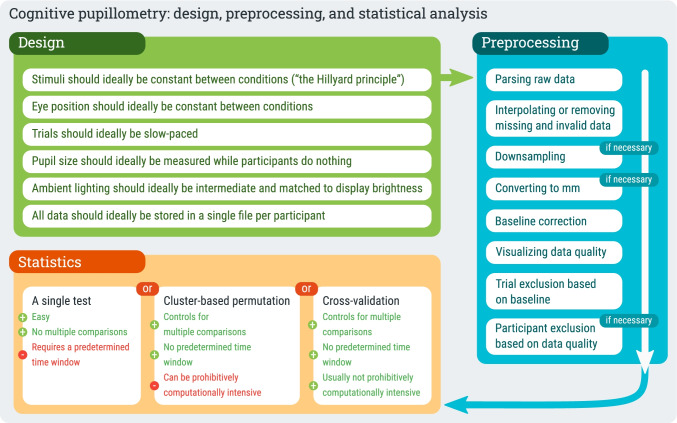
Cognitive pupillometry is the measurement of pupil size to investigate cognitive processes such as attention, mental effort, working memory, and many others. Currently, there is no commonly agreed-upon methodology for conducting cognitive-pupillometry experiments, and approaches vary widely between research groups and even between different experiments from the same group. This lack of consensus makes it difficult to know which factors to consider when conducting a cognitive-pupillometry experiment. Here we provide a comprehensive, hands-on guide to methods in cognitive pupillometry, with a focus on trial-based experiments in which the measure of interest is the task-evoked pupil response to a stimulus. We cover all methodological aspects of cognitive pupillometry: experimental design, preprocessing of pupil-size data, and statistical techniques to deal with multiple comparisons when testing pupil-size data. In addition, we provide code and toolboxes (in Python) for preprocessing and statistical analysis, and we illustrate all aspects of the proposed workflow through an example experiment and example scripts.
Overview
The claims and statistics of this paper haven’t been checked yet.
Run the check — free, no account needed. It reads the open-access text and checks the sources it cites.
Integrity signals
Registry
Cites
Statistics
Figures
Verification
Claims the paper makes
The claims and statistics of this paper haven’t been checked yet.
Run the check — free, no account needed. It reads the open-access text and checks the sources it cites.
Claims other papers make about this one
Each is checked against this paper’s own text: does it say what the citing paper says it does?
The cited source says what the claim attributes to it.
In the citing paper
“We did not preregister a specific time window to assess our hypotheses regarding the effect of expectancy on pupil sizes; thus, we use cross-validation to extract samples from the whole response time window as recommended by Mathôt and Vilotijević [39].”
From Predicting emotional valence in autism: a preregistered study in the Bayesian Brain framework (2026) · cites this paper as [39]
Self-check
Percentages, sums and reported differences re-computed from the paper’s own numbers.
The self-check needs the paper’s full text.
Citations
Cites
Random effects structure for confirmatory hypothesis testing: Keep it maximal
Barr, D. J., Levy, R., Scheepers, C., & Tily, H. J. (2013) · Journal of Memory and Language · doi:10.1016/j.jml.2012.11.001 · Cited by 10,328
Nonparametric statistical testing of EEG- and MEG-data
Maris, E., & Oostenveld, R. (2007) · Journal of Neuroscience Methods · doi:10.1016/j.jneumeth.2007.03.024 · Cited by 8,496
(2001) · doi:10.1017/cbo9780511546396 · Cited by 4,482
Aston-Jones, G., & Cohen, J. D. (2005) · Annual Review of Neuroscience · doi:10.1146/annurev.neuro.28.061604.135709 · Cited by 4,472
Circular analysis in systems neuroscience: the dangers of double dipping
Kriegeskorte, N., Simmons, W. K., Bellgowan, P. S. F., & Baker, C. I. (2009) · Nature Neuroscience · doi:10.1038/nn.2303 · Cited by 2,696
OpenSesame: An open-source, graphical experiment builder for the social sciences
Mathôt, S., Schreij, D., & Theeuwes, J. (2011) · Behavior Research Methods · doi:10.3758/s13428-011-0168-7 · Cited by 2,648
Self-citationThe pupil as a measure of emotional arousal and autonomic activation
Bradley, M. M., Miccoli, L., Escrig, M. A., & Lang, P. J. (2008) · Psychophysiology · doi:10.1111/j.1469-8986.2008.00654.x · Cited by 1,919
Pupil Diameter and Load on Memory
Kahneman, D., & Beatty, J. (1966) · Science · doi:10.1126/science.154.3756.1583 · Cited by 1,617
Power Analysis and Effect Size in Mixed Effects Models: A Tutorial
Brysbaert, M., & Stevens, M. (2018) · Journal of Cognition · doi:10.5334/joc.10 · Cited by 1,420
Joshi, S., Li, Y., Kalwani, R. M., & Gold, J. I. (2016) · Neuron · doi:10.1016/j.neuron.2015.11.028 · Cited by 1,387
Research works printed but not linked: 2
- Van de Kraats, J., Smit, E. P., & Slooter, J. H. (1977). Objective perimetric measurements by the pupil balance method. Documenta Ophthalmologica Proceedings Series, 14, 213–219.
- Vilotijević, A., & Mathôt, S. (2022). Covert shifts of attention towards the visual periphery induce pupil dilation (p. 2022.07.14.500035). bioRxiv. https://doi.org/10.1101/2022.07.14.500035 · DOI
Cited by
Sorted by citations
Neurobehavioral meaning of pupil size
Grujic, N., Polanía, R., & Burdakov, D. (2024) · Neuron · doi:10.1016/j.neuron.2024.05.029 · Cited by 108
(2013) · Natural language processing · doi:10.1075/nlp · Cited by 76
From pre-processing to advanced dynamic modeling of pupil data
Fink, L., Simola, J., Tavano, A., Lange, E. B., Wallot, S., & Laeng, B. (2023) · Behavior Research Methods · doi:10.3758/s13428-023-02098-1 · Cited by 80
The fundamentals of eye tracking part 2: From research question to operationalization
Hooge, I. T. C., Nuthmann, A., Nyström, M., Niehorster, D. C., Holleman, G. A., Andersson, R., & Hessels, R. S. (2025) · Behavior Research Methods · doi:10.3758/s13428-024-02590-2 · Cited by 69
Noradrenaline tracks emotional modulation of attention in human amygdala
Bang, D., Luo, Y., Barbosa, L. S., Batten, S. R., Hadj-Amar, B., Twomey, T., Melville, N., White, J. P., Torres, A. S., Celaya, X., et al. (2023) · Current Biology · doi:10.1016/j.cub.2023.09.074 · Cited by 43
Metadata
- Authors
- Mathôt, S., & Vilotijević, A.
- Affiliations
- University of Groningen (NL)
- Corresponding author
- Mathôt, Sebastiaan
- Venue
- Behavior Research Methods
- Published
- 2022-08-26
- Volume
- 55
- Issue
- 6
- Pages
- 3055-3077
- ISSN
- 1554-351X (ISSN-L)
- 1554-3528
- PMC
- PMC10556184
- OpenAlex
- W4293794846
- Cited by
- 235
- References
- 107
- Citations by year
- 2026: 65 · 2025: 95 · 2024: 46 · 2023: 22 · 2022: 5
- FWCI
- 20.78
- Type
- journal article
- Language
- en
- Open access
- hybrid
- doi.org
- Locations
- Behavior Research Methods (publishedVersion, cc-by)
- bioRxiv (Cold Spring Harbor Laboratory) (acceptedVersion, cc-by)
- PubMed Central (publishedVersion, cc-by)
- PubMed (publishedVersion)
- University of Groningen research database (University of Groningen / Centre for Information Technology) (submittedVersion, cc-by)
- OSF Preprints (OSF Preprints) (submittedVersion)
- Funders
- Nederlandse Organisatie voor Wetenschappelijk Onderzoek (VI.Vidi.191.045)
- Topics
- Physical Sciences › Computer Science › Human-Computer Interaction › Gaze Tracking and Assistive Technology
- Life Sciences › Neuroscience › Cognitive Neuroscience › Neural and Behavioral Psychology Studies
- Social Sciences › Human Factors and Ergonomics › Human-Automation Interaction and Safety
- Keywords
- pupil size, experimental design, multiple comparisons, statistical analysis, attention, cognitive effort, working memory, Python library
- MeSH terms
- Attention, Cognition, Humans, Memory, Short-Term, Pupil, Research Design
About these checks
Registry, retraction, Cites and statistics results are computed, not judged, with one exception: a printed reference that no index lists is read once by a model before it counts as a citation error. Claims are extracted by a model and kept only when their quote appears verbatim in the text; each cited source is then checked, with a model’s help, for whether it says what the claim relies on. Those verdicts can be wrong — read the claim’s quote and the cited source before relying on one.
Statistics and arithmetic are recomputed, not judged.
Confidence bands are shown only for fields calibrated on our annotated test set. None is calibrated yet, so no band is shown.
What counts as a claim ›How we measure confidence ›How we check this ›
Are you an author, or do you see a problem with this page? Request a review
