

Unravelling Colletotrichum species associated with Camellia : employing ApMat and GS loci to resolve species in the C. gloeosporioides complex
Open accessThe DOI matches its Crossref record; 62 of the 64 references it cites were found in a registry or an index.
Abstract
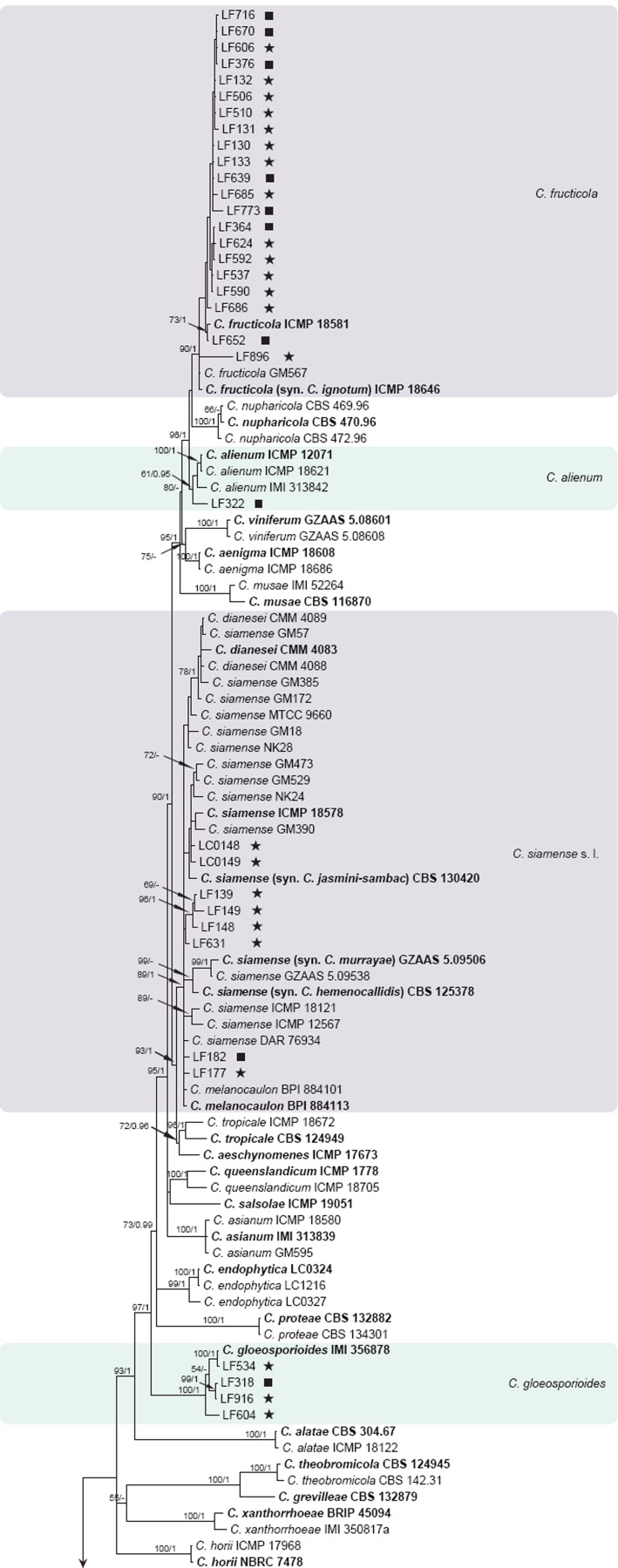
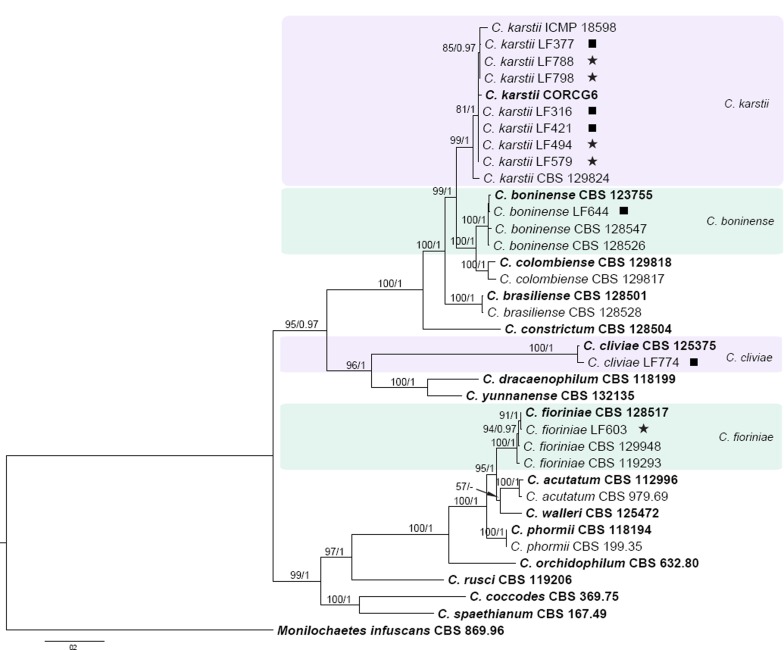
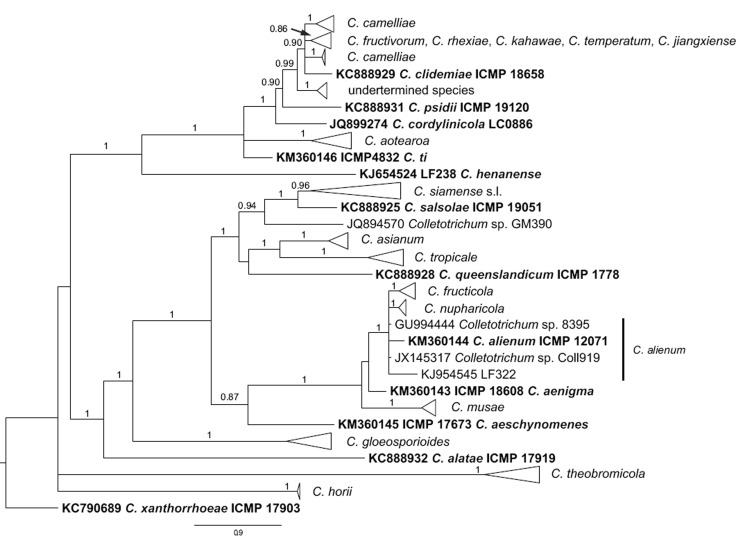
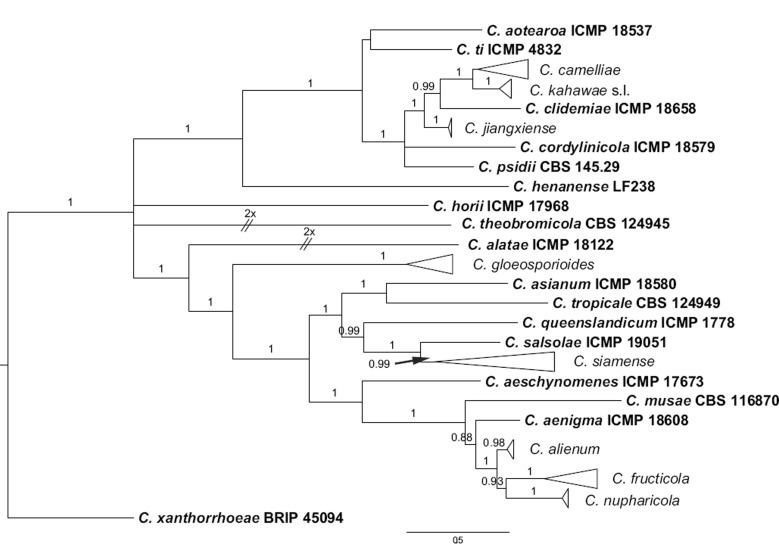
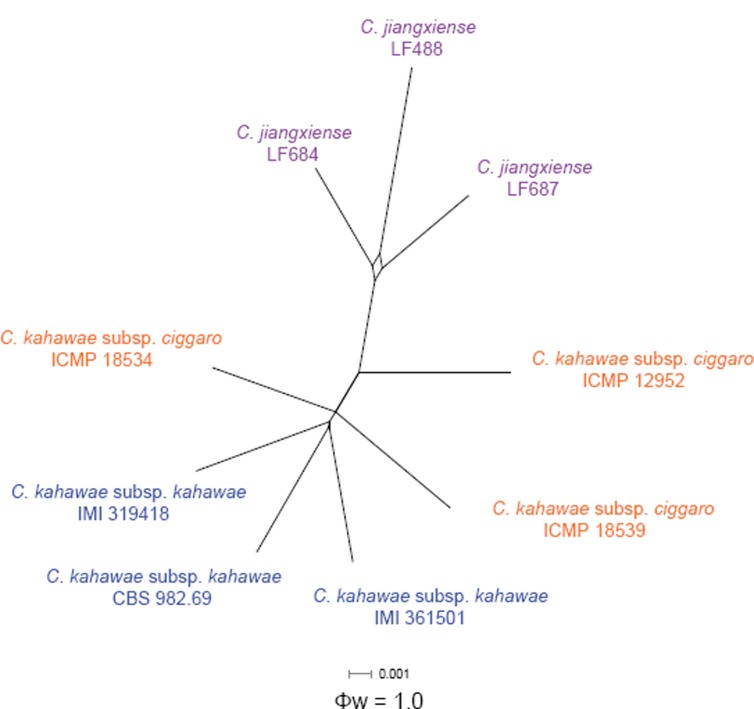
We investigated the phylogenetic diversity of 144 Colletotrichum isolates associated with symptomatic and asymptomatic tissues of Camellia sinensis and other Camellia spp. from seven provinces in China (Fujian, Guizhou, Henan, Jiangxi, Sichuan, Yunnan, Zhejiang), and seven isolates obtained from other countries, including Indonesia, UK, and the USA. Based on multi-locus (ACT, ApMat, CAL, GAPDH, GS, ITS, TUB2) phylogenetic analyses and phenotypic characters, 11 species were distinguished, including nine well-characterised species ( C. alienum , C. boninense , C. camelliae , C. cliviae , C. fioriniae , C. fructicola , C. gloeosporioides , C. karstii , C. siamense ), and two novel species ( C. henanense and C. jiangxiense ). Of these, C. camelliae proved to be the most dominant and probably host specific taxon occurring on Camellia . An epitype is also designated for the latter species in this study. Colletotrichum jiangxiense is shown to be phylogenetically closely related to the coffee berry pathogen C. kahawae subsp. kahawae . Pathogenicity tests and the pairwise homoplasy index test suggest that C. jiangxiense and C. kahawae subsp. kahawae are two independent species. This study represents the first report of C. alienum and C. cliviae occurring on Camellia sinensis . In addition, our study demonstrated that the combined use of the loci ApMat and GS in a phylogenetic analysis is able to resolve all currently accepted species in the C. gloeosporioides species complex.
Overview
The claims and statistics of this paper haven’t been checked yet.
Free: it reads the open-access text and checks the first 5 claims that cite a source we can check. Create a free account to check every claim.
Integrity signals
Registry
Cites
Statistics
Figures
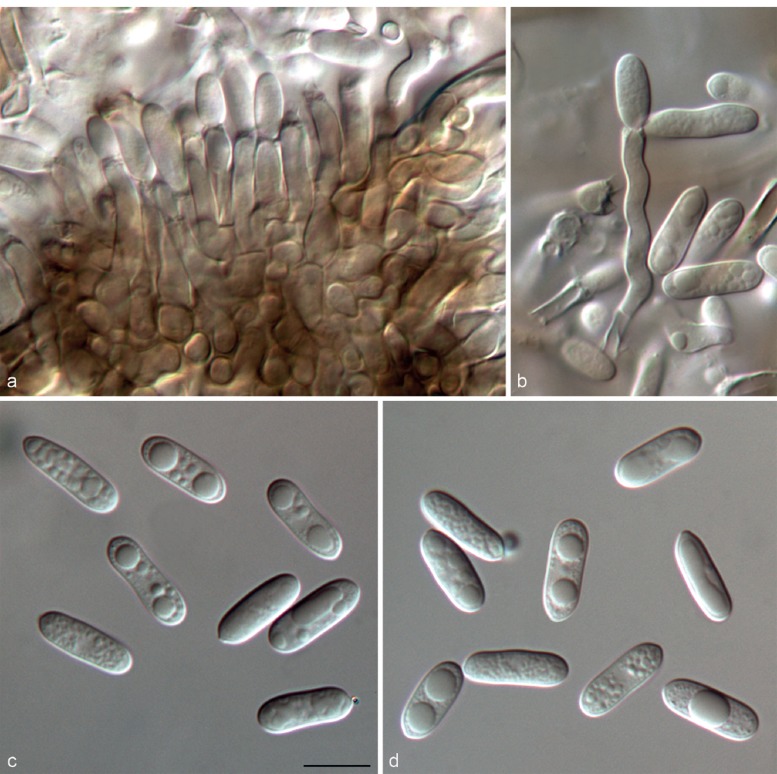
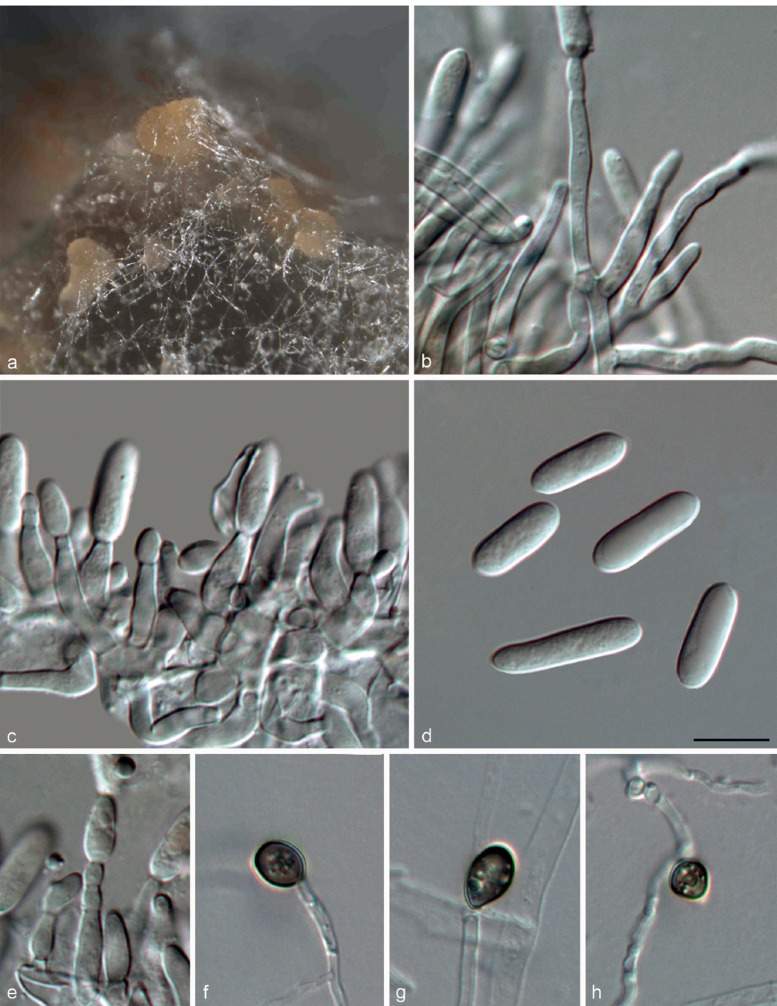
Verification
Claims the paper makes
The claims and statistics of this paper haven’t been checked yet.
Free: it reads the open-access text and checks the first 5 claims that cite a source we can check. Create a free account to check every claim.
Claims other papers make about this one
Each is checked against this paper’s own text: does it say what the citing paper says it does?
The source backs part of the claim, not all of it — or backs it for a different population, condition or comparison.
In the citing paper
“Colletotrichum camelliae belongs to the kahawae clade within the gloeosporioides complex and can be distinguished with the use of gs and apmat sequence data (Liu et al. 2015).”
From Colletotrichum: lifestyles, biology, morpho-species, species complexes and accepted species (2021) · cites this paper as Liu et al. 2015
Experimental — accuracy not yet measured
Self-check
Percentages, sums and reported differences re-computed from the paper’s own numbers.
The self-check needs the paper’s full text.
Citations
Cites
MAFFT Multiple Sequence Alignment Software Version 7: Improvements in Performance and Usability
Katoh, K., & Standley, D. M. (2013) · Molecular Biology and Evolution · doi:10.1093/molbev/mst010 · Cited by 46,209
Tamura, K., Peterson, D., Peterson, N., Stecher, G., Nei, M., & Kumar, S. (2011) · Molecular Biology and Evolution · doi:10.1093/molbev/msr121 · Cited by 39,969
Amplification and direct sequencing of fungal ribosomal RNA genes for phylogenetics
White, T. J., Bruns, T., Lee, S., & Taylor, J. (1990) · PCR Protocols · doi:10.1016/b978-0-12-372180-8.50042-1 · Cited by 36,648
MrBayes 3.2: Efficient Bayesian Phylogenetic Inference and Model Choice Across a Large Model Space
Ronquist, F., Teslenko, M., van der Mark, P., Ayres, D. L., Darling, A., Höhna, S., Larget, B., Liu, L., Suchard, M. A., & Huelsenbeck, J. P. (2012) · Systematic Biology · doi:10.1093/sysbio/sys029 · Cited by 27,843
Application of Phylogenetic Networks in Evolutionary Studies
Huson, D. H., & Bryant, D. (2006) · Molecular Biology and Evolution · doi:10.1093/molbev/msj030 · Cited by 8,830
Glass, N. L., & Donaldson, G. C. (1995) · Applied and Environmental Microbiology · doi:10.1128/aem.61.4.1323-1330.1995 · Cited by 4,755
A method for designing primer sets for speciation studies in filamentous ascomycetes
Carbone, I., & Kohn, L. M. (1999) · Mycologia · doi:10.1080/00275514.1999.12061051 · Cited by 4,217
O'Donnell, K., & Cigelnik, E. (1997) · Molecular Phylogenetics and Evolution · doi:10.1006/mpev.1996.0376 · Cited by 2,397
Rayner, R. W. (1970) · Medical Entomology and Zoology · Cited by 1,693
The Colletotrichum gloeosporioides species complex
Weir, B. S., Johnston, P. R., & Damm, U. (2012) · Studies in Mycology · doi:10.3114/sim0011 · Cited by 1,646
Self-citation
Research works printed but not linked: 26
- Damm U Cannon PF Woudenberg JHC, et al. 2012a The Colletotrichum acutatum species complex. Studies in Mycology 73: 37– 113. 23136458 PMC3458416
- Damm U Cannon PF Woudenberg JHC, et al. 2012b The Colletotrichum boninense species complex. Studies in Mycology 73: 1– 36. 23136457 PMC3458415
- Damm U O’Connell R Groenewald J, et al. 2014 The Colletotrichum destructivum species complex-hemibiotrophic pathogens of forage and field crops. Studies in Mycology 79: 49– 84. 25492986 PMC4255528
- Dai QL Xu YP Lin QQ, et al. 2008 Distribution and establishment of Colletotrichum sp. as an endophyte in tea plants (Camellia sinensis). Scientia Silvae Sinicae 44: 84– 89.
- StudiesinMycology, 50, 19
- ANZEIGER FUR SCHADLINGSKUNDE PFLANZEN UND UMWELTSCHUTZ VEREINIGT MIT SCHADLINGSBEKAMPFUNG, 5, 17
- Copes WE Thomson JL 2008 Survival analysis to determine the length of the incubation period of Camellia twig blight caused by Colletotrichum gloeosporioides. Plant Disease 92: 1177– 1182. 30769490
- FungalDiversity, 39, 183
- Arx JA von 1957 Die Arten der Gattung Colletotrichum Cda. Phytopathologische Zeitschrift 29: 413– 468.
- Cannon PF Damm U Johnston PR, et al. 2012 Colletotrichum – current status and future directions. Studies in Mycology 73: 181– 213. 23136460 PMC3458418
- Willis JC 1899 DCLII – Tea and coffee diseases. Bulletin of Miscellaneous Information Royal Botanical Gardens Kew 1899: 89– 94.
- Yang YL Liu ZY Cai L, et al. 2009 Colletotrichum anthracnose of Amaryllidaceae. Fungal Diversity 39: 123– 146.
- CANADIAN PLANT DISEASE SURVEY, 34, 186
- Weir BS Johnston PR Damm U 2012 The Colletotrichum gloeosporioides species complex. Studies in Mycology 73: 115– 180. 23136459 PMC3458417
- Stephenson SA Green JR Manners JM, et al. 1997 Cloning and characterisation of glutamine synthetase from Colletotrichum gloeosporioides and demonstration of elevated expression during pathogenesis on Stylosanthes guianensis. Current Genetics 31: 447– 454. 9162117
- Shivas RG 1989 Fungal and bacterial diseases of plants in Western Australia. Journal of the Royal Society of Western Australia 72: 1– 62.
- Silva DN Talhinhas P Cai L, et al. 2012a Host-jump drives rapid and recent ecological speciation of the emergent fungal pathogen Colletotrichum kahawae. Molecular Ecology 21: 2655– 2670. 22519519
- Ronquist F Teslenko M Mark P van der, et al. 2012 MrBayes 3.2: efficient Bayesian phylogenetic inference and model choice across a large model space. Systematic Biology 61: 539– 542. 22357727 PMC3329765
- FungalDi- versity, 39, 89
- MYCOLOGICAL PAPERS- INTERNATIONAL MYCOLOGICAL INSTITUTE, 105, 1508
- Nirenberg H 1976 Untersuchungen über die morphologische und biologische Differenzierung in der Fusarium-Sektion Liseola. Mitteilungen aus der Biologischen Bundesanstalt für Land- und Forstwirtschaft Berlin-Dahlem 169: 1– 117.
- FARM MANAGEMENT- FARM MANAGEMENT ASSOCIATION THEN CENTRE OF MANAGEMENT IN AGRICULTURE, 10, 54
- Liu W 2013 Anthracnose pathogens identification and the genetic diversity of tea plant. PhD thesis, Fujian Agriculture and Forestry University, China.
- MolecularBiologyandEvolution, 23, 254
- Katoh K Standley DM 2013 MAFFT multiple sequence alignment software version 7: improvements in performance and usability. Molecular Biology and Evolution 30: 772– 780. 23329690 PMC3603318
- PlantDisease, 98, 284
Cited by
Genera of phytopathogenic fungi: GOPHY 1
Marin-Felix, Y., Groenewald, J. Z., Cai, L., Chen, Q., Marincowitz, S., Barnes, I., Bensch, K., Braun, U., Camporesi, E., Damm, U., et al. (2017) · Studies in Mycology · doi:10.1016/j.simyco.2017.04.002 · Cited by 436
Self-citationWu, B., Hussain, M., Zhang, W., Stadler, M., Liu, X., & Xiang, M. (2019) · Mycology · doi:10.1080/21501203.2019.1614106 · Cited by 368
Notes on currently accepted species of Colletotrichum
Jayawardena, R. (2016) · Mycosphere · doi:10.5943/mycosphere/si/2c/9 · Cited by 363
“Inf., Kew: 91 (1899) This taxon is responsible for causing twig blight and brown blight of Camellia sp. in China, Sri Lanka, the UK and the USA (Liu et al. 2015a, Wang et al. 2016).”
InfluentialLife styles of Colletotrichum species and implications for plant biosecurity
De Silva, D. D., Crous, P. W., Ades, P. K., Hyde, K. D., & Taylor, P. W. J. (2017) · Fungal Biology Reviews · doi:10.1016/j.fbr.2017.05.001 · Cited by 328
“In particular, many endophytes isolated fromgrasses (Poaceae) belonged to the gloeosporioides and boninense complexes (Saikkonen et al., 2000; S anchez_M arquez et al., 2010; Ghimire et al., 2011; Liu et al., 2015).”
BackgroundSelf-citationColletotrichum species and complexes: geographic distribution, host range and conservation status
Talhinhas, P., & Baroncelli, R. (2021) · Fungal Diversity · doi:10.1007/s13225-021-00491-9 · Cited by 280
The Colletotrichum dracaenophilum , C. magnum and C. orchidearum species complexes
Damm, U., Sato, T., Alizadeh, A., Groenewald, J. Z., & Crous, P. W. (2019) · Studies in Mycology · doi:10.1016/j.simyco.2018.04.001 · Cited by 274
Self-citationUpdating species diversity of Colletotrichum, with a phylogenomic overview
Liu, F., Ma, Z. Y., Hou, L. W., Diao, Y. Z., Wu, W. P., Damm, U., Song, S., & Cai, L. (2022) · Studies in Mycology · doi:10.3114/sim.2022.101.01 · Cited by 244
Self-citationColletotrichum: lifestyles, biology, morpho-species, species complexes and accepted species
Jayawardena, R. (2021) · Mycosphere · doi:10.5943/mycosphere/12/1/7 · Cited by 208
de Silva, D. D., Groenewald, J. Z., Crous, P. W., Ades, P. K., Nasruddin, A., Mongkolporn, O., & Taylor, P. W. J. (2019) · IMA Fungus · doi:10.1186/s43008-019-0001-y · Cited by 186
Self-citationColletotrichum species associated with anthracnose of Pyrus spp. in China
Fu, M., Crous, P. W., Bai, Q., Zhang, P. F., Xiang, J., Guo, Y. S., Zhao, F. F., Yang, M. M., Hong, N., Xu, W. X., et al. (2019) · Persoonia - Molecular Phylogeny and Evolution of Fungi · doi:10.3767/persoonia.2019.42.01 · Cited by 175
Self-citationWang, Y.-C., Hao, X.-Y., Wang, L., Xiao, B., Wang, X.-C., & Yang, Y.-J. (2016) · Scientific Reports · doi:10.1038/srep35287 · Cited by 177
Self-citationSpecies boundaries in plant pathogenic fungi: a Colletotrichum case study
Liu, F., Wang, M., Damm, U., Crous, P. W., & Cai, L. (2016) · BMC Evolutionary Biology · doi:10.1186/s12862-016-0649-5 · Cited by 175
“[24], Sharma et al.”
Self-citationGao, Y., Liu, F., Duan, W., Crous, P. W., & Cai, L. (2017) · IMA Fungus · doi:10.5598/imafungus.2017.08.01.11 · Cited by 161
Self-citationInvestigating species boundaries in Colletotrichum
Bhunjun, C. S., Phukhamsakda, C., Jayawardena, R. S., Jeewon, R., Promputtha, I., & Hyde, K. D. (2021) · Fungal Diversity · doi:10.1007/s13225-021-00471-z · Cited by 153
Sharma, G., Maymon, M., & Freeman, S. (2017) · Scientific Reports · doi:10.1038/s41598-017-15946-w · Cited by 152
Optimal markers for the identification of Colletotrichum species
Vieira, W. A. D. S., Bezerra, P. A., da Silva, A. C., Veloso, J. S., Câmara, M. P. S., & Doyle, V. P. (2019) · Molecular Phylogenetics and Evolution · doi:10.1016/j.ympev.2019.106694 · Cited by 179
Fusarium incarnatum-equiseti complex from China
Wang, M., Chen, Q., Diao, Y., Duan, W., & Cai, L. (2019) · Persoonia - Molecular Phylogeny and Evolution of Fungi · doi:10.3767/persoonia.2019.43.03 · Cited by 176
“Fusarium sulawense was obtained from both symptomatic and asymptomatic banana tissues, which supported the hypothesis that endophytes can be latent pathogens (Photita et al. 2001, Romero et al. 2001, Liu et al. 2015).”
InfluentialSelf-citationHigh species diversity in Colletotrichum associated with citrus diseases in Europe
Guarnaccia, V., Groenewald, J. Z., Polizzi, G., & Crous, P. W. (2017) · Persoonia - Molecular Phylogeny and Evolution of Fungi · doi:10.3767/persoonia.2017.39.02 · Cited by 134
“…recently been reviewed in several impactful studies (Cannon et al. 2008, Cai et al. 2009, Damm et al. 2009, 2012a, b, 2013, 2014, Weir et al. 2012, Liu et al. 2014, 2015, 2016). the molecular era, morphological characters such as size and shape of conidia and appressoria, presence or absence of…”
Self-citationKhodadadi, F., González, J. B., Martin, P. L., Giroux, E., Bilodeau, G. J., Peter, K. A., Doyle, V. P., & Aćimović, S. G. (2020) · Scientific Reports · doi:10.1038/s41598-020-66761-9 · Cited by 125
Taxonomy and phylogeny of hyaline-spored coelomycetes
Li, W., McKenzie, E. H. C., Liu, J., Bhat, D. J., Dai, D.-Q., Camporesi, E., Tian, Q., Maharachchikumbura, S. S. N., Luo, Z.-L., Shang, Q.-J., et al. (2020) · Fungal Diversity · doi:10.1007/s13225-020-00440-y · Cited by 147
Jayawardena, R. S., Hyde, K. D., Chen, Y. J., Papp, V., Palla, B., Papp, D., Bhunjun, C. S., Hurdeal, V. G., Senwanna, C., Manawasinghe, I. S., et al. (2020) · Fungal Diversity · doi:10.1007/s13225-020-00460-8 · Cited by 122
Self-citationWhat is a species in fungal plant pathogens?
Jayawardena, R. S., Hyde, K. D., de Farias, A. R. G., Bhunjun, C. S., Ferdinandez, H. S., Manamgoda, D. S., Udayanga, D., Herath, I. S., Thambugala, K. M., Manawasinghe, I. S., et al. (2021) · Fungal Diversity · doi:10.1007/s13225-021-00484-8 · Cited by 176
Pestalotiopsis and allied genera from Camellia, with description of 11 new species from China
Liu, F., Hou, L., Raza, M., & Cai, L. (2017) · Scientific Reports · doi:10.1038/s41598-017-00972-5 · Cited by 125
Self-citationJayawardena, R. S., Hyde, K. D., Jeewon, R., Ghobad‐Nejhad, M., Wanasinghe, D. N., Liu, N.-G., Phillips, A. J. L., Oliveira-Filho, J. R. C., da Silva, G. A., Gibertoni, T. B., et al. (2019) · Fungal Diversity · doi:10.1007/s13225-019-00418-5 · Cited by 141
“Many Alternaria species are saprobic on a variety of plant tissues in different habitats (Thomma 2003; Liu et al. 2015; Wanasinghe et al. 2018).”
BackgroundColletotrichum species associated with chili anthracnose in Australia
De Silva, D. D., Ades, P. K., Crous, P. W., & Taylor, P. W. J. (2017) · Plant Pathology · doi:10.1111/ppa.12572 · Cited by 109
Self-citationTibpromma, S., Hyde, K. D., Bhat, J. D., Mortimer, P. E., Xu, J., Promputtha, I., Doilom, M., Yang, J.-B., Tang, A. M. C., & Karunarathna, S. C. (2018) · MycoKeys · doi:10.3897/mycokeys.33.23670 · Cited by 81
Distribution and Pathogenicity of Colletotrichum Species Associated With Mango Anthracnose in Mexico
Tovar-Pedraza, J. M., Mora-Aguilera, J. A., Nava-Díaz, C., Lima, N. B., Michereff, S. J., Sandoval-Islas, J. S., Câmara, M. P. S., Téliz-Ortiz, D., & Leyva-Mir, S. G. (2020) · Plant Disease · doi:10.1094/pdis-01-19-0178-re · Cited by 105
“In addition, Liu et al. (2015) and C. fructicola confirmed that these species are responsible for causing mango anthracnose in Mexico.”
Soybean anthracnose caused by Colletotrichum species: Current status and future prospects
Boufleur, T. R., Ciampi‐Guillardi, M., Tikami, Í., Rogério, F., Thon, M. R., Sukno, S. A., Júnior, N. S. M., & Baroncelli, R. (2021) · Molecular Plant Pathology · doi:10.1111/mpp.13036 · Cited by 138
Talhinhas, P. (2023) · Mycosphere · doi:10.5943/mycosphere/14/si2/4 · Cited by 124
UnravellingDiaporthespecies associated withCamellia
Gao, Y., Liu, F., & Cai, L. (2016) · Systematics and Biodiversity · doi:10.1080/14772000.2015.1101027 · Cited by 120
Self-citationBag, S., Mondal, A., & Banik, A. (2021) · Microbiological Research · doi:10.1016/j.micres.2021.126890 · Cited by 109
Colletotrichum Species Causing Anthracnose of Citrus in Australia
Wang, W., de Silva, D. D., Moslemi, A., Edwards, J., Ades, P. K., Crous, P. W., & Taylor, P. W. J. (2021) · Journal of Fungi · doi:10.3390/jof7010047 · Cited by 109
Self-citationNumponsak, T., Kumla, J., Suwannarach, N., Matsui, K., & Lumyong, S. (2018) · PLoS ONE · doi:10.1371/journal.pone.0205070 · Cited by 111
Colletotrichum Species Causing Anthracnose of Rubber Trees in China
Liu, X., Li, B., Cai, J., Zheng, X., Feng, Y., & Guixiu, H. (2018) · Scientific Reports · doi:10.1038/s41598-018-28166-7 · Cited by 107
Vieira, W. A. S., Lima, W. G., Nascimento, E. S., Michereff, S. J., Câmara, M. P. S., & Doyle, V. P. (2017) · Mycologia · doi:10.1080/00275514.2017.1418577 · Cited by 83
Lu, Q., Wang, Y., Li, N., Ni, D., Yang, Y., & Wang, X. (2018) · Frontiers in Microbiology · doi:10.3389/fmicb.2018.03060 · Cited by 81
Self-citationIdentification and Characterization of Leaf-Inhabiting Fungi from Castanea Plantations in China
Jiang, N., Fan, X., & Tian, C. (2021) · Journal of Fungi · doi:10.3390/jof7010064 · Cited by 101
Xie, H., Feng, X., Wang, M., Wang, Y., Awasthi, M. K., & Xu, P. (2020) · Bioengineered · doi:10.1080/21655979.2020.1816788 · Cited by 77
Self-citationIntegrative taxonomy reveals hidden species within a common fungal parasite of ladybirds
Haelewaters, D., Kesel, A. D., & Pfister, D. H. (2018) · Scientific Reports · doi:10.1038/s41598-018-34319-5 · Cited by 77
He, L., Li, X., Gao, Y., Li, B., Mu, W., & Liu, F. (2018) · Plant Disease · doi:10.1094/pdis-04-18-0597-re · Cited by 80
Self-citationVeloso, J. S., Câmara, M. P. S., Lima, W. G., Michereff, S. J., & Doyle, V. P. (2018) · Fungal Biology · doi:10.1016/j.funbio.2018.03.005 · Cited by 65
Wang, Y., Xiong, F., Lu, Q., Hao, X., Zheng, M., Wang, L., Li, N., Ding, C., Wang, X., & Yang, Y. (2019) · Plant Disease · doi:10.1094/pdis-02-19-0264-re · Cited by 71
Self-citationEndophytic Colletotrichum species from Dendrobium spp. in China and Northern Thailand
Ma, X., Nontachaiyapoom, S., Jayawardena, R. S., Yde, K. D., Gentekaki, E., Zhou, S., Qian, Y., Wen, T., & Kang, J. (2018) · MycoKeys · doi:10.3897/mycokeys.43.25081 · Cited by 75
Yokosawa, S., Eguchi, N., Kondo, K.-I., & Sato, T. (2017) · Journal of General Plant Pathology · doi:10.1007/s10327-017-0732-9 · Cited by 60
Colletotrichum species causing anthracnose on avocado fruit in Mexico: Current status
Fuentes‐Aragón, D., Silva‐Rojas, H. V., Guarnaccia, V., Mora-Aguilera, J. A., Ocampo, S. A., Bautista‐Martínez, N., & Téliz‐Ortíz, D. (2020) · Plant Pathology · doi:10.1111/ppa.13234 · Cited by 70
Guo, Z., Luo, C., Wu, H.-J., Peng, B., Kang, B., Liu, L.-M., Zhang, M., & Gu, Q. (2022) · Journal of Fungi · doi:10.3390/jof8080790 · Cited by 64
Self-citationWhat are the 100 most cited fungal genera?
Bhunjun, C. S., Chen, Y. J., Phukhamsakda, C., Boekhout, T., Groenewald, J. Z., McKenzi, E. H. C., Francisco, E. C., Frisvad, J. C., Groenewald, M., Hurdeal, V. G., et al. (2024) · Studies in Mycology · doi:10.3114/sim.2024.108.01 · Cited by 88
Self-citationFuentes-Aragón, D., Juárez-Vázquez, S. B., Vargas-Hernández, M., & Silva-Rojas, H. V. (2018) · Mycobiology · doi:10.1080/12298093.2018.1454010 · Cited by 55
Diversity of Colletotrichum Species Associated with Olive Anthracnose Worldwide
Moral, J., Agustí‐Brisach, C., Raya, M. C., Bello, J. J., López‐Moral, A., Roca, L. F., Chattaoui, M., Rhouma, A., Nigro, F., Sergeeva, V., et al. (2021) · Journal of Fungi · doi:10.3390/jof7090741 · Cited by 66
Jeyaraj, A., Elango, T., Chen, X., Zhuang, J., Wang, Y., & Li, X. (2023) · Molecular Plant Pathology · doi:10.1111/mpp.13354 · Cited by 58
Self-citationShi, Y., Sheng, Y.-Y., Cai, Z., Yang, R., Li, Q., Li, X.-M., Li, D., Guo, X., Lu, J., Ye, J., et al. (2019) · International Journal of Molecular Sciences · doi:10.3390/ijms20102439 · Cited by 57
“in tea plant [4,5], the dominant species or major pathogen on the tea plant are considered to be Colletotrichum gloeosporioidesis, C.”
BackgroundGrammen, A., Wenneker, M., Campenhout, J. V., Pham, K. T. K., Hemelrijck, W. V., Bylemans, D., Geeraerd, A. H., & Keulemans, W. (2018) · European Journal of Plant Pathology · doi:10.1007/s10658-018-1539-z · Cited by 57
“Sequencing the loci of CAL, ApMat and GS is necessary to be able to confirm certainly the identity of these isolates, as shown in Liu et al. (2015).”
Cao, X., Xu, X., Che, H., West, J. S., & Luo, D. (2018) · Plant Disease · doi:10.1094/pdis-02-18-0374-re · Cited by 61
Zhou, X., Zeng, L., Chen, Y., Wang, X., Liao, Y., Xiao, Y., Fu, X., & Yang, Z. (2020) · International Journal of Molecular Sciences · doi:10.3390/ijms21165684 · Cited by 45
Manawasinghe, I. S., Hyde, K. D., Wanasinghe, D. N., Karunarathna, S. C., Maharachchikumbura, S. S. N., Samarakoon, M. C., Voglmayr, H., Pang, K.-L., Chiang, M., Jones, E. B. G., et al. (2024) · Fungal Diversity · doi:10.1007/s13225-024-00541-y · Cited by 65
Cabral, A., Azinheira, H. G., Talhinhas, P., Batista, D., Ramos, A. P., Silva, M. D. C., Oliveira, H., & Várzea, V. (2020) · Plants · doi:10.3390/plants9040502 · Cited by 52
Douanla‐Meli, C., & Unger, J.-G. (2017) · Fungal Biology · doi:10.1016/j.funbio.2017.06.003 · Cited by 41
Shi, N., Ruan, H., Jie, Y.-L., Chen, F., & Du, Y. (2021) · Crop Protection · doi:10.1016/j.cropro.2021.105572 · Cited by 44
Zhang, Q., Nizamani, M. M., Feng, Y., Yang, Y., Jayawardena, R. S., Hyde, K., Wang, Y., & Li, C. (2023) · Mycosphere · doi:10.5943/mycosphere/14/si2/1 · Cited by 50
Self-citationHe, S., Chen, H., Wei, Y., An, T., & Liu, S. (2020) · Plant Methods · doi:10.1186/s13007-020-00564-x · Cited by 41
Perspectives into the value of genera, families and orders in classification
Liu, N. (2016) · Mycosphere · doi:10.5943/mycosphere/7/11/3 · Cited by 36
Lu, Q., Wang, Y., Xiong, F., Hao, X., Zhang, X., Li, N., Wang, L., Zeng, J., Yang, Y., & Wang, X. (2020) · Scientific Reports · doi:10.1038/s41598-020-69729-x · Cited by 42
Self-citationClimate-Fungal Pathogen Modeling Predicts Loss of Up to One-Third of Tea Growing Areas
Tibpromma, S., Dong, Y., Ranjitkar, S., Schaefer, D. A., Karunarathna, S. C., Hyde, K. D., Jayawardena, R. S., Manawasinghe, I. S., Bebber, D. P., Promputtha, I., et al. (2021) · Frontiers in Cellular and Infection Microbiology · doi:10.3389/fcimb.2021.610567 · Cited by 41
Endophytic Colletotrichum Species from Aquatic Plants in Southwest China
Zheng, H., Yu, Z., Jiang, X., Fang, L., & Qiao, M. (2022) · Journal of Fungi · doi:10.3390/jof8010087 · Cited by 43
Cao, X., Xu, X., Che, H., West, J. S., & Luo, D. (2019) · Plant Disease · doi:10.1094/pdis-10-19-2077-re · Cited by 40
Eaton, M. J., Edwards, S., Inocencio, H. A., Machado, F. J., Nuckles, E. M., FARMAN, M. L., Gauthier, N. A. W., & Vaillancourt, L. J. (2020) · Plant Disease · doi:10.1094/pdis-06-20-1273-re · Cited by 40
Jian, Y., Li, Y., Tang, G., Zheng, X., Khaskheli, M. I., & Gong, G. (2021) · Plant Disease · doi:10.1094/pdis-10-20-2114-re · Cited by 38
Colletotrichum species associated with Camellia anthracnose in China
Peng, X., Wang, Q., Zhang, S., Guo, K., & Zhou, X. (2023) · Mycosphere · doi:10.5943/mycosphere/14/si2/3 · Cited by 36
“…that there are 11, 16 and three Colletotrichum species causing anthracnose on Ca. oleifera, Ca. sinensis and Ca. japonica, respectively (Table 1) (Liu et al. 2015, Hou et al. 2016, Orrock et al. 2019, Li & Li 2020, Wang et al. 2020, Zhang et al. 2021, Li & Li 2022, Peng et al. 2022, Chen et al.…”
Liang, X., Tian, X., Liu, W., Wei, T., Wang, W., Dong, Q., Wang, B., Meng, Y., Zhang, R., Gleason, M. L., et al. (2017) · BMC Genomics · doi:10.1186/s12864-016-3480-x · Cited by 38
Yu, Z., Jiang, X., Zheng, H., Zhang, H., & Qiao, M. (2022) · Journal of Fungi · doi:10.3390/jof8020185 · Cited by 34
Zhang, L., Li, X., Zhou, Y., Tan, G., & Zhang, L. (2020) · Plant Disease · doi:10.1094/pdis-11-20-2335-re · Cited by 31
Setophoma spp. on Camellia sinensis
Liu, F., Wang, J., Li, H., Wang, W., & Cai, L. (2019) · Fungal Systematics and Evolution · doi:10.3114/fuse.2019.04.05 · Cited by 27
“Isolates were obtained from either diseased or healthy tea plant tissues collected from 18 locations in seven provinces of China, following the single spore isolation and tissue isolation methods described in Liu et al. (2015).”
Self-citationColletotrichum truncatum Causing Anthracnose of Tomato (Solanum lycopersicum L.) in Malaysia
Shahriar, S. A., Husna, A., Paul, T. T., Eaty, M. N. K., Quamruzzaman, M., Siddique, A., Rahim, A., Ahmmed, A. N. F., Uddain, J., & Siddiquee, S. (2023) · Microorganisms · doi:10.3390/microorganisms11010226 · Cited by 37
Fusarium and allied genera from China: species diversity and distribution.
Wang, M.-H., Crous, P. W., Sandoval‐Denis, M., Han, S., Liu, F., Liang, J. M., Duan, W., & Cai, L. (2022) · PubMed Central · doi:10.3767/persoonia.2023.48.01 · Cited by 27
Self-citationOverhauling the Effect of Surface Sterilization on Analysis of Endophytes in Tea Plants
Yu, Y., Chen, Z., Xie, H., Feng, X., Wang, Y., & Xu, P. (2022) · Frontiers in Plant Science · doi:10.3389/fpls.2022.849658 · Cited by 26
Self-citationColletotrichum species associated with cassava anthracnose in China
Liu, X., Shi, T., Li, B., Cai, J., Li, C., & Guixiu, H. (2018) · Journal of Phytopathology · doi:10.1111/jph.12765 · Cited by 29
Li, H. L., Jayawardena, R. S., Xu, W., Hu, M., Li, X. H., Liu, J., Hyde, K. D., & Yan, J. (2019) · Canadian Journal of Plant Pathology · doi:10.1080/07060661.2019.1569559 · Cited by 25
Jeyaraj, A., Elango, T., Li, X., & Guo, G. (2020) · RNA Biology · doi:10.1080/15476286.2020.1774987 · Cited by 26
Liu, J., Manawasinghe, I. S., Liao, X.-N., Mao, J., Dong, Z., Jayawardena, R. S., Wanasinghe, D. N., Shu, Y., & Luo, M. (2023) · MycoKeys · doi:10.3897/mycokeys.95.87121 · Cited by 31
Colletotrichum species causing anthracnose on lima bean in Brazil
Sousa, E. S., Silva-Cabral, J. R. A., Assunção, I. P., de Melo, M. P., Feijó, F. M., Matos, K. D. S., Lima, G. S. D. A., & Beserra, J. E. A. (2017) · Tropical Plant Pathology · doi:10.1007/s40858-017-0182-0 · Cited by 30
“) produced perithecia and ascospores (Liu et al. 2015).”
BackgroundLiu, X., Li, B., Yang, Y., Cai, J., Shi, T., Zheng, X., & Guixiu, H. (2020) · Frontiers in Microbiology · doi:10.3389/fmicb.2020.01484 · Cited by 24
Zhang, H., Wei, T., Li, L.-Z., Luo, M., Jia, W.-Y., Zeng, Y., Jiang, Y., & Tao, G. (2021) · Frontiers in Microbiology · doi:10.3389/fmicb.2021.755919 · Cited by 26
Salotti, I., Liang, Y.-J., Ji, T., & Rossi, V. (2023) · Frontiers in Plant Science · doi:10.3389/fpls.2023.1069092 · Cited by 25
Тркуља, В., Čojić, B., Trkulja, N., Tomić, A., Matić, S., Ikanović, J., & Popović, T. (2024) · Journal of Fungi · doi:10.3390/jof10090660 · Cited by 31
“This species was first described as a pathogen of Camellia sinensis (L.) Kuntze and Cirsium japonicum DC. in China [180], and has subsequently been confirmed as a pathogen of apple in the US [4,141,165].”
BackgroundFungal diversity notes 1919–2016: taxonomic and phylogenetic contributions to fungal taxa
Cao, B., Phurbu, D., Ralaiveloarisoa, A. B., Liimatainen, K., Niskanen, T., Ramírez-Cruz, V., Bradshaw, A. J., Dentinger, B. T. M., Ramírez-Guillén, F., Cortés-Pérez, A., et al. (2025) · Fungal Diversity · doi:10.1007/s13225-025-00556-z · Cited by 37
Two new species of Microdochium from Indocalamus longiauritus in south-western China
Huang, S., Xia, J.-W., Zhang, X.-G., Sun, W., & Li, Z. (2020) · MycoKeys · doi:10.3897/mycokeys.72.55445 · Cited by 22
A New Colletotrichum Species Associated with Brown Blight Disease on Camellia sinensis
Wan, Y., Zou, L., Zeng, L., Tong, H., & Chen, Y. (2020) · Plant Disease · doi:10.1094/pdis-09-20-1912-re · Cited by 27
Tibpromma, S., Karunarathna, S. C., Bhat, J. D., Suwannarach, N., Stephenson, S. L., Elgorban, A. M., Al-Rejaie, S. S., Xu, J., & Mortimer, P. E. (2022) · Diversity · doi:10.3390/d14040287 · Cited by 25
First Report of Anthracnose Caused by Colletotrichum fructicola on Tea in Taiwan
Lin, S. R., Yu, S., Chang, T., Lin, Y. J., Wen, C. J., & Lin, Y.-H. (2020) · Plant Disease · doi:10.1094/pdis-06-20-1288-pdn · Cited by 25
First report of anthracnose caused by Colletotrichum fructicola on Brassica parachinensis in China
Yu, L., Lan, G., Yang, Y., Tang, Y., Li, Z., She, X., & He, Z. (2021) · Crop Protection · doi:10.1016/j.cropro.2021.105842 · Cited by 22
He, S., An, T., Runa, A., & Liu, S. (2019) · Frontiers in Microbiology · doi:10.3389/fmicb.2019.02055 · Cited by 23
Alhudaib, K. A., Ismail, A. M., & Magistà, D. (2023) · Journal of Fungi · doi:10.3390/jof9070705 · Cited by 26
Anthracnose in U.S. Tea: Pathogen Characterization and Susceptibility Among Six Tea Accessions
Orrock, J. M., Rathinasabapathi, B., & Richter, B. S. (2019) · Plant Disease · doi:10.1094/pdis-07-19-1518-re · Cited by 23
Norphanphoun, C., & Hyde, K. D. (2023) · Pathogens · doi:10.3390/pathogens12121436 · Cited by 23
“…chrysan-tha , China [74]; Camellia grijsii , China [75,76]; Camellia oleifera , China [77]; Camellia sinensis , China [67,78–83], Indonesia [42,80]; Capsicum spp., , globose, dark brown, super fi cial on PDA, releasing conidia in China [84,85], Thailand [86]; Carica pa-paya , Mexico [87];…”
BackgroundEtiology of Cyclocarya paliurus Anthracnose in Jiangsu Province, China
Zheng, X.-R., Zhang, M.-J., Shang, X., Fang, S., & Chen, F. (2021) · Frontiers in Plant Science · doi:10.3389/fpls.2020.613499 · Cited by 21
Self-citationSharma, G., Maymon, M., Elazar, M., & Freeman, S. (2021) · Crop Protection · doi:10.1016/j.cropro.2021.105853 · Cited by 34
Menicucci, A., Iacono, S., Ramos, M., Fiorenzani, C., Peres, N. A., Timmer, L. W., Prodi, A., & Baroncelli, R. (2025) · Frontiers in Fungal Biology · doi:10.3389/ffunb.2025.1540469 · Cited by 22
Li, Q., Zhu, J., Ren, N., Li, D., Jin, Y., Lu, W., & Lu, Q. (2023) · Plants · doi:10.3390/plants12193427 · Cited by 19
“fructicola (Cf) were identified as the principal causal agents of tea anthracnose [13,15].”
BackgroundOliveira, M. S., Wang, N., & Peres, N. A. (2021) · Phytopathology · doi:10.1094/phyto-04-20-0151-r · Cited by 19
Mu, T., Zhang, Z., Liu, R., Liu, S., Li, Z., Zhang, X.-G., & Xia, J.-W. (2021) · MycoKeys · doi:10.3897/mycokeys.85.75944 · Cited by 22
Metadata
- Authors
- Liu, F., Weir, B. S., Damm, U., Crous, P. W., Wang, Y., Liu, B., Wang, M., Zhang, M., & Cai, L.
- Affiliations
- Utrecht University (NL)
- Manaaki Whenua – Landcare Research (NZ)
- Senckenberg Museum für Naturkunde Görlitz (DE)
- Guizhou University (CN)
- Chinese Academy of Sciences (CN)
- Henan Agricultural University (CN)
- Corresponding author
- Cai, L.
- Venue
- Persoonia - Molecular Phylogeny and Evolution of Fungi
- Published
- 2015-12-23
- Volume
- 35
- Issue
- 1
- Pages
- 63-86
- ISSN
- 0031-5850 (ISSN-L)
- PMC
- PMC4713112
- OpenAlex
- W2294154321
- Semantic Scholar
- 90233623c9ee4d2a1d0530a03585ed061d50264c
- Cited by
- 239
- References
- 64
- Citations by year
- 2026: 15 · 2025: 23 · 2024: 22 · 2023: 28 · 2022: 30 · 2021: 30 · 2020: 24 · 2019: 19 · 2018: 21 · 2017: 15 · 2016: 11 · 2015: 1
- FWCI
- 8.53
- Type
- journal article
- Language
- en
- Open access
- green
- www.ncbi.nlm.nih.gov
- Licence
- cc-by-nc-nd
- Locations
- Persoonia - Molecular Phylogeny and Evolution of Fungi (publishedVersion)
- PubMed Central (publishedVersion, cc-by-nc-nd)
- PubMed (publishedVersion)
- KNAW Research Portal (The Royal Netherlands Academy of Arts and Sciences) (publishedVersion, other-oa)
- KNAW research portal (Royal Academy of Art and Sciences (KNAW)) (publishedVersion, other-oa)
- Data Archiving and Networked Services (DANS) (submittedVersion, other-oa)
- Data Archiving and Networked Services (DANS) (submittedVersion, cc-by)
- The Digital Academic Repository of Naturalis Biodiversity Center (Naturalis Biodiversity Center) (submittedVersion, cc-by)
- The Digital Academic Repository of Naturalis Biodiversity Center (Naturalis Biodiversity Center) (submittedVersion)
- UpSpace Institutional Repository (University of Pretoria) (submittedVersion)
- Funders
- National Natural Science Foundation of China (31322001)
- Chinese Academy of Agricultural Sciences
- Topics
- Life Sciences › Agricultural and Biological Sciences › Plant Science › Plant Pathogens and Fungal Diseases
- Life Sciences › Immunology and Microbiology › Microbiology › Yeasts and Rust Fungi Studies
- Life Sciences › Agricultural and Biological Sciences › Plant Science › Fungal Plant Pathogen Control
- Keywords
- Colletotrichum, Camellia sinensis, Camellia, Colletotrichum gloeosporioides species complex, Colletotrichum camelliae, Colletotrichum kahawae, new fungal species, species delimitation, multilocus phylogeny, epitype designation, host specificity, plant pathogenic fungi
About these checks
Registry, retraction, Cites and statistics results are computed, not judged, with one exception: a printed reference that no index lists is read once by a model before it counts as a citation error. Claims are extracted by a model and kept only when their quote appears verbatim in the text; each cited source is then checked, with a model’s help, for whether it says what the claim relies on. Those verdicts can be wrong — read the claim’s quote and the cited source before relying on one.
Statistics and arithmetic are recomputed, not judged.
Confidence bands are shown only for fields calibrated on our annotated test set. None is calibrated yet, so no band is shown.
What counts as a claim ›How we measure confidence ›How we check this ›
Are you an author, or do you see a problem with this page? Request a review
Data sources
Bibliographic data: Semantic Scholar, OpenAlex, Crossref.
Contains information from the Semantic Scholar Academic Graph Datasets, made available under the ODC Attribution License (ODC-BY 1.0).
Semantic Scholar’s data is described in: Kinney, R., et al. (2023). The Semantic Scholar Open Data Platform. arXiv:2301.10140.
