

The DOI matches its Crossref record; 37 of the 37 references it cites were found in a registry or an index.
The Use of HRP in Decolorization of Reactive Dyes and Toxicological Evaluation of Their Products
Abstract
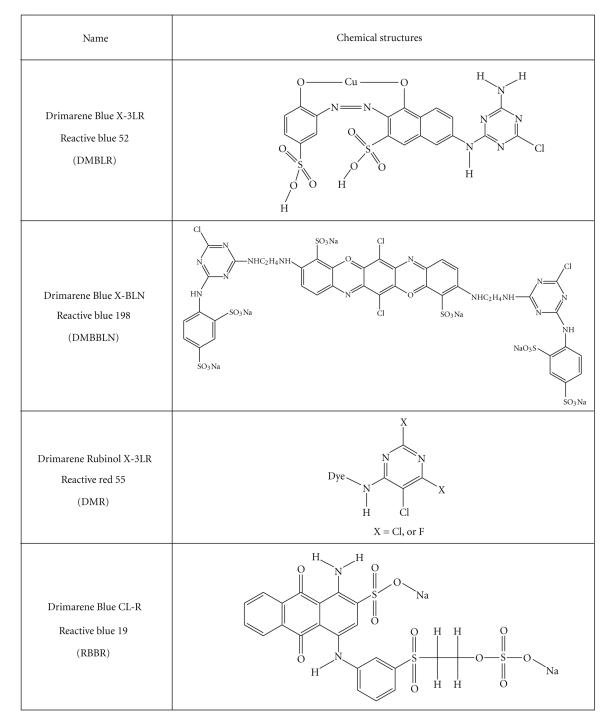
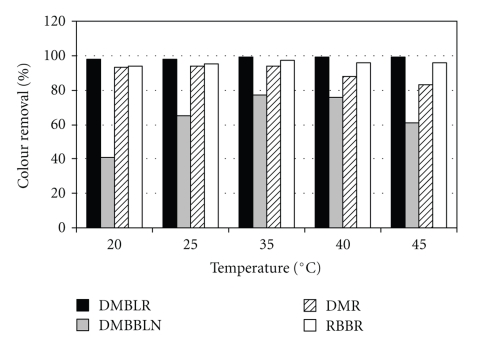
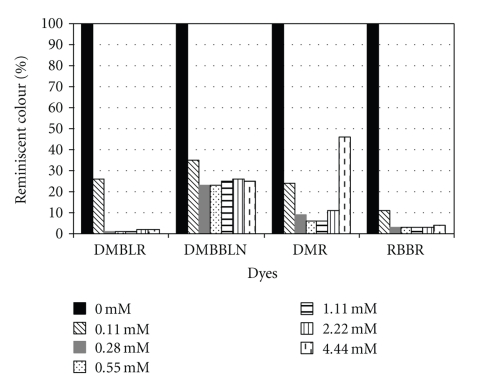
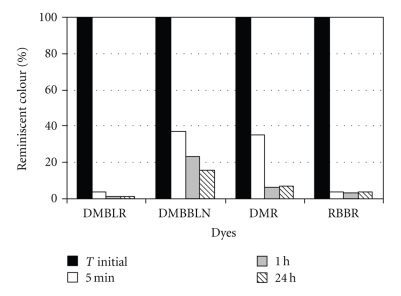
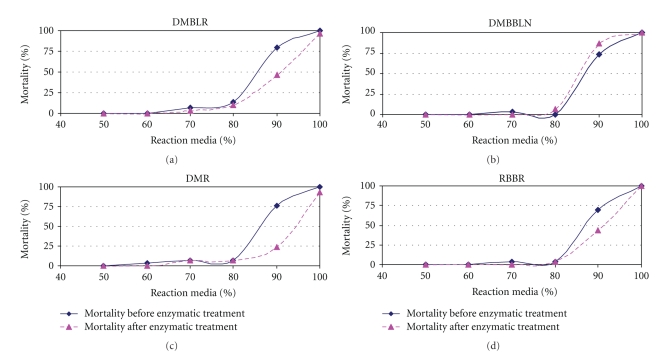
This work studied the potential use of horseradish peroxidase (HRP) in the decolorization of the following textile dyes: Drimarene Blue X-3LR (DMBLR), Drimarene Blue X-BLN (DMBBLN), Drimarene Rubinol X-3LR (DMR), and Drimarene Blue CL-R (RBBR). Dyes were individually tested in the reaction media containing 120 mg⋅L-1, considering the following parameters: temperature (20–45°C), H 2 O 2 concentration (0–4.44 mmol⋅L-1), and reaction time (5 minutes, 1 and 24 h). The following conditions: 35°C, 0.55 mmol⋅L-1, and 1h, provided the best set of results of color removal for DMBLR (99%), DMBBLN (77%), DMR (94%), and RBBR (97%). It should be mentioned that only 5 minutes of reaction was enough to obtain 96% of decolorization for DMBLR and RBBR. After the decolorization reactions of DMBLR, DMR, and RBBR, it was possible to observe the reduction of Artemia salina mortality and the no significant increase in toxicity for the products generated from DMBBLN.
Overview
The claims and statistics of this paper haven’t been checked yet.
Run the check — free, no account needed. It reads the open-access text and checks the sources it cites.
Integrity signals
Registry
Cites
Statistics
Figures
Verification
Claims the paper makes
The claims and statistics of this paper haven’t been checked yet.
Run the check — free, no account needed. It reads the open-access text and checks the sources it cites.
Claims other papers make about this one
Each is checked against this paper’s own text: does it say what the citing paper says it does?
The check wasn’t confident either way, so it gives no verdict — never disputed.
In the citing paper
“Also, diffusional limitations of substrate and/or product in-between the cell compartments can be avoided as well as any other actions besides enzymatic 105-107 .”
From Degradation of anthraquinone dyes from effluents: A review focusing on enzymatic dye degradation with industrial potential (2020) · cites this paper as [106]
Experimental — accuracy not yet measured
Self-check
Percentages, sums and reported differences re-computed from the paper’s own numbers.
The self-check needs the paper’s full text.
Citations
Cites
Brine Shrimp: A Convenient General Bioassay for Active Plant Constituents
Meyer, B., Ferrigni, N., Putnam, J., Jacobsen, L., Nichols, D., & McLaughlin, J. (1982) · Planta Medica · doi:10.1055/s-2007-971236 · Cited by 4,831
Robinson, T., McMullan, G., Marchant, R., & Nigam, P. (2001) · Bioresource Technology · doi:10.1016/s0960-8524(00)00080-8 · Cited by 4,422
White-rot fungi and their enzymes for the treatment of industrial dye effluents
Wesenberg, D. (2003) · Biotechnology Advances · doi:10.1016/j.biotechadv.2003.08.011 · Cited by 1,149
Teodoro, E.-S., John, B., Mark, C., Max, D., Michael, E., David, A. S., Saul, C.-A., & Nehemias, C.-H. (2006) · Applied Biochemistry and Biotechnology · doi:10.1385/abab:132:1:959 · Cited by 1,113
Potential Applications of Enzymes in Waste Treatment
Karam, J., & Nicell, J. A. (1997) · Journal of Chemical Technology & Biotechnology · doi:10.1002/(sici)1097-4660(199706)69:2<141::aid-jctb694>3.0.co;2-u · Cited by 387
Decolorization of ion-exchange effluents derived from sugar-mill operations by Bjerkandera sp.BOS55
Moreira, M. T., Palma, C., Feijoo, G., & Lema, J. M. (1997) · International Biodeterioration & Biodegradation · doi:10.1016/s0964-8305(97)00044-9 · Cited by 291
Murugesan, K., Nam, I. H., Kim, Y., & Chang, Y. (2006) · Enzyme and Microbial Technology · doi:10.1016/j.enzmictec.2006.08.028 · Cited by 278
Toxicity of textile dyes and their degradation by the enzyme horseradish peroxidase (HRP)
Ulson de Souza, S. M. A. G., Forgiarini, E., & Ulson de Souza, A. A. (2007) · Journal of Hazardous Materials · doi:10.1016/j.jhazmat.2007.06.003 · Cited by 243
Decolorization of reactive dyes by immobilized laccase
Peralta-Zamora, P., Pereira, C. M., Tiburtius, E. R. L., Moraes, S. G., Rosa, M. A., Minussi, R. C., & Durán, N. (2003) · Applied Catalysis B: Environmental · doi:10.1016/s0926-3373(02)00220-5 · Cited by 220
Acid azo dye degradation by free and immobilized horseradish peroxidase (HRP) catalyzed process
Mohan, S. V., Prasad, K. K., Rao, N. C., & Sarma, P. N. (2004) · Chemosphere · doi:10.1016/j.chemosphere.2004.09.070 · Cited by 214
Research works printed but not linked: 1
- 1982, Planta Medica, 45, 31
Cited by
Routoula, E., & Patwardhan, S. V. (2020) · Environmental Science & Technology · doi:10.1021/acs.est.9b03737 · Cited by 579
Degradation of Synthetic Dyes by Laccases – A Mini-Review
Legerská, B., Chmelová, D., & Ondrejovič, M. (2016) · Nova Biotechnologica et Chimica · doi:10.1515/nbec-2016-0010 · Cited by 106
Metadata
- Authors
- da Silva, M. R., de Sá, L. R. V., Russo, C., Scio, E., & Ferreira-Leitão, V. S.
- Venue
- Enzyme Research
- Publisher
- Wiley
- Published
- 2010-01-20
- Volume
- 2010
- Pages
- 1-7
- ISSN
- 2090-0414
- PMC
- PMC3034966
- Cited by
- 31
- References
- 37
- Language
- en
- Funders
- Conselho Nacional de Desenvolvimento Científico e Tecnológico
About these checks
Registry, retraction, Cites and statistics results are computed, not judged, with one exception: a printed reference that no index lists is read once by a model before it counts as a citation error. Claims are extracted by a model and kept only when their quote appears verbatim in the text; each cited source is then checked, with a model’s help, for whether it says what the claim relies on. Those verdicts can be wrong — read the claim’s quote and the cited source before relying on one.
Statistics and arithmetic are recomputed, not judged.
Confidence bands are shown only for fields calibrated on our annotated test set. None is calibrated yet, so no band is shown.
What counts as a claim ›How we measure confidence ›How we check this ›
Are you an author, or do you see a problem with this page? Request a review
Data sources
Bibliographic data: Semantic Scholar, OpenAlex, Crossref.
Contains information from the Semantic Scholar Academic Graph Datasets, made available under the ODC Attribution License (ODC-BY 1.0).
Semantic Scholar’s data is described in: Kinney, R., et al. (2023). The Semantic Scholar Open Data Platform. arXiv:2301.10140.
