

The DOI matches its Crossref record; 122 of the 122 references it cites were found in a registry or an index.
Mechanisms of Amyloid-β Peptide Clearance: Potential Therapeutic Targets for Alzheimer's Disease
Open accessAbstract
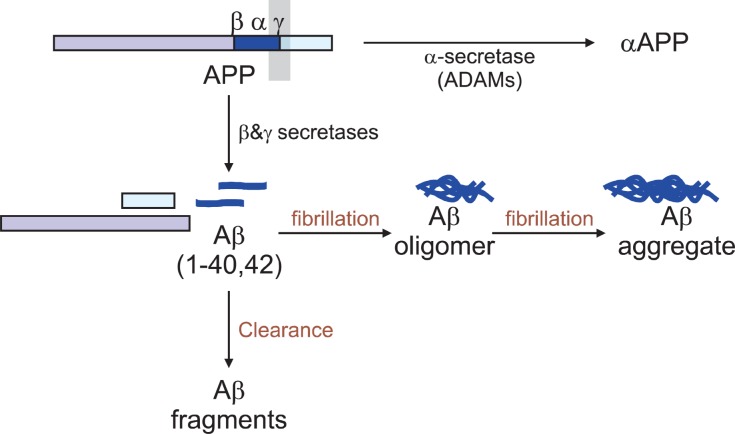
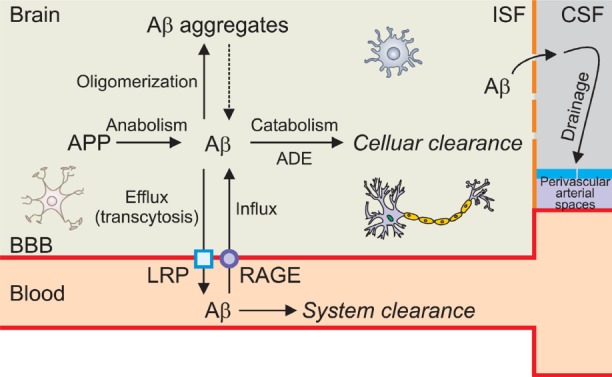
Amyloid-β peptide (Aβ) is still best known as a molecule to cause Alzheimer's disease (AD) through accumulation and deposition within the frontal cortex and hippocampus in the brain. Thus, strategies on developing AD drugs have been focused on the reduc-tion of Aβ in the brain. Since accumulation of Aβ depends on the rate of its synthesis and clearance, the metabolic pathway of Aβ in the brain and the whole body should be carefully explored for AD research. Although the synthetic pathway of Aβ is equally important, we summarize primarily the clearance pathway in this paper because the former has been extensively reviewed in previous studies. The clearance of Aβ from the brain is accomplished by several mechanisms which include non-enzymatic and enzymatic pathways. Nonenzymatic pathway includes interstitial fluid drainage, uptake by microglial phagocytosis, and transport across the blood vessel walls into the circulation. Multiple Aβ-degrading enzymes (ADE) implicated in the clearance process have been identified, which include neprilysin, insulin-degrading enzyme, matrix metalloproteinase-9, glutamate carboxypeptidase II and others. A series of studies on Aβ clearance mechanism provide new insight into the pathogenesis of AD at the molecular level and suggest a new target for the development of novel therapeutics.
Overview
The claims and statistics of this paper haven’t been checked yet.
Run the check — free, no account needed. It reads the open-access text and checks the sources it cites.
Integrity signals
Registry
Cites
Statistics
Figures
Verification
Claims the paper makes
The claims and statistics of this paper haven’t been checked yet.
Run the check — free, no account needed. It reads the open-access text and checks the sources it cites.
Claims other papers make about this one
Each is checked against this paper’s own text: does it say what the citing paper says it does?
The source backs part of the claim, not all of it — or backs it for a different population, condition or comparison.
In the citing paper
“forming a protective barrier to protect brain tissue from the neurotoxicity of Aβ plaques”
From Acoustofluidic assembly of 3D neurospheroids to model Alzheimer's disease (2020) · cites this paper as [47]
Experimental — accuracy not yet measuredThe cited source says what the claim attributes to it.
In the citing paper
“promotes the clearance of Aβ aggregates.47, 48”
From Acoustofluidic assembly of 3D neurospheroids to model Alzheimer's disease (2020) · cites this paper as [47]
In the citing paper
“The Aβ clearance may occur through the transport into the cerebrospinal fluid, the blood across the blood-brain barrier (BBB), and the removal by brain-resident macrophages (Yoon and Jo, 2012).”
From Exploring the Therapeutic Potential of Phytochemicals in Alzheimer’s Disease: Focus on Polyphenols and Monoterpenes (2022) · cites this paper as Yoon and Jo, 2012
Self-check
Percentages, sums and reported differences re-computed from the paper’s own numbers.
The self-check needs the paper’s full text.
Citations
Cites
1 retracted
Pulukuri, S. M. K., Estes, N. C., Patel, J. C., & Rao, J. S. (2007) · Cancer Research · doi:10.1158/0008-5472.can-06-2892 · Cited by 85
RetractedThe Amyloid Hypothesis of Alzheimer’s Disease: Progress and Problems on the Road to Therapeutics
Hardy, J., & Selkoe, D. J. (2002) · Science · doi:10.1126/science.1072994 · Cited by 13,864
Alzheimer's disease: the amyloid cascade hypothesis
Hardy, J. A., & Higgins, G. A. (1992) · Science · doi:10.1126/science.1566067 · Cited by 7,484
Jarrett, J. T., Berger, E. P., & Lansbury, P. T. (1993) · Biochemistry · doi:10.1021/bi00069a001 · Cited by 2,022
Twenty years of the Alzheimer's disease amyloid hypothesis: a genetic perspective
Tanzi, R. E., & Bertram, L. (2005) · Cell · doi:10.1016/j.cell.2005.02.008 · Cited by 1,849
Cellular prion protein mediates impairment of synaptic plasticity by amyloid-β oligomers
Laurén, J., Gimbel, D. A., Nygaard, H. B., Gilbert, J. W., & Strittmatter, S. M. (2009) · Nature · doi:10.1038/nature07761 · Cited by 1,560
Farris, W., Mansourian, S., Chang, Y., Lindsley, L., Eckman, E. A., Frosch, M. P., Eckman, C. B., Tanzi, R. E., Selkoe, D. J., & Guénette, S. Y. (2003) · Proceedings of the National Academy of Sciences · doi:10.1073/pnas.0230450100 · Cited by 1,526
Shibata, M., Yamada, S., Kumar, S. R., Calero, M., Bading, J., Frangione, B., Holtzman, D. M., Miller, C. A., Strickland, D. K., Ghiso, J., et al. (2000) · Journal of Clinical Investigation · doi:10.1172/jci10498 · Cited by 1,413
Wyss-Coray (2006) · doi:10.1038/nm1484 · Cited by 1,284
Simard, A. R., Soulet, D., Gowing, G., Julien, J.-P., & Rivest, S. (2006) · Neuron · doi:10.1016/j.neuron.2006.01.022 · Cited by 1,265
Research works printed but not linked: 6
- 1998, Am. J. Pathol., 152, 307
- 2006, Pharmazie, 61, 66
- 1996, Cell Growth Differ, 7, 787
- 2002, Pharmazie, 57, 556
- 2010, Am. J. Transl. Res., 3, 73
- 2006, Nat. Med., 12, 1005
Cited by
Sorted by citations
Clearance systems in the brain—implications for Alzheimer disease
Tarasoff-Conway, J. M., Carare, R. O., Osorio, R. S., Glodzik, L., Butler, T., Fieremans, E., Axel, L., Rusinek, H., Nicholson, C., Zlokovic, B. V., et al. (2015) · Nature Reviews Neurology · doi:10.1038/nrneurol.2015.119 · Cited by 1,678
The Role of Amyloid-β Oligomers in Toxicity, Propagation, and Immunotherapy
Sengupta, U., Nilson, A. N., & Kayed, R. (2016) · EBioMedicine · doi:10.1016/j.ebiom.2016.03.035 · Cited by 740
“Therefore, any imbalance in the dynamic equilibrium maintained by these three pathways would result in the accumulation of Aβ (Yoon and Jo, 2012; Mucke, 2009).”
BackgroundMechanisms of Aβ Clearance and Degradation by Glial Cells
Ries, M., & Sastre, M. (2016) · Frontiers in Aging Neuroscience · doi:10.3389/fnagi.2016.00160 · Cited by 527
“A great number of reviews have examined the main mechanisms of Aβ clearance and degradation (Bates et al., 2009; Saido and Leissring, 2012; Yoon and Jo, 2012; Tarasoff-Conway et al., 2015).”
BackgroundZhong, L., Xu, Y., Zhuo, R., Wang, T., Wang, K., Huang, R., Wang, D., Gao, Y., Zhu, Y., Sheng, X., et al. (2019) · Nature Communications · doi:10.1038/s41467-019-09118-9 · Cited by 371
The Translational Significance of the Neurovascular Unit
McConnell, H. L., Kersch, C. N., Woltjer, R. L., & Neuwelt, E. A. (2017) · Journal of Biological Chemistry · doi:10.1074/jbc.r116.760215 · Cited by 314
Metadata
- Authors
- Yoon, S.-S., & AhnJo, S.-M.
- Affiliations
- Dankook University (KR)
- ORCID
- Yoon, Sang-Sun
- Venue
- Biomolecules and Therapeutics
- Published
- 2012-05-31
- Volume
- 20
- Issue
- 3
- Pages
- 245-255
- ISSN
- 1976-9148 (ISSN-L)
- PMC
- PMC3794520
- OpenAlex
- W2008487250
- Cited by
- 205
- References
- 122
- Citations by year
- 2026: 15 · 2025: 27 · 2024: 27 · 2023: 23 · 2022: 14 · 2021: 26 · 2020: 18 · 2019: 15 · 2018: 11 · 2017: 9 · 2016: 6 · 2015: 9 · 2014: 1 · 2013: 3 · 2012: 1
- FWCI
- 0.49
- Type
- journal article
- Language
- en
- Open access
- bronze
- doi.org
- Locations
- Biomolecules & Therapeutics (publishedVersion)
- Europe PMC (PubMed Central) (publishedVersion, cc-by-nc)
- PubMed Central (publishedVersion, cc-by-nc)
- PubMed (publishedVersion)
- Funders
- National Research Foundation
- National Research Foundation of Korea (2011-0016127)
- Topics
- Life Sciences › Neuroscience › Cellular and Molecular Neuroscience › Alzheimer's disease research and treatments
- Life Sciences › Neuroscience › Neurology › Neuroinflammation and Neurodegeneration Mechanisms
- Health Sciences › Medicine › Psychiatry and Mental health › Dementia and Cognitive Impairment Research
- Keywords
- amyloid-beta, Alzheimer's disease, amyloid-beta clearance, neprilysin, insulin-degrading enzyme, MMP-9, prostate-specific membrane antigen, microglial phagocytosis, interstitial fluid drainage, blood-brain barrier, therapeutic target
About these checks
Registry, retraction, Cites and statistics results are computed, not judged, with one exception: a printed reference that no index lists is read once by a model before it counts as a citation error. Claims are extracted by a model and kept only when their quote appears verbatim in the text; each cited source is then checked, with a model’s help, for whether it says what the claim relies on. Those verdicts can be wrong — read the claim’s quote and the cited source before relying on one.
Statistics and arithmetic are recomputed, not judged.
Confidence bands are shown only for fields calibrated on our annotated test set. None is calibrated yet, so no band is shown.
What counts as a claim ›How we measure confidence ›How we check this ›
Are you an author, or do you see a problem with this page? Request a review
