

The DOI matches its Crossref record; 95 of the 95 references it cites were found in a registry or an index.
Metabolism of Very Long-Chain Fatty Acids: Genes and Pathophysiology
Open accessAbstract
Fatty acids (FAs) are highly diverse in terms of carbon (C) chain-length and number of double bonds. FAs with C>20 are called very long-chain fatty acids (VLCFAs). VLCFAs are found not only as constituents of cellular lipids such as sphingolipids and glycerophospholipids but also as precursors of lipid mediators. Our understanding on the function of VLCFAs is growing in parallel with the identification of enzymes involved in VLCFA synthesis or degradation. A variety of inherited diseases, such as ichthyosis, macular degeneration, myopathy, mental retardation, and demyelination, are caused by mutations in the genes encoding VLCFA metabolizing enzymes. In this review, we describe mammalian VLCFAs by highlighting their tissue distribution and metabolic pathways, and we discuss responsible genes and enzymes with reference to their roles in pathophysiology.
Overview
The claims and statistics of this paper haven’t been checked yet.
Run the check — free, no account needed. It reads the open-access text and checks the sources it cites.
Integrity signals
Registry
Cites
Statistics
Figures
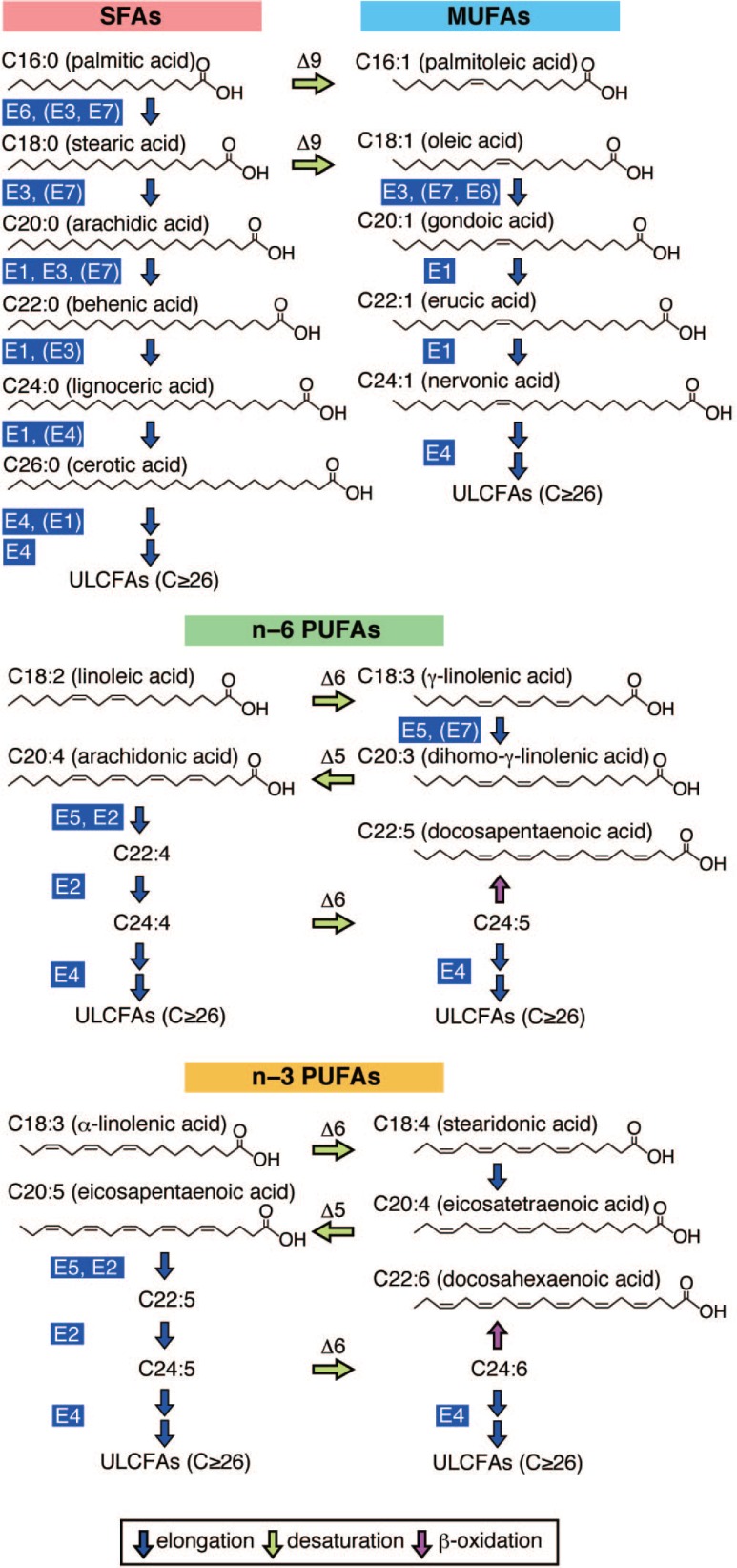
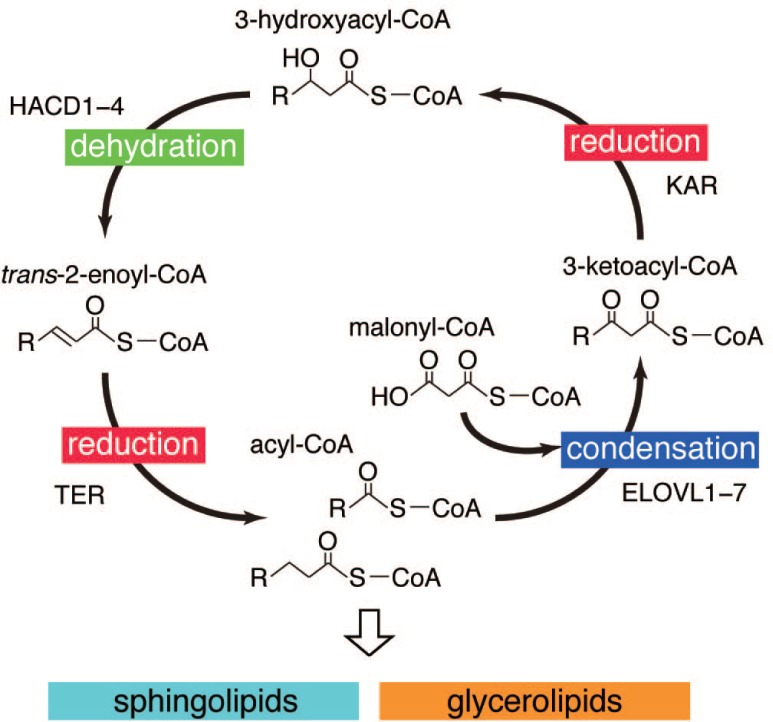
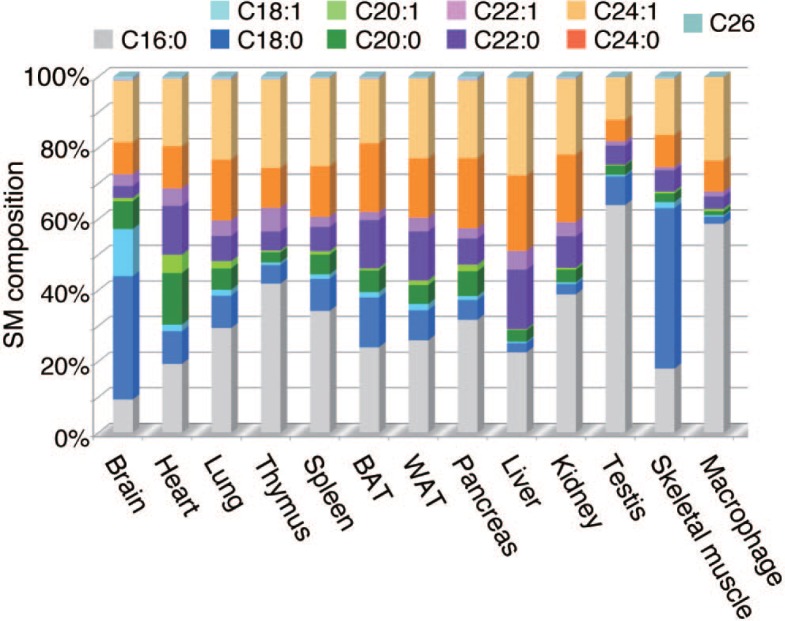
Verification
Claims the paper makes
The claims and statistics of this paper haven’t been checked yet.
Run the check — free, no account needed. It reads the open-access text and checks the sources it cites.
Claims other papers make about this one
Each is checked against this paper’s own text: does it say what the citing paper says it does?
The source backs part of the claim, not all of it — or backs it for a different population, condition or comparison.
In the citing paper
“Half of myelin sphingolipids contain VLCFAs (C > 22) [213,214,215].”
From Revisiting the Pathogenesis of X-Linked Adrenoleukodystrophy (2025) · cites this paper as [213]
Experimental — accuracy not yet measuredThe cited source says what the claim attributes to it.
In the citing paper
“VLCFAs increase membrane stiffness, thereby decreasing fluidity, and they are likely critical for proper myelin function [191,213,214,217], myelination [218], myelin maintenance [207,213,215], and neuron polarity during CNS development [219].”
From Revisiting the Pathogenesis of X-Linked Adrenoleukodystrophy (2025) · cites this paper as [213]
Self-check
Percentages, sums and reported differences re-computed from the paper’s own numbers.
The self-check needs the paper’s full text.
Citations
Cites
Functional rafts in cell membranes
Simons, K., & Ikonen, E. (1997) · Nature · doi:10.1038/42408 · Cited by 9,757 · cited 1×
“…levels, C24 sphingolipids have unique biophysical properties not possessed by C16 sphingolipids such as effects on membrane fluidity, lipid microdomain formation, and signaling across the membrane (Simons and Ikonen, 1997; Kasahara and Sanai, 2000; Sonnino et al., 2009; Silva et al., 2012).”
The skin: an indispensable barrier
Proksch, E., Brandner, J. M., & Jensen, J. (2008) · Experimental Dermatology · doi:10.1111/j.1600-0625.2008.00786.x · Cited by 2,054
Putative X-linked adrenoleukodystrophy gene shares unexpected homology with ABC transporters
Mosser, J., Douar, A.-M., Sarde, C.-O., Kioschis, P., Feil, R., Moser, H., Poustka, A.-M., Mandel, J.-L., & Aubourg, P. (1993) · Nature · doi:10.1038/361726a0 · Cited by 1,202
Global analysis of the yeast lipidome by quantitative shotgun mass spectrometry
Ejsing, C. S., Sampaio, J. L., Surendranath, V., Duchoslav, E., Ekroos, K., Klemm, R. W., Simons, K., & Shevchenko, A. (2009) · Proceedings of the National Academy of Sciences · doi:10.1073/pnas.0811700106 · Cited by 1,053
Fatty acid elongases in mammals: their regulation and roles in metabolism
JAKOBSSON, A., WESTERBERG, R., & JACOBSSON, A. (2006) · Progress in Lipid Research · doi:10.1016/j.plipres.2006.01.004 · Cited by 936
Guillou, H., Zadravec, D., Martin, P. G. P., & Jacobsson, A. (2009) · Progress in Lipid Research · doi:10.1016/j.plipres.2009.12.002 · Cited by 913
The role of omega-3 long-chain polyunsaturated fatty acids in health and disease of the retina
SanGiovanni, J. P., & Chew, E. Y. (2004) · Progress in Retinal and Eye Research · doi:10.1016/j.preteyeres.2004.06.002 · Cited by 905
Lipids of nervous tissue: Composition and metabolism
SASTRY, P. S. (1985) · Progress in Lipid Research · doi:10.1016/0163-7827(85)90011-6 · Cited by 810
Oji, V., Tadini, G., Akiyama, M., Blanchet‐Bardon, C., Bodemer, C., Bourrat, E., Coudiere, P., DiGiovanna, J. J., Elias, P. M., Fischer, J., et al. (2010) · Journal of the American Academy of Dermatology · doi:10.1016/j.jaad.2009.11.020 · Cited by 781
Crucial role of a long-chain fatty acid elongase, Elovl6, in obesity-induced insulin resistance
Matsuzaka, T., Shimano, H., Yahagi, N., Kato, T., Atsumi, A., Yamamoto, T., Inoue, N., Ishikawa, M., Okada, S., Ishigaki, N., et al. (2007) · Nature Medicine · doi:10.1038/nm1662 · Cited by 557
Research works printed but not linked: 5
- 2005, Mol. Vis., 11, 657
- 2007, Int. J. Biol. Sci., 3, 120
- 2010, Mol. Vis., 16, 2438
- 1988, Am. J. Hum. Genet., 42, 422
- 2001, Nat. Genet., 27, 89
Cited by
Sorted by citations
Sphingolipids and their metabolism in physiology and disease
Hannun, Y. A., & Obeid, L. M. (2017) · Nature Reviews Molecular Cell Biology · doi:10.1038/nrm.2017.107 · Cited by 2,117
Understanding the diversity of membrane lipid composition
原山, 武., & Riezman, H. (2018) · Nature Reviews Molecular Cell Biology · doi:10.1038/nrm.2017.138 · Cited by 2,140
Acylcarnitines: Nomenclature, Biomarkers, Therapeutic Potential, Drug Targets, and Clinical Trials
Dambrova, M., Makrecka‐Kuka, M., Kuka, J., Vilšķe̅rsts, R., Nordberg, D. O. T., Attwood, M. M., Smesny, S., Şen, Z. D., Guo, A. C., Oler, E., et al. (2022) · Pharmacological Reviews · doi:10.1124/pharmrev.121.000408 · Cited by 549
Metabolism and functional effects of plant-derived omega-3 fatty acids in humans
Baker, E. J., Miles, E. A., Burdge, G. C., Yaqoob, P., & Calder, P. C. (2016) · Progress in Lipid Research · doi:10.1016/j.plipres.2016.07.002 · Cited by 500
Myelin Fat Facts: An Overview of Lipids and Fatty Acid Metabolism
Poitelon, Y., Kopec, A. M., & Belin, S. (2020) · Cells · doi:10.3390/cells9040812 · Cited by 394
Metadata
- Authors
- Sassa, T., & Kihara, A.
- Affiliations
- Hokkaido University (JP)
- Corresponding author
- Kihara, Akio
- Venue
- Biomolecules & Therapeutics
- Published
- 2014-03-31
- Volume
- 22
- Issue
- 2
- Pages
- 83-92
- ISSN
- 1976-9148 (ISSN-L)
- 2005-4483
- PMC
- PMC3975470
- OpenAlex
- W2009332633
- Cited by
- 302
- References
- 95
- Citations by year
- 2026: 18 · 2025: 27 · 2024: 34 · 2023: 35 · 2022: 22 · 2021: 46 · 2020: 32 · 2019: 23 · 2018: 28 · 2017: 17 · 2016: 11 · 2015: 4 · 2014: 4
- FWCI
- 1.03
- Type
- journal article
- Language
- en
- Open access
- green
- europepmc.org
- Licence
- Locations
- Biomolecules & Therapeutics (publishedVersion)
- Europe PMC (PubMed Central) (publishedVersion, other-oa)
- PubMed Central (publishedVersion, cc-by-nc)
- PubMed (publishedVersion)
- Funders
- Japan Society for the Promotion of Science (23370057, 24590073)
- Topics
- Life Sciences › Biochemistry, Genetics and Molecular Biology › Biochemistry › Lipid metabolism and biosynthesis
- Life Sciences › Biochemistry, Genetics and Molecular Biology › Clinical Biochemistry › Metabolism and Genetic Disorders
- Health Sciences › Nursing › Nutrition and Dietetics › Fatty Acid Research and Health
- Keywords
- very long chain fatty acids, fatty acid synthesis, fatty acid degradation, ichthyosis, macular degeneration, myopathy, demyelination, lipid mediators, sphingolipids, tissue distribution
About these checks
Registry, retraction, Cites and statistics results are computed, not judged, with one exception: a printed reference that no index lists is read once by a model before it counts as a citation error. Claims are extracted by a model and kept only when their quote appears verbatim in the text; each cited source is then checked, with a model’s help, for whether it says what the claim relies on. Those verdicts can be wrong — read the claim’s quote and the cited source before relying on one.
Statistics and arithmetic are recomputed, not judged.
Confidence bands are shown only for fields calibrated on our annotated test set. None is calibrated yet, so no band is shown.
What counts as a claim ›How we measure confidence ›How we check this ›
Are you an author, or do you see a problem with this page? Request a review
