

Nutritional ecology and digestive response to dietary shift in the large South American fox, Pseudalopex culpaeus
Open accessThe DOI matches its Crossref record; 44 of the 44 references it cites were found in a registry or an index; 2 of the 31 sources its claims cite were checked for support.
Abstract
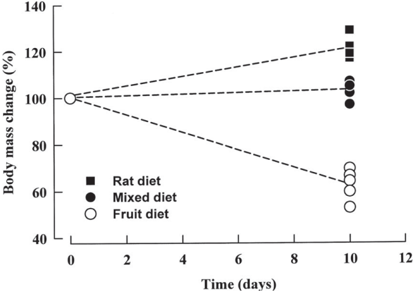
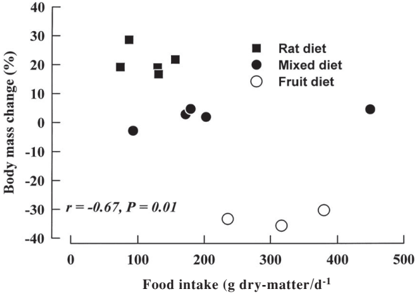
We tested the role of dietary shifts (from rodents to fruits and to mixed diets) on the nutritional ecology of the culpeo fox Pseudalopex culpaeus, a native canid of South America.We studied the effects of food quality on digestive processes, nutrition, and mass balance, and the implications of diet quality for fox survival.We observed at the end of the nutritional trials that body mass differed significantly between the three diet groups (fruits, rats and mixed diets), while percentage of body mass change differed significantly only in the fruit diet treatment.Foxes fed with fruits consumed more food to meet their dietary and metabolic needs.Across diets, dry-matter as well as energy digestibility increased significantly with diet quality.Also, mean retention time was negatively and significantly correlated with dry-matter intake.We put forth that mixed diet may yield higher assimilation efficiencies and hence higher nutrient intakes than those predicted from the ingestion and assimilation of pure diets (i.e,.only rats, only fruits).We hypothesize that during periods of low availability of mammalian prey, a mixed diet should yield a positive energy/mass balance for the fox.We conclude that temporal and spatial variation in nutrient, energy, and water contents of prey available in a given habitat could have an important effect on fox nutrition, energy use, and mass balance.Finally, we postulate that P. culpaeus could not survive on fruits only past seven days.
Overview
CoChat Summary
TL;DR
Captive culpeo foxes fed rat, mixed rat–peppertree fruit, or fruit-only diets showed strong diet-quality effects on intake, digestibility, retention time, and body mass. Foxes maintained or gained mass on rat and mixed diets but lost mass on fruit alone, leading the authors to conclude that *Pseudalopex culpaeus* cannot survive exclusively on fruits beyond about seven days.
Key findings
- Body mass at 10 days differed significantly among diets (F₂,₁₂ = 5.18, P = 0.02): rat and mixed diets produced positive mass balance, whereas fruit-fed foxes lost mass; the authors report a 37% decrease in body mass on fruit diets versus a 46% decrease in foxes without food.
- Dry-matter intake was highest on fruit (310.5 ± 41.7 g d⁻¹), intermediate on mixed (218.9 ± 60.45 g d⁻¹), and lowest on rat (115.3 ± 15.2 g d⁻¹; F₂,₁₀ = 4.22, P = 0.04), while energy intake was similar across diets and nitrogen intake trended downward from rats to fruits.
- Apparent dry-matter digestibility was 87.3 ± 0.9% on rat, 53.4 ± 1.3% on mixed, and 32.7 ± 7.7% on fruit (F₂,₁₀ = 775.84, P < 0.0001); energy digestibility was 92.9 ± 0.5%, 52.7 ± 1.7%, and 29.6 ± 8%, respectively (F₂,₁₀ = 792.67, P < 0.0001).
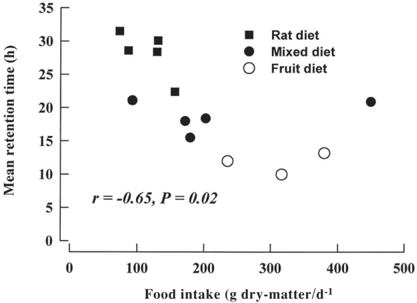
- Mean retention time was shortest on fruit (12.0 ± 0.7 h), intermediate on mixed (18.8 ± 1.0 h), and longest on rat (28.2 ± 1.6 h; F₂,₁₀ = 737.14, P < 0.0001), and was negatively correlated with dry-matter intake; the authors hypothesize that mixed diets may yield higher assimilation efficiencies and positive energy/mass balance during low prey availability.
Methods
- Fifteen nonreproductive adult culpeo foxes (nine males, six females; 4,480–6,140 g) were captured in central and northern Chile between May 1998 and June 2000 and assigned to three diets with five foxes each: live laboratory rats (400 g d⁻¹), peppertree (*Schinus molle*) fruits ad libitum, or a mixed diet (1:4 minced laboratory rats to peppertree fruits) ad libitum for 10 days.
- Nutritional trials used metabolic cages with feces collection; food intake was measured gravimetrically, diets and feces were analyzed by proximal chemical analysis and bomb calorimetry, digestibility was calculated for dry matter, nitrogen, and energy, and mean retention time was estimated using marker particles (100 2-mm² flagging tape) with feces collected every 2 h for two days.
- Data were analyzed with one-way ANOVA and Tukey tests (α = 0.05); results are reported as mean ± SE in the text, though Table 2 indicates mean ± SD.
Limitations
- The paper states that because food intake and mean retention time covary, “it is difficult to assign causality”; the field benefit of mixed diets is presented as a hypothesis rather than a tested outcome.
- Evident from the text, not stated as a formal limitation: each diet had only five captive foxes, trials lasted only 10 days, and only one fruit species (*S. molle*) was tested.
- Evident from the text, not stated as a formal limitation: survival conclusions for wild foxes are extrapolated from short-term captive feeding trials, and the authors note that temporal and spatial variation in prey nutrient, energy, and water contents may affect fox nutrition and mass balance.
Model-written summary. Check it against the paper before relying on it.
Integrity signals
Registry
Cites
Statistics
Figures
Verification
Claims the paper makes
1 Valid · 0 Not valid · 17 Not checked · 22 Own results and interpretations
The cited sources support only part of this claim — read each source’s verdict below.
In the paper
“Comparatively low-quality, energy-diluted foods such as fruits have low digestibility (Bosque & Pacheco 2000, Cipollini 2000).”
What the sources say
- Partly supportedcites Bosque & Pacheco 2000 matched to “Dietary nitrogen as a limiting nutrient in frugivorous birds” (2000) sourceExperimental — accuracy not yet measured
Our copy supports the 'comparatively low-quality, energy-diluted' half of the claim: the CHARACTERISTICS OF FRUIT PULP section (p. 2) states that fruit pulp 'typically contains dilute amounts of Nitrogen' and that low energy values of tropical and temperate fruits indicate pulps are carbohydrate-rich with little energy-rich lipid, and the ABSTRACT (p. 1) calls fruit pulp nutritionally inadequate for its low protein content. It does not, however, state that fruits have low digestibility: the only assimilation figure given ('assuming that 64% of the energy available in fruit pulp is assimilated') is explicitly credited to Karasov 1990, and the DISCUSSION (p. 7) argues the opposite direction, that fruit sugars are monosaccharides 'requiring no enzymatic digestion prior to absorption', that pulps are low in lipids and low in fiber and 'not very abrasive'. The closest the paper comes is a hedged remark (Nutritional quality of pulp nitrogen, p. 5) that nonproteinaceous nitrogen compounds 'might hinder digestion and absorption of nitrogen and other nutrients'. So the digestibility assertion attributed to this source is not made by it. (LLM, conf=0.70)
- Could not verifycites Cipollini 2000 matched to “Secondary metabolites of vertebrate-dispersed fruits: evidence for adaptive functions” (2000) sourceExperimental — accuracy not yet measured
Our copy of Cipollini (2000) is a review of adaptive hypotheses for fruit pulp secondary metabolites; no passage states or argues that fruits, as a food class, are low-quality/energy-diluted or have low digestibility. The nearest content is the gut retention time hypothesis (p. 6-7), which concerns seed passage rate rather than digestibility, and a specific note (p. 7) that the high sucrose of Vaccinium stamineum cannot be digested by many passerine birds — a compound- and taxon-specific point, not a general claim about fruit digestibility. The protein assimilation hypothesis (p. 6) touches fruit low protein quality only via secondary metabolites interfering with protein metabolism, and the Introduction (p. 2) lists 'nutrients ready for uptake' among broad-scale dispersal adaptations, so nothing in our copy settles the cited statement. (LLM, conf=0.62)
plainstates a cause- Asserted: passes — The authors put it forward as true.
- Checkable: passes — It can be checked against evidence.
- Load-bearing: passes — The paper’s conclusions depend on it.
- Based: passes — The paper gives a reason why it holds.
- Partly supported
A result the paper reports from its own data — it cites no other source for it, so there is none to check. The quote shows it is in the paper.
In the paper
“Foxes fed with fruits consumed more food to meet their dietary and metabolic needs.”
- Also stated in: § RESULTS AND DISCUSSION · p. 4 · plain
“As expected, dry-matter intake of fruits was higher than the intake of rats and mixed diets.”
plainstates a cause- Asserted: passes — The authors put it forward as true.
- Checkable: passes — It can be checked against evidence.
- Load-bearing: passes — The paper’s conclusions depend on it.
- Based: passes — The paper gives a reason why it holds.
- Also stated in: § RESULTS AND DISCUSSION · p. 4 · plain
A result the paper reports from its own data — it cites no other source for it, so there is none to check. The quote shows it is in the paper.
In the paper
“while percentage of body mass change differed significantly only in the fruit diet treatment.”
plain- Asserted: passes — The authors put it forward as true.
- Checkable: passes — It can be checked against evidence.
- Load-bearing: unclear — It is unclear whether the paper’s conclusions depend on it.
- Based: passes — The paper gives a reason why it holds.
A result the paper reports from its own data — it cites no other source for it, so there is none to check. The quote shows it is in the paper.
In the paper
“Across diets, dry-matter as well as energy digestibility increased significantly with diet quality.”
- Also stated in: § RESULTS AND DISCUSSION · p. 4 · plain
“Across diets, dry-matter as well as energy digestibility increased significantly with diet quality (Table 2).”
plainstates a cause- Asserted: passes — The authors put it forward as true.
- Checkable: passes — It can be checked against evidence.
- Load-bearing: passes — The paper’s conclusions depend on it.
- Based: passes — The paper gives a reason why it holds.
- Also stated in: § RESULTS AND DISCUSSION · p. 4 · plain
A result the paper reports from its own data — it cites no other source for it, so there is none to check. The quote shows it is in the paper.
In the paper
“Also, mean retention time was negatively and significantly correlated with dry-matter intake.”
- Also stated in: § RESULTS AND DISCUSSION · p. 5 · plain
“Mean retention time was negatively and significantly correlated with dry-matter intake (Fig. 2).”
plainstates an association- Asserted: passes — The authors put it forward as true.
- Checkable: passes — It can be checked against evidence.
- Load-bearing: unclear — It is unclear whether the paper’s conclusions depend on it.
- Based: passes — The paper gives a reason why it holds.
- Also stated in: § RESULTS AND DISCUSSION · p. 5 · plain
11 more claims
Create a free account to see all 40 claims and to verify the 16 references still open.
- The quote only partly states this claim. 1
- It may state two separate claims as one. 13
- Probably not a substantial claim. 15
Self-check
Percentages, sums and reported differences re-computed from the paper’s own numbers.
Each contradiction between two passages listed here was confirmed by an independent check.
Rated major: it would touch a result — a value a result rests on, reported and recomputed p-values on opposite sides of the significance level, two passages that conflict with no sign which is right, or a cited work retracted before this paper was published.
In the paper
§ RESULTS AND DISCUSSION · p. 6
“What is clear, though, is that this fox species cannot survive feeding exclusively fruits for over a week.”
§ Animals and diets · p. 3
“(3) Fruit diet, exclusively of peppertree fruit; 10 days for five foxes.”
Rated major: it would touch a result — a value a result rests on, reported and recomputed p-values on opposite sides of the significance level, two passages that conflict with no sign which is right, or a cited work retracted before this paper was published.
In the paper
“| Digestible intake energy (kJ d -1 ) | 2691.6 + 367.8 | 2042.3 + 299.6 | 2386.7 + 893.3 ** | F 2,10 =77 0.57, P = 0.5877 |”
Reported 2042.3 · recomputed 3044.3
Citations
Cites
Revista chilena de historia natural.
de Valparaâiso, M. D. H. N., & de Valparaíso, M. D. H. N. (1907) · Biodiversity Heritage Library (Smithsonian Institution) · Cited by 794
Comparative biochemistry and physiology
(1975) · Comparative Biochemistry and Physiology Part B: Comparative Biochemistry · doi:10.1016/0305-0491(75)90161-3 · Cited by 779
What are the Biological Bases of Varied Diets?
Westoby, M. (1978) · The American Naturalist · doi:10.1086/283303 · Cited by 422
LONG-TERM DYNAMICS OF MEDITERRANEAN FRUGIVOROUSBIRDS AND FLESHY FRUITS: A 12-YEAR STUDY
Herrera, C. M. (1998) · Ecological Monographs · doi:10.1890/0012-9615(1998)068[0511:ltdomf]2.0.co;2 · Cited by 371
Vertebrate‐Dispersed Plants of the Iberian Peninsula: A Study of Fruit Characteristics
Herrera, C. M. (1987) · Ecological Monographs · doi:10.2307/2937089 · Cited by 352 · cited 1×
“Thus, frugivores may obtain energy and nutrients as a result of digesting fruit pulp (Herrera 1984, 1987, Johnson et al. 1985, Rode & Robbins 2000, Felicetti et al. 2003).”
BackgroundCONSTRAINTS ON FRUGIVORY BY BEARS
Welch, C. A., Keay, J., Kendall, K. C., & Robbins, C. T. (1997) · Ecology · doi:10.1890/0012-9658(1997)078[1105:cofbb]2.0.co;2 · Cited by 283 · cited 2×
“Nevertheless, the role of fruits on carnivore nutritional ecology and energetics has remained virtually unexplored (Vogtsberger & Barret 1973, Moors 1977, Litvaitis & Mautz 1980, Ball & Golightly 1992, McNab 1995, 2000, Welch et al. 1997).”
BackgroundFoxes, Wolves, Jackals, and Dogs: An Action Plan for the Conservation of Canids
Macdonald, D. W., & Ginsberg, J. R. (1990) · Medical Entomology and Zoology · Cited by 278
Nutritional Values of Wild Fruits and Consumption by Migrant Frugivorous Birds
Johnson, R. A., Willson, M. F., Thompson, J. N., & Bertin, R. I. (1985) · Ecology · doi:10.2307/1940543 · Cited by 272
Adaptation to Frugivory of Mediterranean Avian Seed Dispersers
Herrera, C. M. (1984) · Ecology · doi:10.2307/1941423 · Cited by 222 · cited 1×
“Thus, frugivores may obtain energy and nutrients as a result of digesting fruit pulp (Herrera 1984, 1987, Johnson et al. 1985, Rode & Robbins 2000, Felicetti et al. 2003).”
BackgroundThe arctic fox (Alopex lagopus): an opportunistic specialist
Elmhagen, B., Tannerfeldt, M., Verucci, P., & Angerbjörn, A. (2000) · Journal of Zoology · doi:10.1111/j.1469-7998.2000.tb00599.x · Cited by 179 · cited 1×
“Fruit does not represent a high-quality food, but it is nonetheless consumed by different mammals (Ball & Golightly 1992, McNab 1995, 2000, Welch et al. 1997, Kimball et al. 1998, Elmhagen et al. 2000).”
BackgroundAssimilation efficiency in birds: A function of taxon or food type?
Castro, G., Stoyan, N. C., & Myers, J. P. (1989) · Comparative Biochemistry and Physiology Part A Physiology · doi:10.1016/0300-9629(89)90563-x · Cited by 173
Pennings, S. C., Nadeau, M. T., & Paul, V. J. (1993) · Ecology · doi:10.2307/1940813 · Cited by 159
Why bears consume mixed diets during fruit abundance
Rode, K. D., & Robbins, C. T. (2000) · Canadian Journal of Zoology · doi:10.1139/cjz-78-9-1640 · Cited by 152
Plant / frugivore interactions in south american temperate forests
Armesto, J. J., Rozzi, R., Miranda, P., & Sabag, C. (1987) · Revista chilena de historia natural · Cited by 127
Use of fibrous diets by small herbivores: How far can the rules be ‘bent’?
Foley, W. J., & Cork, S. J. (1992) · Trends in Ecology & Evolution · doi:10.1016/0169-5347(92)90210-3 · Cited by 122
Carnivore behavior, ecology, and evolution
(1989) · Choice Reviews Online · doi:10.5860/choice.27-0311 · Cited by 119
Digestive System Trade-offs and Adaptations of Frugivorous Passerine Birds
Karasov, W. H., & Levey, D. J. (1990) · Physiological Zoology · doi:10.1086/physzool.63.6.30152643 · Cited by 110 · cited 1×
“…energy/ matter budget while consuming fruits, the expected foraging behavior and digestion for fruit-eating vertebrates is an increase in the rate of food intake and a decrease in the digesta transit time (Levey & Karasov 1989, Karasov & Levey 1990, Levey & Grajal 1991, Martínez del Río 1994).”
BackgroundFeeding Ecology of Central Chilean Foxes, Dusicyon culpaeus and Dusicyon griseus
Jaksi, F. M., Schlatter, R. P., & Yanez, J. L. (1980) · Journal of Mammalogy · doi:10.2307/1380046 · Cited by 103
Self-citationFuglei, E., & Øritsland, N. A. (1999) · Journal of Comparative Physiology B: Biochemical, Systemic, and Environmental Physiology · doi:10.1007/s003600050232 · Cited by 101
Fat Deposition and Seasonal Variation in Body Composition of Arctic Foxes in Svalbard
Prestrud, P., & Nilssen, K. (1992) · The Journal of Wildlife Management · doi:10.2307/3808816 · Cited by 97 · cited 1×
“These data are in agreement with previous records on mass loss in other starved carnivores (Ball & Golightly 1992, Prestrud & Nilssen 1992, Fuglei & Øristland 1999), as well as with records from Pseudalopex culpaeus during periods of low availability of mammalian prey and high consumption of fruit…”
ResultBozinovic, F. (1995) · Journal of Mammalogy · doi:10.2307/1382371 · Cited by 90 · cited 3×
“Nevertheless, animal nutrition depends not only on food type but also on digestive strategies (i.e., Castro et al. 1989, Bozinovic 1995, Bozinovic & Muñoz-Pedreros 1995a, 1995b, Sabat & Bozinovic 2000, Ahlstrom et al .”
BackgroundInfluentialSelf-citationFelicetti, L. A., Robbins, C. T., & Shipley, L. A. (2003) · Physiological and Biochemical Zoology · doi:10.1086/374279 · Cited by 88 · cited 1×
“Thus, frugivores may obtain energy and nutrients as a result of digesting fruit pulp (Herrera 1984, 1987, Johnson et al. 1985, Rode & Robbins 2000, Felicetti et al. 2003).”
BackgroundChemically Mediated Foraging Preference of Black Bears (Ursus americanus)
Kimball, B. A., Nolte, D. L., Engeman, R. M., Johnston, J. J., & Stermitz, F. R. (1998) · Journal of Mammalogy · doi:10.2307/1382975 · Cited by 86
Secondary metabolites of vertebrate-dispersed fruits: evidence for adaptive functions
CIPOLLINI, M. L. (2000) · Revista chilena de historia natural · doi:10.4067/s0716-078x2000000300006 · Cited by 80
Evolutionary Implications of Fruit-Processing Limitations in Cedar Waxwings
Levey, D. J., & Grajal, A. (1991) · The American Naturalist · doi:10.1086/285210 · Cited by 78
Diet Mixing: Nonadditive Interactions of Diet Items in an Omnivorous Freshwater Turtle
Bjorndal, K. A. (1991) · Ecology · doi:10.2307/1941097 · Cited by 75
Sabat, P., & Bozinovic, F. (2000) · Journal of Comparative Physiology B · doi:10.1007/s003600000118 · Cited by 53
Self-citationEnergy Expenditure and Conservation in Frugivorous and Mixed-Diet Carnivorans
McNab, B. K. (1995) · Journal of Mammalogy · doi:10.2307/1382329 · Cited by 45 · cited 2×
“Nevertheless, the role of fruits on carnivore nutritional ecology and energetics has remained virtually unexplored (Vogtsberger & Barret 1973, Moors 1977, Litvaitis & Mautz 1980, Ball & Golightly 1992, McNab 1995, 2000, Welch et al. 1997).”
BackgroundAnimals eat what they should not: why do they reject our foraging models?
Bozinovic, F., & del Rio, C. M. (1996) · Revista chilena de historia natural · Cited by 43
Self-citationMoors, P. J. (1977) · Oecologia · doi:10.1007/bf00347466 · Cited by 42 · cited 1×
“Nevertheless, the role of fruits on carnivore nutritional ecology and energetics has remained virtually unexplored (Vogtsberger & Barret 1973, Moors 1977, Litvaitis & Mautz 1980, Ball & Golightly 1992, McNab 1995, 2000, Welch et al. 1997).”
BackgroundFOOD SELECTION IN AN HERBIVOROUS RODENT: BALANCING NUTRITION WITH THERMOREGULATION
Torres‐Contreras, H., & Bozinovic, F. (1997) · Ecology · doi:10.1890/0012-9658(1997)078[2230:fsiahr]2.0.co;2 · Cited by 38
Self-citationNutritional ecology of fruit-eating and flower-visiting birds and bats
del Rio, C. M. (1994) · Cambridge University Press eBooks · doi:10.1017/cbo9780511661716.009 · Cited by 35
Bioenergetics of Captive Red Foxes
Vogtsberger, L. M., & Barrett, G. W. (1973) · The Journal of Wildlife Management · doi:10.2307/3800315 · Cited by 28
Cork, S. J. (1994) · The Digestive System in Mammals · doi:10.1017/cbo9780511661716.022 · Cited by 24
Bozinovic, F., & Muñoz-Pedreros, A. (1995) · Physiological Zoology · doi:10.1086/physzool.68.3.30163780 · Cited by 21
Self-citationFood and Energy Use by Captive Coyotes
Litvaitis, J. A., & Mautz, W. W. (1980) · The Journal of Wildlife Management · doi:10.2307/3808350 · Cited by 20
Feeding Ecology of Wood Ducks in South Carolina
Landers, J. L., Fendley, T. T., & Johnson, A. S. (1977) · The Journal of Wildlife Management · doi:10.2307/3800100 · Cited by 7 · cited 1×
“LANDERS JN, TT FENDLEY & AS JOHNSON (1977) Feeding ecology of wood ducks in South Carolina.”
BackgroundDoes digestion rate affect diet selection? A study in Octodon degus, a generalist herbivorous rodent
Bozinovic, F., & Torres‐Contreras, H. (1998) · ACTA THERIOLOGICA · doi:10.4098/at.arch.98-16 · Cited by 6
Self-citationEnergy and Nutrient Assimilation by Gray Foxes on Diets of Mice and Himalaya Berries
Ball, L. C., & Golightly, R. T. (1992) · Journal of Mammalogy · doi:10.2307/1382205 · Cited by 6
Dietary nitrogen as a limiting nutrient in frugivorous birds
CARLOS, B., & PACHECO, M. A. (2000) · Revista chilena de historia natural · doi:10.4067/s0716-078x2000000300007 · Cited by 1
(1988) · Revista chilena de historia natural
(1989) · doi:10.1093/auk/106.4.675
Long-Term Dynamics of Mediterranean Frugivorous Birds and Fleshy Fruits: A 12-Year Study
Herrera, C. M. (1998) · Ecological Monographs · doi:10.2307/2657152
Research works printed but not linked: 6
- AOAC (Asssociation of Official Analytical Chemists) (1980) Official methods of analytical chemists. Thirteenth edition. Association of Official Analytical Chemists, Washington, District of Columbia, USA. 469 pp.
- JIMÉNEZ JE (1993) Comparative ecology of Dusicyon foxes at the Chinchilla National Reserve in northcentral Chile. Master of Sciences Thesis, University of Florida, Gainesville, Florida, USA. viii + 163 pp.
- MCNAB BK (2002) The physiological ecology of vertebrates. Cornell University Press, Ithaca, New York, USA. 576 pp.
- PENRY DL (1993) Digestive constraints on diet selection. In: Hughes RN (ed) Diet selection: an interdisciplinary approach to foraging behaviour: 32-55. Blackwell Scientific Publications, Oxford, United Kingdom.
- SILVA SI (2001) Ecología trófica y nutricional del zorro culpeo ( Pseudalopex culpaeus ): restricciones digestivas y energéticas asociadas a la frugivoría y sus efectos sobre la dispersión de semillas. Ph.D. Thesis, Facultad de Ciencias Biológicas, Pontificia Universidad Católica de Chile, Santiago, Chile. 120 pp.
- WARNER ACY (1981) Rate of passage of digesta through the gut of mammals and birds. Nutritional Abstract Review 51B: 789-820.
Cited by
Carnivorous mammals: nutrient digestibility and energy evaluation
Clauss, M., Kleffner, H., & Kienzle, E. (2010) · Zoo Biology · doi:10.1002/zoo.20302 · Cited by 77
“2% DM [Silva et al., 2005], and one diet of pine nuts only that contained TDF at 40% DM fed to bears [Pritchard and Robbins, 1990].”
BackgroundThe Role of Carnivores as Mediterranean Seed Dispersers
Rosalino, L. M., Rosa, S., & Santos-Reis, M. (2010) · Annales Zoologici Fennici · doi:10.5735/086.047.0304 · Cited by 46
“Gastrointestinal tracts of most carnivores are relatively short and simple (Stevens & Hume 1998), but the high meat content in carnivore diet typically increases retention time of food in the gut (Silva et al. 2005).”
BackgroundMembrane-bound intestinal enzymes of passerine birds: dietary and phylogenetic correlates
Ramírez‐Otarola, N., Narváez, C., & Sabat, P. (2011) · Journal of Comparative Physiology B · doi:10.1007/s00360-011-0557-3 · Cited by 41
“The association between diet and phenotypic variation ranges from molecular and biochemical to the organismal and behavioral level (Sibly and Calow 1986; Marti´nez del Rio and Stevens 1989; Weiner 1992; Bozinovic and Mun ˜oz-Pedreros 1995; Silva et al. 2005; Naya et al. 2009).”
BackgroundCuyper, A. D., Meloro, C., Abraham, A. J., Müller, D. W. H., Codron, D., Janssens, G., & Clauß, M. (2020) · Comparative Biochemistry and Physiology Part A Molecular & Integrative Physiology · doi:10.1016/j.cbpa.2020.110683 · Cited by 30
Improved estimation of gut passage time considerably affects trait‐based dispersal models
Abraham, A. J., Prŷs‐Jones, T. O., Cuyper, A. D., Ridenour, C. L., Hempson, G. P., Hocking, T. D., Clauß, M., & Doughty, C. E. (2020) · Functional Ecology · doi:10.1111/1365-2435.13726 · Cited by 27
“…studies have shown that gut passage time is directly related to the type of food consumed in the experiment and not the dominant feeding preferences (Hilton et al., 1998; Jackson, 1992; Nijboer et al., 2007; Pagan et al., 1998; Remis & Dierenfeld, 2004; Silva et al., 2005; White et al., 2007).”
Background
Metadata
- Authors
- SILVA, S. I., JAKSIC, F. M., & BOZINOVIC, F.
- Affiliations
- Pontificia Universidad Católica de Chile (CL)
- Venue
- Revista chilena de historia natural
- Published
- 2005-06
- Volume
- 78
- Issue
- 2
- ISSN
- 0716-078X (ISSN-L)
- OpenAlex
- W2007491440
- Semantic Scholar
- 03a3a9b957eb344f5f3e4111ca591010fd6e2bfe
- Cited by
- 18
- References
- 38
- Citations by year
- 2022: 1 · 2020: 5 · 2018: 2 · 2016: 2 · 2012: 1
- FWCI
- 0.57
- Type
- journal article
- Language
- en
- Open access
- gold
- doi.org
- Licence
- cc-by
- Locations
- Revista chilena de historia natural (publishedVersion, cc-by)
- LA Referencia (Red Federada de Repositorios Institucionales de Publicaciones Científicas) (publishedVersion, other-oa)
- Americanae (AECID Library) (submittedVersion, other-oa)
- Biodiversity Heritage Library (Smithsonian Institution) (submittedVersion)
- DOAJ (DOAJ: Directory of Open Access Journals) (submittedVersion, cc-by-sa)
- Redalyc (Universidad Autónoma del Estado de México) (submittedVersion)
- Funders
- Comisión Nacional de Investigación Científica y Tecnológica
- Topics
- Physical Sciences › Environmental Science › Ecology › Wildlife Ecology and Conservation
- Physical Sciences › Environmental Science › Ecology › Animal Ecology and Behavior Studies
- Physical Sciences › Environmental Science › Ecology › Physiological and biochemical adaptations
- Keywords
- culpeo fox, dietary change, nutritional ecology, digestive physiology, energy digestibility, dry matter digestibility, fruit diet, rodent diet, mixed diet, assimilation efficiency, food quality
About these checks
Registry, retraction, Cites and statistics results are computed, not judged, with one exception: a printed reference that no index lists is read once by a model before it counts as a citation error. Claims are extracted by a model and kept only when their quote appears verbatim in the text; each cited source is then checked, with a model’s help, for whether it says what the claim relies on. Those verdicts can be wrong — read the claim’s quote and the cited source before relying on one.
The claim verdicts this report counts are experimental: their accuracy is not yet measured.
A language model drew the claims from the paper on 2026-11-14, under version 3 of the claim definition (model deepseek-v4.1-flash, prompt extract-v3).
A second model labelled each claim on 2026-11-14 (model jev-1.13-20260917, definition revision gold-guideline-v0.2).
Cited sources are checked with a language model’s help (qwen3.8-omni-flash).
Statistics and arithmetic are recomputed, not judged.
Confidence bands are shown only for fields calibrated on our annotated test set. None is calibrated yet, so no band is shown.
What counts as a claim ›How we measure confidence ›How we check this ›
Are you an author, or do you see a problem with this page? Request a review
Data sources
Bibliographic data: Semantic Scholar, OpenAlex, Crossref.
Contains information from the Semantic Scholar Academic Graph Datasets, made available under the ODC Attribution License (ODC-BY 1.0).
Semantic Scholar’s data is described in: Kinney, R., et al. (2023). The Semantic Scholar Open Data Platform. arXiv:2301.10140.
