

Associations between total physical activity levels and academic performance in adults: A systematic review and meta-analysis
Open accessThe DOI matches its Crossref record; 60 of the 68 references it cites were found in a registry or an index; none of the 10 sources its claims cite is checked for support yet.
Abstract
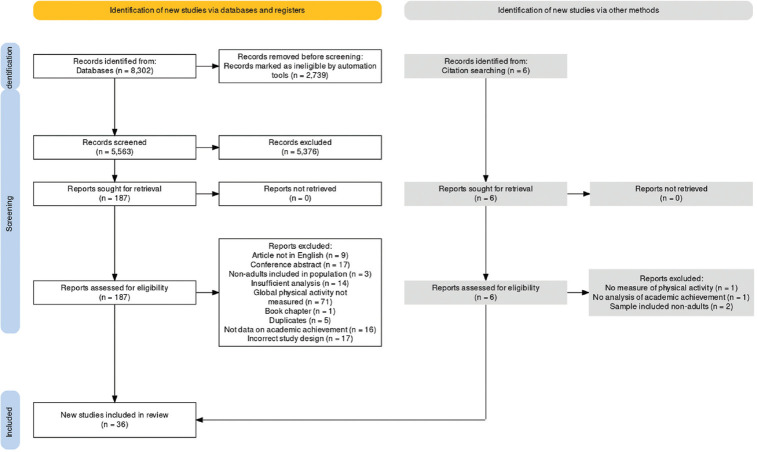
Physical activity has been associated with positive health-related outcomes. Physical inactivity, conversely, has been associated with several negative health outcomes. One topic that has been consistently examined is the relationship between physical activity and academic performance in children; however, studies that involve university-level students have not been aggregated to date. It is therefore the aim of this systematic review to examine the relationship between physical activity and academic performance in university-level students. This systematic review was conducted in line with the Preferred Reporting Items for Systematic Reviews and Meta-Analyses guidelines and included any study published until September 2023 that examined associations between physical activity and any measure of academic performance. SPORTDiscus, ERIC, the British Education Index, Scopus, Embase, Web of Science, and PubMed were searched. A random effects meta-analysis was also undertaken, and risk bias was assessed using the Newcastle Ottawa Scale. After screening, 36 studies were included, with six studies being included in the meta-analysis. The meta-analysis found a significant association between physical activity (high versus low) and academic performance (high versus low performers) (odds ratio = 3.04; 95% CI = 1.84-5.02; P ≤ 0.001; I 2 = 49.62). These results, however, were deemed to be of low credibility. The narrative analysis yielded mixed results, with 50% of studies reporting positive associations and the remaining studies reporting no significant associations. This trend did not differ depending on the subjective or objective measurement of physical activity. Although this review found meta-analytic significant associations between physical activity and academic performance, these results should be treated with caution, as the remaining studies yielded mixed results. Future studies should aim to focus on objective measurements of physical activity where possible to further explore this potential relationship.
Overview
CoChat Summary
## TL;DR
This systematic review and meta-analysis found suggestive evidence that meeting physical activity guidelines is associated with higher academic achievement in university students, but the overall literature was mixed and the meta-analytic result was judged low credibility. Across 36 included studies, about half of the non-meta-analyzed studies found significant associations and half did not.
## Key findings
- The review included 36 studies with 36,271 participants; 6 studies were pooled in the meta-analysis.
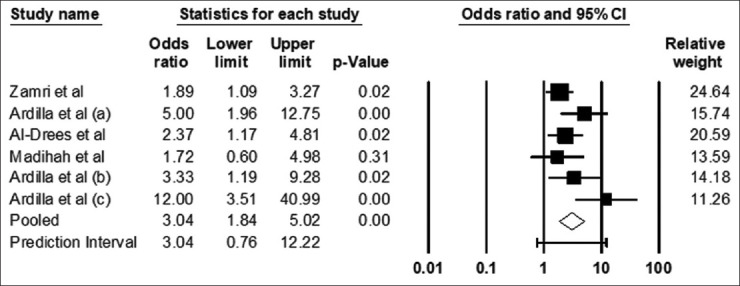
- In the meta-analysis, meeting recommended physical activity guidelines was associated with higher academic achievement: OR = 3.04 (95% CI 1.84–5.02; P ≤ 0.001), with I² = 49.62% and a prediction interval of 3.04 (0.76–12.22).
- The authors judged the meta-analytic evidence to be low credibility, because the number of studies was small and the prediction interval crossed the null.
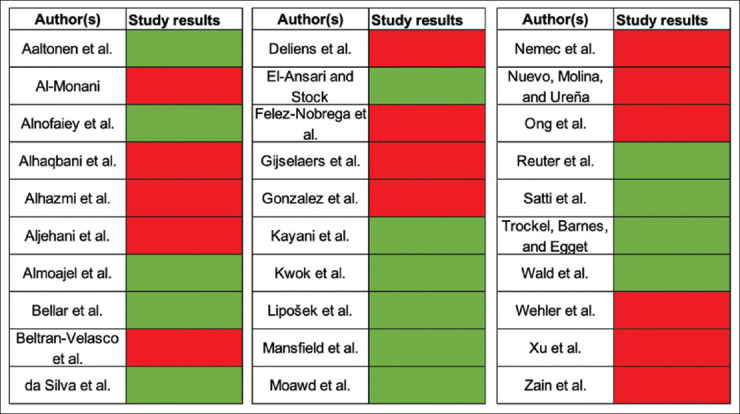
- Among the 30 non-meta-analyzed studies, results were mixed: 50% reported significant findings and 50% found no significant associations; this pattern was similar for both subjective and objective physical activity measures.
## Methods
- Design: Systematic review and meta-analysis conducted according to PRISMA and a pre-written protocol; observational studies only (cross-sectional, cohort, case-control), with random-effects meta-analysis when data were sufficiently homogeneous.
- Data/sample: Searches of 7 databases (SPORTDiscus, ERIC, British Education Index, Scopus, Embase, Web of Science, PubMed) on November 9, 2023; included university-level students aged 18+ and 36 studies in total.
- Main analysis: Titles/abstracts and full texts were screened by multiple authors; risk of bias was assessed with the Newcastle-Ottawa Scale; pooled effects used a random-effects DerSimonian-Laird model, with Egger’s test, I², and prediction intervals; non-pooled studies were synthesized narratively and evidence credibility assessed with GRADE.
## Limitations
- The paper states that heterogeneous dependent and outcome variables mean results should be applied cautiously.
- The search was limited to English-language articles, so non-English studies may have been missed.
- The cross-sectional design of the meta-analysis and most included studies precludes causal inference; this is stated in the paper.
- Evident from the text: the meta-analysis was based on only 6 studies, and most included studies used subjective physical activity measures (33/36) and cross-sectional designs (30/36), which likely limits robustness and generalizability.
Model-written summary. Check it against the paper before relying on it.
Integrity signals
Registry
Cites
Statistics
Figures
Verification
Claims the paper makes
0 Valid · 0 Not valid · 11 Not checked · 39 Own results and interpretations
A result the paper reports from its own data — it cites no other source for it, so there is none to check. The quote shows it is in the paper.
In the paper
“Only one study in this review was found that examined the relationship between PA and students studying distance learning courses.”
§ Associations between total physical activity levels and academic performance in adults: A systematic review and meta-analysis > Discussion
plain- Asserted: passes — The authors put it forward as true.
- Checkable: passes — It can be checked against evidence.
- Load-bearing: unclear — It is unclear whether the paper’s conclusions depend on it.
- Based: passes — The paper gives a reason why it holds.
A result the paper reports from its own data — it cites no other source for it, so there is none to check. The quote shows it is in the paper.
In the paper
“Ten studies were found that examined PA and academic achievement in mature students”
§ Associations between total physical activity levels and academic performance in adults: A systematic review and meta-analysis > Results > Mature students
plain- Asserted: passes — The authors put it forward as true.
- Checkable: passes — It can be checked against evidence.
- Load-bearing: unclear — It is unclear whether the paper’s conclusions depend on it.
- Based: passes — The paper gives a reason why it holds.
In the paper
“Kwok et al.[45] found a significant correlation between PA and academic achievement”
§ Associations between total physical activity levels and academic performance in adults: A systematic review and meta-analysis > Results > Mature students
What the sources say
- Not checked yetcites [45] Kwok C Leung PY Poon KY Fung XC The effects of internet gaming and social media use on physical activity, sleep, quality of life, and academic performance among university students in Hong Kong: A preliminary study Asian J Soc Health Behav 2021 4 36 source
plainstates an association- Asserted: passes — The authors put it forward as true.
- Checkable: passes — It can be checked against evidence.
- Load-bearing: unclear — It is unclear whether the paper’s conclusions depend on it.
- Based: passes — The paper gives a reason why it holds.
A result the paper reports from its own data — it cites no other source for it, so there is none to check. The quote shows it is in the paper.
In the paper
“Several studies used self-report measures to determine academic achievement, most of which yielded significant outcomes (57%).”
§ Associations between total physical activity levels and academic performance in adults: A systematic review and meta-analysis > Results > Campus-based undergraduate students
plainstates an association- Asserted: passes — The authors put it forward as true.
- Checkable: passes — It can be checked against evidence.
- Load-bearing: unclear — It is unclear whether the paper’s conclusions depend on it.
- Based: passes — The paper gives a reason why it holds.
A result the paper reports from its own data — it cites no other source for it, so there is none to check. The quote shows it is in the paper.
In the paper
“Of the studies that used student records as a measure of academic success, most studies (70%) reported significant associations between PA and academic achievement.”
§ Associations between total physical activity levels and academic performance in adults: A systematic review and meta-analysis > Results > Campus-based undergraduate students
plainstates an association- Asserted: passes — The authors put it forward as true.
- Checkable: passes — It can be checked against evidence.
- Load-bearing: unclear — It is unclear whether the paper’s conclusions depend on it.
- Based: passes — The paper gives a reason why it holds.
19 more claims
Create a free account to see all 50 claims and to verify the 4 references still open.
- It may state two separate claims as one. 18
- Probably not a substantial claim. 15
Claims other papers make about this one
Each is checked against this paper’s own text: does it say what the citing paper says it does?
The source backs part of the claim, not all of it — or backs it for a different population, condition or comparison.
In the citing paper
“Trott et al. (2024) and H. Zhang et al. (2023), confirmed significant anxiety reductions and modest academic gains associated with physical activity, although high heterogeneity and low methodological quality persisted.”
From Anxiety, Academic Performance, and Physical Activity in University Students: A Scoping Review (2025) · cites this paper as Trott et al. (2024)
Experimental — accuracy not yet measured
Citations
Cites
Bias in meta-analysis detected by a simple, graphical test
Egger, M., Smith, G. D., Schneider, M., & Minder, C. (1997) · BMJ · doi:10.1136/bmj.315.7109.629 · Cited by 56,722 · cited 1×
“[20] Publication bias was assessed using the Egger statistic, [21] using a conservative P 0.10 to determine if publication bias was present, and heterogeneity was measured using the I 2 statistic, [22] using categories proposed by Higgins [22] to classify high (75‑100%), moderate (50‑75%), or low…”
MethodInfluentialMeta-analysis in clinical trials
DerSimonian, R., & Laird, N. (1986) · Controlled Clinical Trials · doi:10.1016/0197-2456(86)90046-2 · Cited by 39,552 · cited 1×
“[20] Publication bias was assessed using the Egger statistic, [21] using a conservative P 0.10 to determine if publication bias was present, and heterogeneity was measured using the I 2 statistic, [22] using categories proposed by Higgins [22] to classify high (75‑100%), moderate (50‑75%), or low…”
MethodInfluentialQuantifying heterogeneity in a meta‐analysis
Higgins, J. P. T., & Thompson, S. G. (2002) · Statistics in Medicine · doi:10.1002/sim.1186 · Cited by 36,763
The PRISMA 2020 Statement: An Updated Guideline for Reporting Systematic Reviews
Page, M. J., McKenzie, J. E., Bossuyt, P. M., Boutron, I., Hoffmann, T. C., Mulrow, C. D., Shamseer, L., Tetzlaff, J. M., Akl, E. A., Brennan, S. E., et al. (2021) · International Journal of Surgery · doi:10.1016/j.ijsu.2021.105906 · Cited by 11,748
Lee, I.-M., Shiroma, E. J., Lobelo, F., Puska, P., Blair, S. N., & Katzmarzyk, P. T. (2012) · The Lancet · doi:10.1016/s0140-6736(12)61031-9 · Cited by 8,215
Health benefits of physical activity: the evidence
Warburton, D. E. R. (2006) · Canadian Medical Association Journal · doi:10.1503/cmaj.051351 · Cited by 8,007 · cited 1×
“…is typically defined as any type of bodily movement that results in energy expenditure [1] and has been consistently positively associated with health‑related outcomes, including, for example, mortality, [2] several mental health outcomes, [3] and specific cancers, [4] across several age groups.”
BackgroundHaddaway, N. R., Page, M. J., Pritchard, C. C., & McGuinness, L. A. (2022) · Campbell Systematic Reviews · doi:10.1002/cl2.1230 · Cited by 3,486
The pandemic of physical inactivity: global action for public health
Kohl, H. W., Craig, C. L., Lambert, E. V., Inoue, S., Alkandari, J. R., Leetongin, G., & Kahlmeier, S. (2012) · The Lancet · doi:10.1016/s0140-6736(12)60898-8 · Cited by 2,985 · cited 1×
“[5] On the other hand, physical inactivity, defined as not meeting national PA recommendations, [6] is a recognized global pandemic, [7] is negatively associated with several health outcomes, and has been estimated to directly contribute to 5.3 million deaths per year.”
BackgroundInfluentialFit Yourself and Take Your Lungs to Heart
Palange, P., & Bonini, M. (2013) · Respiration · doi:10.1159/000350831 · Cited by 2,779
Physical activity and mental health in children and adolescents: a review of reviews
Biddle, S. J. H., & Asare, M. (2011) · British Journal of Sports Medicine · doi:10.1136/bjsports-2011-090185 · Cited by 2,447 · cited 1×
“[63] There is a possibility that this could also be the case in adults; however, to date, there is a paucity of studies that examine cognition (including levels of concentration) in adults of working age − the majority of the literature leans towards older adults.”
BackgroundHealth benefits of physical activity: a systematic review of current systematic reviews
Warburton, D. E. R., & Bredin, S. S. D. (2017) · Current Opinion in Cardiology · doi:10.1097/hco.0000000000000437 · Cited by 2,410 · cited 1×
“…is typically defined as any type of bodily movement that results in energy expenditure [1] and has been consistently positively associated with health‑related outcomes, including, for example, mortality, [2] several mental health outcomes, [3] and specific cancers, [4] across several age groups.”
BackgroundSackett, D. L. (1979) · Journal of Chronic Diseases · doi:10.1016/0021-9681(79)90012-2 · Cited by 2,075
Stockwell, S., Trott, M., Tully, M., Shin, J., Barnett, Y., Butler, L., McDermott, D., Schuch, F., & Smith, L. (2021) · BMJ Open Sport & Exercise Medicine · doi:10.1136/bmjsem-2020-000960 · Cited by 1,463
Self-citationRebar, A. L., Stanton, R., Geard, D., Short, C., Duncan, M. J., & Vandelanotte, C. (2015) · Health Psychology Review · doi:10.1080/17437199.2015.1022901 · Cited by 1,323
Physical Activity, Cognition, and Brain Outcomes: A Review of the 2018 Physical Activity Guidelines
ERICKSON, K. I., HILLMAN, C., STILLMAN, C. M., BALLARD, R. M., BLOODGOOD, B., CONROY, D. E., MACKO, R., MARQUEZ, D. X., PETRUZZELLO, S. J., & POWELL, K. E. (2019) · Medicine & Science in Sports & Exercise · doi:10.1249/mss.0000000000001936 · Cited by 1,214 · cited 1×
“[64] Future research should aim to investigate any relationships between PA and concentration, and its potential mediating role in the relationship between PA and academic achievement.”
BackgroundA catalog of biases in questionnaires.
Choi, B. C. K., & Pak, A. W. P. (2005) · Preventing Chronic Disease · Cited by 1,098
Physical activity behaviours in adolescence: Current evidence and opportunities for intervention
van Sluijs, E. M. F., Ekelund, U., Crochemore-Silva, I., Guthold, R., Ha, A., Lubans, D., Oyeyemi, A. L., Ding, D., & Katzmarzyk, P. T. (2021) · The Lancet · doi:10.1016/s0140-6736(21)01259-9 · Cited by 919 · cited 1×
“[9] One topic that has been consistently examined is the relationship between PA and academic performance, especially in children.”
Rasberry, C. N., Lee, S. M., Robin, L., Laris, B. A., Russell, L. A., Coyle, K. K., & Nihiser, A. J. (2011) · Preventive Medicine · doi:10.1016/j.ypmed.2011.01.027 · Cited by 709 · cited 2×
“[10] It is likely that the key reason for this is the heterogeneity of the measurement of both dependent and independent variables.”
BackgroundResultHelmerhorst, H. H. J., Brage, S., Warren, J., Besson, H., & Ekelund, U. (2012) · International Journal of Behavioral Nutrition and Physical Activity · doi:10.1186/1479-5868-9-103 · Cited by 552
The longitudinal effects of depression on physical activity
Roshanaei-Moghaddam, B., Katon, W. J., & Russo, J. (2009) · General Hospital Psychiatry · doi:10.1016/j.genhosppsych.2009.04.002 · Cited by 512
Trockel, M. T., Barnes, M. D., & Egget, D. L. (2000) · Journal of American College Health · doi:10.1080/07448480009596294 · Cited by 494
Physical Activity and Anxiety: A Systematic Review and Meta-analysis of Prospective Cohort Studies
McDowell, C. P., Dishman, R. K., Gordon, B. R., & Herring, M. P. (2019) · American Journal of Preventive Medicine · doi:10.1016/j.amepre.2019.05.012 · Cited by 385 · cited 1×
“First, PA has been consistently associated with positive mental health outcomes, including lower levels of depression [59,60] and anxiety, [61,62] which could potentially lead to positive academic outcomes.”
BackgroundAssociation between Bout Duration of Physical Activity and Health: Systematic Review
JAKICIC, J. M., KRAUS, W. E., POWELL, K. E., CAMPBELL, W. W., JANZ, K. F., TROIANO, R. P., SPROW, K., TORRES, A., & PIERCY, K. L. (2019) · Medicine & Science in Sports & Exercise · doi:10.1249/mss.0000000000001933 · Cited by 306 · cited 1×
“[5] On the other hand, physical inactivity, defined as not meeting national PA recommendations, [6] is a recognized global pandemic, [7] is negatively associated with several health outcomes, and has been estimated to directly contribute to 5.3 million deaths per year.”
BackgroundInfluentialTrott, M., Driscoll, R., Iraldo, E., & Pardhan, S. (2022) · eClinicalMedicine · doi:10.1016/j.eclinm.2022.101452 · Cited by 266 · cited 1×
“[17] The NOS has been well validated and used across several studies [18,19] and creates a continuous‑level risk of bias score, with a maximum score of 9 and a minimum score of 0.”
MethodSelf-citationMental health benefits of physical activity
Saxena, S., Van Ommeren, M., Tang, K. C., & Armstrong, T. P. (2005) · Journal of Mental Health · doi:10.1080/09638230500270776 · Cited by 232
Validity and Reliability of the International Physical Activity Questionnaire in College Students
Dinger, M. K., Behrens, T. K., & Han, J. L. (2006) · American Journal of Health Education · doi:10.1080/19325037.2006.10598924 · Cited by 222
Distance Learning in Higher Education During Covid-19
Masalimova, A. R., Khvatova, M. A., Сергеевна, Ч. Л., Zvyagintseva, E. P., Stepanova, V. V., & Melnik, M. V. (2022) · Frontiers in Education · doi:10.3389/feduc.2022.822958 · Cited by 198
Wald, A., Muennig, P. A., O'Connell, K. A., & Garber, C. E. (2014) · American Journal of Health Promotion · doi:10.4278/ajhp.120518-quan-265 · Cited by 136
Depression and Objectively Measured Physical Activity: A Systematic Review and Meta-Analysis
Gianfredi, V., Blandi, L., Cacitti, S., Minelli, M., Signorelli, C., Amerio, A., & Odone, A. (2020) · International Journal of Environmental Research and Public Health · doi:10.3390/ijerph17103738 · Cited by 133
Kwok, C., Leung, P. Y., Poon, K. Y., & Fung, X. C. C. (2021) · Asian Journal of Social Health and Behavior · doi:10.4103/shb.shb_81_20 · Cited by 128
Physical activity and academic achievement among the medical students: A cross-sectional study
Al-Drees, A., Abdulghani, H., Irshad, M., Baqays, A. A., Al-Zhrani, A. A., Alshammari, S. A., & Alturki, N. I. (2016) · Medical Teacher · doi:10.3109/0142159x.2016.1142516 · Cited by 106 · cited 2×
“Six studies [25,32‑34, 37, 47 ] were homogeneous enough”
ResultDeliens, T., Clarys, P., De Bourdeaudhuij, I., & Deforche, B. (2013) · Nutrition Journal · doi:10.1186/1475-2891-12-162 · Cited by 102
Physical activity of university students and its relation to physical fitness and academic success
Lipošek, S., Planinšec, J., Leskošek, B., & Pajtler, A. (2019) · Annales Kinesiologiae · doi:10.35469/ak.2018.171 · Cited by 72 · cited 1×
“[ 46 ] C r o ss ‑ s e c t i ona l S l o v en i a n = 297 M ean age = 20 .”
PEER REVIEWED: A Catalog of Biases in Questionnaires
Choi, B. C. K., & Pak, A. W. P. (2005) · Preventing Chronic Disease · Cited by 72
Chung, Q.-E., Abdulrahman, S. A., Khan, M. K. J., Sathik, H. B. J., & Rashid, A. (2018) · Malaysian Journal of Medical Sciences · doi:10.21315/mjms2018.25.5.9 · Cited by 71
Student health behavior and academic performance
Reuter, P. R., & Forster, B. L. (2021) · PeerJ · doi:10.7717/peerj.11107 · Cited by 61 · cited 2×
“[14] To date, however, the authors can find no literature that has attempted to synthesize these studies.”
BackgroundPhysical Activity and Academic Performance: The Mediating Effect of Self-Esteem and Depression
Kayani, S., Kiyani, T., Wang, J., Zagalaz Sánchez, M. L., Kayani, S., & Qurban, H. (2018) · Sustainability · doi:10.3390/su10103633 · Cited by 60
Felez-Nobrega, M., Hillman, C. H., Dowd, K. P., Cirera, E., & Puig-Ribera, A. (2018) · Journal of Sports Sciences · doi:10.1080/02640414.2018.1451212 · Cited by 58
Alhazmi, A. H., Aziz, F., & Hawash, M. M. (2021) · International Journal of Environmental Research and Public Health · doi:10.3390/ijerph182010912 · Cited by 47
Satti, M. Z., Khan, T. M., Qurat-Ul-Ain, Q.-U.-A., Azhar, M. J., Javed, H., Yaseen, M., Raja, M. T., Zamir, A., & Hamza, M. (2019) · Cureus · doi:10.7759/cureus.5086 · Cited by 47
Exercise and academic performance among nursing and kinesiology students at US colleges
Bellar, D. M., Judge, L. W., Petersen, J. C., Bellar, A., & Bryan, C. (2014) · Journal of Education and Health Promotion · doi:10.4103/2277-9531.127560 · Cited by 43
Physical Activity and Academic Performance in Children and Preadolescents: A Systematic Review
Chacón-Cuberos, R., Zurita-Ortega, F., Ramírez-Granizo, I., & Castro-Sánchez, M. (2020) · Apunts Educación Física y Deportes · doi:10.5672/apunts.2014-0983.es.(2020/1).139.01 · Cited by 41
College Students and Academic Performance: A Case of Taking Control
Mansfield, P. M., Pinto, M. B., Parente, D. H., & Wortman, T. I. (2004) · NASPA Journal · doi:10.2202/1949-6605.1361 · Cited by 33
Ansari, W. E., & Stock, C. (2014) · Global Journal of Health Science · doi:10.5539/gjhs.v6n5p274 · Cited by 33
Beltrán-Velasco, A. I., Donoso-González, M., & Clemente-Suárez, V. J. (2021) · Physiology & Behavior · doi:10.1016/j.physbeh.2021.113497 · Cited by 32
Gonzalez, E. C., Hernandez, E. C., Coltrane, A. K., & Mancera, J. M. (2014) · OTJR Occupational Therapy Journal of Research · doi:10.3928/15394492-20140714-01 · Cited by 31
Ong, C. K. Y., Hutchesson, M., Patterson, A. J., & Whatnall, M. C. (2021) · International Journal of Environmental Research and Public Health · doi:10.3390/ijerph18168314 · Cited by 30
Al-Momani, M. M. (2021) · Pakistan Journal of Medical Sciences · doi:10.12669/pjms.37.2.3417 · Cited by 28
Chen, F., Chen, S., Chu, I., Liu, J.-H., & Chang, Y. (2017) · Journal of Sport and Exercise Psychology · doi:10.1123/jsep.2017-0013 · Cited by 27
Ardila, C. M., & Gómez-Restrepo, Á. M. (2021) · Journal of Education and Health Promotion · doi:10.4103/jehp.jehp_646_20 · Cited by 19
Physical activity and academic performance: Genetic and environmental associations
AALTONEN, S., LATVALA, A., JELENKOVIC, A., ROSE, R. J., KUJALA, U. M., KAPRIO, J., & SILVENTOINEN, K. (2020) · Medicine & Science in Sports & Exercise · doi:10.1249/mss.0000000000002124 · Cited by 15 · cited 1×
“[ 24 ] C r o ss ‑ s e c t i ona l F i n l and”
Alnofaiey, Y. H., Atallah, H. M., Alrawqi, M. K., Alghamdi, H., Almalki, M. G., Almaleky, J. S., & Almalki, K. F. (2023) · Cureus · doi:10.7759/cureus.40253 · Cited by 13
Xu, Q., & Sansgiry, S. S. (2017) · Currents in Pharmacy Teaching and Learning · doi:10.1016/j.cptl.2017.11.007 · Cited by 13
Appraising the degree of physical activities among male students at a Saudi medical school
Alhaqbani, A., AlMaini, R. Y., Alshalhoub, M. Z., Mcrabi, A. H., Marenga, A. S., & Omair, A. A. (2020) · Journal of Taibah University Medical Sciences · doi:10.1016/j.jtumed.2020.06.004 · Cited by 11
Sedentary behavior and not physical activity predicts study progress in distance education
Gijselaers, H. J. M., Kirschner, P. A., Verboon, P., & de Groot, R. H. M. (2016) · Learning and Individual Differences · doi:10.1016/j.lindif.2016.06.021 · Cited by 9
Aljehani, A. M., Banjar, S. A., Alshehri, G. A., AlNojaidi, T. F., Alkhammash, S. M., Almomen, F. A., Alolayan, O. K., Bagazi, G. A., & Bamhair, A. S. (2022) · Cureus · doi:10.7759/cureus.21561 · Cited by 9
Ardila, C. M., & Gómez-Restrepo, Á. M. (2020) · Journal of Education and Health Promotion · doi:10.4103/jehp.jehp_78_20 · Cited by 7
Almoajel, A. M., Al-Zahrani, A. N., & Otaibi, M. S. A. (2017) · Australasian Medical Journal · doi:10.21767/amj.2017.3104 · Cited by 5
Physical Activity and Its Effects among Medical Students at Majmaah University-Saudi Arabia
Zain, H., Alobaysi, Y. M. Y., Alosaimi, A. M. H., Almoharib, K. O. M., Almutairi, A. A., & Alharbi, H. A. H. (2021) · Journal of Research in Medical and Dental Science · Cited by 4
Ravindran, A., da Silva, T., Shahruddin, F., et al. (2020) · International Journal of Noncommunicable Diseases · doi:10.4103/jncd.jncd_32_19 · Cited by 3
Examining the Relationship Between Biometric Indicators and Pharmacy Students' Academic Performance
Nemec, E. C., Thomas, M. C., Gile, K. J., Tong, J., & Mattison, M. J. (2020) · American Journal of Pharmaceutical Education · doi:10.5688/ajpe7683 · Cited by 2
Ardila, C. M., & Gómez-Restrepo, Á. M. (2020) · European Journal Of Dental Education · doi:10.1111/eje.12553 · Cited by 2
(2020) · doi:10.51847/xvvtwe2tmq
Research works printed but not linked: 5
- Trott M Academic performance and physical activity in adults: A systematic review 2022 Available from: osf.io/zdfkj. [Last accessed on 2023 Sept 19]
- Wells GA Shea B O’Connell D Peterson J Welch V Losos M, The Newcastle-Ottawa Scale (NOS) for Assessing the Quality of Nonrandomised Studies in Meta-Analyses Oxford, UK 2000
- Madihah N Izyan Liyana N Syahirah Ain N Aliuddin M Azaldin M Prevalence of physical activity and sleep quality and their relationship with academic achievement among pre-clinical MBBS students of Cyberjaya University Malays J Med Health Sci 2021 17 81 8
- Wehler R Stauffer R Moderate and vigorous physical activity and academic performance among college students J Exer Physiol Online 2023 26 162
- Foddy W Foddy WH Constructing Questions for Interviews and Questionnaires: Theory and Practice in Social Research Cambridge, England Cambridge University Press 1993
Cited by
Anxiety, Academic Performance, and Physical Activity in University Students: A Scoping Review
Vinueza-Fernández, I., Esparza, W., Martín-Rodríguez, A., & Sánchez-Cajas, E. (2025) · European Journal of Investigation in Health, Psychology and Education · doi:10.3390/ejihpe15110231 · Cited by 7
Burel, J., Trost, O., Demeyere, M., Rives, N., Estour, F., Ladner, J., Crampon, F., Deneuve, S., & Maquet, C. (2025) · BMC Medical Education · doi:10.1186/s12909-025-07605-w · Cited by 3
“Likewise, a study of 409 medical students reported that those who exercised regularly were three times more likely to earn a high GPA [35, 36].”
Trinh, T. A., & Nhieu, N. (2026) · Humanities and Social Sciences Communications · doi:10.1057/s41599-026-06959-w · Cited by 3
Chen, J., Zou, L., Fan, Z., Feng, X., Wu, X., Peng, D., Dong, W., Lu, C., & Chen, J. (2026) · Frontiers in Psychology · doi:10.3389/fpsyg.2026.1780820 · Cited by 1
Khachay, F. E., Mansoury, O., Nouari, N., et al. (2025) · Journal of Education and Health Promotion · doi:10.4103/jehp.jehp_1290_24 · Cited by 1
Metadata
- Authors
- Trott, M., Kentzer, N., Horne, J., Langdown, B., & Smith, L.
- Affiliations
- The University of Queensland (AU)
- Corresponding author
- Trott, Mike
- Venue
- Journal of Education and Health Promotion
- Published
- 2024-07
- Volume
- 13
- Issue
- 1
- Pages
- 273-273
- ISSN
- 2277-9531 (ISSN-L)
- 2319-6440
- PMC
- PMC11414872
- OpenAlex
- W4401115955
- Cited by
- 21
- References
- 68
- Citations by year
- 2026: 13 · 2025: 7 · 2024: 1
- FWCI
- 1.42
- Type
- journal article
- Language
- en
- Open access
- gold
- doi.org
- Licence
- cc-by-nc-sa
- Locations
- Journal of Education and Health Promotion (publishedVersion, cc-by-nc-sa)
- PubMed Central (publishedVersion, cc-by-nc-sa)
- PubMed (publishedVersion)
- Open Research Online - ORO (The Open University) (submittedVersion)
- DOAJ (DOAJ: Directory of Open Access Journals) (submittedVersion)
- Figshare (submittedVersion, cc-by-nc-nd)
- Topics
- Health Sciences › Medicine › Public Health, Environmental and Occupational Health › Physical Activity and Health
- Social Sciences › Education › Educational Outcomes and Influences
- Social Sciences › Life-span and Life-course Studies › Recreational Sport and Physical Activity
- Keywords
- physical activity, academic performance, university students, adults, physical inactivity, objective physical activity measurement, student health
About these checks
Registry, retraction, Cites and statistics results are computed, not judged, with one exception: a printed reference that no index lists is read once by a model before it counts as a citation error. Claims are extracted by a model and kept only when their quote appears verbatim in the text; each cited source is then checked, with a model’s help, for whether it says what the claim relies on. Those verdicts can be wrong — read the claim’s quote and the cited source before relying on one.
A language model drew the claims from the paper on 2026-10-10, under version 3 of the claim definition (model deepseek-v4.1-flash, prompt extract-v3).
A second model labelled each claim on 2026-10-10 (model jev-1.13-20260917, definition revision gold-guideline-v0.2).
Statistics and arithmetic are recomputed, not judged.
Confidence bands are shown only for fields calibrated on our annotated test set. None is calibrated yet, so no band is shown.
What counts as a claim ›How we measure confidence ›How we check this ›
Are you an author, or do you see a problem with this page? Request a review
Data sources
Bibliographic data: Semantic Scholar, OpenAlex, Crossref.
Contains information from the Semantic Scholar Academic Graph Datasets, made available under the ODC Attribution License (ODC-BY 1.0).
Semantic Scholar’s data is described in: Kinney, R., et al. (2023). The Semantic Scholar Open Data Platform. arXiv:2301.10140.
