

The effectiveness of group intervention focused on intolerance of uncertainty on psychological distress and quality of life in multiple sclerosis patients
Open accessThe DOI matches its Crossref record; 35 of the 40 references it cites were found in a registry or an index; 6 of the 12 sources its claims cite were checked for support.
Abstract
AIM AND BACKGROUND: Multiple sclerosis (MS) is a long-course incurable disease as well as an unknown prognosis causing patients to experience a variety of psychological outcomes. Meanwhile, inability to control the disease-related uncertainty leads to the use of maladaptive coping strategies, causing more psychological distress. This study investigated the effectiveness of intervention focused on the intolerance of uncertainty on psychological distress and quality of life in MS patients. MATERIALS AND METHODS: This research adopted a true experimental design. All phases of the study were conducted online due to the COVID-19 pandemic during 2021 in Tehran. The statistical population of the study was purposefully selected from among MS patients and was randomly assigned to three groups of 20: IU intervention and two control groups (cognitive behavioral therapy (CBT) and treatment as usual (TAU) groups). The study included pre-test, post-test, and follow-up stages. The outcome measures of the study included the Depression Anxiety Stress Scale (DASS-21) as well as Multiple Sclerosis Quality of Life-54 (MSQoL-54). Mixed analysis of variance was used to analyze the data. RESULTS: The results showed that IU intervention compared to CBT, is more effective on psychological distress (depression P = 0.006, anxiety P = 0.01, and stress P = 0.01) and quality of life (P = 0.001) in MS patients. Nonetheless, IU-focused intervention is more effective than TAU on psychological distress (depression P = 0.0001, anxiety P = 0.0001, stress P = 0.0001) as well as quality of life (P = 0.0001) in these patients. CONCLUSIONS: IU-based intervention can reduce psychological distress and improve quality of life of MS patients. Accepting uncertainty can reduce the anxiety and stress of MS patients which can increase the quality of life of these patients. © 2023 Journal of Education and Health Promotion.
Overview
CoChat Summary
## TL;DR
This true experimental online study in Tehran tested a group intervention focused on intolerance of uncertainty (IU) in 60 people with multiple sclerosis (MS), with 49 completing the study. IU-focused intervention was reported to reduce depression, anxiety, and stress and improve quality of life more than CBT and treatment as usual, with effects persisting at 3-month follow-up.
## Key findings
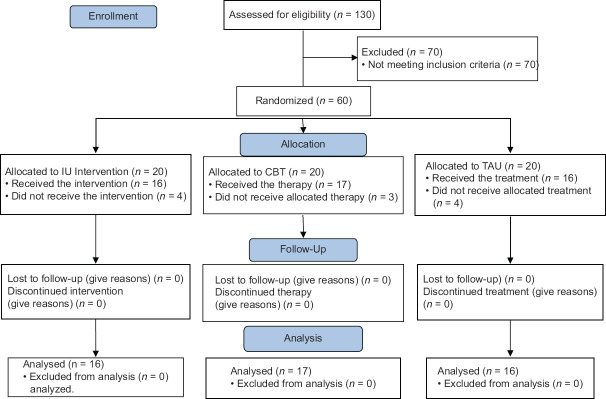
- Participants were randomized into 3 groups of 20: IU intervention, CBT, and treatment as usual (TAU); after excluding 11 participants, 49 remained in the analysis.
- Compared with CBT, IU intervention was more effective on psychological distress: depression P = 0.006, anxiety P = 0.01, stress P = 0.01, and quality of life P = 0.001.
- Compared with TAU, IU-focused intervention was more effective on psychological distress: depression P = 0.0001, anxiety P = 0.0001, stress P = 0.0001, and quality of life P = 0.0001.
- The results section states that measurement time significantly affected quality of life, depression, anxiety, and stress, and that post-test and follow-up scores in the IU group were significantly higher than pre-test scores; the post-test and follow-up difference was not significant.
## Methods
- True experimental design with pre-test, post-test, and 3-month follow-up and equivalent control groups; conducted online in Tehran, Iran, in 2021 because of the COVID-19 pandemic.
- 60 volunteer MS patients were purposefully selected and randomly assigned to 3 groups of 20: IU intervention, CBT, and TAU; 11 were excluded, leaving 49 participants aged 23–42 years (mean 30.79 ± 5.06).
- Outcomes were measured with DASS-21 and MSQoL-54; data were analyzed using mixed-design ANOVA, with Bonferroni pairwise comparisons.
## Limitations
- The authors state that they did not classify participants by stage of MS diagnosis; they note that time since diagnosis may affect performance and should be examined as a moderating variable in future research.
- The authors state that the follow-up period was short, which should be considered when generalizing the findings.
- Evident from the text: the study was online-only and conducted with a small sample from Tehran, which may limit generalizability beyond this setting.
Model-written summary. Check it against the paper before relying on it.
Integrity signals
Registry
Cites
Statistics
Figures
Verification
Claims the paper makes
3 Valid · 1 Not valid · 3 Not checked · 21 Own results and interpretations
The cited sources support only part of this claim — read each source’s verdict below.
In the paper
“The results of the study are in line with those of Molton et al.,[27] Beheshti et al.,[29] Hebert and Dugas,[29] Ghielen et al.,[38] Shareh and Asgharkhah,[39] Mills and Allen,[40] as well as Simpson et al.[41]”
§ The effectiveness of group intervention focused on intolerance of uncertainty on psychological distress and quality of life in multiple sclerosis patients > Discussion
What the sources say
- Not checked — no full text of the sourcecites [27] Molton IR Koelmel E Curran M von Geldern G Ordway A Alschuler KN Pilot intervention to promote tolerance for uncertainty in early multiple sclerosis Rehabil Psychol 2019 64 339 31233326 source
- Not checked — no full text of the sourcecites [29] Beheshti N Zemestani M Rezaei F Comparing the effectiveness of cognitive behavioral therapy focused on intolerance of uncertainty and pharmacotherapy on worry, intolerance of uncertainty, and cognitive avoidance in patients with generalized anxiety disorder Iran J Psychiatry Clin Psychol 2018 24 240 55 source
- Partly supportedcites [38] Ghielen I Rutten S Boeschoten RE Houniet-de Gier M van Wegen EE van den Heuvel OA The effects of cognitive behavioral and mindfulness-based therapies on psychological distress in patients with multiple sclerosis, Parkinson's disease and Huntington's disease: Two meta-analyses J Psychosom Res 2019 122 43 51 31126411 sourceExperimental — accuracy not yet measured
The Discussion reports encouraging mental-health and quality-of-life results from mindfulness-based interventions in people with multiple sclerosis, which could support a general comparison with beneficial intervention results. The Results > Intervention characteristics describes mindfulness practices, not interventions focused on intolerance of uncertainty (IU); that specific characterization is unsupported. (LLM, conf=0.82)
plain- Asserted: passes — The authors put it forward as true.
- Checkable: passes — It can be checked against evidence.
- Load-bearing: unclear — It is unclear whether the paper’s conclusions depend on it.
- Based: passes — The paper gives a reason why it holds.
A result the paper reports from its own data — it cites no other source for it, so there is none to check. The quote shows it is in the paper.
In the paper
“As can be observed, the effect of measurement time on quality of life, depression, anxiety and stress scores is significant.”
- Also stated in: § Results · plain
“regardless of the studied groups, there is a significant difference between the mean scores of QoL, depression, anxiety and stress in pre-test, post-test and follow-up.”
§ The effectiveness of group intervention focused on intolerance of uncertainty on psychological distress and quality of life in multiple sclerosis patients > Results
plainstates an association- Asserted: passes — The authors put it forward as true.
- Checkable: passes — It can be checked against evidence.
- Load-bearing: unclear — It is unclear whether the paper’s conclusions depend on it.
- Based: passes — The paper gives a reason why it holds.
- Also stated in: § Results · plain
A result the paper reports from its own data — it cites no other source for it, so there is none to check. The quote shows it is in the paper.
In the paper
“Intragroup comparisons show that in the research variables, the mean of post-test and follow-up test in the experimental group is significantly higher than that of the pre-test group.”
§ The effectiveness of group intervention focused on intolerance of uncertainty on psychological distress and quality of life in multiple sclerosis patients > Results
plain- Asserted: passes — The authors put it forward as true.
- Checkable: passes — It can be checked against evidence.
- Load-bearing: passes — The paper’s conclusions depend on it.
- Based: passes — The paper gives a reason why it holds.
A result the paper reports from its own data — it cites no other source for it, so there is none to check. The quote shows it is in the paper.
In the paper
“Nonetheless, IU-focused intervention is more effective than TAU on psychological distress (depression P = 0.0001, anxiety P = 0.0001, stress P = 0.0001) as well as quality of life (P = 0.0001) in these patients.”
§ The effectiveness of group intervention focused on intolerance of uncertainty on psychological distress and quality of life in multiple sclerosis patients > Abstract > RESULTS:
plainstates a cause- Asserted: passes — The authors put it forward as true.
- Checkable: passes — It can be checked against evidence.
- Load-bearing: passes — The paper’s conclusions depend on it.
- Based: passes — The paper gives a reason why it holds.
A result the paper reports from its own data — it cites no other source for it, so there is none to check. The quote shows it is in the paper.
In the paper
“The results showed that IU intervention compared to CBT, is more effective on psychological distress (depression P = 0.006, anxiety P = 0.01, and stress P = 0.01) and quality of life (P = 0.001) in MS patients.”
§ The effectiveness of group intervention focused on intolerance of uncertainty on psychological distress and quality of life in multiple sclerosis patients > Abstract > RESULTS:
plainstates a cause- Asserted: passes — The authors put it forward as true.
- Checkable: passes — It can be checked against evidence.
- Load-bearing: passes — The paper’s conclusions depend on it.
- Based: passes — The paper gives a reason why it holds.
10 more claims
Create a free account to see all 28 claims and every source verdict.
- It may state two separate claims as one. 8
- Probably not a substantial claim. 8
Citations
Cites
A health-related quality of life measure for multiple sclerosis
Vickrey, B. G., Hays, R. D., Harooni, R., Myers, L. W., & Ellison, G. W. (1995) · Quality of Life Research · doi:10.1007/bf02260859 · Cited by 1,132 · cited 1×
“96.[36] Borhani and Ghaem also reported the internal consistency reliability of the scales of this questionnaire between 0.”
BackgroundBarlow, D. H., Farchione, T. J., Bullis, J. R., Gallagher, M. W., Murray-Latin, H., Sauer-Zavala, S., Bentley, K. H., Thompson-Hollands, J., Conklin, L. R., Boswell, J. F., et al. (2017) · JAMA Psychiatry · doi:10.1001/jamapsychiatry.2017.2164 · Cited by 853 · cited 4×
“The choice of IU intervention is based on the fact that uncertainty tolerance is a fundamental element in promoting mental well‐being outcomes such as reducing psychological distress and increasing quality of life.[23,26] In many ways, choosing to tolerate uncertainty as a goal is not common in classical interventions.”
BackgroundInfluentialSinclair, S. J., Siefert, C. J., Slavin-Mulford, J. M., Stein, M. B., Renna, M., & Blais, M. A. (2012) · Evaluation & the Health Professions · doi:10.1177/0163278711424282 · Cited by 543
Intolerance of Uncertainty: A Common Factor in the Treatment of Emotional Disorders
Boswell, J. F., Thompson-Hollands, J., Farchione, T. J., & Barlow, D. H. (2013) · Journal of Clinical Psychology · doi:10.1002/jclp.21965 · Cited by 495 · cited 1×
“Moreover, as IU is the core of MS and cannot be considered as a result of depression or anxiety caused by the disease,[23] this intervention can be promoted as a universal, effective, integrated treatment exclusively for MS, like the Unified Protocol (UP) for the treatment of mood disorders, developed universally and…”
BackgroundQuality of life in adults with multiple sclerosis: A systematic review
Gil-González, I., Martín-Rodríguez, A., Conrad, R., & Pérez-San-Gregorio, M. Á. (2020) · BMJ Open · doi:10.1136/bmjopen-2020-041249 · Cited by 263 · cited 1×
“M sclerosis (MS) is a myelogenous disease of the central nervous system in which the myelin sheath of the central nervous system, such as the brain, optic nerve, and spinal cord, is damaged.[1] The spread of this disease is growing increasingly in the youth,[2] and in recent studies, the incidence of MS has been estim…”
BackgroundDepression in multiple sclerosis
Patten, S. B., Marrie, R. A., & Carta, M. G. (2017) · International Review of Psychiatry · doi:10.1080/09540261.2017.1322555 · Cited by 262 · cited 1×
“[9] Research has shown that 50% of people with MS have experienced depressive disorder at least once.[10,11]”
BackgroundFransen, N. L., Hsiao, C.-C., van der Poel, M., Engelenburg, H. J., Verdaasdonk, K., Vincenten, M. C. J., Remmerswaal, E. B. M., Kuhlmann, T., Mason, M. R. J., Hamann, J., et al. (2020) · Brain · doi:10.1093/brain/awaa117 · Cited by 229 · cited 1×
“[4–5] Among these psychological symptoms are psychological distress[6] and decreased quality of life.”
BackgroundHanna, M., & Strober, L. B. (2020) · Multiple Sclerosis and Related Disorders · doi:10.1016/j.msard.2020.102261 · Cited by 202 · cited 1×
“This component is increasingly considered as an important indicator of the effectiveness of health interventions in the field of health policymaking.[13] In this regard, the results of previous studies have shown that patients with MS have significantly lower quality of life compared to healthy people in the community…”
ResultDepression in Multiple Sclerosis: Epidemiology, Aetiology, Diagnosis and Treatment
Solaro, C. M., Gamberini, G., & Masuccio, F. G. (2018) · CNS Drugs · doi:10.1007/s40263-018-0489-5 · Cited by 199 · cited 1×
“On the other hand, anxiety symptoms in these patients such as depression reduce their general health and lead to a decline in well‐being and quality of life.[12] Quality of life is a multidimensional concept encompassing physical, mental and social health.”
BackgroundMindfulness based interventions in multiple sclerosis–a systematic review
Simpson, R., Booth, J., Lawrence, M., Byrne, S., Mair, F., & Mercer, S. (2014) · BMC Neurology · doi:10.1186/1471-2377-14-15 · Cited by 195 · cited 2×
“,[38] Shareh and Asgharkhah,[39] Mills and Allen,[40] as well as Simpson et al.[41]”
Background
Research works printed but not linked: 6
- Tabarsi S Zakeri MM Rezapur R Ebrahimi L Effectiveness of progressive muscle relaxation training on psychological distress of woman's with multiple sclerosis J Rehab Med 2019 7 71 9
- Akin A Çetın B The depression anxiety and stress scale (DASS): The study of validity and reliability. Educational Sciences Theory Pract 2007 7 260 8
- Manafi S Dehshiri Gh Fear of disease progression in patients with cancer and multiple sclerosis and its relationship with emotional problems J Health Psychol 2017 6 115 30
- Vickrey B Hays RD Harooni R Myers L Ellison G A health-related quality of life measure for multiple sclerosis Quality Life Res 1995 4 187 206 7613530 · DOI · Paper page
- Borhani A Ghaem H Quality of life in patients with multiple sclerosis (MS): Translation and cultural adaptation of QoL-54 MS questionnaire Iran J Neurol 2005 4 40 56
- Soheili M Nazari F Shaygannejad V Valiani M A comparison the effects of reflexology and relaxation on the psychological symptoms in women with multiple sclerosis J Edu Health Promot 2017 6 11 PMC5433640 28546976 · DOI · Paper page
Cited by
Suo, X., Chen, L., Kemp, G. J., & Wang, S. (2026) · NeuroImage · doi:10.1016/j.neuroimage.2026.121688 · Cited by 9
van Reenen, E. C., van Nistelrooij, I. A. M., Visser, L. H., de Beukelaar, J. W. K., Frequin, S. T. F. M., & Niemeijer, A. R. (2025) · PLoS ONE · doi:10.1371/journal.pone.0315501 · Cited by 9
“Our empirical findings can enrich the theoretical model and vice versa, especially in light of the development of interventions aimed at (in)tolerance of uncertainty for people with MS [25, 58].”
Sağıcı, Ö., Özdoğar, A. T., Aslan, T., & Özakbaş, S. (2024) · Archives of Clinical Neuropsychology · doi:10.1093/arclin/acad102 · Cited by 4
Yılmaz, F. T., Çelik, S. G., & Özçelik, E. E. (2025) · Journal of Neuroscience Nursing · doi:10.1097/jnn.0000000000000844 · Cited by 3
Drakes, D. H., Rochon, E., & Ouimet, A. J. (2026) · International Journal of Clinical and Health Psychology · doi:10.1016/j.ijchp.2026.100683 · Cited by 1
“…IU-focused intervention incorporating CBT with ACT by emphasizing controllable vs uncon-trollable illness aspects and learning to engage in daily life despite uncertainty may be particularly effective in these populations (e.g., Germino et al., 2013; Molton et al., 2019; Rahimi et al., 2023).”
Yılmaz, F. B., Satıcı, S. A., Okur, S., Kütük, H., & Karaağaç, Z. G. (2024) · Current Issues in Personality Psychology · doi:10.5114/cipp/190902 · Cited by 2
“There is an effective intervention program designed to be used in intolerance of uncertainty, which ele-vates quality of life (Rahimi et al., 2023) and may also be used to elevate happiness.”
BackgroundMetaxouli, K. (2024) · International Journal of Science and Research (IJSR) · doi:10.21275/sr24209185514 · Cited by 1
Davenport, L., McCauley, M., Smyth, L., Reynolds, A., Gaughan, M., Tubridy, N. J., McGuigan, C., & O’Keeffe, F. M. (2024) · Multiple Sclerosis and Related Disorders · doi:10.1016/j.msard.2024.106165
Jamalooei, Y. H., Esmaeili, M., Abedi, A., & Najafi, M. R. (2024) · Journal of Education and Health Promotion · doi:10.4103/jehp.jehp_2093_23 · Cited by 2
Goliroshan, S., Babamohamadi, H., Mohammadi, E., Baghbanian, S. M., & Asgari, M. (2025) · Journal of Education and Health Promotion · doi:10.4103/jehp.jehp_1578_23 · Cited by 1
“[12,16,17] The MS patients’ perceptions about interactions with their treating physicians were also very challenging because they expected to receive full support in this regard, more than other sources, to follow their instructions to get rid of the disease, but such expectations had not always…”
Zhang, M., Zhang, M., Li, Y., Xue, H., Gong, J., Tang, M., & Tan, L. (2025) · Research Square · doi:10.21203/rs.3.rs-7505131/v1
Invisible symptoms and associated factors in multiple sclerosis patients
Sedighi, B., Afshar, P. J., Parizi, M. A., Mohammadalian, S. G., Salehi, A. R., Ajam, F., & Jafari, S. (2026) · Journal of Education and Health Promotion · doi:10.4103/jehp.jehp_2079_24
“21-23] In this study, mood disorders were notably more prevalent (75.5”
Influential
Metadata
- Authors
- Rahimi, H., Pirmoradi, M., Lavasani, F. F., & Farahani, H.
- Affiliations
- Iran University of Medical Sciences (IR)
- Tarbiat Modares University (IR)
- Corresponding author
- Pirmoradi, Mohammadreza
- Venue
- Journal of Education and Health Promotion
- Published
- 2023-01
- Volume
- 12
- Issue
- 1
- Pages
- 29-29
- ISSN
- 2277-9531 (ISSN-L)
- 2319-6440
- PMC
- PMC10079199
- OpenAlex
- W4320011412
- Cited by
- 12
- References
- 40
- Citations by year
- 2026: 3 · 2025: 4 · 2024: 5
- FWCI
- 2.38
- Type
- journal article
- Language
- en
- Open access
- gold
- doi.org
- Licence
- cc-by-nc-sa
- Locations
- Journal of Education and Health Promotion (publishedVersion, cc-by-nc-sa)
- PubMed Central (publishedVersion, cc-by-nc-sa)
- PubMed (publishedVersion)
- DOAJ (DOAJ: Directory of Open Access Journals) (submittedVersion, cc-by-sa)
- Topics
- Health Sciences › Medicine › Clinical Neurology › Multiple Sclerosis Research Studies
- Social Sciences › Psychology › Experimental and Cognitive Psychology › Anxiety, Depression, Psychometrics, Treatment, Cognitive Processes
- Social Sciences › Psychology › Clinical Psychology › Mindfulness and Compassion Interventions
- Keywords
- multiple sclerosis, intolerance of uncertainty, group intervention, psychological distress, quality of life, depression, anxiety, stress, cognitive behavioral therapy, online intervention, COVID-19 pandemic
About these checks
Registry, retraction, Cites and statistics results are computed, not judged, with one exception: a printed reference that no index lists is read once by a model before it counts as a citation error. Claims are extracted by a model and kept only when their quote appears verbatim in the text; each cited source is then checked, with a model’s help, for whether it says what the claim relies on. Those verdicts can be wrong — read the claim’s quote and the cited source before relying on one.
The claim verdicts this report counts are experimental: their accuracy is not yet measured.
A language model drew the claims from the paper on 2026-10-11, under version 3 of the claim definition (model deepseek-v4.1-flash, prompt extract-v3).
A second model labelled each claim on 2026-10-11 (model jev-1.13-20260917, definition revision gold-guideline-v0.2).
Cited sources are checked with a language model’s help (gpt-6-sol).
Statistics and arithmetic are recomputed, not judged.
Confidence bands are shown only for fields calibrated on our annotated test set. None is calibrated yet, so no band is shown.
What counts as a claim ›How we measure confidence ›How we check this ›
Are you an author, or do you see a problem with this page? Request a review
Data sources
Bibliographic data: Semantic Scholar, OpenAlex, Crossref.
Contains information from the Semantic Scholar Academic Graph Datasets, made available under the ODC Attribution License (ODC-BY 1.0).
Semantic Scholar’s data is described in: Kinney, R., et al. (2023). The Semantic Scholar Open Data Platform. arXiv:2301.10140.
