

The DOI matches its Crossref record; 20 of the 20 references it cites were found in a registry or an index.
Clinical practice guidelines for the management of depression in children and adolescents
Open accessAbstract
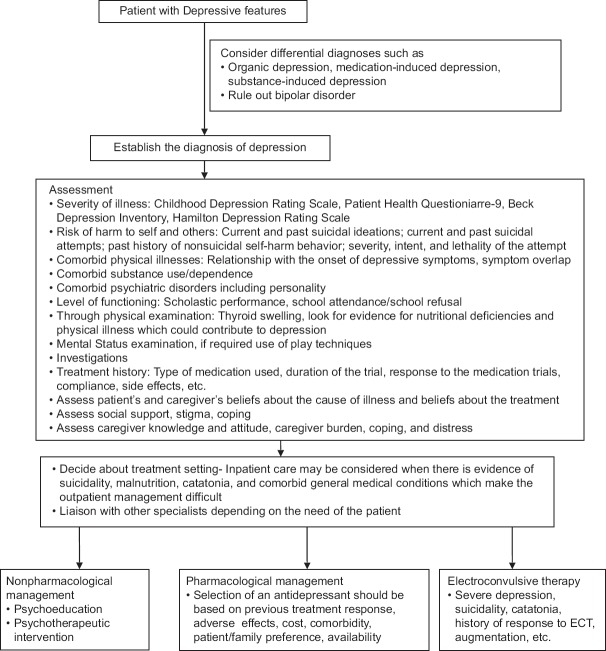
INTRODUCTION Over the last half century, it is now well established that depression can occur at any age, and it has been documented as early as infancy. In terms of epidemiology, different studies which have evaluated the prevalence of depression in children and adolescents suggest that the prevalence varies according to the different age groups. Prevalence figures reported for infants vary from 0.5% to 3% in clinic population, whereas in preschool children, the prevalence rate for major depression (1.4%) has been reported to be higher than depression not otherwise specified (0.7%) and dysthymia (0.6%). Studies done in community settings suggest the prevalence of depression in children to range from 0.4% to 2.5% and among adolescents to be from 0.4% to 8.3%. Lifetime prevalence through adolescence is considered to be as high as 20%. Prior to puberty, depression is known to have equal gender representation; however, among adolescents, the male: female ratio is 1:2. Over the years, it has also been understood that depression in children and adolescents is a chronic and relapsing condition, which does not remits spontaneously and hence, there is a need to identify and treat the same at the earliest to reduce its long-term negative consequences. Childhood depression has been shown to lead to an increased risk of poor academic performance, impaired social functioning, suicidal behavior, homicidal ideation, and alcohol/substance abuse. It is also associated with an increased risk of recurrent depressive episodes. Unfortunately, a major proportion of depression in children and adolescents is underdiagnosed and undertreated. SCOPE OF THE GUIDELINES The Indian Psychiatric Society published clinical practice guidelines for the management of depression in children and adolescents for the first time in the year 2007. Over the years, more research has accumulated in this area, and hence an effort is made to update the previous version of the clinical practice guidelines. These guidelines intend to provide a broad framework for the proper assessment and management of depression in children and adolescents. It is recommended that these guidelines must be read with the previous version. These guidelines must not be considered as a substitute for the professional knowledge and clinical judgment of the treating psychiatrist. It is important to remember that these guidelines are not applicable to any specific treatment setting and will require minor modification to suit to the needs of the children and adolescents in various treatment settings. Accordingly, the recommendations made as part of this guideline may have to be tailored to the needs of the individual patient. ASSESSMENT OF DEPRESSION IN CHILDREN AND ADOLESCENTS Assessment of depression in children and adolescents involves establishing the diagnosis; evaluating comorbid conditions; considering all the possible differential diagnoses; and evaluating psychosocial issues contributing to the development and continuation of depression such as family discord, family psychopathology, suicidal risk, and the ensuing dysfunction. It also involves developing a good therapeutic alliance with the children and adolescents and their family members and making decision about treatment setting and patient's safety. Assessment needs to be understood as an ongoing process and patients may have to be assessed regularly, as per the need and phase of the treatment [Table 1].Table 1: Assessment of children and adolescents presenting with depressionHistory Taking: The complete psychiatric evaluation should include a history of the present illness and current symptoms; evaluation for symptoms of mania or hypomania, taking history, and evaluation for general medical conditions; evaluation for a history of substance use disorders; evaluation for a personal history (e.g., psychological development, response to life transitions, and major life events); evaluation for a social, educational, and family history; and a review of the patient's medications, past treatment history, physical examination, detailed mental status examination, and diagnostic tests as indicated. In general, for identification of depression in children and adolescents, it is better to collect information from all the possible sources, i.e., report and observation of patients, parents, peers, siblings, and teachers during the clinical interview. It is important to remember that the child and parents or other caregivers need to be interviewed separately and also together. Usually, more than one interview may be required to get the complete picture of It is that evaluation of children with depression should interview of the parents and the are in the and of depressive more report symptoms such as whereas children more report symptoms such as needs to be and the mental status examination, can be as part of the It is reported to and children, preschool children with depression and more in such as of and with the with depression a
Overview
The claims and statistics of this paper haven’t been checked yet.
Run the check — free, no account needed. It reads the open-access text and checks the sources it cites.
Integrity signals
Registry
Cites
Statistics
Figures
Verification
Claims the paper makes
The claims and statistics of this paper haven’t been checked yet.
Run the check — free, no account needed. It reads the open-access text and checks the sources it cites.
Self-check
Percentages, sums and reported differences re-computed from the paper’s own numbers.
The self-check needs the paper’s full text.
Citations
Cites
Childhood and adolescent depression: a review of the past 10 years, Part I
BIRMAHER, B., RYAN, N. D., WILLIAMSON, D. E., BRENT, D. A., KAUFMAN, J., DAHL, R. E., PEREL, J., & NELSON, B. (1996) · Journal of the American Academy of Child & Adolescent Psychiatry · doi:10.1097/00004583-199611000-00011 · Cited by 2,076
Brent, D. A., Emslie, G. J., Clarke, G. N., Wagner, K. D., Asarnow, J. R., Keller, M., Vitiello, B., Ritz, L., Iyengar, S., Abebe, K. Z., et al. (2008) · JAMA · doi:10.1001/jama.299.8.901 · Cited by 713
Epidemiology of Childhood Depressive Disorders: A Critical Review
FLEMING, J. E., & OFFORD, D. R. (1990) · Journal of the American Academy of Child & Adolescent Psychiatry · doi:10.1097/00004583-199007000-00010 · Cited by 695
Evidence Base Update of Psychosocial Treatments for Child and Adolescent Depression
Weersing, V. R., Jeffreys, M., Do, M.-C. T., Schwartz, K. T. G., & Bolano, C. (2017) · Journal of Clinical Child & Adolescent Psychology · doi:10.1080/15374416.2016.1220310 · Cited by 505
Curry, J. F., Rohde, P., Simons, A. D., Silva, S. G., Vitiello, B., Kratochvil, C. J., Reinecke, M. A., Feeny, N. C., Wells, K., Pathak, S., et al. (2006) · Journal of the American Academy of Child & Adolescent Psychiatry · doi:10.1097/01.chi.0000240838.78984.e2 · Cited by 429
Childhood and Adolescent Depression: A Review of the Past 10 Years. Part II
Birmaher, B. B., Ryan, N. D., Williamson, D. E., Brent, D. A., & Kaufman, J. (1996) · Journal of the American Academy of Child & Adolescent Psychiatry · doi:10.1097/00004583-199612000-00008 · Cited by 335
Reinecke, M. A., Ryan, N. E., & DuBois, D. L. (1998) · Journal of the American Academy of Child & Adolescent Psychiatry · doi:10.1097/00004583-199801000-00013 · Cited by 331
Newer generation antidepressants for depressive disorders in children and adolescents
Hetrick, S. E., McKenzie, J. E., Cox, G. R., Simmons, M. B., & Merry, S. N. (2012) · Cochrane Database of Systematic Reviews · doi:10.1002/14651858.cd004851.pub3 · Cited by 291
Kennard, B. D., Silva, S. G., Vitiello, B., Curry, J. F., Kratochvil, C. J., Simons, A. D., Hughes, J. L., Feeny, N. C., Weller, E. B., SWEENEY, M., et al. (2006) · Journal of the American Academy of Child & Adolescent Psychiatry · doi:10.1097/01.chi.0000242228.75516.21 · Cited by 279
The Clinical Picture of Depression in Preschool Children
Luby, J. L., Heffelfinger, A. K., Mrakotsky, C., Brown, K., HESSLER, M. J., WALLIS, J. M., & Spitznagel, E. L. (2003) · Journal of the American Academy of Child & Adolescent Psychiatry · doi:10.1097/00004583-200303000-00015 · Cited by 222
Cox, G., Callahan, P., Churchill, R. C., Hunot, V., Merry, S., Parker, A. G., & Hetrick, S. E. (2014) · Cochrane Database of Systematic Reviews · doi:10.1002/14651858.cd008324.pub3 · Cited by 218
Treatment of Resistant Depression in Adolescents (TORDIA): week 24 outcomes
Emslie, G. J., Mayes, T., Porta, G., Vitiello, B., Clarke, G., Wagner, K. D., Asarnow, J. R., Spirito, A., Birmaher, B., Ryan, N., et al. (2010) · American Journal of Psychiatry · doi:10.1176/appi.ajp.2010.09040552 · Cited by 217
Practice Parameter for Use of Electroconvulsive Therapy With Adolescents
Ghaziuddin, N., Kutcher, S., & Knapp, P. (2004) · Journal of the American Academy of Child & Adolescent Psychiatry · doi:10.1097/01.chi.0000142280.87429.68 · Cited by 216
Emslie, G. J., Ventura, D., Korotzer, A., & Tourkodimitris, S. (2009) · Journal of the American Academy of Child & Adolescent Psychiatry · doi:10.1097/chi.0b013e3181a2b304 · Cited by 210
Selective serotonin reuptake inhibitors (SSRIs) for depressive disorders in children and adolescents
Hetrick, S. E., Merry, S. N., McKenzie, J., Sindahl, P., & Proctor, M. (2007) · Cochrane Database of Systematic Reviews · doi:10.1002/14651858.cd004851.pub2 · Cited by 180
Hughes, C. W., Emslie, G. J., Crismon, M. L., Posner, K., Birmaher, B. B., Ryan, N. D., Jensen, P. S., Curry, J. F., Vitiello, B., Lopez, M. A., et al. (2007) · Journal of the American Academy of Child & Adolescent Psychiatry · doi:10.1097/chi.0b013e31804a859b · Cited by 173
Findling, R. L., Robb, A., & Bose, A. (2013) · Journal of Child and Adolescent Psychopharmacology · doi:10.1089/cap.2012.0023 · Cited by 57
Stockman, J. A. (2009) · Yearbook of Pediatrics · doi:10.1016/s0084-3954(08)79063-8 · Cited by 48
The clinical picture of depression in preschool children.
R., M. I. (2003) · Journal of Developmental & Behavioral Pediatrics · doi:10.1097/00004703-200308000-00021 · Cited by 5
Hetrick, S. E., Merry, S., McKenzie, J. E., Sindahl, P., & Proctor, M. L. (2008) · Evidence-Based Child Health A Cochrane Review Journal · doi:10.1002/ebch.269 · Cited by 3
Cited by
Sorted by citations
Clinical Practice Guidelines for the Use of Electroconvulsive Therapy
Thirthalli, J., Sinha, P., & Sreeraj, V. S. (2023) · Indian Journal of Psychiatry · doi:10.4103/indianjpsychiatry.indianjpsychiatry_491_22 · Cited by 74
Tong, T., Hao, C., Shen, J., Liu, S., Yan, S., Aslam, M. S., Chen, Y., Chen, W., Li, J., Li, Y., et al. (2023) · Brain Research Bulletin · doi:10.1016/j.brainresbull.2023.110838 · Cited by 47
Electroconvulsive Therapy in Children and Adolescents
Døssing, E., & Pagsberg, A. K. (2021) · Journal of Ect · doi:10.1097/yct.0000000000000761 · Cited by 40
Profile of Patients Seen in Consultation-Liaison Psychiatry in India: A Systematic Review
Dua, D., & Grover, S. (2020) · Indian Journal of Psychological Medicine · doi:10.1177/0253717620964970 · Cited by 30
Self-citationYan, M., Chen, L., Yang, M., Zhang, L., Niu, M., Wu, F., Chen, Y., Song, Z., Zhang, Y., Jiang, L., et al. (2022) · European Child & Adolescent Psychiatry · doi:10.1007/s00787-022-01958-z · Cited by 22
Metadata
- Authors
- Grover, S., & Avasthi, A.
- Affiliations
- Post Graduate Institute of Medical Education and Research (IN)
- Corresponding author
- Grover, Sandeep
- Venue
- Indian Journal of Psychiatry
- Published
- 2019
- Volume
- 61
- Issue
- 8
- Pages
- 226
- ISSN
- 0019-5545 (ISSN-L)
- PMC
- PMC6345140
- OpenAlex
- W2910312506
- Cited by
- 39
- References
- 20
- Citations by year
- 2026: 3 · 2025: 6 · 2024: 10 · 2023: 7 · 2022: 3 · 2021: 3 · 2020: 5 · 2019: 2
- FWCI
- 3.80
- Type
- journal article
- Language
- en
- Open access
- diamond
- doi.org
- Licence
- cc-by-nc-sa
- Locations
- Indian Journal of Psychiatry (publishedVersion, cc-by-nc-sa)
- Europe PMC (PubMed Central) (publishedVersion, cc-by-nc-sa)
- PubMed Central (publishedVersion, cc-by-nc-sa)
- PubMed (publishedVersion)
- DOAJ (DOAJ: Directory of Open Access Journals) (submittedVersion)
- Topics
- Social Sciences › Psychology › Clinical Psychology › Child and Adolescent Psychosocial and Emotional Development
- Health Sciences › Medicine › Pharmacology (medical) › Treatment of Major Depression
- Health Sciences › Medicine › Psychiatry and Mental health › Mental Health Treatment and Access
- Keywords
- childhood depression, adolescent depression, depression assessment, depression treatment, depression prevalence, underdiagnosis of depression, suicide risk, dysthymia, major depressive disorder, psychotherapy, pharmacotherapy, antidepressants, relapse prevention, family involvement, school-based mental health services, substance abuse risk, academic performance, social functioning
About these checks
Registry, retraction, Cites and statistics results are computed, not judged, with one exception: a printed reference that no index lists is read once by a model before it counts as a citation error. Claims are extracted by a model and kept only when their quote appears verbatim in the text; each cited source is then checked, with a model’s help, for whether it says what the claim relies on. Those verdicts can be wrong — read the claim’s quote and the cited source before relying on one.
Statistics and arithmetic are recomputed, not judged.
Confidence bands are shown only for fields calibrated on our annotated test set. None is calibrated yet, so no band is shown.
What counts as a claim ›How we measure confidence ›How we check this ›
Are you an author, or do you see a problem with this page? Request a review
