

The DOI matches its Crossref record; 14 of the 14 references it cites were found in a registry or an index.
Are Currently Available Wearable Devices for Activity Tracking and Heart Rate Monitoring Accurate, Precise, and Medically Beneficial?
Open accessAbstract
OBJECTIVES: The new wave of wireless technologies, fitness trackers, and body sensor devices can have great impact on healthcare systems and the quality of life. However, there have not been enough studies to prove the accuracy and precision of these trackers. The objective of this study was to evaluate the accuracy, precision, and overall performance of seventeen wearable devices currently available compared with direct observation of step counts and heart rate monitoring. METHODS: Each participant in this study used three accelerometers at a time, running the three corresponding applications of each tracker on an Android or iOS device simultaneously. Each participant was instructed to walk 200, 500, and 1,000 steps. Each set was repeated 40 times. Data was recorded after each trial, and the mean step count, standard deviation, accuracy, and precision were estimated for each tracker. Heart rate was measured by all trackers (if applicable), which support heart rate monitoring, and compared to a positive control, the Onyx Vantage 9590 professional clinical pulse oximeter. RESULTS: The accuracy of the tested products ranged between 79.8% and 99.1%, while the coefficient of variation (precision) ranged between 4% and 17.5%. MisFit Shine showed the highest accuracy and precision (along with Qualcomm Toq), while Samsung Gear 2 showed the lowest accuracy, and Jawbone UP showed the lowest precision. However, Xiaomi Mi band showed the best package compared to its price. CONCLUSIONS: The accuracy and precision of the selected fitness trackers are reasonable and can indicate the average level of activity and thus average energy expenditure.
Overview
The claims and statistics of this paper haven’t been checked yet.
Run the check — free, no account needed. It reads the open-access text and checks the sources it cites.
Integrity signals
Registry
Cites
Statistics
Figures
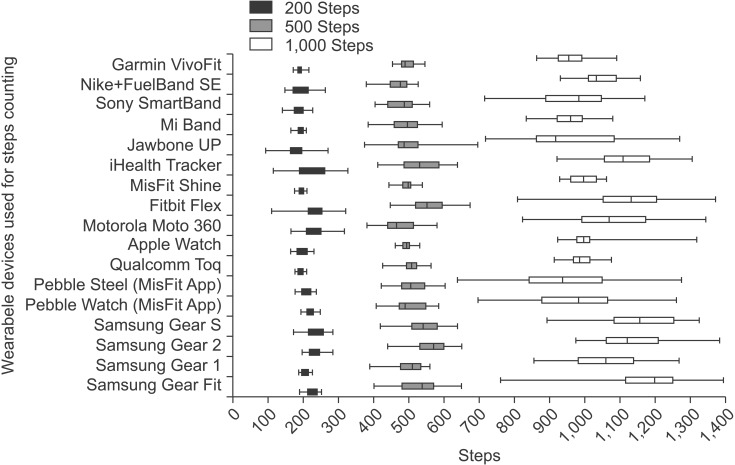
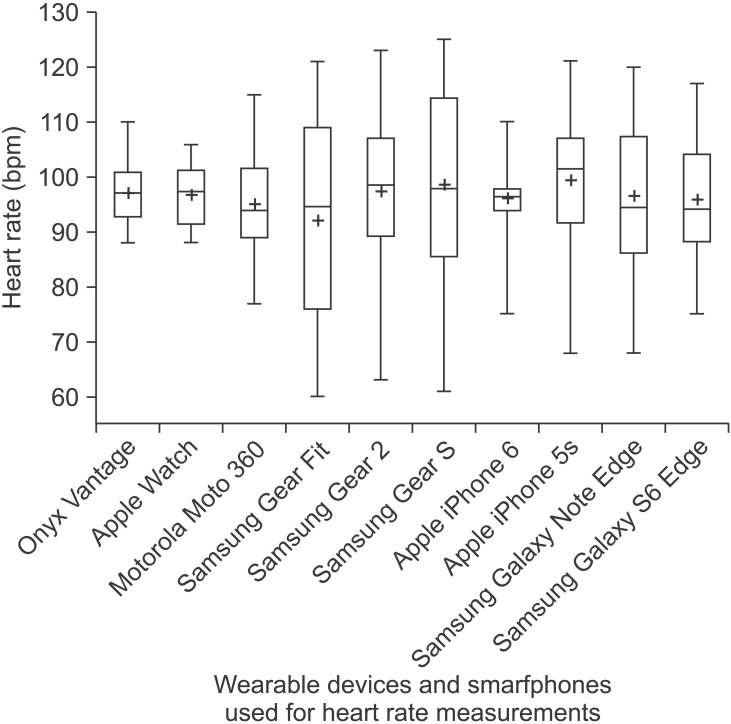
Verification
Claims the paper makes
The claims and statistics of this paper haven’t been checked yet.
Run the check — free, no account needed. It reads the open-access text and checks the sources it cites.
Claims other papers make about this one
Each is checked against this paper’s own text: does it say what the citing paper says it does?
The source backs part of the claim, not all of it — or backs it for a different population, condition or comparison.
In the citing paper
“The accuracy and precision of wearable devices typically range from 92% to 99% [110].”
From Review of Wearable Devices and Data Collection Considerations for Connected Health (2021) · cites this paper as [110]
Experimental — accuracy not yet measuredIn the citing paper
“Smartwatches such as the Apple Watch, Samsung Gear S2, and Pebble Watch are also reported to have acceptable validity and reliability, at least for measuring steps during overground walking [29].”
From Step Counting: A Review of Measurement Considerations and Health-Related Applications (2017) · cites this paper as [29]
In the citing paper
“other studies have used suboptimal reference methods, such as the chest straps45–47 or pulse oximeters48, which themselves have a degree of error (varying between 0 and 40 bpm when compared to ECGs44).”
From Guidelines for wrist-worn consumer wearable assessment of heart rate in biobehavioral research (2020) · cites this paper as [48]
Self-check
Percentages, sums and reported differences re-computed from the paper’s own numbers.
The self-check needs the paper’s full text.
Citations
Cites
‘Small Changes' to Diet and Physical Activity Behaviors for Weight Management
Hills, A. P., Byrne, N. M., Lindstrom, R. C., & Hill, J. O. (2013) · Obesity Facts · doi:10.1159/000345030 · Cited by 9,526
Using Pedometers to Increase Physical Activity and Improve Health: A Systematic Review
Bravata, D. M., Smith-Spangler, C., Sundaram, V., Gienger, A. L., Lin, N., Lewis, R., Stave, C. D., Olkin, I., & Sirard, J. R. (2007) · JAMA · doi:10.1001/jama.298.19.2296 · Cited by 2,064
Non-contact, automated cardiac pulse measurements using video imaging and blind source separation
Poh, M., McDuff, D., & Picard, R. W. (2010) · Optics Express · doi:10.1364/oe.18.010762 · Cited by 1,652
Smart wearable systems: Current status and future challenges
Chan, M., Estève, D., Fourniols, J.-Y., Escriba, C., & Campo, E. (2012) · Artificial Intelligence in Medicine · doi:10.1016/j.artmed.2012.09.003 · Cited by 953
Wearable Devices as Facilitators, Not Drivers, of Health Behavior Change
Patel, M. S., Asch, D. A., & Volpp, K. G. (2015) · JAMA · doi:10.1001/jama.2014.14781 · Cited by 808
Accuracy of Smartphone Applications and Wearable Devices for Tracking Physical Activity Data
Case, M. A., Burwick, H. A., Volpp, K. G., & Patel, M. S. (2015) · JAMA · doi:10.1001/jama.2014.17841 · Cited by 694
Wearable and implantable wireless sensor network solutions for healthcare monitoring
Darwish, A., & Hassanien, A. E. (2011) · Sensors · doi:10.3390/s110605561 · Cited by 556
Detecting Vital Signs with Wearable Wireless Sensors
Yilmaz, T., Foster, R., & Hao, Y. (2010) · Sensors · doi:10.3390/s101210837 · Cited by 341
McGrath, M. J., & Scanaill, C. N. (2013) · Apress eBooks · doi:10.1007/978-1-4302-6014-1 · Cited by 230
Factors Affecting Acceptance of Smartphone Application for Management of Obesity
Jeon, E., & Park, H. (2015) · Healthcare Informatics Research · doi:10.4258/hir.2015.21.2.74 · Cited by 74
Research works printed but not linked: 1
- Wagenaar, 2011, Conf Proc IEEE Eng Med Biol Soc, 2011, 4844
Cited by
Sorted by citations
Henriksen, A., Haugen Mikalsen, M., Woldaregay, A. Z., Muzny, M., Hartvigsen, G., Hopstock, L. A., & Grimsgaard, S. (2018) · Journal of Medical Internet Research · doi:10.2196/jmir.9157 · Cited by 542
A Survey on Wearable Technology: History, State-of-the-Art and Current Challenges
Ometov, A., Shubina, V., Klus, L., Skibińska, J., Saafi, S., Pascacio, P., Flueratoru, L., Quezada-Gaibor, D., Chukhno, N., Chukhno, O., et al. (2021) · Computer Networks · doi:10.1016/j.comnet.2021.108074 · Cited by 572
Step Counting: A Review of Measurement Considerations and Health-Related Applications
Bassett, D. R., Toth, L. P., LaMunion, S. R., & Crouter, S. E. (2017) · Sports Medicine · doi:10.1007/s40279-016-0663-1 · Cited by 460
Review of Wearable Devices and Data Collection Considerations for Connected Health
Vijayan, V., Connolly, J. P., Condell, J., McKelvey, N., & Gardiner, P. (2021) · Sensors · doi:10.3390/s21165589 · Cited by 435
Accuracy of wrist-worn heart rate monitors
Wang, R., Blackburn, G., Desai, M., Phelan, D., Gillinov, L., Houghtaling, P., & Gillinov, M. (2017) · JAMA Cardiology · doi:10.1001/jamacardio.2016.3340 · Cited by 386
Metadata
- Authors
- El-Amrawy, F., & Nounou, M. I.
- Affiliations
- Department of Pharmaceutics, Faculty of Pharmacy, Alexandria University, Alexandria, Egypt.
- Alexandria University (EG)
- Corresponding author
- Nounou, Mohamed Ismail
- Venue
- Healthcare Informatics Research
- Published
- 2015
- Volume
- 21
- Issue
- 4
- Pages
- 315
- ISSN
- 2093-3681 (ISSN-L)
- 2093-369X
- PMC
- PMC4659890
- OpenAlex
- W2175170030
- Cited by
- 287
- References
- 14
- Citations by year
- 2026: 9 · 2025: 11 · 2024: 23 · 2023: 24 · 2022: 28 · 2021: 37 · 2020: 30 · 2019: 43 · 2018: 39 · 2017: 28 · 2016: 15
- FWCI
- 23.74
- Type
- journal article
- Language
- en
- Open access
- gold
- doi.org
- Licence
- Locations
- Healthcare Informatics Research (publishedVersion, cc-by-nc)
- Europe PMC (PubMed Central) (publishedVersion, cc-by-nc)
- PubMed Central (publishedVersion, cc-by-nc)
- PubMed (publishedVersion)
- DOAJ (DOAJ: Directory of Open Access Journals) (submittedVersion, cc-by-sa)
- Funders
- Alexandria University
- Topics
- Physical Sciences › Computer Science › Computer Vision and Pattern Recognition › Context-Aware Activity Recognition Systems
- Health Sciences › Health Professions › General Health Professions › Mobile Health and mHealth Applications
- Health Sciences › Medicine › Public Health, Environmental and Occupational Health › Physical Activity and Health
- Keywords
- wearable devices, wearable activity trackers, activity monitoring, step count accuracy, heart rate monitoring, accelerometer, pulse oximeter, energy expenditure estimation
About these checks
Registry, retraction, Cites and statistics results are computed, not judged, with one exception: a printed reference that no index lists is read once by a model before it counts as a citation error. Claims are extracted by a model and kept only when their quote appears verbatim in the text; each cited source is then checked, with a model’s help, for whether it says what the claim relies on. Those verdicts can be wrong — read the claim’s quote and the cited source before relying on one.
Statistics and arithmetic are recomputed, not judged.
Confidence bands are shown only for fields calibrated on our annotated test set. None is calibrated yet, so no band is shown.
What counts as a claim ›How we measure confidence ›How we check this ›
Are you an author, or do you see a problem with this page? Request a review
