

Effect of Improved Water Quality, Sanitation, Hygiene and Nutrition Interventions on Respiratory Illness in Young Children in Rural Bangladesh: A Multi-Arm Cluster-Randomized Controlled Trial
Open accessThe DOI matches its Crossref record; 27 of the 28 references it cites were found in a registry or an index.
Abstract
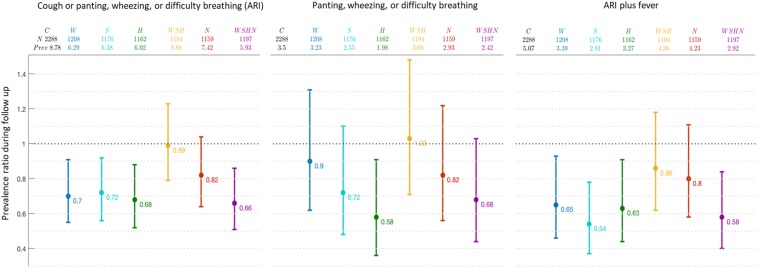
Acute respiratory infections cause mortality in young children. We assessed the effects of water, sanitation, hygiene (WASH) and nutritional interventions on childhood ARI. Geographic clusters of pregnant women from rural Bangladesh were randomly assigned to receive 1) chlorinated drinking water and safe storage (W); 2) upgraded sanitation (S); 3) handwashing promotion (H); 4) combined water, sanitation, and handwashing (WSH); 5) nutrition intervention including lipid-based nutrient supplements; 6) combined WSH plus nutrition (WSHN); or 7) no intervention (control). Masking of participants was not possible. Acute respiratory illness was defined as caregiver-reported persistent cough, panting, wheezing, or difficulty breathing in the past 7 days among index children, those born to enrolled women. We assessed outcomes at 12 and 24 months of intervention using intention to treat. Compared with children in the control group (ARI prevalence, P: 8.9%), caregivers of index children reported significantly lower ARI in the water (P: 6.3%, prevalence ratio (PR): 0.71; 95% CI: 0.53, 0.96), sanitation (P: 6.4%, PR: 0.75, 95% CI: 0.58, 0.96), handwashing (P: 6.4%, PR: 0.68, 95% CI: 0.50, 0.93), and the combined WSH+N arms (P: 5.9%, PR: 0.67, 95% CI: 0.50, 0.90). Those in the nutrition (P: 7.4%, PR: 0.84, 95% CI: 0.63, 1.10) or the WSH arm (P: 8.9%, PR: 0.99, 95% CI: 0.76, 1.28) reported similar ARI prevalence compared with control children. Single targeted water, sanitation, and hygiene interventions reduced reported respiratory illness in young children. There was no apparent respiratory health benefit from combining WASH interventions.
Overview
The claims and statistics of this paper haven’t been checked yet.
Free: it reads the open-access text and checks the first 5 claims that cite a source we can check. Create a free account to check every claim.
Integrity signals
Registry
Cites
Statistics
Figures
Verification
Claims the paper makes
The claims and statistics of this paper haven’t been checked yet.
Free: it reads the open-access text and checks the first 5 claims that cite a source we can check. Create a free account to check every claim.
Claims other papers make about this one
Each is checked against this paper’s own text: does it say what the citing paper says it does?
The cited source doesn’t support the claim as written.
In the citing paper
“Another two cluster‐RCTs were judged to have a low risk of bias because outcome assessors were blinded (Abaluck 2022; Ashraf 2020).”
From Physical interventions to interrupt or reduce the spread of respiratory viruses (2023) · cites this paper as Ashraf 2020
Checked by a reasoning model — may be wrong.
Experimental — accuracy not yet measuredThe source backs part of the claim, not all of it — or backs it for a different population, condition or comparison.
In the citing paper
“Pooling of nine trials for the broad outcome of ARI showed a 14% relative reduction in the numbers of participants with ARI (RR 0.86, 95% CI 0.81 to 0.90; 52,105 participants, moderate‐certainty evidence; Analysis 3.1.1) in the hand hygiene group (Analysis 3.1), suggesting a probable benefit”
From Physical interventions to interrupt or reduce the spread of respiratory viruses (2023) · cites this paper as Ashraf 2020
Experimental — accuracy not yet measuredThe cited source says what the claim attributes to it.
In the citing paper
“The success of randomisation was judged as low risk of bias in one study only that used an off‐site investigator to allocate groups (Ashraf 2020).”
From Physical interventions to interrupt or reduce the spread of respiratory viruses (2023) · cites this paper as Ashraf 2020
Self-check
Percentages, sums and reported differences re-computed from the paper’s own numbers.
The self-check needs the paper’s full text.
Citations
Cites
Liu, L., Oza, S., Hogan, D., Perin, J., Rudan, I., Lawn, J. E., Cousens, S., Mathers, C., & Black, R. E. (2015) · The Lancet · doi:10.1016/s0140-6736(14)61698-6 · Cited by 3,167 · cited 1×
“Acute respiratory infections (ARIs) are a leading cause of morbidity and mortality in young children globally.(1) Acute”
BackgroundWood, L., Egger, M., Gluud, L. L., Schulz, K. F., Jüni, P., Altman, D. G., Gluud, C., Martin, R. M., Wood, A. J. G., & Sterne, J. A. C. (2008) · BMJ · doi:10.1136/bmj.39465.451748.ad · Cited by 2,538 · cited 1×
“ventions is known to inflate health impact when outcome is based on the caregiver-reported prevalence of disease.(27) Respiratory illness unlike diarrheal disease is less likely to be directly linked to our interventions by the study respondents.”
BackgroundFewtrell, L., Kaufmann, R. B., Kay, D., Enanoria, W., Haller, L., & Colford, J. M. (2005) · The Lancet Infectious Diseases · doi:10.1016/s1473-3099(04)01253-8 · Cited by 1,670
Self-citationChild undernutrition, tropical enteropathy, toilets, and handwashing
Humphrey, J. H. (2009) · The Lancet · doi:10.1016/s0140-6736(09)60950-8 · Cited by 862
Effect of hand hygiene on infectious disease risk in the community setting: a meta-analysis
Aiello, A. E., Coulborn, R. M., Perez, V., & Larson, E. L. (2008) · American Journal of Public Health · doi:10.2105/ajph.2007.124610 · Cited by 796 · cited 2×
“well-known protective effects of handwashing on respiratory illness by interrupting pathogen transmission through hands.(5) Viral infections that are predominantly spread by fomite contact through hands, eyes, or noses are consistently reducedwith simple handwashing interventions,”
BackgroundLuby, S. P., Rahman, M., Arnold, B. F., Unicomb, L., Ashraf, S., Winch, P. J., Stewart, C. P., Begum, F., Hussain, F., Benjamin-Chung, J., et al. (2018) · The Lancet Global Health · doi:10.1016/s2214-109x(17)30490-4 · Cited by 759
Self-citationBhutta, Z. A., Das, J. K., Walker, N., Rizvi, A., Campbell, H., Rudan, I., & Black, R. E. (2013) · The Lancet · doi:10.1016/s0140-6736(13)60648-0 · Cited by 675
Rudan, I., O'Brien, K. L. O., Nair, H., Liu, L., Τheodoratou, E., Qazi, S., Lukšić, I., Walker, C. L. F., Black, R. E., & Campbell, H. J. (2013) · PubMed · doi:10.7189/jogh.03.010401 · Cited by 491
Patil, S. R., Arnold, B. F., Salvatore, A. L., Briceno, B., Ganguly, S., Colford, J. M., & Gertler, P. J. (2014) · PLoS Medicine · doi:10.1371/journal.pmed.1001709 · Cited by 487 · cited 1×
“Our study findings add to the literature that demonstrate a reduction in respiratory illness in children from sanitation interventions.(19) Given that we observed a significant reduction in diarrheal FIGURE 2.”
ResultSelf-citationJackson, S., Mathews, K. H., Pulanić, D., Falconer, R., Rudan, I., Campbell, H., & Nair, H. (2013) · Croatian Medical Journal · doi:10.3325/cmj.2013.54.110 · Cited by 278
Cited by
Physical interventions to interrupt or reduce the spread of respiratory viruses
Jefferson, T., Dooley, L., Ferroni, E., Al-Ansary, L. A., van Driel, M. L., Bawazeer, G. A., Jones, M. A., Hoffmann, T. C., Clark, J., Beller, E. M., et al. (2023) · Cochrane Database of Systematic Reviews · doi:10.1002/14651858.cd006207.pub6 · Cited by 291
Ross, I., Bick, S., Ayieko, P., Dreibelbis, R., Wolf, J., Freeman, M. C., Allen, E., Brauer, M., & Cumming, O. (2023) · The Lancet · doi:10.1016/s0140-6736(23)00021-1 · Cited by 118
Gaffan, N., Kpozéhouen, A., Dégbey, C., Ahanhanzo, Y. G., Kakaï, R. G., & Salamon, R. (2022) · BMC Public Health · doi:10.1186/s12889-022-13665-0 · Cited by 73
Nasim, N., El‐Zein, A., & Thomas, J. (2022) · International Journal of Hygiene and Environmental Health · doi:10.1016/j.ijheh.2022.113992 · Cited by 43
Sangalang, S. O., Prado, N. O., Lemence, A. L. G., Cayetano, M. G., Lu, J. L., Valencia, J. C., Kistemann, T., & Borgemeister, C. (2022) · The Science of The Total Environment · doi:10.1016/j.scitotenv.2022.155882 · Cited by 46
Fathmawati, F., Rauf, S., & Indraswari, B. W. (2021) · PLoS ONE · doi:10.1371/journal.pone.0257881 · Cited by 50
Balasubramani, K., Prasad, K. A., Kodali, N. K., Rasheed, N. K. A., Chellappan, S., Sarma, D. K., Kumar, M., Dixit, R., James, M. M., Behera, S. K., et al. (2022) · Frontiers in Public Health · doi:10.3389/fpubh.2022.906248 · Cited by 35
Design and analysis of three‐arm parallel cluster randomized trials with small numbers of clusters
Watson, S., Girling, A. J., & Hemming, K. (2020) · Statistics in Medicine · doi:10.1002/sim.8828 · Cited by 24
Leung, M.-W., O'Donoghue, M. M., & Suen, L. K. P. (2022) · International Journal of Environmental Research and Public Health · doi:10.3390/ijerph20010229 · Cited by 33
Contreras, J. D., Islam, M., Mertens, A., Pickering, A. J., Arnold, B. F., Benjamin‐Chung, J., Hubbard, A., Rahman, M. M., UNICOMB, L. E., Luby, S. P., et al. (2022) · PLoS Medicine · doi:10.1371/journal.pmed.1004041 · Cited by 18
Self-citationAn assessment of the water, sanitation and hygiene (WASH) situation in rural Volta Region, Ghana
Osarfo, J., Ampofo, G. D., Arhin, Y. A., Ekpor, E., Azagba, C. K., & Tagbor, H. K. (2023) · PLOS Water · doi:10.1371/journal.pwat.0000134 · Cited by 19
Shayo, F. K., & Bintabara, D. (2022) · Annals of Global Health · doi:10.5334/aogh.3650 · Cited by 15
Chakraborty, R., Armijos, R. X., Beidelman, E. T., Rosenberg, M. S., & Weigel, M. M. (2024) · Maternal and Child Nutrition · doi:10.1111/mcn.13683 · Cited by 21
Influences on water source selection and use among women in rural Odisha, India
Patrick, M., Hennink, M. M., Dasmohapatra, M., Rout, M., Clasen, T., & Caruso, B. A. (2023) · Frontiers in Water · doi:10.3389/frwa.2023.1040981 · Cited by 17
Ercümen, A., Mertens, A., Butzin-Dozier, Z., Jung, D. K., Ali, S., Achando, B. S., Rao, G., Hemlock, C., Pickering, A. J., Stewart, C. P., et al. (2025) · Nature Communications · doi:10.1038/s41467-024-55801-x · Cited by 14
Self-citationGaffan, N., Dégbey, C., Kpozéhouen, A., Ahanhanzo, Y. G., & Paraïso, M. N. (2023) · BMJ Open · doi:10.1136/bmjopen-2023-074332 · Cited by 12
Hanif, A., Nakano, Y., & Matsushima, M. (2024) · Water Resources and Economics · doi:10.1016/j.wre.2024.100249 · Cited by 27
Lin, A., Mertens, A., Rahman, M. Z., Tan, S. T., Il’yasova, D., Spasojević, I., Ali, S., Stewart, C. P., Fernald, L. C. H., Kim, L., et al. (2024) · Nature Communications · doi:10.1038/s41467-024-47896-z · Cited by 12
Self-citationFatima, M. T., Butt, I., MohammadEbrahimi, S., Kiani, B., & Gruebner, O. (2025) · BMC Public Health · doi:10.1186/s12889-025-21741-4 · Cited by 8
Mim, M. S., Rahaman, M. M., & Sajib, A. H. (2025) · PLoS ONE · doi:10.1371/journal.pone.0318467 · Cited by 6
Abubakar, F. I., Oche, M., Kaoje, A. U., Garba, B. I., Abubakar, M., & Ahmed, H. (2025) · BMC Pediatrics · doi:10.1186/s12887-025-06193-4 · Cited by 10
Davies‐Barrett, A. M., Casna, M., & Inskip, S. A. (2025) · PLoS ONE · doi:10.1371/journal.pone.0324045 · Cited by 4
Hussain, M. M., Iqbal, A., & Abbas, S. J. (2024) · Asian Social Work and Policy Review · doi:10.1111/aswp.12325 · Cited by 5
Irfan, A., & Jean, D. T. S. (2021) · Annals of Global Health · doi:10.5334/aogh.3358 · Cited by 7
Lin, A., Mertens, A., Tan, S. T., Rahman, M. Z., Hester, L., Kim, L., Arnold, B. F., Karim, M. R., Shahriar, S., Ali, S., et al. (2021) · medRxiv · doi:10.1101/2021.11.10.21266206 · Cited by 5
Self-citationLin, A., Mertens, A., Rahman, M. Z., Tan, S. T., Il’yasova, D., Spasojević, I., Ali, S., Stewart, C. P., Fernald, L. C. H., Kim, L., et al. (2021) · medRxiv · doi:10.1101/2021.11.24.21266798 · Cited by 4
Self-citationWarmington, A. V., Bowdish, D. M. E., Sherifali, D., & Sloboda, D. M. (2024) · AJPM Focus · doi:10.1016/j.focus.2024.100234 · Cited by 4
Mansour, N., & Alfojery, A. (2025) · Critical Public Health · doi:10.1080/09581596.2025.2505760 · Cited by 9
Establishing Healthy Lifestyle Choices Early
Mukdad, L. A., & Shapiro, N. L. (2022) · Otolaryngologic Clinics of North America · doi:10.1016/j.otc.2022.06.013 · Cited by 4
Babalola, A. S., Busari, L. O., Adewale, B., Omitola, O. O., Gbadewole, A. O., Fawole, J. K., Olaonipekun, O. F., Adekunle, T. A., Babalola, O. A., Oyelude, F., et al. (2026) · Discover Environment · doi:10.1007/s44274-026-00857-3 · Cited by 3
Ercümen, A., Mertens, A., Butzin-Dozier, Z., Jung, D. K., Ali, S., Achando, B. S., Rao, G., Hemlock, C., Pickering, A. J., Stewart, C. P., et al. (2024) · medRxiv · doi:10.1101/2024.05.10.24307069 · Cited by 2
Self-citationEndres, K., Sanvura, P., Williams, C., Thomas, E., Kuhl, J., Coglianese, N., Bauler, S., François, R., Bisimwa, J., Mirindi, P. N., et al. (2022) · American Journal of Tropical Medicine and Hygiene · doi:10.4269/ajtmh.21-0676 · Cited by 1
Watson, S., Alam, M. A. U., Rego, R. T. T., Lilford, R. J., Barman, A. K., Alam, B., Faruque, A. S. G., & Islam, M. S. (2024) · Conflict and Health · doi:10.1186/s13031-024-00617-1 · Cited by 2
Self-citationNguyen, A., Heitmann, G. B., Mertens, A., Ashraf, S., Rahman, M. Z., Ali, S., Rahman, M., Arnold, B. F., Grembi, J. A., Lin, A., et al. (2025) · EClinicalMedicine · doi:10.1016/j.eclinm.2025.103147 · Cited by 3
Self-citationMazumder, T., Mohanty, I., Ahmad, D., & Niyonsenga, T. (2025) · BMC Public Health · doi:10.1186/s12889-025-23053-z · Cited by 2
Niven, C. G., Clark, B., Floess, E., Chirwa, B., Matekenya, M., Budden, E., Cadono, S., Chavula, J., Chisamanga, V., Dzinkambani, A., et al. (2026) · Environmental Science & Technology · doi:10.1021/acs.est.5c08820 · Cited by 7
Budden, E., Niven, C. G., Clark, B., Floess, E., Chirwa, B., Matekenya, M., Cadono, S., Chavula, J., Chisamanga, V., Dzinkambani, A., et al. (2026) · PLOS Global Public Health · doi:10.1371/journal.pgph.0006264 · Cited by 1
Three years of COVID-19-related school restrictions and children's mental health in JapanPreprint
Takaku, R., Shobako, N., & Nakata, T. (2023) · Research Square · doi:10.21203/rs.3.rs-3144141/v1 · Cited by 1
Nguyen, A., Heitmann, G. B., Mertens, A., Ashraf, S., Rahman, M. Z., Ali, S., Rahman, M., Arnold, B. F., Grembi, J. A., Lin, A., et al. (2024) · medRxiv · doi:10.1101/2024.10.13.24315425 · Cited by 1
Self-citationNiven, C. G., Clark, B., Floess, E., Chirwa, B., Matekenya, M., Budden, E., Cadono, S., Chavula, J., Chisamanga, V., Dzinkambani, A., et al. (2025) · medRxiv · doi:10.1101/2025.06.03.25328821 · Cited by 1
Watson, S., Alam, M. A. U., Rego, R. T. T., Lilford, R. J., Barman, A. K., Alam, B., Faruque, A. S. G., & Islam, M. S. (2022) · medRxiv · doi:10.1101/2022.03.07.22271752
Self-citationYusida, H., Fathurrahman, F., & Ardiansyah, A. (2022) · An-Nadaa Jurnal Kesehatan Masyarakat · doi:10.31602/ann.v9i2.6750
Liu, W., Tung, T.-H., & Shi, L. (2025) · BMJ Public Health · doi:10.1136/bmjph-2023-000477
Ross, I., Bick, S., Evans, B., Pickering, A. J., & Cumming, O. (2026) · Research Square · doi:10.21203/rs.3.rs-11084659/v1 · Cited by 1
Su, X., Xu, W., Wen-wen, L., Zheng, J., Wang, Y., Wu, T., Sun, L., Hu, H., Liu, Y., & Li, Y. (2026) · Journal of International Medical Research · doi:10.1177/03000605261467663
Sanvura, P., Endres, K., Bisimwa, J., Perin, J., Cikomola, C., Bengehya, J., Kulondwa, J.-C., Maheshe, G., Mizrahi, A., Mwishingo, A., et al. (2026) · Tropical Medicine & International Health · doi:10.1111/tmi.70229
Metadata
- Authors
- Ashraf, S., Islam, M., Unicomb, L., Rahman, M., Winch, P. J., Arnold, B. F., Benjamin-Chung, J., Ram, P. K., Colford, J. M., & Luby, S. P.
- Affiliations
- Johns Hopkins University (US)
- International Centre for Diarrhoeal Disease Research (BD)
- University of California, Berkeley (US)
- Division of Epidemiology and Biostatistics, School of Public Health, University of California Berkeley, Berkeley, California;
- University at Buffalo, State University of New York (US)
- Corresponding author
- Ashraf, Sania
- ORCID
- Venue
- The American Journal of Tropical Medicine and Hygiene
- Published
- 2020-05-06
- Volume
- 102
- Issue
- 5
- Pages
- 1124-1130
- ISSN
- 0002-9637 (ISSN-L)
- 1476-1645
- PMC
- PMC7204588
- OpenAlex
- W3008310615
- Cited by
- 46
- References
- 28
- Citations by year
- 2026: 6 · 2025: 10 · 2024: 8 · 2023: 6 · 2022: 11 · 2021: 4 · 2020: 1
- FWCI
- 3.48
- Type
- journal article
- Language
- en
- Open access
- bronze
- doi.org
- Locations
- American Journal of Tropical Medicine and Hygiene (publishedVersion)
- PubMed Central (publishedVersion, cc-by)
- PubMed (publishedVersion)
- eScholarship (California Digital Library) (submittedVersion)
- eScholarship (California Digital Library) (submittedVersion, cc-by)
- Funders
- Bill and Melinda Gates Foundation (OPPGD759)
- International Centre for Diarrhoeal Disease Research, Bangladesh
- Topics
- Health Sciences › Nursing › Nutrition and Dietetics › Child Nutrition and Water Access
- Health Sciences › Medicine › Pediatrics, Perinatology and Child Health › Pediatric health and respiratory diseases
- Health Sciences › Medicine › Pediatrics, Perinatology and Child Health › Global Maternal and Child Health
- Keywords
- acute respiratory infections, young children, chlorinated drinking water, safe water storage, sanitation, handwashing promotion, lipid-based nutrient supplements, child nutrition, rural Bangladesh, chronic cough, wheezing
- MeSH terms
- Adolescent, Bangladesh, Child, Child, Preschool, Family Characteristics, Female, Humans, Hygiene, Infant, Infant, Newborn, Male, Respiratory Tract Diseases, Rural Population, Sanitation, Toilet Facilities, Child Nutrition Disorders, Young Adult, Water Quality
About these checks
Registry, retraction, Cites and statistics results are computed, not judged, with one exception: a printed reference that no index lists is read once by a model before it counts as a citation error. Claims are extracted by a model and kept only when their quote appears verbatim in the text; each cited source is then checked, with a model’s help, for whether it says what the claim relies on. Those verdicts can be wrong — read the claim’s quote and the cited source before relying on one.
Statistics and arithmetic are recomputed, not judged.
Confidence bands are shown only for fields calibrated on our annotated test set. None is calibrated yet, so no band is shown.
What counts as a claim ›How we measure confidence ›How we check this ›
Are you an author, or do you see a problem with this page? Request a review
Data sources
Bibliographic data: Semantic Scholar, OpenAlex, Crossref.
Contains information from the Semantic Scholar Academic Graph Datasets, made available under the ODC Attribution License (ODC-BY 1.0).
Semantic Scholar’s data is described in: Kinney, R., et al. (2023). The Semantic Scholar Open Data Platform. arXiv:2301.10140.
