

Analysis of the Application of Ergonomics to Increase Productivity in Manufacturing Companies: A Systematic Review of the Literature
Open accessThe DOI matches its Crossref record; 27 of the 27 references it cites were found in a registry or an index; 1 of the 35 sources its claims cite were checked for support.
Abstract
Nowadays, manufacturing companies consider ergonomics as a relevant factor in workstations, since it is a means to ensure productivity in the company and comfort and safety of employees. However, there is still resistance to the implementation of postural assessment methods during the various production processes of different manufacturing companies. Consequently, the main objective of this article is to analyze the advances in the application of ergonomics methods to improve productivity in manufacturing companies in America, Europe or Asia during the last 13 years. To fulfill this purpose, a systematic review of the literature was carried out, as well as a bibliometric analysis. The results found will be of great value to manufacturing companies, especially those aiming to improve the efficiency of their processes, reduce musculoskeletal disorders (MSDs) and increase productivity. Therefore, the implementation of ergonomics involves the inclusion from the corporate level to the operational level; in addition, the participation of the workers who work directly in the production processes is important, since they play an important role in guaranteeing and optimizing the smooth and safe work of the processes. This article evidences the increase of productivity in manufacturing companies through the application of ergonomics and a considerable reduction of MSDs along the production processes.
Overview
CoChat Summary
TL;DR
This paper is a systematic literature review and bibliometric analysis of ergonomics methods in manufacturing companies in America, Europe, and Asia over the last 13 years. It argues that ergonomics is linked to higher productivity, fewer musculoskeletal disorders (MSDs), and lower costs, and reports screening 444 records down to 45 included articles.
Key findings
- The search identified 444 articles related to “Workplace productivity” and “ergonomics”; after screening, 185 articles remained, and 45 articles were finally selected for analysis.
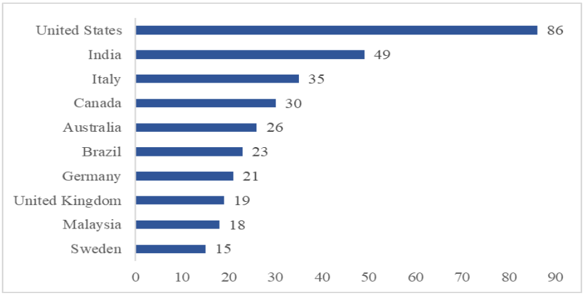
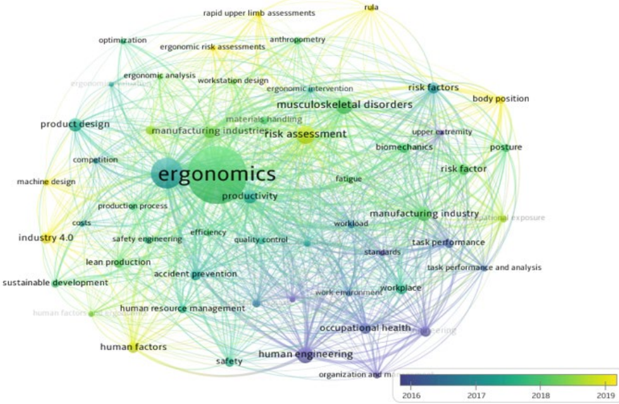
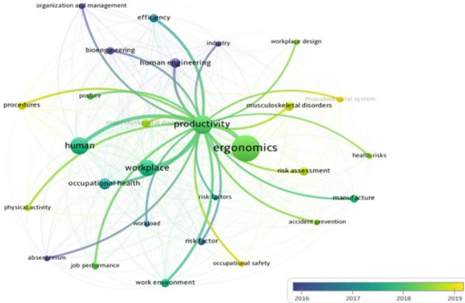
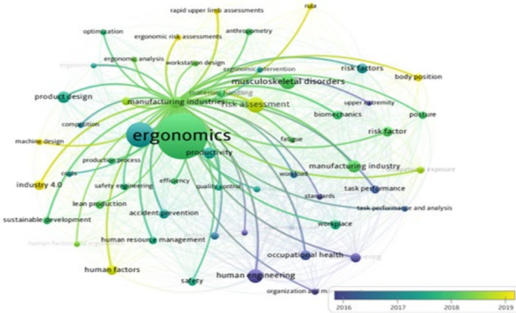
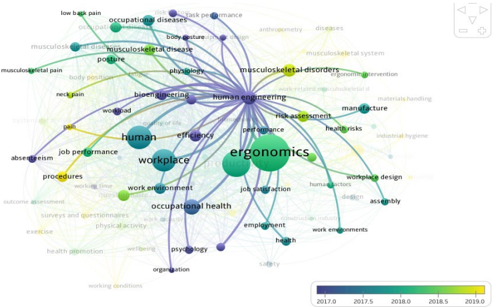
- The paper reports that the most prominent keyword groups were “Ergonomy” and “Manufacturing,” with 1,864 matches, and that the United States ranks first in publication distribution by country.
- Cited studies in the review report substantial effects of ergonomic interventions, including a 30% reduction in errors, 11% reduction at customer sites, 50% productivity increase, and $950,000 per year profit increase in an electronics company.
- Another cited study found that after integrating ergonomics into a lean production system in a Brazilian automobile factory, the share of vehicles without rework increased from 48% to 78%, alongside decreased absenteeism and accidents.
- Across the paper’s synthesis, ergonomics is presented as reducing MSDs, disability-related costs, overtime, medical care, and incident premiums or fines, while improving efficiency and safety.
Methods
- The study used a systematic literature review with a bibliometric analysis, framed as an interpretive paradigm with a qualitative approach and an exploratory-descriptive scope.
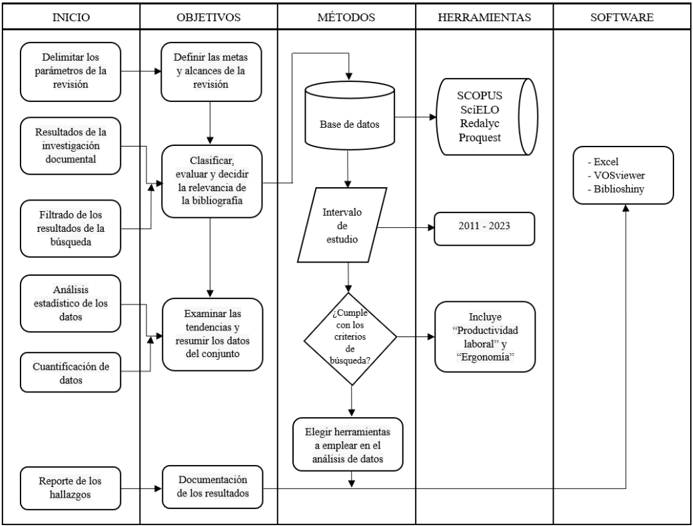
- Searches were conducted in SciELO, Redalyc, Dialnet, Scopus, Proquest, Science Direct, and Web of Science, using terms including “workplace productivity,” “ergonomics,” “labor productivity,” and “manufacturing”; filters included journal articles, relevant fields, and years 2011–2023.
- The paper states it followed PRISMA and used VOSviewer and Microsoft Excel for visualization and data handling.
Limitations
- The paper states that in less developed countries there is a lack of use and/or application of ergonomic evaluation methods, and that implementation is hindered by workers’ misperceptions and unwillingness to participate.
- It also notes that the literature has limitations and disadvantages that directly and indirectly affect the traceability of the implementation of ergonomics evaluation methods.
- Evident from the text: the paper is a review of published studies rather than a primary intervention study, so its conclusions depend on the quality and scope of the included literature.
Model-written summary. Check it against the paper before relying on it.
Integrity signals
Registry
Cites
Statistics
Figures
Verification
Claims the paper makes
1 Valid · 0 Not valid · 34 Not checked · 24 Own results and interpretations
A result the paper reports from its own data — it cites no other source for it, so there is none to check. The quote shows it is in the paper.
In the paper
“In terms of the distribution of publications by country, the United States ranks first.”
plain- Asserted: passes — The authors put it forward as true.
- Checkable: passes — It can be checked against evidence.
- Load-bearing: unclear — It is unclear whether the paper’s conclusions depend on it.
- Based: passes — The paper gives a reason why it holds.
In the paper
“In particular, the identification of bending as a risk factor was found in most of the selected papers (51.9%).”
What the sources say
- Not matchedcites Benos et al., 2020
An author–year citation the paper’s reference list doesn’t settle. We don’t search these by name.
plainstates an association- Asserted: passes — The authors put it forward as true.
- Checkable: passes — It can be checked against evidence.
- Load-bearing: unclear — It is unclear whether the paper’s conclusions depend on it.
- Based: passes — The paper gives a reason why it holds.
- Not matched
In the paper
“There was also a decrease in absenteeism and accidents and an increase in productivity (as cited in Zare et al., 2016, p. 14).”
What the sources say
- Not checked — no full text of the sourcecites Zare et al., 2016 matched to “Does Ergonomics Improve Product Quality and Reduce Costs? A Review Article” (2016) source
plainstates a causeSingle case- Asserted: passes — The authors put it forward as true.
- Checkable: passes — It can be checked against evidence.
- Load-bearing: passes — The paper’s conclusions depend on it.
- Based: passes — The paper gives a reason why it holds.
In the paper
“In the risk factors for the development of MSDs, it was noted that it was strongly related to bending over, i.e., prolonged trunk flexion.”
What the sources say
- Not matchedcites Benos et al., 2020
An author–year citation the paper’s reference list doesn’t settle. We don’t search these by name.
boostedstates an association- Asserted: passes — The authors put it forward as true.
- Checkable: passes — It can be checked against evidence.
- Load-bearing: unclear — It is unclear whether the paper’s conclusions depend on it.
- Based: passes — The paper gives a reason why it holds.
- Not matched
None of the sources cited for this claim have been checked yet.
In the paper
“The application of the RULA method, combined with self-reported musculoskeletal symptomatology questionnaires, has also shown an important contribution to the risk assessment of musculoskeletal disorders in jobs with manufacturing and repetitive type tasks”
What the sources say
- Not checked yetcites Colim et al., 2020 matched to “Ergonomic intervention on a packing workstation with robotic aid –case study at a furniture manufacturing industry” (2020) source
Checked before — its earlier verdict is held back until a new check runs.
boostedstates a cause- Asserted: passes — The authors put it forward as true.
- Checkable: passes — It can be checked against evidence.
- Load-bearing: unclear — It is unclear whether the paper’s conclusions depend on it.
- Based: passes — The paper gives a reason why it holds.
- Not checked yet
4 more claims
Create a free account to see all 59 claims and to verify the 3 references still open.
- Probably not a substantial claim. 39
- It may state two separate claims as one. 25
Citations
Cites
Un sistema de clasificación de los diseños de investigación en psicología
Ato, M., López-García, J. J., & Benavente, A. (2013) · Anales de Psicología · doi:10.6018/analesps.29.3.178511 · Cited by 2,254
International archives of occupational and environmental health
(1985) · Journal of Sound and Vibration · doi:10.1016/0022-460x(85)90556-5 · Cited by 326
Human factors and ergonomics in manufacturing in the industry 4.0 context – A scoping review
Reiman, A., Kaivo-oja, J., Parviainen, E., Takala, E.-P., & Lauraeus, T. (2021) · Technology in Society · doi:10.1016/j.techsoc.2021.101572 · Cited by 261
International Journal of Occupational Safetyand Ergonomics
Fallahi‐Khoshknab, M., & Arsalani, N. (2014) · International Journal of Occupational Safety and Ergonomics · Cited by 257
Sundstrup, E., Seeberg, K. G. V., Bengtsen, E., & Andersen, L. L. (2020) · Journal of Occupational Rehabilitation · doi:10.1007/s10926-020-09879-x · Cited by 200
Intra-rater and inter-rater reliability of the rapid entire body assessment (REBA) tool
Schwartz, A., Albin, T. J., & Gerberich, S. G. (2019) · International Journal of Industrial Ergonomics · doi:10.1016/j.ergon.2019.02.010 · Cited by 114
Ergonomic assessment and workstation design of shipping crane cabin in steel industry
Kushwaha, D. K., & Kane, P. V. (2015) · International Journal of Industrial Ergonomics · doi:10.1016/j.ergon.2015.08.003 · Cited by 98
Musculoskeletal Disorders and Psychosocial Factors at WorkPreprint
Roquelaure, Y. (2019) · SSRN Electronic Journal · doi:10.2139/ssrn.3316143 · Cited by 89
Does Ergonomics Improve Product Quality and Reduce Costs? A Review Article
Zare, M., Croq, M., Hossein‐Arabi, F., Brunet, R., & Roquelaure, Y. (2016) · Human Factors and Ergonomics in Manufacturing & Service Industries · doi:10.1002/hfm.20623 · Cited by 79
The prevalence of occupational musculoskeletal disorders in Iran: A meta-analysis study
Parno, A., Sayehmiri, K., Parno, M., Khandan, M., Poursadeghiyan, M., Maghsoudipour, M., & Ebrahimi, M. H. (2017) · Work · doi:10.3233/wor-172619 · Cited by 51
Rose, L. M., Eklund, J. A. E., Nilsson, L. N., Barman, L., & Lind, C. M. (2020) · Applied Ergonomics · doi:10.1016/j.apergo.2020.103101 · Cited by 42
Heidarimoghadam, R., Mohammadfam, I., Babamiri, M., Soltanian, A. R., Khotanlou, H., & Sohrabi, M. S. (2020) · International Journal of Industrial Ergonomics · doi:10.1016/j.ergon.2020.103030 · Cited by 40
Ergonomics study and analysis of workstations in Tunisian mechanical manufacturing
Boulila, A., Ayadi, M., & Mrabet, K. (2018) · Human Factors and Ergonomics in Manufacturing & Service Industries · doi:10.1002/hfm.20732 · Cited by 35
Mattos, D. L. D., Ariente Neto, R., Merino, E. A. D., & Forcellini, F. A. (2019) · Applied Ergonomics · doi:10.1016/j.apergo.2018.08.001 · Cited by 34
Svendsen, M. J., Schmidt, K. G., Holtermann, A., & Rasmussen, C. D. N. (2020) · Safety Science · doi:10.1016/j.ssci.2020.104932 · Cited by 31
Ergonomic Design of an Adaptive Automation Assembly System
Bortolini, M., Botti, L., Galizia, F. G., & Mora, C. (2023) · Machines · doi:10.3390/machines11090898 · Cited by 28
Colim, A., Sousa, N., Carneiro, P., Costa, N., Arezes, P., & Cardoso, A. (2020) · Work · doi:10.3233/wor-203144 · Cited by 26
Munguía Vega, N. E., Flores Borboa, V. S., Zepeda Quintana, D. S., & Velazquez Contreras, L. E. (2019) · International Journal of Occupational Safety and Ergonomics · doi:10.1080/10803548.2017.1419589 · Cited by 25
Enhancement of human-centered workplace design and optimization with Exoskeleton technology
Ippolito, D., Constantinescu, C., & Rusu, C.-A. (2020) · Procedia CIRP · doi:10.1016/j.procir.2020.02.173 · Cited by 25
Rostami, M., Choobineh, A., Shakerian, M., Faraji, M., & Modarresifar, H. (2022) · International Archives of Occupational and Environmental Health · doi:10.1007/s00420-021-01811-x · Cited by 19
Trisusanto, D. (2020) · Asia-Pacific Journal of Science and Technology · doi:10.14456/apst.2020.4 · Cited by 15
Human-Oriented Assembly Line Balancing and Sequencing Model in the Industry 4.0 Era
Battini, D., Finco, S., & Sgarbossa, F. (2020) · International Series in Operations Research & Management Science · doi:10.1007/978-3-030-43177-8_8 · Cited by 13
Ergonomics workstation environment toward organisational competitiveness
Mohamed Makhbul, Z. K., Shukor, M. S., & Azly Muhamed, A. (2022) · International Journal of Public Health Science (IJPHS) · doi:10.11591/ijphs.v11i1.20680 · Cited by 12
Quick response manufacturing and ergonomic consequences in manufacturing environment
Nelfiyanti, & Mohamed, N. M. Z. N. (2020) · IOP Conference Series Materials Science and Engineering · doi:10.1088/1757-899x/788/1/012031 · Cited by 10
Quality improvement through ergonomics intervention at chemical plant
Hadidi, L. A., Kolus, A., & AlKhamis, M. (2019) · Facilities · doi:10.1108/f-06-2018-0068 · Cited by 7
Ergonomic Interventions in Lighting Products Manufacturing Plant
Masahuling, A. M., & Saman, A. M. (2020) · IOP Conference Series Materials Science and Engineering · doi:10.1088/1757-899x/834/1/012076 · Cited by 4
The incorporation of virtual ergonomics to improve the occupational safety condition in a factory
Kandananond, K. (2018) · International Journal of Metrology and Quality Engineering · doi:10.1051/ijmqe/2018013 · Cited by 3
Research works printed but not linked: 1
- López, V. G., Marín, M. E., & Alcalá, M. C., Ergonomía y Productividad: variables que se relacionan con la competitividad de las plantas maquiladoras. Ingeniería Industrial. Actualidad y Nuevas Tendencias , 3(9), 17-32, 2012.
Metadata
- Authors
- Marchisio, R. A. O., & Collao-Díaz, M. F.
- Venue
- Proceedings of the International Conference on Industrial Engineering and Operations Management
- Publisher
- IEOM Society International
- Published
- 2023-11-14
- OpenAlex
- W4392234946
- Cited by
- 0
- References
- 24
- FWCI
- 0.00
- Type
- journal article
- Language
- en
- Open access
- bronze
- doi.org
- Locations
- International Conference on Industrial Engineering and Operations Management (IEOM) (publishedVersion)
- Topics
- Health Sciences › Health Professions › Occupational Therapy › Occupational Health and Safety Management
- Health Sciences › Medicine › Public Health, Environmental and Occupational Health › Occupational Health and Safety in Workplaces
- Social Sciences › Human Factors and Ergonomics › Ergonomics and Musculoskeletal Disorders
- Keywords
- human factors, manufacturing productivity, workstation design, musculoskeletal disorders, occupational safety, worker comfort, employee participation, production process efficiency
About these checks
Registry, retraction, Cites and statistics results are computed, not judged, with one exception: a printed reference that no index lists is read once by a model before it counts as a citation error. Claims are extracted by a model and kept only when their quote appears verbatim in the text; each cited source is then checked, with a model’s help, for whether it says what the claim relies on. Those verdicts can be wrong — read the claim’s quote and the cited source before relying on one.
A language model drew the claims from the paper on 2026-10-10, under version 3 of the claim definition (model deepseek-v4.1-flash, prompt extract-v3).
A second model labelled each claim on 2026-10-10 (model jev-1.13-20260917, definition revision gold-guideline-v0.2).
Statistics and arithmetic are recomputed, not judged.
Confidence bands are shown only for fields calibrated on our annotated test set. None is calibrated yet, so no band is shown.
What counts as a claim ›How we measure confidence ›How we check this ›
Are you an author, or do you see a problem with this page? Request a review
Data sources
Bibliographic data: Semantic Scholar, OpenAlex, Crossref.
Contains information from the Semantic Scholar Academic Graph Datasets, made available under the ODC Attribution License (ODC-BY 1.0).
Semantic Scholar’s data is described in: Kinney, R., et al. (2023). The Semantic Scholar Open Data Platform. arXiv:2301.10140.
