

The DOI matches its DataCite record; 85 of the 91 references it cites were found in a registry or an index.
Explaining Neural Scaling Laws
Open accessAbstract
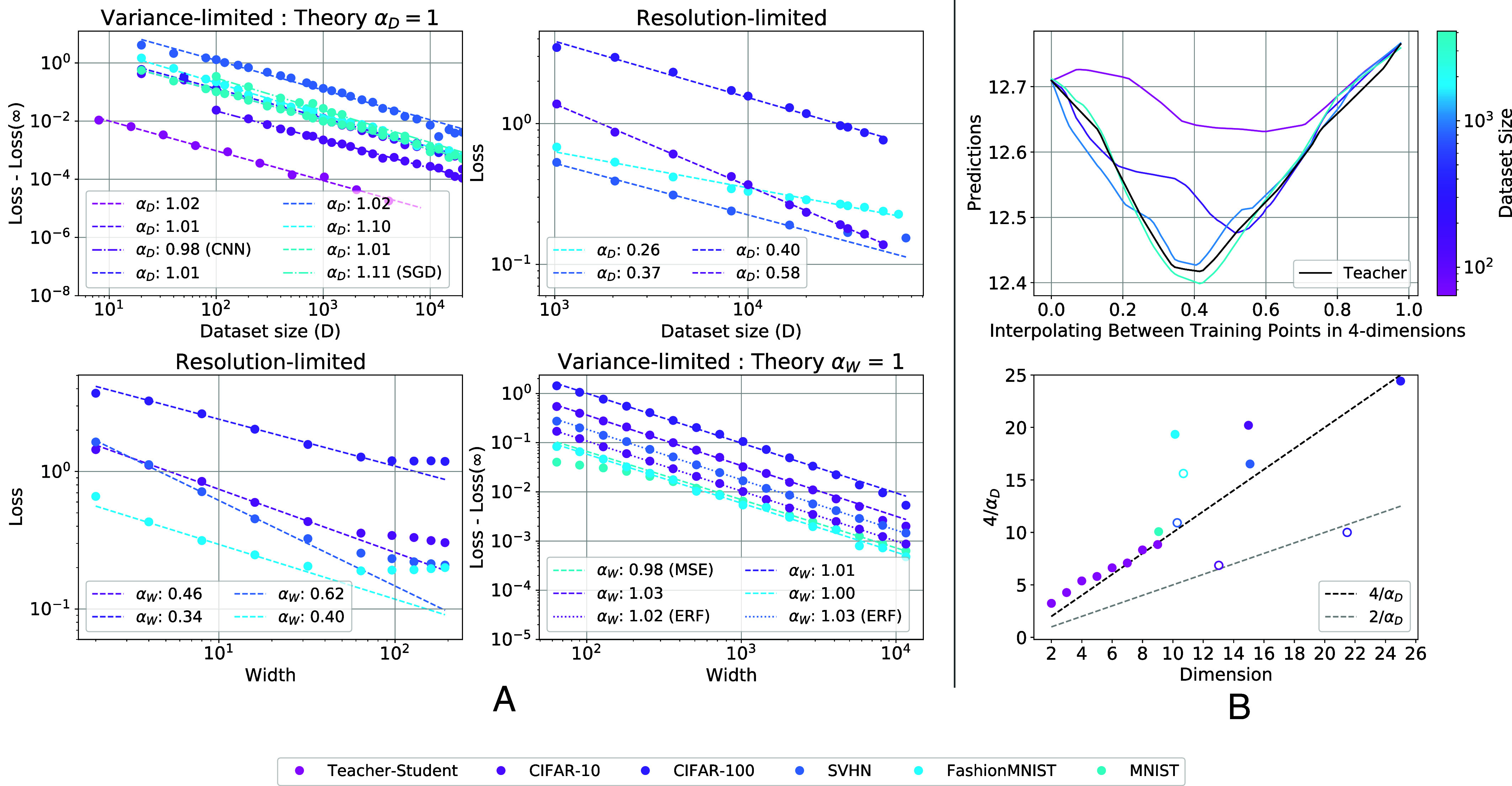
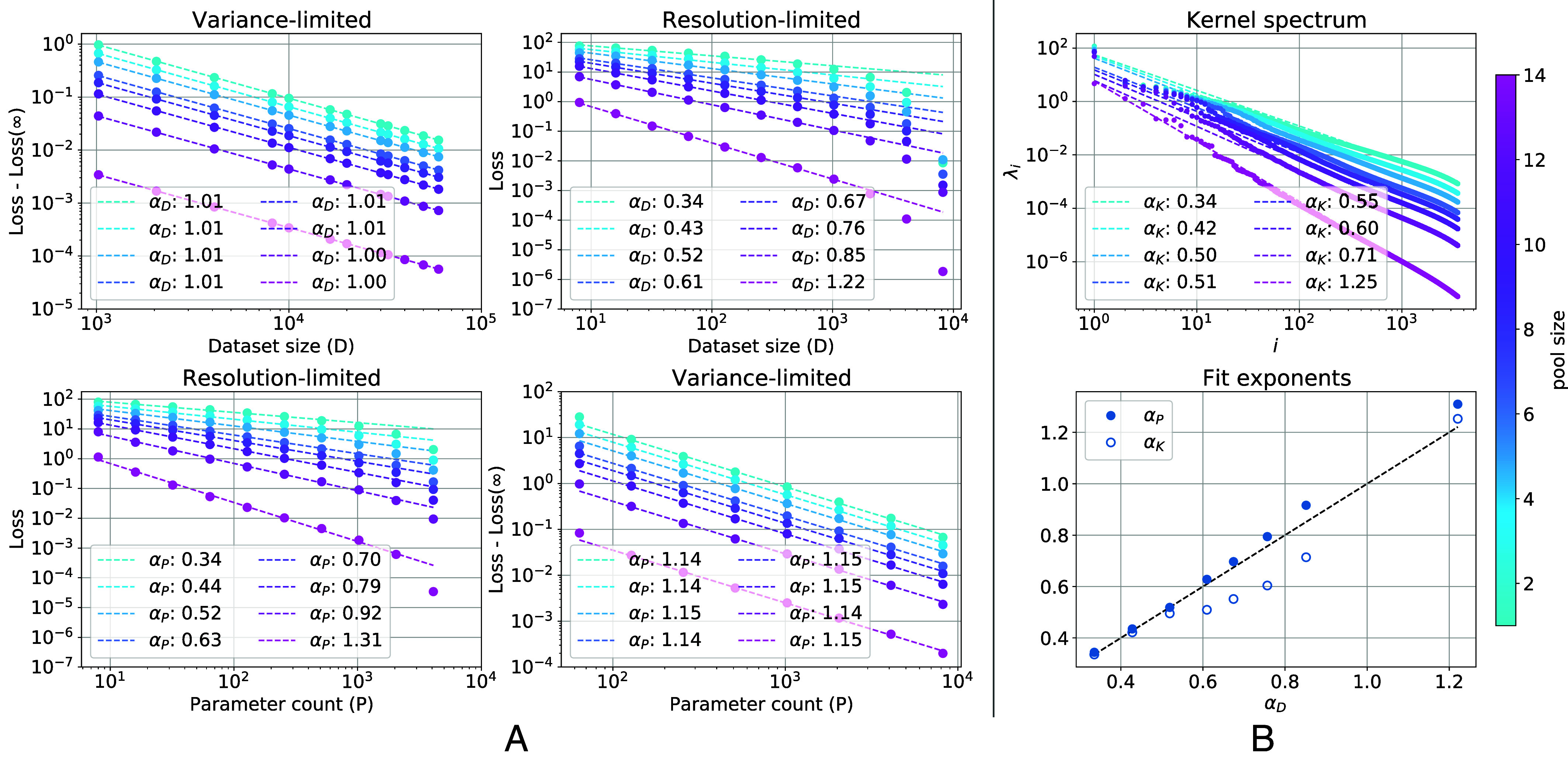
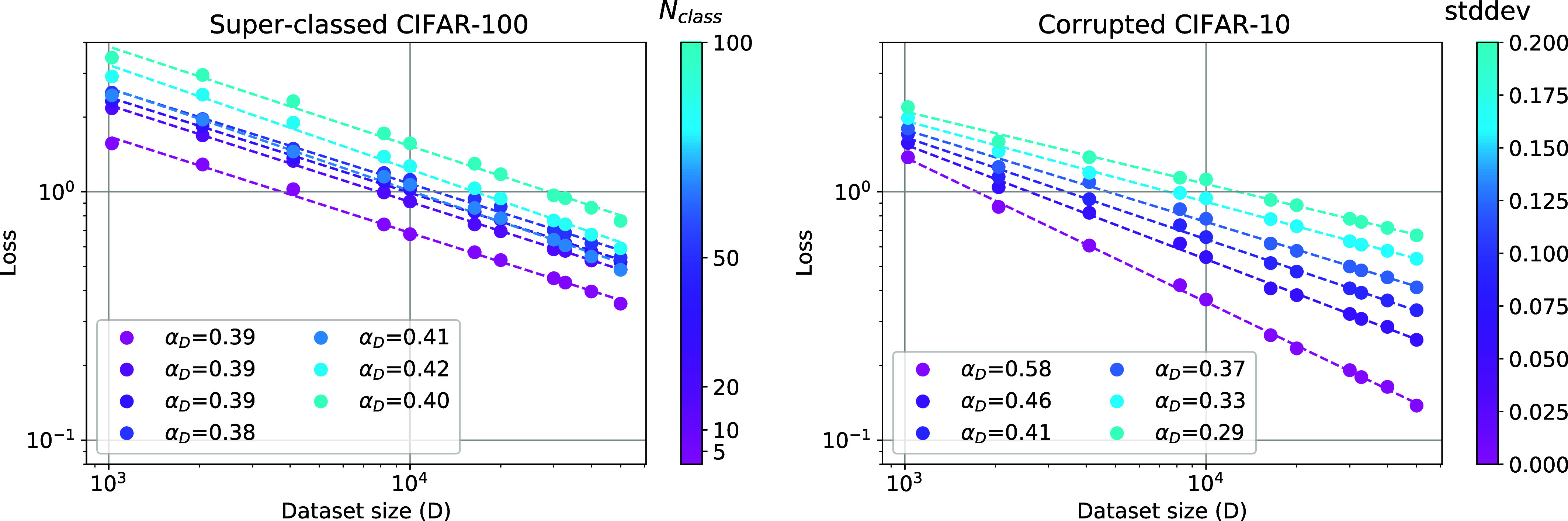
The population loss of trained deep neural networks often follows precise power-law scaling relations with either the size of the training dataset or the number of parameters in the network. We propose a theory that explains the origins of and connects these scaling laws. We identify variance-limited and resolution-limited scaling behavior for both dataset and model size, for a total of four scaling regimes. The variance-limited scaling follows simply from the existence of a well-behaved infinite data or infinite width limit, while the resolution-limited regime can be explained by positing that models are effectively resolving a smooth data manifold. In the large width limit, this can be equivalently obtained from the spectrum of certain kernels, and we present evidence that large width and large dataset resolution-limited scaling exponents are related by a duality. We exhibit all four scaling regimes in the controlled setting of large random feature and pretrained models and test the predictions empirically on a range of standard architectures and datasets. We also observe several empirical relationships between datasets and scaling exponents under modifications of task and architecture aspect ratio. Our work provides a taxonomy for classifying different scaling regimes, underscores that there can be different mechanisms driving improvements in loss, and lends insight into the microscopic origins of and relationships between scaling exponents.
Overview
The claims and statistics of this paper haven’t been checked yet.
Run the check — free, no account needed. It reads the open-access text and checks the sources it cites.
Integrity signals
Registry
Cites
Statistics
Figures
Verification
Claims the paper makes
The claims and statistics of this paper haven’t been checked yet.
Run the check — free, no account needed. It reads the open-access text and checks the sources it cites.
Claims other papers make about this one
Each is checked against this paper’s own text: does it say what the citing paper says it does?
The cited source says what the claim attributes to it.
In the citing paper
“Return follows a powerlaw: loss scales as a power-law with the amount of compute used for training (Henighan et al., 2020;Kaplan et al., 2020;Bahri et al., 2021;Ghorbani et al., 2021;Bansal et al., 2022;Hernandez et al., 2021).”
From Scaling Data-Constrained Language Models (2023) · cites this paper as Bahri et al., 2021
Self-check
Percentages, sums and reported differences re-computed from the paper’s own numbers.
The self-check needs the paper’s full text.
Citations
Cites
PyTorch: An Imperative Style, High-Performance Deep Learning Library
Paszke, A., Gross, S., Massa, F., Lerer, A., Bradbury, J., Chanan, G., Killeen, T., Lin, Z., Gimelshein, N., Antiga, L., et al. (2019) · arXiv · doi:10.48550/arxiv.1912.01703 · Cited by 31,473
The Elements of Statistical Learning
Hastie, T., Tibshirani, R., & Friedman, J. (2009) · Springer Series in Statistics · doi:10.1007/978-0-387-84858-7 · Cited by 25,970
Language Models are Few-Shot Learners
Brown, T. B., Mann, B., Ryder, N., Subbiah, M., Kaplan, J., Dhariwal, P., Neelakantan, A., Shyam, P., Sastry, G., Askell, A., et al. (2020) · arXiv · doi:10.48550/arxiv.2005.14165 · Cited by 23,372
EfficientNet: Rethinking Model Scaling for Convolutional Neural Networks
Tan, M., & Le, Q. V. (2019) · arXiv · doi:10.48550/arxiv.1905.11946 · Cited by 17,072
McCullagh, P., & Nelder, J. A. (1989) · doi:10.1007/978-1-4899-3242-6 · Cited by 16,836
Scaling Laws for Neural Language Models
Kaplan, J., McCandlish, S., Henighan, T., Brown, T. B., Chess, B., Child, R., Gray, S., Radford, A., Wu, J., & Amodei, D. (2020) · arXiv · doi:10.48550/arxiv.2001.08361 · Cited by 9,550
Zagoruyko, S., & Komodakis, N. (2016) · Procedings of the British Machine Vision Conference 2016 · doi:10.5244/c.30.87 · Cited by 7,244
SGDR: Stochastic Gradient Descent with Warm Restarts
Loshchilov, I., & Hutter, F. (2016) · arXiv · doi:10.48550/arxiv.1608.03983 · Cited by 5,309
Bayesian Learning for Neural Networks
Neal, R. M. (1996) · Lecture Notes in Statistics · doi:10.1007/978-1-4612-0745-0 · Cited by 4,276
Stein, M. L. (1999) · Springer series in statistics · doi:10.1007/978-1-4612-1494-6 · Cited by 2,358
Interpolation of Spatial Data: Some Theory for Kriging
Rathbun, S. L., & Stein, M. L. (2000) · Journal of the American Statistical Association · doi:10.2307/2669494 · Cited by 1,969
Neural Tangent Kernel: Convergence and Generalization in Neural Networks
Jacot, A., Gabriel, F., & Hongler, C. (2018) · arXiv · doi:10.48550/arxiv.1806.07572 · Cited by 1,562
Do Better ImageNet Models Transfer Better?
Kornblith, S., Shlens, J., & Le, Q. V. (2019) · 2019 IEEE/CVF Conference on Computer Vision and Pattern Recognition (CVPR) · doi:10.1109/cvpr.2019.00277 · Cited by 1,325
Weyl, H. (1912) · Mathematische Annalen · doi:10.1007/bf01456804 · Cited by 1,285
Big Transfer (BiT): General Visual Representation Learning
Kolesnikov, A., Beyer, L., Zhai, X., Puigcerver, J., Yung, J., Gelly, S., & Houlsby, N. (2020) · Lecture Notes in Computer Science · doi:10.1007/978-3-030-58558-7_29 · Cited by 1,039
Switch Transformers: Scaling to Trillion Parameter Models with Simple and Efficient Sparsity
Fedus, W., Zoph, B., & Shazeer, N. (2021) · arXiv · doi:10.48550/arxiv.2101.03961 · Cited by 1,005
Surprises in high-dimensional ridgeless least squares interpolation
Hastie, T. J., Andrea Montanari, A., Rosset, S., & Tibshirani, R. J. (2022) · The Annals of Statistics · doi:10.1214/21-aos2133 · Cited by 747
Maximum Likelihood Estimation of Intrinsic Dimension
Levina, E., & Bickel, P. J. (2004) · Cited by 696
Wide neural networks of any depth evolve as linear models under gradient descent *
Lee, J., Xiao, L., Schoenholz, S. S., Bahri, Y., Novak, R., Sohl‐Dickstein, J., & Pennington, J. (2020) · Journal of Statistical Mechanics Theory and Experiment · doi:10.1088/1742-5468/abc62b · Cited by 688
Self-citationDeep Neural Networks as Gaussian ProcessesPreprint
Lee, J., Bahri, Y., Novak, R., Schoenholz, S. S., Pennington, J., & Sohl‐Dickstein, J. (2017) · arXiv (Cornell University) · doi:10.48550/arxiv.1711.00165 · Cited by 603
Self-citationOptimal Rates for the Regularized Least-Squares Algorithm
Caponnetto, A., & Vito, E. D. (2006) · Foundations of Computational Mathematics · doi:10.1007/s10208-006-0196-8 · Cited by 566
Deep double descent: where bigger models and more data hurt*
Nakkiran, P., Kaplun, G., Bansal, Y., Yang, T., Barak, B., & Sutskever, I. (2021) · Journal of Statistical Mechanics: Theory and Experiment · doi:10.1088/1742-5468/ac3a74 · Cited by 565
The generalization error of random features regression: Precise asymptotics and double descent curve
Mei, S., & Montanari, A. (2019) · arXiv · doi:10.48550/arxiv.1908.05355 · Cited by 537
Weighted Sums of Random Kitchen Sinks: Replacing minimization with randomization in learning
Rahimi, A., & Recht, B. (2008) · Cited by 520
Deep Learning Scaling is Predictable, Empirically
Hestness, J., Narang, S., Ardalani, N., Diamos, G., Jun, H., Kianinejad, H., Patwary, M. M. A., Yang, Y., & Zhou, Y. (2017) · arXiv · doi:10.48550/arxiv.1712.00409 · Cited by 427
High-dimensional dynamics of generalization error in neural networks
Advani, M., Saxe, A., & Sompolinsky, H. (2020) · Neural Networks · doi:10.1016/j.neunet.2020.08.022 · Cited by 402
On Lazy Training in Differentiable ProgrammingPreprint
Chizat, L., Oyallon, E., & Bach, F. (2018) · arXiv (Cornell University) · doi:10.48550/arxiv.1812.07956 · Cited by 396
Your Classifier is Secretly an Energy Based Model and You Should Treat it Like OnePreprint
Grathwohl, W., Wang, K.-C. J., Jacobsen, J.-H., Duvenaud, D., Norouzi, M., & Swersky, K. (2019) · arXiv (Cornell University) · doi:10.48550/arxiv.1912.03263 · Cited by 374
Yang, G. (2019) · arXiv (Cornell University) · doi:10.48550/arxiv.1902.04760 · Cited by 299
The large learning rate phase of deep learning: the catapult mechanismPreprint
Lewkowycz, A., Bahri, Y., Dyer, E., Sohl‐Dickstein, J., & Gur-Ari, G. (2020) · arXiv (Cornell University) · doi:10.48550/arxiv.2003.02218 · Cited by 279
Self-citationBayesian Deep Convolutional Networks with Many Channels are Gaussian ProcessesPreprint
Novak, R., Xiao, L., Lee, J., Bahri, Y., Yang, G., Hron, J., Abolafia, D. A., Pennington, J., & Sohl‐Dickstein, J. (2018) · arXiv (Cornell University) · doi:10.48550/arxiv.1810.05148 · Cited by 260
Self-citationDeep Convolutional Networks as shallow Gaussian ProcessesPreprint
Garriga-Alonso, A., Aitchison, L., & Rasmussen, C. E. (2018) · arXiv (Cornell University) · doi:10.17863/cam.42340 · Cited by 231
Xiao, L., Bahri, Y., Sohl‐Dickstein, J., Schoenholz, S. S., & Pennington, J. (2018) · arXiv (Cornell University) · doi:10.48550/arxiv.1806.05393 · Cited by 215
Self-citationOptimal Rates for Regularized Least Squares Regression.
Steinwart, I., Hush, D. R., & Scovel, C. (2009) · Cited by 188
Scaling description of generalization with number of parameters in deep learning
Geiger, M., Jacot, A., Spigler, S., Gabriel, F., Sagun, L., d’Ascoli, S., Biroli, G., Hongler, C., & Wyart, M. (2020) · Journal of Statistical Mechanics Theory and Experiment · doi:10.1088/1742-5468/ab633c · Cited by 182
Canatar, A., Bordelon, B., & Pehlevan, C. (2021) · Nature Communications · doi:10.1038/s41467-021-23103-1 · Cited by 176
Scaling Laws for Autoregressive Generative Modeling
Henighan, T., Kaplan, J., Katz, M., Chen, M., Hesse, C., Jackson, J., Jun, H., Brown, T. B., Dhariwal, P., Gray, S., et al. (2020) · arXiv · doi:10.48550/arxiv.2010.14701 · Cited by 150
A Solvable Model of Neural Scaling LawsPreprint
Maloney, A., Roberts, D. A., & Sully, J. (2022) · arXiv (Cornell University) · doi:10.48550/arxiv.2210.16859 · Cited by 128
Goh, G. (2017) · Distill · doi:10.23915/distill.00006 · Cited by 127
Notes on Regularized Least Squares
Rifkin, R. M., & Lippert, R. A. (2007) · DSpace@MIT (Massachusetts Institute of Technology) · Cited by 123
Generalisation error in learning with random features and the hidden manifold model*
Gerace, F., Loureiro, B., Krząkała, F., Mézard, M., & Zdeborová, L. (2021) · Journal of Statistical Mechanics Theory and Experiment · doi:10.1088/1742-5468/ac3ae6 · Cited by 122
Neural Tangents: Fast and Easy Infinite Neural Networks in PythonPreprint
Novak, R., Xiao, L., Hron, J., Lee, J., Alemi, A. A., Sohl‐Dickstein, J., & Schoenholz, S. S. (2019) · arXiv (Cornell University) · doi:10.48550/arxiv.1912.02803 · Cited by 122
Self-citationLocal polynomial regression on unknown manifolds
Bickel, P. J., & Li, B. (2007) · Institute of Mathematical Statistics eBooks · doi:10.1214/074921707000000148 · Cited by 119
Learning Curve TheoryPreprint
Hütter, M. (2021) · arXiv (Cornell University) · doi:10.48550/arxiv.2102.04074 · Cited by 105
Finite Depth and Width Corrections to the Neural Tangent KernelPreprint
Hanin, B., & Nica, M. (2019) · arXiv (Cornell University) · doi:10.48550/arxiv.1909.05989 · Cited by 104
Finite Versus Infinite Neural Networks: an Empirical StudyPreprint
Lee, J., Schoenholz, S. S., Pennington, J., Adlam, B., Xiao, L., Novak, R., & Sohl‐Dickstein, J. (2020) · arXiv (Cornell University) · doi:10.48550/arxiv.2007.15801 · Cited by 99
Self-citationEigenvalues of Integral Operators Defined by Smooth Positive Definite Kernels
Ferreira, J. C., & Menegatto, V. . (2009) · Integral Equations and Operator Theory · doi:10.1007/s00020-009-1680-3 · Cited by 92
Double Trouble in Double Descent : Bias and Variance(s) in the Lazy Regime
d’Ascoli, S., Refinetti, M., Biroli, G., & Krząkała, F. (2020) · HAL · doi:10.48550/arxiv.2003.01054 · Cited by 86
Spectrum Dependent Learning Curves in Kernel Regression and Wide Neural NetworksPreprint
Bordelon, B., Canatar, A., & Pehlevan, C. (2020) · arXiv (Cornell University) · doi:10.48550/arxiv.2002.02561 · Cited by 84
More Data Can Hurt for Linear Regression: Sample-wise Double DescentPreprint
Nakkiran, P. (2019) · arXiv (Cornell University) · doi:10.48550/arxiv.1912.07242 · Cited by 75
Canatar, A., Bordelon, B., & Pehlevan, C. (2021) · RePEc: Research Papers in Economics · Cited by 75
A Constructive Prediction of the Generalization Error Across Scales
Rosenfeld, J. S., Rosenfeld, A., Belinkov, Y., & Shavit, N. (2019) · arXiv · doi:10.48550/arxiv.1909.12673 · Cited by 74
Learning curves for overparametrized deep neural networks: A field theory perspective
Cohen, O., Malka, O., & Ringel, Z. (2021) · Physical Review Research · doi:10.1103/physrevresearch.3.023034 · Cited by 61
Asymptotic learning curves of kernel methods: empirical data versus teacher–student paradigm
Spigler, S., Geiger, M., & Wyart, M. (2020) · Journal of Statistical Mechanics Theory and Experiment · doi:10.1088/1742-5468/abc61d · Cited by 58
Upper and Lower Bounds on the Learning Curve for Gaussian Processes
Williams, C. K. I., & Vivarelli, F. (2000) · Machine Learning · doi:10.1023/a:1007601601278 · Cited by 57
Adlam, B., & Pennington, J. (2020) · arXiv (Cornell University) · doi:10.48550/arxiv.2008.06786 · Cited by 56
Asymptotics of Wide Networks from Feynman DiagramsPreprint
Dyer, E., & Gur-Ari, G. (2019) · arXiv (Cornell University) · doi:10.48550/arxiv.1909.11304 · Cited by 54
Self-citationNon-Gaussian processes and neural networks at finite widthsPreprint
Yaida, S. (2019) · arXiv (Cornell University) · doi:10.48550/arxiv.1910.00019 · Cited by 53
The Deep Bootstrap Framework: Good Online Learners are Good Offline GeneralizersPreprint
Nakkiran, P., Neyshabur, B., & Sedghi, H. (2020) · arXiv (Cornell University) · doi:10.48550/arxiv.2010.08127 · Cited by 52
Scaling and Generalization in Neural Networks: A Case Study
Ahmad, S., & Tesauro, G. J. (1988) · neural information processing systems · Cited by 52
Eigenvalues of Positive Definite Kernels
Reade, J. B. (1983) · SIAM Journal on Mathematical Analysis · doi:10.1137/0514012 · Cited by 50
Eigenvalues of Positive Definite Kernels II
Reade, J. B. (1984) · SIAM Journal on Mathematical Analysis · doi:10.1137/0515010 · Cited by 48
Understanding Double Descent Requires a Fine-Grained Bias-Variance DecompositionPreprint
Adlam, B., & Pennington, J. (2020) · arXiv (Cornell University) · doi:10.48550/arxiv.2011.03321 · Cited by 45
Distributional Generalization: A New Kind of GeneralizationPreprint
Nakkiran, P., & Bansal, Y. (2020) · arXiv (Cornell University) · doi:10.48550/arxiv.2009.08092 · Cited by 43
Neural Kernels Without TangentsPreprint
Shankar, V., Fang, A., Guo, W., Fridovich-Keil, S., Schmidt, L., Ragan‐Kelley, J., & Recht, B. (2020) · arXiv (Cornell University) · doi:10.48550/arxiv.2003.02237 · Cited by 43
Sobolev Norm Learning Rates for Regularized Least-Squares Algorithms
Fischer, S., & Steinwart, I. (2020) · Journal of Machine Learning Research · Cited by 36
A.: Learning curves for Gaussian process regression: Approximations and boundsPreprint
Peter Sollich, A., & Halees, A. S. (2013) · Cited by 36
Learning Curves for Gaussian Processes
Sollich, P. (1998) · Research Portal (King's College London) · Cited by 35
Eigenvalues of integral operators with smooth positive definite kernels
K�hn, T. (1987) · Archiv der Mathematik · doi:10.1007/bf01194301 · Cited by 30
A Continuous-Time View of Early Stopping for Least Squares RegressionPreprint
Ali, A., Kolter, J. Z., & Tibshirani, R. J. (2018) · arXiv (Cornell University) · Cited by 29
Asymptotics of Wide Convolutional Neural NetworksPreprint
Andreassen, A., & Dyer, E. (2020) · arXiv (Cornell University) · doi:10.48550/arxiv.2008.08675 · Cited by 23
Self-citationCan neural networks do better than the Vapnik-Chervonenkis bounds?
Cohn, D. A., & Tesauro, G. J. (1990) · neural information processing systems · Cited by 22
On the Predictability of Pruning Across ScalesPreprint
Rosenfeld, J. S., Frankle, J., Carbin, M., & Shavit, N. (2020) · arXiv (Cornell University) · doi:10.48550/arxiv.2006.10621 · Cited by 21
A Neural Scaling Law from the Dimension of the Data ManifoldPreprint
Sharma, U., & Jared Kaplan, A. (2020) · arXiv (Cornell University) · doi:10.48550/arxiv.2004.10802 · Cited by 19
Self-citationGeneralization error rates in kernel regression: the crossover from the noiseless to noisy regime*
Cui, H., Loureiro, B., Krząkała, F., & Zdeborová, L. (2022) · Journal of Statistical Mechanics Theory and Experiment · doi:10.1088/1742-5468/ac9829 · Cited by 19
A Variational Approach to Learning Curves
Malzahn, D., & Opper, M. (2002) · The MIT Press eBooks · doi:10.7551/mitpress/1120.003.0064 · Cited by 17
Learning Curves for Gaussian Processes Regression: A Framework for Good Approximations
Malzahn, D., & Opper, M. (2000) · Cited by 16
How Close Are the Eigenvectors of the Sample and Actual Covariance Matrices
Loukas, A. (2017) · International Conference on Machine Learning · Cited by 10
More Than a Toy: Random Matrix Models Predict How Real-World Neural Representations GeneralizePreprint
Wei, A., Hu, W. P., & Steinhardt, J. (2022) · arXiv (Cornell University) · doi:10.48550/arxiv.2203.06176 · Cited by 8
A Theoretical-Empirical Approach to Estimating Sample Complexity of DNNs
Bisla, D., Saridena, A. N., & Choromanska, A. (2021) · IEEE/CVF Conference on Computer Vision and Pattern Recognition Workshops (CVPRW) · doi:10.1109/cvprw53098.2021.00365 · Cited by 6
Malzahn, D., & Opper, M. (2003) · Complexity · doi:10.1002/cplx.10082 · Cited by 6
Statistical Mechanics of Generalization in Kernel Regression.Preprint
Canatar, A., Bordelon, B., & Pehlevan, C. (2020) · arXiv (Cornell University) · Cited by 5
Caliban: Docker-based job manager for reproducible workflows
Ritchie, S., Slone, A., & Ramasesh, V. (2020) · The Journal of Open Source Software · doi:10.21105/joss.02403 · Cited by 5
Replica theory for learning curves for Gaussian processes on random graphs
Urry, M. J., & Peter Sollich, A. (2012) · Journal of Physics A Mathematical and Theoretical · doi:10.1088/1751-8113/45/42/425005 · Cited by 4
Implicit bias of deep linear networks in the large learning rate phasePreprint
Huang, W., Du, W., Xu, R. Y. D., & Liu, C. (2020) · arXiv (Cornell University) · doi:10.48550/arxiv.2011.12547 · Cited by 2
Research works printed but not linked: 4
- [9]J. Hoffmann, An empirical analysis of compute-optimal large language model training. Adv. Neural Inf. Process. Syst. 35, 30016– 30030 (2022).
- [14]A. Matthews, J. Hron, M. Rowland, R. E. Turner, Z. Ghahramani, “Gaussian process behaviour in wide deep neural networks” in International Conference on Learning Representations (2018).
- [30]M. S. Advani, A. M. Saxe, High-dimensional dynamics of generalization error in neural networks. arXiv [Preprint] (2017). 10.48550/arXiv.1710.03667 (Accessed 1 January 2021). PMC7685244 33022471 · DOI
- [44]D. de Laat, “Approximating manifolds by meshes: Asymptotic bounds in higher codimension” Thesis, University of Groningen, Groningen, The Netherlands (2011).
Cited by
Sorted by citations
Beyond the Imitation Game: Quantifying and extrapolating the capabilities of language models
Srivastava, A., Rastogi, A., Rao, A., Shoeb, A. A. M., Abid, A., Fisch, A., Brown, A. R., Santoro, A., Gupta, A., Garriga-Alonso, A., et al. (2022) · arXiv · doi:10.48550/arxiv.2206.04615 · Cited by 569
Self-citationHow critical is brain criticality?
O’Byrne, J., & Jerbi, K. (2022) · Trends in Neurosciences · doi:10.1016/j.tins.2022.08.007 · Cited by 283
He, J., Treude, C., & Lo, D. (2025) · ACM Transactions on Software Engineering and Methodology · doi:10.1145/3712003 · Cited by 246
A Theory for Emergence of Complex Skills in Language Models
Arora, S., & Goyal, A. (2023) · arXiv · doi:10.48550/arxiv.2307.15936 · Cited by 129
Dataset Distillation with Infinitely Wide Convolutional NetworksPreprint
Nguyen, T., Novak, R., Xiao, L., & Lee, J. (2021) · arXiv (Cornell University) · doi:10.48550/arxiv.2107.13034 · Cited by 100
Self-citation
Metadata
- Authors
- Bahri, Y., Dyer, E., Kaplan, J., Lee, J., & Sharma, U.
- Affiliations
- Google (United States) (US)
- Johns Hopkins University (US)
- Corresponding author
- Bahri, Yasaman
- Dyer, Ethan
- Lee, Jaehoon
- Sharma, Utkarsh
- Venue
- arXiv
- Publisher
- arXiv
- Published
- 2021
- Volume
- 121
- Issue
- 27
- Pages
- e2311878121-e2311878121
- ISSN
- 0027-8424 (ISSN-L)
- arXiv
- 2102.06701
- PMC
- PMC11228526
- OpenAlex
- W3133450183
- Cited by
- 182
- References
- 91
- Citations by year
- 2026: 56 · 2025: 74 · 2024: 17 · 2023: 15 · 2022: 7 · 2021: 13
- FWCI
- 21.65
- Type
- journal article
- Language
- en
- Open access
- hybrid
- doi.org
- Licence
- cc-by-nc-nd
- arxiv.org/licenses/nonexclusive-distrib/1.0/
- Locations
- Proceedings of the National Academy of Sciences (publishedVersion, cc-by-nc-nd)
- PubMed Central (publishedVersion, cc-by-nc-nd)
- PubMed (publishedVersion)
- arXiv (Cornell University) (submittedVersion)
- arXiv (Cornell University)
- Funders
- Open Philanthropy Project
- Topics
- Physical Sciences › Computer Science › Artificial Intelligence › Stochastic Gradient Optimization Techniques
- Physical Sciences › Computer Science › Artificial Intelligence › Neural Networks and Applications
- Physical Sciences › Computer Science › Artificial Intelligence › Domain Adaptation and Few-Shot Learning
- Keywords
- neural scaling laws, power-law scaling, population decline, infinite-width limit, data manifold, random features, pre-trained models, scaling exponents, duality, model size, training data size
About these checks
Registry, retraction, Cites and statistics results are computed, not judged, with one exception: a printed reference that no index lists is read once by a model before it counts as a citation error. Claims are extracted by a model and kept only when their quote appears verbatim in the text; each cited source is then checked, with a model’s help, for whether it says what the claim relies on. Those verdicts can be wrong — read the claim’s quote and the cited source before relying on one.
Statistics and arithmetic are recomputed, not judged.
Confidence bands are shown only for fields calibrated on our annotated test set. None is calibrated yet, so no band is shown.
What counts as a claim ›How we measure confidence ›How we check this ›
Are you an author, or do you see a problem with this page? Request a review
