

The DOI matches its DataCite record; 85 of the 91 references it cites were found in a registry or an index.
Explaining Neural Scaling Laws
Open accessAbstract
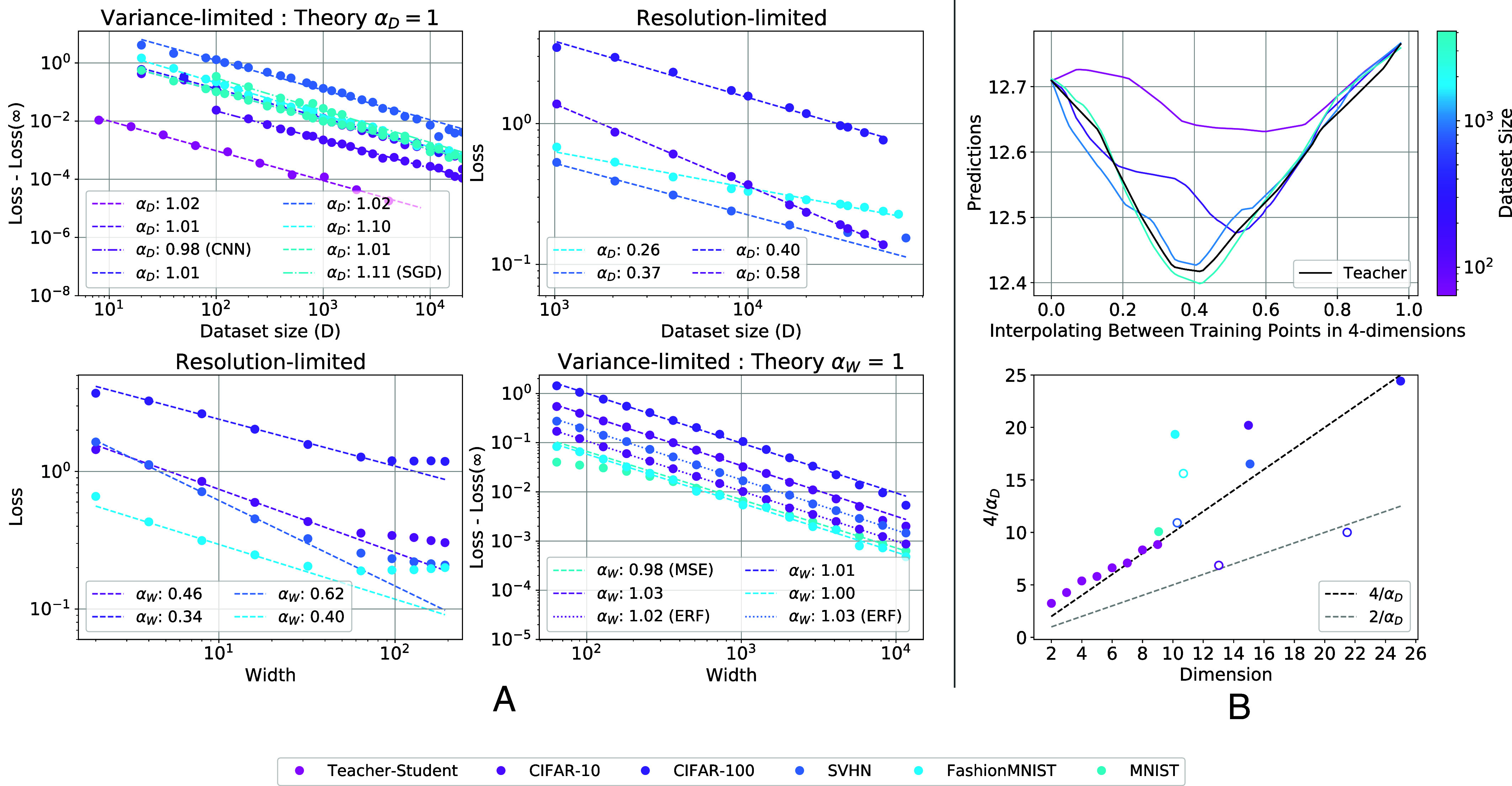
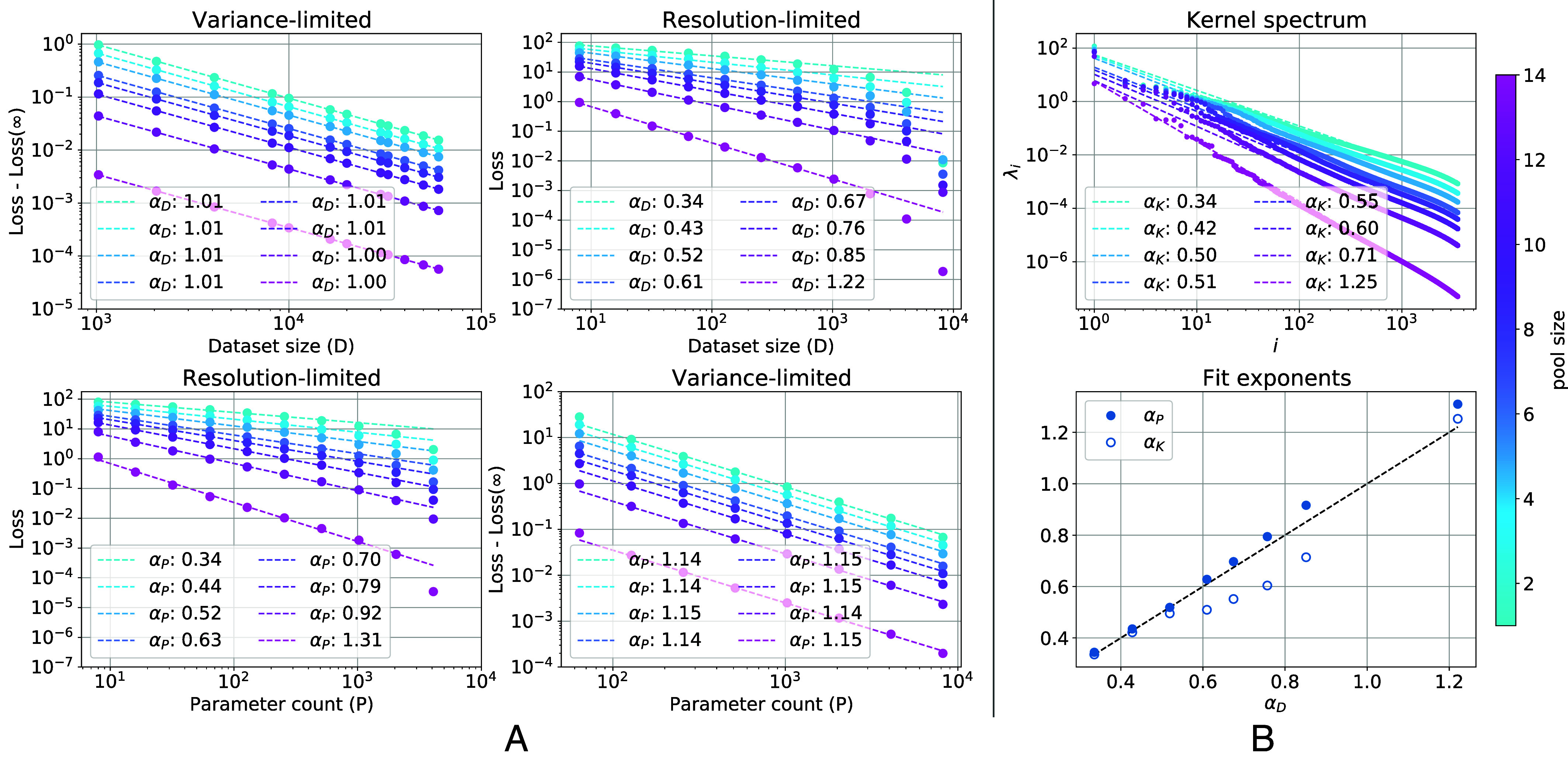
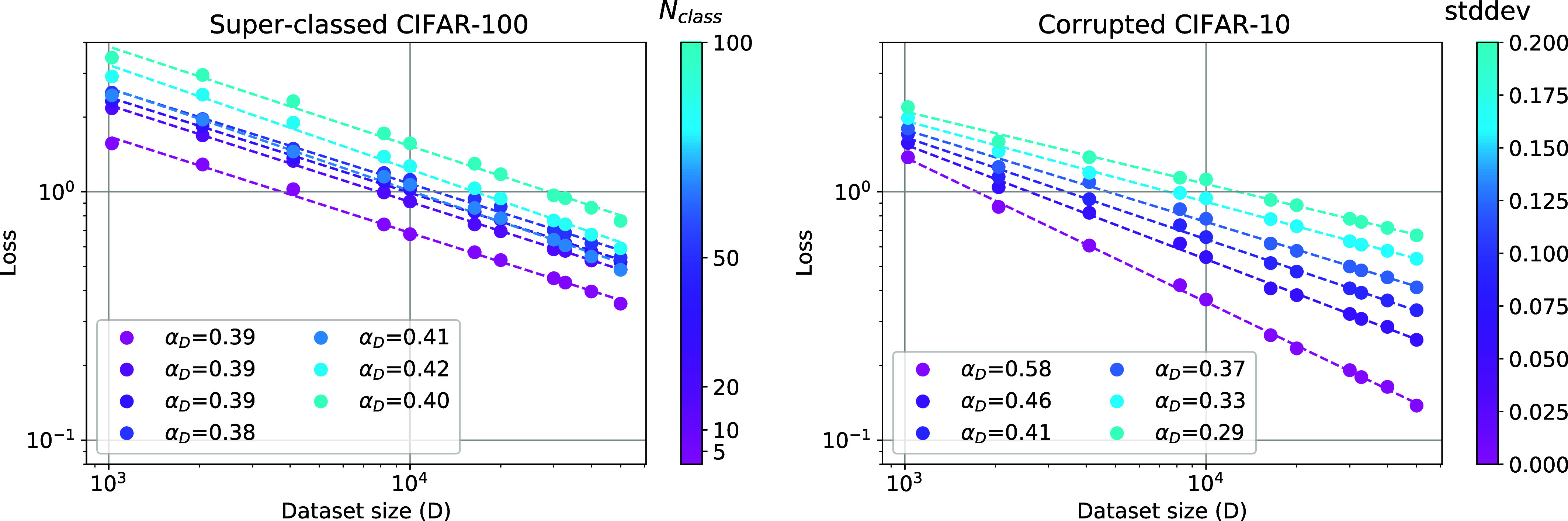
The population loss of trained deep neural networks often follows precise power-law scaling relations with either the size of the training dataset or the number of parameters in the network. We propose a theory that explains the origins of and connects these scaling laws. We identify variance-limited and resolution-limited scaling behavior for both dataset and model size, for a total of four scaling regimes. The variance-limited scaling follows simply from the existence of a well-behaved infinite data or infinite width limit, while the resolution-limited regime can be explained by positing that models are effectively resolving a smooth data manifold. In the large width limit, this can be equivalently obtained from the spectrum of certain kernels, and we present evidence that large width and large dataset resolution-limited scaling exponents are related by a duality. We exhibit all four scaling regimes in the controlled setting of large random feature and pretrained models and test the predictions empirically on a range of standard architectures and datasets. We also observe several empirical relationships between datasets and scaling exponents under modifications of task and architecture aspect ratio. Our work provides a taxonomy for classifying different scaling regimes, underscores that there can be different mechanisms driving improvements in loss, and lends insight into the microscopic origins of and relationships between scaling exponents.
Overview
The claims and statistics of this paper haven’t been checked yet.
Run the check — free, no account needed. It reads the open-access text and checks the sources it cites.
Integrity signals
Registry
Cites
Statistics
Figures
Verification
Claims the paper makes
The claims and statistics of this paper haven’t been checked yet.
Run the check — free, no account needed. It reads the open-access text and checks the sources it cites.
Claims other papers make about this one
Each is checked against this paper’s own text: does it say what the citing paper says it does?
The cited source says what the claim attributes to it.
In the citing paper
“Return follows a powerlaw: loss scales as a power-law with the amount of compute used for training (Henighan et al., 2020;Kaplan et al., 2020;Bahri et al., 2021;Ghorbani et al., 2021;Bansal et al., 2022;Hernandez et al., 2021).”
From Scaling Data-Constrained Language Models (2023) · cites this paper as Bahri et al., 2021
Self-check
Percentages, sums and reported differences re-computed from the paper’s own numbers.
The self-check needs the paper’s full text.
Citations
Cites
PyTorch: An Imperative Style, High-Performance Deep Learning Library
Paszke, A., Gross, S., Massa, F., Lerer, A., Bradbury, J., Chanan, G., Killeen, T., Lin, Z., Gimelshein, N., Antiga, L., et al. (2019) · arXiv · doi:10.48550/arxiv.1912.01703 · Cited by 31,473
The Elements of Statistical Learning
Hastie, T., Tibshirani, R., & Friedman, J. (2009) · Springer Series in Statistics · doi:10.1007/978-0-387-84858-7 · Cited by 25,970
Language Models are Few-Shot Learners
Brown, T. B., Mann, B., Ryder, N., Subbiah, M., Kaplan, J., Dhariwal, P., Neelakantan, A., Shyam, P., Sastry, G., Askell, A., et al. (2020) · arXiv · doi:10.48550/arxiv.2005.14165 · Cited by 23,372
EfficientNet: Rethinking Model Scaling for Convolutional Neural Networks
Tan, M., & Le, Q. V. (2019) · arXiv · doi:10.48550/arxiv.1905.11946 · Cited by 17,072
McCullagh, P., & Nelder, J. A. (1989) · doi:10.1007/978-1-4899-3242-6 · Cited by 16,836
Scaling Laws for Neural Language Models
Kaplan, J., McCandlish, S., Henighan, T., Brown, T. B., Chess, B., Child, R., Gray, S., Radford, A., Wu, J., & Amodei, D. (2020) · arXiv · doi:10.48550/arxiv.2001.08361 · Cited by 9,550
Zagoruyko, S., & Komodakis, N. (2016) · Procedings of the British Machine Vision Conference 2016 · doi:10.5244/c.30.87 · Cited by 7,244
SGDR: Stochastic Gradient Descent with Warm Restarts
Loshchilov, I., & Hutter, F. (2016) · arXiv · doi:10.48550/arxiv.1608.03983 · Cited by 5,309
Bayesian Learning for Neural Networks
Neal, R. M. (1996) · Lecture Notes in Statistics · doi:10.1007/978-1-4612-0745-0 · Cited by 4,276
Stein, M. L. (1999) · Springer series in statistics · doi:10.1007/978-1-4612-1494-6 · Cited by 2,358
Research works printed but not linked: 4
- [9]J. Hoffmann, An empirical analysis of compute-optimal large language model training. Adv. Neural Inf. Process. Syst. 35, 30016– 30030 (2022).
- [14]A. Matthews, J. Hron, M. Rowland, R. E. Turner, Z. Ghahramani, “Gaussian process behaviour in wide deep neural networks” in International Conference on Learning Representations (2018).
- [30]M. S. Advani, A. M. Saxe, High-dimensional dynamics of generalization error in neural networks. arXiv [Preprint] (2017). 10.48550/arXiv.1710.03667 (Accessed 1 January 2021). PMC7685244 33022471 · DOI
- [44]D. de Laat, “Approximating manifolds by meshes: Asymptotic bounds in higher codimension” Thesis, University of Groningen, Groningen, The Netherlands (2011).
Cited by
Sorted by citations
Beyond the Imitation Game: Quantifying and extrapolating the capabilities of language models
Srivastava, A., Rastogi, A., Rao, A., Shoeb, A. A. M., Abid, A., Fisch, A., Brown, A. R., Santoro, A., Gupta, A., Garriga-Alonso, A., et al. (2022) · arXiv · doi:10.48550/arxiv.2206.04615 · Cited by 569
Self-citationHow critical is brain criticality?
O’Byrne, J., & Jerbi, K. (2022) · Trends in Neurosciences · doi:10.1016/j.tins.2022.08.007 · Cited by 283
He, J., Treude, C., & Lo, D. (2025) · ACM Transactions on Software Engineering and Methodology · doi:10.1145/3712003 · Cited by 246
A Theory for Emergence of Complex Skills in Language Models
Arora, S., & Goyal, A. (2023) · arXiv · doi:10.48550/arxiv.2307.15936 · Cited by 129
Dataset Distillation with Infinitely Wide Convolutional NetworksPreprint
Nguyen, T., Novak, R., Xiao, L., & Lee, J. (2021) · arXiv (Cornell University) · doi:10.48550/arxiv.2107.13034 · Cited by 100
Self-citation
Metadata
- Authors
- Bahri, Y., Dyer, E., Kaplan, J., Lee, J., & Sharma, U.
- Affiliations
- Google (United States) (US)
- Johns Hopkins University (US)
- Corresponding author
- Bahri, Yasaman
- Dyer, Ethan
- Lee, Jaehoon
- Sharma, Utkarsh
- Venue
- arXiv
- Publisher
- arXiv
- Published
- 2021
- Volume
- 121
- Issue
- 27
- Pages
- e2311878121-e2311878121
- ISSN
- 0027-8424 (ISSN-L)
- arXiv
- 2102.06701
- PMC
- PMC11228526
- OpenAlex
- W3133450183
- Cited by
- 182
- References
- 91
- Citations by year
- 2026: 56 · 2025: 74 · 2024: 17 · 2023: 15 · 2022: 7 · 2021: 13
- FWCI
- 21.65
- Type
- journal article
- Language
- en
- Open access
- hybrid
- doi.org
- Licence
- cc-by-nc-nd
- arxiv.org/licenses/nonexclusive-distrib/1.0/
- Locations
- Proceedings of the National Academy of Sciences (publishedVersion, cc-by-nc-nd)
- PubMed Central (publishedVersion, cc-by-nc-nd)
- PubMed (publishedVersion)
- arXiv (Cornell University) (submittedVersion)
- arXiv (Cornell University)
- Funders
- Open Philanthropy Project
- Topics
- Physical Sciences › Computer Science › Artificial Intelligence › Stochastic Gradient Optimization Techniques
- Physical Sciences › Computer Science › Artificial Intelligence › Neural Networks and Applications
- Physical Sciences › Computer Science › Artificial Intelligence › Domain Adaptation and Few-Shot Learning
- Keywords
- neural scaling laws, power-law scaling, population decline, infinite-width limit, data manifold, random features, pre-trained models, scaling exponents, duality, model size, training data size
About these checks
Registry, retraction, Cites and statistics results are computed, not judged, with one exception: a printed reference that no index lists is read once by a model before it counts as a citation error. Claims are extracted by a model and kept only when their quote appears verbatim in the text; each cited source is then checked, with a model’s help, for whether it says what the claim relies on. Those verdicts can be wrong — read the claim’s quote and the cited source before relying on one.
Statistics and arithmetic are recomputed, not judged.
Confidence bands are shown only for fields calibrated on our annotated test set. None is calibrated yet, so no band is shown.
What counts as a claim ›How we measure confidence ›How we check this ›
Are you an author, or do you see a problem with this page? Request a review
