

The DOI matches its DataCite record; 1 of the 1 references it cites were found in a registry or an index.
The Hydra Effect: Emergent Self-repair in Language Model Computations
Open accessAbstract
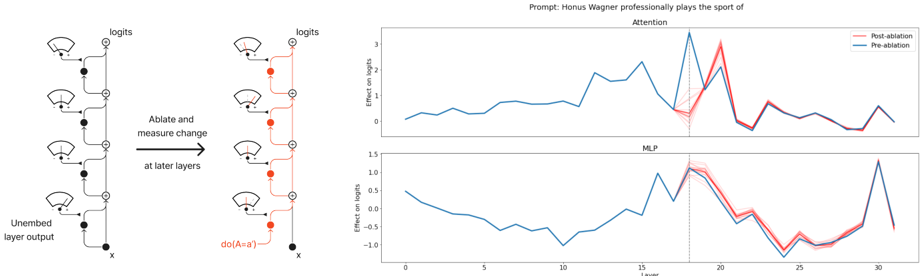
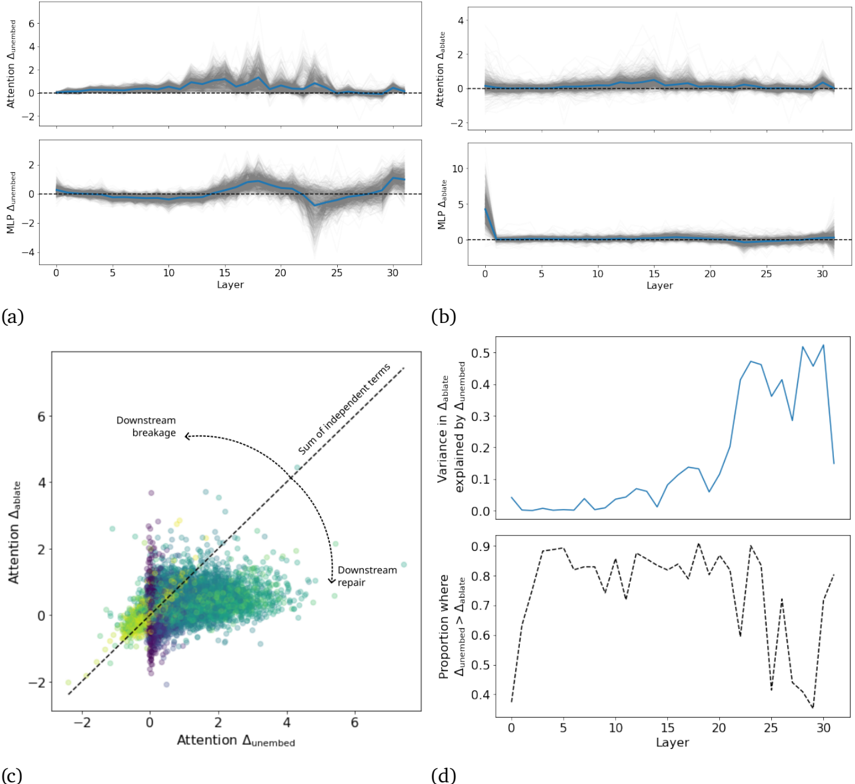
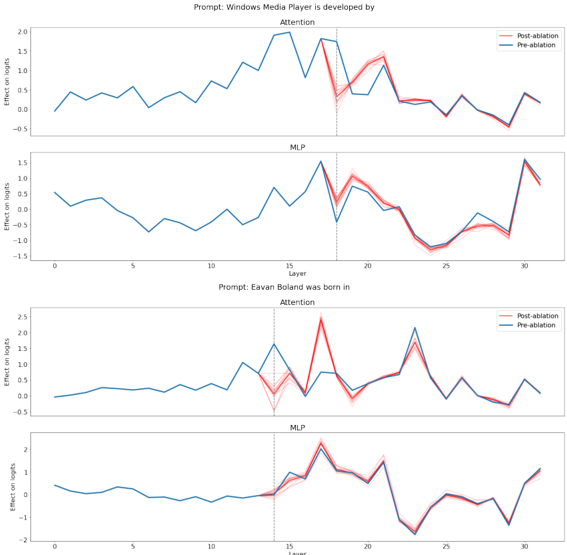
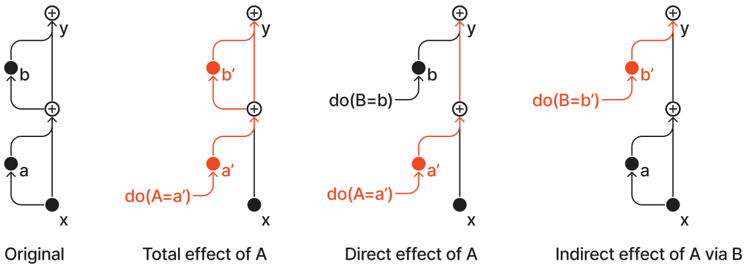
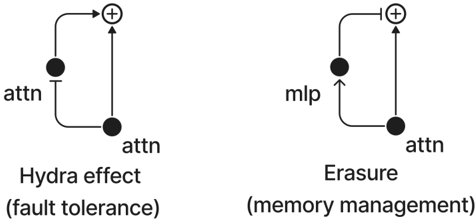
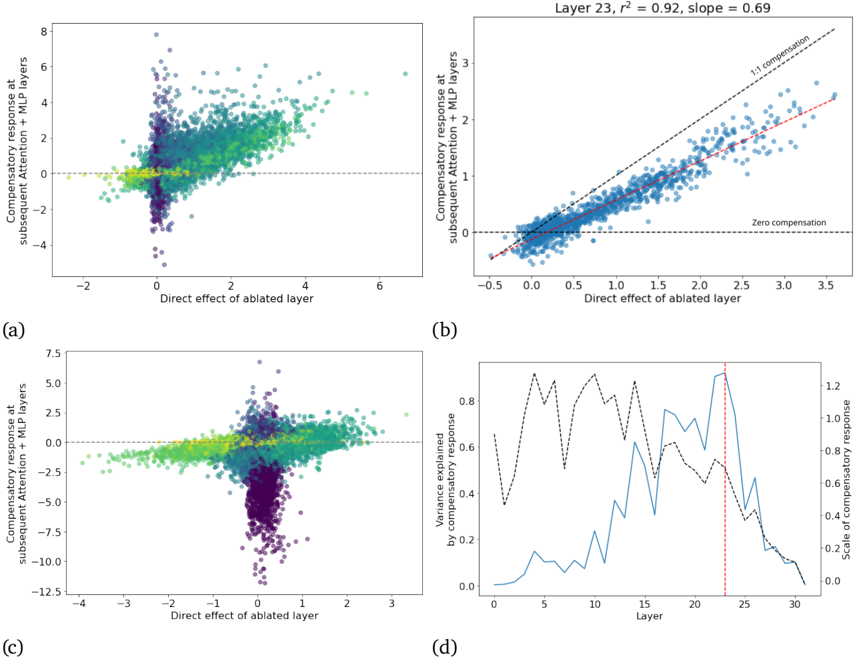
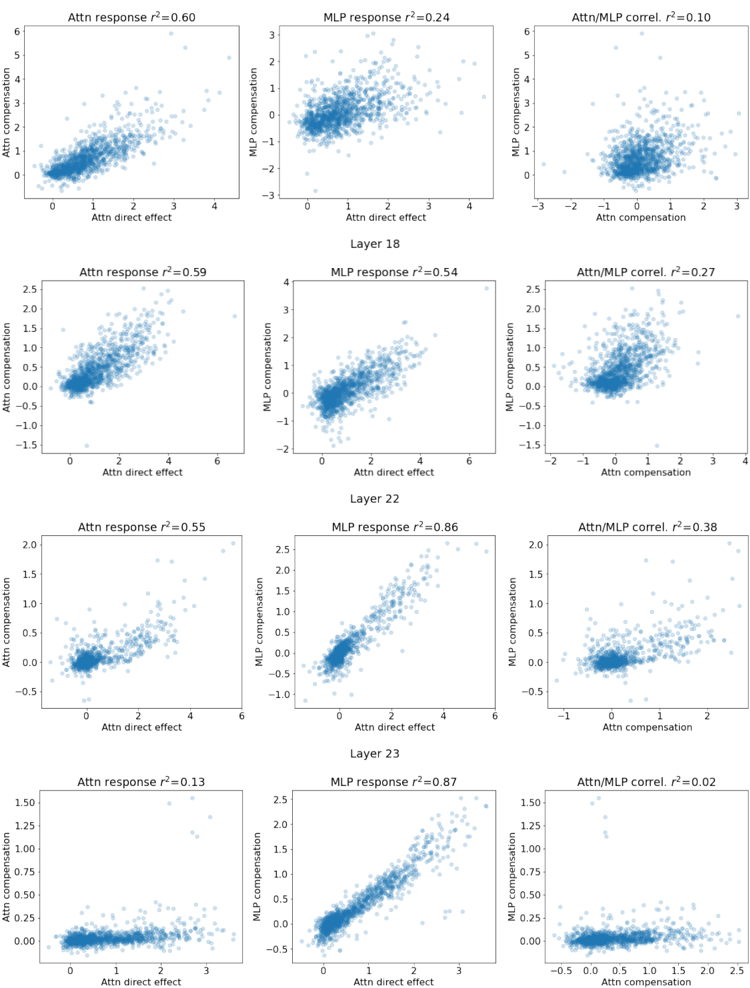
We investigate the internal structure of language model computations using causal analysis and demonstrate two motifs: (1) a form of adaptive computation where ablations of one attention layer of a language model cause another layer to compensate (which we term the Hydra effect) and (2) a counterbalancing function of late MLP layers that act to downregulate the maximum-likelihood token. Our ablation studies demonstrate that language model layers are typically relatively loosely coupled (ablations to one layer only affect a small number of downstream layers). Surprisingly, these effects occur even in language models trained without any form of dropout. We analyse these effects in the context of factual recall and consider their implications for circuit-level attribution in language models.
Overview
The claims and statistics of this paper haven’t been checked yet.
Run the check — free, no account needed. It reads the open-access text and checks the sources it cites.
Integrity signals
Registry
Cites
Statistics
Figures
Verification
Claims the paper makes
The claims and statistics of this paper haven’t been checked yet.
Run the check — free, no account needed. It reads the open-access text and checks the sources it cites.
Claims other papers make about this one
Each is checked against this paper’s own text: does it say what the citing paper says it does?
The source backs part of the claim, not all of it — or backs it for a different population, condition or comparison.
In the citing paper
“In the language of causality (Pearl, 2009), unembedding a residual stream vector measures the direct effect of that vector on the output (McGrath et al., 2023).”
From Open Problems in Mechanistic Interpretability (2025) · cites this paper as McGrath et al., 2023
Experimental — accuracy not yet measured
Self-check
Percentages, sums and reported differences re-computed from the paper’s own numbers.
The self-check needs the paper’s full text.
Citations
Cites
Grokking: Generalization Beyond Overfitting on Small Algorithmic Datasets
Power, A., Burda, Y., Edwards, H., Babuschkin, I., & Misra, V. (2022) · arXiv · doi:10.48550/arxiv.2201.02177 · Cited by 83
Research works printed but not linked: 44
- G. Alain and Y. Bengio. Understanding intermediate layers using linear classifier probes. arXiv preprint arXiv:1610.01644, 2016. · arXiv
- J. L. Ba, J. R. Kiros, and G. E. Hinton. Layer normalization. arXiv preprint arXiv:1607.06450, 2016. · arXiv
- D. Bahdanau, K. Cho, and Y. Bengio. Neural machine translation by jointly learning to align and translate. arXiv preprint arXiv:1409.0473, 2014. · arXiv
- D. Bau, J.-Y. Zhu, H. Strobelt, B. Zhou, J. B. Tenenbaum, W. T. Freeman, and A. Torralba. Gan dissection: Visualizing and understanding generative adversarial networks. arXiv preprint arXiv:1811.10597, 2018. · arXiv
- N. Belrose, Z. Furman, L. Smith, D. Halawi, I. Ostrovsky, L. McKinney, S. Biderman, and J. Steinhardt. Eliciting latent predictions from transformers with the tuned lens. arXiv preprint arXiv:2303.08112, 2023. · arXiv
- N. Cammarata, G. Goh, S. Carter, L. Schubert, M. Petrov, and C. Olah. Curve detectors. Distill, 5(6): e00024-003, 2020.
- S. Carter, Z. Armstrong, L. Schubert, I. Johnson, and C. Olah. Activation atlas. Distill, 2019. doi: 10.23915/distill.00015. https://distill.pub/2019/activation-atlas. · DOI · Paper page
- B. Chughtai, L. Chan, and N. Nanda. A toy model of universality: Reverse engineering how networks learn group operations. arXiv preprint arXiv:2302.03025, 2023. · arXiv
- A. Conmy, A. N. Mavor-Parker, A. Lynch, S. Heimersheim, and A. Garriga-Alonso. Towards automated circuit discovery for mechanistic interpretability. arXiv preprint arXiv:2304.14997, 2023. · arXiv
- G. Dar, M. Geva, A. Gupta, and J. Berant. Analyzing transformers in embedding space. arXiv preprint arXiv:2209.02535, 2022. · arXiv
- T. Dettmers, M. Lewis, Y. Belkada, and L. Zettlemoyer. Llm. int8 (): 8-bit matrix multiplication for transformers at scale. arXiv preprint arXiv:2208.07339, 2022. · arXiv
- M. Finlayson, A. Mueller, S. Gehrmann, S. Shieber, T. Linzen, and Y. Belinkov. Causal analysis of syntactic agreement mechanisms in neural language models. arXiv preprint arXiv:2106.06087, 2021. · arXiv
- J. Z. Forde, C. Lovering, G. Konidaris, E. Pavlick, and M. L. Littman. Where, when & which concepts does alphazero learn? lessons from the game of hex. In AAAI Workshop on Reinforcement Learning in Games, volume 2, 2022.
- A. Geiger, H. Lu, T. Icard, and C. Potts. Causal abstractions of neural networks. Advances in Neural Information Processing Systems, 34:9574-9586, 2021.
- A. Geiger, Z. Wu, H. Lu, J. Rozner, E. Kreiss, T. Icard, N. Goodman, and C. Potts. Inducing causal structure for interpretable neural networks. In International Conference on Machine Learning, pages 7324-7338. PMLR, 2022.
- A. Geiger, C. Potts, and T. Icard. Causal abstraction for faithful model interpretation. arXiv preprint arXiv:2301.04709, 2023a. · arXiv
- A. Geiger, Z. Wu, C. Potts, T. Icard, and N. D. Goodman. Finding alignments between interpretable causal variables and distributed neural representations. arXiv preprint arXiv:2303.02536, 2023b. · arXiv
- M. Geva, A. Caciularu, G. Dar, P. Roit, S. Sadde, M. Shlain, B. Tamir, and Y. Goldberg. Lm-debugger: An interactive tool for inspection and intervention in transformer-based language models. arXiv preprint arXiv:2204.12130, 2022a. · arXiv
- M. Geva, A. Caciularu, K. R. Wang, and Y. Goldberg. Transformer feed-forward layers build predictions by promoting concepts in the vocabulary space. arXiv preprint arXiv:2203.14680, 2022b. · arXiv
- M. Glymour, J. Pearl, and N. P. Jewell. Causal inference in statistics: A primer. John Wiley & Sons, 2016.
- G. Goh, N. C. †, C. V. †, S. Carter, M. Petrov, L. Schubert, A. Radford, and C. Olah. Mul- timodal neurons in artificial neural networks. Distill, 2021. doi: 10.23915/distill.00030. https://distill.pub/2021/multimodal-neurons. · DOI · Paper page
- W. Gurnee, N. Nanda, M. Pauly, K. Harvey, D. Troitskii, and D. Bertsimas. Finding neurons in a haystack: Case studies with sparse probing. arXiv preprint arXiv:2305.01610, 2023. · arXiv
- J. Y. Halpern. Actual causality. MiT Press, 2016.
- J. Hilton, N. Cammarata, S. Carter, G. Goh, and C. Olah. Understanding rl vision. Distill, 2020. doi: 10.23915/distill.00029. https://distill.pub/2020/understanding-rl-vision. · DOI · Paper page
- J. Hoffmann, S. Borgeaud, A. Mensch, E. Buchatskaya, T. Cai, E. Rutherford, D. d. L. Casas, L. A. Hendricks, J. Welbl, A. Clark, et al. Training compute-optimal large language models. arXiv preprint arXiv:2203.15556, 2022. · arXiv
- M. L. Leavitt and A. Morcos. Towards falsifiable interpretability research. arXiv preprint arXiv:2010.12016, 2020. · arXiv
- R. Massidda, A. Geiger, T. Icard, and D. Bacciu. Causal abstraction with soft interventions. arXiv preprint arXiv:2211.12270, 2022. · arXiv
- T. McGrath, A. Kapishnikov, N. Tomašev, A. Pearce, M. Wattenberg, D. Hassabis, B. Kim, U. Paquet, and V. Kramnik. Acquisition of chess knowledge in alphazero. Proceedings of the National Academy of Sciences, 119(47):e2206625119, 2022.
- K. Meng, D. Bau, A. Andonian, and Y. Belinkov. Locating and editing factual associations in gpt. Advances in Neural Information Processing Systems, 35:17359-17372, 2022.
- A. S. Morcos, D. G. Barrett, N. C. Rabinowitz, and M. Botvinick. On the importance of single directions for generalization. arXiv preprint arXiv:1803.06959, 2018. · arXiv
- N. Nanda, L. Chan, T. Liberum, J. Smith, and J. Steinhardt. Progress measures for grokking via mechanistic interpretability. arXiv preprint arXiv:2301.05217, 2023. · arXiv
- C. Olah, A. Satyanarayan, I. Johnson, S. Carter, L. Schubert, K. Ye, and A. Mordvintsev. The building blocks of interpretability. Distill, 3(3):e10, 2018.
- C. Olah, N. Cammarata, L. Schubert, G. Goh, M. Petrov, and S. Carter. Zoom in: An introduction to circuits. Distill, 2020. doi: 10.23915/distill.00024.001. https://distill.pub/2020/circuits/zoom-in. · DOI · Paper page
- C. Olsson, N. Elhage, N. Nanda, N. Joseph, N. DasSarma, T. Henighan, B. Mann, A. Askell, Y. Bai, A. Chen, et al. In-context learning and induction heads. arXiv preprint arXiv:2209.11895, 2022. · arXiv
- J. Pearl. Causality. Cambridge university press, 2009.
- M. Phuong and M. Hutter. Formal algorithms for transformers. arXiv preprint arXiv:2207.09238, 2022. · arXiv
- N. Srivastava, G. Hinton, A. Krizhevsky, I. Sutskever, and R. Salakhutdinov. Dropout: a simple way to prevent neural networks from overfitting. The journal of machine learning research, 15(1): 1929-1958, 2014.
- N. Tinbergen. On aims and methods of ethology. Zeitschrift für tierpsychologie, 20(4):410-433, 1963.
- A. Vaswani, N. Shazeer, N. Parmar, J. Uszkoreit, L. Jones, A. N. Gomez, Ł. Kaiser, and I. Polosukhin. Attention is all you need. Advances in neural information processing systems, 30, 2017.
- A. Veit, M. J. Wilber, and S. Belongie. Residual networks behave like ensembles of relatively shallow networks. Advances in neural information processing systems, 29, 2016.
- J. Vig, S. Gehrmann, Y. Belinkov, S. Qian, D. Nevo, S. Sakenis, J. Huang, Y. Singer, and S. Shieber. Causal mediation analysis for interpreting neural nlp: The case of gender bias. arXiv preprint arXiv:2004.12265, 2020a. · arXiv
- J. Vig, S. Gehrmann, Y. Belinkov, S. Qian, D. Nevo, Y. Singer, and S. Shieber. Investigating gender bias in language models using causal mediation analysis. Advances in neural information processing systems, 33:12388-12401, 2020b.
- K. Wang, A. Variengien, A. Conmy, B. Shlegeris, and J. Steinhardt. Interpretability in the wild: a circuit for indirect object identification in gpt-2 small. arXiv preprint arXiv:2211.00593, 2022. · arXiv
- B. Zhang and R. Sennrich. Root mean square layer normalization. Advances in Neural Information Processing Systems, 32, 2019.
Cited by
Sorted by citations
Open Problems in Mechanistic Interpretability
Sharkey, L., Chughtai, B., Batson, J., Lindsey, J., Wu, J., Bushnaq, L., Goldowsky-Dill, N., Heimersheim, S., Ortega, A., Bloom, J., et al. (2025) · arXiv · doi:10.48550/arxiv.2501.16496 · Cited by 291
Self-citationFuture Shock: Generative AI and the International AI Policy and Governance Crisis
Leslie, D., & Perini, A. M. (2024) · Harvard Data Science Review · doi:10.1162/99608f92.88b4cc98 · Cited by 33
Emergent Linear Representations in World Models of Self-Supervised Sequence Models
Nanda, N., Lee, A., & Wattenberg, M. (2023) · Proceedings of the 6th BlackboxNLP Workshop: Analyzing and Interpreting Neural Networks for NLP · doi:10.18653/v1/2023.blackboxnlp-1.2 · Cited by 55
Metadata
- Authors
- McGrath, T., Rahtz, M., Kramar, J., Mikulik, V., & Legg, S.
- ORCID
- Mikulik, Vladimir
- Venue
- arXiv
- Publisher
- arXiv
- Published
- 2023
- ISSN
- 2331-8422 (ISSN-L)
- arXiv
- 2307.15771
- OpenAlex
- W4385473442
- Cited by
- 140
- References
- 1
- Citations by year
- 2026: 75 · 2025: 27 · 2024: 29 · 2023: 9
- Type
- posted content
- Language
- en
- Open access
- green
- arxiv.org
- Licence
- Locations
- arXiv (Cornell University) (submittedVersion, cc-by)
- arXiv (Cornell University) (cc-by)
- Topics
- Physical Sciences › Computer Science › Artificial Intelligence › Explainable Artificial Intelligence (XAI)
- Physical Sciences › Computer Science › Artificial Intelligence › Topic Modeling
- Physical Sciences › Computer Science › Artificial Intelligence › Natural Language Processing Techniques
- Keywords
- adaptive computation, self-healing, causal analysis, factual recall, interlayer coupling
About these checks
Registry, retraction, Cites and statistics results are computed, not judged, with one exception: a printed reference that no index lists is read once by a model before it counts as a citation error. Claims are extracted by a model and kept only when their quote appears verbatim in the text; each cited source is then checked, with a model’s help, for whether it says what the claim relies on. Those verdicts can be wrong — read the claim’s quote and the cited source before relying on one.
Statistics and arithmetic are recomputed, not judged.
Confidence bands are shown only for fields calibrated on our annotated test set. None is calibrated yet, so no band is shown.
What counts as a claim ›How we measure confidence ›How we check this ›
Are you an author, or do you see a problem with this page? Request a review
