

The DOI matches its DataCite record; 18 of the 19 references it cites were found in a registry or an index, and 1 are not checked yet.
An Empirical Study of Catastrophic Forgetting in Large Language Models During Continual Fine-tuning
Open accessAbstract
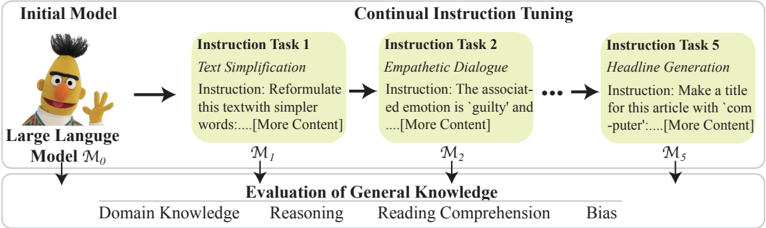
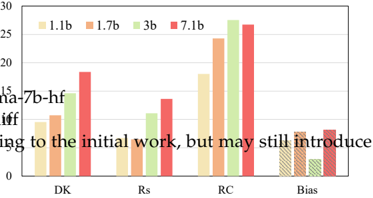
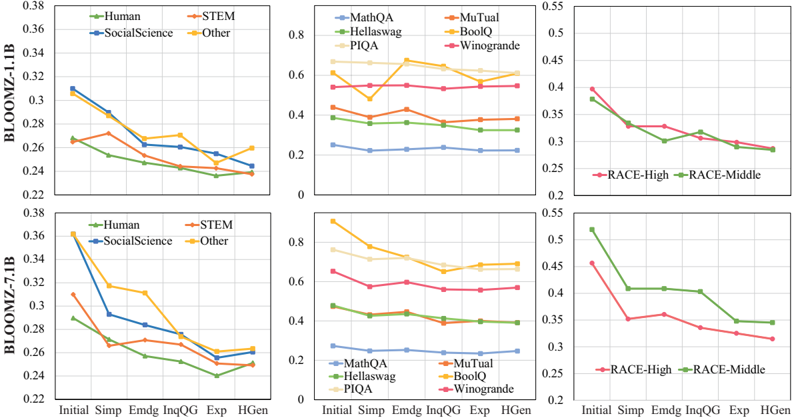
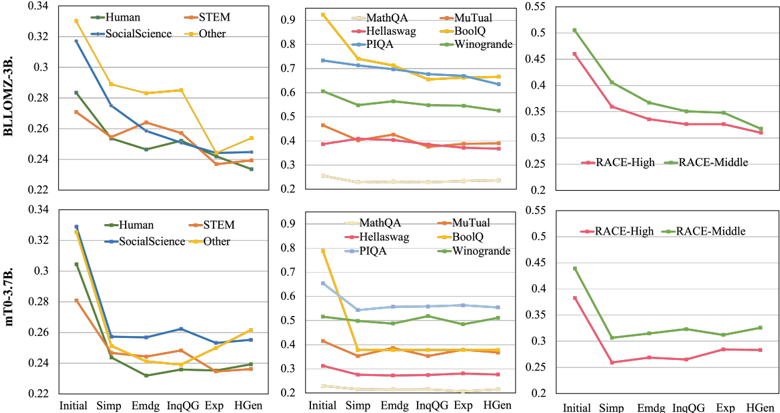
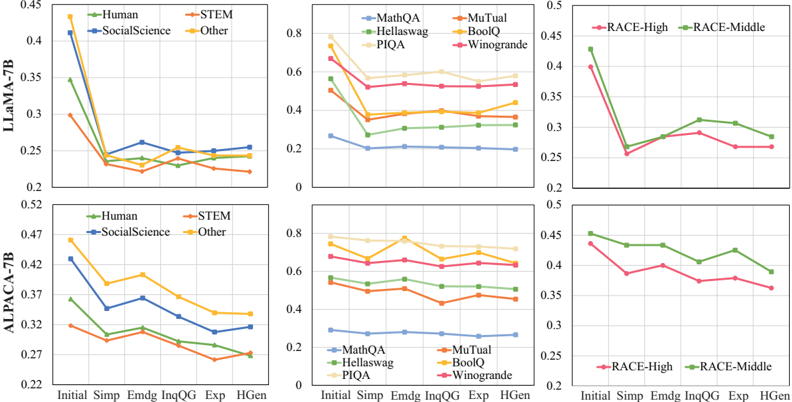
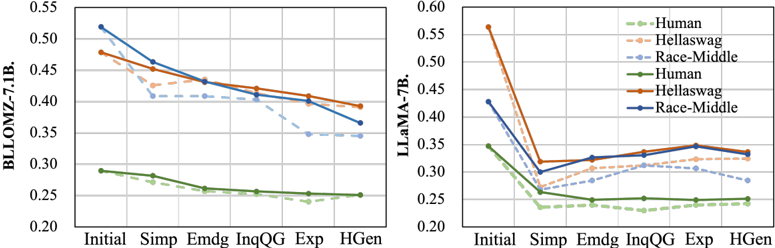
Catastrophic forgetting (CF) is a phenomenon that occurs in machine learning when a model forgets previously learned information while acquiring new knowledge for achieving a satisfactory performance in downstream tasks. As large language models (LLMs) have demonstrated remarkable performance, it is intriguing to investigate whether CF exists during the continual instruction tuning of LLMs. This study empirically evaluates the forgetting phenomenon in LLMs' knowledge during continual instruction tuning from the perspectives of domain knowledge, reasoning, and reading comprehension. The experiments reveal that catastrophic forgetting is generally observed in LLMs ranging from 1b to 7b parameters. Surprisingly, as the model scale increases, the severity of forgetting intensifies in such a model sale range which may result from the much significant initial performance in the larger LLM. Comparing the decoder-only model BLOOMZ with the encoder-decoder model mT0, BLOOMZ exhibits less forgetting and retains more knowledge. Interestingly, we also observe that LLMs can mitigate language biases, such as gender bias, during continual fine-tuning. Furthermore, our findings indicate that general instruction tuning can help alleviate the forgetting phenomenon in LLMs during subsequent fine-tuning.
Overview
The claims and statistics of this paper haven’t been checked yet.
Run the check — free, no account needed. It reads the open-access text and checks the sources it cites.
Integrity signals
Registry
Cites
Statistics
Figures
Verification
Claims the paper makes
The claims and statistics of this paper haven’t been checked yet.
Run the check — free, no account needed. It reads the open-access text and checks the sources it cites.
Claims other papers make about this one
Each is checked against this paper’s own text: does it say what the citing paper says it does?
The source backs part of the claim, not all of it — or backs it for a different population, condition or comparison.
In the citing paper
“However, finetuning and pretraining are computation-expensive [13, 10] and usually suffer from catastrophic forgetting [63] and overfitting [64].”
From WISE: Rethinking the Knowledge Memory for Lifelong Model Editing of Large Language Models (2024) · cites this paper as [63]
Experimental — accuracy not yet measuredThe cited source says what the claim attributes to it.
In the citing paper
“current knowledge injection methods often suffer from computational overhead [13, 10], catastrophic forgetting [63], and overfitting [64].”
From WISE: Rethinking the Knowledge Memory for Lifelong Model Editing of Large Language Models (2024) · cites this paper as [63]
Self-check
Percentages, sums and reported differences re-computed from the paper’s own numbers.
The self-check needs the paper’s full text.
Citations
Cites
Li, Z., & Hoiem, D. (2018) · IEEE Transactions on Pattern Analysis and Machine Intelligence · doi:10.1109/tpami.2017.2773081 · Cited by 4,202
Self-Instruct: Aligning Language Models with Self-Generated Instructions
Wang, Y., Kordi, Y., Mishra, S., Liu, A., Smith, N. A., Khashabi, D., & Hajishirzi, H. (2023) · Proceedings of the 61st Annual Meeting of the Association for Computational Linguistics (Volume 1: Long Papers) · doi:10.18653/v1/2023.acl-long.754 · Cited by 1,243
RACE: Large-scale ReAding Comprehension Dataset From Examinations
Lai, G., Xie, Q., Liu, H., Yang, Y., & Hovy, E. (2017) · Proceedings of the 2017 Conference on Empirical Methods in Natural Language Processing · doi:10.18653/v1/d17-1082 · Cited by 1,044 · cited 1×
“Reading Comprehension: We assess the LLMs’ performance on the RACE dataset [35], which includes both middle and high-school-level reading comprehension tasks.”
Towards Empathetic Open-domain Conversation Models: A New Benchmark and Dataset
Rashkin, H., Smith, E. M., Li, M., & Boureau, Y.-L. (2019) · Proceedings of the conference - Association for Computational Linguistics. Meeting · doi:10.18653/v1/p19-1534 · Cited by 1,020
HellaSwag: Can a Machine Really Finish Your Sentence?
Zellers, R., Holtzman, A., Bisk, Y., Farhadi, A., & Choi, Y. (2019) · Proceedings of the 57th Annual Meeting of the Association for Computational Linguistics · doi:10.18653/v1/p19-1472 · Cited by 830
CrowS-Pairs: A Challenge Dataset for Measuring Social Biases in Masked Language Models
Nangia, N., Vania, C., Bhalerao, R., & Bowman, S. R. (2020) · Proceedings of the 2020 Conference on Empirical Methods in Natural Language Processing (EMNLP) · doi:10.18653/v1/2020.emnlp-main.154 · Cited by 446
Crosslingual Generalization through Multitask Finetuning
Muennighoff, N., Wang, T., Sutawika, L., Roberts, A., Biderman, S., Le Scao, T., Bari, M. S., Shen, S., Yong, Z. X., Schoelkopf, H., et al. (2023) · Proceedings of the 61st Annual Meeting of the Association for Computational Linguistics (Volume 1: Long Papers) · doi:10.18653/v1/2023.acl-long.891 · Cited by 361
WinoGrande: an adversarial winograd schema challenge at scale
Sakaguchi, K., Bras, R. L., Bhagavatula, C., & Choi, Y. (2021) · Communications of the ACM · doi:10.1145/3474381 · Cited by 356
ELI5: long form question answering
Fan, A., Jernite, Y., Perez, E., Grangier, D., Weston, J., & Auli, M. (2019) · Proceedings of the 57th Annual Meeting of the Association for Computational Linguistics · doi:10.18653/v1/p19-1346 · Cited by 319
MetaICL: Learning to Learn In Context
Min, S., Lewis, M., Zettlemoyer, L., & Hajishirzi, H. (2022) · Proceedings of the 2022 Conference of the North American Chapter of the Association for Computational Linguistics: Human Language Technologies · doi:10.18653/v1/2022.naacl-main.201 · Cited by 169
Neural CRF Model for Sentence Alignment in Text Simplification
Jiang, C., Maddela, M., Lan, W., Yang, Z., & Xu, W. H. (2020) · Proceedings of the conference - Association for Computational Linguistics. Meeting · doi:10.18653/v1/2020.acl-main.709 · Cited by 131
Self-citationAlva-Manchego, F. E., Martin, L., Bordes, A., Scarton, C., Sagot, B., & Specia, L. (2020) · Proceedings of the conference - Association for Computational Linguistics. Meeting · doi:10.18653/v1/2020.acl-main.424 · Cited by 128
A framework for few-shot language model evaluation
Sutawika, L., Gao, L., Schoelkopf, H., Biderman, S., Tow, J., Abbasi, B., fattori, B., Lovering, C., farzanehnakhaee70, Phang, J., et al. (2021) · Zenodo (CERN European Organization for Nuclear Research) · doi:10.5281/zenodo.5371628 · Cited by 124
Fine-tuned Language Models are Continual Learners
Scialom, T., Chakrabarty, T., & Muresan, S. (2022) · Conference on Empirical Methods in Natural Language Processing (EMNLP) · doi:10.18653/v1/2022.emnlp-main.410 · Cited by 118
MuTual: A Dataset for Multi-Turn Dialogue Reasoning
Cui, L., Wu, Y., Liu, S., Zhang, Y., & Zhou, M. (2020) · Proceedings of the 58th Annual Meeting of the Association for Computational Linguistics · doi:10.18653/v1/2020.acl-main.130 · Cited by 110
Self-citationProbing Representation Forgetting in Supervised and Unsupervised Continual Learning
Davari, M., Asadi, N., Mudur, S. P., Aljundi, R., & Belilovsky, E. (2022) · IEEE Computer Society Conference on Computer Vision and Pattern Recognition/Proceedings - IEEE Computer Society Conference on Computer Vision and Pattern Recognition/Proceedings · doi:10.1109/cvpr52688.2022.01621 · Cited by 58
AdaPrompt: Adaptive Model Training for Prompt-based NLP
Chen, Y., Liu, Y., Li, D., Wang, S., Zhu, C., Zeng, M., & Zhang, Y. (2022) · Findings of the Association for Computational Linguistics: EMNLP (Findings of EMNLP) · doi:10.18653/v1/2022.findings-emnlp.448 · Cited by 50
Self-citationPIQA: Reasoning about Physical Commonsense in Natural Language
Bisk, Y., Zellers, R., Le bras, R., Gao, J., & Choi, Y. (2020) · Proceedings of the AAAI Conference on Artificial Intelligence · doi:10.1609/aaai.v34i05.6239 · Cited by 37
Continual Training of Language Models for Few-Shot Learning
Ke, Z., Lin, H., Shao, Y., Xu, H., Shu, L., & Liu, B. (2022) · Proceedings of the 2022 Conference on Empirical Methods in Natural Language Processing · doi:10.18653/v1/2022.emnlp-main.695 · Cited by 35
Research works printed but not linked: 18
- Aida Amini, Saadia Gabriel, Shanchuan Lin, Rik Koncel-Kedziorski, Yejin Choi, and Han- naneh Hajishirzi. Mathqa: Towards interpretable math word problem solving with operation-based formalisms. In Proceedings of the 2019 Conference of the North American Chapter of the Association for Computational Linguistics: Human Language Technologies, Volume 1 (Long and Short Papers), pp. 2357-2367, 2019.
- Sébastien Bubeck, Varun Chandrasekaran, Ronen Eldan, Johannes Gehrke, Eric Horvitz, Ece Kamar, Peter Lee, Yin Tat Lee, Yuanzhi Li, Scott Lundberg, et al. Sparks of artificial general intelligence: Early experiments with gpt-4. arXiv preprint arXiv:2303.12712, 2023. · arXiv
- Pietro Buzzega, Matteo Boschini, Angelo Porrello, Davide Abati, and Simone Calderara. Dark experience for general continual learning: a strong, simple baseline. Advances in neural information processing systems, 33:15920-15930, 2020.
- Oana-Maria Camburu, Tim Rocktäschel, Thomas Lukasiewicz, and Phil Blunsom. e-snli: Natural language inference with natural language explanations. Advances in Neural Information Processing Systems, 31, 2018.
- Christopher Clark, Kenton Lee, Ming-Wei Chang, Tom Kwiatkowski, Michael Collins, and Kristina Toutanova. Boolq: Exploring the surprising difficulty of natural yes/no questions. In Proceedings of the 2019 Conference of the North American Chapter of the Association for Computational Linguistics: Human Language Technologies, Volume 1 (Long and Short Papers), pp. 2924-2936, 2019.
- Dan Hendrycks, Collin Burns, Steven Basart, Andy Zou, Mantas Mazeika, Dawn Song, and Jacob Steinhardt. Measuring massive multitask language understanding. arXiv preprint arXiv:2009.03300, 2020. · arXiv
- Zixuan Ke and Bing Liu. Continual learning of natural language processing tasks: A survey. arXiv preprint arXiv:2211.12701, 2022. · arXiv
- Diederik P Kingma and Jimmy Ba. Adam: A method for stochastic optimization. arXiv preprint arXiv:1412.6980, 2014. · arXiv
- David Lopez-Paz and Marc'Aurelio Ranzato. Gradient episodic memory for continual learning. Advances in neural information processing systems, 30, 2017.
- Yun Luo, Xiaotian Lin, Zhen Yang, Fandong Meng, Jie Zhou, and Yue Zhang. Mitigating catastrophic forgetting in task-incremental continual learning with adaptive classification criterion. arXiv preprint arXiv:2305.12270, 2023a. · arXiv
- Yun Luo, Zhen Yang, Xuefeng Bai, Fandong Meng, Jie Zhou, and Yue Zhang. Investigat- ing forgetting in pre-trained representations through continual learning. arXiv preprint arXiv:2305.05968, 2023b. · arXiv
- Long Ouyang, Jeffrey Wu, Xu Jiang, Diogo Almeida, Carroll Wainwright, Pamela Mishkin, Chong Zhang, Sandhini Agarwal, Katarina Slama, Alex Ray, et al. Training language models to follow instructions with human feedback. Advances in Neural Information Processing Systems, 35:27730-27744, 2022.
- Matthew Riemer, Ignacio Cases, Robert Ajemian, Miao Liu, Irina Rish, Yuhai Tu, and Gerald Tesauro. Learning to learn without forgetting by maximizing transfer and minimizing in- terference. In International Conference on Learning Representations. International Conference on Learning Representations, ICLR, 2019.
- Victor Sanh, Albert Webson, Colin Raffel, Stephen H Bach, Lintang Sutawika, Zaid Alyafeai, Antoine Chaffin, Arnaud Stiegler, Teven Le Scao, Arun Raja, et al. Multitask prompted training enables zero-shot task generalization. arXiv preprint arXiv:2110.08207, 2021. · arXiv
- Nisan Stiennon, Long Ouyang, Jeffrey Wu, Daniel Ziegler, Ryan Lowe, Chelsea Voss, Alec Radford, Dario Amodei, and Paul F Christiano. Learning to summarize with human feedback. Advances in Neural Information Processing Systems, 33:3008-3021, 2020.
- Hugo Touvron, Thibaut Lavril, Gautier Izacard, Xavier Martinet, Marie-Anne Lachaux, Timothée Lacroix, Baptiste Rozière, Naman Goyal, Eric Hambro, Faisal Azhar, et al. Llama: Open and efficient foundation language models. arXiv preprint arXiv:2302.13971, 2023. · arXiv
- Jason Wei, Maarten Bosma, Vincent Y Zhao, Kelvin Guu, Adams Wei Yu, Brian Lester, Nan Du, Andrew M Dai, and Quoc V Le. Finetuned language models are zero-shot learners. arXiv preprint arXiv:2109.01652, 2021. · arXiv
- Tongtong Wu, Massimo Caccia, Zhuang Li, Yuan-Fang Li, Guilin Qi, and Gholamreza Haffari. Pretrained language model in continual learning: A comparative study. In The Tenth International Conference on Learning Representations, ICLR 2022, Virtual Event, April 25- 29, 2022. OpenReview.net, 2022. URL https://openreview.net/forum?id=figzpGMrdD.
Cited by
Sorted by citations
Security and Privacy Challenges of Large Language Models: A Survey
Das, B. C., Amini, M. H., & Wu, Y. (2025) · ACM Computing Surveys · doi:10.1145/3712001 · Cited by 445
Prompt Engineering Paradigms for Medical Applications: Scoping Review
Zaghir, J., Naguib, M., Bjelogrlic, M., Névéol, A., Tannier, X., & Lovis, C. (2024) · Journal of Medical Internet Research · doi:10.2196/60501 · Cited by 143
Application of large language models in medicine
Liu, F., Zhou, H., Gu, B., Zou, X., Huang, J., Wu, J., Li, Y., Chen, S. S., Hua, Y., Zhou, P., et al. (2025) · Nature Reviews Bioengineering · doi:10.1038/s44222-025-00279-5 · Cited by 94
Self-citationLarge language models for life cycle assessments: Opportunities, challenges, and risks
Preuss, N., Alshehri, A. S., & You, F. (2024) · Journal of Cleaner Production · doi:10.1016/j.jclepro.2024.142824 · Cited by 71
When Large Language Models Meet Vector Databases: A Survey
Jing, Z., Su, Y., & Han, Y. (2025) · 2025 Conference on Artificial Intelligence x Multimedia (AIxMM) · doi:10.1109/aixmm62960.2025.00008 · Cited by 93
Metadata
- Authors
- Luo, Y., Yang, Z., Meng, F., Li, Y., Zhou, J., & Zhang, Y.
- Affiliations
- Westlake University (CN)
- Tencent (China) (CN)
- Venue
- arXiv
- Publisher
- arXiv
- Published
- 2023
- Volume
- 33
- Pages
- 3776-3786
- ISSN
- 2998-4173 (ISSN-L)
- arXiv
- 2308.08747
- OpenAlex
- W4414037010
- Cited by
- 135
- References
- 18
- Citations by year
- 2026: 57 · 2025: 56 · 2024: 21 · 2023: 1
- FWCI
- 45.32
- Type
- journal article
- Language
- en
- Open access
- green
- arxiv.org
- Licence
- Locations
- IEEE Transactions on Audio Speech and Language Processing (publishedVersion)
- arXiv (Cornell University) (submittedVersion, cc-by)
- arXiv (Cornell University) (cc-by)
- Funders
- National Natural Science Foundation of China
- National Key Research and Development Program of China
- Topics
- Physical Sciences › Computer Science › Artificial Intelligence › Domain Adaptation and Few-Shot Learning
- Physical Sciences › Computer Science › Artificial Intelligence › Topic Modeling
- Physical Sciences › Computer Science › Artificial Intelligence › Natural Language Processing Techniques
- Keywords
- catastrophic forgetting, large language models, continual fine-tuning, knowledge retention, model scale, gender bias, reading comprehension, reasoning
About these checks
Registry, retraction, Cites and statistics results are computed, not judged, with one exception: a printed reference that no index lists is read once by a model before it counts as a citation error. Claims are extracted by a model and kept only when their quote appears verbatim in the text; each cited source is then checked, with a model’s help, for whether it says what the claim relies on. Those verdicts can be wrong — read the claim’s quote and the cited source before relying on one.
Statistics and arithmetic are recomputed, not judged.
Confidence bands are shown only for fields calibrated on our annotated test set. None is calibrated yet, so no band is shown.
What counts as a claim ›How we measure confidence ›How we check this ›
Are you an author, or do you see a problem with this page? Request a review
