

InternVL3: Exploring Advanced Training and Test-Time Recipes for Open-Source Multimodal Models
Open accessThe DOI matches its DataCite record; 145 of the 145 references it cites were found in a registry or an index; none of the 38 sources its claims cite is checked for support yet.
Abstract
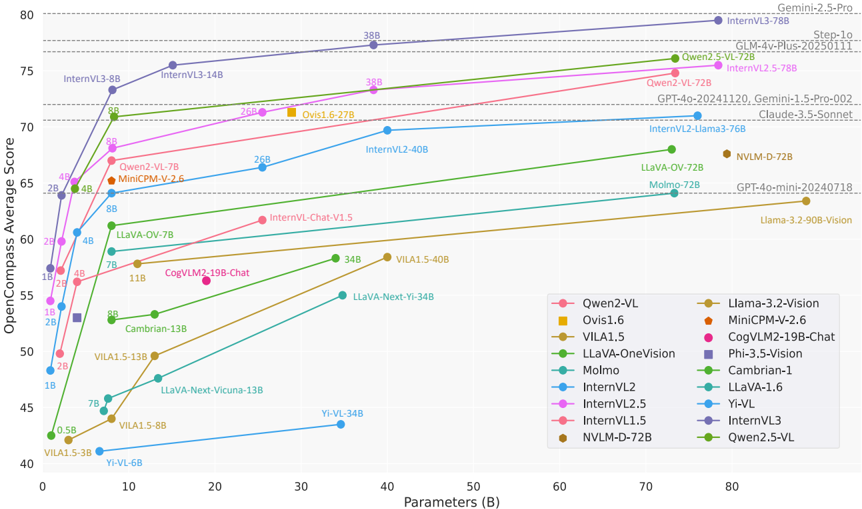
We introduce InternVL3, a significant advancement in the InternVL series featuring a native multimodal pre-training paradigm. Rather than adapting a text-only large language model (LLM) into a multimodal large language model (MLLM) that supports visual inputs, InternVL3 jointly acquires multimodal and linguistic capabilities from both diverse multimodal data and pure-text corpora during a single pre-training stage. This unified training paradigm effectively addresses the complexities and alignment challenges commonly encountered in conventional post-hoc training pipelines for MLLMs. To further improve performance and scalability, InternVL3 incorporates variable visual position encoding (V2PE) to support extended multimodal contexts, employs advanced post-training techniques such as supervised fine-tuning (SFT) and mixed preference optimization (MPO), and adopts test-time scaling strategies alongside an optimized training infrastructure. Extensive empirical evaluations demonstrate that InternVL3 delivers superior performance across a wide range of multi-modal tasks. In particular, InternVL3-78B achieves a score of 72.2 on the MMMU benchmark, setting a new state-of-the-art among open-source MLLMs. Its capabilities remain highly competitive with leading proprietary models, including ChatGPT-4o, Claude 3.5 Sonnet, and Gemini 2.5 Pro, while also maintaining strong pure-language proficiency. In pursuit of open-science principles, we will publicly release both the training data and model weights to foster further research and development in next-generation MLLMs.
Overview
CoChat Summary
TL;DR
InternVL3 introduces a native multimodal pre-training paradigm that jointly learns language and multimodal capabilities in one stage, plus V2PE, SFT/MPO post-training, test-time scaling, and infrastructure optimizations. InternVL3-78B reaches 72.2 on MMMU, setting a new state of the art among open-source MLLMs while remaining competitive with proprietary models.
Key findings
- InternVL3-78B achieves 72.2 on MMMU, 906 on OCRBench, 96.0/98.6 on VCR-EN-Easy (EM/Jaccard), and 89.0/88.7 on MMBench English/Chinese; the paper reports it as a new open-source MLLM state of the art and competitive with ChatGPT-4o, Claude 3.5 Sonnet, and Gemini 2.5 Pro.
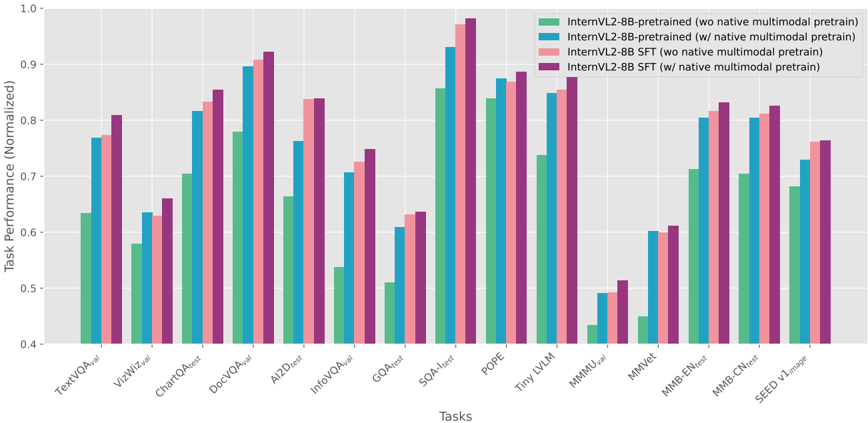
- Native multimodal pre-training is effective: replacing InternVL2-8B’s MLP warmup with native multimodal pre-training yields performance on most benchmarks comparable to the fully multi-stage-trained InternVL2-8B baseline, with further gains after instruction tuning on higher-quality data.
- MPO improves multimodal reasoning across seven benchmarks: InternVL3-78B and InternVL3-38B outperform their non-MPO counterparts by 4.1 and 4.5 points overall, respectively, even though MPO training data is a subset of SFT data.
- Test-time scaling with Best-of-8 and VisualPRM improves reasoning: on the Vision-Only split of MathVerse, best-of-8 gives increases of approximately 6.0 and 3.2 percentage points for InternVL3-38B and InternVL3-78B, respectively.
Methods
- Architecture follows “ViT-MLP-LLM”: vision encoder options are InternViT-300M and InternViT-6B; language models are pre-trained Qwen2.5 series and InternLM3-8B base models; the MLP is a two-layer randomly initialized network; pixel unshuffle reduces each 448×448 image tile to 256 visual tokens.
- Native multimodal pre-training jointly optimizes all parameters on multimodal and pure-language corpora, computes loss only on text tokens, and uses square averaging for token weights. Data combines InternVL2.5 pre-training corpus with GUI, tool usage, 3D scene, and video data, plus InternLM2.5 and open-source text data; the chosen language:multimodal ratio is 1:3, totaling about 200B tokens (50B language, 150B multimodal).
- Post-training uses SFT followed by MPO. SFT grows from 16.3M samples in InternVL2.5 to 21.7M in InternVL3; MPO uses about 300K preference samples and combines DPO preference loss, BCO quality loss, and LM generation loss. Test-time scaling uses Best-of-N with VisualPRM-8B as critic; infrastructure extends InternEVO, yielding a 50% to 200% training speedup for comparable-size models under the same compute budget.
Limitations
- The paper states a noticeable performance gap remains between InternVL3 and models like Qwen2.5-VL on certain benchmarks, such as MuirBench, implying future work may need better training data curation and model refinements.
- The paper reports minor declines on some benchmarks, such as MMHal, and states that optimizing data and training strategies for more consistent improvements remains an important future direction.
- The paper states visual grounding gains plateau at larger scales: InternVL2.5-78B reaches an average score of 92.3 while InternVL3-78B shows 91.4; it speculates this is because InternVL3’s training data expansion did not include additional grounding-specific data and the relative reduction in grounding-targeted data may have restricted localization capabilities.
Model-written summary. Check it against the paper before relying on it.
Integrity signals
Registry
Cites
Statistics
Figures
Verification
Claims the paper makes
0 Valid · 1 Not valid · 14 Not checked · 83 Own results and interpretations
A result the paper reports from its own data — it cites no other source for it, so there is none to check. The quote shows it is in the paper.
In the paper
“When compared with other competitive models, such as Qwen2-VL-72B and Qwen2.5-VL-72B, the InternVL3 series-especially the 78B variant-offers a consistent performance advantage on the multimodal understanding benchmarks.”
§ InternVL3: Exploring Advanced Training and Test-Time Recipes for Open-Source Multimodal Models > 3.6 Comprehensive Multimodal Evaluation
plainstates an association- Asserted: passes — The authors put it forward as true.
- Checkable: passes — It can be checked against evidence.
- Load-bearing: passes — The paper’s conclusions depend on it.
- Based: unclear — It is unclear why the paper says it holds.
A result the paper states — it cites no source for it, so there is none to check. The quote shows it is in the paper.
In the paper
“As a result, the number of training samples grows from 16.3M in InternVL2.5 to 21.7M in InternVL3.”
§ InternVL3: Exploring Advanced Training and Test-Time Recipes for Open-Source Multimodal Models > Data.
plainstates a cause- Asserted: passes — The authors put it forward as true.
- Checkable: passes — It can be checked against evidence.
- Load-bearing: unclear — It is unclear whether the paper’s conclusions depend on it.
- Based: passes — The paper gives a reason why it holds.
A result the paper states — it cites no source for it, so there is none to check. The quote shows it is in the paper.
In the paper
“while also maintaining strong pure-language proficiency.”
§ InternVL3: Exploring Advanced Training and Test-Time Recipes for Open-Source Multimodal Models > Abstract
boosted- Asserted: passes — The authors put it forward as true.
- Checkable: passes — It can be checked against evidence.
- Load-bearing: unclear — It is unclear whether the paper’s conclusions depend on it.
- Based: passes — The paper gives a reason why it holds.
A result the paper reports from its own data — it cites no other source for it, so there is none to check. The quote shows it is in the paper.
In the paper
“Compared with previous models, InternVL3 demonstrates substantial improvements across a wide range of task categories.”
§ InternVL3: Exploring Advanced Training and Test-Time Recipes for Open-Source Multimodal Models > 3.1 Overall Comparison to Other Advanced MLLMs
boosted- Asserted: passes — The authors put it forward as true.
- Checkable: passes — It can be checked against evidence.
- Load-bearing: passes — The paper’s conclusions depend on it.
- Based: passes — The paper gives a reason why it holds.
A result the paper reports from its own data — it cites no other source for it, so there is none to check. The quote shows it is in the paper.
In the paper
“Its capabilities remain highly competitive with leading proprietary models, including ChatGPT-4o, Claude 3.5 Sonnet, and Gemini 2.5 Pro, while also maintaining strong pure-language proficiency.”
§ InternVL3: Exploring Advanced Training and Test-Time Recipes for Open-Source Multimodal Models > Abstract
plain- Asserted: passes — The authors put it forward as true.
- Checkable: passes — It can be checked against evidence.
- Load-bearing: passes — The paper’s conclusions depend on it.
- Based: passes — The paper gives a reason why it holds.
45 more claims
Create a free account to see all 98 claims and every source verdict.
- It may state two separate claims as one. 42
- Probably not a substantial claim. 6
- The quote only partly states this claim. 1
Self-check
Percentages, sums and reported differences re-computed from the paper’s own numbers.
Each contradiction between two passages listed here was confirmed by an independent check.
Rated minor: it would not touch a result — a value no result rests on, a p-value that stays on the same side of the significance level, or a conflict that is clerical, resolved elsewhere in the paper, or outside its own findings.
In the paper
§ InternVL3: Exploring Advanced Training and Test-Time Recipes for Open-Source Multimodal Models > 3.8 Visual Grounding
“InternVL3-8B, InternVL3-9B, and InternVL3-14B yield average scores around 88.2-89.6,reflecting a consistent trend of performance gains as the model size increases.”
§ InternVL3: Exploring Advanced Training and Test-Time Recipes for Open-Source Multimodal Models > 3.6 Comprehensive Multimodal Evaluation
“InternVL3-8B 92.5 94.6 88.0 88.2 92.5 81.8 89.6 90.0 89.6 InternVL3-9B 91.8 93.2 86.6 86.4 91.0 79.9 88.0 88.5 88.2”
Rated minor: it would not touch a result — a value no result rests on, a p-value that stays on the same side of the significance level, or a conflict that is clerical, resolved elsewhere in the paper, or outside its own findings.
In the paper
§ InternVL3: Exploring Advanced Training and Test-Time Recipes for Open-Source Multimodal Models > GPT-4o Gemini 2.0 Claude Aguvis-72B Qwen2.5-VL-72B UI-TARS-72B InternVL3-8B -38B -72B
“The 8B variant (81.4%) already surpasses UI-TARS-72B”
§ InternVL3: Exploring Advanced Training and Test-Time Recipes for Open-Source Multimodal Models > GPT-4o Gemini 2.0 Claude Aguvis-72B Qwen2.5-VL-72B UI-TARS-72B InternVL3-8B -38B -72B
“InternVL3-72B achieves 90.9%, outperforming UI-TARS-72B (90.3%).”
Citations
Cites
Fei-Fei, L., Fergus, R., & Perona, P. (2005) · 2004 Conference on Computer Vision and Pattern Recognition Workshop · doi:10.1109/cvpr.2004.383 · Cited by 2,502
Liu, H., Li, C., Wu, Q., & Lee, Y. J. (2023) · Advances in Neural Information Processing Systems 36 · doi:10.52202/075280-1516 · Cited by 2,428
Making the V in VQA Matter: Elevating the Role of Image Understanding in Visual Question Answering
Goyal, Y., Khot, T., Summers-Stay, D., Batra, D., & Parikh, D. (2017) · 2017 IEEE Conference on Computer Vision and Pattern Recognition (CVPR) · doi:10.1109/cvpr.2017.670 · Cited by 2,287
Chen, Z., Wang, W., Cao, Y., Liu, Y., Gao, Z., Cui, E., Zhu, J., Ye, S., Tian, H., Liu, Z., et al. (2024) · arXiv · doi:10.48550/arxiv.2412.05271 · Cited by 2,204
Self-citationGrounding DINO: Marrying DINO with Grounded Pre-training for Open-Set Object Detection
Liu, S., Zeng, Z., Ren, T., Li, F., Zhang, H., Yang, J., Jiang, Q., Li, C., Yang, J., Su, H., et al. (2025) · Lecture Notes in Computer Science · doi:10.1007/978-3-031-72970-6_3 · Cited by 2,074
Self-citationNatural Questions: A benchmark for question answering research
Kwiatkowski, T., Palomaki, J., Redfield, O., Collins, M., Parikh, A., Alberti, C., Epstein, D., Polosukhin, I., Devlin, J., Lee, K., et al. (2019) · Transactions of the Association for Computational Linguistics · doi:10.1162/tacl_a_00276 · Cited by 2,069
MiniCPM-V: A GPT-4V Level MLLM on Your PhonePreprint
Yao, Y., Yu, T., Zhang, A., Wang, C., Cui, J., Zhu, H., Cai, T., Li, H., Zhao, W., He, Z., et al. (2024) · arXiv · doi:10.48550/arxiv.2408.01800 · Cited by 1,695
Self-citationTriviaQA: A Large Scale Distantly Supervised Challenge Dataset for Reading Comprehension
Joshi, M., Choi, E., Weld, D., & Zettlemoyer, L. (2017) · Proceedings of the 55th Annual Meeting of the Association for Computational Linguistics (Volume 1: Long Papers) · doi:10.18653/v1/p17-1147 · Cited by 1,690
Math-Shepherd: Verify and Reinforce LLMs Step-by-step without Human Annotations
Wang, P., Li, L., Shao, Z., Xu, R., Dai, D., Li, Y., Chen, D., Wu, Y., & Sui, Z. (2024) · Proceedings of the conference - Association for Computational Linguistics. Meeting · doi:10.18653/v1/2024.acl-long.510 · Cited by 1,665
TriviaQA: A Large Scale Distantly Supervised Challenge Dataset for Reading Comprehension
Joshi, M., Choi, E., Weld, D. S., & Zettlemoyer, L. (2017) · arXiv · doi:10.48550/arxiv.1705.03551 · Cited by 1,650
Research works printed but not linked: 6
- Anonymous. CG-bench: Clue-grounded question answering benchmark for long video understanding. In Submitted to The Thirteenth International Conference on Learning Representations, 2024. under review. 14, 15
- Shuai Bai, Keqin Chen, Xuejing Liu, Jialin Wang, Wenbin Ge, Sibo Song, Kai Dang, Peng Wang, Shijie Wang, Jun Tang, et al. Qwen2.5-vl technical report. arXiv preprint arXiv:2502.13923, 2025. 1, 2, 9, 10, 15 · arXiv
- Jie Cao and Jing Xiao. An augmented benchmark dataset for geometric question answering through dual parallel text encoding. In Proceedings of the 29th International Conference on Computational Linguistics, pages 1511-1520, 2022. 6
- Zhe Chen, Weiyun Wang, Hao Tian, Shenglong Ye, Zhangwei Gao, Erfei Cui, Wenwen Tong, Kongzhi Hu, Jiapeng Luo, Zheng Ma, et al. How far are we to gpt-4v? closing the gap to commercial multimodal models with open-source suites. arXiv preprint arXiv:2404.16821, 2024. 2, 3 · arXiv
- Hunter Lightman, Vineet Kosaraju, Yuri Burda, Harrison Edwards, Bowen Baker, Teddy Lee, Jan Leike, John Schulman, Ilya Sutskever, and Karl Cobbe. Let's verify step by step. In The Twelfth International Conference on Learning Representations, 2023. 7
- Minesh Mathew, Viraj Bagal, Rubèn Tito, Dimosthenis Karatzas, Ernest Valveny, and CV Jawahar. Infographicvqa. In Proceedings of the IEEE/CVF Winter Conference on Applications of Computer Vision, pages 1697-1706, 2022. 6, 7, 8, 10
Cited by
Items 1,101–1,200 of 2,641
Magic-MM-Embedding: Towards Visual-Token-Efficient Universal Multimodal Embedding with MLLMs
Li, Q., Zhao, Y., Zhou, Y., Wang, Y., Yang, Y., Zhou, Y., & Liu, J. (2026) · Lecture notes in computer science · doi:10.1007/978-3-032-37152-2_32 · Cited by 4
Self-citationAutomated Structured Radiology Report Generation with Rich Clinical ContextPreprint
Kang, S., Lee, D. B., Jung, J., Kim, D., Kim, W. H., & Joo, S. (2025) · arXiv · doi:10.48550/arxiv.2510.00428 · Cited by 4
“…LLMs (Bai et al., 2023; Achiam et al., 2023; Touvron et al., 2023a;b; Yang et al., 2025), MLLMs have shown strong performance across many domains, including medical applications (Achiam et al., 2023; Team et al., 2023; Yang et al., 2025; Comanici et al., 2025; Wang et al., 2025; Zhu et al., 2025).”
BigEarthNet.txt: A Large-Scale Multi-Sensor Image-Text Dataset and Benchmark for Earth ObservationPreprint
Herzog, J.-L., Adler, M. J., Hackel, L., Shu, Y., Zavras, A., Papoutsis, I., Rota, P., & Demir, B. (2026) · arXiv · doi:10.48550/arxiv.2603.29630 · Cited by 4
“Fine-tuning a state-of-the-art (SOTA) VLM (InternVL3-1B [45]) adapted for multi-sensor input (denoted as InternVL ∗ ) on BigEarthNet.txt leads to substantial performance gains across all considered tasks.”
InfluentialXGC-AVis: Towards Audio-Visual Content Understanding with a Multi-Agent Collaborative SystemPreprint
Cao, Y., Min, X., Gao, Y., Sun, W., Zhang, Z., Han, J., & Zhai, G. (2025) · arXiv · doi:10.48550/arxiv.2509.23251 · Cited by 4
“In recent years, MLLMs Li et al. (2024a); Chen et al. (2024); Zhu et al. (2025a); Cheng et al. (2024) have made significant advances, demonstrating remarkable performance in tasks such as dialogue systems, video understanding, and video question answering.”
Self-citationWhen MLLMs Meet Compression Distortion: A Coding Paradigm Tailored to MLLMs
Liu, J., Jia, Z., Li, J., Li, B., Jin, X., Zeng, W., & Lu, Y. (2026) · International Conference on Learning Representations · doi:10.48550/arxiv.2509.24258 · Cited by 4
AppCopilot: Toward General, Accurate, Long-Horizon, and Efficient Mobile AgentPreprint
Fan, J., Dang, Y., Wu, J., Li, H., Yang, R., Yang, X., Wang, Y., & Chen, Q. (2025) · arXiv · doi:10.48550/arxiv.2509.02444 · Cited by 4
Self-citationNeural Catalog: Scaling Species Recognition with Catalog of Life-Augmented GenerationPreprint
Khan, F. F., Chen, J., Mohamed, Y., Feng, C.-M., & Elhoseiny, M. (2025) · arXiv · doi:10.48550/arxiv.2505.05635 · Cited by 4
More Images, More Problems? A Controlled Analysis of VLM Failure Modes.
Das, A., Bulat, A., Baldrati, A., Metaxas, I. M., Schiele, B., Tzimiropoulos, G., & Martínez, B. (2026) · Findings of the Association for Computational Linguistics: ACL (Findings of ACL) · doi:10.18653/v1/2026.findings-acl.366 · Cited by 4
Towards Effective MLLM Jailbreaking Through Balanced On-Topicness and OOD-IntensityPreprint
Li, Z., Zhang, W., Wang, J., Zhang, S., Bai, W., Kainz, B., & Qiao, M. (2025) · arXiv · doi:10.48550/arxiv.2508.09218 · Cited by 4
Self-citationInnoText: A Unified Model for Visual Text Generation and Editing
Liu, H., He, R., Lu, J., Ma, A., Ling, R., Cao, K., Feng, J., Feng, W., Lu, S., Xu, Y., et al. (2026) · Lecture notes in computer science · doi:10.1007/978-3-032-37152-2_7 · Cited by 4
Self-citationChoi, M., Choi, S.-A., Kwon, M., Joung, W., Kim, J., & Lee, J. (2026) · International Conference on Machine Learning · doi:10.48550/arxiv.2606.15821 · Cited by 4
MOON3.0: Reasoning-aware Multimodal Representation Learning for E-commerce Product Understanding
Wu, J., Fu, C., Nie, Z., Zhang, D., Wan, B., Guan, W., Yu, C., Xu, J., & Zheng, B. (2026) · ACM International Conference on Multimedia (ACM MM) · doi:10.1145/3767308.3835126 · Cited by 4
“0 , which leverages the reasoning capabilities of MLLMs to explicitly model fine-grained product attributes before generating the representation.”
InfluentialXu, D., Yang, Z., Chen, J., Yuan, Y., Hu, M., Sun, L., Gool, L. V., Paudel, D. P., & Feng, C.-M. (2026) · Lecture notes in computer science · doi:10.1007/978-3-032-37321-2_16 · Cited by 4
What Shapes a Creative Machine Mind? Comprehensively Benchmarking Creativity in Foundation ModelsPreprint
He, Z., Zhang, B., Liu, W., Tang, R., & Cheng, L. (2025) · arXiv · doi:10.48550/arxiv.2510.04009 · Cited by 4
Spotlight: Identifying and Localizing Video Generation Errors Using VLMs
Chinchure, A., Ravi, S., Shukla, P., Shwartz, V., & Sigal, L. (2026) · Lecture notes in computer science · doi:10.1007/978-3-032-37321-2_1 · Cited by 4
Wu, J., Ma, H., Tang, S., Xu, Y., Kang, X., & Gao, J. (2026) · International Conference on Machine Learning · doi:10.48550/arxiv.2610.34418 · Cited by 4
Breaking Bad Molecules: Are MLLMs Ready for Structure-Level Molecular Detoxification?
Lin, F., Gong, Z., Wang, C., Zhang, T., Tian, Y., Jiang, Y., Dai, J., Guo, C., Yu, X., Yang, X., et al. (2026) · ACM SIGKDD Conference on Knowledge Discovery and Data Mining (KDD) · doi:10.1145/3770855.3818840 · Cited by 4
“The benchmark covers many real-world toxicity mechanisms, provides a standardized dataset, and introduces a complementary multi-criteria evaluation framework, ToxiEval .”
Self-citationSpaceMind++: Toward Allocentric Cognitive Maps for Spatially Grounded Video MLLMsPreprint
Gu, B., Zhang, Z., Wei, Z., Chen, Z., Li, L., & Song, Z. (2026) · arXiv · doi:10.48550/arxiv.2605.09449 · Cited by 4
“Despite recent advances that have endowed Multimodal Large Language Models (MLLMs) with strong visual understanding and reasoning capabilities[3, 29, 32, 75], a fundamental gap persists between language-level reasoning and 3D spatial organization[57, 70].”
Self-citationProactive Reasoning-with-Retrieval Framework for Medical Multimodal Large Language ModelsPreprint
Wang, L.-H., Qin, Y., Yang, H., & Li, X.-M. (2025) · arXiv.org · doi:10.48550/arxiv.2510.18303 · Cited by 2
Self-citationPulseMind: A Multi-Modal Medical Model for Real-World Clinical DiagnosisPreprint
Xu, J., Liu, J., Lao, J., Zhu, Q., Zhao, Y., Jin, C., Liu, S., Lu, Z., Zhang, L., Chen, X., et al. (2026) · arXiv · doi:10.48550/arxiv.2601.07344 · Cited by 4
“5VL-72B and InternVL3, PulseMind attains win rates of 86% and 83%, respectively.”
InfluentialSelf-citationMedHorizon: Towards Long-context Medical Video Understanding in the WildPreprint
Du, B., Liu, B., Yu, Y., Ding, X., Wu, Z., Wang, S., Nie, S., Liu, N., Chen, Q., Song, Y., et al. (2026) · arXiv · doi:10.48550/arxiv.2605.06537 · Cited by 4
Ye, Z., Niu, X., Wu, X., Han, X., Liu, S., Hao, J., Peng, Z., Sun, H., Lv, J., Wang, F., et al. (2026) · arXiv · doi:10.48550/arxiv.2601.02737 · Cited by 4
Self-citationGraph-to-Frame RAG: Visual-Space Knowledge Fusion for Training-Free and Auditable Video ReasoningPreprint
Yang, S., Yu, W., Liu, Z., Tang, G., Yang, W., Tan, H., & Xiao, N. (2026) · arXiv · doi:10.48550/arxiv.2604.04372 · Cited by 4
“For broader context, we report results on strong open-source families such as QwenVL [4], InternVL [9, 65], MiniCPM-V [55, 57], VideoLLaMA 3 [58], and VILA-1.”
Self-citationTAMA: Tool-Augmented Multimodal Agent for Procedural Activity UnderstandingPreprint
Hasegawa, K., Imrattanatrai, W., Asada, M., Fukuda, K., & Mitamura, T. (2025) · arXiv · doi:10.48550/arxiv.2510.00161 · Cited by 4
“5-VL 32B, InternVL3 38B, and MiMo-VL 7B.”
InfluentialCaved or Convinced: Temporal Sampling Gates Claim Deference in Video Large Language ModelsPreprint
Cao, Y., Song, W., Xue, J., & Dong, J. S. (2026) · arXiv · doi:10.48550/arxiv.2608.03160 · Cited by 4
Self-citationVisChainBench: A Benchmark for Multi-Turn, Multi-Image Visual Reasoning Beyond Language PriorsPreprint
Lyu, W., Du, Y., Zhao, J., Zhen, X., & Shao, L. (2025) · arXiv · doi:10.48550/arxiv.2512.06759 · Cited by 4
“We observe a steep performance increase in Fig.6 for vision-language models as model size increases—much steeper than scaling trends reported on classical benchmarks(Bai et al. 2025; Zhu et al. 2025) like BLINK(Fu et al. 2024) and MTVQA(Tang et al. 2024).”
Diagram-MMU: A Multi-modal Benchmark for Scientific Diagrams
Bo, W., Zhang, S., Sun, Y., Liu, J., Yao, Y., Du, J., He, W., Zou, K., Li, Z., & Wang, J. (2026) · Lecture notes in computer science · doi:10.1007/978-3-032-37356-4_29 · Cited by 4
Self-citationEgoProceVQA: A Novel Egocentric Procedural Understanding Task with Self-Skill-Exploration Agent
Li, J., Li, J., Yang, Y., Zou, W., Chau, L., & Wang, Y. (2026) · ACM International Conference on Multimedia (ACM MM) · doi:10.1145/3767308.3835752 · Cited by 4
Self-citationSwift Sampling: Selecting Temporal Surprises via Taylor SeriesPreprint
Kim, D., Sachdeva, B., Uppal, K., Gupta, N., Balasubramanian, V. N., & Ghadiyaram, D. (2026) · arXiv · doi:10.48550/arxiv.2605.22678 · Cited by 4
Wang, H., Xie, W., Jiang, H., Wei, Y., Jiang, K., Cao, M., Hao, C., & Fang, L. (2026) · Proceedings of the AAAI Conference on Artificial Intelligence · doi:10.1609/aaai.v40i18.38614 · Cited by 4
Self-citationDRIFT: Transferring Reasoning Priors for Efficient MLLM Fine-Tuning
Huang, C., Zhang, Z., Liu, J., Sun, X., Wu, J., Yu, X., Wang, Z., Xu, C., Barsoum, E., & Liu, Z. (2026) · Findings of the Association for Computational Linguistics: ACL (Findings of ACL) · doi:10.18653/v1/2026.findings-acl.1015 · Cited by 4
Self-citationAlignment in large vision language models: A survey
Fang, Y., Pang, X., Yu, Q., Min, F., Cao, X., Tao, P., & Li, T. (2026) · Information Fusion · doi:10.1016/j.inffus.2026.104294 · Cited by 4
GraphVerse: A Comprehensive Visual Graph Reasoning Benchmark for Multimodal Large Language Models
Sun, Y., Ren, Y., Li, K., Ji, C., Li, J., Liu, J., Liu, N., & Tan, Q. (2026) · Conference on Empirical Methods in Natural Language Processing (EMNLP) · doi:10.18653/2026.emnlp-main.1989 · Cited by 4
OpenVTON-Bench: A Large-Scale High-Resolution Benchmark for Controllable Virtual Try-On EvaluationPreprint
Li, J., Chen, T., Wen, K., Yin, S., Jiang, S., Wang, W., Luo, J., & Wu, C. (2026) · arXiv · doi:10.48550/arxiv.2601.22725 · Cited by 4
“With the rise of VLMs [63, 9, 32, 2, 38], the VLM-as-a-Judge paradigm [4, 35] enables human-like semantic assessment, yet remains susceptible to prompt bias and hallucination.”
Self-citationYang, H., Li, J., Li, G., Chang, Y., & Wu, Y. (2025) · arXiv · doi:10.48550/arxiv.2508.04017 · Cited by 4
$Δ$ynamics: Language-Based Representation for Inferring Rigid-Body Dynamics From VideosPreprint
Kao, C.-H., Huynh, C. P., Wang, C.-Y., Vesdapunt, N., Stojanov, S., Hariharan, B., Obiednikov, O., & Zhou, N. (2026) · arXiv · doi:10.48550/arxiv.2605.20576 · Cited by 4
“For evaluation, we establish baselines using both proprietary and open-source vision–language models (VLMs), including InternVL3-8B [63], Qwen2.”
Dang, Y., Dai, M., Yang, Y., Li, Z., Li, W., Miao, F., & Gao, Y. (2026) · International Conference on Machine Learning · doi:10.48550/arxiv.2604.13565 · Cited by 4
Peng, X., Huang, X., & Choi, S. H. (2026) · arXiv · doi:10.48550/arxiv.2602.17419 · Cited by 4
“5-VL-7B [2], InternVL3-8B[44], MiniCPM-8B[14].”
G$^2$TR: Generation-Guided Visual Token Reduction for Separate-Encoder Unified Multimodal ModelsPreprint
Li, J., Liu, K., Ding, Z., Wang, Z., Chen, Z., Pei, R., & Zhang, Y. (2026) · arXiv · doi:10.48550/arxiv.2605.12309 · Cited by 4
“UMMs integrate understanding capabilities of MLLMs [17, 32, 29, 45, 42, 43, 13, 12] and generation capabilities of diffusion or flow models [6, 23, 2, 11].”
Self-citationWei, T., Ni, Q., Gao, R., Wang, Y., & He, L. (2026) · Proceedings of the AAAI Conference on Artificial Intelligence · doi:10.1609/aaai.v40i40.40674 · Cited by 4
“Weselect a range of state-of-the-art large language and multimodal models for evaluation, including representatives from the deepseek (DeepSeek-AI et al. 2025), gpt (OpenAI et al. 2023), gemini (Comanici et al. 2025), llava (Li et al. 2025), mistral (Mistral-AI et al. 2025), and InternVL (Zhu et al. 2025) families.”
Self-citationChu, Pawar, K., He, Z., Sharifi, R., Sonnenblick, R. M., Curry, M., D’Adamo, L., Young, L. E., Murray, S., & Lerman, K. (2026) · Conference of the European Chapter of the Association for Computational Linguistics · doi:10.18653/v1/2026.eacl-long.33 · Cited by 4
Retrieval Heads Meet Vision: Uncovering How VLMs Locate and Extract Visual InformationPreprint
Park, C., Choi, D., Lee, J., & Sung, M. (2026) · arXiv · doi:10.48550/arxiv.2608.27417 · Cited by 4
“5-VL-7B [ 6] with InternVL3-8B [8], which share a Qwen2.”
Xing, H., Gao, F., Zheng, Q., Zhu, Z., Shao, Z., & Yan, M. (2025) · Findings of the Association for Computational Linguistics: EMNLP (Findings of EMNLP) · doi:10.18653/v1/2025.findings-emnlp.1088 · Cited by 4
LoViF 2026 The First Challenge on Holistic Quality Assessment for 4D World Model (PhyScore)Preprint
Luo, W., Lu, Y., Li, X., Li, H., Guan, F., Gao, C., Jin, X., Li, Y., Chen, Z., Wu, S., et al. (2026) · arXiv · doi:10.48550/arxiv.2605.05187 · Cited by 4
“5-VL-7B [4], InternVL3-38B [45], and UI-TARS-7B-SFT [28] as base LMMs to jointly predict video quality, physical realism, condition–video alignment, consistency, and timestamps.”
Self-citationSee or Say Graphs: Agent-Driven Scalable Graph Understanding with Vision-Language Models
Han, S., Cao, Y., Ding, Z., Gao, Z., Zhou, S. K., & Xie, X. (2026) · Findings of the Association for Computational Linguistics: ACL (Findings of ACL) · doi:10.18653/v1/2026.findings-acl.2066 · Cited by 4
Self-citationMoE-GRPO: Optimizing Mixture-of-Experts via Reinforcement Learning in Vision-Language ModelsPreprint
Ko, D., Park, J., Choi, S., Lee, S., Lee, S., & Kim, H. J. (2026) · Computer Vision and Pattern Recognition · doi:10.48550/arxiv.2603.24984 · Cited by 5
Liang, D., Wei, X.-Y., Xiao, L., & Zheng, C. (2025) · arXiv · doi:10.48550/arxiv.2511.11182 · Cited by 4
“The open-source models consist of DeepSeek-VL-7B (Lu et al. 2024), LLaVA-OneVision-7B (Li et al. 2024), LLaVA-NEXT-Llama3-8B (Haotian et al. 2024), InternVL2-8B(Chen et al. 2024b), InternVL3-14B(Zhu et al. 2025) and Qwen2.”
InfluentialSelf-citationFine-grained Defocus Blur Control for Generative Image Models
Shrivastava, A., Barnes, C., Zhang, X., Zhang, L., Owens, A., Amirghodsi, S., & Shechtman, E. (2026) · IEEE Winter Conference on Applications of Computer Vision · doi:10.1109/wacv61042.2026.00422 · Cited by 4
Self-citationZhang, X., Bai, L., Zhang, T., Zhang, Y., Ye, Q., Zhao, Y., Du, R., & Hu, H. (2026) · arXiv · doi:10.48550/arxiv.2602.09431 · Cited by 4
“InternVL3 [53] is built upon InternViT, a hierarchical vision backbone optimized for multimodal fusion.”
Self-citationCut to the Chase: Training-free Multimodal Summarization via Chain-of-EventsPreprint
You, X., Huang, Q., Li, L., Chang, X., & Yu, J. (2026) · arXiv · doi:10.48550/arxiv.2603.06213 · Cited by 4
“CoF [15] uses the official InternVL3-8B [60] checkpoint, while CoS [20] follows its original design with LLaVA-Video [58] for binary encoding and LongVA [56] for summary generation.”
NVIDIA Nemotron Parse 1.1Preprint
Chumachenko, K., Deshmukh, A. S., Seppanen, J., Karmanov, I., Chen, C.-C., Voegtle, L., Fischer, P., Wawrzos, M., Motiian, S., Ageev, R., et al. (2025) · arXiv · doi:10.48550/arxiv.2511.20478 · Cited by 4
Reasoning Dynamics and the Limits of Monitoring Modality Reliance in Vision-Language ModelsPreprint
Villegas, D. S., Lewis-Lim, S., Αλέτρας, Ν., & Elliott, D. (2026) · arXiv · doi:10.48550/arxiv.2604.14888 · Cited by 4
“5-VL-Instruct ( 3B , 7B , 32B ) (Bai et al., 2025), Qwen3-VL-Instruct ( 4B , 8B , 32B ) (Yang et al., 2025), InternVL3 ( 2B , 8B , 38B ) (Zhu et al., 2025), and InternVL3.”
From Detection to Understanding: Multi-Turn Reasoning for Video Misinformation Analysis
Zeng, Z., Wu, J., Luo, M., Zhang, D., Yang, Y., Kong, X., Wan, H., & Ma, Z. (2026) · Proceedings of the conference - Association for Computational Linguistics. Meeting · doi:10.18653/v1/2026.acl-long.1716 · Cited by 4
Rethinking Composed Image Retrieval Evaluation: A Fine-Grained Benchmark from Image Editing
Song, T., Zhang, Y., Li, M., Guo, Z., Long, D., Xie, P., Zhang, S., Zhao, Y., & Wu, S. (2026) · Proceedings of the conference - Association for Computational Linguistics. Meeting · doi:10.18653/v1/2026.acl-long.2144 · Cited by 4
Boosting Document Parsing Efficiency and Performance with Coarse-to-Fine Visual ProcessingPreprint
Cui, C., Sun, T., Liang, S., Gao, T., Zhang, Z., Liu, J., Wang, X., Zhou, C., Liu, H., Lin, M., et al. (2026) · arXiv · doi:10.48550/arxiv.2603.24326 · Cited by 4
Self-citationOmni-Judge: Can Omni-LLMs Serve as Human-Aligned Judges for Text-Conditioned Audio-Video Generation?Preprint
Liang, S., Huang, C., Bellos, F., Tang, Y., Shen, Q., Bi, J., Song, L., Zhang, Z., Corso, J. J., & Xu, C. (2026) · arXiv · doi:10.48550/arxiv.2602.01623 · Cited by 4
“The rise of multi-modal large language models (MLLMs) [1–5, 8, 11, 12, 23, 24, 26, 38, 50, 57, 73] has enabled LLM-based evaluation for visual and video generation.”
Plug-and-Play Clarifier: A Zero-Shot Multimodal Framework for Egocentric Intent DisambiguationPreprint
Yang, S., Huang, Y., Cai, W., Sun, S., He, Y., Deng, J., Zhang, H., Song, J., & Zhang, Z. (2025) · AAAI Publications (The Association for the Advancement of Artificial Intelligence (AAAI)) · doi:10.48550/arxiv.2511.08971 · Cited by 4
“…work addresses this by improving the monolithic models themselves, for instance, through specialized pre-training for high-resolution visuals (DeepSeek-AI et al. 2024), incorporating fine-grained object grounding (Bai et al. 2025), or using native multimodal pre-training methods (Zhu et al. 2025).”
Self-citationText2Traffic: a text-to-image generation and editing method for traffic scenes
Lv, F., Feng, H., Zhang, Z., Xia, C., & Li, Y. (2026) · International Conference on AI-Generated Content (AIGC) · doi:10.1117/12.3109071 · Cited by 4
Seeing Isn't Knowing: Do VLMs Know When Not to Answer Spatial Questions (and Why)?Preprint
zhang, Y., Wang, Z., Lin, H., Bitton, Y., Szpektor, I., & Bansal, M. (2026) · arXiv · doi:10.48550/arxiv.2605.30557 · Cited by 4
OmniView-Space: Reinforcing Spatial Reasoning via Multi-Perspective Spatial MappingPreprint
Li, X., Zhang, M., Chen, P., Tan, J., Huang, Z. Z., Zheng, J., Zhang, Y., Zheng, X., Sun, X., & Ji, R. (2026) · arXiv · doi:10.48550/arxiv.2607.00881 · Cited by 4
Representations of Text and Images Align From Layer OnePreprint
Wybitul, E., Rando, J., Tramèr, F., & Fort, S. (2026) · arXiv · doi:10.48550/arxiv.2601.08017 · Cited by 4
Aligning What Vision-Language Models See and Perceive with Adaptive Information FlowPreprint
Liu, C., Choi, W., Zhang, C., & Oh, T.-H. (2026) · arXiv · doi:10.48550/arxiv.2604.15809 · Cited by 4
“Breakdown of inference time with LLaVA-1.”
ViDA-UGC: Detailed Image Quality Analysis via Visual Distortion Assessment for UGC ImagesPreprint
Liao, W., Yuan, J., Xu, Y., Guo, C., Zhang, Z., Li, J., Fu, J., Fan, H., Li, T., Cui, J., et al. (2025) · arXiv · doi:10.48550/arxiv.2508.12605 · Cited by 4
“For Qwen2-VL-7B and InternVL3-8B, which achieve overall accuracy close to GPT-4o on Q-Bench, training with Q-Instruct degrades their performance, while their ViDA-UGC-tuned versions demonstrate improvements, with Qwen2-VL even surpassing GPT-4o’s performance.”
Format Matters: The Robustness of Multimodal LLMs in Reviewing Evidence from Tables and Charts
Ho, X., Wu, Y.-A., Kumar, S., Boudin, F., Takasu, A., & Aizawa, A. (2026) · Proceedings of the AAAI Conference on Artificial Intelligence · doi:10.1609/aaai.v40i37.40361 · Cited by 4
Yang, S., Huang, Y., Sun, S., Cai, W., Deng, J., Song, J., & Zhang, Z. (2026) · arXiv · doi:10.48550/arxiv.2601.10228 · Cited by 4
“…of many multi-modal large language models (MLLMs) on general visual question answering benchmarks [3], including notable closed-source models like Gemini 2.5 Pro [11], GPT-4o [13], and Grok-3 [20], and prominent open-source counterparts such as DeepSeek-v3 [9], InternVL3 [22], and Qwen2.”
InfluentialERA: Entropy-Guided Visual Token Pruning with Rectified Attention for Efficient MLLMsPreprint
Wang, Y., Qiao, M., Diao, H., Zhuge, Y., Zhang, P., Zhang, X., Zhang, L., & Ҫirkinoğlu, H. O. (2026) · arXiv · doi:10.48550/arxiv.2606.31982 · Cited by 4
“We then adopt In-ternVL3 [42] as an additional strong MLLM to stress-test architectural robustness beyond the LLaVA and Qwen series.”
Self-citationUniPCB: A Unified Vision-Language Benchmark for Open-Ended PCB Quality InspectionPreprint
Sun, F., Jiang, X., Wu, J., Zhang, H., Zheng, F., & Yang, J. (2026) · arXiv · doi:10.48550/arxiv.2601.19222 · Cited by 4
“…capabilities of general-purpose MLLMs, such as Qwen-VL series [Wang et al. , 2024; Bai et al. , 2025; Yang et al. , 2025], InternVL series [ Zhu et al. , 2025; Wang et al. , 2025 ] , and LLaVA series [Li et al. , 2024a; Li et al. , 2024b], have steadily improved, their performance remains…”
Self-citationImproving Region Representation Learning from Urban Imagery with Noisy Long-Caption SupervisionPreprint
Zhang, Y., Shen, G., Ning, K., Ren, T., Qiu, X., Wang, M., & Kong, X. (2025) · arXiv · doi:10.48550/arxiv.2511.07062 · Cited by 4
“5-VL-7B (Wang et al. 2024), DeepSeek-VL2-tiny (Wu et al. 2024b), and InternVL3-8B (Zhu et al. 2025).”
MARBLE: A Hard Benchmark for Multimodal Spatial Reasoning and PlanningPreprint
Jiang, Y., Ouerghemi, N., Chai, Y., Brbić, M., & Moor, M. (2025) · arXiv · doi:10.3929/ethz-c-000794410 · Cited by 4
PhysVidBench: Language-Grounded Evaluation of Physical Commonsense in Text-to-Video Models
Sanli, E., Tezcan, B. S., Erdem, E., & Erdem, A. (2026) · Findings of the Association for Computational Linguistics: EMNLP (Findings of EMNLP) · doi:10.18653/2026.findings-emnlp.2126 · Cited by 4
Enhancing Scientific Visual Question Answering through Multimodal Reasoning and Ensemble Modeling
Movva, P., & Marupaka, N. H. (2025) · Workshop on Scholarly Document Processing (SDP) · doi:10.18653/v1/2025.sdp-1.23 · Cited by 4
Xu, D., Cheng, H., Lin, X., Xie, Z., & Wang, H. (2025) · arXiv · doi:10.48550/arxiv.2511.02415 · Cited by 4
Self-citationCREM: Compression-Driven Representation Enhancement for Multimodal Retrieval and ComprehensionPreprint
Liu, L., Wang, Y., Yang, B., Li, D., Cao, J., Luo, Y., Chen, X., Wu, X., Yuan, W., Yang, F., et al. (2026) · arXiv · doi:10.48550/arxiv.2602.19091 · Cited by 4
“Predominant models such as Qwen-VL [3, 42] and InternVL [9, 59] series further advance multimodal understanding through architectural innovations, improved training, and large-scale datasets, supporting complex tasks.”
Self-citationLee, J., Yoon, Y., & Kim, T. (2026) · Findings of the Association for Computational Linguistics: EMNLP (Findings of EMNLP) · doi:10.18653/2026.findings-emnlp.693 · Cited by 4
InstructTable: Improving Table Structure Recognition Through InstructionsPreprint
Chen, B., Wang, Z., Guo, Z., Liu, J. L., Duan, C., Gu, Y., Zhou, K., & Yan, P. (2026) · arXiv · doi:10.48550/arxiv.2604.02880 · Cited by 4
Seeing Radio: From Zero RF Priors to Explainable Modulation Recognition with Vision Language ModelsPreprint
Zou, H., Wang, B., Tian, Y., Bariah, L., Huang, C., Lasaulce, S., & Debbah, M. A. (2026) · arXiv · doi:10.48550/arxiv.2601.13157 · Cited by 4
“Building on this progress, multimodal LLMs have emerged, bridging vision and language by pairing frozen or jointly trained vision encoders with powerful LLM backbones to ground linguistic reasoning in visual context [2]–[4].”
Judge Before Answer: can MLLM Discern the False Premise in Question?
Li, J., Fang, L., Zhao, H., Duan, S., & Liu, G. H. (2026) · IEEE International Conference on Acoustics Speech and Signal Processing · doi:10.1109/icassp55912.2026.11462162 · Cited by 4
Do You See What I Am Pointing At? Gesture-Based Egocentric Video Question AnsweringPreprint
Choi, Y., Miles, R., Potamias, R. A., Elezi, I., Deng, J., & Zafeiriou, S. P. (2026) · arXiv · doi:10.48550/arxiv.2603.12533 · Cited by 4
DISSECT: Diagnosing Where Vision Ends and Language Priors Begin in Scientific VLMsPreprint
Kukreja, D., Sah, K., Goyal, K., Mohania, M., & Goyal, V. (2026) · arXiv · doi:10.48550/arxiv.2604.06250 · Cited by 4
Gan, R., Ma, J., Li, P., Yang, X., Chen, K., Chen, S., & Ran, B. (2026) · arXiv · doi:10.48550/arxiv.2604.08457 · Cited by 4
Self-citationLuu, S. T., Vo, T., Nguyen, H., Tran, K. Q., Nguyen, K. V., Tran, V., Nguyen, N. L.-T., & Nguyen, L.-M. (2025) · arXiv · doi:10.48550/arxiv.2510.20381 · Cited by 4
SimpleVSF: VLM-Scoring Fusion for Trajectory Prediction of End-to-End Autonomous DrivingPreprint
Zheng, P., Zhao, Y., Gong, Z., Zhu, H., & Wu, S. (2025) · arXiv · doi:10.48550/arxiv.2510.17191 · Cited by 4
A Computational Approach to Visual Metonymy
Ghosh, S., Liu, L., & Jiang, T. (2026) · Conference of the European Chapter of the Association for Computational Linguistics · doi:10.18653/v1/2026.eacl-long.92 · Cited by 4
Self-citationShort-Window Sliding Learning for Real-Time Violence Detection via LLM-based Auto-LabelingPreprint
Jung, S., Song, T., Lee, Y., & Lee, S. (2025) · arXiv · doi:10.48550/arxiv.2511.10866 · Cited by 4
“This study used the InternVL3 [17] architecture.”
Evaluating Multimodal Large Language Models for Heterogeneous Face RecognitionPreprint
Shahreza, H. O., George, A., & Marcel, S. (2026) · arXiv · doi:10.48550/arxiv.2601.15406 · Cited by 4
“The Gemma 3 models are trained with distillation and achieve superior performance to Gemma 2 for both pre-trained and instruction finetuned versions.”
MinerU2.5: A Decoupled Vision-Language Model for Efficient High-Resolution Document Parsing
Niu, J., Liu, Z., Gu, Z., Wang, B., Ouyang, L., Zhao, Z., Chu, T., He, T., Wu, F., Zhang, Q., et al. (2025) · arXiv · doi:10.48550/arxiv.2509.22186 · Cited by 3
Self-citationUniTeD: Unified Temporal Diffusion for Joint Perception and Planning in Autonomous Driving
Zhao, B., Zhao, X., Li, N., Cheng, E., & Ling, H. (2026) · Lecture notes in computer science · doi:10.1007/978-3-032-37132-4_16 · Cited by 3
Vision-language models for human motion understanding: Lessons from stroke rehabilitation
Li, V. R., Kamalakannan, N., Parnandi, A., Schambra, H. M., & Fernandez-Granda, C. (2026) · PLOS Digital Health · doi:10.1371/journal.pdig.0001506
“5-VL [4], InternVL3 [5], and InternVL3.”
Yin, B., Wang, S., Zhou, X., & Wang, H. (2026) · Advanced Engineering Informatics · doi:10.1016/j.aei.2026.104594 · Cited by 3
Self-citationGuan, T., Wang, H., Shen, W., & Yang, X. (2026) · Lecture notes in computer science · doi:10.1007/978-3-032-37211-6_37 · Cited by 3
Self-citationTiny-R1V: Lightweight Multimodal Unified Reasoning Model via Model MergingPreprint
Yin, Q.-X., Yao, H.-J., Chen, J.-H., Huang, J.-X., Zhao, Z.-C., & Su, F. (2025) · arXiv.org · doi:10.48550/arxiv.2510.08987
Canvas-of-Thought: Grounding Reasoning via Mutable Structured StatesPreprint
Sun, L., Zhu, Y., Liu, R., Liang, H., Sun, Z., Jia, C., He, H., Wu, Y., Li, S., Wei, J., et al. (2026) · arXiv · doi:10.48550/arxiv.2602.10494 · Cited by 3
“Current MLLM paradigms typically treat reasoning as a linear, append-only stream [4, 6, 11, 14, 15, 24, 30].”
Self-citationHallucination Detection and Correction in Medical VLMs via Counter-Evidence Verification
Zhou, N., Zou, K., Liu, M. Y., He, L., Zhu, J., Zhang, Y., Chen, H., & Fu, H. (2026) · Lecture notes in computer science · doi:10.1007/978-3-032-38059-3_18 · Cited by 3
Self-citationLess Redundancy: Boosting Practicality of Vision Language Model in Walking Assistants
Li, C., Yuan, Z., Bi, H., Jia, Z., & Zhang, J. (2026) · IEEE International Conference on Acoustics Speech and Signal Processing · doi:10.1109/icassp55912.2026.11464758 · Cited by 3
ActionX: pre-training action experts with reinforcement learning for vision-language action models
Yi, T., Yang, Q., & Chen, E. (2026) · Frontiers in Neurorobotics · doi:10.3389/fnbot.2026.1806605 · Cited by 3
VideoHallu: Evaluating and Mitigating Multi-modal Hallucinations for Synthetic VideosPreprint
Li, Z., Wu, X., Qin, Y., Shi, G., Du, H., Manocha, D., Zhou, T., & Boyd-Graber, J. L. (2025) · Qeios · doi:10.32388/bxc6x1 · Cited by 3
MapVerse: A Benchmark for Geospatial Question Answering on Diverse Real-World Maps
Bhat, S., Khandelwal, H., Kataria, T., & Gupta, V. (2026) · IEEE Winter Conference on Applications of Computer Vision · doi:10.1109/wacv61042.2026.00788 · Cited by 3
“Open-Source Models: Aya-Vision-8B [13], CogVLM2-19B [18], DeepSeek-VL2-Small [48], Idefics3-8B [32], InternVL3-8B [53], Llama-3.”
Ma, Q., Zhao, Z., Wu, Y., Zhang, J., Bai, L., & Shi, Y. (2026) · International Conference on Machine Learning · doi:10.48550/arxiv.2605.19852 · Cited by 3
TaxaAdapter: Vision Taxonomy Models are Key to Fine-grained Image Generation over the Tree of LifePreprint
Khurana, M., Monsefi, A. K., Lee, J., Sawhney, M., Carlyn, D., Chae, J., Gu, J., Ramnath, R., Beery, S., Chao, W.-L., et al. (2026) · arXiv · doi:10.48550/arxiv.2603.26128 · Cited by 3
“For each species, we prompt an InternVL3-8B [54] to describe only visible traits.”
Shen, H., Yan, S., Xue, H., Lu, S., Tang, X., Zhang, G., Zhao, T., & Yin, J. (2026) · arXiv · doi:10.48550/arxiv.2603.12266 · Cited by 3
Metadata
- Authors
- Zhu, J., Wang, W., Chen, Z., Liu, Z., Ye, S., Gu, L., Tian, H., Duan, Y., Su, W., Shao, J., Gao, Z., Cui, E., Wang, X., Cao, Y., Liu, Y., Wei, X., Zhang, H., Wang, H., Xu, W., Li, H., Wang, J., Deng, N., Li, S., He, Y., Jiang, T., Luo, J., Wang, Y., He, C., Shi, B., Zhang, X., Shao, W., He, J., Xiong, Y., Qu, W., Sun, P., Jiao, P., Lv, H., Wu, L., Zhang, K., Deng, H., Ge, J., Chen, K., Wang, L., Dou, M., Lu, L., Zhu, X., Lu, T., Lin, D., Qiao, Y., Dai, J., & Wang, W.
- Affiliations
- Shanghai Artificial Intelligence Laboratory (CN)
- Chinese University of Hong Kong (HK)
- Sensetime (China) (CN)
- Shanghai Jiao Tong University (CN)
- ORCID
- Venue
- arXiv
- Publisher
- arXiv
- Published
- 2025
- ISSN
- 2331-8422 (ISSN-L)
- arXiv
- 2504.10479
- OpenAlex
- W4416053382
- Cited by
- 2,644
- References
- 138
- Citations by year
- 2026: 1999 · 2025: 638
- Type
- posted content
- Language
- en
- Open access
- green
- arxiv.org
- Licence
- Locations
- arXiv (submittedVersion, cc-by)
- Topics
- Physical Sciences › Computer Science › Computer Vision and Pattern Recognition › Multimodal Machine Learning Applications
- Physical Sciences › Computer Science › Artificial Intelligence › Domain Adaptation and Few-Shot Learning
- Physical Sciences › Computer Science › Computer Vision and Pattern Recognition › Advanced Neural Network Applications
- Keywords
- multimodal large language models, multimodal pre-training, supervised fine-tuning, test-time scaling
About these checks
Registry, retraction, Cites and statistics results are computed, not judged, with one exception: a printed reference that no index lists is read once by a model before it counts as a citation error. Claims are extracted by a model and kept only when their quote appears verbatim in the text; each cited source is then checked, with a model’s help, for whether it says what the claim relies on. Those verdicts can be wrong — read the claim’s quote and the cited source before relying on one.
A language model drew the claims from the paper on 2026-11-28, under version 3 of the claim definition (model deepseek-v4.1-flash, prompt extract-v3).
A second model labelled each claim on 2026-11-28 (model jev-1.13-20260917, definition revision gold-guideline-v0.2).
Statistics and arithmetic are recomputed, not judged.
Confidence bands are shown only for fields calibrated on our annotated test set. None is calibrated yet, so no band is shown.
What counts as a claim ›How we measure confidence ›How we check this ›
Are you an author, or do you see a problem with this page? Request a review
Data sources
Bibliographic data: Semantic Scholar, OpenAlex, Crossref.
Contains information from the Semantic Scholar Academic Graph Datasets, made available under the ODC Attribution License (ODC-BY 1.0).
Semantic Scholar’s data is described in: Kinney, R., et al. (2023). The Semantic Scholar Open Data Platform. arXiv:2301.10140.
