

Working with AI: Measuring the Applicability of Generative AI to Occupations
Open accessThe DOI matches its DataCite record; 45 of the 45 references it cites were found in a registry or an index; none of the 57 sources its claims cite is checked for support yet.
Abstract
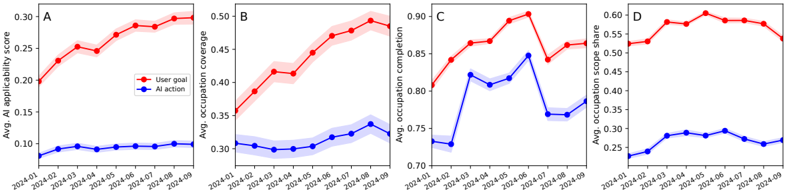
With generative AI emerging as a general-purpose technology, understanding its economic effects is among society's most pressing questions. Earlier work on AI impact largely relied on predictions of AI capabilities or focused narrowly on individual firms. Drawing instead on real-world AI usage, we analyze a dataset of 200k anonymized conversations with Microsoft Bing Copilot to measure AI applicability to occupations. We use an LLM-based pipeline to classify the O*NET work activities assisted or performed by AI in each conversation. We find that the most common and successful AI-assisted work activities involve information work--the creation, processing, and communication of information. At the occupation level, we find widespread AI applicability cutting across sectors, as most occupations have information work components. Our methodology also allows us to predict which occupations are more likely to delegate tasks to AI and which are more likely to use AI to assist existing workflows. Finally, we see an increase in occupation-level AI applicability over our 9-month data period, driven primarily by people using AI for more varied tasks. AI applicability scores and component usage and success metrics are available at https://github.com/microsoft/working-with-ai.
Overview
CoChat Summary
TL;DR
Analyzing 200k anonymized Microsoft Bing Copilot conversations from January–September 2024, the paper maps real-world generative AI usage to O*NET work activities and computes occupation-level AI applicability scores. It finds AI is most often and most successfully used for information work, with broad but uneven applicability across occupations and increasing task variety over the nine-month period.
Key findings
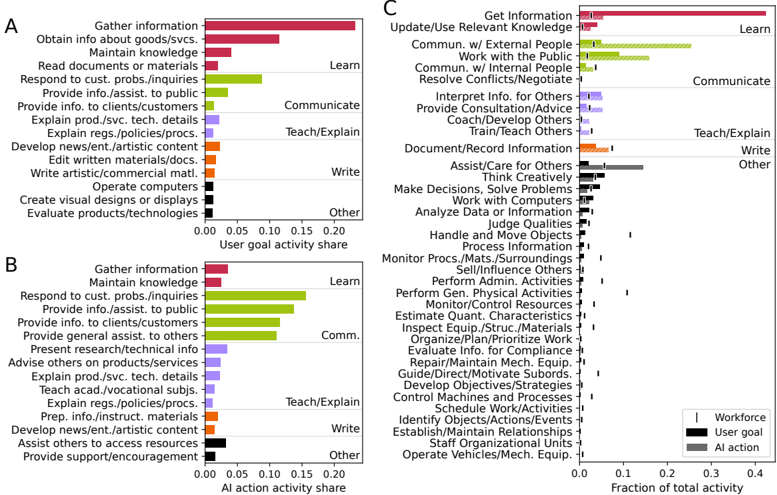
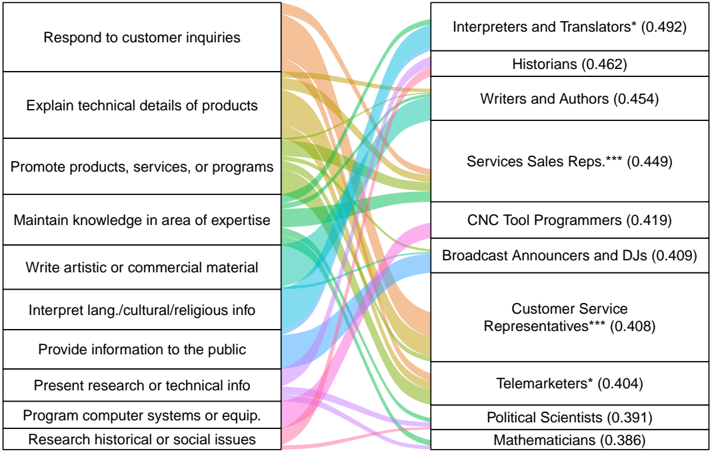
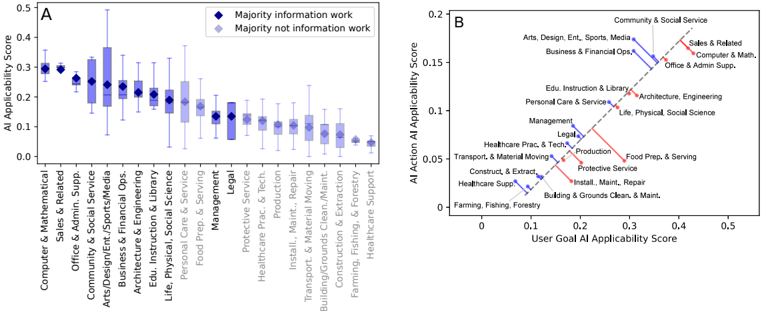
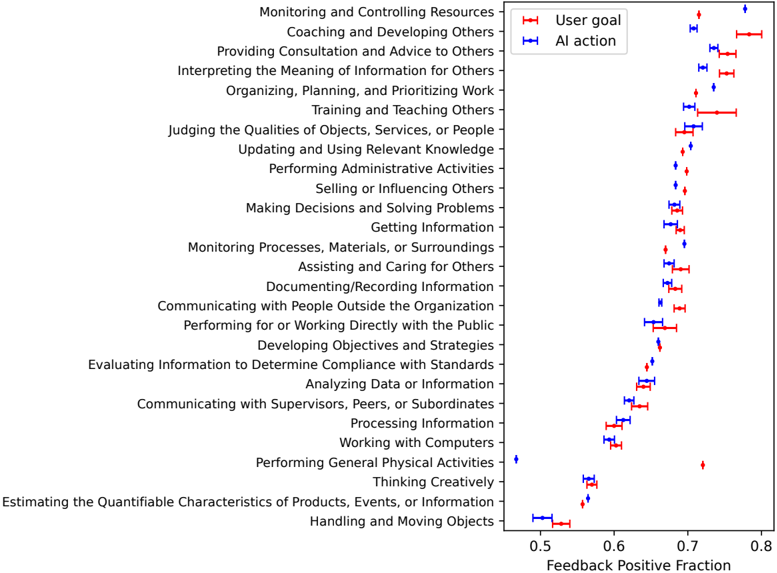
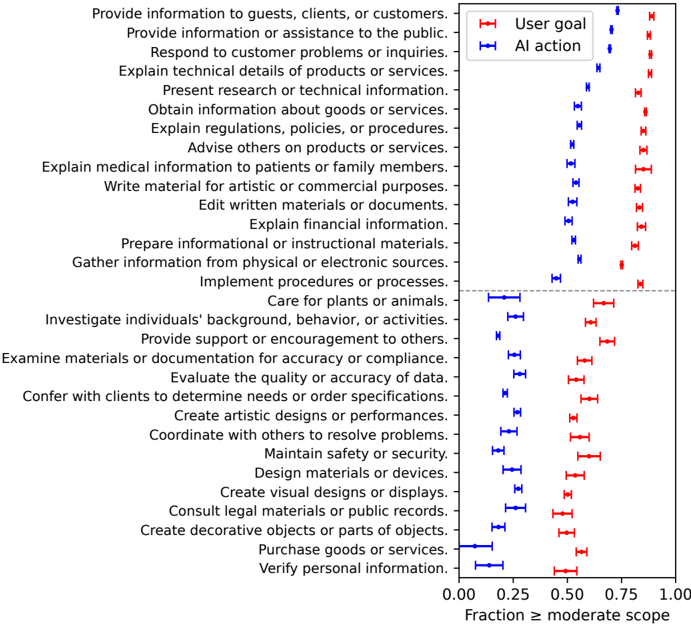
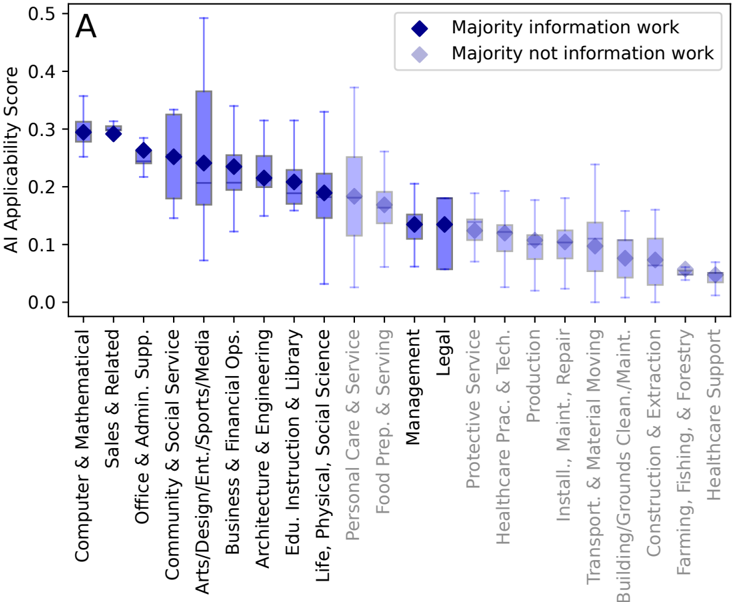
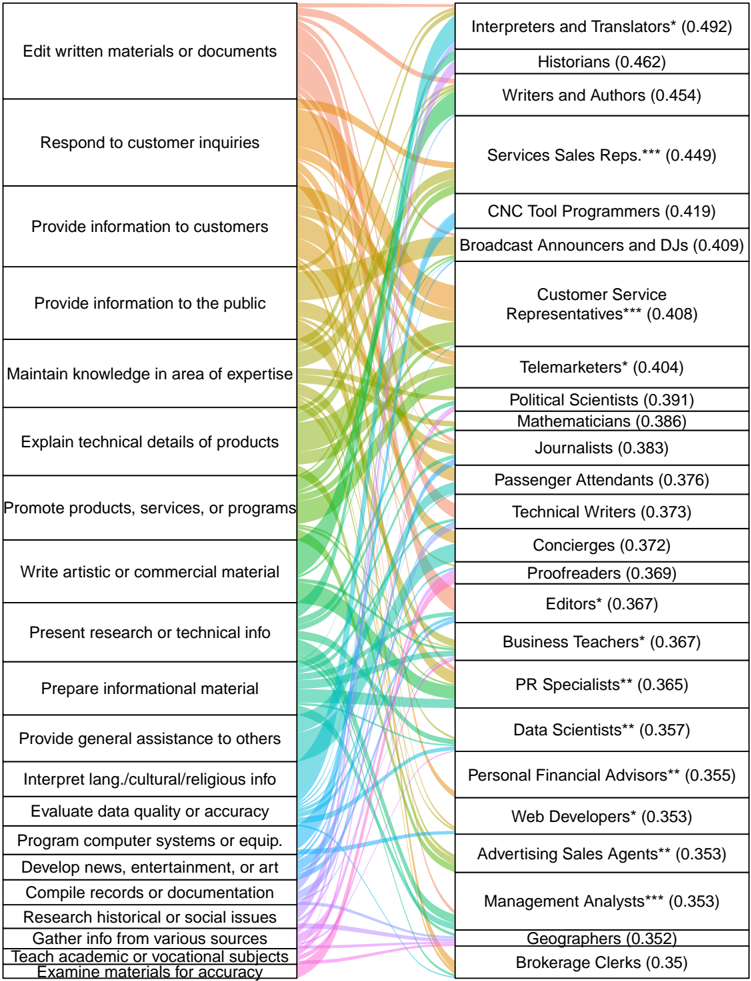
- Information work dominates: the most common and successful AI-assisted activities involve creating, gathering, and disseminating information. Top occupations by AI applicability score include Interpreters and Translators (0.492), Historians (0.462), Writers and Authors (0.454), Sales Representatives of Services (0.449), and Customer Service Representatives (0.408); top SOC major groups are Computer & Mathematical (0.29), Sales & Related (0.29), and Office & Administrative Support (0.26).
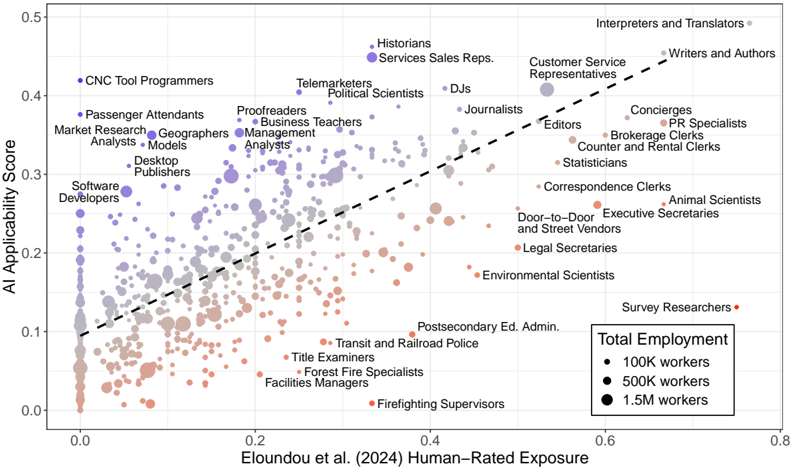
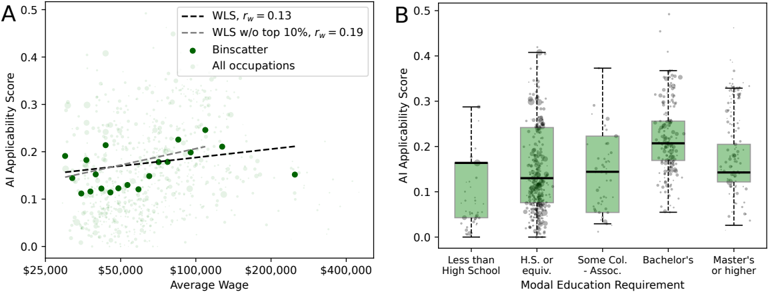
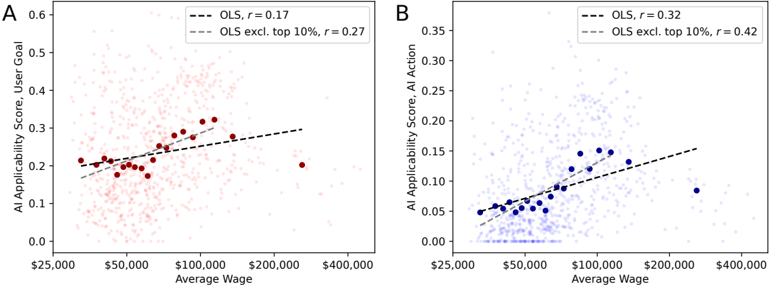
- AI applicability is widespread but weakly related to wage: most occupations have at least some AI applicability, and the employment-weighted correlation between AI applicability and occupational wage is r = 0.13. The score correlates with Eloundou et al.’s exposure predictions at employment-weighted r = 0.73, but the authors suggest prior work underestimated relevance to some information work occupations like proofreaders and software developers.
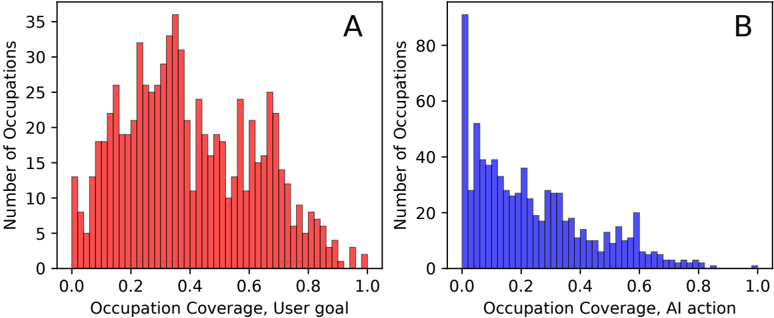
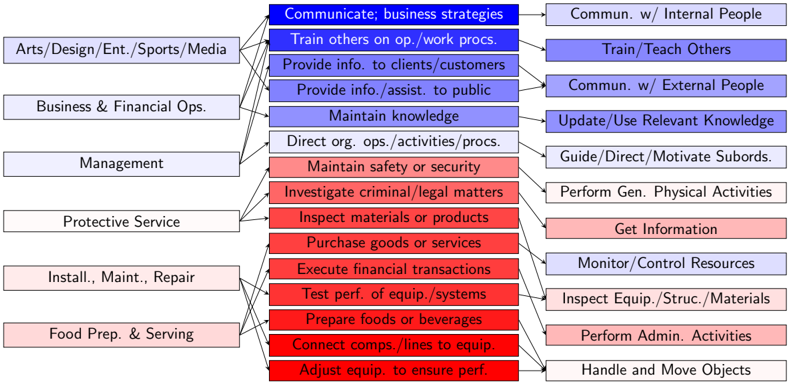
- User goals and AI actions differ: in 40% of conversations the user-goal and AI-action IWA sets are disjoint, and in 96% there are more IWAs unique to one side than in common; for every work activity matched to a user goal, the AI performs an average of two work activities in service of the request. Media and financial operations occupations are relatively likelier to delegate tasks to AI, while physical occupations like food preparation are likelier to use AI assistively.
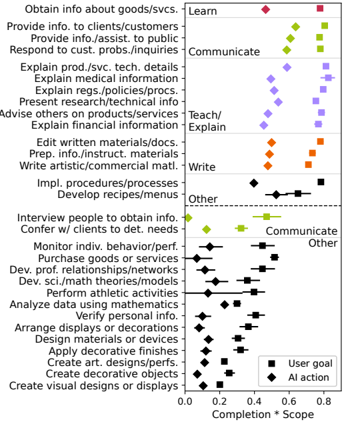
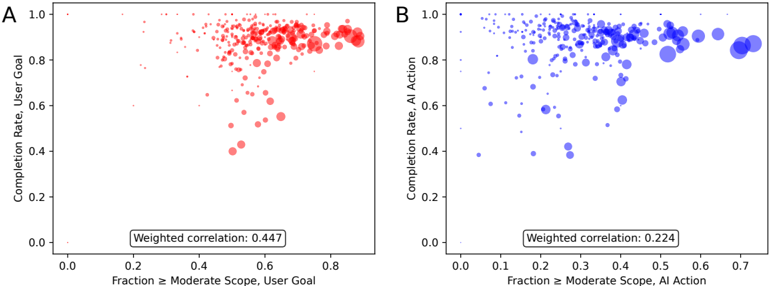
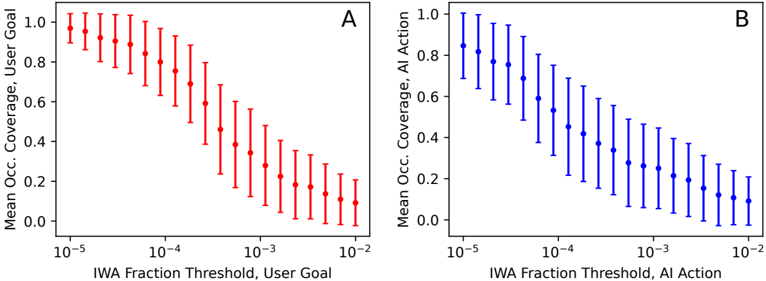
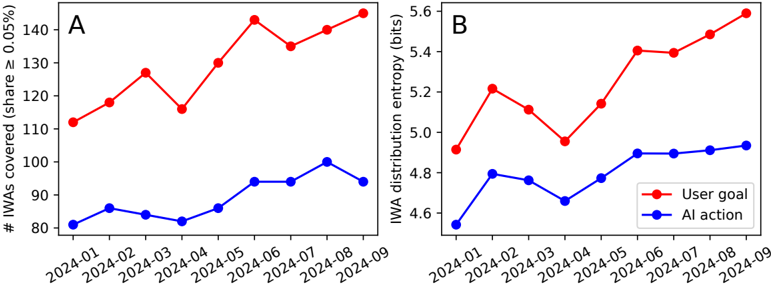
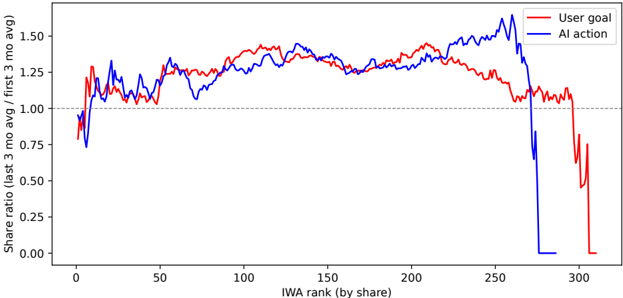
- Over the 9-month period, the number of user goals covering 75% of activity increases from 20 to 28, and IWA distribution entropy increases by about 0.5 bits (≈40% increase in perplexity). Coverage is the primary contributor to AI applicability scores: a coverage-only ranking has Kendall tau 0.88 with the full score, adding scope raises it to 0.95, and completion provides the last 0.05.
Methods
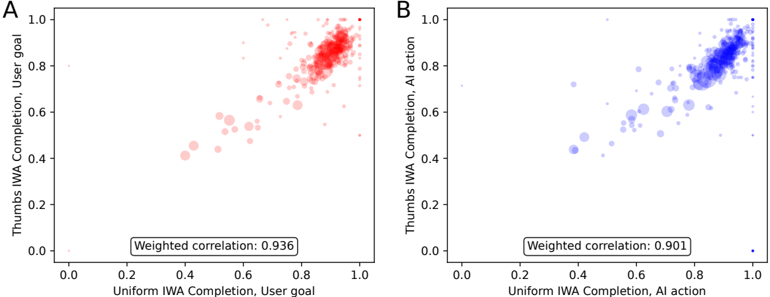
- Data: 200k anonymized, privacy-scrubbed U.S. Bing Copilot conversations from January 1 to September 30, 2024, split into COPILOT-UNIFORM (~100k uniform sample) and COPILOT-THUMBS (100k conversations with at least one thumbs up/down). The analysis uses O*NET 29.0, 2023 BLS OEWS data, and 2024 CPS data, covering 785 SOC codes and 149.8 million workers.
- Classification pipeline: two-stage GPT-4o prompts summarize each conversation’s user goal and AI action in the style of O*NET Intermediate Work Activities (IWAs), generate four rewordings, rank all 332 IWAs by embedding cosine similarity, then binary-classify each IWA as matching the user goal and/or AI action. Validation against human annotations on 195 conversations found human-human κ ≈ 0.51 and human-LLM pipeline κ ≈ 0.40 on a held-out test set, with overall agreement well over 90%.
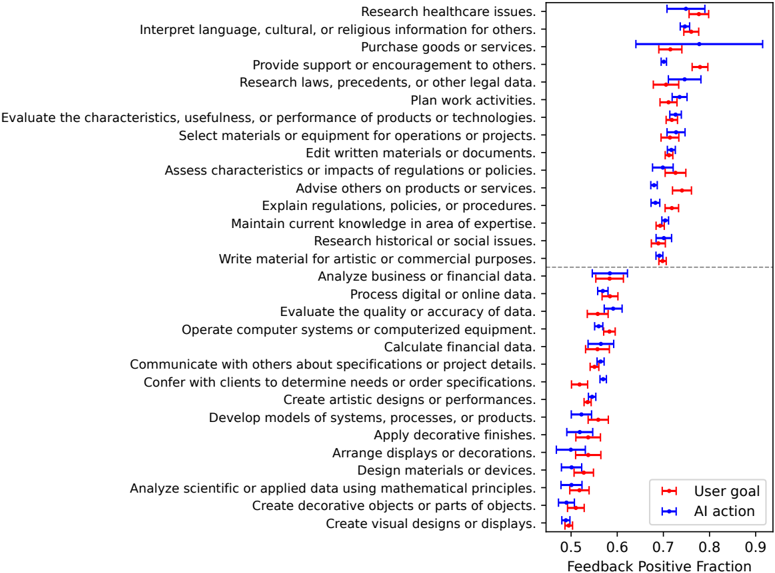
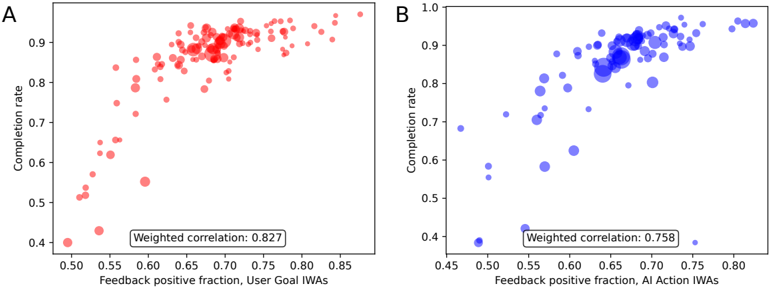
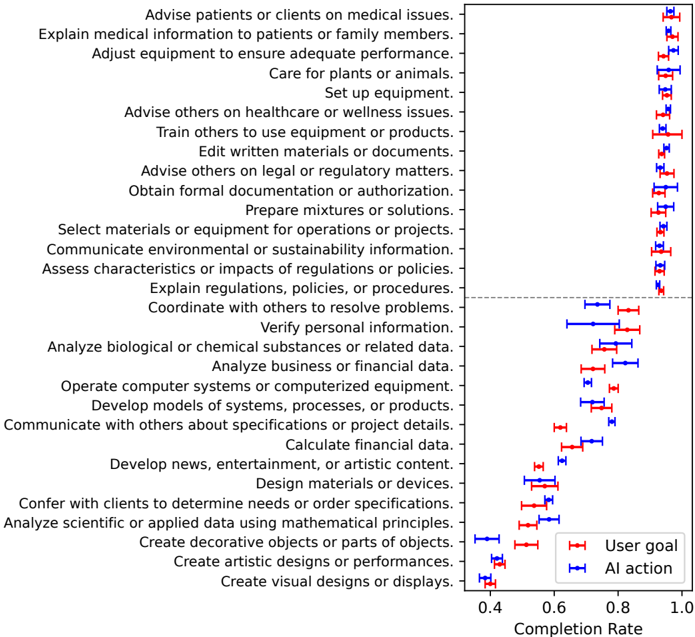
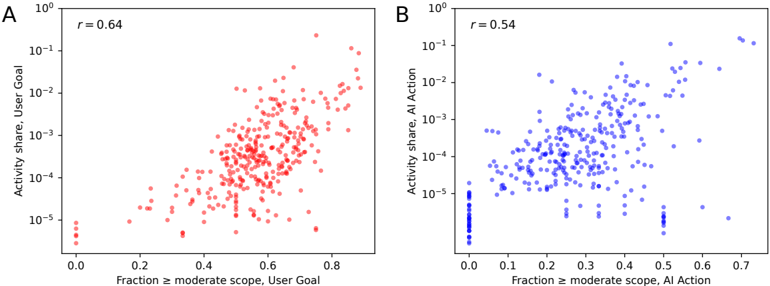
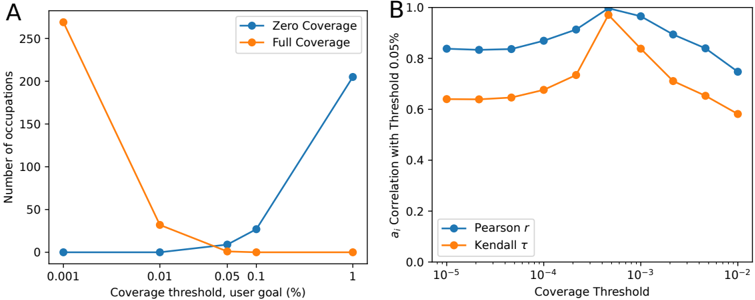
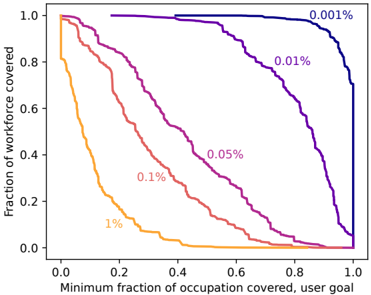
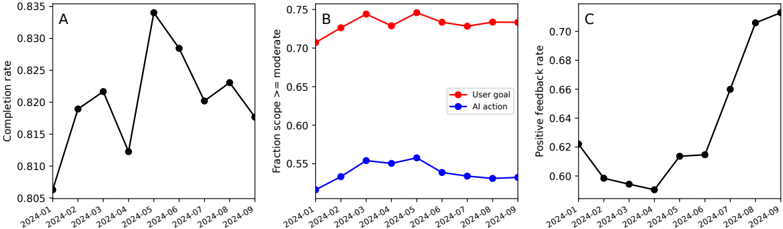
- Metrics: activity share is computed with a 0.05% coverage threshold; success is measured via thumbs positive feedback share, an LLM completion classifier, and a six-point scope rating. These are aggregated into occupation-level AI applicability scores using O*NET importance weights, separately for user goals and AI actions, then averaged.
Limitations
- Paper-stated: the data are from 2024 and models have improved since; the data represent only one AI platform (Bing Copilot), while other platforms differ (e.g., ChatGPT skews toward writing, Claude toward coding and mathematics); completion and scope measure AI utility toward an IWA, not productivity impact on workers; O*NET is U.S.-centric, may lag current workplace activities, and does not capture non-occupational work or the “connecting glue” between tasks.
- Paper-stated: the 0.05% coverage threshold means absolute scores depend strongly on the threshold, so relative comparisons are more meaningful; thumbs feedback may suffer selection bias; IWA classification has moderate κ values due to unclear boundaries between IWAs; scope validation shows substantial variance and a larger human-human vs. human-LLM gap than IWA classification.
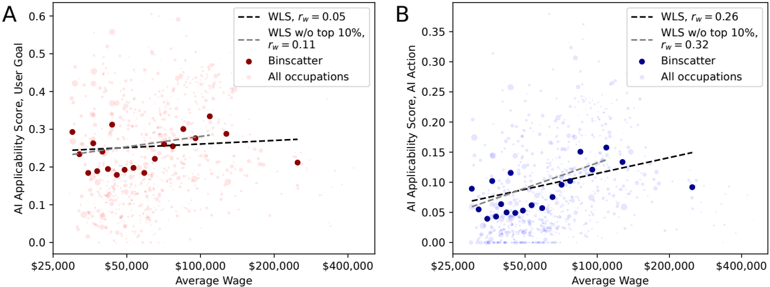
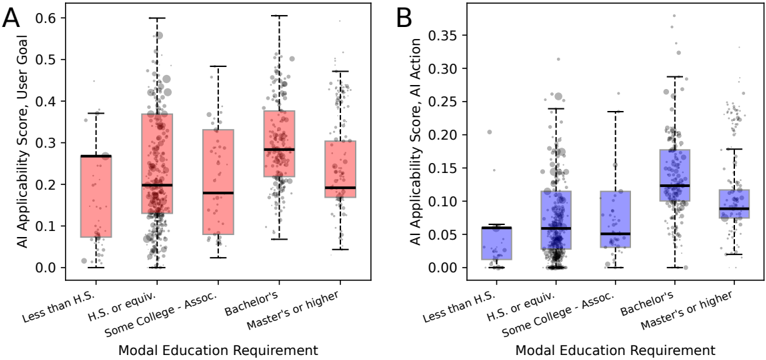
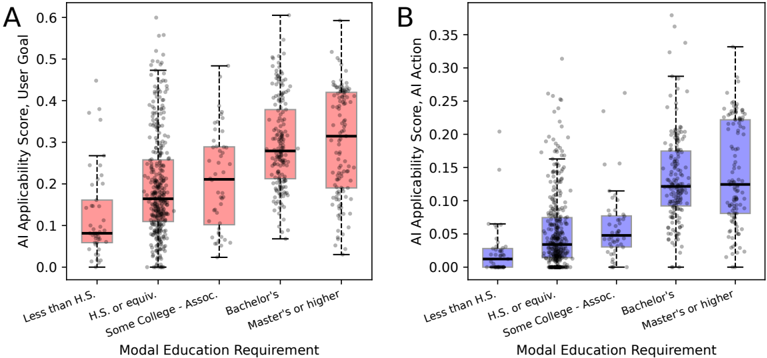
- Evident from the text: the study is observational and usage-based, so it does not establish causal effects of AI on employment or wages; the authors explicitly caution that automation vs. augmentation conclusions are hard to predict. Reproducibility is limited because raw conversations cannot be released, though aggregated metrics are public; employment weighting materially affects wage/education correlations (unweighted r = 0.17 for user goals and 0.32 for AI actions vs. weighted r = 0.13).
Model-written summary. Check it against the paper before relying on it.
Integrity signals
Registry
Cites
Statistics
Figures
Verification
Claims the paper makes
0 Valid · 4 Not valid · 32 Not checked · 156 Own results and interpretations
A result the paper reports from its own data — it cites no other source for it, so there is none to check. The quote shows it is in the paper.
In the paper
“We find that the most common and successful AI-assisted work activities involve information work-the creation, processing, and communication of information.”
§ Working with AI: Measuring the Applicability of Generative AI to Occupations > Abstract
plainstates an association- Asserted: passes — The authors put it forward as true.
- Checkable: passes — It can be checked against evidence.
- Load-bearing: passes — The paper’s conclusions depend on it.
- Based: passes — The paper gives a reason why it holds.
A result the paper states — it cites no source for it, so there is none to check. The quote shows it is in the paper.
In the paper
“At the occupation level, we find widespread AI applicability cutting across sectors, as most occupations have information work components.”
§ Working with AI: Measuring the Applicability of Generative AI to Occupations > Abstract
plain- Asserted: passes — The authors put it forward as true.
- Checkable: passes — It can be checked against evidence.
- Load-bearing: passes — The paper’s conclusions depend on it.
- Based: passes — The paper gives a reason why it holds.
A result the paper reports from its own data — it cites no other source for it, so there is none to check. The quote shows it is in the paper.
In the paper
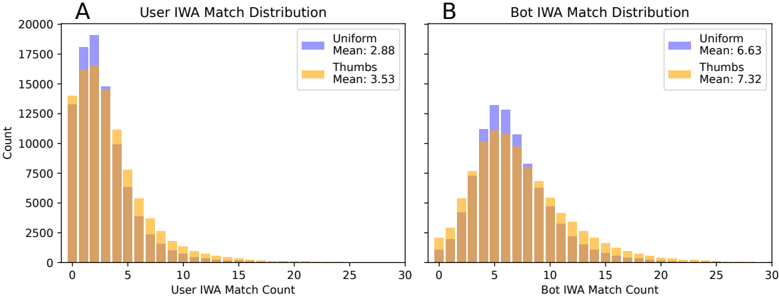
“In most conversations, there are multiple IWA matches on both sides (on average, about 3 user goal IWAs and 6 AI action IWAs out of 332 total; see Figure K.6).”
§ Working with AI: Measuring the Applicability of Generative AI to Occupations > 4.1 Work activity classification
plain- Asserted: passes — The authors put it forward as true.
- Checkable: passes — It can be checked against evidence.
- Load-bearing: unclear — It is unclear whether the paper’s conclusions depend on it.
- Based: passes — The paper gives a reason why it holds.
A result the paper reports from its own data — it cites no other source for it, so there is none to check. The quote shows it is in the paper.
In the paper
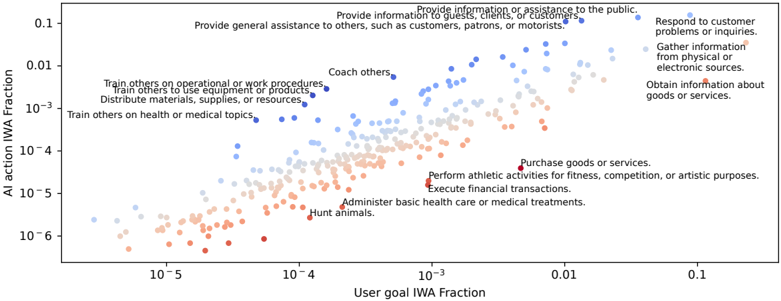
“GWAs focused on learning and communication are most prevalent, echoing the results in Figure 1A,B.”
§ Working with AI: Measuring the Applicability of Generative AI to Occupations > 5.1 Work activities
plain- Asserted: passes — The authors put it forward as true.
- Checkable: passes — It can be checked against evidence.
- Load-bearing: unclear — It is unclear whether the paper’s conclusions depend on it.
- Based: passes — The paper gives a reason why it holds.
A result the paper reports from its own data — it cites no other source for it, so there is none to check. The quote shows it is in the paper.
In the paper
“Conversely, to the extent that AI is used for more physical occupations like those in the food preparation and serving category, it is likely to be in a more assistive role.”
§ Working with AI: Measuring the Applicability of Generative AI to Occupations > 5.2 AI applicability to occupations
hedgedstates an association- Asserted: passes — The authors put it forward as true.
- Checkable: passes — It can be checked against evidence.
- Load-bearing: unclear — It is unclear whether the paper’s conclusions depend on it.
- Based: passes — The paper gives a reason why it holds.
73 more claims
Create a free account to see all 192 claims and every source verdict.
- It may state two separate claims as one. 78
- Probably not a substantial claim. 51
Claims other papers make about this one
Each is checked against this paper’s own text: does it say what the citing paper says it does?
In the citing paper
“AI exposure should thus be thought of as the potential rather than realized substitution of AI for human tasks, though recent work has shown a high correlation between our chosen AI exposure measures and real task usage using Microsoft Bing Copilot (Tomlinson et al. (2025)).”
From How Retrainable are AI-Exposed Workers? (2025) · cites this paper as Tomlinson et al. (2025)
Citations
Cites
The future of employment: How susceptible are jobs to computerisation?
Frey, C. B., & Osborne, M. A. (2017) · Technological Forecasting and Social Change · doi:10.1016/j.techfore.2016.08.019 · Cited by 8,727 · cited 2×
“This technique has become a standard practice in the economics literature [1, 21, 20, 17, 9, 8, 34] and the business world [26].”
The Skill Content of Recent Technological Change: An Empirical Exploration
Autor, D. H., Levy, F., & Murnane, R. J. (2003) · The Quarterly Journal of Economics · doi:10.1162/003355303322552801 · Cited by 6,205
Estimating within-group interrater reliability with and without response bias
James, L. R., Demaree, R. G., & Wolf, G. (1984) · Journal of Applied Psychology · doi:10.1037/0021-9010.69.1.85 · Cited by 4,774 · cited 1×
“The test set user goal and AI action r wg scores [58] (where 1 indicates perfect agreement and 0 only agreement due to chance) between the human rater pairs were 0.48 ( n = 55 ), 0.32 ( n = 66 ), 0.55 ( n = 51 ) and 0.66 ( n = 74 ), 0.12 ( n = 89 ), 0.30 ( n = 88 ), respectively.”
InfluentialWhy Are There Still So Many Jobs? The History and Future of Workplace Automation
Autor, D. H. (2015) · Journal of Economic Perspectives · doi:10.1257/jep.29.3.3 · Cited by 3,917
General purpose technologies ‘Engines of growth’?
Bresnahan, T. F., & Trajtenberg, M. (1995) · Journal of Econometrics · doi:10.1016/0304-4076(94)01598-t · Cited by 2,879
Automation and New Tasks: How Technology Displaces and Reinstates Labor
Acemoglu, D., & Restrepo, P. (2019) · Journal of Economic Perspectives · doi:10.1257/jep.33.2.3 · Cited by 2,612
GPTs are GPTs: An Early Look at the Labor Market Impact Potential of Large Language Models
Eloundou, T., Manning, S., Mishkin, P., & Rock, D. (2023) · arXiv · doi:10.48550/arxiv.2303.10130 · Cited by 2,330
What can machine learning do? Workforce implications
Brynjolfsson, E., & Mitchell, T. (2017) · Science · doi:10.1126/science.aap8062 · Cited by 1,131
A future that works: automation, employment, and productivity
Manyika, J., Chui, M., Miremadi, M., Bughin, J., George, K. F., Willmott, P., & Dewhurst, M. (2017) · Cited by 897
What Can Machines Learn and What Does It Mean for Occupations and the Economy?
Brynjolfsson, E., Mitchell, T., & Rock, D. (2018) · AEA Papers and Proceedings · doi:10.1257/pandp.20181019 · Cited by 695 · cited 1×
“…AI, similar techniques were used to predict the occupational impacts of robotics, machine learning, and computerization more broadly [7, 11, 12, 10, 13–15 , The studies most similar to ours are the Anthropic Economic Index [20] and Google’s AI & Economy ATLAS [21], which analyze Claude and…”
Research works printed but not linked: 5
- Carlos E Jimenez, John Yang, Alexander Wettig, Shunyu Yao, Kexin Pei, Ofir Press, and Karthik R Narasimhan. SWE-bench: Can language models resolve real-world GitHub issues? In The Twelfth International Conference on Learning Representations, 2024. URL https: //openreview.net/forum?id=VTF8yNQM66.
- Samuel Miserendino, Michele Wang, Tejal Patwardhan, and Johannes Heidecke. SWE-Lancer: Can frontier LLMs earn $1 million from real-world freelance software engineering? In Forty- second International Conference on Machine Learning, 2025. URL https://openreview.net/ forum?id=xZXhFg43EI.
- Wenting Zhao, Xiang Ren, Jack Hessel, Claire Cardie, Yejin Choi, and Yuntian Deng. WildChat: 1M ChatGPT interaction logs in the wild. In International Conference on Learning Representa- tions, pages 34590-34605, 2024. URL https://proceedings.iclr.cc/paper_files/paper/ 2024/file/9421261e06f1a63a352b068f1ac90609-Paper-Conference.pdf.
- Peter Ferdinand Drucker. Landmarks of tomorrow: a report on the new "post-modern" world. Harper, New York, 1st edition, 1959.
- Scott Counts, Yan Chen, Jing Dong, Himanshu Sharma, Andrey Zaikin, Rui Hu, Alperen Kok, Gorkem Ozer Yilmaz, Siddharth Suri, Kiran Tomlinson, Sonia Jaffe, and Will Wang. AI in the enterprise: How people use M365 Copilot Chat, 2026. URL https://arxiv.org/abs/2605. 23958.
Cited by
Items 101–155 of 155
Measuring the Occupation-Level Impact of AbbVie Intelligence: AI Applicability Analysis, 2024-2025Preprint
Regan, J., Stevens, & Martin, B. (2026) · arXiv (Cornell University) · doi:10.48550/arxiv.2606.20635
Szczęsny, A. M. (2026) · Rocznik Przekładoznawczy · doi:10.12775/rp.2025.012
Warsztat pracy polskich tłumaczy literackich AD 2025: wyniki badania ankietowego
Guttfeld, D. (2026) · Rocznik Przekładoznawczy · doi:10.12775/rp.2025.011
La Robustesse en pédagogie : ses implications dans les pratiques évaluatives
Larcin, C. (2026) · ORBi (University of Liège)
Who Gains from AI? General-Equilibrium Rebound, Distribution, and Welfare *Preprint
Gyntelberg, J. (2026) · SSRN Electronic Journal · doi:10.2139/ssrn.7131679
Privacy Perceptions in Using Generative AI Tools Among Israeli Students
Weinberger, M., & Bouhnik, D. (2026) · Issues in Informing Science and Information Technology · doi:10.28945/5806
Partial Identification with Multiple Nonlinear Measurements of a Latent RegressorPreprint
Ogut, B., & Yin, M. (2026) · arXiv (Cornell University) · doi:10.48550/arxiv.2607.12219
"Artificial Historian": Artificial Intelligence and the Issues of Technogenic Historiography
Volodin, A. U. (2026) · Историческая информатика · doi:10.7256/2585-7797.2026.2.78911
Creighton, C., Ksiazek, K., & Weaver, R. (2026) · eCommons (Cornell University)
Huber, P. (2026) · Springer eBooks · doi:10.1007/978-3-658-52578-1_4
A Multi-Level Assessment Model for Generative AI's Occupational Impact
Ji, L., Zhou, Y., Wang, Z., & Li, J.-Y. (2026) · International Conference on Artificial Intelligence and Computing (AIC) · doi:10.1109/aic65131.2026.11633682
Does it pay off to use GenAI in the Russian labor market?
Rozhkova, K. V., Roshchin, S., & Roshchina, Y. M. (2026) · Voprosy Ekonomiki · doi:10.32609/0042-8736-2026-8-29-54
Adaptive Enrollment Planning for Higher Education in the Generative AI Era: A Data-Driven Framework
Liang, X. (2026) · ITM Web of Conferences · doi:10.1051/itmconf/20268904017
Rahimzadeh, V., Zhauniarovich, Y., & Zannettou, S. (2026) · Conference on Empirical Methods in Natural Language Processing (EMNLP) · doi:10.18653/2026.emnlp-main.2659
Sophistication in GenAI Use: Field Evidence from a Large FirmPreprint
Hallman, N., Kowaleski, Z. T., Puvvada, A., & Schmidt, J. J. (2026) · SSRN Electronic Journal · doi:10.2139/ssrn.7351443
Artificial Intelligence in Oral and Maxillofacial Surgery—A Narrative Review
Zawadka-Modras, D., Rożko, J., Chloupek, A., & Jurkiewicz, D. (2026) · Journal of Clinical Medicine · doi:10.3390/jcm15176728 · Cited by 1
大学におけるAI時代の翻訳教育 : 翻訳プロセスの変化と学修に対する学生の認識
瀧本, 眞. (2026) · Institutional Repositories DataBase (IRDB) · doi:10.50873/11854
Future Forecasts? - Is AI a Workforce Revolution or Disruption?
Cardwell, J. (2026) · Phoenix Scholar · doi:10.64657/yhhp8213
Terminator Economy: Assessing Jobs and Tasks Exposure to AI
Colombo, E., Mercorio, F., Mezzanzanica, M., Serino, A., & Seveso, A. (2026) · Lecture notes in computer science · doi:10.1007/978-3-032-37685-5_36
Hartley, K. (2026) · Springer eBooks · doi:10.1007/978-3-032-24819-0_9
West, J., & Cosimano, M. (2026) · SSRN Electronic Journal · doi:10.2139/ssrn.7462099
Paulsen, R. J., Jordan, C. E., & Shukaylo, G. (2026) · Sport Business and Management An International Journal · doi:10.1108/sbm-07-2026-0223
How People Use ChatGPT in Australia: A WildChat AnalysisPreprint
Ma, Y., Gero, K., Canonne, C. L., Jin, C., & Thilakarathna, K. (2026) · arXiv (Cornell University) · doi:10.48550/arxiv.2609.28990
Accelerating HNSW in RAG: A Dynamic Cache Method Based on Topic-Biased Access Patterns
Masuda, R., Iwamoto, K., Yokoyama, H., Ando, K., & Kamei, H. (2026) · Communications in computer and information science · doi:10.1007/978-3-032-28460-0_1
Presente y Pasado. Año 30 N° 59 Especial 2025
Andes, U. D. L. (2026) · Presente y pasado (Mérida)
Dependence on Artificial Intelligence and the Risk of Declining Cognitive Engagement in Learning
Abbas, F. M., Kholil, M., & Asholihah, M. (2026) · Lentera Pendidikan Jurnal Ilmu Pendidikan dan Keguruan Islam
The Interpreters’ Newsletter, n. 30
Lambertini, N. N. V., Lambertini, V., & Niemants, N. S. A. (2025) · Institutional Research Information System University of Turin (University of Turin)
History and algorithms: the historian's craft within digitality
Rodríguez, D. A. Q. (2026) · Presente y pasado (Mérida)
Santhiago, R. (2026) · Revista Confluências Culturais · doi:10.21726/rcc.v15i2.2939
Tekoälyä sosiaalityössä : Onko tekoäly saavuttanut sosiaalityön
Linko, M. (2026) · UTUPub (University of Turku)
Sorsszerű véletlenek. Hogyan lesz valakiből fordításkutató?
Klaudy, K. (2026) · Fordítástudomány · doi:10.35924/fordtud.28.si.1
Professional Translators’ Attitudes towards MT and AI Translation Tools in Romania
Fazakas, N., & Sárosi-Márdirosz, K. (2026) · Fordítástudomány · doi:10.35924/fordtud.28.si.6
The New Work of Generative AIPreprint
Harris, T. (2026) · SSRN Electronic Journal · doi:10.2139/ssrn.7608062
Dissecting the Carbon-SLO Tension in Geo-Distributed LLM ServingPreprint
Topçu, B., Cim, M., Öztürk, Z., & Kandemir, M. T. (2026) · arXiv (Cornell University) · doi:10.48550/arxiv.2610.14571
Rai, A., Ramesh, B., Breazeal, C., Klopfer, E. D., Ampel, B., George, A., & Fu, X. (n.d.) · AIS Electronic Library (AISeL)
Nakagomi, A., Inagaki, S., & Tabuchi, T. (2026) · Computers in Human Behavior Reports · doi:10.1016/j.chbr.2026.101407
The Delegation Divide: An Open Index of AI-Agent Delegability across Occupations and CountriesPreprint
Maya, C. E., & Londoño, S. J. (2026) · arXiv (Cornell University) · doi:10.48550/arxiv.2610.30752
Błoch, A., Hussain, S., & Santana, C. (2026) · Cogent Arts and Humanities · doi:10.1080/23311983.2026.2704630
TaskNet: Building Occupational Task Inventories from Worker Interviews at ScalePreprint
Wang, J., Haupt, A. A., Robinson, I. A., Lewis, P., Brynjolfsson, E., & Yang, D. (2026) · SSRN Electronic Journal · doi:10.2139/ssrn.7670419
Freire, M. Á. G. (2026) · Horizontes Amazónicos · doi:10.67321/7d3ygr02
Human-in-the-Loop Pedagogy: Reframing Technical Communication Education in the Age of AI
Getto, G. (2026) · Technical Communication Quarterly · doi:10.1080/10572252.2026.2757800
Schulte, P. A., Kander, M. C., Streit, J. M. K., Adamec, N. T., Wendt, C., Hartman, L. M., Bhattacharya, A., Lentz, T. J., Jacklitsch, B. L., Dean, J., et al. (2026) · Frontiers in Public Health · doi:10.3389/fpubh.2026.1999864
Legal translation and automation: practices, challenges, and transformations
Pontrandolfo, G., & Quinci, C. (2026) · Perspectives · doi:10.1080/0907676x.2026.2746146
PAYWORTHY: Can LLMs Predict Which Freelance Jobs an AI Agent Will Complete?Preprint
Rezaei, M. R., Wang, D., Levert, B., Fejzo, C., Rabinovich, A., & Chen, Z. (2026) · arXiv (Cornell University) · doi:10.48550/arxiv.2611.05759
Assessing the Impact of Robotics and AI (RAI) on Workforce Transformation in HydropowerPreprint
Liu, H., & DeGeorge, E. (2026) · doi:10.66816/pr3866113
Experience, schooling, and occupations in Mexico’s wage structure: evidence from 2005–2025
Ramírez, R. V. (2026) · Repositorio del Tecnológico de Monterrey (Tecnológico de Monterrey)
AI Exposure and the Changing Responsibilities in Job PostingsPreprint
Zhao, D., Ai, L., Khadpe, P., Suri, S., & Counts, S. (2026) · arXiv (Cornell University) · doi:10.48550/arxiv.2611.09870
Self-citationUngo, R., & Ungo, N. (2026) · International Conference on Industrial Engineering and Operations Management (IEOM) · doi:10.46254/sa07.20260145
No humans-in-the-loop: The people-less stories generated by GPT
Carroll, C., & Kirilloff, G. (2026) · Narrative Inquiry · doi:10.1075/ni.25153.car
Atento, R. G. (2026) · Journal of Enterprise Strategy and Management Innovation · doi:10.65166/21fmda70
What Should We Tax When We Tax AI?
Brusco, G., & Capozza, F. (2026) · CESifo · doi:10.65864/dtp1vz98pn
Malkawi, G., Elsayed, A. A. A., Alhagyan, M., & Hussein, B. (2026) · Research Square · doi:10.21203/rs.3.rs-11308901/v1
Metadata
- Authors
- Tomlinson, K., Jaffe, S., Wang, W., Counts, S., & Suri, S.
- Affiliations
- Microsoft (United States) (US)
- Venue
- arXiv
- Publisher
- arXiv
- Published
- 2025
- ISSN
- 2331-8422 (ISSN-L)
- arXiv
- 2507.07935
- OpenAlex
- W4417063314
- Semantic Scholar
- ac610777f9990294d91d2be88e41867a4eabb939
- Cited by
- 152
- References
- 40
- Citations by year
- 2026: 127 · 2025: 25
- Type
- posted content
- Language
- en
- Open access
- green
- arxiv.org
- Licence
- Locations
- arXiv (Cornell University) (submittedVersion, cc-by)
- arXiv (Cornell University)
- Funders
- Microsoft Research
- Topics
- Social Sciences › Economics, Econometrics and Finance › Economics and Econometrics › Labor market dynamics and wage inequality
- Physical Sciences › Computer Science › Artificial Intelligence › Artificial Intelligence Applications
- Physical Sciences › Computer Science › Artificial Intelligence › Ethics and Social Impacts of AI
- Keywords
- generative AI, occupation, information work, AI-assisted workflows, large language models, economic impact of AI, general purpose technologies
About these checks
Registry, retraction, Cites and statistics results are computed, not judged, with one exception: a printed reference that no index lists is read once by a model before it counts as a citation error. Claims are extracted by a model and kept only when their quote appears verbatim in the text; each cited source is then checked, with a model’s help, for whether it says what the claim relies on. Those verdicts can be wrong — read the claim’s quote and the cited source before relying on one.
A language model drew the claims from the paper on 2026-11-17, under version 3 of the claim definition (model deepseek-v4.1-flash, prompt extract-v3).
A second model labelled each claim on 2026-11-17 (model jev-1.13-20260917, definition revision gold-guideline-v0.2).
Statistics and arithmetic are recomputed, not judged.
Confidence bands are shown only for fields calibrated on our annotated test set. None is calibrated yet, so no band is shown.
What counts as a claim ›How we measure confidence ›How we check this ›
Are you an author, or do you see a problem with this page? Request a review
Data sources
Bibliographic data: Semantic Scholar, OpenAlex, Crossref.
Contains information from the Semantic Scholar Academic Graph Datasets, made available under the ODC Attribution License (ODC-BY 1.0).
Semantic Scholar’s data is described in: Kinney, R., et al. (2023). The Semantic Scholar Open Data Platform. arXiv:2301.10140.
