

The DOI matches its Crossref record; 20 of the 20 references it cites were found in a registry or an index.
How to Assess Regional and Whole Gut Transit Time With Wireless Motility Capsule
Open accessAbstract
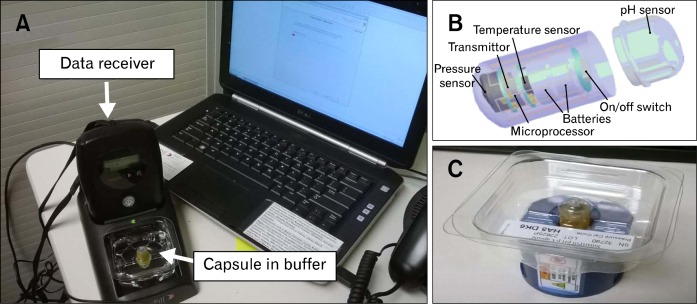
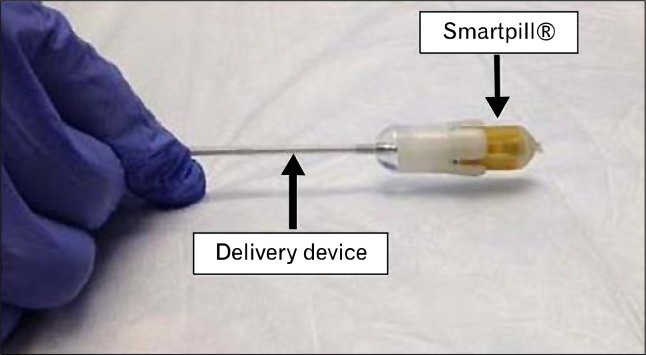
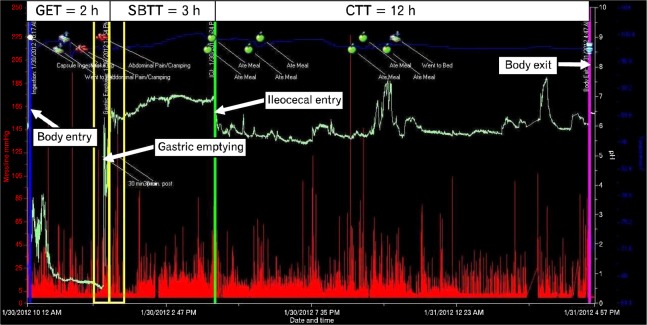
Assessment of transit through the gastrointestinal tract provides useful information regarding gut physiology and patho-physiology. Although several methods are available, each has distinct advantages and limitations. Recently, an ingestible wire-less motility capsule (WMC), similar to capsule video endoscopy, has become available that offers a less-invasive, standardized, radiation-free and office-based test. The capsule has 3 sensors for measurement of pH, pressure and temperature, and collec-tively the information provided by these sensors is used to measure gastric emptying time, small bowel transit time, colonic transit time and whole gut transit time. Current approved indications for the test include the evaluation of gastric emptying in gastroparesis, colonic transit in constipation and evaluation of generalised dysmotility. Rare capsule retention and malfunc-tion are known limitations and some patients may experience difficulty with swallowing the capsule. The use of WMC has been validated for the assessment of gastrointestinal transit. The normal range for transit time includes the following: gastric empty-ing (2-5 hours), small bowel transit (2-6 hours), colonic transit (10-59 hours) and whole gut transit (10-73 hours). Besides avoiding the use of multiple endoscopic, radiologic and functional gastrointestinal tests, WMC can provide new diagnoses, leads to a change in management decision and help to direct further focused work-ups in patients with suspected disordered motility. In conclusion, WMC represents a significant advance in the assessment of segmental and whole gut transit and mo-tility, and could prove to be an indispensable diagnostic tool for gastrointestinal physicians worldwide.
Overview
The claims and statistics of this paper haven’t been checked yet.
Run the check — free, no account needed. It reads the open-access text and checks the sources it cites.
Integrity signals
Registry
Cites
Statistics
Figures
Verification
Claims the paper makes
The claims and statistics of this paper haven’t been checked yet.
Run the check — free, no account needed. It reads the open-access text and checks the sources it cites.
Claims other papers make about this one
Each is checked against this paper’s own text: does it say what the citing paper says it does?
The cited source says what the claim attributes to it.
In the citing paper
“Advanced techniques, including antroduodenal‑jejunal manometry [71–75], wireless motility capsule [76–79], gastric ultrasound [80–82], and high‑resolution electrogastrography (EGG) [83–87] may provide additional pathophysiological insight, particularly in complex or mixed‑pattern cases.”
From Diabetic gastroparesis: pathophysiology and impact on insulin timing choices (2026) · cites this paper as [77]
Self-check
Percentages, sums and reported differences re-computed from the paper’s own numbers.
The self-check needs the paper’s full text.
Citations
Cites
Simplified assessment of segmental colonic transit
Metcalf, A. M., Phillips, S. F., Zinsmeister, A. R., MacCarty, R. L., Beart, R. W., & Wolff, B. G. (1987) · Gastroenterology · doi:10.1016/0016-5085(87)90837-7 · Cited by 928 · cited 1×
“In studies using ROMs, the mean CTT was 30-40 hours (maximum 70 hours), with women having longer maximal CTT than men.(12,13) Based on these studies, a delayed CTT with the capsule was defined as greater than 59 hours and a rapid transit as less than 5 hours.”
MethodComparison of fermentation reactions in different regions of the human colon
Macfarlane, G. T., Gibson, G. R., & Cummings, J. H. (1992) · Journal of Applied Bacteriology · doi:10.1111/j.1365-2672.1992.tb04882.x · Cited by 676
Rao, S. S. C., Camilleri, M., Hasler, W. L., Maurer, A. H., Parkman, H. P., Saad, R., Scott, S. M., Simrén, M., Soffer, E., & Szarka, L. A. (2010) · Neurogastroenterology & Motility · doi:10.1111/j.1365-2982.2010.01612.x · Cited by 383
Self-citationKuo, B., McCallum, R. W., Koch, K. L., Sitrin, M. D., Wo, J. M., Chey, W. D., Hasler, W. L., Lackner, J. M., KATZ, L. A., Semler, J. R., et al. (2007) · Alimentary Pharmacology & Therapeutics · doi:10.1111/j.1365-2036.2007.03564.x · Cited by 356
Rao, S. S. C., Kuo, B., McCallum, R. W., Chey, W. D., DiBaise, J. K., Hasler, W. L., Koch, K. L., Lackner, J. M., Miller, C., Saad, R. J., et al. (2009) · Clinical Gastroenterology and Hepatology · doi:10.1016/j.cgh.2009.01.017 · Cited by 345
Self-citationComparison of fermentation reactions in different regions of the human colon
Macfarlane, G. T., Gibson, G. R., & Cummings, J. H. (1992) · Journal of Applied Microbiology · doi:10.1111/j.1365-2672.1992.tb05187.x · Cited by 279
Maqbool, S., Parkman, H. P., & Friedenberg, F. K. (2009) · Digestive Diseases and Sciences · doi:10.1007/s10620-009-0899-9 · Cited by 235
Camilleri, M., Thorne, N. K., Ringel, Y., Hasler, W. L., Kuo, B., Esfandyari, T., Gupta, A., Scott, S. M., McCallum, R. W., Parkman, H. P., et al. (2010) · Neurogastroenterology & Motility · doi:10.1111/j.1365-2982.2010.01517.x · Cited by 206
Self-citationGelfond, D., Ma, C., Semler, J. R., & Borowitz, D. (2012) · Digestive Diseases and Sciences · doi:10.1007/s10620-012-2209-1 · Cited by 173
Sarosiek, I., Selover, K., KATZ, L. A., Semler, J. R., Wilding, G. E., Lackner, J. M., Sitrin, M. D., Kuo, B., Chey, W. D., Hasler, W. L., et al. (2009) · Alimentary Pharmacology & Therapeutics · doi:10.1111/j.1365-2036.2009.04162.x · Cited by 147
Cited by
Sorted by citations
The gut microbiota and its biogeography
McCallum, G., & Tropini, C. (2023) · Nature Reviews Microbiology · doi:10.1038/s41579-023-00969-0 · Cited by 361
Epidemiology and management of chronic constipation in elderly patients
Vázquez-Roque, M., & Bouras, E. P. (2015) · Clinical Interventions in Aging · doi:10.2147/cia.s54304 · Cited by 249
Software for enhanced video capsule endoscopy: challenges for essential progress
Iakovidis, D. K., & Koulaouzidis, A. (2015) · Nature Reviews Gastroenterology & Hepatology · doi:10.1038/nrgastro.2015.13 · Cited by 203
Powering implantable and ingestible electronics
Yang, S., Sencadas, V., You, S. S., Jia, N. Z., Srinivasan, S. S., Huang, H., Ahmed, A. E., Liang, J. Y., & Traverso, G. (2021) · Advanced Functional Materials · doi:10.1002/adfm.202009289 · Cited by 183
Ibrahim, A., Ali, R. A. R., Manaf, M. R. A., Ahmad, N., Tajurruddin, F. W., Qin, W. Z., Desa, S. H. M., & Ibrahim, N. M. (2020) · PLoS ONE · doi:10.1371/journal.pone.0244680 · Cited by 179
Metadata
- Authors
- Lee, Y. Y., Erdogan, A., & Rao, S. S. C.
- Affiliations
- Universiti Sains Malaysia (MY)
- Corresponding author
- Lee, Yeong Yeh
- Venue
- Journal of Neurogastroenterology and Motility
- Published
- 2014-04-30
- Volume
- 20
- Issue
- 2
- Pages
- 265-270
- ISSN
- 2093-0879 (ISSN-L)
- 2093-0887
- PMC
- PMC4015195
- OpenAlex
- W2084058854
- Cited by
- 187
- References
- 20
- Citations by year
- 2026: 24 · 2025: 36 · 2024: 31 · 2023: 15 · 2022: 11 · 2021: 22 · 2020: 11 · 2019: 8 · 2018: 4 · 2017: 10 · 2016: 6 · 2015: 8 · 2014: 1
- FWCI
- 8.35
- Type
- journal article
- Language
- en
- Open access
- hybrid
- doi.org
- Licence
- cc-by-nc
- Locations
- Journal of Neurogastroenterology and Motility (publishedVersion, cc-by-nc)
- Europe PMC (PubMed Central) (publishedVersion, other-oa)
- PubMed Central (publishedVersion, cc-by-nc)
- PubMed (publishedVersion)
- Topics
- Health Sciences › Medicine › Gastroenterology › Gastrointestinal motility and disorders
- Health Sciences › Medicine › Gastroenterology › Gastrointestinal Bleeding Diagnosis and Treatment
- Health Sciences › Medicine › Gastroenterology › Gastroesophageal reflux and treatments
- Keywords
- wireless motility capsule, gastrointestinal transit time, gastric emptying, small intestinal transit, colonic transit, whole gut transit, gastroparesis, constipation, dysmotility, capsule retention, gastrointestinal motility assessment
About these checks
Registry, retraction, Cites and statistics results are computed, not judged, with one exception: a printed reference that no index lists is read once by a model before it counts as a citation error. Claims are extracted by a model and kept only when their quote appears verbatim in the text; each cited source is then checked, with a model’s help, for whether it says what the claim relies on. Those verdicts can be wrong — read the claim’s quote and the cited source before relying on one.
Statistics and arithmetic are recomputed, not judged.
Confidence bands are shown only for fields calibrated on our annotated test set. None is calibrated yet, so no band is shown.
What counts as a claim ›How we measure confidence ›How we check this ›
Are you an author, or do you see a problem with this page? Request a review
