

The DOI matches its Crossref record.
Predictors of poor outcomes in 488 patients with herb-induced liver injury
Abstract
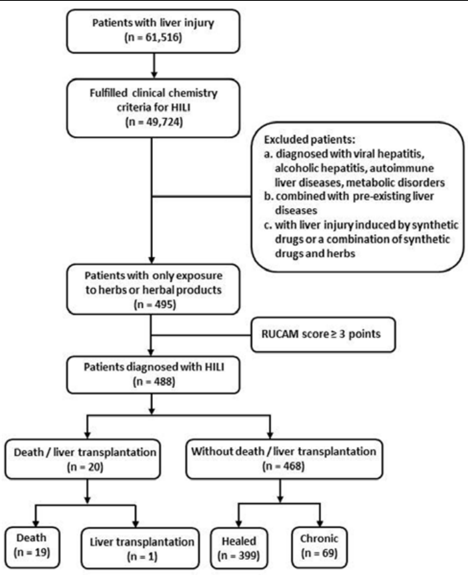
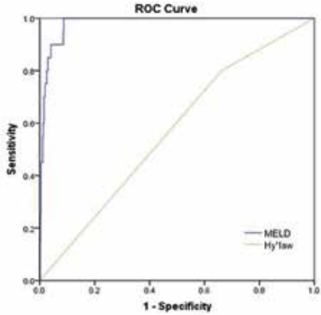
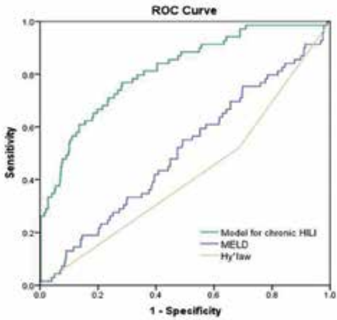
Background/Aims: Herb-induced liver injury (HILI) can lead to chronic liver injury, liver transplantation, or even death. This study aimed to identify the predictors of poor HILI outcomes, especially chronic HILI. Materials and Methods: Clinical data of 488 patients with HILI were retrospectively analyzed from a Chinese center between January 2010 and January 2014. Logistic regression and C-statistic were used to identify risk factors and prognostic models for HILI outcomes. Results: In all patients, 69 (14.1%) developed chronic HILI, and 20 (4.1%) died due to liver injury or underwent liver transplantation. To predict the fatal HILI prognosis, the model for end-stage liver disease (MELD) with a C-statistic of 0.981 (95%CI 0.968-0.995) was better than Hy’s law (C-statistic 0.569; 95%CI 0.449-0.689). The latency, course of peak alanine aminotransferase decreasing ≥50% after discontinuation of herb application, peak triglyceride value, and platelet count at liver injury onset were identified as independent risk factors for chronicity with the adjusted odds ratios of 1.268 (95% confidence interval [CI] 1.034-1.554), 2.303 (95%CI 1.588-3.340), 0.580 (95%CI 0.343-0.978), and 0.183 (95%CI 0.091-0.368), respectively. A prognostic model for chronic HILI based on these four factors yielded the best prediction with a C-statistic of 0.812 (95%CI 0.755-0.868), compared with MELD (C-statistic 0.506; 95%CI 0.431-0.581) and Hy’s law (C-statistic 0.418; 95%CI 0.343-0.492). Conclusion: Model for end-stage liver disease can be used to predict the fatal prognosis of HILI. A long latency, slow recovery, and low triglyceride value and platelet counts are important determinants for chronic HILI. Cite this article as: Zhu Y, Niu M, Wang JB, et al. Predictors of poor outcomes in 488 patients with herb-induced liver injury. Turk J Gastroenterol 2019; 30: 47-58.
Overview
The claims and statistics of this paper haven’t been checked yet.
Run the check — free, no account needed. It reads the open-access text and checks the sources it cites.
Integrity signals
Registry
Cites
Statistics
Figures
Verification
Claims the paper makes
The claims and statistics of this paper haven’t been checked yet.
Run the check — free, no account needed. It reads the open-access text and checks the sources it cites.
Claims other papers make about this one
Each is checked against this paper’s own text: does it say what the citing paper says it does?
In the citing paper
“Some studies included HILI cases not only with highly probable or probable causality gradings but also with a possible causality level based on RUCAM scores ≥3 (Table 1).24,25,27,28,30,36,38”
From Herb-induced Liver Injury in Asia and Current Role of RUCAM for Causality Assessment in 11,160 Published Cases (2020) · cites this paper as [38]
Self-check
Percentages, sums and reported differences re-computed from the paper’s own numbers.
The self-check needs the paper’s full text.
Citations
Cites
No references could be resolved yet.
Research works printed but not linked: 27
- Teschke R, Andrade RJ. Drug, herb, and dietary supplement hepa- totoxicity. Int J Mol Sci 2016; 17: pii: E1488. [CrossRef] · DOI · Paper page
- Drug-induced Liver Injury Study Group, Chinese Society of Hepa- tology, Chinese Medical Association. CSH guidelines for the diagno- sis and treatment of drug-induced liver injury. Hepatol Int 2017; 11: 221-41. [CrossRef] · DOI · Paper page
- Zhu Y, Niu M, Chen J, et al. Hepatobiliary and pancreatic: com- parison between Chinese herbal medicine and western medicine-in- duced liver injury of 1985 patients. J Gastroenterol Hepatol 2016; 31: 1476-82. [CrossRef] · DOI · Paper page
- Lee WJ, Kim HW, Lee HY, Son CG. Systematic review on herb-in- duced liver injury in Korea. Food Chem Toxicol 2015; 84: 47-54.
- CrossRef] · DOI · Paper page
- Branch of Hepatobiliary Diseases China Association of Chinese Medicine, Branch of Chinese Patent Medicine China Association of Chinese Medicine. Guidelines for the diagnosis and treatment of herb-induced liver injury. Chin J Integr Med 2018 Mar 15. doi: 10.1007/s11655-018-3000-8. [Epub ahead of print] [CrossRef] · DOI · Paper page
- Danan G, Teschke R. RUCAM in drug and herb induced liver injury: the update. Int J Mol Sci 2015; 17: pii: E14. [CrossRef] · DOI · Paper page
- Bénichou C. Criteria of drug-induced liver disorders. Report of an in- ternational consensus meeting. J Hepatol 1990; 11: 272-6. [CrossRef] · DOI · Paper page
- Kamath PS, Kim WR; Advanced Liver Disease Study Group. The model for end-stage liver disease (MELD). Hepatology 2007; 45: 797-805. [CrossRef] · DOI · Paper page
- Teschke R. Traditional Chinese medicine induced liver injury. J Clin Transl Hepatol 2014; 2: 80-94.
- Melchart D, Hager S, Albrecht S, Dai J, Weidenhammer W, Teschke R. Herbal traditional Chinese medicine and suspected liver injury: a prospective study. World J Hepatol 2017; 9: 1141-57. [CrossRef] · DOI · Paper page
- Aithal GP, Watkins PB, Andrade RJ, et al. Case definition and phe- notype standardization in drug-induced liver injury. Clin Pharmacol Ther 2011; 89: 806-15. [CrossRef] · DOI · Paper page
- Teschke R, Danan G. Diagnosis and management of drug-In- duced liver injury (DILI) in patients with pre-existing liver disease. Drug Saf 2016; 39: 729-44. [CrossRef] · DOI
- Dağ MS, Aydınlı M, Oztürk ZA, et al. Drug-and herb-induced liver injury: a case series from a single center. Turk J Gastroenterol 2014; 25: 41-5. [CrossRef] · DOI
- Alempijevic T, Zec S, Milosavljevic T. Drug-induced liver injury: Do we know everything? World J Hepatol 2017; 9: 491-502. [CrossRef] · DOI
- Rathi C, Pipaliya N, Patel R, Ingle M, Phadke A, Sawant P. Drug induced liver injury at a Tertiary hospital in India: etiology, clinical features and predictors of mortality. Ann Hepatol 2017; 16: 442-50. [CrossRef] · DOI · Paper page
- Jeong R, Lee YS, Sohn C, Jeon J, Ahn S, Lim KS. Model for end- stage liver disease score as a predictor of short-term outcome in patients with drug-induced liver injury. Scand J Gastroenterol 2015; 50: 439-46. [CrossRef] · DOI
- Reuben A. Hy's law. Hepatology 2004; 39: 574-8. [CrossRef] · DOI
- Bessone F. Predicting fatalities in serious idiosyncratic drug-in- duced liver injury-a matter of choosing the best Hy's law. Transl Gas- troenterol Hepatol 2017; 2: 112. [CrossRef] · DOI
- Zhu Y, Li YG, Wang Y, et al. Analysis of Clinical Characteristics in 595 Patients with Herb-induced Liver Injury. Chin J Integr Trad West Med 2016; 36: 44-8.
- Pang L, Yang W, Hou F. Features and outcomes from a retrospec- tive study of 570 hospitalized Chinese patients with drug-induced liver injury. Clin Res Hepatol Gastroenterol 2018; 42: 48-56. [CrossRef] · DOI
- Medina-Caliz I, Robles-Diaz M, Garcia-Muñoz B, et al. Definition and risk factors for chronicity following acute idiosyncratic drug-in- duced liver injury. J Hepatol 2016; 65: 532-42. [CrossRef] · DOI · Paper page
- Stine JG, Chalasani N. Chronic liver injury induced by drugs: a systematic review. Liver Int 2015; 35: 2343-53. [CrossRef] · DOI
- de Vries E, Beuers U. Management of cholestatic disease in 2017. Liver Int 2017; 37: 123-9. [CrossRef] · DOI
- Lo Re V 3rd, Haynes K, Forde KA, et al. Risk of acute liver failure in patients with drug-induced liver injury evaluation of Hy's law and a new prognostic model. Clin Gastroenterol Hepatol 2015; 13: 2360-8. [CrossRef] · DOI
- Tonomura Y, Kato Y, Hanafusa H, et al. Diagnostic and predictive performance and standardized threshold of traditional biomarkers for drug-induced liver injury in rats. J Appl Toxicol 2015; 35: 165-72. [CrossRef] · DOI
- Ou P, Chen Y, Li B, et al. Causes, clinical features and outcomes of drug-induced liver injury in hospitalized patients in a Chinese tertia- ry care hospital. Springerplus 2015; 4: 802. [CrossRef · DOI · Paper page
Cited by
Sorted by citations
Teschke, R., Zhu, Y., & Jing, J. (2020) · Journal of Clinical and Translational Hepatology · doi:10.14218/jcth.2020.00009 · Cited by 41
Self-citation
Metadata
- Authors
- Zhu, Y., Niu, M., Wang, J.-B., Wang, R.-L., Li, J.-Y., Ma, Y.-Q., Zhao, Y.-L., Zhang, Y.-F., He, T.-T., Yu, S.-M., Guo, Y.-M., Zhang, F., Xiao, X.-H., & Schulze, J.
- Venue
- Turkish Journal of Gastroenterology
- Publisher
- AVES YAYINCILIK A.Ş.
- Published
- 2019-07-25
- Volume
- 30
- Issue
- 1
- Pages
- 47-58
- ISSN
- 2148-5607
- Cited by
- 5
- References
- 0
About these checks
Registry, retraction, Cites and statistics results are computed, not judged, with one exception: a printed reference that no index lists is read once by a model before it counts as a citation error. Claims are extracted by a model and kept only when their quote appears verbatim in the text; each cited source is then checked, with a model’s help, for whether it says what the claim relies on. Those verdicts can be wrong — read the claim’s quote and the cited source before relying on one.
Statistics and arithmetic are recomputed, not judged.
Confidence bands are shown only for fields calibrated on our annotated test set. None is calibrated yet, so no band is shown.
What counts as a claim ›How we measure confidence ›How we check this ›
Are you an author, or do you see a problem with this page? Request a review
