

Analysis of present-day and future OH and methane lifetime in the ACCMIP simulations
Open accessPublished version of a preprint
The DOI matches its Crossref record; 105 of the 105 references it cites were found in a registry or an index.
Abstract
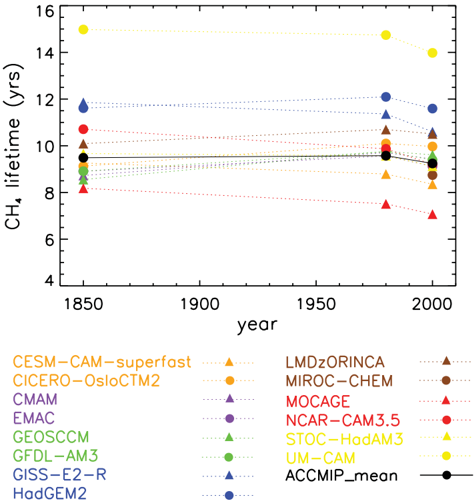
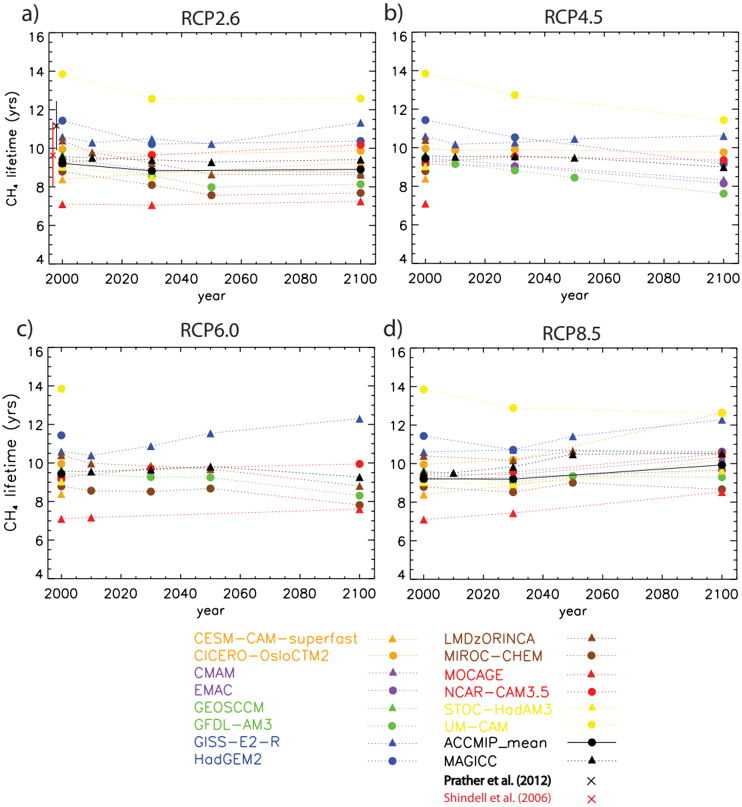
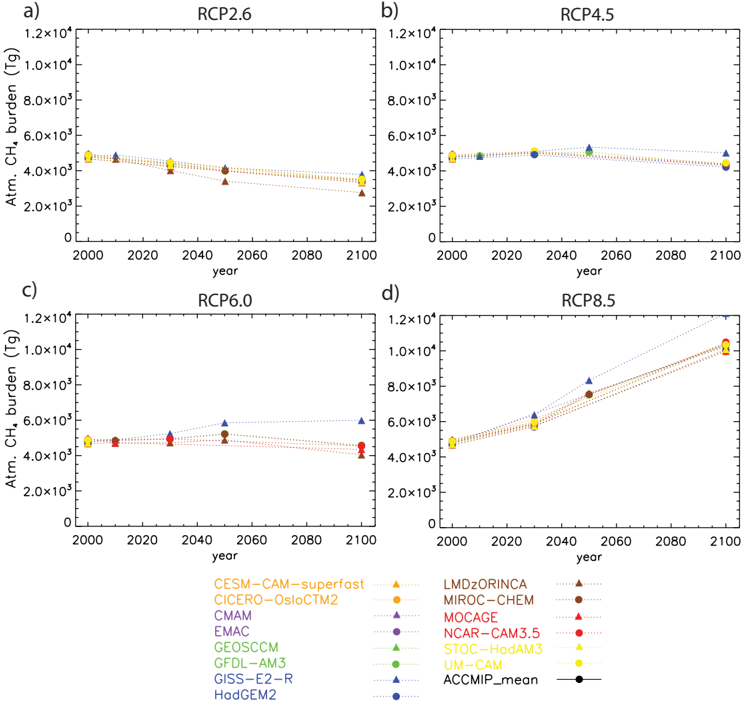
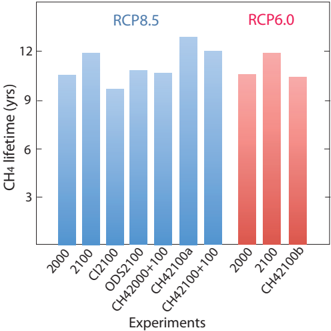
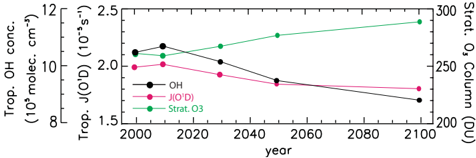
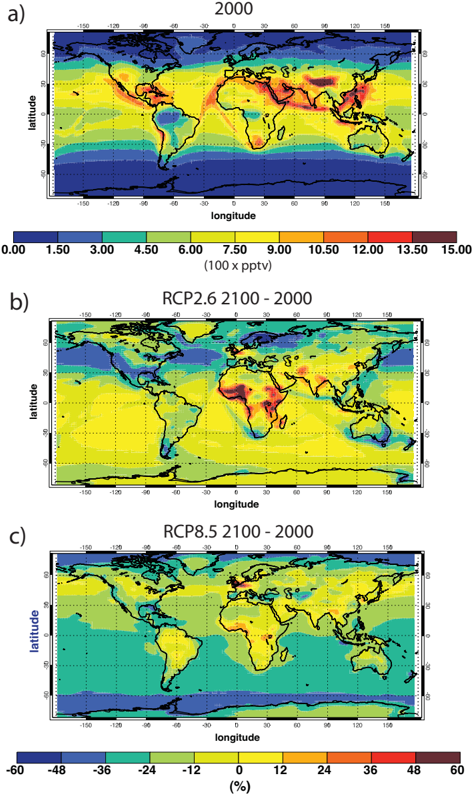
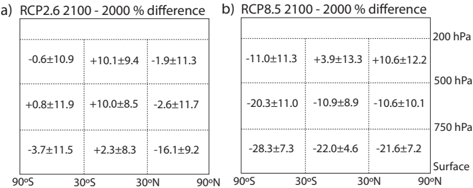
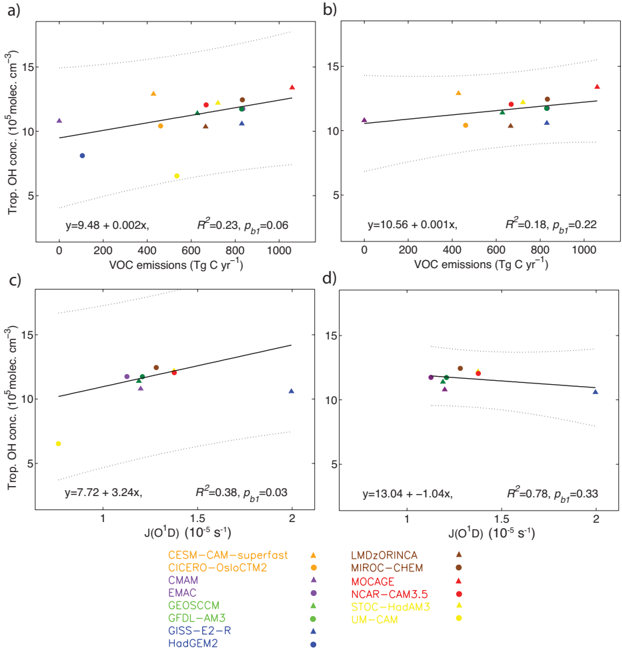
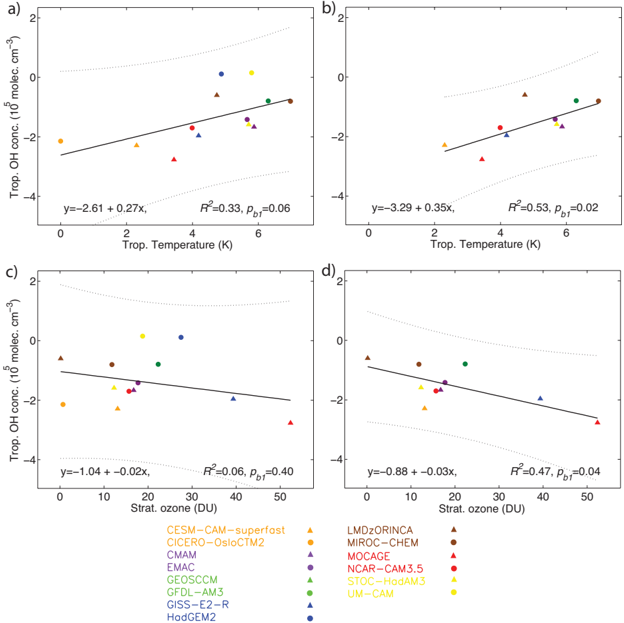
Results from simulations performed for the Atmospheric Chemistry and Climate Modeling Intercomparison Project (ACCMIP) are analysed to examine how OH and methane lifetime may change from present day to the future, under different climate and emissions scenarios. Present day (2000) mean tropospheric chemical lifetime derived from the ACCMIP multi-model mean is 9.8 ± 1.6 yr (9.3 ± 0.9 yr when only including selected models), lower than a recent observationally-based estimate, but with a similar range to previous multi-model estimates. Future model projections are based on the four Representative Concentration Pathways (RCPs), and the results also exhibit a large range. Decreases in global methane lifetime of 4.5 ± 9.1% are simulated for the scenario with lowest radiative forcing by 2100 (RCP 2.6), while increases of 8.5 ± 10.4% are simulated for the scenario with highest radiative forcing (RCP 8.5). In this scenario, the key driver of the evolution of OH and methane lifetime is methane itself, since its concentration more than doubles by 2100 and it consumes much of the OH that exists in the troposphere. Stratospheric ozone recovery, which drives tropospheric OH decreases through photolysis modifications, also plays a partial role. In the other scenarios, where methane changes are less drastic, the interplay between various competing drivers leads to smaller and more diverse OH and methane lifetime responses, which are difficult to attribute. For all scenarios, regional OH changes are even more variable, with the most robust feature being the large decreases over the remote oceans in RCP8.5. Through a regression analysis, we suggest that differences in emissions of non-methane volatile organic compounds and in the simulation of photolysis rates may be the main factors causing the differences in simulated present day OH and methane lifetime. Diversity in predicted changes between present day and future OH was found to be associated more strongly with differences in modelled temperature and stratospheric ozone changes. Finally, through perturbation experiments we calculated an OH feedback factor (F) of 1.24 from present day conditions (1.50 from 2100 RCP8.5 conditions) and a climate feedback on methane lifetime of 0.33 ± 0.13 yr K−1, on average. Models that did not include interactive stratospheric ozone effects on photolysis showed a stronger sensitivity to climate, as they did not account for negative effects of climate-driven stratospheric ozone recovery on tropospheric OH, which would have partly offset the overall OH/methane lifetime response to climate change.
Overview
The claims and statistics of this paper haven’t been checked yet.
Free: it reads the open-access text and checks the first 5 claims that cite a source we can check. Create a free account to check every claim.
Integrity signals
Registry
Cites
Statistics
Figures
Verification
Claims the paper makes
The claims and statistics of this paper haven’t been checked yet.
Free: it reads the open-access text and checks the first 5 claims that cite a source we can check. Create a free account to check every claim.
Claims other papers make about this one
Each is checked against this paper’s own text: does it say what the citing paper says it does?
The cited source says what the claim attributes to it.
In the citing paper
“The TROPOS CH4 lifetimes agree relatively well with other studies (e.g., Holmes et al., 2013; Voulgarakis et al., 2013; Dals ø ren et al., 2016) not only in terms of absolute numbers but also the rate of changes; a detailed comparison is presented in Table D.3.”
From The contribution of global aviation to anthropogenic climate forcing for 2000 to 2018 (2021) · cites this paper as Voulgarakis et al., 2013
Self-check
Percentages, sums and reported differences re-computed from the paper’s own numbers.
The self-check needs the paper’s full text.
Citations
Cites
Climate change 2007: the physical science basis
Solomon, S., Qin, D., Manning, M., Marquis, M. C., Averyt, K. B., Tignor, M., Miller, H. L., & Chen, Z. (2007) · Cited by 24,705
The representative concentration pathways: an overview
van Vuuren, D. P., Edmonds, J., Kainuma, M., Riahi, K., Thomson, A., Hibbard, K., Hurtt, G. C., Kram, T., Krey, V., Lamarque, J.-F., et al. (2011) · Climatic Change · doi:10.1007/s10584-011-0148-z · Cited by 7,741
The RCP greenhouse gas concentrations and their extensions from 1765 to 2300
Meinshausen, M., Smith, S. J., Calvin, K., Daniel, J. S., Kainuma, M. L. T., Lamarque, J.-F., Matsumoto, K., Montzka, S. A., Raper, S. C. B., Riahi, K., et al. (2011) · Climatic Change · doi:10.1007/s10584-011-0156-z · Cited by 3,584
Lamarque, J.-F., Bond, T. C., Eyring, V., Granier, C., Heil, A., Klimont, Z., Lee, D., Liousse, C., Mieville, A., Owen, B., et al. (2010) · Atmospheric Chemistry and Physics · doi:10.5194/acp-10-7017-2010 · Cited by 2,105 · cited 1×
“former two; Landgraf and Crutzen (1998) for the latter three), while HadGEM2 and UM-CAM used offline rates (Law and Pyle 1993).”
Atkinson, R., Baulch, D. L., Cox, R. A., Crowley, J. N., Hampson, R. F., Hynes, R. G., Jenkin, M. E., Rossi, M. J., & Troe, J. (2004) · Atmospheric Chemistry and Physics · doi:10.5194/acp-4-1461-2004 · Cited by 2,025
Tropospheric chemistry: A global perspective
Logan, J. A., Prather, M. J., Wofsy, S. C., & McElroy, M. B. (1981) · Journal of Geophysical Research: Oceans · doi:10.1029/jc086ic08p07210 · Cited by 1,888
Development and evaluation of an Earth-System model – HadGEM2
Collins, W. J., Bellouin, N., Doutriaux-Boucher, M., Gedney, N., Halloran, P., Hinton, T., Hughes, J., Jones, C. D., Joshi, M., Liddicoat, S., et al. (2011) · Geoscientific Model Development · doi:10.5194/gmd-4-1051-2011 · Cited by 1,516
MIROC-ESM 2010: model description and basic results of CMIP5-20c3m experiments
Watanabe, S., Hajima, T., Sudo, K., Nagashima, T., Takemura, T., Okajima, H., Nozawa, T., Kawase, H., Abe, M., Yokohata, T., et al. (2011) · Geoscientific Model Development · doi:10.5194/gmd-4-845-2011 · Cited by 1,395
Multimodel ensemble simulations of present‐day and near‐future tropospheric ozone
Stevenson, D. S., Dentener, F. J., Schultz, M. G., Ellingsen, K., van Noije, T. P. C., Wild, O., Zeng, G., Amann, M., Atherton, C. S., Bell, N., et al. (2006) · Journal of Geophysical Research: Atmospheres · doi:10.1029/2005jd006338 · Cited by 1,198
Normal Atmosphere: Large Radical and Formaldehyde Concentrations Predicted
Levy, H. (1971) · Science · doi:10.1126/science.173.3992.141 · Cited by 1,076
Research works printed but not linked: 4
- IPCC (Intergovernmental Panel on Climate Change): Special report on emissions scenarios: a special report of Working Group III of the Intergovernmental Panel on Climate Change, 599 pp., Cam- bridge University Press, Cambridge, UK, 2000.
- Klinger, Carolin, Quantitative evaluation of ozone and selected cli- mate parameters in the chemistry-climate model EMAC, Mas- ter thesis, Ludwig Maximilian University (LMU), Munich, Ger- many, December 2011.
- Meehl, G. A., Stocker, T. F., Collins, W. D., Friedlingstein, P., Gaye, A. T., Gregory, J. M., Kitoh, A., Knutti, R., Murphy, J. M., Noda, A., Raper, S. C. B., Watterson, I. G., Weaver, A. J., and Zhao, Z.-C.: Global climate projections, in: Climate Change 2007: The Physical Science Basis. Contribution of Working Group I to the Fourth Assessment Report of the Intergovernmental Panel on Climate Change, edited by: Solomon, S., Qin, D., Manning, M., Chen, Z., Marquis, M., Averyt, K. B., Tignor, M., and Miller, H. L., Cambridge Univ. Press, Cambridge, UK and New York, NY, USA, 2007.
- Prather, M., Ehhalt, D., Prather, M., Dentener, F., Derwent, R., Dlu- gokencky, E., Holland, E., Isaksen, I., Katima, J., Kirchhoff, V., Matson, P., Midgley, P., and Wang, M.: Atmospheric chemistry and greenhouse gases, in: Climate Change 2001: The Scientific Basis. Contribution of Working Group I to the Third Assessment Report of the Intergovernmental Panel on Climate Change, edited by: Houghton, J. T., Ding, Y., Griggs, D. J., Noguer, M., van der Linden, P. J., Dai, X., Maskell, K., and Johnson, C. A., Cam- bridge Univ. Press, Cambridge, UK, 239-287, 2001.
Cited by
Items 201–300 of 325
Field, R. D., Luo, M., Kim, D., C, A. D. D. G., Voulgarakis, A., & Worden, J. R. (2015) · Journal of Geophysical Research Atmospheres · doi:10.1002/2015jd023402 · Cited by 15
“Chatfield et al. [1998], for example, required an arbitrary 150% increase in parameterized cloud base mass flux for CO at the surface to reach the upper troposphere, but this required an increase in emissions to maintain reasonable CO concentrations in the lower troposphere.”
BackgroundRevising VOC emissions speciation improves the simulation of global background ethane and propane
Rowlinson, M., Evans, M. J., Carpenter, L. J., Read, K., Punjabi, S., Adedeji, A., Fakes, L., Lewis, A., Richmond, B., Passant, N. R., et al. (2024) · Atmospheric chemistry and physics · doi:10.5194/acp-24-8317-2024 · Cited by 20
Nalam, A., Lupaşcu, A., Ansari, T. U., & Butler, T. M. (2025) · Atmospheric chemistry and physics · doi:10.5194/acp-25-5287-2025 · Cited by 23
GLOBAL METHANE CYCLE: A REVIEW
Eliseev, A. V. (2018) · Fundamental and Applied Climatology · doi:10.21513/2410-8758-2018-1-52-70 · Cited by 24
Glotfelty, T., Zhang, Y., Karamchandani, P., & Streets, D. G. (2016) · Atmospheric Environment · doi:10.1016/j.atmosenv.2016.05.008 · Cited by 19
Guo, H., Flynn, C. M., Prather, M. J., Strode, S. A., Steenrod, S. D., Emmons, L. K., Lacey, F. G., Lamarque, J., Fiore, A. M., Correa, G. J. P., et al. (2023) · Atmospheric chemistry and physics · doi:10.5194/acp-23-99-2023 · Cited by 13
“◦ with high sun, dominates the budget It is seen in previous model intercomparisons that calculate budgets in large tropo-spheric blocks like Voulgarakis et al. (2013) with 63 % of L-CH4 in 31 % of the air mass (500 hPa–surface, 30 S–30 N).”
BackgroundLingaswamy, A. P., Arafath, S. M., Balakrishnaiah, G., Gopal, K. R., Reddy, N. S. K., Reddy, K. R. O., Reddy, R. R., & Tandule, C. R. (2017) · Atmospheric Environment · doi:10.1016/j.atmosenv.2017.03.048 · Cited by 14
Sabia, E., Zanon, T., Braghieri, A., Pacelli, C., Angerer, V., & Gauly, M. (2024) · The Science of The Total Environment · doi:10.1016/j.scitotenv.2024.170798 · Cited by 16
Mertens, M., Brinkop, S., Graf, P., Grewe, V., Hendricks, J., Jöckel, P., Lanteri, A., Matthes, S., Rieger, V., Righi, M., et al. (2024) · Atmospheric chemistry and physics · doi:10.5194/acp-24-12079-2024 · Cited by 17
Net radiative forcing and air quality responses to regional CO emission reductions
Fry, M. M., Schwarzkopf, M. D., Adelman, Z. E., Naïk, V., Collins, W. J., & West, J. J. (2013) · Atmospheric chemistry and physics · doi:10.5194/acp-13-5381-2013 · Cited by 15
Westervelt, D. M., Fiore, A. M., Baublitz, C. B., & Correa, G. J. P. (2021) · Atmospheric chemistry and physics · doi:10.5194/acp-21-6799-2021 · Cited by 13
Heterogeneity and chemical reactivity of the remote troposphere defined by aircraft measurements
Guo, H., Flynn, C. M., Prather, M. J., Strode, S. A., Steenrod, S. D., Emmons, L. K., Lacey, F. G., Lamarque, J., Fiore, A. M., Correa, G. J. P., et al. (2021) · Atmospheric chemistry and physics · doi:10.5194/acp-21-13729-2021 · Cited by 11
Sensitivity of climate effects of hydrogen to leakage size, location, and chemical background
Skeie, R. B., Sandstad, M., Krishnan, S., Myhre, G., & Sand, M. (2025) · Atmospheric chemistry and physics · doi:10.5194/acp-25-4929-2025 · Cited by 15
Joly, L., Coopmann, O., Guidard, V., Decarpenterie, T., Dumelié, N., Cousin, J., Burgalat, J., Chauvin, N., Albora, G., Maamary, R., et al. (2020) · Atmospheric measurement techniques · doi:10.5194/amt-13-3099-2020 · Cited by 20
“Atmospheric residence time is a few decades for CH4, whose reactivity makes it an important player in atmospheric chemistry (Voulgarakis et al., 2013), and a few hundred to thousands of years for CO2 which is inert in the atmosphere from a chemical point of view (Archer and Brovkin, 2008; Eby et…”
BackgroundPrather, M. J., Guo, H., & Xin, Z. (2023) · Earth system science data · doi:10.5194/essd-15-3299-2023 · Cited by 13
Assessing the lifetime of anthropogenic CO 2 and its sensitivity to different carbon cycle processes
Kaufhold, C., Willeit, M., Liu, B., & Ganopolski, A. (2025) · Biogeosciences · doi:10.5194/bg-22-2767-2025 · Cited by 17
Tsuruta, J., Okumura, M., Makita, N., Kosugi, Y., Miyama, T., Kume, T., & Tohno, S. (2018) · Journal of Forest Research · doi:10.1080/13416979.2018.1483129 · Cited by 10
“1995), and the higher reactivity of BVOCs with hydroxyl radicals than most anthropogenic VOCs indirectly leads to an increase in the methane concentration through their effects on the fate of hydroxyl radicals in the troposphere (Fall 1999; Voulgarakis et al. 2013).”
BackgroundLee, B. H., Munger, J. W., Wofsy, S. C., Rizzo, L. V., Yoon, J., Turner, A. J., Thornton, J. A., & Swann, A. L. S. (2024) · Geophysical Research Letters · doi:10.1029/2023gl107214 · Cited by 12
“The sensitivity of the burden and lifetime of methane to global OH levels is well studied (Squire et al., 2015; Voulgarakis et al., 2013; Wild et al., 2020; Zhao et al., 2020).”
Key role of short-lived halogens on global atmospheric oxidation during historical periods
Bossolasco, A. G., Fernández, R. P., Li, Q., Mahajan, A. S., Villamayor, J., Barrera, J. A., Heard, D. E., Cuevas, C. A., Caram, C., Szopa, S., et al. (2025) · Environmental Science Atmospheres · doi:10.1039/d4ea00141a · Cited by 13
“9,12,18 This agreement provides con dence in the model's ability to represent the complex interactions between OH and other atmospheric species.”
An improved method for atmospheric 14 CO measurements
Petrenko, V. V., Smith, A. M., II, Crosier, E. M., Kazemi, R., Place, P. F., Colton, A., Yang, B., Hua, Q., & Murray, L. T. (2021) · Atmospheric measurement techniques · doi:10.5194/amt-14-2055-2021 · Cited by 12
Stecher, L., Winterstein, F., Dameris, M., Jöckel, P., Ponater, M., & Kunze, M. (2021) · Atmospheric chemistry and physics · doi:10.5194/acp-21-731-2021 · Cited by 11
“Following Winterstein et al. (2019) we calculate the stratosphere adjusted temperature response 1Tadj to changes in CH4, tropospheric and stratospheric H2O, and tropospheric and stratospheric O3 as well as their individual contributions for S2 MLO and S5 MLO (see Fig.”
MethodDrivers of persistent changes in the global methane cycle under aggressive mitigation action
Folberth, G., JONES, C. D., O’Connor, F. M., Gedney, N., Griffiths, P. T., & Wiltshire, A. (2025) · npj Climate and Atmospheric Science · doi:10.1038/s41612-024-00867-z · Cited by 20
Adame, J. A., Padilla, R., Gutiérrez-Álvarez, I., Bogeat, J. A., Lopez, A., & Yela, M. (2024) · Atmospheric Research · doi:10.1016/j.atmosres.2024.107221 · Cited by 10
Arata, C. M., Rahn, T. A., & Dubey, M. K. (2016) · The Journal of Physical Chemistry A · doi:10.1021/acs.jpca.5b12737 · Cited by 9
Leaf carbon monoxide emissions under different drought, heat, and light conditions in the field
Muller, J. D., Qubaja, R., Koh, E., Stern, R., Bohak, Y., Tatarinov, F. A., Rotenberg, E., & Yakir, D. (2025) · New Phytologist · doi:10.1111/nph.20424 · Cited by 9
Cluster-based analysis of multi-model climate ensembles
Hyde, R., Hossaini, R., & Leeson, A. A. (2018) · Geoscientific model development · doi:10.5194/gmd-11-2033-2018 · Cited by 7
“…computed from a simple arithmetic mean of all models (i.e. a one model, one vote approach), such as during the recent Atmospheric Chemistry and Climate Model Intercomparison Project (ACCMIP) studies of tropospheric ozone and the hydroxyl radical, OH (Young et al., 2013; Voulgarakis et al., 2013).”
MethodLinkages between ozone-depleting substances, tropospheric oxidation and aerosols
Voulgarakis, A., Shindell, D. T., & Faluvegi, G. (2013) · Atmospheric chemistry and physics · doi:10.5194/acp-13-4907-2013 · Cited by 10
Stratospheric distribution of methane over a tropical region as observed by MIPAS on board ENVISAT
Nair, P. R., & Kavitha, M. (2020) · International Journal of Remote Sensing · doi:10.1080/01431161.2020.1779376 · Cited by 7
Source attribution of near-surface ozone pollution in Jiangsu Province of China over 2013–2019
He, S., Yang, Y., Wang, H., Wang, P., & Liao, H. (2025) · Atmospheric Environment · doi:10.1016/j.atmosenv.2025.121205 · Cited by 6
Pang, X., Shang, Q., Chen, L., Sun, S., Zhao, G., Wu, Z., Zhao, C., Lu, Y., Sun, Q., Lyu, Y., et al. (2024) · Journal of Environmental Sciences · doi:10.1016/j.jes.2024.03.045 · Cited by 7
Sources and Variability of Greenhouse Gases over Greece
Bougiatioti, A., Gialesakis, N., Sarafidis, Y., Gini, M. I., Mermigkas, M., Kalkavouras, P., Mirasgedis, S., Ramonet, M., Narbaud, C., Lopez, M., et al. (2024) · Atmosphere · doi:10.3390/atmos15111288 · Cited by 8
Stecher, L., Winterstein, F., Jöckel, P., Ponater, M., Mertens, M., & Dameris, M. (2025) · Atmospheric chemistry and physics · doi:10.5194/acp-25-5133-2025 · Cited by 12
López-Comí, L., Morgenstern, O., Zeng, G., Masters, S. L., Querel, R., & Nedoluha, G. E. (2016) · Atmospheric chemistry and physics · doi:10.5194/acp-16-14599-2016 · Cited by 7
Surface temperature and ozone responses to the 2030 Global Methane Pledge
Predybaylo, E., Lelieveld, J., Pozzer, A., Gromov, S. A., Zimmermann, P. H., Osipov, S., Klingmüller, K., Steil, B., Stenchikov, G. L., & McCabe, M. F. (2025) · Climatic Change · doi:10.1007/s10584-025-03908-5 · Cited by 11
“The future OH and methane lifetime under different climate and emissions scenarios in EMAC are compared to other atmospheric chemistry GCMs in Voulgarakis et al. (2013).”
Feng, C., Chen, S., Zeng, Z., Luo, Y., Natraj, V., & Yung, Y. L. (2024) · Earth and Space Science · doi:10.1029/2024ea003519 · Cited by 7
“Methane (CH 4 ) is a short‐lived (steady‐state lifetime about 9 years, Voulgarakis et al., 2013) greenhouse gas and the second‐most abundant after carbon dioxide (CO 2 ) (Montzka et al., 2011).”
Padilla, R., Adame, J. A., Hidalgo, P. J., Bolívar, J. P., & Yela, M. (2024) · Atmospheric Environment · doi:10.1016/j.atmosenv.2024.120665 · Cited by 7
Ming, T., de Richter, R. K., Felzer, B. S., & Li, W. (2025) · Atmosphere · doi:10.3390/atmos16040406 · Cited by 5
Short-lived halogen sources and chemistry in the Community Earth System Model v2 (CESM2-SLH)
Fernández, R. P., Cuevas, C. A., Villamayor, J., Feinberg, A. I., Kinnison, D. E., Vitt, F. M., Bossolasco, A. G., Barrera, J. A., Reynoso, A., Tomazzeli, O. G., et al. (2026) · Geoscientific model development · doi:10.5194/gmd-19-9325-2026 · Cited by 14
Identifying under-characterized atmospheric methane emission sources in Western Maryland
Li, Z., Reeder, M. D., Litten, J., & Pekney, N. J. (2019) · Atmospheric Environment · doi:10.1016/j.atmosenv.2019.117053 · Cited by 4
Kim, Y., Tsunogai, S., & Тanaka, N. (2021) · Polar Science · doi:10.1016/j.polar.2021.100681 · Cited by 4
Projection of PM2.5 and Ozone Concentration Changes over the Jing-Jin-Ji Region in China
Jie, W., Xu, Y., & Bing, Z. (2015) · Atmospheric and Oceanic Science Letters · doi:10.3878/aosl20140102 · Cited by 4
“Voulgarakis et al. (2013) found that hydroxide and methane show large uncertainties under different emissions scenarios.”
BackgroundComparing imaging spectroscopy and in situ observations of Chino dairy complex emissions
Leifer, I., Melton, C., Tratt, D. M., Frash, J., Gupta, M. X., Leen, J. B., Buckland, K. N., & Johnson, P. D. (2016) · Workshop on Hyperspectral Image and Signal Processing: Evolution in Remote Sensing · doi:10.1109/whispers.2016.8071725 · Cited by 4
Morgenstern, O., Zeng, G., Abraham, N. L., Telford, P. J., Braesicke, P., Pyle, J. A., Hardiman, S. C., O’Connor, F. M., & Johnson, C. E. (2014) · Journal of Geophysical Research Atmospheres · doi:10.1002/2014jd021515 · Cited by 4
Wang, P., Chen, T., Zhang, S., & Wang, F. (2025) · Atmospheric Research · doi:10.1016/j.atmosres.2025.108633 · Cited by 4
Wild, O., & Ryan, E. (2026) · Atmospheric chemistry and physics · doi:10.5194/acp-26-2255-2026 · Cited by 11
Changes in global atmospheric oxidant chemistry from land cover conversion
Vella, R., Gromov, S., Nussbaumer, C. M., Stecher, L., Kohl, M., Ruhl, S., Tost, H., Lelieveld, J., & Pozzer, A. (2025) · Atmospheric chemistry and physics · doi:10.5194/acp-25-9885-2025 · Cited by 4
Effects of different emission inventories on tropospheric ozone and methane lifetime
Acquah, C., Stecher, L., Mertens, M., & Jöckel, P. (2025) · Atmospheric chemistry and physics · doi:10.5194/acp-25-13665-2025 · Cited by 3
Семенов, С. М., & Ran’kova, E. Y. (2018) · Fundamental and Applied Climatology · doi:10.21513/2410-8758-2018-4-105-120 · Cited by 3
Семенов, С. М., & Ran’kova, E. Y. (2018) · Fundamental and Applied Climatology · doi:10.21513/2410-8758-2018-4-71-87 · Cited by 3
Improving estimates of the atmospheric oxidative capacity and Amazon fire emissions
Naus, S. (2021) · doi:10.18174/536720 · Cited by 5
Ghosh, S., Cholakian, A., Mailler, S., & Menut, L. (2025) · Atmospheric chemistry and physics · doi:10.5194/acp-25-6273-2025 · Cited by 5
Kuzovkin, V. V., & Семенов, С. М. (2020) · Fundamental and Applied Climatology · doi:10.21513/2410-8758-2020-3-05-21 · Cited by 2
Global impact of monocyclic aromatics on tropospheric compositionPreprint
Cabrera-Perez, D., Taraborrelli, D., Lelieveld, J., Hoffmann, T., & Pozzer, A. (2017) · doi:10.5194/acp-2017-928 · Cited by 2
Brown‐Steiner, B., Selin, N. E., Prinn, R. G., Tilmes, S., Emmons, L. K., Lamarque, J., & Cameron-Smith, P. J. (2018) · doi:10.5194/gmd-2018-16-supplement · Cited by 2
Drivers of persistent changes in the global methane cycle under aggressive mitigation actionPreprint
Folberth, G., O’Connor, F. M., JONES, C. D., Gedney, N., & Wiltshire, A. J. (2024) · Research Square · doi:10.21203/rs.3.rs-4078060/v1 · Cited by 2
Atmospheric Mixing Ratios of Ozone and Radiative Forcing
Sudo, K. (2023) · Springer eBooks · doi:10.1007/978-981-15-2760-9_30 · Cited by 3
Pandey, A. K., Stevenson, D. S., Zhao, A., Pope, R. J., Hossaini, R., Kumar, K., & Chipperfield, M. P. (2025) · Atmospheric chemistry and physics · doi:10.5194/acp-25-4785-2025 · Cited by 1
DiGangi, J. P., Diskin, G. S., Yoon, S., Alvarez, S. L., Flynn, J., Robinson, C. E., Shook, M. A., Thornhill, K. L., Winstead, E. L., Ziemba, L. D., et al. (2025) · Atmospheric chemistry and physics · doi:10.5194/acp-25-17387-2025 · Cited by 1
Historical and Contemporary Global Methane Cycling
Ussiri, D. A. N., & Lal, R. (2017) · Springer eBooks · doi:10.1007/978-3-319-53845-7_7 · Cited by 3
Diurnal Pattern of PM10 and CO in Riau as a Forest Fire Risk Area
Sumaryati, Budiwati, T., Indrawati, A., & Syahrial (2019) · IOP Conference Series Earth and Environmental Science · doi:10.1088/1755-1315/303/1/012041 · Cited by 1
Семенов, С. М. (2018) · Fundamental and Applied Climatology · doi:10.21513/2410-8758-2018-3-82-95 · Cited by 2
de Bruyn, N. (2021) · doi:10.22215/etd/2021-14581 · Cited by 1
Aamaas, B. (2016) · NVA (Nasjonalt vitenarkiv)
Pollutants: Aqueous Organic, Nonthermal Degradation
Reddy, P. M. K., & Subrahmanyam, C. (2016) · CRC Press eBooks · doi:10.1081/e-eplt-120051262
Antarctic scientists begin hunt for sky’s ‘detergent’
Phillips, N. (2018) · Nature · doi:10.1038/d41586-018-07422-w
Sources of variability in short-lived climate pollutants and their effect on climate
Rowlinson, M. (2019) · White Rose eTheses Online (University of Leeds, The University of Sheffield, University of York)
Westervelt, D. M. (2021) · Atmospheric chemistry and physics · doi:10.5194/acp-2020-1255-ac1
Murray, L. T. (2021) · Geoscientific model development · doi:10.5194/gmd-2021-144-ac1
(2021) · Geoscientific model development · doi:10.5194/gmd-2021-201-cec1
Ye, Q. (2021) · Geoscientific model development · doi:10.5194/gmd-2021-201-ac1
Ye, Q. (2021) · Geoscientific model development · doi:10.5194/gmd-2021-201-ac2
Caram, C., Szopa, S., Cozic, A., et al. (2022) · Geoscientific model development · doi:10.5194/gmd-2021-388-cc1
(2021) · Geoscientific model development · doi:10.5194/gmd-2021-201-cec2
(2021) · Atmospheric chemistry and physics · doi:10.5194/acp-2020-1255-rc1
(2021) · Geoscientific model development · doi:10.5194/gmd-2021-201-rc2
(2022) · Geoscientific model development · doi:10.5194/gmd-2022-44-rc1
Anderson, D. C. (2022) · Geoscientific model development · doi:10.5194/gmd-2022-44-ac1
(2022) · Geoscientific model development · doi:10.5194/gmd-2022-44-cec1
(2022) · Geoscientific model development · doi:10.5194/gmd-2022-44-cec2
(2022) · Geoscientific model development · doi:10.5194/gmd-2022-44-rc2
Ye, Q. (2021) · Geoscientific model development · doi:10.5194/gmd-2021-201-ac3
Ye, Q. (2021) · Geoscientific model development · doi:10.5194/gmd-2021-201-ac4
Murray, L. T., Leibensperger, E. M., Orbe, C., et al. (2021) · Geoscientific model development · doi:10.5194/gmd-2021-144-rc1
“It is common for atmospheric models to be biased high with respect to OH in these observational constraints (i.e., low with respect to lifetime, e.g., Naik et al., 2013; Voulgarakis et al., 2013), which is true as well in our three simulations.”
BackgroundInfluentialMurray, L. T., Mickley, L. J., Kaplan, J. O., Sofen, E. D., Pfeiffer, M., & Alexander, B. (2013) · doi:10.5194/acpd-13-24517-2013-supplement
(2021) · Geoscientific model development · doi:10.5194/gmd-2021-201-rc1
Terrenoire, E., Hauglustaine, D. A., Cohen, Y., et al. (2022) · Atmospheric chemistry and physics · doi:10.5194/acp-2022-222-rc1
Anderson, D. C. (2022) · Geoscientific model development · doi:10.5194/gmd-2022-44-ac3
Anderson, D. C. (2022) · Geoscientific model development · doi:10.5194/gmd-2022-44-ac2
(2022) · Atmospheric chemistry and physics · doi:10.5194/acp-2022-222-rc2
Urban Methane Emissions in Auckland, New Zealand
O'Sullivan-Moffat, H. (2022) · doi:10.26686/wgtn.20086670
Hauglustaine, D. A. (2022) · Atmospheric chemistry and physics · doi:10.5194/acp-2022-222-ac2
Hauglustaine, D. A. (2022) · Atmospheric chemistry and physics · doi:10.5194/acp-2022-222-ac1
(2022) · Atmospheric chemistry and physics · doi:10.5194/acp-2022-438-rc1
(2022) · Atmospheric chemistry and physics · doi:10.5194/acp-2022-438-rc2
Carter, T. S. (2022) · Atmospheric chemistry and physics · doi:10.5194/acp-2022-438-ac1
(2022) · Atmospheric chemistry and physics · doi:10.5194/acp-2022-631-rc1
(2022) · Atmospheric chemistry and physics · doi:10.5194/acp-2022-631-rc2
Prather, M. J. (2022) · Atmospheric chemistry and physics · doi:10.5194/acp-2022-631-ac1
Prather, M. J. (2022) · Atmospheric chemistry and physics · doi:10.5194/acp-2022-631-ac2
Thanks and response to RC1 with a query
Prather, M. J. (2023) · Earth system science data · doi:10.5194/essd-2023-110-ac1
Metadata
- Authors
- Voulgarakis, A., Naik, V., Lamarque, J.-F., Shindell, D. T., Young, P. J., Prather, M. J., Wild, O., Field, R. D., Bergmann, D., Cameron-Smith, P., Cionni, I., Collins, W. J., Dalsøren, S. B., Doherty, R. M., Eyring, V., Faluvegi, G., Folberth, G. A., Horowitz, L. W., Josse, B., MacKenzie, I. A., Nagashima, T., Plummer, D. A., Righi, M., Rumbold, S. T., Stevenson, D. S., Strode, S. A., Sudo, K., Szopa, S., & Zeng, G.
- Affiliations
- Goddard Institute for Space Studies (US)
- NSF National Center for Atmospheric Research (US)
- Cooperative Institute for Research in Environmental Sciences (US)
- University of California, Irvine (US)
- Lancaster University (GB)
- Lawrence Livermore National Laboratory (US)
- National Agency for New Technologies, Energy and Sustainable Economic Development (IT)
- Met Office (GB)
- CICERO Center for International Climate Research (NO)
- University of Edinburgh (GB)
- Imperial College London (GB)
- NOAA Geophysical Fluid Dynamics Laboratory (US)
- Centre National de la Recherche Scientifique (FR)
- National Institute for Environmental Studies (JP)
- Environment and Climate Change Canada (CA)
- Deutsches Zentrum für Luft- und Raumfahrt e. V. (DLR) (DE)
- Goddard Space Flight Center (US)
- National Institute of Water and Atmospheric Research (NZ)
- ORCID
- Voulgarakis, A.
- Lamarque, J.-F.
- Shindell, D. T.
- Young, P. J.
- Prather, M. J.
- Wild, O.
- Field, R. D.
- Bergmann, D.
- Cameron-Smith, P.
- Cionni, I.
- Collins, W. J.
- Dalsøren, S. B.
- Doherty, R. M.
- Eyring, V.
- Faluvegi, G.
- Folberth, G. A.
- Horowitz, L. W.
- Josse, B.
- Plummer, D. A.
- Righi, M.
- Rumbold, S. T.
- Stevenson, D. S.
- Strode, S. A.
- Sudo, K.
- Szopa, S.
- Zeng, G.
- Venue
- Atmospheric chemistry and physics
- Publisher
- Copernicus GmbH
- Published
- 2013-03-05
- Volume
- 13
- Issue
- 5
- Pages
- 2563-2587
- ISSN
- 1680-7316 (ISSN-L)
- 1680-7324
- OpenAlex
- W2152387463
- Cited by
- 324
- References
- 95
- Citations by year
- 2026: 9 · 2025: 23 · 2024: 17 · 2023: 20 · 2022: 33 · 2021: 35 · 2020: 22 · 2019: 25 · 2018: 28 · 2017: 27 · 2016: 28 · 2015: 14 · 2014: 23 · 2013: 18
- FWCI
- 18.25
- Type
- journal article
- Language
- en
- Open access
- gold
- doi.org
- Licence
- Locations
- Atmospheric chemistry and physics (publishedVersion, cc-by)
- elib (German Aerospace Center) (submittedVersion)
- Lancaster EPrints (Lancaster University) (submittedVersion)
- HAL (submittedVersion, other-oa)
- DOAJ (DOAJ: Directory of Open Access Journals) (submittedVersion, cc-by-sa)
- eScholarship (California Digital Library) (submittedVersion, cc-by)
- ENEA Open Archive (National Agency for New Technologies, Energy and Sustainable Economic Development) (submittedVersion)
- Edinburgh Research Explorer (University of Edinburgh) (submittedVersion, cc-by)
- Funders
- National Science Foundation (DE-AC52-07-NA27344)
- U.S. Department of Energy (DEAC5207NA27344, AC52‐07NA27344, 05CH11231, Contract DE-AC52-07NA27344)
- National Aeronautics and Space Administration (DE-AC52-07NA27344)
- National Center for Atmospheric Research
- University Corporation for Atmospheric Research
- National Energy Research Scientific Computing Center (05CH11231)
- Deutsches Klimarechenzentrum
- Canadian Foundation for Climate and Atmospheric Sciences
- Department for Environment, Food and Rural Affairs, UK Government (GA01101)
- Centre National de la Recherche Scientifique
- Ministerio de Ciencia e Innovación
- Norges Forskningsråd
- Institut National Du Cancer
- Grand Équipement National De Calcul Intensif
- Scheme for Promotion of Academic and Research Collaboration
- Natural Environment Research Council (GA 01101, NE/I008063/1, NE/K001329/1)
- Leibniz-Gemeinschaft
- Japan Society for the Promotion of Science (25241006)
- Leibniz-Rechenzentrum
- Lawrence Livermore National Laboratory (DE‐AC5207NA27344, 07NA27344, Contract DE-AC52-07NA27344, AC52-07NA27344)
- SLAC National Accelerator Laboratory
- Topics
- Physical Sciences › Earth and Planetary Sciences › Atmospheric Science › Atmospheric chemistry and aerosols
- Physical Sciences › Earth and Planetary Sciences › Atmospheric Science › Atmospheric Ozone and Climate
- Physical Sciences › Environmental Science › Global and Planetary Change › Atmospheric and Environmental Gas Dynamics
- Keywords
- hydroxyl radicals, methane lifetime, tropospheric chemistry, RCP scenarios, stratospheric ozone recovery, photolysis, non-methane volatile organic compounds, methane emissions, radiative forcing, multi-model intercomparison
About these checks
Registry, retraction, Cites and statistics results are computed, not judged, with one exception: a printed reference that no index lists is read once by a model before it counts as a citation error. Claims are extracted by a model and kept only when their quote appears verbatim in the text; each cited source is then checked, with a model’s help, for whether it says what the claim relies on. Those verdicts can be wrong — read the claim’s quote and the cited source before relying on one.
Statistics and arithmetic are recomputed, not judged.
Confidence bands are shown only for fields calibrated on our annotated test set. None is calibrated yet, so no band is shown.
What counts as a claim ›How we measure confidence ›How we check this ›
Are you an author, or do you see a problem with this page? Request a review
Data sources
Bibliographic data: Semantic Scholar, OpenAlex, Crossref.
Contains information from the Semantic Scholar Academic Graph Datasets, made available under the ODC Attribution License (ODC-BY 1.0).
Semantic Scholar’s data is described in: Kinney, R., et al. (2023). The Semantic Scholar Open Data Platform. arXiv:2301.10140.
