

Analysis of present-day and future OH and methane lifetime in the ACCMIP simulations
Open accessPublished version of a preprint
The DOI matches its Crossref record; 105 of the 105 references it cites were found in a registry or an index.
Abstract
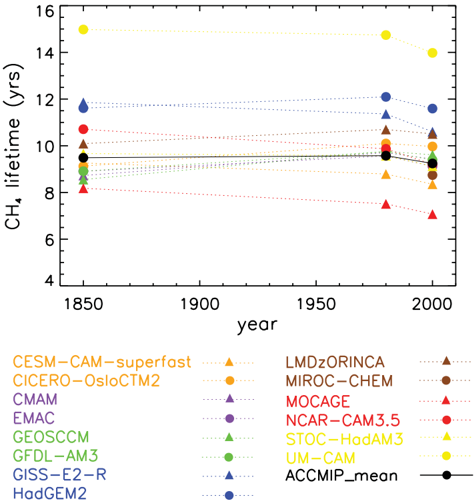
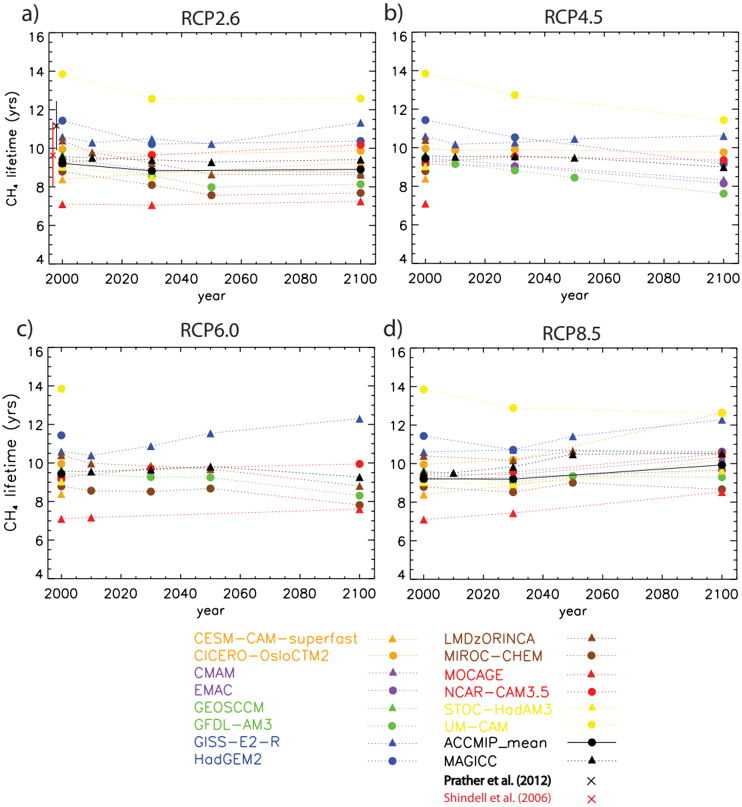
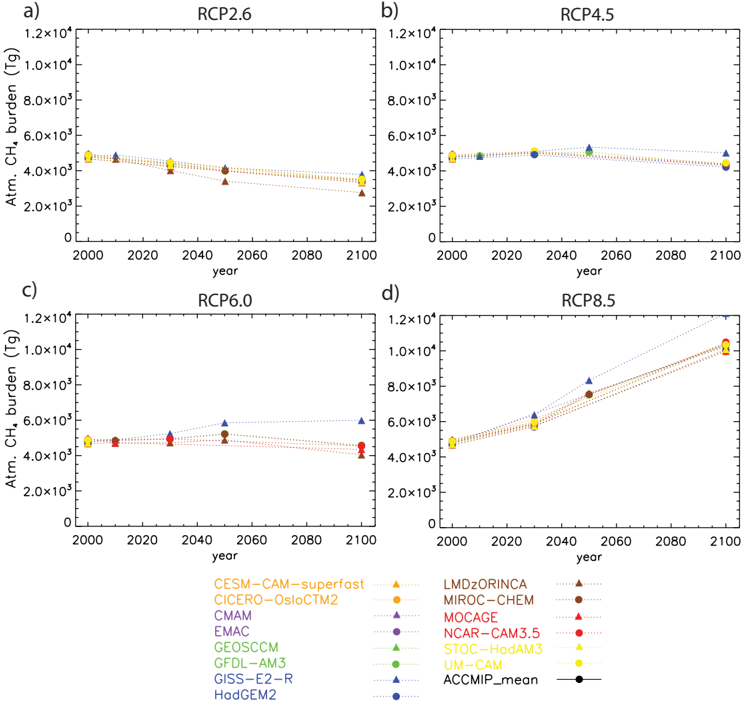
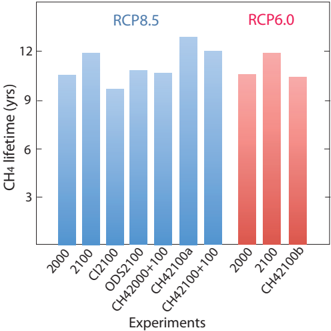
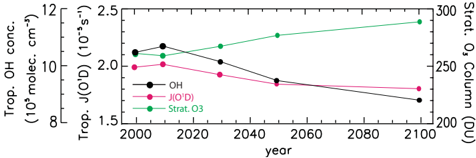
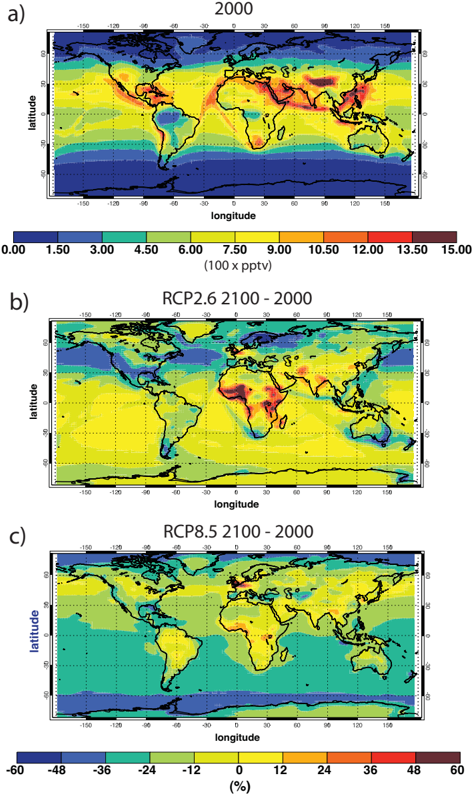
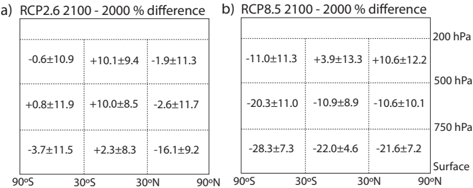
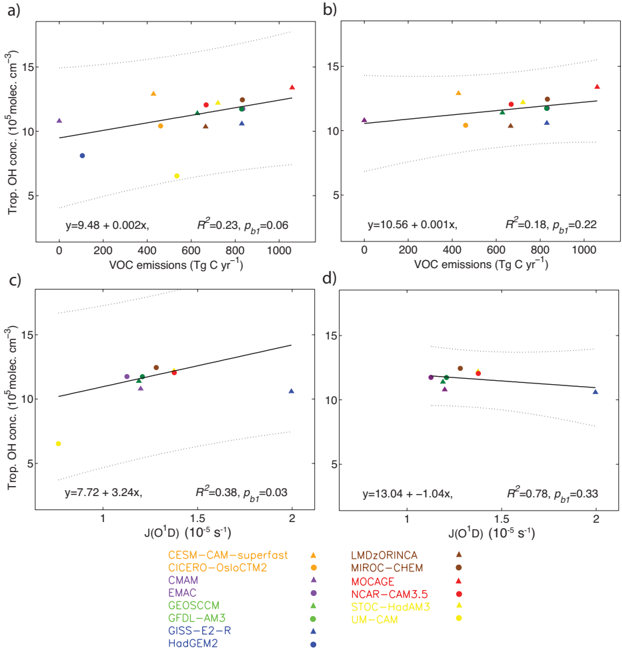
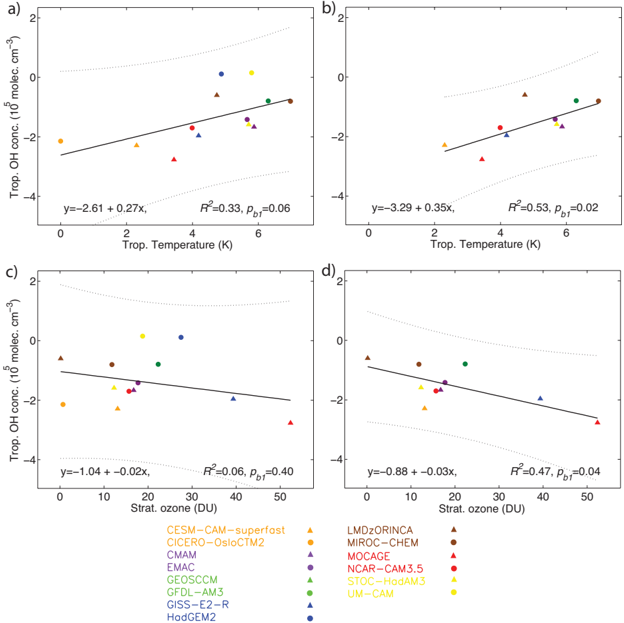
Results from simulations performed for the Atmospheric Chemistry and Climate Modeling Intercomparison Project (ACCMIP) are analysed to examine how OH and methane lifetime may change from present day to the future, under different climate and emissions scenarios. Present day (2000) mean tropospheric chemical lifetime derived from the ACCMIP multi-model mean is 9.8 ± 1.6 yr (9.3 ± 0.9 yr when only including selected models), lower than a recent observationally-based estimate, but with a similar range to previous multi-model estimates. Future model projections are based on the four Representative Concentration Pathways (RCPs), and the results also exhibit a large range. Decreases in global methane lifetime of 4.5 ± 9.1% are simulated for the scenario with lowest radiative forcing by 2100 (RCP 2.6), while increases of 8.5 ± 10.4% are simulated for the scenario with highest radiative forcing (RCP 8.5). In this scenario, the key driver of the evolution of OH and methane lifetime is methane itself, since its concentration more than doubles by 2100 and it consumes much of the OH that exists in the troposphere. Stratospheric ozone recovery, which drives tropospheric OH decreases through photolysis modifications, also plays a partial role. In the other scenarios, where methane changes are less drastic, the interplay between various competing drivers leads to smaller and more diverse OH and methane lifetime responses, which are difficult to attribute. For all scenarios, regional OH changes are even more variable, with the most robust feature being the large decreases over the remote oceans in RCP8.5. Through a regression analysis, we suggest that differences in emissions of non-methane volatile organic compounds and in the simulation of photolysis rates may be the main factors causing the differences in simulated present day OH and methane lifetime. Diversity in predicted changes between present day and future OH was found to be associated more strongly with differences in modelled temperature and stratospheric ozone changes. Finally, through perturbation experiments we calculated an OH feedback factor (F) of 1.24 from present day conditions (1.50 from 2100 RCP8.5 conditions) and a climate feedback on methane lifetime of 0.33 ± 0.13 yr K−1, on average. Models that did not include interactive stratospheric ozone effects on photolysis showed a stronger sensitivity to climate, as they did not account for negative effects of climate-driven stratospheric ozone recovery on tropospheric OH, which would have partly offset the overall OH/methane lifetime response to climate change.
Overview
The claims and statistics of this paper haven’t been checked yet.
Free: it reads the open-access text and checks the first 5 claims that cite a source we can check. Create a free account to check every claim.
Integrity signals
Registry
Cites
Statistics
Figures
Verification
Claims the paper makes
The claims and statistics of this paper haven’t been checked yet.
Free: it reads the open-access text and checks the first 5 claims that cite a source we can check. Create a free account to check every claim.
Claims other papers make about this one
Each is checked against this paper’s own text: does it say what the citing paper says it does?
The cited source says what the claim attributes to it.
In the citing paper
“The TROPOS CH4 lifetimes agree relatively well with other studies (e.g., Holmes et al., 2013; Voulgarakis et al., 2013; Dals ø ren et al., 2016) not only in terms of absolute numbers but also the rate of changes; a detailed comparison is presented in Table D.3.”
From The contribution of global aviation to anthropogenic climate forcing for 2000 to 2018 (2021) · cites this paper as Voulgarakis et al., 2013
Self-check
Percentages, sums and reported differences re-computed from the paper’s own numbers.
The self-check needs the paper’s full text.
Citations
Cites
Climate change 2007: the physical science basis
Solomon, S., Qin, D., Manning, M., Marquis, M. C., Averyt, K. B., Tignor, M., Miller, H. L., & Chen, Z. (2007) · Cited by 24,705
The representative concentration pathways: an overview
van Vuuren, D. P., Edmonds, J., Kainuma, M., Riahi, K., Thomson, A., Hibbard, K., Hurtt, G. C., Kram, T., Krey, V., Lamarque, J.-F., et al. (2011) · Climatic Change · doi:10.1007/s10584-011-0148-z · Cited by 7,741
The RCP greenhouse gas concentrations and their extensions from 1765 to 2300
Meinshausen, M., Smith, S. J., Calvin, K., Daniel, J. S., Kainuma, M. L. T., Lamarque, J.-F., Matsumoto, K., Montzka, S. A., Raper, S. C. B., Riahi, K., et al. (2011) · Climatic Change · doi:10.1007/s10584-011-0156-z · Cited by 3,584
Lamarque, J.-F., Bond, T. C., Eyring, V., Granier, C., Heil, A., Klimont, Z., Lee, D., Liousse, C., Mieville, A., Owen, B., et al. (2010) · Atmospheric Chemistry and Physics · doi:10.5194/acp-10-7017-2010 · Cited by 2,105 · cited 1×
“former two; Landgraf and Crutzen (1998) for the latter three), while HadGEM2 and UM-CAM used offline rates (Law and Pyle 1993).”
Atkinson, R., Baulch, D. L., Cox, R. A., Crowley, J. N., Hampson, R. F., Hynes, R. G., Jenkin, M. E., Rossi, M. J., & Troe, J. (2004) · Atmospheric Chemistry and Physics · doi:10.5194/acp-4-1461-2004 · Cited by 2,025
Tropospheric chemistry: A global perspective
Logan, J. A., Prather, M. J., Wofsy, S. C., & McElroy, M. B. (1981) · Journal of Geophysical Research: Oceans · doi:10.1029/jc086ic08p07210 · Cited by 1,888
Development and evaluation of an Earth-System model – HadGEM2
Collins, W. J., Bellouin, N., Doutriaux-Boucher, M., Gedney, N., Halloran, P., Hinton, T., Hughes, J., Jones, C. D., Joshi, M., Liddicoat, S., et al. (2011) · Geoscientific Model Development · doi:10.5194/gmd-4-1051-2011 · Cited by 1,516
MIROC-ESM 2010: model description and basic results of CMIP5-20c3m experiments
Watanabe, S., Hajima, T., Sudo, K., Nagashima, T., Takemura, T., Okajima, H., Nozawa, T., Kawase, H., Abe, M., Yokohata, T., et al. (2011) · Geoscientific Model Development · doi:10.5194/gmd-4-845-2011 · Cited by 1,395
Multimodel ensemble simulations of present‐day and near‐future tropospheric ozone
Stevenson, D. S., Dentener, F. J., Schultz, M. G., Ellingsen, K., van Noije, T. P. C., Wild, O., Zeng, G., Amann, M., Atherton, C. S., Bell, N., et al. (2006) · Journal of Geophysical Research: Atmospheres · doi:10.1029/2005jd006338 · Cited by 1,198
Normal Atmosphere: Large Radical and Formaldehyde Concentrations Predicted
Levy, H. (1971) · Science · doi:10.1126/science.173.3992.141 · Cited by 1,076
Research works printed but not linked: 4
- IPCC (Intergovernmental Panel on Climate Change): Special report on emissions scenarios: a special report of Working Group III of the Intergovernmental Panel on Climate Change, 599 pp., Cam- bridge University Press, Cambridge, UK, 2000.
- Klinger, Carolin, Quantitative evaluation of ozone and selected cli- mate parameters in the chemistry-climate model EMAC, Mas- ter thesis, Ludwig Maximilian University (LMU), Munich, Ger- many, December 2011.
- Meehl, G. A., Stocker, T. F., Collins, W. D., Friedlingstein, P., Gaye, A. T., Gregory, J. M., Kitoh, A., Knutti, R., Murphy, J. M., Noda, A., Raper, S. C. B., Watterson, I. G., Weaver, A. J., and Zhao, Z.-C.: Global climate projections, in: Climate Change 2007: The Physical Science Basis. Contribution of Working Group I to the Fourth Assessment Report of the Intergovernmental Panel on Climate Change, edited by: Solomon, S., Qin, D., Manning, M., Chen, Z., Marquis, M., Averyt, K. B., Tignor, M., and Miller, H. L., Cambridge Univ. Press, Cambridge, UK and New York, NY, USA, 2007.
- Prather, M., Ehhalt, D., Prather, M., Dentener, F., Derwent, R., Dlu- gokencky, E., Holland, E., Isaksen, I., Katima, J., Kirchhoff, V., Matson, P., Midgley, P., and Wang, M.: Atmospheric chemistry and greenhouse gases, in: Climate Change 2001: The Scientific Basis. Contribution of Working Group I to the Third Assessment Report of the Intergovernmental Panel on Climate Change, edited by: Houghton, J. T., Ding, Y., Griggs, D. J., Noguer, M., van der Linden, P. J., Dai, X., Maskell, K., and Johnson, C. A., Cam- bridge Univ. Press, Cambridge, UK, 239-287, 2001.
Cited by
Items 101–200 of 325
Key drivers of ozone change and its radiative forcing over the 21st century
Iglesias‐Suarez, F., Kinnison, D. E., Rap, A., Maycock, A. C., Wild, O., & Young, P. J. (2018) · Atmospheric chemistry and physics · doi:10.5194/acp-18-6121-2018 · Cited by 74
On the Changing Role of the Stratosphere on the Tropospheric Ozone Budget: 1979–2010
Griffiths, P. T., Keeble, J., Shin, Y. M., Abraham, N. L., Archibald, A. T., & Pyle, J. A. (2020) · Geophysical Research Letters · doi:10.1029/2019gl086901 · Cited by 62
“In addition, ozone is important since it indirectly affects the lifetime of other greenhouse gases, particularly methane, through its role in the formation of the hydroxyl radical (OH) (Voulgarakis et al., 2013).”
BackgroundMethodInfluentialLiang, Q., Chipperfield, M. P., Fleming, E. L., Abraham, N. L., Braesicke, P., Burkholder, J. B., Daniel, J. S., Dhomse, S., Fraser, P. J., Hardiman, S. C., et al. (2017) · Journal of Geophysical Research: Atmospheres · doi:10.1002/2017jd026926 · Cited by 60
“…Chemistry and Climate Model Intercomparison Project (ACCMIP) (Lamarque et al., 2013), illustrate that models show a large spread in simulated global mean OH despite identical anthropogenic emissions of VOCs and NOx (NO + NO2) used in the models (Naik et al., 2013; Voulgarakis et al., 2013).”
BackgroundInfluentialAkimoto, H., & Tanimoto, H. (2022) · Atmospheric Environment · doi:10.1016/j.atmosenv.2022.119033 · Cited by 67
Climate versus emission drivers of methane lifetime against loss by tropospheric OH from 1860–2100
John, J. G., Fiore, A. M., Naik, V., Horowitz, L. W., & Dunne, J. P. (2012) · Atmospheric Chemistry and Physics · doi:10.5194/acp-12-12021-2012 · Cited by 57
Zhao, Y., Saunois, M., Bousquet, P., Lin, X., Berchet, A., Hegglin, M. I., Canadell, J. G., Jackson, R. B., Dlugokencky, E. J., Langenfelds, R. L., et al. (2020) · Atmospheric Chemistry and Physics · doi:10.5194/acp-20-9525-2020 · Cited by 57
An assessment of natural methane fluxes simulated by the CLASS-CTEM model
Arora, V. K., Melton, J. R., & Plummer, D. A. (2018) · Biogeosciences · doi:10.5194/bg-15-4683-2018 · Cited by 73
Future ozone and oxidants change under the RCP scenarios
Kim, M. J., Park, R. J., Ho, C.-H., Woo, J., Choi, K.-C., Song, C., & Lee, J.-B. (2014) · Atmospheric Environment · doi:10.1016/j.atmosenv.2014.11.016 · Cited by 61
Description and Evaluation of an Emission‐Driven and Fully Coupled Methane Cycle in UKESM1
Folberth, G., Staniaszek, Z., Archibald, A. T., Gedney, N., Griffiths, P. T., JONES, C. D., O’Connor, F. M., Parker, R. J., Sellar, A., & Wiltshire, A. J. (2022) · Journal of Advances in Modeling Earth Systems · doi:10.1029/2021ms002982 · Cited by 67
“The main source of uncertainty from this process comes from inter-model differences in the simulation of OH (Naik et al., 2013; Stevenson et al., 2020; Voulgarakis et al., 2013).”
BackgroundMethodAlexander, B., & Mickley, L. J. (2015) · Current Pollution Reports · doi:10.1007/s40726-015-0006-0 · Cited by 61
“While the three scenarios with the lowest target radiative forcing all project modest increases in OH· by 2100, the uncertainties swamp the median result [13].”
BackgroundA machine learning examination of hydroxyl radical differences among model simulations for CCMI-1
Nicely, J. M., Duncan, B. N., Hanisco, T. F., Wolfe, G. M., Salawitch, R. J., Deushi, M., Haslerud, A. S., Jöckel, P., Josse, B., Kinnison, D. E., et al. (2020) · Atmospheric Chemistry and Physics · doi:10.5194/acp-20-1341-2020 · Cited by 52
Morgenstern, O., Zeng, G., Abraham, N. L., Telford, P. J., Braesicke, P., Pyle, J. A., Hardiman, S. C., O’Connor, F. M., & Johnson, C. E. (2013) · Journal of Geophysical Research Atmospheres · doi:10.1029/2012jd018382 · Cited by 57
Understanding the glacial methane cycle
Hopcroft, P. O., Valdes, P. J., O’Connor, F. M., Kaplan, J. O., & Beerling, D. J. (2017) · Nature Communications · doi:10.1038/ncomms14383 · Cited by 61
Fast sensitivity analysis methods for computationally expensive models with multi-dimensional output
Ryan, E., Wild, O., O’Connor, F. M., Voulgarakis, A., & Lee, L. A. (2018) · Geoscientific model development · doi:10.5194/gmd-11-3131-2018 · Cited by 66
Chen, H. S., Wang, Z. F., Li, J., Tang, X., Ge, B., Wu, X. L., Wild, O., & Carmichael, G. R. (2015) · Geoscientific model development · doi:10.5194/gmd-8-2857-2015 · Cited by 51
IAP-AACM v1.0: a global to regional evaluation of the atmospheric chemistry model in CAS-ESM
Wei, Y., Chen, X., Chen, H., Li, J., Wang, Z., Yang, W., Ge, B., Du, H., Hao, J., Wang, W., et al. (2019) · Atmospheric chemistry and physics · doi:10.5194/acp-19-8269-2019 · Cited by 56
Top‐Down CO Emissions Based On IASI Observations and Hemispheric Constraints on OH Levels
Müller, J., Stavrakou, T., Bauwens, M., George, M., Hurtmans, D. R., Coheur, P., Clerbaux, C., & Sweeney, C. (2018) · Geophysical Research Letters · doi:10.1002/2017gl076697 · Cited by 53
“…OH fields show large differences among models; for example, the global tropospheric chemical lifetime of methane ranges between 7.1 and 13.9 years (Voulgarakis et al., 2013), whereas the best estimate based on methylchloroform (MCF) is 11.2 years with an uncertainty range of 9.8–12.5 years…”
BackgroundInfluentialLeifer, I., Melton, C., Tratt, D. M., Buckland, K. N., Clarisse, L., Coheur, P., Frash, J., Gupta, M. X., Johnson, P. D., Leen, J. B., et al. (2016) · Environmental Pollution · doi:10.1016/j.envpol.2016.09.083 · Cited by 53
Ferracci, V., Heimann, I., Abraham, N. L., Pyle, J. A., & Archibald, A. T. (2018) · Atmospheric chemistry and physics · doi:10.5194/acp-18-7109-2018 · Cited by 48
Polar amplification of Pliocene climate by elevated trace gas radiative forcing
Hopcroft, P. O., Ramstein, G., Pugh, T. A. M., Hunter, S. J., Murguía‐Flores, F., Quiquet, A., Sun, Y., Tan, N., & Valdes, P. J. (2020) · Proceedings of the National Academy of Sciences · doi:10.1073/pnas.2002320117 · Cited by 48
Zhu, J., & Liao, H. (2016) · Journal of Geophysical Research Atmospheres · doi:10.1002/2015jd023926 · Cited by 50
“…been observed in many Chinese sites, with seasonal mean concentrations of 20–60ppbv [Zhu et al., 2006;Wang et al., 2009, 2011; Tang et al., 2013; Zhang et al., 2014] and episodic concentrations of exceeding 100ppbv [Zhu et al., 2004;Wang et al., 2008, 2010; Lam et al., 2013; Tang et al., 2013].”
BackgroundDrinkwater, A., Palmer, P. I., Feng, L., Arnold, T., Lan, X., Michel, S., Parker, R. J., & Boesch, H. (2023) · Atmospheric chemistry and physics · doi:10.5194/acp-23-8429-2023 · Cited by 55
Air pollution modulates trends and variability of the global methane budget
Zhao, Y., Zheng, B., Saunois, M., Ciais, P., Hegglin, M. I., Lu, S., Li, Y., & Bousquet, P. (2025) · Nature · doi:10.1038/s41586-025-09004-z · Cited by 67
“However, these models often exhibit discrepancies between simulated and observed pollutant concentrations, indicating underlying shortcomings in the model transport and chemistry mechanisms or uncertainties in the emission databases used 10,11,15 .”
Ricaud, P., Sič, B., Amraoui, L. E., Attié, J., Zbinden, R., Huszár, P., Szopa, S., Parmentier, J., Jaidan, N., Michou, M., et al. (2014) · Atmospheric chemistry and physics · doi:10.5194/acp-14-11427-2014 · Cited by 46
Hardiman, S. C., Butchart, N., O’Connor, F. M., & Rumbold, S. T. (2017) · Geoscientific model development · doi:10.5194/gmd-10-1209-2017 · Cited by 44
Ren, X., Hall, D., Vinciguerra, T., Benish, S. E., Stratton, P. R., Ahn, D. Y., Hansford, J. R., Cohen, M., Sahu, S., He, H., et al. (2019) · Journal of Geophysical Research Atmospheres · doi:10.1029/2018jd029690 · Cited by 42
“Because the methane lifetime in the atmosphere is about 10 years (Voulgarakis et al., 2013), a 20‐year (or a few decades) time horizon should be preferred to consider in terms of the”
Air quality and climate – synergies and trade-offs
von Schneidemesser, E., & Monks, P. S. (2013) · Environmental Science Processes & Impacts · doi:10.1039/c3em00178d · Cited by 48
Li, Y., Ma, Z., Han, T., Quan, W., Wang, J., Zhou, H., He, D., & Dong, F. (2020) · Journal of Environmental Sciences · doi:10.1016/j.jes.2020.11.011 · Cited by 45
Murray, L. T., Leibensperger, E. M., Orbe, C., Mickley, L. J., & Sulprizio, M. P. (2021) · Geoscientific model development · doi:10.5194/gmd-14-5789-2021 · Cited by 54
Myriokefalitakis, S., Daskalakis, N., Gkouvousis, A., Hilboll, A., van Noije, T., Williams, J. E., Sager, P. L., Huijnen, V., Houweling, S., Bergman, T., et al. (2020) · Geoscientific model development · doi:10.5194/gmd-13-5507-2020 · Cited by 41
Nicely, J. M., Anderson, D. C., Canty, T. P., Salawitch, R. J., Wolfe, G. M., Apel, E. C., Arnold, S. R., Atlas, E., Blake, N. J., Bresch, J. F., et al. (2016) · Journal of Geophysical Research Atmospheres · doi:10.1002/2016jd025067 · Cited by 42
Quantitative evaluation of ozone and selected climate parameters in a set of EMAC simulations
Righi, M., Eyring, V., Gottschaldt, K.-D., Klinger, C., Frank, F., Jöckel, P., & Cionni, I. (2015) · Geoscientific model development · doi:10.5194/gmd-8-733-2015 · Cited by 45
Methane Emissions in a Chemistry‐Climate Model: Feedbacks and Climate Response
Heimann, I., Griffiths, P. T., Warwick, N. J., Abraham, N. L., Archibald, A. T., & Pyle, J. A. (2020) · Journal of Advances in Modeling Earth Systems · doi:10.1029/2019ms002019 · Cited by 42
Iglesias-Suarez, F., Young, P. J., & Wild, O. (2016) · Atmospheric Chemistry and Physics · doi:10.5194/acp-16-343-2016 · Cited by 36
Christensen, T. R., Arora, V. K., Gauss, M., Höglund-Isaksson, L., & Parmentier, F. W. (2019) · Scientific Reports · doi:10.1038/s41598-018-37719-9 · Cited by 46
Winterstein, F., Tanalski, F., Jöckel, P., Dameris, M., & Ponater, M. (2019) · Atmospheric chemistry and physics · doi:10.5194/acp-19-7151-2019 · Cited by 44
Hydroxyl Radical (OH) Response to Meteorological Forcing and Implication for the Methane Budget
He, J., Naïk, V., & Horowitz, L. W. (2021) · Geophysical Research Letters · doi:10.1029/2021gl094140 · Cited by 40
“Intercomparison of results from global atmospheric chemistry models show significant intermodel diversity in the simulated OH distribution, variability, and trends (Naik, Voulgarakis, et al., 2013; Voulgarakis et al., 2013; Zhao et al., 2019).”
BackgroundNewsome, B., & Evans, M. J. (2017) · Atmospheric chemistry and physics · doi:10.5194/acp-17-14333-2017 · Cited by 35
“…17, 14333–14352, 2017 model standard deviations in the ozone burden, tropospheric OH concentration and troposphere methane lifetime were found to be 7, 10 and 10 % in the Atmospheric Chemistry and Climate Model Intercomparison Project (ACCMIP) studies (Young et al., 2013; Voulgarakis et al., 2013).”
BackgroundMethodMohammadi, S. S., Schmitz, R. A., Pol, A., Berben, T., Jetten, M. S. M., & den Camp, H. J. M. O. (2019) · Frontiers in Microbiology · doi:10.3389/fmicb.2019.02352 · Cited by 41
Nechita-Bândă, N., Krol, M., van Noije, T., van Weele, M., Williams, J. E., Sager, P. L., Niemeier, U., Thomason, L. W., & Röckmann, T. (2015) · Journal of Geophysical Research Atmospheres · doi:10.1002/2014jd022137 · Cited by 36
Tropospheric Ozone at Northern Mid-Latitudes: Modeled and Measured Long-Term Changes
Staehelin, J., Tummon, F., Revell, L. E., Stenke, A., & Peter, T. (2017) · Atmosphere · doi:10.3390/atmos8090163 · Cited by 34
“7 year on average for the ACCMIP models [71].”
MethodChang, K., Cooper, O. R., West, J. J., Serre, M. L., Schultz, M. G., Lin, M., Marécal, V., Josse, B., Deushi, M., Sudo, K., et al. (2019) · Geoscientific model development · doi:10.5194/gmd-12-955-2019 · Cited by 41
Yuan, Y., Sun, Z., Kännaste, A., Guo, M. H., Zhou, G., & Niinemets, Ü. (2020) · Urban forestry & urban greening · doi:10.1016/j.ufug.2020.126705 · Cited by 36
Fahey, D. W., Doherty, S. J., Hibbard, K. A., Romanou, A., & Taylor, P. C. (2017) · doi:10.7930/j0513wcr · Cited by 57
Effects of stratospheric ozone recovery on photochemistry and ozone air quality in the troposphere
Zhang, H., Wu, S., Huang, Y., & Wang, Y. (2014) · Atmospheric Chemistry and Physics · doi:10.5194/acp-14-4079-2014 · Cited by 33
Multifractal Detrended Cross-Correlation Analysis of Global Methane and Temperature
Tzanis, C. G., Koutsogiannis, I., Philippopoulos, K., & Kalamaras, N. (2020) · Remote Sensing · doi:10.3390/rs12030557 · Cited by 33
Current understanding of the global cycling of carbon dioxide, methane, and nitrous oxide
Nakazawa, T. (2020) · Proceedings of the Japan Academy Series B · doi:10.2183/pjab.96.030 · Cited by 45
Thanwerdas, J., Saunois, M., Berchet, A., Pison, I., & Bousquet, P. (2024) · Atmospheric chemistry and physics · doi:10.5194/acp-24-2129-2024 · Cited by 42
Enhanced atmospheric oxidation toward carbon neutrality reduces methane’s climate forcing
Liu, M., Song, Y., Matsui, H., Shang, F., Kang, L., Cai, X., Zhang, H., & Zhu, T. (2024) · Nature Communications · doi:10.1038/s41467-024-47436-9 · Cited by 48
“Arangeof competingfactors that determine OH sources and sinks (referred to as loss of OH via reactionwiththose trace gases)complicatetheprediction of OH levels in the global troposphere 9,12 – 14 .”
BackgroundMermigkas, M., Topaloglou, C., Balis, D., Koukouli, M.-E., Hase, F., Dubravica, D., Borsdorff, T., & Lorente, A. (2021) · Remote Sensing · doi:10.3390/rs13173395 · Cited by 36
Schwieterman, E. W., Olson, S. L., Pidhorodetska, D., Reinhard, C. T., Ganti, A., Fauchez, T. J., Bastelberger, S., Crouse, J., Ridgwell, A. J., & Lyons, T. W. (2022) · The Astrophysical Journal · doi:10.3847/1538-4357/ac8cfb · Cited by 45
“The photochemical lifetime of N2O on Earth is around 120 yr (Prather et al. 2015), which is substantially greater than the lifetime of CH4, which is about 10 yr (Voulgarakis et al. 2013).”
BackgroundThompson, R. L., Montzka, S. A., Vollmer, M. K., Arduini, J., Crotwell, M., Krummel, P. B., Lunder, C., Mühle, J., O’Doherty, S., Prinn, R. G., et al. (2024) · Atmospheric chemistry and physics · doi:10.5194/acp-24-1415-2024 · Cited by 43
Quiquet, A., Archibald, A. T., Friend, A. D., Chappellaz, J., Levine, J. G., Stone, E. J., Telford, P. J., & Pyle, J. A. (2015) · Quaternary Science Reviews · doi:10.1016/j.quascirev.2015.01.004 · Cited by 31
Achakulwisut, P., Mickley, L. J., Murray, L. T., Tai, A. P. K., Kaplan, J. O., & Alexander, B. (2015) · Atmospheric chemistry and physics · doi:10.5194/acp-15-7977-2015 · Cited by 35
Rieger, V., Mertens, M., & Grewe, V. (2018) · Geoscientific model development · doi:10.5194/gmd-11-2049-2018 · Cited by 41
“HOx impacts global warming and local air quality in various ways: by reacting with greenhouse gases such as methane (CH4) and ozone (O3), OH reduces their atmospheric residence time (e.g. Stevenson et al., 2006; Voulgarakis et al., 2013; Righi et al., 2015).”
BackgroundScenarios and Information for Policymakers
Harris, N., Wuebbles, D. J., Daniel, J. S., Hu, J., Kuijpers, L. J. M., Law, K. S., Prather, M. J., & Schofield, R. (2014) · HAL · Cited by 38
Monks, S. A., Wilson, C., Emmons, L. K., Hannigan, J. W., Helmig, D., Blake, N. J., & Blake, D. R. (2018) · Journal of Geophysical Research: Atmospheres · doi:10.1029/2017jd028112 · Cited by 28
“Large intermodel OH differences highlight the uncertainties that exist in simulated global tropospheric OH in current state-of-the-art CTMs (e.g., Emmons et al., 2015; Monks et al., 2015; Voulgarakis et al., 2013).”
BackgroundA roadmap for OH reactivity research
Williams, J., & Brune, W. H. (2015) · Atmospheric Environment · doi:10.1016/j.atmosenv.2015.02.017 · Cited by 28
Regional and seasonal radiative forcing by perturbations to aerosol and ozone precursor emissions
Bellouin, N., Baker, L., Hodnebrog, Ø., Olivié, D., Cherian, R., MacIntosh, C. R., Samset, B. H., Esteve, A. R., Aamaas, B., Quaas, J., et al. (2016) · Atmospheric chemistry and physics · doi:10.5194/acp-16-13885-2016 · Cited by 33
Kuang, X. M., Gonzalez, D. H., Scott, J. A., Vu, K., Hasson, A. S., Charbouillot, T., Hawkins, L. N., & Paulson, S. E. (2019) · ACS Earth and Space Chemistry · doi:10.1021/acsearthspacechem.9b00243 · Cited by 28
Ren, X., Hall, D., Vinciguerra, T., Benish, S. E., Stratton, P. R., Ahn, D. Y., Hansford, J. R., Cohen, M., Sahu, S., He, H., et al. (2017) · Journal of Geophysical Research Atmospheres · doi:10.1002/2016jd026070 · Cited by 27
RetractedAtmospheric Implications of Large C 2 ‐C 5 Alkane Emissions From the U.S. Oil and Gas Industry
Tzompa‐Sosa, Z. A., Henderson, B. H., Keller, C. A., Travis, K. R., Mahieu, E., Franco, B., Estes, M., Helmig, D., Fried, A., Richter, D. A., et al. (2018) · Journal of Geophysical Research Atmospheres · doi:10.1029/2018jd028955 · Cited by 31
“Both of our simulations have a global annual mean tropospheric mass‐weighted OH concentration of 1.3 × 10⁶ molecule/cm3, which is very close to the upper bound of previous model studies in the literature (Naik et al., 2013; Voulgarakis et al., 2013).”
ResultInfluentialAnshika, A., Kunchala, R. K., Attada, R., Vellore, R. K., Soni, V. K., Mohan, M., & Chilukoti, N. (2021) · Atmospheric Research · doi:10.1016/j.atmosres.2021.105653 · Cited by 28
Effects of decarbonising international shipping and aviation on climate mitigation and air pollution
Dessens, O., Anger-Kraavi, A., Barker, T., & Pyle, J. A. (2014) · Environmental Science & Policy · doi:10.1016/j.envsci.2014.07.007 · Cited by 31
Miyazaki, K., & Bowman, K. W. (2017) · Atmospheric chemistry and physics · doi:10.5194/acp-17-8285-2017 · Cited by 29
Li, Z., Mundia-Howe, M., Reeder, M. D., & Pekney, N. J. (2020) · Atmosphere · doi:10.3390/atmos11070716 · Cited by 27
“However, methane itself has a global warming potential 28-36 times more than that of CO2 in a time horizon of 100 years [1].”
BackgroundInfluentialPitari, G., Visioni, D., Mancini, E., Cionni, I., Genova, G. D., & Gandolfi, I. (2016) · Atmosphere · doi:10.3390/atmos7070085 · Cited by 28
“The OH perturbation (Figure 8b) is directly linked to that of NOx and is important for tropospheric chemistry because it regulates the CH4 lifetime [52,53] and its longwave forcing in the global radiative budget (see Section 3.”
BackgroundGlotfelty, T., & Zhang, Y. (2016) · Atmospheric Environment · doi:10.1016/j.atmosenv.2016.12.034 · Cited by 26
Morimoto, S., Fujita, R., Aoki, S., Goto, D., & Nakazawa, T. (2017) · Tellus B · doi:10.1080/16000889.2017.1380497 · Cited by 29
Global Scale Inversions from MOPITT CO and MODIS AOD
Gaubert, B., Edwards, D. P., Anderson, J. G., Arellano, A. F., Barré, J., Buchholz, R. R., Darras, S., Emmons, L. K., Fillmore, D., Granier, C., et al. (2023) · Remote Sensing · doi:10.3390/rs15194813 · Cited by 29
“Later, Voulgarakis et al. [48] compiled model simulations of OH and CH 4 lifetimes from the Atmospheric Chemistry and Climate Modeling Intercomparison Project (ACCMIP) [49] and found large differences in the inter-model estimations of OH and CH 4 lifetimes.”
BackgroundThe stable carbon isotope signature of methane produced by saprotrophic fungi
Schroll, M., Keppler, F., Greule, M., Eckhardt, C., Zorn, H., & Lenhart, K. (2020) · Biogeosciences · doi:10.5194/bg-17-3891-2020 · Cited by 25
Niinemets, Ü. (2018) · Springer eBooks · doi:10.1007/978-3-319-74515-2_3 · Cited by 25
A Twenty Years Record of Greenhouse Gases in the East Mediterranean Atmosphere
Gialesakis, N., Kalivitis, N., Kouvarakis, G., Ramonet, M., Lopez, M., Yver-Kwok, C., Narbaud, C., Daskalakis, N., Mermigkas, M., Mihalopoulos, N., et al. (2022) · The Science of The Total Environment · doi:10.1016/j.scitotenv.2022.161003 · Cited by 33
“Methane has a mean lifetime of 9.8 ± 1.6 years (Voulgarakis et al., 2013) that is at least one order of magnitude shorter than that of CO 2 .”
InfluentialWai, K. M., Wu, S., Kumar, A., & Liao, H. (2014) · Atmospheric chemistry and physics · doi:10.5194/acp-14-4859-2014 · Cited by 24
Brown‐Steiner, B., Selin, N. E., Prinn, R. G., Tilmes, S., Emmons, L. K., Lamarque, J., & Cameron-Smith, P. J. (2018) · Geoscientific model development · doi:10.5194/gmd-11-4155-2018 · Cited by 26
Ozone and carbon monoxide budgets over the Eastern Mediterranean
Myriokefalitakis, S., Daskalakis, N., Fanourgakis, G. S., Voulgarakis, A., Krol, M., de Brugh, J. M. J. A., & Kanakidou, M. (2016) · The Science of The Total Environment · doi:10.1016/j.scitotenv.2016.04.061 · Cited by 22
A machine learning methodology for the generation of a parameterization of the hydroxyl radical
Anderson, D. C., Follette‐Cook, M. B., Strode, S. A., Nicely, J. M., Liu, J., Ivatt, P. D., & Duncan, B. N. (2022) · Geoscientific model development · doi:10.5194/gmd-15-6341-2022 · Cited by 22
Ventrillard, I., Xueref-Rémy, I., Schmidt, M., Yver-Kwok, C., Faïn, X., & Romanini, D. (2017) · Atmospheric measurement techniques · doi:10.5194/amt-10-1803-2017 · Cited by 22
On the chemistry of the global warming potential of hydrogen
Chen, C., Solomon, S., & Stone, K. A. (2024) · Frontiers in Energy Research · doi:10.3389/fenrg.2024.1463450 · Cited by 25
Climate and Tropospheric Oxidizing Capacity
Fiore, A. M., Mickley, L. J., Zhu, Q., & Baublitz, C. B. (2024) · Annual Review of Earth and Planetary Sciences · doi:10.1146/annurev-earth-032320-090307 · Cited by 41
No equatorial divide for a cleansing radical
Fiore, A. M. (2014) · Nature · doi:10.1038/513176a · Cited by 21
Analysis of global methane changes after the 1991 Pinatubo volcanic eruption
Nechita-Bândă, N., Krol, M., van Weele, M., van Noije, T., & Röckmann, T. (2013) · Atmospheric chemistry and physics · doi:10.5194/acp-13-2267-2013 · Cited by 26
“This is consistent with the findings of Wang et al. (2004) of a global drop in OH of 10 5 molec cm−3, equivalent to 7%, between the end of 1991 and beginning of 1994. Using the same parametric model, but keeping stratospheric ozone constant, they find much smaller variability in OH in this period, on the order of 1–2…”
InfluentialAnderson, D. C., Duncan, B. N., Nicely, J. M., Liu, J., Strode, S. A., & Follette‐Cook, M. B. (2023) · Atmospheric chemistry and physics · doi:10.5194/acp-23-6319-2023 · Cited by 28
Scott, C. E., Monks, S. A., Spracklen, D. V., Arnold, S. R., Forster, P. M. D. F., Rap, A., Carslaw, K. S., Chipperfield, M. P., Reddington, C. L. S., & Wilson, C. (2017) · Faraday Discussions · doi:10.1039/c7fd00028f · Cited by 23
The influence of short-lived halogens on atmospheric chemistry and climate
Saiz‐Lopez, A., Mahajan, A. S., Abbatt, J. P. D., Bobrowski, N., Brown, S. S., Burrows, J. P., Carpenter, L. J., Chipperfield, M. P., Cuevas, C. A., Fernández, R. P., et al. (2025) · Nature · doi:10.1038/s41586-025-09753-x · Cited by 36
“This can lead to inaccuracies in estimates of ozone loss or the methane lifetime 171 (Fig.”
Elshorbany, Y., Duncan, B. N., Strode, S. A., Wang, J. S., & Kouatchou, J. (2016) · Geoscientific model development · doi:10.5194/gmd-9-799-2016 · Cited by 21
Khodayari, A., Tilmes, S., Olsen, S. C., Phoenix, D. B., Wuebbles, D. J., Lamarque, J., & Chen, C. (2014) · Atmospheric chemistry and physics · doi:10.5194/acp-14-9925-2014 · Cited by 20
Carter, T. S., Heald, C. L., Kroll, J. H., Apel, E. C., Blake, D. R., Coggon, M. M., Edtbauer, A., Gkatzelis, G. I., Hornbrook, R. S., Peischl, J., et al. (2022) · Atmospheric chemistry and physics · doi:10.5194/acp-22-12093-2022 · Cited by 21
Global Modelling of Volatile Organic Compound Emissions
Ashworth, K., Boissard, C., Folberth, G., Lathière, J., & Schurgers, G. (2013) · Tree physiology/Tree physiology (Dordrecht) · doi:10.1007/978-94-007-6606-8_16 · Cited by 20
Daneshvar, M. R. M., Tavousi, T., & Khosravi, M. (2013) · Air Quality Atmosphere & Health · doi:10.1007/s11869-013-0214-y · Cited by 18
The role of temporal evolution in modeling atmospheric emissions from tropical fires
Marlier, M. E., Voulgarakis, A., Shindell, D. T., Faluvegi, G., Henry, C. L., & Randerson, J. T. (2014) · Atmospheric Environment · doi:10.1016/j.atmosenv.2014.02.039 · Cited by 18
“see Voulgarakis et al. (2011)) provides a weighting towards the middle to upper troposphere, there were undetectable differences at multiple levels in the troposphere between the two simulations when compared to TES.”
ResultZhou, L., Warner, J. X., Nalli, N. R., Wei, Z., Oh, Y., Bruhwiler, L., Liu, X., Divakarla, M. G., Pryor, K. L., Kalluri, S. N. V., et al. (2023) · Remote Sensing · doi:10.3390/rs15122992 · Cited by 18
Future tropospheric ozone budget and distribution over east Asia under a net-zero scenario
Hou, X., Wild, O., Zhu, B., & Lee, J. D. (2023) · Atmospheric chemistry and physics · doi:10.5194/acp-23-15395-2023 · Cited by 22
“OH (and, by implication, O 3 ) controls the lifetime of methane (Voulgarakis et al., 2013), the second most important anthropogenic greenhouse gas after carbon dioxide (Myhre et al., 2013) .”
BackgroundFleming, E. L., George, C., Heard, D. E., Jackman, C. H., Kurylo, M. J., Mellouki, A., Orkin, V. L., Swartz, W. H., Wallington, T. J., Wine, P. H., et al. (2015) · Journal of Geophysical Research Atmospheres · doi:10.1002/2014jd022067 · Cited by 17
Radiocarbon monoxide indicates increasing atmospheric oxidizing capacity
Morgenstern, O., Moss, R., Manning, M., Zeng, G., Schaefer, H., USOSKIN, I. G., Turnbull, J. C., Brailsford, G., Nichol, S. E., & Bromley, T. M. (2025) · Nature Communications · doi:10.1038/s41467-024-55603-1 · Cited by 27
Sonnemann, G. R., & Grygalashvyly, M. (2014) · Annales Geophysicae · doi:10.5194/angeo-32-277-2014 · Cited by 16
Qin, Y., Fang, Y., Li, X., Naïk, V., Horowitz, L. W., Liu, J., Scovronick, N., & Mauzerall, D. L. (2019) · Atmospheric Environment · doi:10.1016/j.atmosenv.2019.02.048 · Cited by 16
“AM3 is designed to address key emerging issues in climate science, including aerosol-cloud interactions and chemistry-climate feedbacks, and has been widely applied in many recent studies (Fang et al., 2013; Lamarque et al., 2013a, 2013b; Lee et al., 2013; Naik et al., 2013; Parrish et al., 2014; Schnell et al., 2015;…”
BackgroundMethodInterplay between climate and carbon cycle feedbacks could substantially enhance future warming
Kaufhold, C., Willeit, M., Talento, S., Ganopolski, A., & Rockström, J. (2025) · Environmental Research Letters · doi:10.1088/1748-9326/adb6be · Cited by 25
100 Years of Progress in Gas-Phase Atmospheric Chemistry Research
Wallington, T. J., Seinfeld, J. H., & Barker, J. R. (2019) · Meteorological Monographs · doi:10.1175/amsmonographs-d-18-0008.1 · Cited by 18
Qian, Y., Li, J., Chen, X., Chen, H., Yang, W., Du, H., Pan, X., Tang, X., Wang, W., Zhu, L., et al. (2021) · Geoscientific model development · doi:10.5194/gmd-14-7573-2021 · Cited by 18
Metadata
- Authors
- Voulgarakis, A., Naik, V., Lamarque, J.-F., Shindell, D. T., Young, P. J., Prather, M. J., Wild, O., Field, R. D., Bergmann, D., Cameron-Smith, P., Cionni, I., Collins, W. J., Dalsøren, S. B., Doherty, R. M., Eyring, V., Faluvegi, G., Folberth, G. A., Horowitz, L. W., Josse, B., MacKenzie, I. A., Nagashima, T., Plummer, D. A., Righi, M., Rumbold, S. T., Stevenson, D. S., Strode, S. A., Sudo, K., Szopa, S., & Zeng, G.
- Affiliations
- Goddard Institute for Space Studies (US)
- NSF National Center for Atmospheric Research (US)
- Cooperative Institute for Research in Environmental Sciences (US)
- University of California, Irvine (US)
- Lancaster University (GB)
- Lawrence Livermore National Laboratory (US)
- National Agency for New Technologies, Energy and Sustainable Economic Development (IT)
- Met Office (GB)
- CICERO Center for International Climate Research (NO)
- University of Edinburgh (GB)
- Imperial College London (GB)
- NOAA Geophysical Fluid Dynamics Laboratory (US)
- Centre National de la Recherche Scientifique (FR)
- National Institute for Environmental Studies (JP)
- Environment and Climate Change Canada (CA)
- Deutsches Zentrum für Luft- und Raumfahrt e. V. (DLR) (DE)
- Goddard Space Flight Center (US)
- National Institute of Water and Atmospheric Research (NZ)
- ORCID
- Voulgarakis, A.
- Lamarque, J.-F.
- Shindell, D. T.
- Young, P. J.
- Prather, M. J.
- Wild, O.
- Field, R. D.
- Bergmann, D.
- Cameron-Smith, P.
- Cionni, I.
- Collins, W. J.
- Dalsøren, S. B.
- Doherty, R. M.
- Eyring, V.
- Faluvegi, G.
- Folberth, G. A.
- Horowitz, L. W.
- Josse, B.
- Plummer, D. A.
- Righi, M.
- Rumbold, S. T.
- Stevenson, D. S.
- Strode, S. A.
- Sudo, K.
- Szopa, S.
- Zeng, G.
- Venue
- Atmospheric chemistry and physics
- Publisher
- Copernicus GmbH
- Published
- 2013-03-05
- Volume
- 13
- Issue
- 5
- Pages
- 2563-2587
- ISSN
- 1680-7316 (ISSN-L)
- 1680-7324
- OpenAlex
- W2152387463
- Cited by
- 324
- References
- 95
- Citations by year
- 2026: 9 · 2025: 23 · 2024: 17 · 2023: 20 · 2022: 33 · 2021: 35 · 2020: 22 · 2019: 25 · 2018: 28 · 2017: 27 · 2016: 28 · 2015: 14 · 2014: 23 · 2013: 18
- FWCI
- 18.25
- Type
- journal article
- Language
- en
- Open access
- gold
- doi.org
- Licence
- Locations
- Atmospheric chemistry and physics (publishedVersion, cc-by)
- elib (German Aerospace Center) (submittedVersion)
- Lancaster EPrints (Lancaster University) (submittedVersion)
- HAL (submittedVersion, other-oa)
- DOAJ (DOAJ: Directory of Open Access Journals) (submittedVersion, cc-by-sa)
- eScholarship (California Digital Library) (submittedVersion, cc-by)
- ENEA Open Archive (National Agency for New Technologies, Energy and Sustainable Economic Development) (submittedVersion)
- Edinburgh Research Explorer (University of Edinburgh) (submittedVersion, cc-by)
- Funders
- National Science Foundation (DE-AC52-07-NA27344)
- U.S. Department of Energy (DEAC5207NA27344, AC52‐07NA27344, 05CH11231, Contract DE-AC52-07NA27344)
- National Aeronautics and Space Administration (DE-AC52-07NA27344)
- National Center for Atmospheric Research
- University Corporation for Atmospheric Research
- National Energy Research Scientific Computing Center (05CH11231)
- Deutsches Klimarechenzentrum
- Canadian Foundation for Climate and Atmospheric Sciences
- Department for Environment, Food and Rural Affairs, UK Government (GA01101)
- Centre National de la Recherche Scientifique
- Ministerio de Ciencia e Innovación
- Norges Forskningsråd
- Institut National Du Cancer
- Grand Équipement National De Calcul Intensif
- Scheme for Promotion of Academic and Research Collaboration
- Natural Environment Research Council (GA 01101, NE/I008063/1, NE/K001329/1)
- Leibniz-Gemeinschaft
- Japan Society for the Promotion of Science (25241006)
- Leibniz-Rechenzentrum
- Lawrence Livermore National Laboratory (DE‐AC5207NA27344, 07NA27344, Contract DE-AC52-07NA27344, AC52-07NA27344)
- SLAC National Accelerator Laboratory
- Topics
- Physical Sciences › Earth and Planetary Sciences › Atmospheric Science › Atmospheric chemistry and aerosols
- Physical Sciences › Earth and Planetary Sciences › Atmospheric Science › Atmospheric Ozone and Climate
- Physical Sciences › Environmental Science › Global and Planetary Change › Atmospheric and Environmental Gas Dynamics
- Keywords
- hydroxyl radicals, methane lifetime, tropospheric chemistry, RCP scenarios, stratospheric ozone recovery, photolysis, non-methane volatile organic compounds, methane emissions, radiative forcing, multi-model intercomparison
About these checks
Registry, retraction, Cites and statistics results are computed, not judged, with one exception: a printed reference that no index lists is read once by a model before it counts as a citation error. Claims are extracted by a model and kept only when their quote appears verbatim in the text; each cited source is then checked, with a model’s help, for whether it says what the claim relies on. Those verdicts can be wrong — read the claim’s quote and the cited source before relying on one.
Statistics and arithmetic are recomputed, not judged.
Confidence bands are shown only for fields calibrated on our annotated test set. None is calibrated yet, so no band is shown.
What counts as a claim ›How we measure confidence ›How we check this ›
Are you an author, or do you see a problem with this page? Request a review
Data sources
Bibliographic data: Semantic Scholar, OpenAlex, Crossref.
Contains information from the Semantic Scholar Academic Graph Datasets, made available under the ODC Attribution License (ODC-BY 1.0).
Semantic Scholar’s data is described in: Kinney, R., et al. (2023). The Semantic Scholar Open Data Platform. arXiv:2301.10140.
