

The efficacy of aerosol–cloud radiative perturbations from near-surface emissions in deep open-cell stratocumuli
Open accessPublished version of a preprint
The DOI matches its Crossref record; 52 of the 53 references it cites were found in a registry or an index.
Abstract
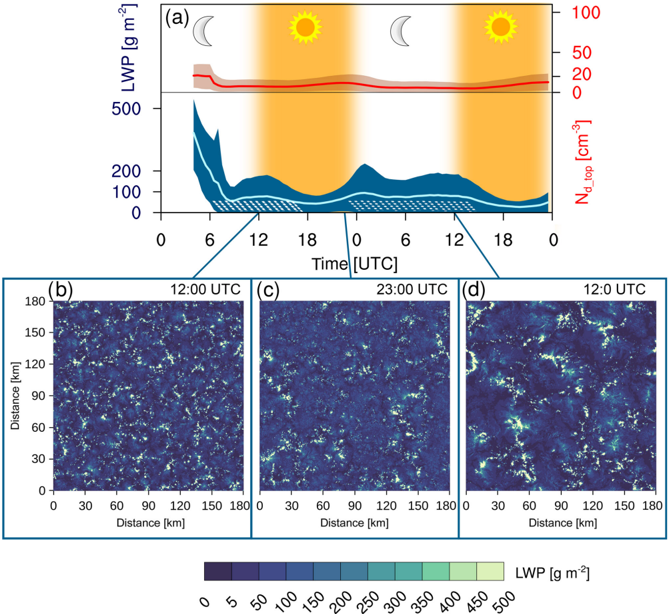
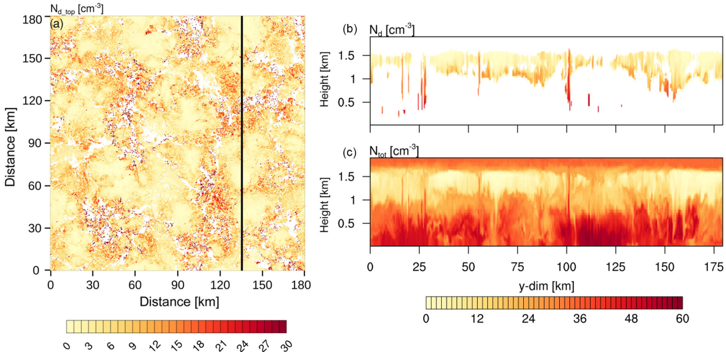
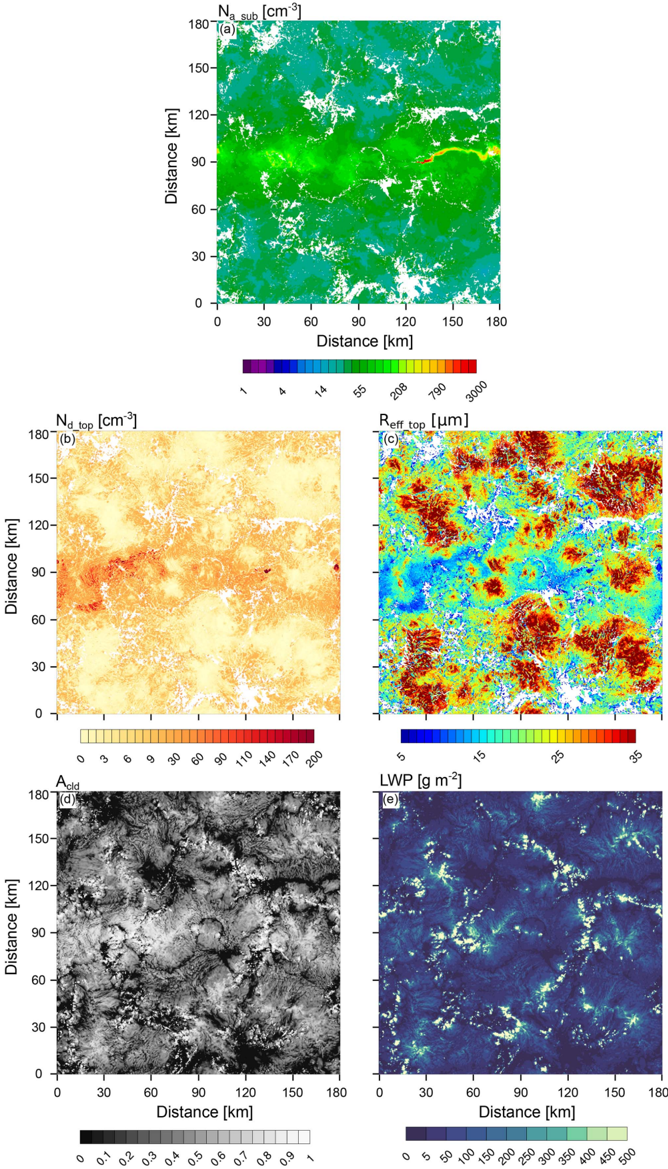
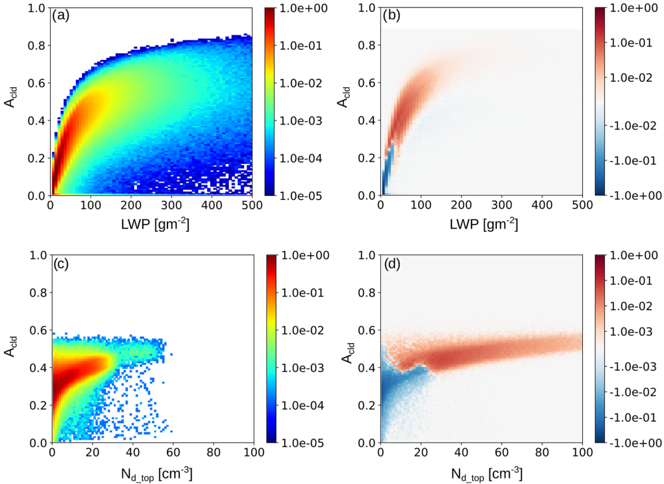
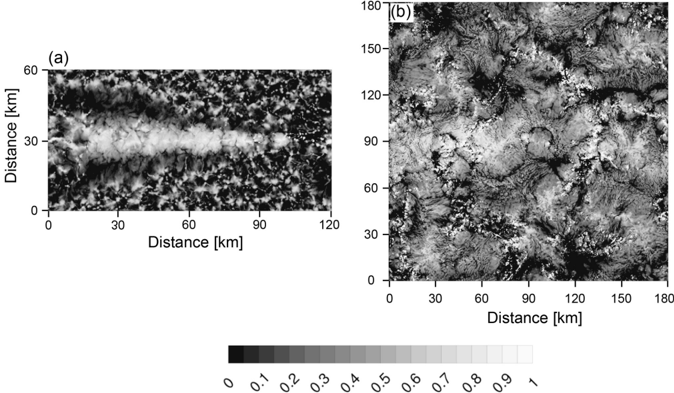
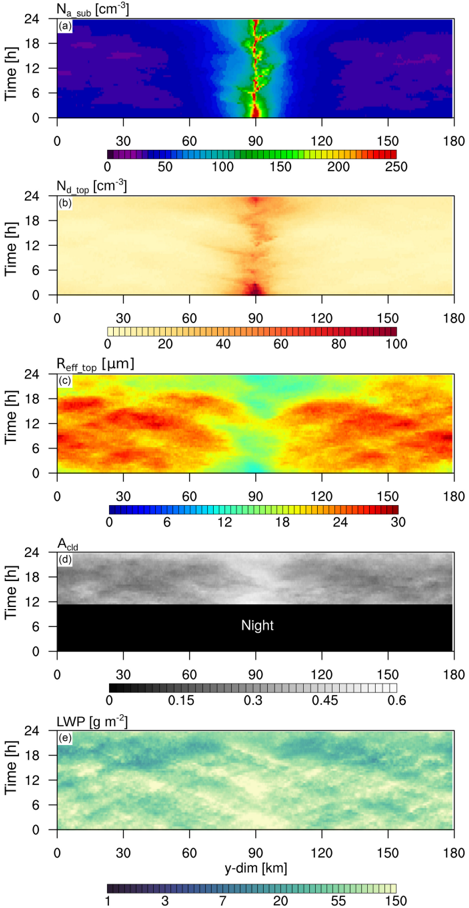
Aerosol–cloud radiative effects are determined and quantified in simulations of deep open-cell stratocumuli observed during the VAMOS Ocean-Cloud-Atmosphere-Land Study Regional Experiment (VOCALS-REx) campaign off the west coast of Chile. The cloud deck forms in a boundary layer 1.5 km deep, with cell sizes reaching 50 km in diameter. Global databases of ship tracks suggest that these linear structures are seldom found in boundary layers this deep. Here, we quantify the changes in cloud radiative properties to a continuous aerosol point source moving along a fixed emission line releasing 10 17 particles per second. We show that a spatially coherent cloud perturbation is not evident along the emission line. Yet our model simulates an increase in domain-mean all-sky albedo of 0.05, corresponding to a diurnally averaged cloud radiative effect of 20 W m −2 , given the annual mean solar insolation at the VOCALS-REx site. Therefore, marked changes in cloud radiative properties in precipitating deep open cells may be driven by anthropogenic near-surface aerosol perturbations, such as those generated by ships. Furthermore, we demonstrate that these changes in cloud radiative properties are masked by the naturally occurring variability within the organised cloud field. A clear detection and attribution of cloud radiative effects to a perturbation in aerosol concentrations becomes possible when sub-filtering of the cloud field is applied, using the spatio-temporal distribution of the aerosol perturbation. Therefore, this work has implications for the detection and attribution of effective cloud radiative forcing in marine stratocumuli, which constitutes one of the major physical uncertainties within the climate system. Our results suggest that ships may sometimes have a substantial radiative effect on marine clouds and albedo, even when ship tracks are not readily visible.
Overview
The claims and statistics of this paper haven’t been checked yet.
Free: it reads the open-access text and checks the first 5 claims that cite a source we can check. Create a free account to check every claim.
Integrity signals
Registry
Cites
Statistics
Figures
Verification
Claims the paper makes
The claims and statistics of this paper haven’t been checked yet.
Free: it reads the open-access text and checks the first 5 claims that cite a source we can check. Create a free account to check every claim.
Self-check
Percentages, sums and reported differences re-computed from the paper’s own numbers.
The self-check needs the paper’s full text.
Citations
Cites
Climate Change 2007: The Physical Science Basis.
Schiavon, S., & Zecchin, R. (2007) · eScholarship (California Digital Library) · Cited by 16,994
Anthropogenic and Natural Radiative Forcing
(2014) · Climate Change 2013 – The Physical Science Basis · doi:10.1017/cbo9781107415324.018 · Cited by 3,683
Morrison, H., Thompson, G., & Tatarskii, V. (2009) · Monthly Weather Review · doi:10.1175/2008mwr2556.1 · Cited by 2,438 · cited 1×
“The simulations were performed with the two-moment Morrison et al. (2009) microphysics scheme with a prognostic treatment of number and mass concentrations for cloud water and rain.”
Wood, R. (2012) · Monthly Weather Review · doi:10.1175/mwr-d-11-00121.1 · Cited by 1,219
Self-citationA New Cloud Physics Parameterization in a Large-Eddy Simulation Model of Marine Stratocumulus
Khairoutdinov, M., & Kogan, Y. (2000) · Monthly Weather Review · doi:10.1175/1520-0493(2000)128<0229:ancppi>2.0.co;2 · Cited by 809 · cited 4×
“The exponents of the cloud liquid water content and Nd in the Khairoutdinov and Kogan (2000) autoconversion rate were adjusted to values obtained from the VOCALS-REx field campaign 25 as 3.”
InfluentialAerosols, clouds and radiation
Twomey, S. (1991) · Atmospheric Environment. Part A. General Topics · doi:10.1016/0960-1686(91)90159-5 · Cited by 645 · cited 8×
“Changes in cloud microphysical properties and the associated Twomey (1991) effect5 were found to be of secondary importance to the change in total albedo.”
InfluentialWood, R., & Hartmann, D. L. (2006) · Journal of Climate · doi:10.1175/jcli3702.1 · Cited by 412 · cited 1×
“The characteristic cell size was found to be between 30 and 40 km, which is detected frequently in southeast Pacific stratocumulus clouds (Wood and Hartmann, 2006).”
BackgroundSelf-citationThe ‘too few, too bright’ tropical low-cloud problem in CMIP5 models.
Nam, C., Bony, S., Dufresne, J. ‐., & Chepfer, H. (2012) · Geophysical Research Letters · doi:10.1029/2012gl053421 · Cited by 375 · cited 1×
“…to issues of collocation in retrievals of aerosol and cloud properties from space (Koren et al., 2007; Charlson et al., 2007) and the inadequate representation of small-scale dynamical processes contributing to the cloud response in coarse-scale models (Nam et al., 2012; Schneider et al., 2017).”
Platnick, S., & Twomey, S. (1994) · Journal of Applied Meteorology · doi:10.1175/1520-0450(1994)033<0334:dtsoca>2.0.co;2 · Cited by 344
On the twilight zone between clouds and aerosols
Koren, I., Remer, L. A., Kaufman, Y. J., Rudich, Y., & Martins, J. V. (2007) · Geophysical Research Letters · doi:10.1029/2007gl029253 · Cited by 316 · cited 2×
“…and global climate models (GCMs) remains challenging due to issues of collocation in retrievals of aerosol and cloud properties from space (Koren et al., 2007; Charlson et al., 2007) and the inadequate representation of small-scale dynamical processes contributing to the cloud response in…”
Research works printed but not linked: 2
- Boucher, O., Randall, D., Artaxo, P., Bretherton, C., Feingold, G., Forster, P., Kerminen, V.-M., Kondo, Y., Liao, H., Lohmann, U., Rasch, P., Satheesh, S. K., Sherwood, S., Stevens, B., and Zhang, X. Y.: Clouds and Aerosols, in: Climate Change 2013: The phys- ical science basis. Contribution of Working Group I to the Fifth Assessment Report of the Intergovernmental Panel on Climate Change, edited by: Stocker, T., Qin, D., Plattner, G.-K., Tignor, M., Allen, S., Boschung, J., Nauels, A., Xia, Y., Bex, V., and Midgley, P. M., Cambridge University Press, Cambridge, 2013.
- Conover, J. H.: Anomalous cloud lines, J. Atmos. Sci., 23, 778-785, 1966. · doi:10.1175/1520-0469(1966)023
Cited by
Bounding Global Aerosol Radiative Forcing of Climate Change
Bellouin, N., Quaas, J., Gryspeerdt, E., Kinne, S., Stier, P., Watson‐Parris, D., Boucher, O., Carslaw, K. S., Christensen, M., Daniau, A. ‐., et al. (2020) · Reviews of Geophysics · doi:10.1029/2019rg000660 · Cited by 1,116
Self-citationWeak average liquid-cloud-water response to anthropogenic aerosols
Toll, V., Christensen, M., Quaas, J., & Bellouin, N. (2019) · Nature · doi:10.1038/s41586-019-1423-9 · Cited by 254
Substantial Cloud Brightening From Shipping in Subtropical Low Clouds
Diamond, M. S., Director, H. M., Eastman, R., Possner, A., & Wood, R. (2020) · AGU Advances · doi:10.1029/2019av000111 · Cited by 151
Self-citationOpportunistic experiments to constrain aerosol effective radiative forcing
Christensen, M. W., Gettelman, A., Cermak, J., Dagan, G., Diamond, M., Douglas, A., Feingold, G., Glassmeier, F., Goren, T., Grosvenor, D. P., et al. (2022) · Atmospheric Chemistry and Physics · doi:10.5194/acp-22-641-2022 · Cited by 138
Self-citationSorooshian, A., Corral, A. F., Braun, R. A., Cairns, B., Crosbie, E., Ferrare, R. A., Hair, J. W., Kleb, M. M., Mardi, A. H., Maring, H., et al. (2020) · Journal of Geophysical Research Atmospheres · doi:10.1029/2019jd031626 · Cited by 121
Self-citationWood, R. (2021) · Atmospheric Chemistry and Physics · doi:10.5194/acp-21-14507-2021 · Cited by 104
Self-citationAssessing effective radiative forcing from aerosol–cloud interactions over the global ocean
Wall, C. J., Norris, J. R., Possner, A., McCoy, D. T., McCoy, I. L., & Lutsko, N. J. (2022) · Proceedings of the National Academy of Sciences · doi:10.1073/pnas.2210481119 · Cited by 125
Self-citationInvisible ship tracks show large cloud sensitivity to aerosol
Manshausen, P., Watson-Parris, D., Christensen, M. W., Jalkanen, J.-P., & Stier, P. (2022) · Nature · doi:10.1038/s41586-022-05122-0 · Cited by 89
Possner, A., Eastman, R., Bender, F., & Glassmeier, F. (2020) · Atmospheric Chemistry and Physics · doi:10.5194/acp-20-3609-2020 · Cited by 85
Self-citationYuan, T., Song, H., Oreopoulos, L., Wood, R., Bian, H., Breen, K., Chin, M., Yu, H., Barahona, D., Meyer, K., et al. (2024) · Communications Earth & Environment · doi:10.1038/s43247-024-01442-3 · Cited by 79
Self-citationGlobal reduction in ship-tracks from sulfur regulations for shipping fuel
Yuan, T., Song, H., Wood, R., Wang, C., Oreopoulos, L., Platnick, S. E., von Hippel, S., Meyer, K., Light, S., & Wilcox, E. (2022) · Science Advances · doi:10.1126/sciadv.abn7988 · Cited by 76
“The existence and detection of the contrast depends on various factors such as the wavelength of the observation, and the background properties of cloud and aerosols, tiny suspended airborne particles( 2 – 5 ).”
Self-citationObserving the timescales of aerosol–cloud interactions in snapshot satellite images
Gryspeerdt, E., Goren, T., & Smith, T. W. P. (2021) · Atmospheric Chemistry and Physics · doi:10.5194/acp-21-6093-2021 · Cited by 75
The Impact of Ship Emission Controls Recorded by Cloud Properties
Gryspeerdt, E., Smith, T. W. P., O'Keeffe, E., Christensen, M. W., & Goldsworth, F. W. (2019) · Geophysical Research Letters · doi:10.1029/2019gl084700 · Cited by 72
Physical science research needed to evaluate the viability and risks of marine cloud brightening
Feingold, G., Ghate, V. P., Russell, L. M., Blossey, P., Cantrell, W., Christensen, M. W., Diamond, M. S., Gettelman, A., Glassmeier, F., Gryspeerdt, E., et al. (2024) · Science Advances · doi:10.1126/sciadv.adi8594 · Cited by 69
“…MCB activities, vary considerably: Observational studies of manually detected ship tracks suggest a global forcing in the range of − 0.0004 to − 0.0006 W m − 2 ( 41 ) but such low estimates are likely to be heavily biased toward the less frequently occurring strongly visible tracks ( 42, 43 ).”
BackgroundInfluentialSelf-citationShipping regulations lead to large reduction in cloud perturbations
Watson‐Parris, D., Christensen, M. W., Laurenson, A., Clewley, D., Gryspeerdt, E., & Stier, P. (2022) · Proceedings of the National Academy of Sciences · doi:10.1073/pnas.2206885119 · Cited by 90
Untangling causality in midlatitude aerosol–cloud adjustments
McCoy, D. T., Field, P. R., Gordon, H., Elsaesser, G. S., & Grosvenor, D. P. (2020) · Atmospheric chemistry and physics · doi:10.5194/acp-20-4085-2020 · Cited by 69
Observational evidence of strong forcing from aerosol effect on low cloud coverage
Yuan, T., Song, H., Wood, R., Oreopoulos, L., Platnick, S., Wang, C., Yu, H., Meyer, K., & Wilcox, E. (2023) · Science Advances · doi:10.1126/sciadv.adh7716 · Cited by 49
“Our measurements indicate that the Cf increase due to aerosols only becomes substantial under such background cloud conditions, likely through precipitation suppression, which supports the conceptual mechanism proposed by Albrecht ( 2 ). nearly overcast ones ( 11 , 12 , 22 , 23 ).”
Self-citationChun, J.-Y., Wood, R., Blossey, P. N., & Doherty, S. J. (2023) · Atmospheric chemistry and physics · doi:10.5194/acp-23-1345-2023 · Cited by 55
Self-citationWarming effects of reduced sulfur emissions from shipping
Yoshioka, M., Grosvenor, D. P., Booth, B. B. B., Morice, C., & Carslaw, K. S. (2024) · Atmospheric chemistry and physics · doi:10.5194/acp-24-13681-2024 · Cited by 57
“…the majority of ocean-going ships do not leave identifiable ship tracks, the sulfur species will still be widely dispersed and potentially cause significant, but less apparent, aerosol-cloud interactions that modulate the Earth’s energy budget (Possner et al., 2018; Manshausen et al., 2022).”
Global observations of aerosol indirect effects from marine liquid clouds
Wall, C. J., Storelvmo, T., & Possner, A. (2023) · Atmospheric chemistry and physics · doi:10.5194/acp-23-13125-2023 · Cited by 49
“…cause changes in the morphology or horizontal size of liquid clouds, thereby changing the relative amounts of partly and fully cloudy pixels (Possner et al., 2018; Rosenfeld et al., 2006) Here we examine a case study to demonstrate this concept We analyze instantaneous pixel data from the…”
Self-citationPrabhakaran, P., Hoffmann, F., & Feingold, G. (2023) · Journal of the Atmospheric Sciences · doi:10.1175/jas-d-22-0207.1 · Cited by 35
Trofimov, H., Bellouin, N., & Toll, V. (2020) · Journal of Geophysical Research Atmospheres · doi:10.1029/2020jd032575 · Cited by 31
A protocol for model intercomparison of impacts of marine cloud brightening climate intervention
Rasch, P. J., Hirasawa, H., Wu, M., Doherty, S. J., Wood, R., Wang, H., Jones, A., Haywood, J., & Singh, H. (2024) · Geoscientific model development · doi:10.5194/gmd-17-7963-2024 · Cited by 43
“…soil moisture, etc.) through interactions and feedbacks occurring between climate system components (atmosphere, ocean, land, ecosystems) So it is important to use both small scale process models, and climate models for exploring different science questions associated with MCB intervention.”
Self-citationGoren, T., Feingold, G., Gryspeerdt, E., Kazil, J., Kretzschmar, J. G., Jia, H., & Quaas, J. (2022) · Geophysical Research Letters · doi:10.1029/2022gl101169 · Cited by 24
Effects of intermittent aerosol forcing on the stratocumulus-to-cumulus transition
Prabhakaran, P., Hoffmann, F., & Feingold, G. (2024) · Atmospheric chemistry and physics · doi:10.5194/acp-24-1919-2024 · Cited by 30
An Overview of Aerosol‐Cloud Interactions
Gordon, H., Glassmeier, F., & McCoy, D. T. (2023) · Geophysical monograph · doi:10.1002/9781119700357.ch2 · Cited by 27
Rapid saturation of cloud water adjustments to shipping emissions
Manshausen, P., Watson‐Parris, D., Christensen, M. W., Jalkanen, J.-P., & Stier, P. (2023) · Atmospheric chemistry and physics · doi:10.5194/acp-23-12545-2023 · Cited by 20
“While they allow to study aerosol-cloud interactions in isolation, ship track studies introduce biases: With respect to space, Possner et al. (2018) suggest that ship tracks are mostly sampled from shallow boundary layers (<800 m), because they are not”
BackgroundAn Optical Flow Approach to Tracking Ship Track Behavior Using GOES-R Satellite Imagery
Larson, K. M., Shand, L., Staid, A., Gray, S., Roesler, E. L., & Lyons, D. (2022) · IEEE Journal of Selected Topics in Applied Earth Observations and Remote Sensing · doi:10.1109/jstars.2022.3193024 · Cited by 15
Diurnal evolution of non-precipitating marine stratocumuli in a large-eddy simulation ensemble
Chen, Y., Zhang, J., Hoffmann, F., Yamaguchi, T., Glassmeier, F., Zhou, X., & Feingold, G. (2024) · Atmospheric chemistry and physics · doi:10.5194/acp-24-12661-2024 · Cited by 19
“…works focused on case studies with aerosol perturbation experiments (Sandu et al., 2008; Caldwell and Brether-ton, 2009; Wang and Feingold, 2009b; Wang et al., 2010; Chen et al., 2011; Yamaguchi et al., 2015; Possner et al., 2018; Kazil et al., 2021; Prabhakaran et al., 2023; Chun et al., 2023 .”
Toward data assimilation of ship-induced aerosol–cloud interactions
Patel, L., & Shand, L. (2022) · Environmental Data Science · doi:10.1017/eds.2022.21 · Cited by 7
Meteorological Conditions Favorable for Strong Anthropogenic Aerosol Impacts on Clouds
Trofimov, H., Post, P., Gryspeerdt, E., & Toll, V. (2022) · Journal of Geophysical Research Atmospheres · doi:10.1029/2021jd035871 · Cited by 6
Li, X., Wang, H., Christensen, M. W., Chen, J., Tang, S., Kirschler, S., Crosbie, E., Ziemba, L. D., Painemal, D., Corral, A. F., et al. (2024) · Journal of Geophysical Research Atmospheres · doi:10.1029/2023jd039489 · Cited by 9
Self-citationAnalyses of Virtual Ship‐Tracks Systematically Underestimate Aerosol‐Cloud Interactions Signals
Yuan, T., Song, H., Oreopoulos, L., Wood, R., Meyer, K., Crawford, A., Smith, W. L., & Eastman, R. M. (2025) · Geophysical Research Letters · doi:10.1029/2024gl114356 · Cited by 7
“For example, strong variability of background clouds can overwhelm the contrast between ship‐track and background clouds (Ackerman et al., 1995); Clouds are too broken to form coherent tracks in the trade cumulus region (Possner et al., 2018; Yuan et al., 2022).”
Self-citationDetectable ship tracks account for just 5% of aerosol indirect forcing from ship emissions
Yuan, T., Song, H., Boss, L. F., & Diamond, M. (2025) · Communications Earth & Environment · doi:10.1038/s43247-025-02825-w · Cited by 6
Evaluating simulations of ship tracks in a km-scale model
Tippett, A., Field, P. R., & Gryspeerdt, E. (2026) · Atmospheric chemistry and physics · doi:10.5194/acp-26-4251-2026 · Cited by 2
Features of the development of space-based shading and lighting systems for the Earth’s surface
Alpatov, А. P., & Lapkhanov, E. (2023) · Technical mechanics · doi:10.15407/itm2023.01.025 · Cited by 2
Trofimov, H., & Toll, V. (2020) · doi:10.5194/egusphere-egu2020-8909 · Cited by 4
Substantial Radiative Warming by an Inadvertent Geoengineering Experiment from 2020 Fuel RegulationsPreprint
Yuan, T., Song, H., Oreopoulos, L., Wood, R., Bian, H., Breen, K. H., Chin, M., Yu, H., Barahona, D., Meyer, K., et al. (2023) · Research Square · doi:10.21203/rs.3.rs-3490826/v1 · Cited by 2
Self-citationLee, J. D., Pasternak, D., Wilde, S. E., Drysdale, W. S., Lacy, S., Moller, S. J., Shaw, M., Squires, F., Edwards, P., Temple, L. G., et al. (2025) · Environmental Science Atmospheres · doi:10.1039/d5ea00089k · Cited by 3
Goren, T., Choudhury, G. G., & Feingold, G. (2026) · Atmospheric chemistry and physics · doi:10.5194/acp-26-7193-2026 · Cited by 1
“This differs from formulations based on scene-mean albedo (Bellouin et al., 2020), where CF changes contribute an additional term.”
InfluentialSantos, L., Frostenberg, H. C., Pérez, A. B., Ekman, A. M. L., Ickes, L., & Thomson, E. S. (2025) · Atmospheric chemistry and physics · doi:10.5194/acp-25-119-2025 · Cited by 4
Integrative data-driven approaches for characterization & prediction of aerosol-cloud processes
Shand, L., Hillman, B., Patel, L., Huerta, G., Tucker, J., Staid, A., Lyons, D., & Schliep, E. M. (2021) · OSTI OAI (U.S. Department of Energy Office of Scientific and Technical Information) · doi:10.2172/1769729
Shand, L., Larson, K. M., Staid, A., Gray, S., Roesler, E. L., & Lyons, D. (2021) · arXiv (Cornell University)
Christensen, M. W. (2021) · Atmospheric chemistry and physics · doi:10.5194/acp-2021-559-ac1
“However, real but less easily detectable effects may exist in other conditions (Possner et al., 2018), and different integrated aerosol–cloud responses are expected between shallow well-mixed marine boundary layers, deeper decoupled marine boundary layers, and continental boundary layers (Possner…”
InfluentialSimulating cloud-aerosol interactions made by ship emissionsPreprint
Patel, L., & Shand, L. (2021) · arXiv (Cornell University) · doi:10.48550/arxiv.2111.05356
“In climate simulation studies of this phenomenon (Wang et al., 2011; Berner et al., 2015; Possner et al., 2018; Blossey et al., 2018), aerosol injections are initiated by the user at a known location in fully defined environments.”
Christensen, M. W., Gettelman, A., Cermak, J., et al. (2021) · Atmospheric chemistry and physics · doi:10.5194/acp-2021-559-rc2
Wood, R. (2021) · Atmospheric chemistry and physics · doi:10.5194/acp-2021-327-ac1
Self-citationWood, R. (2021) · Atmospheric chemistry and physics · doi:10.5194/acp-2021-327-ac2
Self-citationChristensen, M. W., Gettelman, A., Čermák, J., et al. (2021) · Atmospheric chemistry and physics · doi:10.5194/acp-2021-559-rc1
(2021) · Atmospheric chemistry and physics · doi:10.5194/acp-2021-327-rc1
(2021) · Atmospheric chemistry and physics · doi:10.5194/acp-2021-327-rc2
(2022) · Atmospheric chemistry and physics · doi:10.5194/acp-2022-351-rc1
(2022) · Atmospheric chemistry and physics · doi:10.5194/acp-2022-351-rc2
Chun, J.-Y. (2022) · Atmospheric chemistry and physics · doi:10.5194/acp-2022-351-ac3
Chun, J.-Y. (2022) · Atmospheric chemistry and physics · doi:10.5194/acp-2022-351-ac1
Chun, J.-Y. (2022) · Atmospheric chemistry and physics · doi:10.5194/acp-2022-351-ac2
Visioni, D., Narenpitak, P., & Honegger, M. (2024) · Elsevier eBooks · doi:10.1016/b978-0-323-96026-7.00170-3
Aerodynamic passive control systems of the space objects orbital motion
Алпатов, А. П., Lapkhanov, E., & Palii, O. S. (2024) · PH "Akademperiodyka" eBooks · doi:10.15407/akademperiodyka.527.172
Visioni, D., Narenpitak, P., & Honegger, M. (2025) · Elsevier eBooks · doi:10.1016/b978-0-443-15748-6.00003-4
Metadata
- Authors
- Possner, A., Wang, H., Wood, R., Caldeira, K., & Ackerman, T. P.
- Affiliations
- Carnegie Institution for Science (US)
- Pacific Northwest National Laboratory (US)
- University of Washington (US)
- Corresponding author
- Possner, Anna
- Venue
- Atmospheric Chemistry and Physics
- Publisher
- Copernicus GmbH
- Published
- 2018-12-11
- Volume
- 18
- Issue
- 23
- Pages
- 17475-17488
- ISSN
- 1680-7316 (ISSN-L)
- 1680-7324
- OpenAlex
- W2887947886
- Cited by
- 63
- References
- 53
- Citations by year
- 2026: 2 · 2025: 5 · 2024: 9 · 2023: 10 · 2022: 15 · 2021: 12 · 2020: 6 · 2019: 3 · 2018: 1
- FWCI
- 3.22
- Type
- journal article
- Language
- en
- Open access
- gold
- doi.org
- Licence
- Locations
- Atmospheric chemistry and physics (publishedVersion, cc-by)
- OSTI OAI (U.S. Department of Energy Office of Scientific and Technical Information) (submittedVersion, other-oa)
- DOAJ (DOAJ: Directory of Open Access Journals) (submittedVersion, cc-by-sa)
- NOAA Institutional Repository (submittedVersion, cc-by)
- Biogeosciences (European Geosciences Union) (submittedVersion, cc-by)
- Funders
- Fund for Innovative Climate and Energy Research (N/A)
- Topics
- Physical Sciences › Environmental Science › Global and Planetary Change › Atmospheric aerosols and clouds
- Physical Sciences › Earth and Planetary Sciences › Atmospheric Science › Meteorological Phenomena and Simulations
- Physical Sciences › Earth and Planetary Sciences › Atmospheric Science › Atmospheric chemistry and aerosols
- Keywords
- aerosol-cloud interactions, cloud radiative effects, ship track, anthropogenic aerosols, cloud albedo, cloud radiative forcing, VOCALS-REx, detection and attribution, boundary layer clouds
About these checks
Registry, retraction, Cites and statistics results are computed, not judged, with one exception: a printed reference that no index lists is read once by a model before it counts as a citation error. Claims are extracted by a model and kept only when their quote appears verbatim in the text; each cited source is then checked, with a model’s help, for whether it says what the claim relies on. Those verdicts can be wrong — read the claim’s quote and the cited source before relying on one.
Statistics and arithmetic are recomputed, not judged.
Confidence bands are shown only for fields calibrated on our annotated test set. None is calibrated yet, so no band is shown.
What counts as a claim ›How we measure confidence ›How we check this ›
Are you an author, or do you see a problem with this page? Request a review
Data sources
Bibliographic data: Semantic Scholar, OpenAlex, Crossref.
Contains information from the Semantic Scholar Academic Graph Datasets, made available under the ODC Attribution License (ODC-BY 1.0).
Semantic Scholar’s data is described in: Kinney, R., et al. (2023). The Semantic Scholar Open Data Platform. arXiv:2301.10140.
