

The impact of aerosols on photolysis frequencies and ozone production in Beijing during the 4-year period 2012–2015
Open accessPublished version of a preprint
The DOI matches its Crossref record; 81 of the 83 references it cites were found in a registry or an index.
Abstract
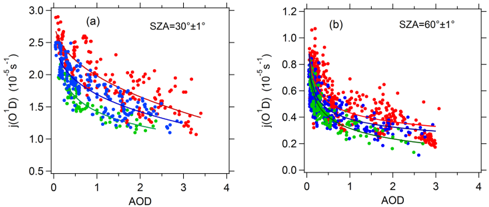
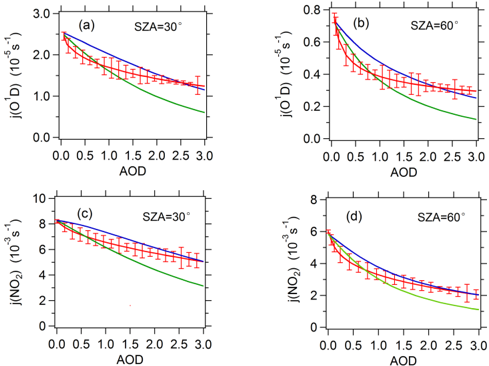
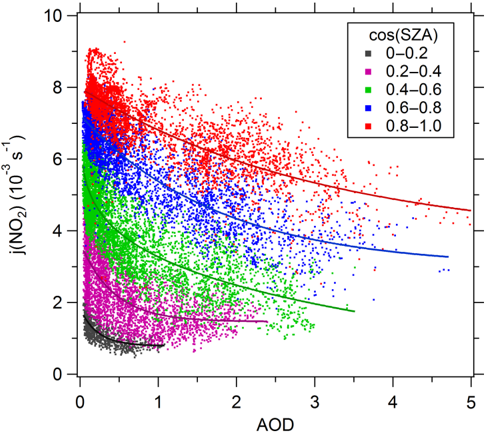
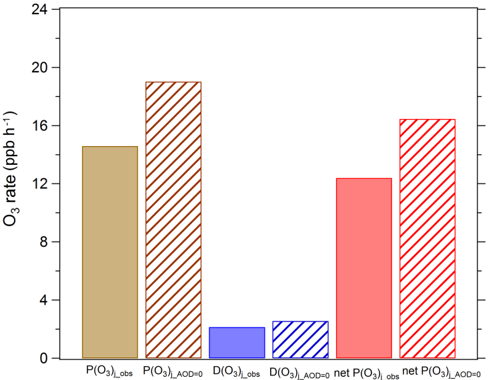
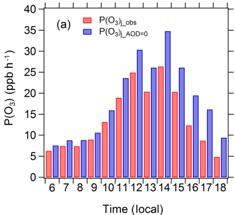
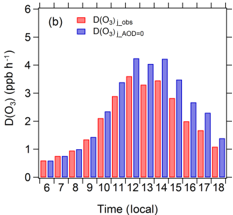
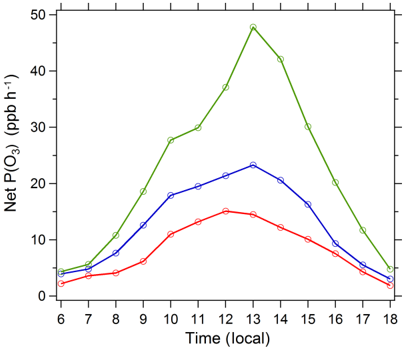
During the period 2012–2015, photolysis frequencies were measured at the Peking University site (PKUERS), a site representative of Beijing. We present a study of the effects of aerosols on two key photolysis frequencies, j (O 1 D) and j (NO 2 ). Both j (O 1 D) and j (NO 2 ) display significant dependence on aerosol optical depth (AOD; 380 nm) with a non-linear negative correlation. With the increase in AOD, the slopes of photolysis frequencies vs. AOD decrease, which indicates that the capacity of aerosols to reduce the actinic flux decreases with AOD. The absolute values of slopes are equal to 4.2–6.9×10⁻⁶ and 3.4×10⁻³ s −1 per AOD unit for j (O 1 D) and j (NO 2 ) respectively at a solar zenith angle (SZA) of 60 ∘ and AOD smaller than 0.7, both of which are larger than those observed in a similar, previous study in the Mediterranean. This indicates that the aerosols in Beijing have a stronger extinction effect on actinic flux than absorptive dust aerosols in the Mediterranean. Since the photolysis frequencies strongly depended on the AOD and the SZA, we established a parametric equation to quantitatively evaluate the effect of aerosols on photolysis frequencies in Beijing. According to the parametric equation, aerosols lead to a decrease in seasonal mean j (NO 2 ) by 24 % and 30 % for summer and winter, respectively, and a corresponding decrease in seasonal mean j (O 1 D) by 27 % and 33 %, respectively, compared to an aerosol-free atmosphere (AOD =0). Based on an observation campaign in August 2012, we used a photochemical box model to simulate the ozone production rate ( P (O 3 )). The simulation results shows that the monthly mean daytime net ozone production rate is reduced by up to 25 % due to the light extinction of aerosols. Through further in-depth analysis, it was found that particulate matter concentrations maintain a high level under the condition of high concentrations of ozone precursors (volatile organic compounds, VOCs, and NO x ), which inhibits the production of ozone to a large extent. This phenomenon implies a negative feedback mechanism in the atmospheric environment of Beijing.
Overview
The claims and statistics of this paper haven’t been checked yet.
Free: it reads the open-access text and checks the first 5 claims that cite a source we can check. Create a free account to check every claim.
Integrity signals
Registry
Cites
Statistics
Figures
Verification
Claims the paper makes
The claims and statistics of this paper haven’t been checked yet.
Free: it reads the open-access text and checks the first 5 claims that cite a source we can check. Create a free account to check every claim.
Claims other papers make about this one
Each is checked against this paper’s own text: does it say what the citing paper says it does?
The cited source says what the claim attributes to it.
In the citing paper
“Simulations with numerical models show several possible reasons including increases in UV radiation [31, 33–39], shifts in the VOC/NOx chemical regime resulting in increased production of O3 efficiency [35, 40], higher emissions of biogenic VOC due to rising temperatures [30], and decreased competition for gas-phase radicals by aerosol surfaces [34, 40], with reality likely being a combination of”
From Changes in tropospheric air quality related to the protection of stratospheric ozone in a changing climate (2023) · cites this paper as [31]
In the citing paper
“This has led to surface brightening (e.g., by 0.70–1.16 W m−2 year−1 in eastern China over 2014–2019) [29] but also to undesirable increases in ambient O3 [30–33] (e.g., by 2–6 µg m−3 year−1 in megacity clusters of Beijing and Shanghai over 2013–2017) [34].”
From Changes in tropospheric air quality related to the protection of stratospheric ozone in a changing climate (2023) · cites this paper as [31]
Self-check
Percentages, sums and reported differences re-computed from the paper’s own numbers.
The self-check needs the paper’s full text.
Citations
Cites
Environmental Health Perspectives at 50
Kaufman, J. D. (2022) · Environmental Health Perspectives · doi:10.1289/ehp11367 · Cited by 2,284
Physical Chemistry Chemical Physics
(2024) · Physical Chemistry Chemical Physics · doi:10.1039/1463-9084/1999 · Cited by 2,176
Elucidating severe urban haze formation in China
Guo, S., Hu, M., Zamora, M. L., Peng, J., Shang, D., Zheng, J., Du, Z., Wu, Z., Shao, M., Zeng, L., et al. (2014) · Proceedings of the National Academy of Sciences · doi:10.1073/pnas.1419604111 · Cited by 1,711 · cited 1×
“Previous studies have reported that secondary particulate matter has accounted for more than 60 % of total particulate matter during severe smog pollution in Beijing summers (T. Han et al., 2015; Guo et al., 2014).”
BackgroundSelf-citationvan Donkelaar, A., Martin, R. V., Brauer, M., Kahn, R., Levy, R., Verduzco, C., & Villeneuve, P. J. (2010) · Environmental Health Perspectives · doi:10.1289/ehp.0901623 · Cited by 1,623 · cited 1×
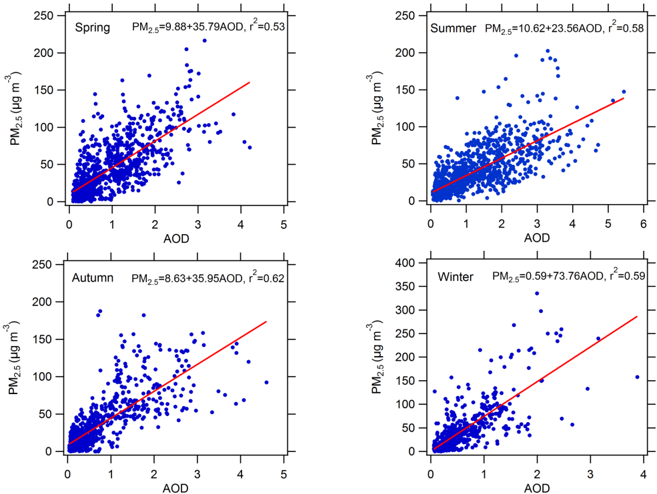
“The factors that affect this relationship include aerosol type, aerosol size distribution, aerosol distribution in the vertical direction, relative humidity (RH), and planetary boundary layer height (PBLH) (van Donkelaar et al., 2010).”
BackgroundChemical characterization and source apportionment of PM 2.5 in Beijing: seasonal perspective
Zhang, R., Jing, J., Tao, J., Hsu, S.-C., Wang, G., Cao, J., Lee, C. S. L., Zhu, L., Chen, Z., Zhao, Y., et al. (2013) · Atmospheric Chemistry and Physics · doi:10.5194/acp-13-7053-2013 · Cited by 1,206 · cited 1×
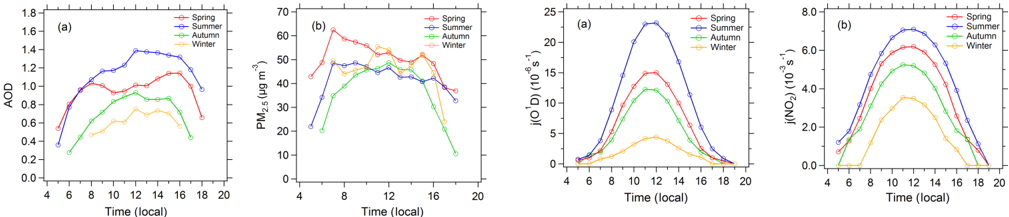
“…the biomass burning and soot emission generated from heating, the fine-mode heavily absorbing aerosol percentage is higher in winter than in summer (Zheng et al., 2017; Liu et al., 2016; Zhang et al., 2013), and thus aerosols in winter have a stronger ability to reduce the photolysis frequencies.”
BackgroundJournal of Geophysical Research. Atmospheres
Rinsland, C. P., Goldman, A., Mahieu, E., Zander, R., Notholt, J., Jones, N., GRIFFITH, D. W. T., Stephen, T., & Chiou, L. (2002) · Cited by 1,112
The Impact of Aerosols on Solar Ultraviolet Radiation and Photochemical Smog
Dickerson, R. R., Kondragunta, S., Stenchikov, G., Civerolo, K. L., Doddridge, B. G., & Holben, B. N. (1997) · Science · doi:10.1126/science.278.5339.827 · Cited by 675 · cited 3×
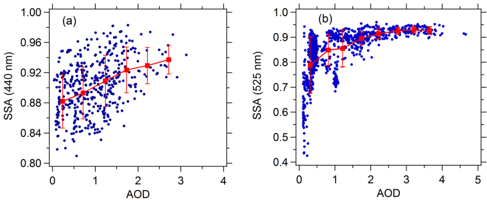
“The smaller the SSA, the higher the absorptive component and the lower the scattering component of the aerosol and the stronger the ability of the aerosol to reduce the actinic flux (Dickerson et al., 1997).”
BackgroundTropospheric OH and HO2 radicals: field measurements and model comparisons
Stone, D., Whalley, L. K., & Heard, D. E. (2012) · Chemical Society Reviews · doi:10.1039/c2cs35140d · Cited by 599 · cited 1×
“The strong dependence of OH concentration on j (O1D) was found in a number of field measurements (Ehhalt and Rohrer, 2000; Rohrer et al., 2014; Stone et al., 2012).”
BackgroundThe Role of Solar Radiation in Atmospheric Chemistry
Madronich, S., & Flocke, S. (1999) · The Handbook of Environmental Chemistry · doi:10.1007/978-3-540-69044-3_1 · Cited by 582 · cited 1×
“The radiative transfer model is based on an algorithm for calculating solar radiation and photolysis frequencies (Madronich and Flocke, 1999).”
MethodEstimating Ground-Level PM2.5 in China Using Satellite Remote Sensing
Ma, Z., Hu, X., Huang, L., Bi, J., & Liu, Y. (2014) · Environmental Science & Technology · doi:10.1021/es5009399 · Cited by 568
Research works printed but not linked: 1
- Finlayson-Pitts, B. J. and Pitts, J. N.: Chemistry of the Upper and Lower Atmosphere, Academic Press, New York, 2000.
Cited by
Bais, A. F., Lucas, R. M., Bornman, J. F., Williamson, C. E., Sulzberger, B., Austin, A. T., Wilson, S. R., Andrady, A. L., Bernhard, G., McKenzie, R. L., et al. (2018) · Photochemical & Photobiological Sciences · doi:10.1039/c7pp90043k · Cited by 350
Archibald, A. T., O'Connor, F. M., Abraham, N. L., Archer-Nicholls, S., Chipperfield, M. P., Dalvi, M., Folberth, G. A., Dennison, F., Dhomse, S. S., Griffiths, P. T., et al. (2020) · Geoscientific Model Development · doi:10.5194/gmd-13-1223-2020 · Cited by 300
Wang, W., Parrish, D. D., Wang, S., Bao, F., Ni, R., Li, X., Yang, S., Wang, H., Cheng, Y., & Su, H. (2022) · Atmospheric Chemistry and Physics · doi:10.5194/acp-22-8935-2022 · Cited by 240
“This modelling approach has been used previously (Wang et al., 2019, 2020, 2021a).”
MethodSelf-citationNeale, R. E., Barnes, P. W., Robson, T. M., Neale, P. J., Williamson, C. E., Zepp, R. G., Wilson, S. R., Madronich, S., Andrady, A. L., Heikkilä, A. M., et al. (2021) · Photochemical & Photobiological Sciences · doi:10.1007/s43630-020-00001-x · Cited by 225
Ozone pollution mitigation strategy informed by long-term trends of atmospheric oxidation capacity
Wang, W., Li, X., Cheng, Y., Parrish, D. D., Ni, R., Tan, Z., Liu, Y., Lü, S., Wu, Y., Chen, S., et al. (2023) · Nature Geoscience · doi:10.1038/s41561-023-01334-9 · Cited by 151
Self-citationLong-term trend of ozone in southern China reveals future mitigation strategy for air pollution
Li, X., Yuan, B., Parrish, D. D., Chen, D., Song, Y., Yang, S., Liu, Z., & Shao, M. (2021) · Atmospheric Environment · doi:10.1016/j.atmosenv.2021.118869 · Cited by 135
Self-citationShao, M., Wang, W., Yuan, B., Parrish, D. D., Li, X., Lu, K., Wu, L., Wang, X., Mo, Z., Yang, S., et al. (2021) · The Science of The Total Environment · doi:10.1016/j.scitotenv.2021.147712 · Cited by 129
Self-citationWang, W., Yuan, B., Peng, Y., Su, H., Cheng, Y., Yang, S., Wu, C., Qi, J., Bao, F., Huangfu, Y., et al. (2022) · Atmospheric chemistry and physics · doi:10.5194/acp-22-4117-2022 · Cited by 124
Self-citationIn situ ozone production is highly sensitive to volatile organic compounds in Delhi, India
Nelson, B. S., Stewart, G. J., Drysdale, W. S., Newland, M. J., Vaughan, A., Dunmore, R. E., Edwards, P. M., Lewis, A. C., Hamilton, J. F., Acton, W. J. F., et al. (2021) · Atmospheric chemistry and physics · doi:10.5194/acp-21-13609-2021 · Cited by 109
“The relationship between aerosol optical depth (AOD) and photolysis rates is strongly non-linear and has a larger impact at low solar zenith angles (i.e., in the morning/evening /high latitudes) (Wang et al., 2019).”
Exploring the drivers of the increased ozone production in Beijing in summertime during 2005–2016
Wang, W., Parrish, D. D., Li, X., Shao, M., Liu, Y., Mo, Z., Lü, S., Hu, M., Fang, X., Wu, Y., et al. (2020) · Atmospheric chemistry and physics · doi:10.5194/acp-20-15617-2020 · Cited by 105
Self-citationQu, Y., Wang, T., Yuan, C., Wu, H., Gao, L., Huang, C., Li, Y., Li, M., & Xie, M. (2023) · The Science of The Total Environment · doi:10.1016/j.scitotenv.2023.162434 · Cited by 104
Gao, J., Li, Y., Zhu, B., Hu, B., Wang, L., & Bao, F. (2020) · Atmospheric Chemistry and Physics · doi:10.5194/acp-20-10831-2020 · Cited by 89
Gao, J., Li, Y., Zhu, B., Hu, B., Wang, L., & Bao, F. (2020) · doi:10.5194/acp-2020-140 · Cited by 89
Heterogeneous Nitrate Production Mechanisms in Intense Haze Events in the North China Plain
Chan, Y., Evans, M. J., He, P., Holmes, C. D., Jaeglé, L., Kasibhatla, P. S., Liu, X., Sherwen, T., Thornton, J. A., Wang, X., et al. (2021) · Journal of Geophysical Research Atmospheres · doi:10.1029/2021jd034688 · Cited by 83
Benish, S. E., He, H., Ren, X., Roberts, S. J., Salawitch, R. J., Li, Z., Wang, F., Wang, Y., Zhang, F., Shao, M., et al. (2020) · Atmospheric chemistry and physics · doi:10.5194/acp-20-14523-2020 · Cited by 75
Self-citationHu, B., Liu, C., Hong, Y., Xu, L., Li, M., Wu, X., Wang, H., Chen, J., & Chen, J. (2020) · The Science of The Total Environment · doi:10.1016/j.scitotenv.2020.137493 · Cited by 72
Zhu, J., Chen, L., Liao, H., Yang, H., Yang, Y., & Yue, X. (2021) · Geophysical Research Letters · doi:10.1029/2020gl090260 · Cited by 71
Madronich, S., Sulzberger, B., Longstreth, J. D., Schikowski, T., Andersen, M. P. S., Solomon, K. R., & Wilson, S. R. (2023) · Photochemical & Photobiological Sciences · doi:10.1007/s43630-023-00369-6 · Cited by 64
Yang, Y., Wang, Y., Yao, D., Zhao, S., Yang, S.-H., Ji, D., Sun, J., Wang, Y., Liu, Z., Hu, B., et al. (2020) · Environmental Pollution · doi:10.1016/j.envpol.2020.114657 · Cited by 64
A study of the effect of aerosols on surface ozone through meteorology feedbacks over China
Qu, Y., Voulgarakis, A., Wang, T., Kasoar, M. R., Wells, C., Yuan, C., Varma, S., & Mansfield, L. (2021) · Atmospheric chemistry and physics · doi:10.5194/acp-21-5705-2021 · Cited by 64
Yang, Y., Wang, Y., Zhou, P., Yao, D., Ji, D., Sun, J., Wang, Y., Zhao, S., Huang, W., Yang, S.-H., et al. (2020) · Atmospheric chemistry and physics · doi:10.5194/acp-20-8181-2020 · Cited by 64
“Phys., 20, 8181–8200, 2020 observed in the eastern Mediterranean (Gerasopoulos et al., 2012) but lower than those in Beijing (Wang et al., 2019).”
BackgroundResultSelf-citationYang, H., Chen, L., Liao, H., Zhu, J., Wang, W., & Li, X. (2022) · Atmospheric chemistry and physics · doi:10.5194/acp-22-4101-2022 · Cited by 62
Self-citationZhao, D., Liu, G., Xin, J., Quan, J., Wang, Y., Wang, X., Dai, L., Gao, W., Tang, G., Hu, B., et al. (2020) · Atmospheric chemistry and physics · doi:10.5194/acp-20-4575-2020 · Cited by 61
Yang, Y., Wang, Y., Huang, W., Yao, D., Zhao, S., Wang, Y., Ji, D., Zhang, R., & Wang, Y. (2021) · The Science of The Total Environment · doi:10.1016/j.scitotenv.2021.145264 · Cited by 55
Multiple Impacts of Aerosols on O3 Production Are Largely Compensated: A Case Study Shenzhen, China
Tan, Z., Lu, K., Ma, X., Chen, S., He, L., Huang, X., Li, X., Lin, X., Tang, M., Yu, D., et al. (2022) · Environmental Science & Technology · doi:10.1021/acs.est.2c06217 · Cited by 52
Self-citationLi, R., Mei, X., Chen, L., Wang, L., Wang, Z., & Jing, Y. (2020) · Remote Sensing · doi:10.3390/rs12061041 · Cited by 45
“In addition, it was found that the large reduction of aerosol loading enhanced O3 production rate to stronger photolysis [38].”
BackgroundChang, B., Liu, H., Zhang, C., Xing, C., Tan, W., & Liu, C. (2025) · npj Climate and Atmospheric Science · doi:10.1038/s41612-024-00891-z · Cited by 40
“Photolysis of NO 2 is a primary mechanism for its removal in the atmosphere 37,38 .”
The influence of aerosols on the NO2 photolysis rate in a suburban site in North China
Zhao, S., Hu, B., Liu, H., Du, C., Xia, X., & Wang, Y. (2021) · The Science of The Total Environment · doi:10.1016/j.scitotenv.2020.144788 · Cited by 36
Wang, W., Yuan, B., Su, H., Cheng, Y., Qi, J., Wang, S., Song, W., Wang, X., Xue, C., Ma, C., et al. (2024) · Atmospheric chemistry and physics · doi:10.5194/acp-24-4017-2024 · Cited by 33
“The box model was used to evaluate the impact of missing VOC R on the O 3 production rate. the base scenario, the box model was constrained by all measured inorganic and organic gases, but the missing VOC R was not considered.”
MethodSelf-citationEvaluation of the WRF-Chem performance for the air pollutants over the United Arab Emirates
Yarragunta, Y., Francis, D., Fonseca, R., & Nelli, N. (2025) · Atmospheric chemistry and physics · doi:10.5194/acp-25-1685-2025 · Cited by 28
Luo, H., Tang, X., Wu, H., Kong, L., Wu, Q., Cao, K., Song, Y., Luo, X., Wang, Y., Zhu, J., et al. (2022) · Advances in Atmospheric Sciences · doi:10.1007/s00376-022-1346-5 · Cited by 28
Shu, Z., Zhao, T., Chen, Y., Liu, Y., Yang, F., Jiang, Y., He, G., Yang, Q., & Zhang, Y. (2023) · Environmental Pollution · doi:10.1016/j.envpol.2023.122622 · Cited by 28
Reversal of Aerosol Properties in Eastern China with Rapid Decline of Anthropogenic Emissions
Tao, M., Wang, L., Chen, L., Wang, Z., & Tao, J. (2020) · Remote Sensing · doi:10.3390/rs12030523 · Cited by 27
“It has been found that high-concentration aerosols can reduce O3 production rate by ~25% in Beijing though intense light extinction [14].”
BackgroundInfluentialShao, P. H., Xin, J., Zhang, X., Gong, C., Ma, Y., Wang, Y., Wang, S., Hu, B., Ren, X., & Wang, B. (2021) · Atmospheric Research · doi:10.1016/j.atmosres.2021.105963 · Cited by 26
Investigation of the multi-year trend of surface ozone and ozone-precursor relationship in Hong Kong
Feng, X., Guo, J., Wang, Z., Gu, D., Ho, K., Chen, Y., Liao, K., Cheung, V. T. F., Louie, P. K. K., Leung, K. K. M., et al. (2023) · Atmospheric Environment · doi:10.1016/j.atmosenv.2023.120139 · Cited by 25
Chai, W., Wang, M., Li, J., Tang, G., Zhang, G., & Chen, W. (2023) · Environmental Pollution · doi:10.1016/j.envpol.2023.122403 · Cited by 23
Ju, W., Wang, Q., Xu, C., Lun, X., Wang, L., Gao, Y., Huang, L., Zhang, Q., Li, L., Liu, B., et al. (2024) · The Science of The Total Environment · doi:10.1016/j.scitotenv.2024.172944 · Cited by 23
Photolysis rate in the Beijing-Tianjin-Hebei region: Reconstruction and long-term trend
Zhao, S., Hu, B., Du, C., Liu, H., Li, M., Liu, J., Wang, Q., Xia, X., & Wang, Y. (2021) · Atmospheric Research · doi:10.1016/j.atmosres.2021.105568 · Cited by 22
Effect of Aerosol Vertical Distribution on the Modeling of Solar Radiation
Fountoulakis, I., Papachristopoulou, K., Proestakis, E., Amiridis, V., Kontoes, C., & Kazadzis, S. (2022) · Remote Sensing · doi:10.3390/rs14051143 · Cited by 22
Resquin, M. D., Lichtig, P., Alessandrello, D., Oto, M. D., Gómez, D. R., Rössler, C., Castesana, P. S., & Dawidowski, L. E. (2023) · Earth system science data · doi:10.5194/essd-15-189-2023 · Cited by 20
“This could have led to greater photolysis due to the decrease in the emissions of fine particles as a consequence of the vehicular restrictions imposed during the lockdown periods, which in turn could have led to higher O3 concentrations (Wang et al., 2019).”
BackgroundUltraviolet Radiation Environment of a Tropical Megacity in Transition: Mexico City 2000–2019
Ipiña, A., López-Padilla, G., Retama, A., Piacentini, R. D., & Madronich, S. (2021) · Environmental Science & Technology · doi:10.1021/acs.est.0c08515 · Cited by 19
Kalluri, R. O. R., Gugamsetty, B., Tandule, C. R., Kotalo, R. G., Thotli, L. R., Rajuru, R. R., & Palle, S. N. R. (2020) · Journal of Atmospheric and Solar-Terrestrial Physics · doi:10.1016/j.jastp.2020.105491 · Cited by 18
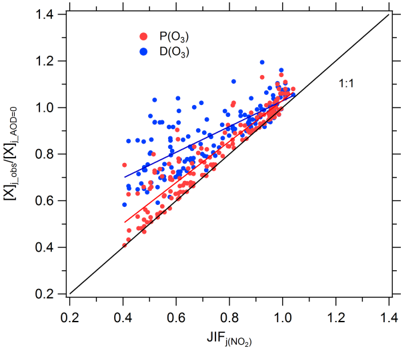
“photolysis frequencies ratio to the photolysis frequencies at AOD equal to 0 (Flynn et al., 2010; Wang et al., 2019).”
BackgroundLidar- and UAV-Based Vertical Observation of Spring Ozone and Particulate Matter in Nanjing, China
Qu, Y., Zhao, M., Wang, T., Li, S., Li, M., Xie, M., & Zhuang, B. (2022) · Remote Sensing · doi:10.3390/rs14133051 · Cited by 17
Wang, W., Li, X., Kuang, Y., Su, H., Cheng, Y., Hu, M., Zeng, L., Tan, T., & Zhang, Y. (2021) · Environmental Science & Technology Letters · doi:10.1021/acs.estlett.1c00300 · Cited by 14
Self-citationChen, C.-H., Chen, T.-F., Huang, S.-P., & Chang, K. (2021) · Scientific Reports · doi:10.1038/s41598-021-84629-4 · Cited by 13
Kong, X., Kong, L., Chen, D., Liu, S., Feng, M., Tan, Q., Zhou, L., & Yang, F. (2025) · Journal of Geophysical Research Atmospheres · doi:10.1029/2024jd042945 · Cited by 14
Wang, R., Wang, L., Yang, Y., Zhan, J., Ji, D., Hu, B., Ling, Z., Xue, M., Zhao, S., Yao, D., et al. (2024) · Environmental Research · doi:10.1016/j.envres.2024.118250 · Cited by 12
Attenuation of Ultraviolet Radiation by Aerosols and Clouds in Beijing Area in 2005–2020
Zhao, S., Xin, H., Wu, S., Sun, Y., & Hu, B. (2024) · Atmosphere · doi:10.3390/atmos15030311 · Cited by 12
Yang, J., Wang, C., Zhang, Y., Zhang, S., Peng, X., Qin, X., Bai, J. M., Xue, L., Wang, G., Cui, S., et al. (2025) · Atmospheric Pollution Research · doi:10.1016/j.apr.2025.102461 · Cited by 11
Sun, Y., & Wang, X. (2022) · Frontiers in Environmental Science · doi:10.3389/fenvs.2022.1015723 · Cited by 11
Radiative Effects of Particular Matters on Ozone Pollution in Six North China Cities
Li, S., Liu, R., Wang, S., & Chen, S. X. (2021) · Journal of Geophysical Research Atmospheres · doi:10.1029/2021jd035963 · Cited by 11
Sensitivity of photochemical surface ozone formation regimes to emissions and meteorology in India
Gopikrishnan, G. P., Westervelt, D. M., & Kuttippurath, J. (2026) · Atmospheric chemistry and physics · doi:10.5194/acp-26-1907-2026 · Cited by 10
“…arise substantially due to changes 3 Studies on the impact of aerosols on near-surface ozone formation have predominantly focused on the significance of Aerosol Optical Depth (AOD) extinction in photochemical processes that generate ozone (Bian et al., 2007; Kim et al., 2013; Wang et al., 2019a).”
Aerosol and Tropospheric Ozone Direct Radiative Impacts
Mallet, M., Nabat, P., di Sarra, A. G., Solmon, F., Gutiérrez, C., Mailler, S., Menut, L., Kaskaoutis, D. G., Rowlinson, M., Rap, A., et al. (2022) · Springer eBooks · doi:10.1007/978-3-030-82385-6_19 · Cited by 10
Probing the mechanism of prolonged ozone pollution in arid and semi-arid urban areas
Song, X. S., Tian, P., Yu, Z., Liu, X., Wang, T., Zhang, M., Li, J., Cao, X., Liang, J., Ren, Y. Q., et al. (2025) · Urban Climate · doi:10.1016/j.uclim.2025.102399 · Cited by 8
Tingting, X., Gao, X., Jiang, S., Hu, K., Peng, Z., Zhao, X., & Tang, X. (2025) · Environmental Research · doi:10.1016/j.envres.2025.122274 · Cited by 9
Qi, L., Yin, J., Li, J., & Duan, X. (2024) · Environmental Research Letters · doi:10.1088/1748-9326/ad376d · Cited by 7
“According to Wang et al (2019a), light extinction of aerosols reduces the photolysis frequency of NO 2 and O 1 D by 24% (30”
BackgroundInfluentialEPICC Model Working Group (2025) · Advances in Atmospheric Sciences · doi:10.1007/s00376-025-4384-y · Cited by 6
“Wang et al. (2019) quantified a 25% aerosol-mediated suppression of net O 3 production via photolysis attenuation in Beijing, contrasting sharply with earlier radiative regime assumptions by Li et al. (2018).”
The influence of the black carbon warming effect on near-surface ozone in China in summer
Chen, H., Zhuang, B., Liu, J. J., Ma, D., Li, S., Wang, T., Xie, M., & Li, M. (2024) · Atmospheric Research · doi:10.1016/j.atmosres.2024.107284 · Cited by 6
Sun, J., Duan, S., Wang, B., Sun, L., Zhu, C., Fan, G., Sun, X., Xia, Z., Lv, B. S., Yang, J., et al. (2022) · Atmosphere · doi:10.3390/atmos13060994 · Cited by 6
Li, T., Liu, S., Chen, D., Zhang, R., Liu, H., Song, D., Tan, Q., Jiang, H., Zhou, L., & Yang, F. (2025) · Atmospheric Pollution Research · doi:10.1016/j.apr.2025.102526 · Cited by 5
Li, S., Zhang, H., Chen, Q., Chen, Y., An, Q., Wang, Z., & Wu, X. (2026) · Atmospheric chemistry and physics · doi:10.5194/acp-26-3669-2026 · Cited by 5
Ye, C., Liu, P., Xue, C., Zhang, C., Ma, Z., Liu, C., Liu, J., Lu, K., Mu, Y., & Zhang, Y. (2025) · Atmospheric chemistry and physics · doi:10.5194/acp-25-6991-2025 · Cited by 5
Pietruczuk, A., Fernandes, A., Szkop, A., & Krzyścin, J. W. (2022) · Remote Sensing · doi:10.3390/rs14051057 · Cited by 5
Song, X. S., Tian, P., Guo, Y., Du, T., Yu, Z., Shi, J., Chang, Y. K., Li, J., & Zhang, L. (2023) · Atmospheric Environment · doi:10.1016/j.atmosenv.2023.120172 · Cited by 5
Aerosol Impacts on Atmospheric and Precipitation Chemistry
Kanakidou, M., Myriokefalitakis, S., Papadimitriou, V. C., & Nenes, A. (2022) · Springer eBooks · doi:10.1007/978-3-030-82385-6_21 · Cited by 4
The Importance of Capturing Local Measurement-Driven Adjustment of Modelled j(NO2)
Walker, H., Heal, M. R., Braban, C. F., Leeson, S. R., Simmons, I., Jones, M. R., Kift, R., Marsden, N., & Twigg, M. M. (2022) · Atmosphere · doi:10.3390/atmos13071065 · Cited by 4
Chen, Y., Zhao, G., Ye, C., Lin, W., Zhang, C., Zhou, J., Gao, J., & Zhu, T. (2025) · The Science of The Total Environment · doi:10.1016/j.scitotenv.2025.178562 · Cited by 3
Assessing the impact of 2023 wildfire smoke on ozone and public health in Chicago communities
Jing, P., Deng, W., Crabtree, T., Chen, D., Harbison, J. E., Whalen, M. C. R., & Wang, J. (2026) · Atmospheric Environment · doi:10.1016/j.atmosenv.2026.121773 · Cited by 3
Assessment of Extreme Firework Episode in a Coastal City of Southern India: Kannur as a Case Study
Resmi, C. T., Nishanth, T., Kumar, M. K. S., Valsaraj, K. T., & Balachandramohan, M. (2022) · Disaster Resilience and Green Growth · doi:10.1007/978-981-16-7727-4_11 · Cited by 3
Wei, N., Zhao, W., Zhang, T., Wang, J., Zhang, C., Chen, Y., Yu, X., Lin, W., Ye, C., Fittschen, C., et al. (2025) · Journal of Geophysical Research Atmospheres · doi:10.1029/2024jd043138 · Cited by 2
Nam, W., Cho, C., Lee, G., Jeong, S.-A., Park, J., & Min, K. (2025) · Environmental Pollution · doi:10.1016/j.envpol.2025.127481 · Cited by 2
Rupakheti, D., Lakshmi, K. A. K., Ye, F., Nishanth, T., Manoj, M. G., Sreekala, R., Kumar, M. K. S., Valsaraj, K. T., & Hu, J. (2024) · Environmental Forensics · doi:10.1080/15275922.2024.2366785 · Cited by 2
“Previous studies revealed that scattering particles could modify the solar actinic flux, and the absorbing particles can reduce the incoming flux throughout the troposphere, leading to a change in surface O 3 concentrations (Wang et al. 2019; Di Ciaula and Bilancia et al. 2015; Li et al. 2011).”
Lou, M., Wu, Q., Wang, W., Chen, H., Cao, K., Fan, X., Liang, D., Yu, F., Zhang, J., Wang, W., et al. (2026) · Geoscientific model development · doi:10.5194/gmd-19-9651-2026 · Cited by 1
“…(Seinfeld and Pandis, 2016; Sillman, 1999), while O 3 concentrations remain relatively low during the colder months because weaker solar radiation suppresses photolysis and lower temperatures reduce thermochemical reaction rates, collectively weakening photochemical activity (Wang et al., 2019).”
Self-citationA, A. A. K., Ganguly, D., Nandi, I., Kajino, M., & Dey, S. (2025) · Journal of Geophysical Research Atmospheres · doi:10.1029/2025jd045316 · Cited by 1
Wen, W., Shen, L., Ma, X., Liu, X., Sheng, L., & Hua, T. (2026) · Aerosol and Air Quality Research · doi:10.1007/s44408-026-00103-8 · Cited by 1
EXAMINATION OF PHOTOCHEMISTRY AND METEOROLOGY OF ATMOSPHERIC POLLUTANTS FROM THE NORTH CHINA PLAIN
Benish, S. E. (2020) · University Libraries (University of Maryland) · doi:10.13016/wxn0-2sqc · Cited by 1
Yuan, B. (2024) · doi:10.5194/egusphere-2023-2647-ac2 · Cited by 1
Comment on egusphere-2023-2647
(2024) · doi:10.5194/egusphere-2023-2647-rc2 · Cited by 1
(2021) · Atmospheric chemistry and physics · doi:10.5194/acp-2021-278-rc2
(2021) · Atmospheric chemistry and physics · doi:10.5194/acp-2021-913-rc2
Nelson, B. (2021) · Atmospheric chemistry and physics · doi:10.5194/acp-2021-278-ac2
Nelson, B. (2021) · Atmospheric chemistry and physics · doi:10.5194/acp-2021-278-ac1
Yuan, B. (2022) · Atmospheric chemistry and physics · doi:10.5194/acp-2021-913-ac1
Yuan, B. (2022) · Atmospheric chemistry and physics · doi:10.5194/acp-2021-913-ac2
(2022) · Atmospheric chemistry and physics · doi:10.5194/acp-2022-123-cc1
(2022) · Atmospheric chemistry and physics · doi:10.5194/acp-2022-123-rc1
(2022) · Atmospheric chemistry and physics · doi:10.5194/acp-2022-123-rc2
(2021) · Atmospheric chemistry and physics · doi:10.5194/acp-2021-278-rc1
(2021) · Atmospheric chemistry and physics · doi:10.5194/acp-2021-119-rc1
Liao, H. (2021) · Atmospheric chemistry and physics · doi:10.5194/acp-2021-119-ac1
Liao, H. (2021) · Atmospheric chemistry and physics · doi:10.5194/acp-2021-119-ac2
(2021) · Atmospheric chemistry and physics · doi:10.5194/acp-2021-119-rc2
Wang, W. (2022) · Atmospheric chemistry and physics · doi:10.5194/acp-2022-123-ac1
Self-citation(2022) · Earth system science data · doi:10.5194/essd-2021-318-rc2
Resquin, M. D. (2022) · Earth system science data · doi:10.5194/essd-2021-318-ac1
Yuan, B. (2024) · doi:10.5194/egusphere-2023-2647-ac1
Multi-source Learning for Target Population by High-dimensional CalibrationPreprint
Zhan, H., Kim, J. K., & Qiu, Y. (2025) · arXiv (Cornell University) · doi:10.48550/arxiv.2512.04412
“Our motivating example is to investigate the relationship be-tween ozone variation and key meteorological variables (Wang et al., 2019; Li et al., 2021b).”
Wang, F., Han, X., Gao, Y., & Zhang, M. (2026) · Atmospheric Environment · doi:10.1016/j.atmosenv.2026.121837
Zhao, G., Yu, J., Guo, S., Hu, M., Zeng, L., Lin, W., & Zhao, C. (2026) · Atmospheric Environment · doi:10.1016/j.atmosenv.2026.122194
Self-citation
Metadata
- Authors
- Wang, W., Li, X., Shao, M., Hu, M., Zeng, L., Wu, Y., & Tan, T.
- Affiliations
- Peking University (CN)
- Jinan University (CN)
- Corresponding author
- Li, Xin
- Wu, Yusheng
- Venue
- Atmospheric Chemistry and Physics
- Publisher
- Copernicus GmbH
- Published
- 2019-07-23
- Volume
- 19
- Issue
- 14
- Pages
- 9413-9429
- ISSN
- 1680-7316 (ISSN-L)
- 1680-7324
- OpenAlex
- W2987913470
- Semantic Scholar
- de18b2d3446e51eb65e70c067139336cb2980ae4
- Cited by
- 99
- References
- 83
- Citations by year
- 2026: 10 · 2025: 12 · 2024: 11 · 2023: 8 · 2022: 21 · 2021: 23 · 2020: 12 · 2019: 1
- FWCI
- 5.65
- Type
- journal article
- Language
- en
- Open access
- gold
- doi.org
- Licence
- Locations
- Atmospheric chemistry and physics (publishedVersion, cc-by)
- DOAJ (DOAJ: Directory of Open Access Journals) (submittedVersion)
- Funders
- National Natural Science Foundation of China (91644222)
- Topics
- Physical Sciences › Earth and Planetary Sciences › Atmospheric Science › Atmospheric chemistry and aerosols
- Physical Sciences › Environmental Science › Global and Planetary Change › Atmospheric aerosols and clouds
- Physical Sciences › Earth and Planetary Sciences › Atmospheric Science › Atmospheric Ozone and Climate
- Keywords
- photolysis frequency, ozone production rate, aerosol optical depth, NO2 photolysis, solar zenith angle, particulate matter, volatile organic compounds, NOx, ozone precursors, photochemical box model, negative feedback loop, Beijing air pollution, aerosol extinction coefficient
About these checks
Registry, retraction, Cites and statistics results are computed, not judged, with one exception: a printed reference that no index lists is read once by a model before it counts as a citation error. Claims are extracted by a model and kept only when their quote appears verbatim in the text; each cited source is then checked, with a model’s help, for whether it says what the claim relies on. Those verdicts can be wrong — read the claim’s quote and the cited source before relying on one.
Statistics and arithmetic are recomputed, not judged.
Confidence bands are shown only for fields calibrated on our annotated test set. None is calibrated yet, so no band is shown.
What counts as a claim ›How we measure confidence ›How we check this ›
Are you an author, or do you see a problem with this page? Request a review
Data sources
Bibliographic data: Semantic Scholar, OpenAlex, Crossref.
Contains information from the Semantic Scholar Academic Graph Datasets, made available under the ODC Attribution License (ODC-BY 1.0).
Semantic Scholar’s data is described in: Kinney, R., et al. (2023). The Semantic Scholar Open Data Platform. arXiv:2301.10140.
