

Worsening urban ozone pollution in China from 2013 to 2017 – Part 2: The effects of emission changes and implications for multi-pollutant control
Open accessPublished version of a preprint
The DOI matches its Crossref record; 69 of the 69 references it cites were found in a registry or an index.
Abstract
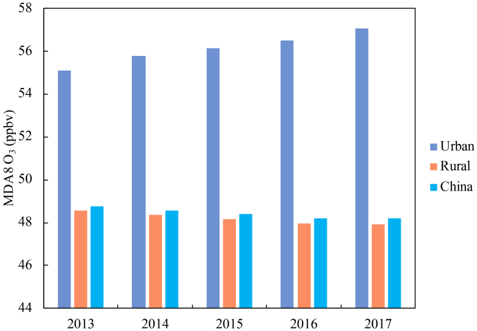
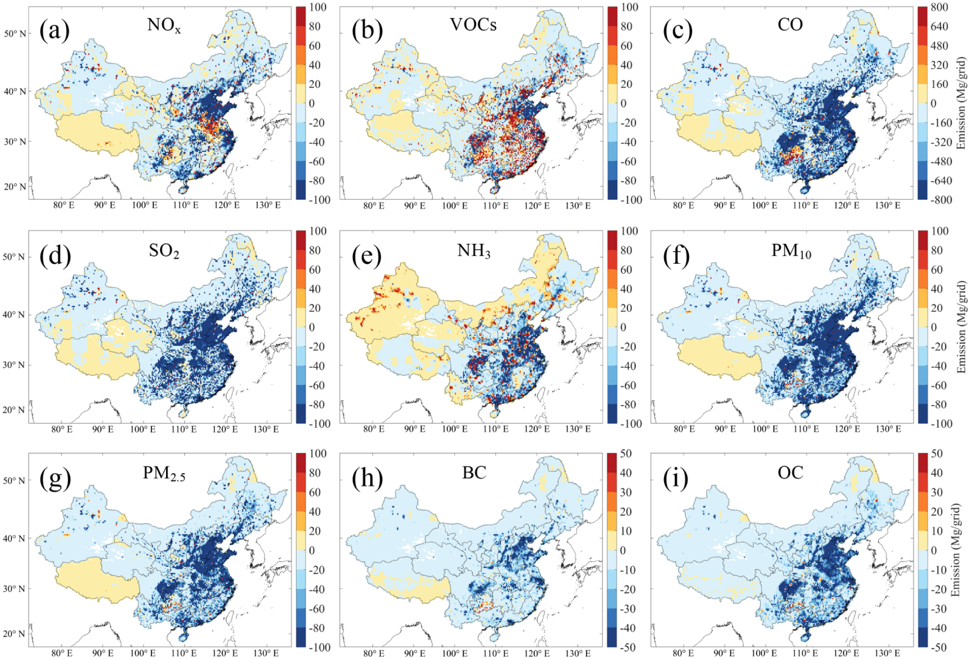
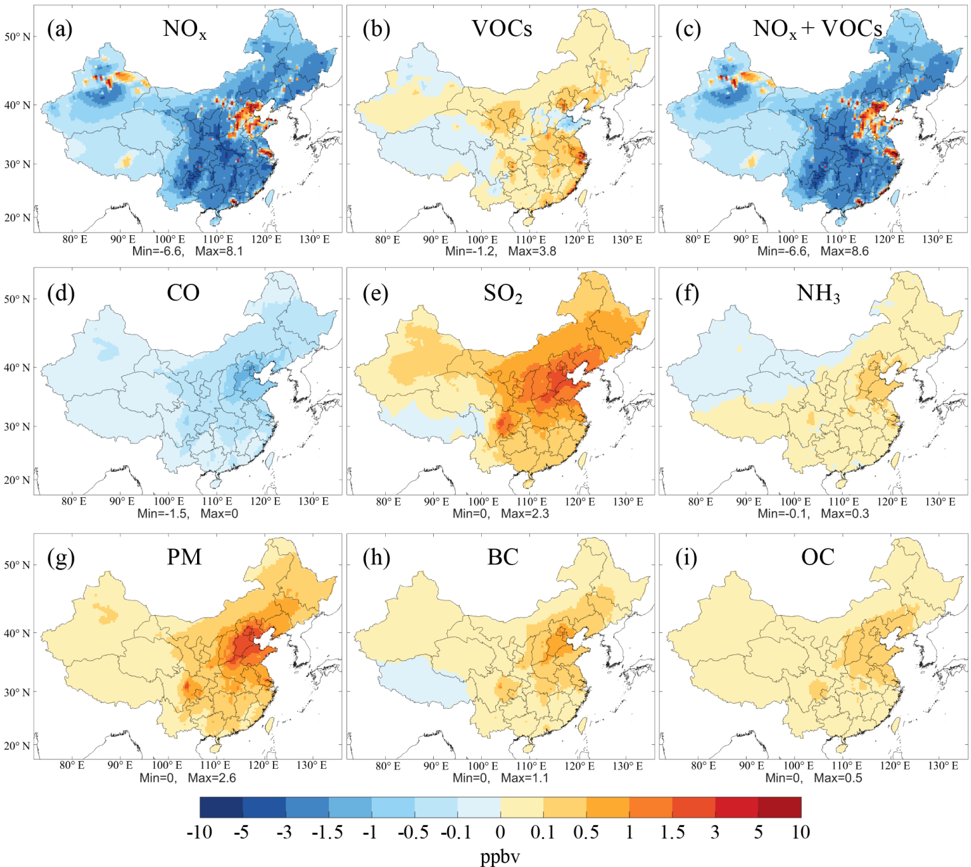
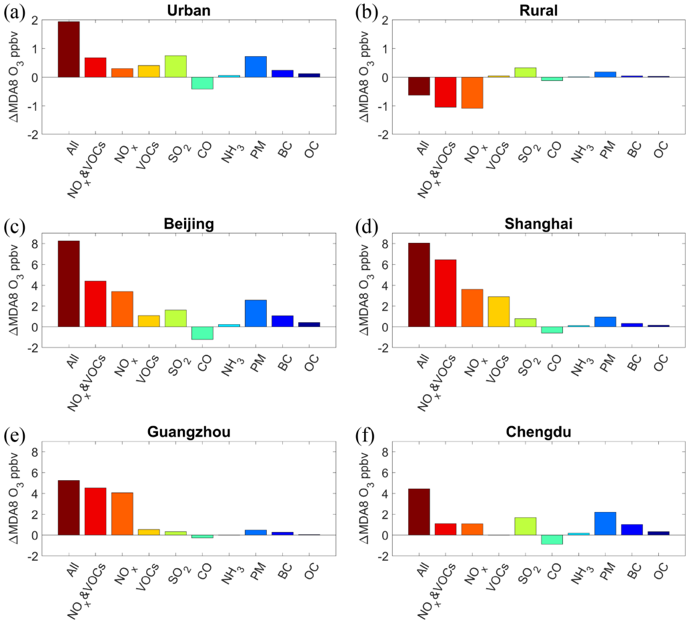
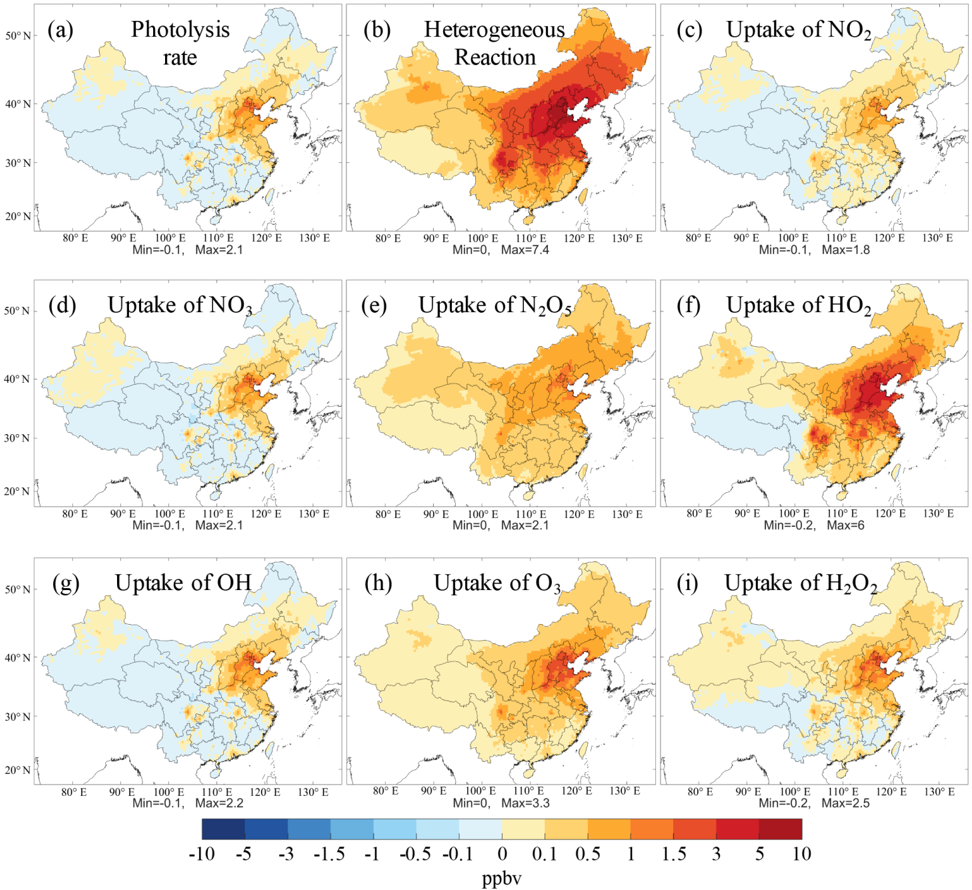
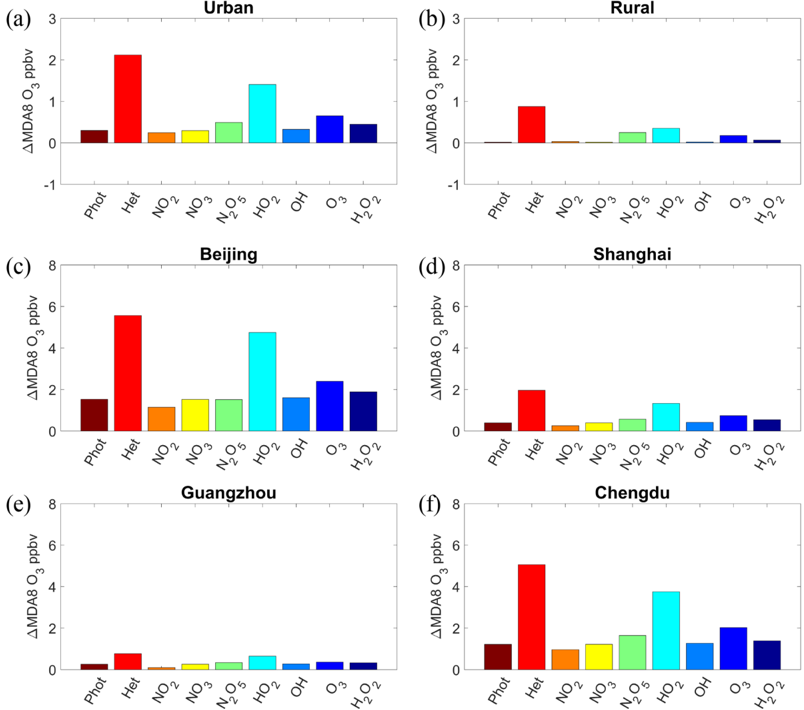
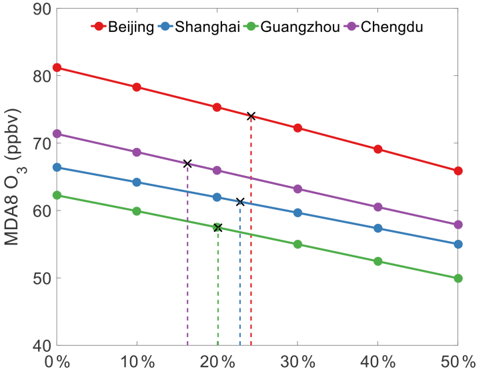
The Chinese government launched the Air Pollution Prevention and Control Action Plan in 2013, and various stringent measures have since been implemented, which have resulted in significant decreases in emissions and ambient concentrations of primary pollutants such as SO 2 , NO x , and particulate matter (PM). However, surface ozone (O 3 ) concentrations have still been increasing in urban areas across the country. In a previous analysis, we examined in detail the roles of meteorological variation during 2013–2017 in the summertime surface O 3 trend in various regions of China. In this study, we evaluated the effect of changes in multi-pollutant emissions from anthropogenic activities on O 3 levels during the same period by using an up-to-date regional chemical transport model (WRF-CMAQ) driven by an interannual anthropogenic emission inventory. The Community Multiscale Air Quality (CMAQ) model was improved with regard to heterogeneous reactions of reactive gases on aerosol surfaces, which led to better model performance in reproducing the ambient concentrations of those gases. The model simulations showed that the maximum daily 8 h average (MDA8) O 3 mixing ratio in urban areas increased by 0.46 ppbv per year (ppbv a −1 ) ( p =0.001) from 2013 to 2017. In contrast, a slight decrease in MDA8 O 3 by 0.17 ppbv a −1 ( p =0.005) in rural areas was predicted, mainly attributable to the NO x emission reduction. The effects of changes in individual pollutant emissions on O 3 were also simulated. The reduction of NO x emission increased the O 3 levels in urban areas due to the nonlinear NO x and volatile organic compound (VOC) chemistry and decreasing aerosol effects; the slight increase in VOC emissions enhanced the O 3 levels; the reduction of PM emissions increased the O 3 levels by enhancing the photolysis rates and reducing the loss of reactive gases on aerosol surfaces; and the reduction of SO 2 emissions resulted in a drastic decrease in sulfate concentrations, which increased O 3 through aerosol effects. In contrast to the unfavorable effect of the above changes in pollutant emissions on efforts to reduce surface O 3 , the reduction of CO emissions did help to decrease the O 3 level in recent years. The dominant cause of increasing O 3 due to changes in anthropogenic emissions varied geographically. In Beijing, NO x and PM emission reductions were the two largest causes of the O 3 increase; in Shanghai, the reduction of NO x and increase in VOC emissions were the two major causes; in Guangzhou, NO x reduction was the primary cause; in Chengdu, the PM and SO 2 emission decreases contributed most to the O 3 increase. Regarding the effects of decreasing concentrations of aerosols, the drop in heterogeneous uptake of reactive gases – mainly HO 2 and O 3 – was found to be more important than the increase in photolysis rates. The adverse effect of the reductions of NO x , SO 2 , and PM emissions on O 3 abatement in Beijing, Shanghai, Guangzhou, and Chengdu would have been avoided if the anthropogenic VOCs emission had been reduced by 24 %, 23 %, 20 %, and 16 %, respectively, from 2013 to 2017. Our analysis revealed that the NO x reduction in recent years has helped to contain the total O 3 production in China. However, to reduce O 3 levels in major urban and industrial areas, VOC emission controls should be added to the current NO x -SO 2 -PM policy.
Overview
The claims and statistics of this paper haven’t been checked yet.
Free: it reads the open-access text and checks the first 5 claims that cite a source we can check. Create a free account to check every claim.
Integrity signals
Registry
Cites
Statistics
Figures
Verification
Claims the paper makes
The claims and statistics of this paper haven’t been checked yet.
Free: it reads the open-access text and checks the first 5 claims that cite a source we can check. Create a free account to check every claim.
Claims other papers make about this one
Each is checked against this paper’s own text: does it say what the citing paper says it does?
The cited source says what the claim attributes to it.
In the citing paper
“Simulations with numerical models show several possible reasons including increases in UV radiation [31, 33–39], shifts in the VOC/NOx chemical regime resulting in increased production of O3 efficiency [35, 40], higher emissions of biogenic VOC due to rising temperatures [30], and decreased competition for gas-phase radicals by aerosol surfaces [34, 40], with reality likely being a combination of”
From Changes in tropospheric air quality related to the protection of stratospheric ozone in a changing climate (2023) · cites this paper as [35]
Self-check
Percentages, sums and reported differences re-computed from the paper’s own numbers.
The self-check needs the paper’s full text.
Citations
Cites
High secondary aerosol contribution to particulate pollution during haze events in China
Huang, R.-J., Zhang, Y., Bozzetti, C., Ho, K.-F., Cao, J.-J., Han, Y., Daellenbach, K. R., Slowik, J. G., Platt, S. M., Canonaco, F., et al. (2014) · Nature · doi:10.1038/nature13774 · Cited by 4,556
Global and regional climate changes due to black carbon
Ramanathan, V., & Carmichael, G. (2008) · Nature Geoscience · doi:10.1038/ngeo156 · Cited by 3,616
Atmospheric chemistry of VOCs and NOx
Atkinson, R. (2000) · Atmospheric Environment · doi:10.1016/s1352-2310(99)00460-4 · Cited by 3,500
Trends in China's anthropogenic emissions since 2010 as the consequence of clean air actions
Zheng, B., Tong, D., Li, M., Liu, F., Hong, C., Geng, G., Li, H., Li, X., Peng, L., Qi, J., et al. (2018) · Atmospheric Chemistry and Physics · doi:10.5194/acp-18-14095-2018 · Cited by 2,916
Byun, D., & Schere, K. L. (2006) · Applied Mechanics Reviews · doi:10.1115/1.2128636 · Cited by 2,413
Drivers of improved PM 2.5 air quality in China from 2013 to 2017
Zhang, Q., Zheng, Y., Tong, D., Shao, M., Wang, S., Zhang, Y., Xu, X., Wang, J., He, H., Liu, W., et al. (2019) · Proceedings of the National Academy of Sciences · doi:10.1073/pnas.1907956116 · Cited by 2,204
Self-citationWang, T., Xue, L., Brimblecombe, P., Lam, Y. F., Li, L., & Zhang, L. (2017) · Science of The Total Environment · doi:10.1016/j.scitotenv.2016.10.081 · Cited by 1,876
Self-citationAnthropogenic drivers of 2013–2017 trends in summer surface ozone in China
Li, K., Jacob, D. J., Liao, H., Shen, L., Zhang, Q., & Bates, K. H. (2019) · Proceedings of the National Academy of Sciences · doi:10.1073/pnas.1812168116 · Cited by 1,804
Elucidating severe urban haze formation in China
Guo, S., Hu, M., Zamora, M. L., Peng, J., Shang, D., Zheng, J., Du, Z., Wu, Z., Shao, M., Zeng, L., et al. (2014) · Proceedings of the National Academy of Sciences · doi:10.1073/pnas.1419604111 · Cited by 1,711
Heterogeneous chemistry and tropospheric ozone
Jacob, D. (2000) · Atmospheric Environment · doi:10.1016/s1352-2310(99)00462-8 · Cited by 1,289
Severe Surface Ozone Pollution in China: A Global Perspective
Lu, X., Hong, J., Zhang, L., Cooper, O. R., Schultz, M. G., Xu, X., Wang, T., Gao, M., Zhao, Y., & Zhang, Y. (2018) · Environmental Science & Technology Letters · doi:10.1021/acs.estlett.8b00366 · Cited by 1,040
Self-citationInvestigations of emissions and heterogeneous formation of HONO in a road traffic tunnel
Kurtenbach, R., Becker, K. H., Gomes, J. A. G., Kleffmann, J., Lörzer, J. C., Spittler, M., Wiesen, P., Ackermann, R., Geyer, A., & Platt, U. (2001) · Atmospheric Environment · doi:10.1016/s1352-2310(01)00138-8 · Cited by 502
Aggravating O3 pollution due to NOx emission control in eastern China
Wang, N., Lyu, X., Deng, X., Huang, X., Jiang, F., & Ding, A. (2019) · Science of The Total Environment · doi:10.1016/j.scitotenv.2019.04.388 · Cited by 431
Tan, Z., Fuchs, H., Lu, K., Hofzumahaus, A., Bohn, B., Broch, S., Dong, H., Gomm, S., Häseler, R., He, L., et al. (2017) · Atmospheric Chemistry and Physics · doi:10.5194/acp-17-663-2017 · Cited by 430
Self-citationLiu, Y., & Wang, T. (2020) · Atmospheric Chemistry and Physics · doi:10.5194/acp-20-6305-2020 · Cited by 410
Self-citationLu, K. D., Rohrer, F., Holland, F., Fuchs, H., Bohn, B., Brauers, T., Chang, C. C., Häseler, R., Hu, M., Kita, K., et al. (2012) · Atmospheric Chemistry and Physics · doi:10.5194/acp-12-1541-2012 · Cited by 364
Bertram, T. H., & Thornton, J. A. (2009) · Atmospheric Chemistry and Physics · doi:10.5194/acp-9-8351-2009 · Cited by 357
Lu, K. D., Hofzumahaus, A., Holland, F., Bohn, B., Brauers, T., Fuchs, H., Hu, M., Häseler, R., Kita, K., Kondo, Y., et al. (2013) · Atmospheric Chemistry and Physics · doi:10.5194/acp-13-1057-2013 · Cited by 301
Ozone and organic nitrates over the eastern United States: Sensitivity to isoprene chemistry
Mao, J., Paulot, F., Jacob, D. J., Cohen, R. C., Crounse, J. D., Wennberg, P. O., Keller, C. A., Hudman, R. C., Barkley, M. P., & Horowitz, L. W. (2013) · Journal of Geophysical Research: Atmospheres · doi:10.1002/jgrd.50817 · Cited by 296
Photoenhanced uptake of NO2 on mineral dust: Laboratory experiments and model simulations
Ndour, M., D'Anna, B., George, C., Ka, O., Balkanski, Y., Kleffmann, J., Stemmler, K., & Ammann, M. (2008) · Geophysical Research Letters · doi:10.1029/2007gl032006 · Cited by 275
Responses of PM2.5 and O3 concentrations to changes of meteorology and emissions in China
Wang, P., Guo, H., Hu, J., Kota, S. H., Ying, Q., & Zhang, H. (2019) · Science of The Total Environment · doi:10.1016/j.scitotenv.2019.01.227 · Cited by 272
Light induced conversion of nitrogen dioxide into nitrous acid on submicron humic acid aerosol
Stemmler, K., Ndour, M., Elshorbany, Y., Kleffmann, J., D'Anna, B., George, C., Bohn, B., & Ammann, M. (2007) · Atmospheric Chemistry and Physics · doi:10.5194/acp-7-4237-2007 · Cited by 269
Exploring the atmospheric chemistry of nitrous acid (HONO) at a rural site in Southern China
Li, X., Brauers, T., Häseler, R., Bohn, B., Fuchs, H., Hofzumahaus, A., Holland, F., Lou, S., Lu, K. D., Rohrer, F., et al. (2012) · Atmospheric Chemistry and Physics · doi:10.5194/acp-12-1497-2012 · Cited by 268
Bauer, S. E., Balkanski, Y., Schulz, M., Hauglustaine, D. A., & Dentener, F. (2004) · Journal of Geophysical Research: Atmospheres · doi:10.1029/2003jd003868 · Cited by 257
Xing, J., Wang, J., Mathur, R., Wang, S., Sarwar, G., Pleim, J., Hogrefe, C., Zhang, Y., Jiang, J., Wong, D. C., et al. (2017) · Atmospheric Chemistry and Physics · doi:10.5194/acp-17-9869-2017 · Cited by 246
Xing, J., Wang, S. X., Jang, C., Zhu, Y., & Hao, J. M. (2011) · Atmospheric Chemistry and Physics · doi:10.5194/acp-11-5027-2011 · Cited by 241
Liao, H., & Seinfeld, J. H. (2005) · Journal of Geophysical Research: Atmospheres · doi:10.1029/2005jd005907 · Cited by 238
Fu, X., Wang, T., Zhang, L., Li, Q., Wang, Z., Xia, M., Yun, H., Wang, W., Yu, C., Yue, D., et al. (2019) · Atmospheric Chemistry and Physics · doi:10.5194/acp-19-1-2019 · Cited by 235
Self-citationTham, Y. J., Wang, Z., Li, Q., Yun, H., Wang, W., Wang, X., Xue, L., Lu, K., Ma, N., Bohn, B., et al. (2016) · Atmospheric Chemistry and Physics · doi:10.5194/acp-16-14959-2016 · Cited by 210
Self-citationLou, S., Liao, H., & Zhu, B. (2014) · Atmospheric Environment · doi:10.1016/j.atmosenv.2013.12.004 · Cited by 208
The Role of Mineral Aerosol in Tropospheric Chemistry in East Asia—A Model Study
Zhang, Y., & Carmichael, G. R. (1999) · Journal of applied meteorology · doi:10.1175/1520-0450(1999)038<0353:tromai>2.0.co;2 · Cited by 200
Relative humidity dependence of HONO chemistry in urban areas
Stutz, J., Alicke, B., Ackermann, R., Geyer, A., Wang, S., White, A. B., Williams, E. J., Spicer, C. W., & Fast, J. D. (2004) · Journal of Geophysical Research: Atmospheres · doi:10.1029/2003jd004135 · Cited by 194
Detection of HO 2 by laser-induced fluorescence: calibration and interferences from RO 2 radicals
Fuchs, H., Bohn, B., Hofzumahaus, A., Holland, F., Lu, K. D., Nehr, S., Rohrer, F., & Wahner, A. (2011) · Atmospheric Measurement Techniques · doi:10.5194/amt-4-1209-2011 · Cited by 194
Sarwar, G., Simon, H., Bhave, P., & Yarwood, G. (2012) · Atmospheric Chemistry and Physics · doi:10.5194/acp-12-6455-2012 · Cited by 179
Li, J., Wang, Z., Wang, X., Yamaji, K., Takigawa, M., Kanaya, Y., Pochanart, P., Liu, Y., Irie, H., Hu, B., et al. (2011) · Atmospheric Environment · doi:10.1016/j.atmosenv.2011.01.016 · Cited by 175
Self-citationLiao, H., Seinfeld, J. H., Adams, P. J., & Mickley, L. J. (2004) · Journal of Geophysical Research: Atmospheres · doi:10.1029/2003jd004456 · Cited by 173
Xu, Z., Wang, T., Wu, J., Xue, L., Chan, J., Zha, Q., Zhou, S., Louie, P. K. K., & Luk, C. W. Y. (2015) · Atmospheric Environment · doi:10.1016/j.atmosenv.2015.01.061 · Cited by 167
Self-citationWang, Z., Wang, W., Tham, Y. J., Li, Q., Wang, H., Wen, L., Wang, X., & Wang, T. (2017) · Atmospheric chemistry and physics · doi:10.5194/acp-17-12361-2017 · Cited by 165
Self-citationOzone decomposition on Saharan dust: an experimental investigation
Hanisch, F., & Crowley, J. N. (2003) · Atmospheric Chemistry and Physics · doi:10.5194/acp-3-119-2003 · Cited by 164
Li, J., Chen, X., Wang, Z., Du, H., Yang, W., Sun, Y., Hu, B., Li, J., Wang, W., Wang, T., et al. (2018) · Science of The Total Environment · doi:10.1016/j.scitotenv.2017.12.041 · Cited by 161
Self-citationOxidizing capacity of the rural atmosphere in Hong Kong, Southern China
Li, Z., Xue, L., Yang, X., Zha, Q., Tham, Y. J., Yan, C., Louie, P. K. K., Luk, C. W. Y., Wang, T., & Wang, W. (2017) · The Science of The Total Environment · doi:10.1016/j.scitotenv.2017.08.310 · Cited by 141
Self-citationWang, T., Dai, J., Lam, K. S., Poon, C., & Brasseur, G. P. (2019) · Geophysical Research Letters · doi:10.1029/2019gl084459 · Cited by 136
Self-citationWang, J., Zhang, X., Guo, J., Wang, Z., & Zhang, M. (2017) · Science of The Total Environment · doi:10.1016/j.scitotenv.2017.02.159 · Cited by 134
Abbatt, J. P. D., & Waschewsky, G. C. G. (1998) · The Journal of Physical Chemistry A · doi:10.1021/jp980932d · Cited by 129
An observational study of the HONO–NO2 coupling at an urban site in Guangzhou City, South China
Qin, M., Xie, P., Su, H., Gu, J., Peng, F., Li, S., Zeng, L., Liu, J., Liu, W., & Zhang, Y. (2009) · Atmospheric Environment · doi:10.1016/j.atmosenv.2009.08.017 · Cited by 127
Reactive uptake of NO3 on pure water and ionic solutions
Rudich, Y., Talukdar, R. K., Ravishankara, A. R., & Fox, R. W. (1996) · Journal of Geophysical Research: Atmospheres · doi:10.1029/96jd01844 · Cited by 121
Long-term changes of regional ozone in China: implications for human health and ecosystem impacts
Xu, X., Lin, W., Xu, W., Jin, J., Wang, Y., Zhang, G., Zhang, X., Ma, Z., Yuanzhen, D., Ma, Q., et al. (2020) · Elementa Science of the Anthropocene · doi:10.1525/elementa.409 · Cited by 121
Reactive uptake of ozone on mineral oxides and mineral dusts
Michel, A. E., Usher, C. R., & Grassian, V. H. (2003) · Atmospheric Environment · doi:10.1016/s1352-2310(03)00319-4 · Cited by 113
Analysis of Small-Scale Convective Dynamics in a Crown Fire Using Infrared Video Camera Imagery
Clark, T. L., Radke, L. F., Coen, J. L., & Middleton, D. (1999) · Journal of applied meteorology · doi:10.1175/1520-0450(1999)038<1401:aosscd>2.0.co;2 · Cited by 108
de Reus, M., Fischer, H., Sander, R., Gros, V., Kormann, R., Salisbury, G., Dingenen, R. V., Williams, J., Zöllner, M., & Lelieveld, J. (2005) · Atmospheric chemistry and physics · doi:10.5194/acp-5-1787-2005 · Cited by 102
George, I. J., Matthews, P. S. J., Whalley, L. K., Brooks, B., Goddard, A., Baeza‐Romero, M. T., & Heard, D. E. (2013) · Physical Chemistry Chemical Physics · doi:10.1039/c3cp51831k · Cited by 92
Laser‐Based Studies of Reactions of the Nitrate Radical in Aqueous Solution
Exner, M., Herrmann, H., & Zellner, R. (1992) · Berichte der Bunsengesellschaft für physikalische Chemie · doi:10.1002/bbpc.19920960347 · Cited by 90
Tham, Y. J., Yan, C., Xue, L., Zha, Q., Wang, X., & Wang, T. (2013) · Chinese Science Bulletin · doi:10.1007/s11434-013-0063-y · Cited by 85
Self-citationYan, C., Tham, Y. J., Zha, Q., Wang, X., Xue, L., Dai, J., Wang, Z., & Wang, T. (2019) · The Science of The Total Environment · doi:10.1016/j.scitotenv.2019.04.389 · Cited by 82
Self-citationMichel, A. E., Usher, C. R., & Grassian, V. H. (2002) · Geophysical Research Letters · doi:10.1029/2002gl014896 · Cited by 77
Ozone impacts of gas–aerosol uptake in global chemistry transport models
Stadtler, S., Simpson, D. M., Schröder, S., Taraborrelli, D., Bott, A., & Schultz, M. G. (2018) · Atmospheric chemistry and physics · doi:10.5194/acp-18-3147-2018 · Cited by 77
Pozzoli, L., Bey, I., Rast, S., Schultz, M. G., Stier, P., & Feichter, J. (2008) · Journal of Geophysical Research: Atmospheres · doi:10.1029/2007jd009007 · Cited by 76
Reactive uptake of NO3 by liquid and frozen organics
Moise, T., Talukdar, R. K., Frost, G. J., Fox, R. W., & Rudich, Y. (2002) · Journal of Geophysical Research Atmospheres · doi:10.1029/2001jd000334 · Cited by 74
Observation of NO3 radicals over Shanghai, China
Wang, S., Shi, C., Zhou, B., Zhao, H., Wang, Z., Yang, S., & Chen, L. (2013) · Atmospheric Environment · doi:10.1016/j.atmosenv.2013.01.022 · Cited by 69
Yu, Y., Wang, Z., He, T., Meng, X., Xie, S., & Yu, H. (2019) · Atmospheric Pollution Research · doi:10.1016/j.apr.2019.03.010 · Cited by 68
Liang, H., Chen, Z. M., Huang, D., Zhao, Y., & Li, Z. Y. (2013) · Atmospheric chemistry and physics · doi:10.5194/acp-13-11259-2013 · Cited by 57
Reactive and nonreactive uptake on hydrocarbon soot: HNO3, O3, and N2O5
Longfellow, C. A., Ravishankara, A. R., & Hanson, D. R. (2000) · Journal of Geophysical Research: Atmospheres · doi:10.1029/2000jd900297 · Cited by 56
Wang, Y., Chen, Z., Wu, Q., Liang, H., Huang, L., Li, H., Lu, K., Wu, Y., Dong, H., Zeng, L., et al. (2016) · Atmospheric chemistry and physics · doi:10.5194/acp-16-10985-2016 · Cited by 49
Impacts of heterogeneous reactions to atmospheric peroxides: Observations and budget analysis study
Qin, M., Chen, Z., Shen, H., Li, H., Wu, H., & Wang, Y. (2018) · Atmospheric Environment · doi:10.1016/j.atmosenv.2018.04.005 · Cited by 49
Examining Photolysis Rates with a Prototype Online Photolysis Module in CMAQ
Binkowski, F. S., Arunachalam, S., Adelman, Z. E., & Pinto, J. P. (2007) · Journal of Applied Meteorology and Climatology · doi:10.1175/jam2531.1 · Cited by 47
Impact of dust on tropospheric chemistry over polluted regions: a case study of the Beijing megacity
Zhu, S., Butler, T. M., Sander, R., Ma, J., & Lawrence, M. G. (2010) · Atmospheric chemistry and physics · doi:10.5194/acp-10-3855-2010 · Cited by 43
Modeling global impacts of heterogeneous loss of HO2 on cloud droplets, ice particles and aerosolsPreprint
Huijnen, V., Williams, J., & Flemming, J. (2014) · doi:10.5194/acpd-14-8575-2014 · Cited by 25
Li, S., Liu, W., Xie, P., Qin, M., & Yang, Y. (2012) · Terrestrial Atmospheric and Oceanic Sciences · doi:10.3319/tao.2011.07.26.01(a · Cited by 22
Liao, H., Seinfeld, J. H., Adams, P. J., & Mickley, L. J. (2004) · Journal of Geophysical Research Atmospheres · doi:10.1029/2004jd005476 · Cited by 16
Research works printed but not linked: 1
- NRC: Rethinking the ozone problem in urban and regional air pol- lution, National Academy Press, Washington, D.C., 1991.
Cited by
Enhanced secondary pollution offset reduction of primary emissions during COVID-19 lockdown in China
Huang, X., Ding, A., Gao, J., Zheng, B., Zhou, D., Qi, X., Tang, R., Wang, J., Ren, C., Nie, W., et al. (2021) · National Science Review · doi:10.1093/nsr/nwaa137 · Cited by 960
Liu, Y., & Wang, T. (2020) · Atmospheric Chemistry and Physics · doi:10.5194/acp-20-6305-2020 · Cited by 410
Self-citationEfficacy of China’s clean air actions to tackle PM2.5 pollution between 2013 and 2020
Geng, G., Liu, Y., Liu, Y., Liu, S., Cheng, J., Yan, L., Wu, N., Hu, H., Tong, D., Zheng, B., et al. (2024) · Nature Geoscience · doi:10.1038/s41561-024-01540-z · Cited by 369
Self-citationWang, T., Xue, L., Feng, Z., Dai, J., Zhang, Y., & Tan, Y. (2022) · Environmental Research Letters · doi:10.1088/1748-9326/ac69fe · Cited by 237
Self-citationDang, R., Liao, H., & Fu, Y. (2021) · Science of The Total Environment · doi:10.1016/j.scitotenv.2020.142394 · Cited by 237
Metadata
- Authors
- Liu, Y., & Wang, T.
- Affiliations
- Hong Kong Polytechnic University (HK)
- Corresponding author
- Wang, Tao
- ORCID
- Venue
- Atmospheric Chemistry and Physics
- Publisher
- Copernicus GmbH
- Published
- 2020-06-03
- Volume
- 20
- Issue
- 11
- Pages
- 6323-6337
- ISSN
- 1680-7316 (ISSN-L)
- 1680-7324
- OpenAlex
- W3003589880
- Cited by
- 345
- References
- 69
- Citations by year
- 2026: 23 · 2025: 46 · 2024: 51 · 2023: 61 · 2022: 75 · 2021: 74 · 2020: 15
- FWCI
- 18.43
- Type
- journal article
- Language
- en
- Open access
- gold
- doi.org
- Licence
- Locations
- Atmospheric chemistry and physics (publishedVersion, cc-by)
- DOAJ (DOAJ: Directory of Open Access Journals) (submittedVersion, cc-by-sa)
- PolyU Institutional Research Archive (Hong Kong Polytechnic University) (submittedVersion, cc-by)
- Funders
- National Natural Science Foundation of China (91844301)
- Topics
- Physical Sciences › Earth and Planetary Sciences › Atmospheric Science › Atmospheric chemistry and aerosols
- Physical Sciences › Earth and Planetary Sciences › Atmospheric Science › Atmospheric Ozone and Climate
- Physical Sciences › Environmental Science › Global and Planetary Change › COVID-19 impact on air quality
- Keywords
- urban ozone, surface ozone trends, NOx reduction, volatile organic compounds, particulate emissions, sulfur dioxide emissions, carbon monoxide emissions, ozone precursors, multi-pollutant control, Air Pollution Prevention and Control Action Plan, WRF-CMAQ, China, urban air pollution
About these checks
Registry, retraction, Cites and statistics results are computed, not judged, with one exception: a printed reference that no index lists is read once by a model before it counts as a citation error. Claims are extracted by a model and kept only when their quote appears verbatim in the text; each cited source is then checked, with a model’s help, for whether it says what the claim relies on. Those verdicts can be wrong — read the claim’s quote and the cited source before relying on one.
Statistics and arithmetic are recomputed, not judged.
Confidence bands are shown only for fields calibrated on our annotated test set. None is calibrated yet, so no band is shown.
What counts as a claim ›How we measure confidence ›How we check this ›
Are you an author, or do you see a problem with this page? Request a review
Data sources
Bibliographic data: Semantic Scholar, OpenAlex, Crossref.
Contains information from the Semantic Scholar Academic Graph Datasets, made available under the ODC Attribution License (ODC-BY 1.0).
Semantic Scholar’s data is described in: Kinney, R., et al. (2023). The Semantic Scholar Open Data Platform. arXiv:2301.10140.
